 (+971) 8007 4267
 (+91) 946 340 7140
 (+1) 628 432 4305

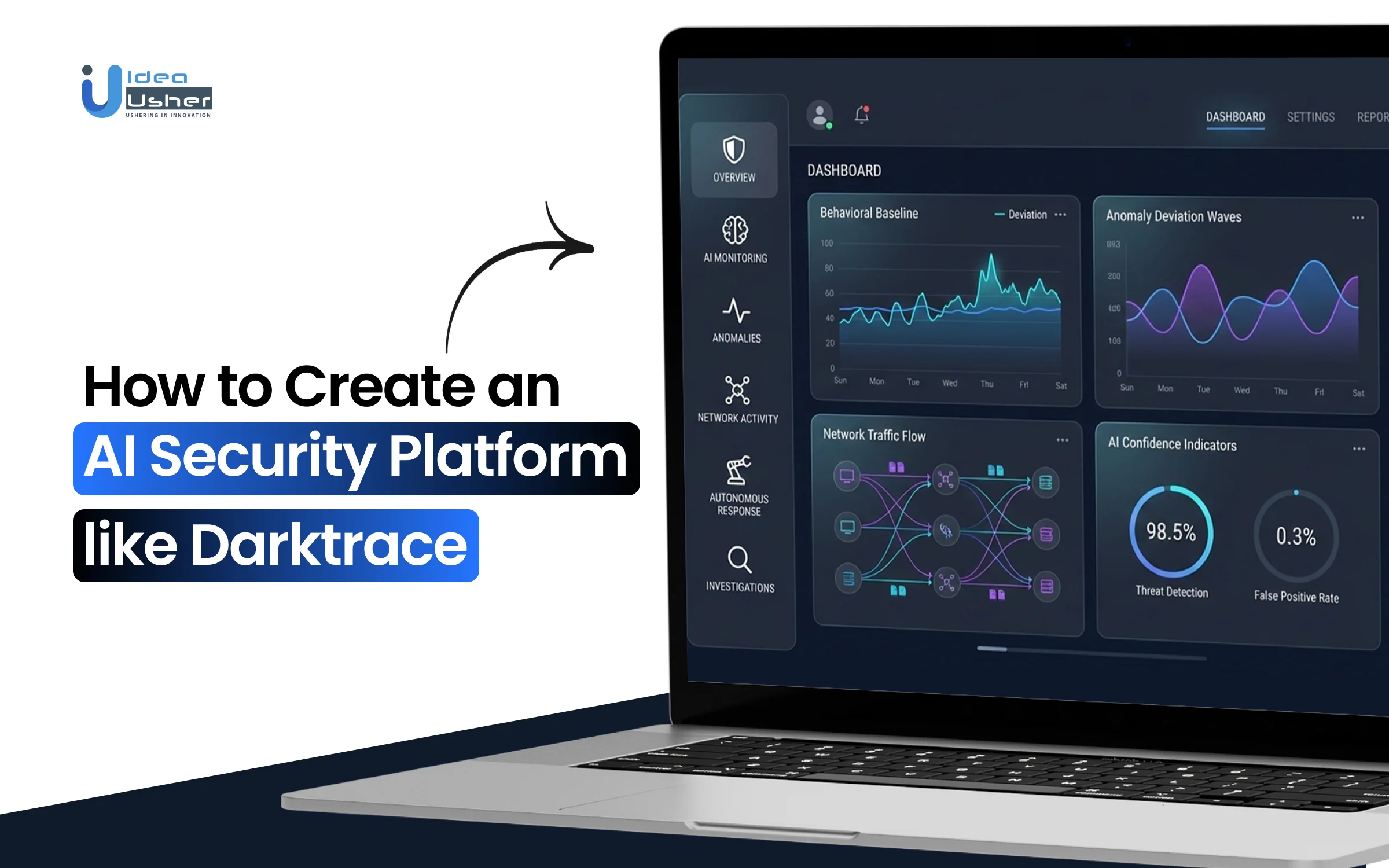
Cyber threats no longer follow predictable patterns, and traditional security tools often struggle to keep up. As networks grow more complex and attacks become quieter and more sophisticated, many organizations don’t realize something is wrong until real damage is done. This growing gap is why interest in a Darktrace-like AI security platform is rising that can continuously learn what “normal” looks like and spot unusual behavior before it turns into a breach.
AI-driven security platforms change the way threats are detected and managed by using machine learning, behavioral analytics, and real-time monitoring. Instead of relying only on predefined rules or signatures, these systems analyze network activity, user behavior, and data flows to identify subtle anomalies. This allows security teams to respond faster, reduce false alarms, and gain visibility into risks that would otherwise go unnoticed.
In this guide, we’ll explore how to build an AI security app similar to Darktrace, covering the core features, underlying technologies, and architectural considerations involved. This blog will give you a clear roadmap for creating an intelligent, adaptive cybersecurity solution.

What is an AI Security Platform, Darktrace?
Darktrace is an AI-driven cybersecurity platform using self-learning AI, behavioral analytics, and autonomous response to detect threats across networks, cloud, email, endpoints, identity, and OT environments. Its engine applies unsupervised machine learning, pattern-of-life modeling, and real-time anomaly detection to identify zero-day attacks, insider threats, AI-generated risks, and emerging threats with autonomous containment and AI-assisted investigation.
This platform stands out by addressing modern cyber risk with an adaptive AI-first approach that detects unknown threats others miss. Its self-learning system delivers real-time automated defense, reduces alert overload, scales across hybrid environments, and protects against AI-enabled attacks, providing broad visibility, faster response, and lower operational overhead.
- Learns “normal” behavior for every user, device, application, and network to identify subtle deviations.
- Uses behavioral analytics to detect polymorphic and AI-driven attacks that evade traditional tools.
- Can take targeted automated actions that minimize business disruption while stopping active threats.
- Provides unified AI analytics across multiple environments rather than operating in silos.
- Includes Cyber AI Analyst, which automatically triages and investigates threats, reducing analyst workload.
A. Business Model: How Darktrace Operates
Darktrace uses AI-driven software to protect enterprises, governments, and organizations from threats. Its approach combines advanced tech, ongoing engagement, and strategic partnerships, making it a global leader in autonomous cybersecurity.
- ActiveAI Security Platform: Central to its model, combining AI, machine learning, and autonomous response to detect and mitigate both known and unknown threats.
- Proactive, Adaptive Security: Markets itself as an intelligent alternative to traditional rule-based cybersecurity, offering real-time detection across network, cloud, email, endpoint, and identity environments.
- Recurring Revenue: Uses subscription-based contracts that cover technology deployment, ongoing monitoring, updates, and evolving threat intelligence.
- Strategic Partnerships: Collaborates with global systems integrators, managed service providers, resellers, and hyperscaler marketplaces to expand distribution and co-selling opportunities.
- Global Reach: Targets enterprises across regions and sectors, leveraging partnerships and technology to scale rapidly while maintaining adaptive security coverage.
B. Darktrace Funding & Investment History
Darktrace has attracted investor attention, raising capital to expand its AI cybersecurity platform worldwide. Its funding history shows strategic backers supporting growth and market expansion in autonomous security.
1. Early Venture Funding
Darktrace was founded in 2013 with early backing from Invoke Capital, the venture firm started by Autonomy co-founder Mike Lynch, a key early investor and supporter of the company’s initial AI-driven cybersecurity vision.
Over its early years, Darktrace raised multiple rounds of venture capital, including:
- Series A (2015): ~$18M (investors included Talis Capital, Hoxton Ventures)
- Series B (2015): ~$22.5M (Summit Partners)
- Series C (2016): ~$65M led by KKR and others
- Series D (2017): ~$75M with Insight Venture Partners and existing investors
- Series E (2018): ~$50M at a $1.65 billion valuation (led by Vitruvian Partners with participation from KKR and TenEleven Ventures)
Across these rounds, Darktrace built out its AI cybersecurity platform, expanded globally, and increased customer deployments.
Darktrace had raised roughly $230M–$240M in private funding over several rounds from institutional backers including Summit Partners, KKR, TenEleven Ventures, Hoxton Ventures, Vitruvian Partners, and SoftBank affiliates.
2. IPO & Post-IPO / Take-Private Transactions
Darktrace’s IPO and subsequent transactions reflect its market valuation, investor confidence, and strategic moves to expand its AI cybersecurity offerings globally.
a. London Stock Exchange IPO (2021)
Darktrace went public on the London Stock Exchange in April 2021, raising about £165M (~$230M) and achieving a valuation of approximately £1.7–£2.5 billion at listing.
b. Acquisition by Thoma Bravo (2024)
In 2024, Darktrace was acquired in an all-cash deal by U.S. private equity firm Thoma Bravo for approximately $5.3 billion. This transaction marked a significant liquidity event and investor exit.
How an AI Security Platform Works?
An AI security platform uses machine learning and behavioral analysis to detect threats in real time. Understanding its operation helps improve threat detection accuracy and strengthen security posture.

1. Collects Telemetry Across Digital Environment
The platform begins by gathering continuous telemetry from networks, cloud workloads, identities, endpoints, applications and OT systems. This creates a complete behavioral view of how users, devices and systems normally operate.
2. Builds Behavioral Baselines via Self-Learning AI
Using self-learning models, the platform studies day-to-day interactions and establishes behavioral baselines. It learns normal activity patterns without rules or signatures, creating a living behavioral map unique to the organization.
3. Detects Anomalies via Behavioral Deviation Analysis
Once baselines are set, the system monitors for deviations. It flags unusual activity through pattern comparison, anomaly scoring and contextual analysis, identifying early signs of insider threats, ransomware, account misuse and unknown attacks.
4. Correlates Events to Identify High-Risk Threat Patterns
The platform correlates signals across domains to understand attack paths. It links network anomalies with identity behaviors, cloud events or endpoint signals to identify multi-stage threats that traditional tools often miss.
5. Executes Autonomous Response for Containment
When a high-risk threat is confirmed, the platform can take precision response actions. It may restrict connections, isolate devices, block malicious behavior or limit account permissions to contain the attack without disrupting business.
6. Generates AI-Driven Investigation Insights
Finally, the platform produces automated incident summaries showing what happened, how the threat unfolded and why the AI took action. This accelerates investigation, supports compliance reporting and strengthens long-term security learning.
How 94% IT Investment & $2.22M Savings Highlight the Value of AI Cybersecurity?
The global AI in cybersecurity market was valued at USD 25.35 billion in 2024 and is projected to reach USD 93.75 billion by 2030, growing at a CAGR of 24.4%. This growth reflects rising enterprise adoption of AI-driven security to reduce breach impact, improve threat detection, and manage increasingly complex cyber risks.

In 2024, 94% of IT leaders invested in AI security systems as AI-driven platforms cut breach costs nearly in 2.22B. While breaches cost $4.88 million on average, AI and automation reduced this to $2.66 million, showing a clear ROI.
A. AI Security Gap: 69% Demand vs 31% Full Adoption
AI drives modern cybersecurity as threats surpass human effort. Firms look for security platforms with real-time awareness, autonomous decisions, and accurate threat detection to fill security gaps and enhance resilience.
- The 38-point gap between those who consider AI crucial (69%) and those using it extensively (31%) represents billions in unfulfilled demand. Enterprises recognize they need AI security but haven’t deployed comprehensive platforms. This creates perfect conditions to sell enterprise-wide solutions: organizations understand value, have budgets, and seek scalable platforms.
- 67% deployment rate proves mainstream adoption, eliminating unproven technology objections. 31% using AI “extensively across multiple layers” represents highest-value customers willing to purchase a solution versus $50K point solutions.
- 80% of security professionals report AI increases threat detection accuracy, providing concrete evidence overcoming vendor skepticism. When 4 of 5 security pros confirm AI improves detection, it removes objections delaying purchases.
- Organizations report 60% improvement in threat detection and 60% reduction in false positives, solving security operations’ two biggest pain points. Position platform as delivering offensive capability (finding threats) and operational efficiency (eliminating alert fatigue), appealing to CISOs and COOs.
B. Rising Security Spend Is Driving Demand for AI Security Platforms
Cybersecurity spending increases as enterprises prepare for advanced threats, shifting budgets to automated defenses. This creates opportunities for AI-driven security platforms to meet rising expectations.
- $213B annual cybersecurity spending validates an enormous, established market. Even 0.1% market share equals $213M annual revenue. With AI the fastest-growing segment, target 1-3% share within 5 years, building a $2-6B business.
- The 65/35 split favoring third-party solutions proves enterprises prefer buying platforms over building in-house. McKinsey data shows they overwhelmingly buy.
- 80% of CIOs planning budget increases make cybersecurity a priority above cloud, data, and digital transformation.
- 15.1% YoY spending growth ($183.9B to $212B) shows the market accelerating, creating ideal timing for new platforms. Markets growing 15%+ annually reward aggressive entrants. This high-growth phase has organizations evaluating vendors, switching from legacy tools, and consolidating into unified AI platforms.
- PwC reports 57% cite customer trust and 49% brand integrity as cybersecurity investment drivers, elevating security to competitive advantage.
- Deloitte reports 48% of cyber-mature organizations address security quarterly at board level, 26% monthly, highlighting C-suite priority. Enterprises want updates on comprehensive AI platforms with dashboards, risk quantification, and ROI.

Key Industries That Benefit Most From AI-Driven Cyber Defense
AI-driven cyber defense enhances threat detection and automated response, helping industries with sensitive data and complex operations stay secure while highlighting opportunities for targeted cybersecurity solutions.

1. Healthcare
Healthcare organizations manage distributed systems with sensitive data and critical operations. AI platforms provide behavior monitoring, real-time anomaly detection, and ransomware prevention for EHRs, medical devices, and hospital networks.
Example: Milton Keynes University Hospital Trust used Darktrace’s AI to secure patient systems. The AI learns user and device patterns to spot deviations. It detected and prevented a ransomware attack from encrypting data, avoiding patient care disruption.
2. Financial Services & Banking
Financial institutions encounter fraud, credential abuse, and transaction issues. Behavioral AI detects small deviations in user and transaction patterns to quickly identify insider activity, breaches, and fraud signals.
Example: DZ Bank adopted Vectra AI’s Cognito for Office 365 to prevent privilege escalation and account takeovers. A global financial firm using Vectra AI gained visibility into attack behaviors, detecting Carbanak and hidden threats, revealing attacker behaviors without signatures and identifying suspicious remote admin tools.
3. Government & Public Sector
Government agencies handle classified info, infrastructure, and critical systems. AI cyber defense boosts security via ongoing threat analysis, autonomous attack disruption, and enhanced visibility into behavioral anomalies across departments.
Example: CrowdStrike’s Charlotte AI earned FedRAMP High Authorization, giving federal, state, and local agencies access via the Falcon platform in GovCloud. DHS, CISA, and the Defense Department rely on it to protect vital government systems, and it also holds Impact Level 5 (IL5) authorization, the highest unclassified level.
4. Energy & Utilities
Energy, oil, gas, and utility providers rely on mission-critical OT systems often targeted by attackers. AI security platforms detect OT threats behaviorally, reducing attack duration and safeguarding operations.
Example: Littleton Electric Light and Water Departments used Dragos’s cybersecurity platform to detect and remove the VOLTZITE threat group via OT Watch. A large energy utility using Nozomi Networks leverages AI analysis to detect deviations, enabling IT and OT convergence into one SOC.
5. Technology & SaaS Companies
Tech organizations manage large cloud systems, pipelines, and multi-tenant architectures. AI cyber defense improves security by detecting cloud deviations, API misuse, privilege escalation, and suspicious workloads in dynamic systems.
Example: Amplitude, managing 5,000+ virtual machines and 30+ Kubernetes clusters, deployed Wiz for visibility in its AWS environment. In two days, Wiz detected 100+ security issues, a task that would take six months manually, helping dev and security teams collaborate for rapid and secure feature deployment.
Key Features of Darktrace-like AI Security Platform
A Darktrace-like AI security platform combines advanced machine learning, real-time threat detection, and autonomous response to protect digital environments. These key features help organizations implement proactive, adaptive cybersecurity solutions effectively.

1. Self-Learning AI & Behavioral Baselines
A Darktrace-like platform uses self-learning AI to build behavioral baselines and map subtle patterns known as behavioral DNA for every user and device. It identifies anomalies through self-calibrating anomaly vectors, allowing the system to adapt continuously as digital behaviors evolve.
2. Real-Time Threat Detection
The platform monitors activity across networks, cloud, email, identity and endpoints using real-time anomaly detection and telemetry fusion pipelines. By correlating signals across the environment, it identifies emerging threats and zero-day behavior shifts before damage occurs.
3. Autonomous Response Capabilities
Autonomous response uses machine-speed containment logic to interrupt active threats without relying on human reaction time. It applies precision control actions that isolate malicious behavior, restrict abnormal flows and stabilize the environment while maintaining business continuity.
4. Cyber AI Analyst for Investigation
Cyber AI Analyst performs automated investigation using probabilistic threat scoring and event correlation. It generates clear incident summaries by simulating human reasoning, reducing alert noise and accelerating triage through AI-augmented analytical workflows.
5. Multi-Domain Security Architecture
The platform unifies network, cloud, email, identity, OT (Operational Technology Protection) and endpoint security through cross-domain analytics and a centralized decision engine. This architecture reveals multi-step attack paths and strengthens detection by linking signals that would remain isolated in traditional tools.
6. Precision & Noise Reduction via Contextual Understanding
Context-aware analytics evaluate threats within the organization’s evolving behavioral landscape. The system reduces false positives using contextual deviation profiling, allowing detection logic to adjust naturally as workloads, users and environments shift.
7. Encrypted & Decrypted Traffic Analysis
The platform analyzes encrypted and decrypted traffic using encrypted flow intelligence to identify hidden malicious activity. It detects command communication, data exfiltration patterns and insider anomalies without breaking or weakening encryption.
8. Security Ecosystem Integration
A Darktrace-like system integrates with SIEM, XDR and firewall tools using API-level telemetry synchronization. This improves workflow visibility, enriches alerts with AI-driven insights and supports coordinated response across the broader security ecosystem.
9. Proactive Exposure & Resilience Tools
Exposure management identifies vulnerabilities and high-risk assets using risk-weighted exposure mapping. Predictive modeling highlights areas likely to be targeted, helping teams improve resilience and prioritize remediation based on real-world attack patterns.
10. Hybrid Environment Scalability
The platform scales across hybrid and multi-cloud ecosystems using lightweight sensors and distributed behavioral modeling. This ensures consistent detection accuracy across remote endpoints, virtual workloads, container clusters and on-premise environments.
11. Machine-Speed Coverage for Modern Threats
The system counters ransomware, identity attacks and AI-generated threats with machine-speed behavioral inference. By learning continuously and detecting micro-level deviations, it adapts faster than emerging adversaries and strengthens overall cyber resilience.

How to Create a Darktrace-like AI Security Platform?
Building a Darktrace-like AI security platform involves integrating self-learning AI, behavioral analytics, and real-time threat detection. Our developers generally follow these essential steps to develop an adaptive, enterprise-ready cybersecurity solution.

1. Consultation
We begin by understanding the organization’s security challenges, data flows and operational needs. During consultation we map risk exposure, identify behavioral patterns to model and define the scope for self-learning detection that aligns with the client’s infrastructure and security objectives.
2. Requirements Analysis & Planning
Our developers translate consultation insights into a structured development blueprint. We outline functional requirements, define behavioral modeling goals and plan the architecture for continuous anomaly detection and multi-domain visibility that will operate across networks, endpoints, cloud and identity systems.
3. Behavioral Intelligence Framework Design
We design the behavioral intelligence layer by outlining how the system will learn normal patterns using behavioral baselining and adaptive deviation profiling. This framework allows dynamic understanding of user and device activity, forming the foundation for accurate threat detection.
4. AI Detection Engine Development
Our team develops the detection engine that performs real-time analysis using context-aware anomaly signals and pattern correlation. This engine identifies micro-level behavioral shifts and emerging threat indicators, enabling accurate detection of unknown attacks within complex digital environments.
5. Training & Refining AI Behavioral Models
We train and refine the AI models using diverse behavioral datasets to strengthen pattern recognition and anomaly accuracy. Through iterative learning cycles, the models improve their understanding of normal activity and develop stronger sensitivity to subtle deviations that indicate emerging threats.
6. Autonomous Response Logic Development
We create autonomous response logic that applies precision control actions when threats are confirmed. The logic evaluates context, scope and potential impact, ensuring the platform can contain attacks at machine speed while reducing disruption to legitimate business activity.
7. Multi-domain Telemetry Integration
We integrate telemetry from networks, cloud workloads, email, identity and endpoints to create unified analytics. This telemetry fusion enables cross-domain threat correlation, allowing the platform to reveal multi-step attack sequences that would remain hidden in isolated monitoring systems.
8. Automated Investigation Workflow Development
Our developers build automated investigation workflows that simulate human analysis using probabilistic threat scoring and event sequencing. These workflows generate clear incident narratives and reduce the burden on security teams by automating early-stage triage and pattern interpretation.
9. Testing & Behavioral Calibration
We test and calibrate the system using controlled datasets and real behavioral patterns to refine anomaly sensitivity. Through behavioral calibration cycles, the platform learns environmental norms and adjusts detection thresholds for accuracy, stability and reduced false positives.
10. Deployment & Continuous Optimization
We deploy the platform across the client’s digital estate and monitor its performance during the learning phase. Continuous optimization ensures adaptive intelligence growth, allowing the platform to evolve with new behaviors, technologies and threat landscapes while maintaining reliable detection accuracy.
Cost to build an AI Cybersecurity Platform like Darktrace
Building an AI cybersecurity platform like Darktrace costs vary based on technology complexity, AI models & infrastructure size. Knowing these helps organizations budget for a secure, enterprise-grade solution.
| Development Phase | Description | Estimated Cost |
| Consultation | Defines goals and security gaps for AI-driven detection strategies. | $3,000 – $6,000 |
| Analysis & Planning | Creates structured requirements and plans for behavioral modeling. | $5,000 – $9,000 |
| Behavioral Intelligence Framework Design | Designs core structure for behavioral baselining and adaptive profiling. | $6,000 – $12,000 |
| AI Detection Engine | Builds analytical engine enabling real-time anomaly detection. | $16,000 – $31,000 |
| AI Behavioral Model Training | Enhances model accuracy through iterative AI learning cycles. | $14,000 – $20,000 |
| Autonomous Response Logic | Develops automated threat containment using machine-speed response logic. | $12,000 – $17,000 |
| Multi-Domain Telemetry Integration | Merges network and cloud signals for cross-domain correlation. | $14,000 – $22,000 |
| Automated Investigation Workflow | Creates workflows supporting AI-driven triage and incident summaries. | $15,000 – $24,000 |
| Behavioral Testing | Fine-tunes detection through behavioral calibration cycles. | $6,000 – $10,000 |
| Deployment & Optimization | Deploys platform and strengthens detection via adaptive optimization. | $10,000 – $15,000 |
Total Estimated Cost: $68,000 – $130,000
Note: Development costs vary based on data quality, compliance needs, system complexity, AI depth, custom integrations, and ongoing model calibration over time.
Consult with IdeaUsher for a tailored cost estimate and a clear roadmap to build a scalable AI security platform aligned with your infrastructure and long-term cybersecurity goals.
Cost-Affecting Factors to Consider
Several technical, operational, and infrastructure factors influence the overall cost of developing a Darktrace-like AI security platform.
1. Project Scope & Feature Complexity
Broader platform capabilities increase development time and cost. Advanced features like behavioral intelligence, autonomous response and multi-domain analytics require deeper engineering effort and model refinement.
2. Data Volume & Data Quality
High-quality, diverse behavioral data improves AI accuracy but raises costs due to preprocessing, labeling and building robust training pipelines capable of handling large-scale telemetry inputs.
3. AI Model Sophistication
More advanced models with adaptive learning, anomaly scoring and autonomous decision logic require additional research, tuning and iterative cycles, impacting overall development effort and budget.
4. Integration Requirements
Integrating with existing infrastructure, cloud systems, identity tools and network environments increases complexity. Extensive cross-platform compatibility and custom connectors can significantly expand development costs.
5. Security & Compliance Needs
Industries requiring strict compliance must implement enhanced safeguards, auditing features and privacy-preserving data handling, increasing development timelines and associated expenses.

Challenges & How Our Developers Solve These?
Developing a Darktrace-like AI security platform comes with challenges like data complexity, false positives, and model scalability. Our developers address these issues with advanced algorithms, optimized data pipelines, and adaptive AI solutions for reliable threat detection.

1. Handling High-Volume Telemetry Data
Challenge: Managing continuous, high-volume telemetry from networks, cloud systems and identities becomes difficult as data velocity grows beyond traditional processing capacity.
Solution: We design scalable data pipelines and optimized ingestion layers that balance throughput, reduce latency, and keep behavioral signals intact so real-time detection operates reliably under heavy telemetry loads.
2. Achieving Accurate Anomaly Detection
Challenge: Producing accurate anomaly insights requires understanding subtle behavior shifts without generating excessive false positives that interfere with genuine threat visibility.
Solution: We refine detection using behavioral baselining, adaptive thresholds and continuous validation cycles that strengthen anomaly precision while maintaining dependable alert quality for security teams.
3. Building Adaptive Self-Learning Models
Challenge: Self-learning models often struggle when environments change rapidly, causing learning gaps and reduced awareness of emerging behavioral patterns.
Solution: We build progressive learning loops that retrain incrementally, incorporate new signals, and preserve historical understanding so the platform adapts naturally to evolving digital behavior.
4. Real-Time Detection & Response Speed
Challenge: Real-time detection is challenging when processing pipelines slow due to large data loads or complex analytical operations.
Solution: We optimize our decision engine with low-latency workflows, efficient feature extraction and event prioritization so the platform identifies and reacts to threats at machine speed.
Suggested Technologies for an AI Cybersecurity Platform
Building a Darktrace-like AI security platform requires integrating advanced machine learning, behavioral analytics, and real-time monitoring technologies. Choosing the right tech stack ensures effective threat detection, autonomous response, and scalable security operations.
| Category | Suggested Technologies | Purpose / Why It’s Needed |
| AI & ML Frameworks | TensorFlow, PyTorch, Scikit-learn | Powers behavioral modeling and adaptive anomaly detection for continuous learning. |
| Data Processing & Streaming | Apache Kafka, Flink, Spark Streaming | Handles telemetry for real-time detection and behavioral evaluation. |
| Data Storage & Management | Elasticsearch, MongoDB, PostgreSQL | Stores baselines and logs for fast analysis and correlation. |
| Cloud Platforms | AWS, Azure, Google Cloud | Supports scalable AI workloads and continuous model updates. |
| Security & Identity Tools | OAuth, OpenID Connect, Keycloak | Enables identity behavior monitoring and threat analytics. |
| Network Monitoring Tools | Zeek, Suricata | Provides packet data for deep behavior analysis. |
| Containerization & Orchestration | Docker, Kubernetes | Ensures scalable deployments and efficient model execution. |
| Behavioral Analytics Libraries | River ML, PyOD, ADTK | Supports behavior deviation scoring and anomaly modeling. |
| Threat Intelligence Platforms | MISP, OpenCTI | Adds external context for smarter AI decisions. |
| MLOps & Model Monitoring | MLflow, Kubeflow, Seldon | Manages model lifecycle and performance stability. |
| Security Data Lakes | Snowflake, BigQuery, OpenSearch | Centralizes telemetry for high-quality AI training. |
Revenue Models for Darktrace-like AI Security Platform
A Darktrace-like AI security platform generates revenue via subscriptions, managed services, and licensing AI threat detection tools. Understanding these models helps businesses optimize monetization and provide scalable cybersecurity.

1. Subscription-Based SaaS Model
A recurring subscription model provides steady revenue through monthly or annual plans. Organizations pay for continuous access to AI-driven threat detection, platform updates and ongoing monitoring, ensuring predictable long-term income.
2. Usage-Based Pricing
Charging based on telemetry volume, user count or number of protected assets provides scalable pricing. This model aligns costs with customer growth and supports enterprises with rapidly expanding digital footprints.
3. Enterprise Licensing
Large organizations can opt for comprehensive licensing that covers entire networks or business units. This model provides higher upfront revenue and long-term retention through organization-wide deployment.
4. Professional Services & Custom Deployments
Custom integrations, behavioral model tuning, data migration and strategic consulting add further income opportunities. These services support complex deployments and ensure clients maximize the power of behavior-driven security.
Conclusion
Creating an AI security platform inspired by Darktrace reshapes how organizations understand and manage cyber risk. The real value lies in systems that learn continuously, explain their reasoning, and support human decision-making. A Darktrace-like AI security platform depends on quality data, adaptive modeling, and responsible design that prioritizes trust and transparency. When built thoughtfully, it strengthens detection accuracy while reducing alert fatigue. The result is security that feels collaborative, helping teams respond intelligently, protect critical assets, and maintain resilience as threats evolve across diverse infrastructures and operational contexts globally.
Why Choose IdeaUsher for Your AI Security Platform?
At IdeaUsher, we specialize in developing AI-driven cybersecurity solutions that detect and respond to threats autonomously, helping businesses safeguard sensitive data and maintain regulatory compliance.
Why Work with Us?
- Advanced Threat Detection: We build AI algorithms that analyze network traffic, identify anomalies, and flag potential intrusions in real time.
- Automated Response Systems: Our solutions can automatically isolate threats and reduce potential downtime.
- Industry-Proven Expertise: We’ve developed AI security platforms that protect enterprise networks, cloud systems, and critical applications.
- Scalable Architecture: Platforms are designed to scale with growing network traffic while maintaining high accuracy in threat detection.
Explore our portfolio to see how we’ve helped organizations implement intelligent AI solutions in the market.
Contact us for a consultation to launch a robust AI security platform for your business.


FAQs
To build an AI security platform like Darktrace, you need behavioral analytics, real-time threat detection, scalable data ingestion, and explainable AI models. These capabilities help identify anomalies accurately while supporting security teams with meaningful and trusted insights.
An AI security platform relies on network traffic, endpoint activity, cloud logs, identity data, and historical threat patterns. High-quality, diverse data sources are essential to train models that can understand normal behavior and detect subtle security anomalies.
Common challenges include data quality issues, model explainability, integration with existing tools, and earning customer trust. Addressing regulatory compliance and reducing false positives early helps position the platform as reliable and enterprise-ready.
AI models detect unknown threats by learning normal behavioral patterns across users, devices, and networks. When deviations occur, the system flags them as potential risks, allowing the platform to identify zero-day and insider threats effectively.


