

Key Takeaways
- Healthcare RPA streamlines tasks in administrative and financial areas across EHRs, payer portals, clearinghouses and billing systems without replacing legacy applications.
- The cost of RCP for healthcare RCM software development can span from $50,000 to $1 million+, depending on workflow complexity, AI capabilities, compliance requirements and deployment scale.
- Advanced capabilities like AI coding, denial prediction, payment reconciliation and A/R prioritization increase costs because they require stronger data pipelines, validation and human oversight.
- A custom RCM platform can offer more long-term control and room for growth than off-the-shelf RPA tools, especially for organizations handling complex workflows, multiple locations, custom rules and high transaction volumes.
- Choosing the right RPA company requires healthcare RCM expertise, safe EHR and EDI integration, a HIPAA-ready architecture, clear pricing and reliable ongoing maintenance.
The biggest expense when it comes to RCM is not usually the software. It is the money that hospitals do not collect because everyday work takes too long. Eligibility errors, incomplete claims, manual payment posting and delayed A/R follow-ups can turn small workflow gaps into substantial financial losses. This is the reason why healthtech enterprises are eager to launch their RCM softwares, exploring RCM software development companies and carefully assessing the cost to hire an RPA company for healthcare RCM.
Traditional automation projects usually focus on tasks like entering data or checking claim status. This way of doing things is no longer enough for healthcare organizations. They need connected workflows across areas like eligibility checks, claims, payment posting, denial management and A/R follow-ups. Modern robotic process automation solutions need to work with existing systems while meeting strict security, compliance and scalability requirements.
In this blog, we will talk about the cost to hire an RPA company for healthcare RCM in 2026, key pricing factors, development stages, integration costs, ongoing expenses, expected ROI and how to choose a partner capable of building scalable healthcare RPA automation RCM software that supports secure, efficient, and scalable RCM workflows.
What Does Healthcare RCM Automation Actually Do?
Healthcare revenue cycle management (RCM) automation uses software bots, API connectors and machine learning models to execute rules-based, multi-system billing workflows with minimal manual intervention. It connects EHRs, practice management platforms, clearinghouses, payer portals and Medicare/Medicaid gateways into one coordinated process.
Automation agents serve as a continuous digital workforce, eliminating manual data entry and system switching. They handle unstructured data, perform round-the-clock transactions, verify clinical rules and progress claims from pre-registration to final zero-balance settlement with minimal delay.
A. How RPA Automates Repetitive Revenue-Cycle Workflows
Robotic Process Automation (RPA) functions as a non-invasive integration layer. It interacts with the presentation and database layers of existing healthcare applications exactly like a human operator, eliminating the need to overhaul underlying infrastructure:
- System Navigation & Authentication: Bots securely access EHRs, Practice Management Systems (PMS), clearinghouses and payer portals using encrypted credential vaults and role-based permissions.
- Bi-Directional Data Transfer: Bots read structured records, including patient intake files, appointment schedules and charge sheets, then populate target billing fields without manual copy-pasting.
- Deterministic Decision Execution: Using pre-programmed rules engines, bots execute tasks such as matching NCCI edits, verifying modifier rules and cross-referencing insurance policy numbers.
- Exception Logging & Routing: When variables such as missing subscriber IDs or dropped clearinghouse batches occur, bots halt the affected file, log diagnostic metadata and route exceptions to human billing work queues.
B. Which Healthcare RCM Processes Can Be Automated?
Automation spans the entire continuum of the healthcare revenue cycle, eliminating manual bottlenecks from pre-registration to final balance resolution:
| RCM Stage | Target Workflow | What Automation Executes |
| Front-End (Patient Access) | Eligibility & Benefits Verification | Queries clearinghouses through batch/real-time EDI 270/271 to retrieve coverage, deductibles, copays and secondary coordination of benefits before service. |
| Prior Authorization Tracking | Cross-checks CPT codes against payer rules, retrieves clinical documentation from the EHR, submits requests through payer portals and records authorization numbers. | |
| Mid-Cycle (Health Information) | Charge Capture & Claims Scrubbing | Aggregates billable items from clinician charts, validates coding against payer edits and compiles clean ANSI ASC X12 837 institutional and professional claims. |
| Back-End (Billing & Collections) | Claims Status Inquiries | Queries payer EDI 276/277 endpoints and payer websites to monitor adjudication, automatically flagging stalled or rejected claims. |
| Payment Posting & Reconciliation | Ingests EDI 835 ERA files and digital lockbox records, automatically posting payments and adjustments to patient ledgers. | |
| Denial Management & Appeals | Ingests CARC/RARC denial codes, categorizes root causes and generates appeal packages populated with relevant clinical records. | |
| Accounts Receivable (A/R) Prioritization | Scores and routes aged receivables, directing collectors toward high-yield accounts nearing timely filing limits. |
C. Why Healthcare RPA Adoption Is Accelerating Globally
The global robotic process automation in healthcare market size is estimated at $2.80 billion in 2025 and is anticipated to reach around $27.23 billion by 2035, expanding at a CAGR of 26.10% between 2026 and 2035. Within this vertical, claims and revenue cycle management represent the largest single application segment, commanding over 32.8% of total market share.
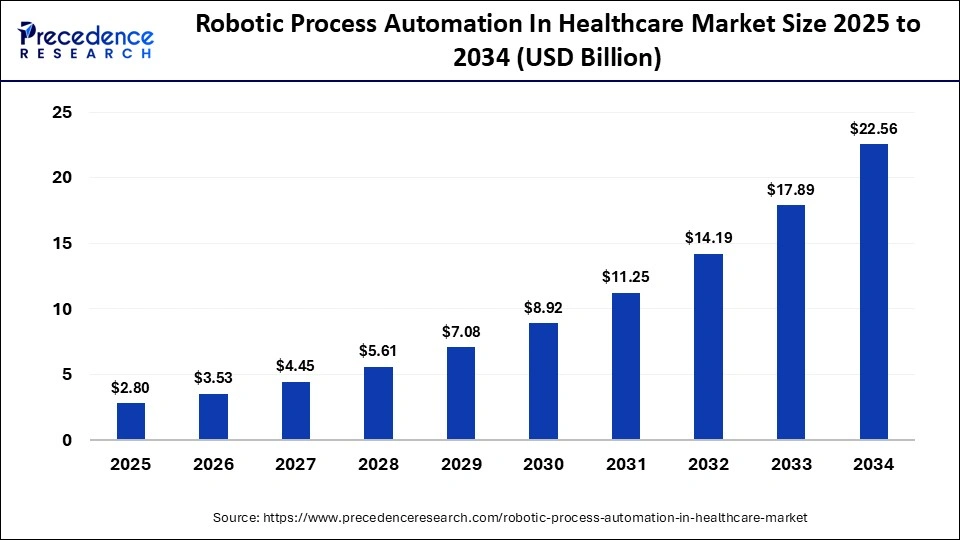
A 2026 industry analysis reports that healthcare organizations using RPA in RCM have seen roughly 70% ROI within 12 to 18 months, while mid-cycle automation can save approximately 61% to 70% of staff time in applicable workflows.
- Unsustainable Administrative Overhead & Denials: The American Hospital Association estimates claim denials cost U.S. hospitals over $262 billion annually in lost revenue, rework and recovery expenses. With manual rework costing $25–$118 per denied claim, providers use RPA to detect errors and reduce avoidable rework.
- Persistent Healthcare Staffing Shortages: Billing departments face severe turnover and vacancy rates exceeding 15%–20%. RPA acts as a capacity multiplier, helping health systems process higher transaction volumes without adding back-office staff.
- Increasing Payer Policy Volatility: Commercial health plans frequently revise coverage guidelines, authorization lists and modifier requirements. Automation platforms update these rulesets quickly, reducing exposure to unexpected policy changes and revenue loss.
- Rapid Return on Investment (ROI): Unlike EHR replacements that may take years to deliver returns, healthcare RPA implementations can reach breakeven within 6–9 months and deliver 3x–5x ROI through recovered charges and faster A/R cycles.
The Enterprise Takeaway: Healthcare RCM automation is fundamentally about executing financial transactions with precision and velocity. By deploying software bots across eligibility, claim assembly, payment posting and denial appeals, healthcare systems replace fragile manual data-entry routines with a resilient, scalable digital workforce that protects clinical operating margins.
How Much Does It Cost to Hire an RPA Company for Healthcare RCM?
Hiring a specialized healthcare software development company to engineer and deploy RPA for Revenue Cycle Management (RCM) involves several cost factors.
Healthcare billing requires HIPAA compliance, X12 EDI processing and payer portal integration, making it more specialized than generic automation. Costs vary based on workflow scope, integrations, AI capabilities and platform complexity.
For healthcare RCM automation, enterprises should evaluate cost through two separate lenses:
- What type of team do you need to hire?
- What does that team need to build, enhance, integrate or maintain?
A. Healthcare RPA Hiring Cost by Engagement Model
The most suitable hiring model depends on whether the enterprise needs one specialist, additional engineering capacity, or a complete product development partner.
| Hiring Model | Typical Cost Range | Best Fit Scenario |
| Individual RPA Developer | $25 – $80+ per hour | Minor workflow enhancements, bot maintenance, bug fixes, or isolated script updates. |
| Senior RPA Developer | $60 – $120+ per hour | Complex automation logic, ANSI ASC X12 EDI processing, portal scraping and production refactoring. |
| Healthcare Integration Specialist | $80 – $150+ per hour | Connecting EHRs (Epic, Cerner), clearinghouses, HL7 v2/FHIR interfaces and custom payer APIs. |
| AI / ML Engineer | $80 – $160+ per hour | In-line denial prediction, OCR document ingestion, clinical NLP coding and dynamic A/R ranking. |
| Pre-Vetted Development Pod | $25,000 – $100,000+ per month | Mid-size healthcare platforms needing an assembled engineering pod without recruitment overhead. |
| Dedicated RPA Development Team | $150,000 – $500,000+ per year | Long-term proprietary platform builds, continuous roadmap enhancements and ongoing multi-EHR support. |
| Full-Service RPA Development Company | $150,000 – $1M+ per project | Turnkey delivery: product discovery, design, HIPAA cloud infrastructure, deployment and SLA-backed support. |
Note: Comparing RPA for healthcare RCM development costs requires reviewing more than hourly or monthly rates. Developer-only arrangements may exclude architecture, QA, HIPAA compliance, infrastructure, deployment and maintenance, while full-service partners like IdeaUsher can manage planning, integrations, testing, deployment and ongoing support.
B. RPA Developer Cost by Experience Level
In healthcare IT, a developer’s experience level directly influences code resilience, clearinghouse acceptance rates and regulatory compliance:
| Developer Level | Indicative Hourly Rate | Typical Scope & Responsibilities |
| Junior RPA Developer | $25 – $50+ | Basic UI bot scripting, straightforward form filling, test execution and basic bot log monitoring. |
| Mid-Level RPA Developer | $50 – $90+ | Multi-step workflow orchestration, REST API integration, exception logging and clearinghouse testing. |
| Senior RPA Developer | $80 – $130+ | Core RCM automation architecture, complex EDI 837/835 processing, headless scraping and production stability. |
| RPA Solution Architect | $100 – $160+ | High-level system architecture, microservices scaling, HIPAA security governance and multi-tenant data schemas. |
| Healthcare Domain Consultant | $80 – $150+ | Workflow discovery, clinical chart mapping, NCCI edit validation, CARC/RARC categorization and billing audits. |
Lower hourly rates do not guarantee lower overall project costs. Inexperienced junior developers often build fragile scrapers and struggle with ANSI X12 standards, leading to dropped claims and expensive rework. Conversely, higher-rate senior engineers build resilient, production-ready pipelines much faster.
C. RPA Development Cost by Project Scope
Healthcare RCM automation projects can vary significantly in scope, from targeted workflow automation to enterprise-wide platforms. Each scope requires different development resources, integrations, timelines and levels of technical complexity.
| Project Scope | Estimated Cost | Timeline | Core Deliverables |
| Focused RCM automation | $50,000 – $150,000 | 2 – 4 months | 1–3 bots for eligibility or payment posting; one payer or clearinghouse integration; basic exception logging |
| Narrow production implementation | $150,000 – $300,000 | 4 – 6 months | Eligibility, claim scrubbing, EDI 837 and denial classification; 1–2 EHR integrations; work-queue triage |
| Multi-workflow RCM platform | $300,000 – $700,000+ | 6 – 10 months | Eligibility, authorization, claims, denials, payment posting and A/R automation; multiple integrations; AI-assisted processing |
| Enterprise or multi-facility program | $700,000 – $1M+ | 10 – 18+ months | Multi-facility RCM automation; advanced AI for denials and A/R; complex integrations; centralized governance and monitoring |
Note: These estimates provide a starting point for enterprises planning healthcare RCM automation. IdeaUsher can help translate complex workflows into a practical development roadmap, combining healthcare integration expertise, scalable architecture and production-ready automation to support secure, efficient and measurable revenue-cycle transformation.
D. How Hiring Costs Change by Project Requirement
The appropriate team structure depends entirely on your existing technical foundation: whether the project needs basic bot development, complex healthcare integrations, AI capabilities, or a complete RCM automation platform.
1. When You Need a New Healthcare RPA Platform from Scratch:
Required Team: Product Manager / Healthtech BA, Solution Architect, Senior RPA Developers, Backend Developers (Node.js/Python/Go), Frontend UI/UX Designer, Healthcare Integration Specialist, QA Automation Engineer and HIPAA DevOps/Security Engineer.
Cost Profile: An assembled production team typically costs $40,000 to $100,000+ per month. Full-platform builds generally require 4 to 9 months of engineering, resulting in a total investment of $200,000 to $700,000+.
2. When You Already Have RCM Software (Feature & Workflow Enhancement):
Required Team: One Senior RPA Developer, one Healthcare Integration Specialist, one QA Tester and part-time oversight from an RCM Solution Architect.
Cost Profile: Targeted enhancements (e.g., adding automated eligibility or denial management to existing software) typically range from $25,000 to $100,000+, depending on API accessibility and code documentation quality.
3. When You Have In-House Developers but Need More Capacity (Staff Augmentation):
Required Team: Targeted external developers embedded directly into your internal engineering sprints to handle specialized tasks like EDI file generation or clearinghouse integration.
Cost Profile: Individual pre-vetted engineers run $4,000 to $12,000+ per month, while dedicated extension pods run $25,000 to $100,000+ per month, eliminating permanent payroll taxes, benefits and recruiting friction.
Note: These are indicative cost ranges, not fixed line-item quotes. Actual pricing depends on the number of workflows, integration complexity, AI requirements, compliance scope and deployment scale. Some costs may overlap across project phases, so they should not be added together mechanically.
E. Why Two Healthcare RPA Projects Can Have Different Quotes
Prospective buyers often wonder why two seemingly identical RCM automation requests receive drastically different price estimates. The disparity usually comes down to structural variables beneath the surface:
| Cost Driver | Lower Quote Scope ($50K–$150K) | Higher Quote Scope ($700K–$1M+) |
| Integration Method | Surface-level RPA screen scrapers that break when web layouts change. | Bi-directional FHIR/HL7 APIs and direct clearinghouse engine integration. |
| Payer System Complexity | 1–2 predictable clearinghouse interfaces. | Multiple Medicaid, Medicare MAC and commercial payer portals. |
| Exception Handling | Basic error logging when missing data stops the bot. | Cognitive AI remediation and context-rich staff worklists. |
| Security & Compliance | Basic cloud setup using the client’s compliance infrastructure. | HIPAA architecture, SOC 2 Type II readiness and signed BAAs. |
| Development Team Model | Junior or unvetted offshore developers requiring heavy client oversight. | Senior healthtech developers, certified medical coding consultants and dedicated PMs. |
| Platform Scalability | Monolithic codebase for a single practice location. | Multi-TIN, multi-facility architecture scaling from 5,000 to 500,000+ claims/month. |
F. What Is the Right RPA Budget for Your Healthcare RCM Project?
To establish a realistic cost to hire an RPA company for healthcare RCM, align development expenditure with monthly claim volume, recurring collections drag, system architecture, and long-term operating goals:
Maximum Justified Budget ≤ (Annual FTE Capacity Recaptured + Annual Denials Avoidance) × 1.5
1. Budget $50,000 – $150,000 (Focused RCM Automation) — Best Fit When:
- A 3-to-10 provider specialty practice, single clinic, or emerging digital health service collects under $5M annually.
- A specific operational bottleneck requires resolution, such as eliminating 30+ weekly staff hours spent on manual eligibility verification or claim-status scraping.
- An existing, stable EHR/PM system requires only targeted bot scripting or surface-level connectors without major database changes.
2. Budget $150,000 – $300,000 (Narrow Production Implementation) — Best Fit When:
- An expanding group practice or specialized surgical center collects $5M to $15M annually.
- A production-ready implementation is needed across two to three critical workflows, such as eligibility verification, prior authorization tracking and basic claim scrubbing.
- Bi-directional API/HL7 integration with the primary EHR and a major clearinghouse is required, along with an exception-handling dashboard for billing staff.
3. Budget $300,000 – $700,000+ (Multi-Workflow RCM Platform) — Best Fit When:
- A growing MSO, mid-to-large regional medical group, or national telehealth platform collects $15M to $50M annually.
- A proprietary billing engine is needed to reduce reliance on commercial SaaS vendors charging 3%–6% of collections.
- End-to-end automation is required across front-end intake, claim pre-scrubbing, ERA (EDI 835) posting, denial management and multi-specialty charge capture.
4. Budget $700,000 – $1,000,000+ (Enterprise or Multi-Facility Program) — Best Fit When:
- An enterprise health system, hospital network, multi-TIN MSO, or high-volume billing aggregator processes over 100,000 claims monthly and generates $50M+ in annual collections.
- Financial workflows include complex provider compensation, inter-company revenue routing, distributed facility billing, or value-based care contracts.
- Advanced AI features such as clinical NLP, predictive denial models and ERV queue routing require a secure, single-tenant HIPAA/SOC 2 Type II cloud architecture.
What Are You Actually Hiring an RPA Company to Build?
Hiring a healthcare Robotic Process Automation (RPA) partner is rarely about replacing an entire Electronic Health Record (EHR) or practice management system. The cost to hire an RPA company for healthcare RCM is typically far lower, allowing organizations to automate existing workflows without major disruption.
Instead, you are hiring an engineering partner to build an intelligent automation and interoperability layer that sits on top of your existing infrastructure. This layer connects fragmented EHRs, clearinghouses, billing databases and commercial payer web portals, executing manual data transfers and status checks at machine speed without human error.
A. RPA Automation vs. A Full RCM Automation Platform
The scope of what a development partner builds falls into three distinct tiers of technical sophistication: basic task automation, integrated RCM workflows, and advanced platforms with AI, analytics, and orchestration.
Tier 1: Isolated RPA Bots (Task Automation)
What It Is: Standalone, headless scripts designed to mimic repetitive human keystrokes for specific, isolated tasks.
Typical Build: A bot that logs into five regional payer portals nightly to download Explanation of Benefits (EOB) files, or an automated script that batches demographic queries into a clearinghouse.
Limitations: If an input format changes or a portal UI shifts, the bot breaks silently unless manually patched.
Tier 2: Workflow Automation Platform (System Interoperability)
What It Is: An orchestrated middleware engine that links disparate healthcare systems together into continuous operational pipelines.
Typical Build: The platform pulls scheduled appointments from an EHR via HL7/FHIR, triggers real-time EDI 270 eligibility checks, updates the patient encounter status, generates an automated Good Faith Estimate (GFE) and pushes unverified accounts to front-desk exception queues.
Value: Moves beyond task completion to govern complete operational handoffs across departments.
Tier 3: AI-Enabled RCM Automation Platform (Intelligent Revenue Operations)
What It Is: A cognitive automation environment that pairs deterministic bots with machine learning models, natural language processing (NLP) and dynamic exception management.
Typical Build: Features ambient clinical chart reading for computer-assisted coding (CAC), pre-submission denial risk prediction, automated appeal packet assembly with medical record attachments and dynamic worklist prioritization ranked by expected recovery value (ERV).
Value: Solves non-linear problems, adapts to semi-structured documents and provides executive-level BI and revenue forecasting.
B. Which RCM Workflows Are You Planning to Automate?
RPA development costs scale based on which revenue cycle modules you include in your product roadmap. A comprehensive build typically selects from these core cost-driving workflows:
| RCM Workflow Module | Technical Complexity | Core Automation Action |
| Eligibility Verification | Low – Moderate | Running automated batch EDI 270/271 queries 48 hours pre-visit; writing deductibles and copays back to the EHR. |
| Claim-Status Checks | Low – Moderate | Deploying headless scrapers to query payer portals and EDI 276/277 endpoints to identify stalled claims. |
| Prior Authorization | High | Cross-referencing CPT codes against payer rules, checking portal approval statuses and logging auth IDs. |
| Claims Processing & Scrubbing | Moderate – High | Pre-scrubbing charges against NCCI edits and commercial LCD/NCD rules before packaging ANSI ASC X12 EDI 837 batches. |
| Payment & Remittance Posting | Moderate | Ingesting EDI 835 ERAs and lockbox EOBs, auto-posting line-item write-offs and flagging contract variances. |
| Claims Reconciliation | Moderate | Auditing deposits against bank clearing records and identifying unallocated or suspense-account funds. |
| Denial Management | High | Ingesting CARC/RARC codes, categorizing denial root causes and populating pre-formatted appeal packets. |
| Coding Assistance | High (AI Required) | Extracting billable ICD-10/CPT codes from physician chart narratives using specialized clinical NLP. |
| A/R Follow-Up & Prioritization | Moderate – High | Scoring outstanding receivables by recovery yield and routing high-dollar accounts to specialized staff. |
| Revenue-Cycle Analytics | Moderate | Aggregating longitudinal data into real-time BI dashboards tracking clean claim rates, DAR and net yield. |
C. Why Workflow Scope Matters More Than Bot Count
A frequent misconception in software procurement is evaluating projects by the “number of bots” delivered. In healthcare IT, workflow complexity drives development effort, not bot quantity.
A project building five simple bots to download PDFs from a single payer portal is straightforward and inexpensive. Conversely, building a single end-to-end Prior Authorization Workflow can cost significantly more because of four critical engineering layers:
- Multi-System Business Rules: Accommodating distinct, constantly shifting medical necessity rules across hundreds of commercial plans.
- Heterogeneous Integrations: Pulling clinical charts from an EHR via SMART on FHIR, passing data through an NLP engine and inputting fields into non-standard payer web forms.
- Non-Linear Exception Handling: Designing secure Human-in-the-Loop (HITL) exception screens for cases where clinical justifications require physician review.
- Strict Healthcare Testing: Running synthetic claims and extensive sandbox tests to guarantee zero dropped encounters or compliance exposures during deployment.
Scoping your project around the depth and integration boundaries of the workflow rather than an arbitrary bot headcount ensures your development budget aligns with real-world technical requirements.
RCM Automation Features That Change the Development Quote
Software development quotes for healthcare RCM platforms vary by functional complexity, which directly affects the cost to hire an RPA company for healthcare RCM. Basic read-only bots need less engineering, while transactional workflows and machine learning require complex architecture, validation, and compliance controls.
A. Basic RCM Automation Features
Basic RCM automation targets high-volume, repetitive tasks across existing healthcare systems, reducing manual effort, improving data accuracy and keeping routine revenue-cycle workflows consistent. The table below highlights the key features and their business value.
| Features | What It Includes | Business Value |
| Eligibility Verification | Automated insurance eligibility and benefits checks through payer portals or clearinghouses | Reduces manual verification time and helps prevent avoidable claim issues |
| Claim-Status Verification | Automated retrieval and tracking of claim-status updates from payers | Reduces repetitive follow-ups and improves visibility into claim progress |
| Payer-Portal Navigation | Automated login, data retrieval and form interactions across supported payer portals | Reduces manual portal work and improves processing consistency |
| Repetitive Data Entry | Transferring patient, insurance and claim information between connected systems | Reduces keystrokes, rework and data-entry errors |
| Patient Information Updates | Updating patient demographics, insurance details and related records across systems | Improves data accuracy and reduces administrative workload |
| Basic Task Routing | Assigning routine RCM tasks to appropriate work queues or teams | Improves workflow consistency and reduces manual coordination |
Why these features are less expensive:
These features typically cost less because they rely on standard protocols, limited system changes and lower-risk workflows, reducing development effort, testing requirements, integration complexity and infrastructure needs.
- Standardized Communication Formats: Transactions like EDI 270/271 and 276/277 follow strict ANSI ASC X12 syntax standards. Pre-built parsing libraries and developer-first clearinghouse APIs handle the heavy lifting, eliminating the need to write custom protocol engines.
- Read-Only / Low-Liability Operations: Querying eligibility or checking a claim’s status does not modify general ledgers, alter medical charge amounts, or submit legal billing records. The QA validation requirements are minimal, reducing testing cycles.
- No Database Restructuring: These bots run as external utilities on top of existing EHR/PM databases, requiring zero complex schema migrations or multi-table relational refactoring.
B. Advanced RCM Automation Features
Advanced RCM automation goes beyond routine tasks by connecting multi-step workflows, financial processes, AI-assisted decisions and exception handling to support more efficient revenue-cycle operations. Here are the advanced capabilities that can deliver greater automation and financial control.
| Features | What It Includes | Business Value |
| Automated Payment Posting | Posting payment and remittance information into billing or patient-accounting systems | Reduces manual posting effort and speeds up payment processing |
| Claims Reconciliation | Matching claims, payments, adjustments and remittance data across systems, with exception handling for mismatches | Reduces reconciliation workload and helps identify financial discrepancies |
| Denial Management Workflows | Routing denied claims, classifying denial reasons, applying payer-specific rules and managing follow-up actions | Reduces denial rework and supports faster revenue recovery |
| Prior Authorization Automation | Managing authorization requests, status checks, documentation and payer follow-ups | Reduces administrative delays and improves workflow visibility |
| Coding Assistance | Supporting coding workflows through rules-based automation or AI-assisted recommendations | Reduces repetitive coding work and supports consistent processing |
| A/R Prioritization | Ranking outstanding accounts using claim status, financial value, aging and collection rules | Helps teams focus on higher-value accounts and improve collection efficiency |
| Exception Management | Flagging failed transactions, incomplete data and cases requiring human review | Prevents automation failures from moving through the revenue cycle |
| Multi-Step Claims Processing | Coordinating claims submission, payer responses, billing updates, reconciliation and follow-up | Reduces manual handoffs and improves end-to-end workflow efficiency |
Why these features increase development scope:
These features require more development effort because they involve financial data, complex exceptions, system write access and strict validation, increasing engineering, testing, integration and security requirements.
- Financial Transaction Integrity: Bugs in automated payment-posting scripts can corrupt A/R ledgers, misstate patient liabilities, or trigger erroneous balance billing. Database rollbacks and reconciliation safeguards require significant senior backend engineering.
- Edge-Case Volatility: Remittances may contain non-standard payer adjustment codes, zero-dollar allowances, or split claims. Building and testing exception logic for these cases can consume roughly 60% of module engineering time.
- Deep System Write Permissions: Writing charges and adjustments into EHR or ERP ledgers requires certified FHIR/HL7 interfaces, extensive partner testing and strict database concurrency management.
C. AI Features That Increase Healthcare RPA Costs
Adding AI moves software from fixed tasks to adaptive decision-making. It needs custom data pipelines, model training and Human-in-the-Loop compliance controls. AI should only be added if it directly improves key metrics like clean claim rates or collected revenue.
| AI Capability | Development Cost Impact | Technical & Governance Drivers | Primary ROI Metric |
| Intelligent Document Processing (IDP) | +$25,000 – $55,000 | OCR/computer-vision training for varied lockbox EOBs, faxes and paper medical records. | 70% faster data extraction from non-electronic documents. |
| Pre-Submission Denial Prediction | +$35,000 – $75,000 | ML classification models trained on historical 837/835 payer adjudication patterns. | Lowers initial denial rates from >10% to <4%. |
| AI-Assisted Medical Coding (CAC) | +$45,000 – $95,000+ | Clinical NLP to suggest ICD-10/CPT codes with strict HITL review and OIG/RAC audit logging. | Increases coder chart throughput by 40%+; reduces unbundling. |
| Yield-Based A/R Prioritization | +$20,000 – $40,000 | Expected Recovery Value (ERV) algorithms ranking queues by win probability and timely filing. | Recovers 2%–3% in aged accounts nearing write-off limits. |
The Reality of AI Development Overhead:
AI-powered RCM requires data infrastructure, human oversight, explainability, and compliance controls. These factors affect the cost to hire an RPA company for healthcare RCM while keeping AI decisions secure and suitable for healthcare workflows.
- Infrastructure & Training Pipelines: AI implementation requires secure, HIPAA-compliant data lakes, Safe Harbor de-identification pipelines, vector indexing and ongoing model fine-tuning infrastructure.
- Human-in-the-Loop (HITL) Architecture: Unmonitored AI coding can create compliance exposure and False Claims Act scrutiny through upcoding or misinterpreted clinical intent. Mandatory review thresholds, evidence visualization and audit trails can add 25%–40% to frontend and backend development.
- Explainability & Compliance Tooling: Under HHS OIG and RAC guidelines, automated coding and billing decisions must be auditable. Explainability interfaces should highlight the exact clinical-note text supporting each recommended code.
RPA Platform Licensing vs. Custom Development Costs
Choosing between licensing an existing enterprise RPA platform and engineering custom healthcare automation software is fundamentally a Total Cost of Ownership (TCO) decision.
Commercial platform licenses look predictable on paper, but licensing fees typically represent only 25% to 30% of actual enterprise automation costs, the remainder goes toward professional implementation services, custom script development, connector subscriptions and ongoing maintenance.
The critical question is not just “What is the software license fee?” but “How will our total costs scale over a 3- to 5-year operating horizon as transaction volumes expand?”
A. When an Existing RPA Platform May Be Enough
Licensing an off-the-shelf commercial RPA suite is often the fastest, most economical approach for healthcare organizations with straightforward operational footprints:
- Standardized Administrative Workflows: Linear, standard fee-for-service processes with minimal variation, such as daily EDI 270/271 eligibility batches and claim-status checks through commercial payer portals.
- Single EHR or Modern API-First Stack: Operations centered on one modern EHR with reliable, prebuilt third-party connectors.
- Rapid Deployment Mandates: Bot deployment required within 30–60 days to address staffing shortages or administrative backlogs.
- Limited In-House Engineering Capacity: No dedicated cloud engineers, healthtech integration specialists, or DevOps personnel to maintain an independent codebase.
- Delegated Infrastructure Compliance: Preference for an enterprise vendor to manage ongoing SOC 2 Type II, ISO 27001 and HIPAA-eligible hosting requirements.
B. When Custom RCM Automation Development Makes Sense
Custom healthcare RPA development becomes the superior financial and operational choice when an organization encounters structural complexity that off-the-shelf platforms cannot accommodate without expensive workarounds:
- Multiple Disconnected Healthcare Systems: Multi-facility health systems, MSOs and regional provider networks often run disparate EHRs, including Epic, athenahealth and legacy billing databases. Custom middleware unifies data without multiple connector subscriptions.
- Complex or Non-Standard RCM Workflows: Behavioral health networks, value-based care risk pools and outpatient surgical centers require specialized modifier rules, bundled episode payments and non-standard charge capture beyond generic templates.
- Custom AI and Autonomous Coding Requirements: Organizations may need ML and clinical NLP models trained on historical progress notes and regional payer denial trends instead of premium licenses for generic, black-box vendor AI.
- Specialized Payer Rules and Contract Modeling: Proprietary pre-bill scrubbing and underpayment detection rules can be tailored to regional commercial and Medicaid managed-care contracts.
- Multi-Facility & Multi-Tenant Operations: Strict data segregation across TINs, provider groups and billing entities requires custom RBAC, avoiding costly commercial per-user licensing.
- Custom Dashboards and Native Analytics: Direct access to financial lakehouses and executive BI dashboards supports net collection yield, DSO and bot-performance tracking without third-party extraction surcharges.
C. What to Compare Beyond the Initial Development Quote
Evaluating the cost to hire an RPA company for healthcare RCM requires looking beyond Year-1 capital outlay and comparing structural cost drivers across a multi-year horizon:
| Cost Dimension | Commercial RPA Platform (Licensing) | Custom RCM Automation (Build) |
| Licensing Structure | $5K–$15K/bot/year, plus developer and orchestrator licenses. Costs increase with scale. | Upfront CapEx with no per-bot or per-user license fees. |
| Customization & Configuration | $150–$250+/hour for consultants adapting rigid templates to healthcare workflows. | Built around proprietary billing rules, EHR screens and payer mix. |
| System Integrations | Marketplace fees or fragile UI scraping for unsupported legacy systems. | Native SMART on FHIR, HL7 v2 and ANSI ASC X12 EDI integrations. |
| Maintenance & Payer Drift | Support fees plus script updates when vendor changes disrupt workflows. | 15%–20% of initial build annually for payer and CPT/ICD updates. |
| Scalability & Margins | Scaling from 10 to 50 bots increases software costs linearly. | Additional transactions mainly require lightweight cloud compute. |
| Long-Term Ownership & IP | Vendor controls the software and roadmap, creating migration risks. | Full IP ownership of the platform, codebase and ML assets. |
When transaction volume is high and workflows are strategically important, custom engineering yields a lower TCO over 3 to 5 years while giving your organization complete control over its technological roadmap.
How to Choose an RPA Company for Healthcare RCM
Hiring a healthcare RPA firm differs from a general software agency. RCM bots handle ePHI, clinical records, and clearinghouses, so the cost to hire an RPA company for healthcare RCM should reflect specialized expertise to avoid claim denials, compliance issues, and ledger errors.
Evaluating prospective engineering vendors across five core disciplines ensures your automation initiative delivers measurable ROI, regulatory compliance and resilient performance.
1. Look for Healthcare RCM Experience
A technical team can understand automation scripts, but if they do not understand the mechanics of hospital reimbursement, the implementation will struggle. Generalist agencies often treat medical billing like standard e-commerce processing, failing to account for the payer adjudication rules that dictate provider cash flow.
Your prospective development partner must demonstrate working fluency across the entire revenue cycle:
- Claims Processing: Practical knowledge of CMS-1500 (837P) and UB-04 (837I) claim generation, National Correct Coding Initiative (NCCI) edits and modifier logic.
- Denial Management: Ability to ingest and parse Claim Adjustment Reason Codes (CARCs) and Remittance Advice Remark Codes (RARCs) to automate root-cause categorization and appeal generation.
- Payment Posting & Reconciliation: Experience parsing complex ANSI ASC X12 835 Electronic Remittance Advice (ERA) files to auto-post contractual allowances, patient responsibility and split payments without leaving unallocated suspense cash.
- Eligibility & Prior Authorization: Experience orchestrating automated real-time and batch EDI 270/271 benefit checks and managing multi-payer authorization workflows.
- Accounts Receivable (A/R) Follow-Up: Designing algorithmic work queues that prioritize aging claims by timely filing urgency and recovery probability rather than static balance size.
2. Evaluate Integration and Automation Capabilities
Healthcare automation rarely takes place in a clean, modern software environment. An experienced partner must know how to interface with both legacy architectures and cutting-edge cloud protocols without causing session drops or synchronization lag.
| Integration Surface | Technical Protocols | Key Evaluation Criteria |
| EHR & Practice Management | SMART on FHIR, HL7 v2, REST APIs | Proven track record connecting bi-directionally to platforms like Epic, Cerner/Oracle Health, athenahealth and MEDITECH without violating API rate limits. |
| Payer Portals | Headless Browsers, Computer Vision, Session Vaults | Resilient bot scrapers capable of navigating two-factor authentication (MFA), dynamic DOM layouts and CAPTCHA hurdles across hundreds of commercial payer sites. |
| Clearinghouses & EDI Rails | ANSI ASC X12 (837, 835, 270/271, 276/277) | Native parsing and compilation engines that process multi-megabyte batch files asynchronously via SFTP or direct clearinghouse APIs. |
| Billing & Banking Ledgers | Direct SQL, Windows Automation, Lockbox APIs | Safely automating data entry into legacy, on-premise billing systems or digital lockboxes while maintaining ACID database compliance. |
3. Ask About AI, Security and Compliance
Basic screen-scraping must be reinforced with cognitive intelligence and strict regulatory governance in modern healthcare IT. However, introducing Artificial Intelligence into RCM without strict safety controls creates serious financial and legal liabilities. Ensure your development vendor provides:
- Human-in-the-Loop (HITL) Governance: Automated confidence-scoring thresholds that route borderline AI coding recommendations or appeal drafts to human specialists for sign-off prior to submission.
- HIPAA & HITECH Compliance: Readiness to sign a comprehensive Business Associate Agreement (BAA) and build within HIPAA-eligible cloud architectures (AWS HealthLake, Azure for Healthcare, or GCP Healthcare API).
- Robust Encryption & Secret Management: AES-256 encryption at rest, TLS 1.3 in transit and centralized credential vaulting (e.g., HashiCorp Vault) to ensure bot login credentials are never exposed in plaintext scripts.
- Tamper-Evident Audit Trails: Immutable logging tracking every automated keystroke, record access and claim alteration to satisfy third-party SOC 2 Type II and CMS compliance audits.
4. Review the Development Process and Support Model
Software development does not end when code is pushed to production. Because clearinghouse rules, payer portal layouts and clinical code sets change constantly, an automation agency must offer a mature, end-to-end delivery framework:
Discovery & Mapping → Architecture Design → Synthetic Testing → Phased Deployment → SLA Maintenance
- Discovery & Process Mapping: Shadowing billing staff to document workflows, define exception boundaries and establish baseline performance metrics.
- Architecture & UI/UX Design: Engineering containerized microservices and intuitive exception-handling dashboards for billing operators.
- Synthetic Sandbox Testing: Stress-testing bots against simulated claim batches and clearinghouse sandboxes to catch edge-case bugs before live production.
- Phased Rollout & Staff Training: Transitioning billing personnel from data-entry clerks into exception managers through structured operational training.
- Post-Launch Maintenance & SLAs: Providing contractual Service Level Agreements (SLAs) with proactive monitoring to update bots immediately when payers alter portal layouts or CMS releases annual CPT/ICD code updates.
5. Ask for a Clear Scope and Cost Breakdown
Vague, one-line estimates often signal an inexperienced development partner. Without a clear breakdown of architecture and scope, the cost to hire an RPA company for healthcare RCM can rise due to unexpected complexities, change orders, budget overruns, and delays.
A reputable healthcare engineering firm will break down your commercial proposal into discrete, transparent line items:
- Discovery & Architecture Blueprinting: Dedicated hours for clinical workflow mapping, data dictionary definition, clearinghouse sandbox evaluations and security audit readiness.
- Component-Level Engineering: Explicit cost allocations separating deterministic RPA bots, user-facing exception dashboards, custom rules scrubbers and AI/NLP pipelines.
- Integration & Gateway Line Items: Individual line items detailing EHR connection setups (SMART on FHIR vs. HL7 v2), clearinghouse EDI parsers and custom payer portal automation scripts.
- Compliance & Infrastructure Hardening: The investment required for HIPAA-compliant cloud provisioning, BAA execution, secret vaulting and tamper-evident audit trail logging.
- Testing, Pilot Validation & Go-Live: Budget allocations for synthetic claims data testing, clearinghouse stress testing and supervised pilot rollout.
- Post-Launch Maintenance & Ongoing SLAs: Clear pricing models (retainer, tier-based SLAs, or hourly support) for continuous bot recalibration, annual CPT/ICD code set updates and rapid fixes when payer portal UIs change.
Demand a proposal connecting technical milestones to operational deliverables. The right development partner does more than quote a feature list. Firms like Idea Usher assess operational bottlenecks, audit workflows, define technical architecture, and map EHR and clearinghouse integrations to build a realistic roadmap. This helps clarify the cost to hire an RPA company for healthcare RCM while supporting scalability, compliance, and faster ROI.
How Idea Usher Can Help Build Healthcare RCM Automation
IdeaUsher is a product engineering partner expert in the healthtech industry with 11+ years of experience across 50+ countries. Backed by 250+ experts, 1,000+ builds and a 4.9/5 Clutch rating, we engineer custom Healthcare Revenue Cycle Management (RCM) automation platforms.
Our healthtech portfolio includes Zeno, Kamelion, Vezita and Mediport, with experience across the integration and operational needs of healthcare platforms. We build scalable cloud architecture, EHR/clearinghouse integrations, AI denial tools, eligibility checks and unattended bots to improve clean claims and protect margins.
A. From RCM Workflow Assessment to Production Deployment
We manage the entire engineering lifecycle from initial clinical discovery and clearinghouse workflow mapping to custom software architecture, validation and zero-downtime production deployment. Our cross-functional teams build tailored automation bots and intelligent rule engines that eliminate manual intervention from intake through final remittance reconciliation.
B. Building Automation Around Your Existing Healthcare Systems
Rather than forcing disruptive rip-and-replace rollouts, we engineer unified automation layers that integrate directly with your operational ecosystem:
- EHR & Practice Management: Bi-directional FHIR and HL7 connections across Epic, Cerner, Athenahealth and MEDITECH.
- Clearinghouses & EDI Rails: Direct X12 pipelines (270/271, 278, 837, 835) across Availity, Change Healthcare and Waystar.
- Payer Portals & Payment Gateways: Automated web-bot navigation for stubborn payer portals alongside PCI-compliant patient payment engines.
C. Designing for Security, Scalability and Long-Term ROI
We construct HIPAA-, HITECH- and SOC 2-compliant cloud architectures using end-to-end AES-256 encryption and isolated credential vaults. Every workflow is calibrated to deliver measurable business outcomes, slashing Days in Accounts Receivable (DAR), raising clean-claim rates and scaling transaction volume effortlessly with complete zero vendor lock-in ownership.
Ready to modernize your revenue cycle with custom automation? Connect with IdeaUsher’s principal healthtech software architects today to review your RCM workflow requirements and receive a comprehensive technical roadmap and project estimate.
Conclusion
Healthcare RCM automation can improve reimbursement speed, reduce administrative costs, and provide better revenue visibility. The cost to hire an RPA company for healthcare RCM depends on workflow complexity, integrations, security requirements, AI capabilities, and ongoing support. The right partner should bring more than technical expertise by understanding healthcare operations and building automation around measurable outcomes. With the right scope and team, organizations can modernize revenue-cycle workflows while maintaining compliance, scalability, and appropriate human oversight.
FAQs
A.1. Healthcare RCM automation software can cost $50,000 to $1 million or more, depending on workflow complexity, integrations, compliance requirements, AI features, team structure, deployment scope and organizational scale.
A.2. Core features include eligibility verification, claims processing, payment posting, denial management, prior authorization, A/R prioritization, exception handling, reporting, audit trails and human approval workflows for safer daily operations.
A.3. Successful RCM automation requires EHR, practice-management, clearinghouse, payer portal, HL7, FHIR and EDI integrations to exchange patient, claim, eligibility, remittance and payment information securely across connected systems.
A.4. Healthcare RCM automation should use role-based access, encryption, audit logging, secure hosting, controlled data handling, exception monitoring and human oversight to support HIPAA-conscious operations, reliability, scalability and long-term compliance.