

Key Takeaways
- RCM software links access, eligibility checks, authorizations, coding, claims, payments, denials, accounts receivable, and collections to build a single unified financial workflow.
- Modern RCM software is more than medical billing tools. It uses automation, interoperability, predictive denial prevention, and real-time financial visibility to focus on proactive revenue management.
- The top priority of an MVP RCM software should be patient registration, eligibility verification, authorization, coding, claims, payment posting, denial management, and A/R tracking.
- RCM software can also include AI features like denial prevention, AI coding, smart accounts receivable prioritization, payment reconciliation, and revenue analytics.
- The cost of building healthcare RCM software varies widely from $60,000 to over $1 million. The price depends on platform complexity, integrations, AI features, security measures, compliance needs, data migration, and enterprise scalability.
The real question is no longer whether healthcare providers need better revenue infrastructure, but who can build it around the way healthcare actually operates. Fragmented workflows, payer complexity, and rising administrative pressure are exposing the limits of legacy systems, creating greater demand for specialized healthcare revenue cycle management companies that can connect financial operations with modern digital infrastructure.
The old model of stitching together billing, coding, claims, and payment tools is becoming harder to scale. Doctors and healthcare providers want automation, better information sharing, smarter denial prediction, and real-time financial visibility inside one system instead of many separate tools. For builders, this creates an opportunity to develop RCM platforms that solve deeper operational problems while adapting to specialty, payer, and organizational requirements.
In this blog, we will talk about the top healthcare revenue cycle management companies in 2026, their capabilities, services, technology expertise and how to choose the right development partner for building a scalable RCM platform designed to streamline billing, claims, payments, and revenue operations.
What Is Revenue Cycle Management Software?
Revenue Cycle Management (RCM) software is a financial operating platform designed to track, automate, and optimize the entire financial journey of a patient episode, from initial appointment scheduling and insurance verification through clinical documentation, claims adjudication, and final zero-balance payment resolution.
Unlike general enterprise resource planning (ERP) or generic accounting ledgers, RCM software is built specifically for the multi-payer healthcare economy. It reconciles clinical workflows governed by ICD-10, CPT, and HCPCS coding taxonomies with complex, continuously shifting commercial and government payer rules (e.g., Medicare, Medicaid).
A. How Modern RCM Platforms Manage the Revenue Cycle
Modern RCM architectures orchestrate the healthcare revenue cycle across four synchronized phases, ensuring clinical activities translate into collectible revenue without administrative leakage:
- Front-End Access & Financial Clearance: Captures patient demographics, verifies coverage through EDI 270/271, flags deductibles, and secures prior authorizations to prevent registration errors before care.
- Mid-Cycle Revenue Integrity: Interfaces with EHR databases to capture billable clinical activities. CDI models cross-reference clinical notes and operative reports to improve coding accuracy and prevent charge drop-offs.
- Back-End Claims Engine: Converts diagnostic and procedural codes into ANSI 5010 EDI 837 formats, including 837P professional and 837I institutional claims. Payer-specific scrubbers validate modifiers and medical necessity before clearinghouse routing.
- Payment Resolution & Collections: Parses EDI 835 ERA files and matches line items to patient accounts. Unpaid balances route to secondary insurance claims or digital patient invoicing channels.
B. RCM Software vs. Medical Billing Software
The terms RCM software and medical billing software are frequently conflated, but they represent fundamentally different architectural and operational scopes:
| Dimension | Medical Billing Software | Enterprise RCM Platform |
| Operational Scope | Narrow & Transactional: Starts after patient discharge; focuses on creating and submitting claims. | Comprehensive & Strategic: Spans the full lifecycle from pre-registration to final balance resolution. |
| Primary Objective | Process claims and record insurance payments. | Maximize net collection rate, reduce days in A/R, and eliminate upstream revenue leakage. |
| System Integration | Standalone tool or basic clearinghouse plugin; limited clinical context. | Deep bi-directional EHR, PMS, clearinghouse, and enterprise accounting integration. |
| Workflow Timing | Post-Service Reactive: Acts once care is complete and encounters are locked. | Full-Cycle Proactive: Validates eligibility and authorizations before care begins. |
| Denial Handling | Records denials and relies on billers to manually rework and resubmit. | Employs predictive scrubbing to prevent denials, using automated root-cause routing. |
| Patient Financials | Generates paper or basic PDF statements post-insurance adjudication. | Offers upfront cost estimates, propensity-to-pay scoring, and digital self-service payment plans. |
C. Why Healthcare Providers Are Building Custom RCM Platforms
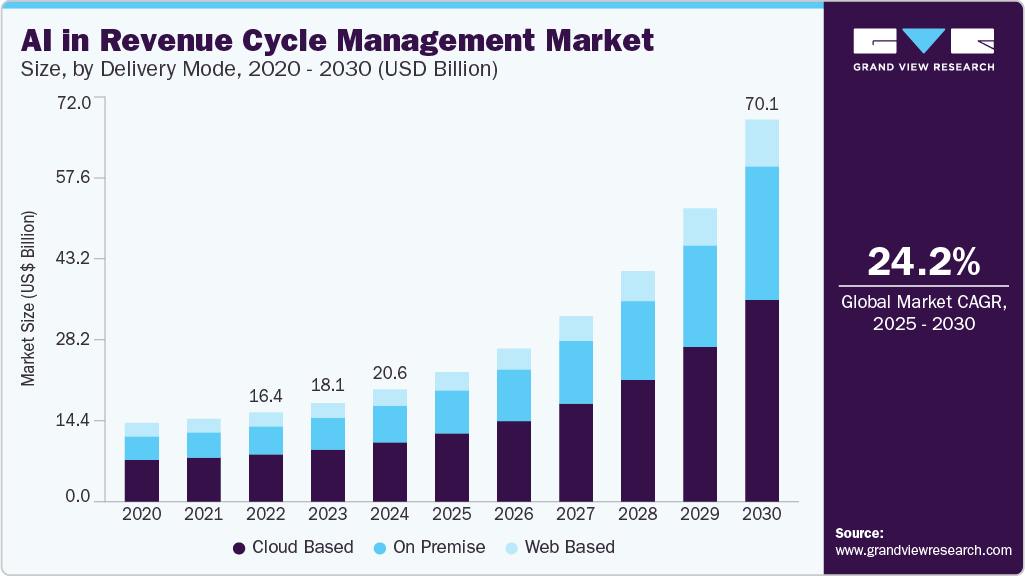
The global AI in revenue cycle management market size was valued at $20.6 billion in 2024 and is projected to grow from $28.1 billion in 2026 to $70.1 billion by 2030, at a CAGR of 24.2% from 2025 to 2030. This growth reflects the increasing adoption of AI to automate complex RCM workflows, improve claim accuracy, and strengthen revenue performance.
While commercial off-the-shelf (COTS) RCM suites exist, hospitals, multi-specialty practices, digital health startups, and management services organizations (MSOs) are increasingly investing in proprietary, custom-built RCM infrastructure:
- Eliminating Percentage-of-Collections Fees: Legacy RCM vendors charge 3%–8% of collections. At $50M+ annual collections, a custom platform can save millions while reducing cost-to-collect from 3.5%–5% to under 1.5%–2%.
- Handling Non-Standard & Specialty Care Models: Off-the-shelf RCM tools favor traditional fee-for-service. Value-based care, RPM, behavioral health, and hybrid telemedicine require custom billing state machines for capitation, bundled payments, and recurring care, as 40%+ of reimbursements shift toward APMs.
- Direct Control Over Payer Rulesets: COTS vendors may take weeks or months to update rules after payer policy changes. With initial denial rates at 11.8% and 4.8% average net revenue leakage, custom architectures enable rapid payer-specific logic updates and support 95%–98% clean-claim rates.
- Unifying Fragmented Enterprise Systems via FHIR: Multi-EHR networks can use custom RCM as a vendor-agnostic financial layer, unifying systems such as Epic and Athenahealth through HL7 FHIR microservices and eliminating 50–75 weekly analyst hours spent reconciling billing silos.
The Enterprise Takeaway: Medical billing handles transactions, but RCM software orchestrates the broader financial lifecycle. That is why healthtech enterprises seeking to build and launch RCM software increasingly look for healthcare revenue cycle management companies that can combine healthcare expertise, intelligent automation, interoperability, security, and scalable technology into a market-ready platform.
How to Choose an RCM Software Development Company
Choosing a custom healthcare revenue cycle management companies differs from standard SaaS outsourcing. Because RCM platforms manage both financial transactions and ePHI, a partner without deep healthtech expertise risks creating non-compliant architectures, flawed billing logic, and fragile integrations that cause widespread claim denials.
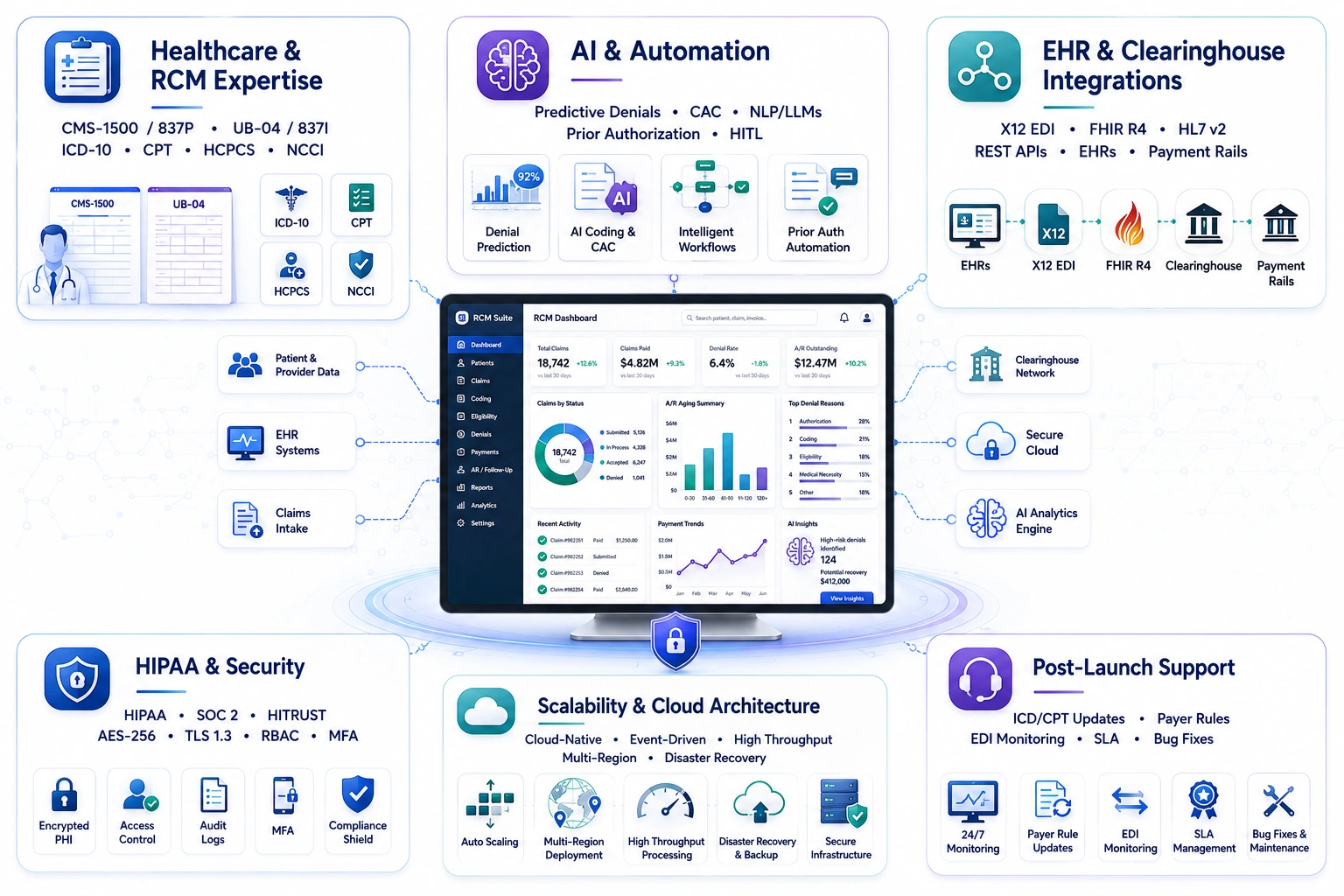
Evaluating prospective engineering vendors across six foundational capabilities ensures your platform achieves high first-pass acceptance rates and enterprise-grade reliability.
1. Healthcare and RCM Domain Expertise
Your development partner must have hands-on experience navigating the complexities of medical billing workflows. Generalist software agencies often fail to grasp the operational rules that govern provider reimbursement.
- Billing Forms and Claim Types: Demonstrable fluency with both professional (CMS-1500 / 837P) and institutional (UB-04 / 837I) claim generation.
- Coding Taxonomies: Practical experience building validation logic around ICD-10-CM, CPT, and HCPCS Level II code sets, including National Correct Coding Initiative (NCCI) edits and modifier sequencing.
- Payer Adjudication Nuances: An understanding of Claim Adjustment Reason Codes (CARCs), Remittance Advice Remark Codes (RARCs), and how commercial managed care, Medicare Advantage, and Medicaid state plans differ in adjudication.
- Workflow Modeling: Ability to design intuitive user experiences that match the daily operational patterns of intake specialists, certified coders, and accounts receivable (A/R) teams.
2. AI and Automation Capabilities
Modern RCM platforms require purposeful, production-grade artificial intelligence rather than superficial wrapper features. Evaluate the team’s ability to engineer secure, compliant machine learning workflows:
- Predictive Denial Modeling: Training algorithms on historical adjudication data to identify line-item denial risks and missing documentation prior to claim submission.
- Autonomous & Computer-Assisted Coding (CAC): Deploying natural language processing (NLP) and large clinical language models that extract billable concepts from physician progress notes while enforcing Human-in-the-Loop (HITL) oversight.
- Prior Authorization & Intake Automation: Automating real-time benefits verification and leveraging predictive parsing to extract clinical documentation for electronic prior authorizations (ePA).
- Model Governance & Transparency: Enforcing strict guardrails to prevent algorithmic drift, hallucinations, and compliance exposure in automated claim modifications.
3. EHR, EMR, and Clearinghouse Integrations
A custom RCM platform cannot operate in a silo; its value depends on bidirectional data exchange across clinical, clearinghouse, and banking environments.
| Interface Layer | Protocols & Standards | Key Focus Areas |
| Clearinghouse Gateways | ANSI ASC X12 (EDI) | Robust parsing and generation of 837 (Claims), 835 (Remittances/ERAs), 270/271 (Eligibility), and 276/277 (Claim Status) files. |
| EHR / EMR Systems | SMART on FHIR, HL7 v2, RESTful APIs | Interfacing with systems like Epic, Cerner, and athenahealth using FHIR R4 resources (Coverage, Claim, ExplanationOfBenefit) and HL7 messaging (ADT, DFT, ORM). |
| Financial & Payment Rails | ACH, Credit Card, Lockbox APIs | Integrating payment gateways for patient out-of-pocket collections, merchant processing, and automated bank deposit reconciliation. |
4. HIPAA and Healthcare Security Experience
Building custom healthcare software requires security controls woven directly into the continuous integration and delivery (CI/CD) pipeline. Your partner must treat compliance as an architectural requirement:
- Regulatory Accreditations: Proven readiness to sign a comprehensive Business Associate Agreement (BAA) and support third-party SOC 2 Type II, HITRUST CSF, and HIPAA security audits.
- Data Protection & Encryption: Implementation of AES-256 encryption for ePHI at rest and TLS 1.3 for data in transit across all internal microservices and external endpoints.
- Access Governance: Granular Role-Based Access Controls (RBAC), Multi-Factor Authentication (MFA), and automated session management to prevent unauthorized chart access.
- Immutable Audit Trails: Tamper-evident, queryable logging that records every user interaction, data export, and automated claim edit to satisfy federal HIPAA compliance audits.
5. Scalability and Cloud Architecture
Healthcare transaction volumes fluctuate significantly around billing cycles, month-end closes, and payer batch windows. The underlying infrastructure must scale dynamically without downtime:
- Cloud-Native Infrastructure: Multi-tenant or single-tenant containerized architectures deployed on HIPAA-compliant cloud environments (AWS HealthLake/ECS, Google Cloud Healthcare API, or Microsoft Azure for Healthcare).
- Asynchronous High-Throughput Processing: Event-driven architectures (using Apache Kafka, RabbitMQ, or AWS SQS) capable of scrubbing and processing high-volume X12 batch files without latency bottlenecks.
- Fault Tolerance and Data Residency: Automated multi-region replication, strict disaster recovery RPO/RTO objectives, and clear adherence to state or national data residency requirements.
6. Post-Launch Support and Maintenance
Software development does not end at deployment. In the RCM domain, external policy and regulatory changes require ongoing engineering adaptation:
- Annual Code Set Updates: Incorporating mandatory annual updates to ICD-10 diagnosis codes, CPT procedure codes, and CMS fee schedules without system downtime.
- Payer Policy Updates: Regularly updating pre-submission claim scrubbers to accommodate shifting clearinghouse edits and private payer billing rules.
- Proactive SLA Commitments: Defined Service Level Agreements covering 24/7 uptime monitoring, critical bug-fix turnaround, and EDI transaction drop recovery to protect clinical cash flow.
Top RCM Software Development Companies in 2026
Choosing healthcare revenue cycle management companies is less about finding a vendor that can reproduce a billing dashboard and more about finding a team that can connect patient access, claims, payments, denials, A/R, analytics, AI, and healthcare interoperability into one reliable financial workflow. Based on their published healthcare, RCM, AI, and custom software capabilities, the following companies are worth considering in 2026.
1. IdeaUsher
IdeaUsher is a custom software development company with 11+ years of experience across the healthtech industry, serving businesses in 50+ countries. Its healthcare portfolio includes AI, EHR, mHealth, automation, and secure digital health platforms, with products such as Zeno, Kamelion, Vezita, and Mediport.
RCM Software Development Capabilities
IdeaUsher’s healthcare fintech practice is positioned around building custom financial infrastructure rather than simply digitizing individual billing tasks, with dedicated development teams, reusable healthcare modules, AI-first engineering, and scalable cloud architecture.
- Custom RCM Platform Development: Build connected workflows covering patient registration, eligibility, claims, payments, denials, A/R, collections, and revenue analytics.
- AI-Powered RCM Automation: Implement ML-powered claim scrubbing, predictive denial detection, NLP-assisted medical coding, intelligent prioritization, and automated workflow recommendations.
- EHR & Payer Integrations: Connect RCM platforms with systems such as Epic and Cerner, alongside clearinghouses and payer infrastructure using healthcare interoperability standards.
- Healthcare Fintech Modules: Use reusable components for eligibility engines, claims pipelines, payment gateways, patient payment portals, and financial dashboards to accelerate development.
- Secure Healthcare Architecture: Build around PHI protection, encryption, access controls, auditability, secure APIs, and compliance requirements from the architecture stage.
- End-to-End Product Engineering: Support discovery, compliance scoping, UX/UI, architecture, development, integrations, QA, deployment, monitoring, and post-launch product evolution.
- Scalable Cloud Infrastructure: Design cloud-native and microservices-based systems intended to scale from hundreds to millions of claims as transaction volumes grow.
Why Consider IdeaUsher?
IdeaUsher is particularly compelling for businesses building a custom AI-powered RCM platform, because its published healthcare fintech capabilities combine RCM automation, EHR and payer connectivity, predictive analytics, reusable healthcare modules, and scalable architecture. Its 1,000+ project track record, 250+ experts, 50+ country reach, and 95% client retention further support its positioning as a long-term product engineering partner.
2. Intellivon
Intellivon is one of healthcare revenue cycle management companies offers development focused on connecting patient access, coding, claims, payments, and revenue analytics. Its published RCM capabilities also include AI-based denial prediction, coding assistance, underpayment detection, and revenue forecasting.
RCM Software Development Capabilities
Intellivon approaches RCM as a modular software system, combining revenue-cycle workflows with automation, analytics, and AI capabilities designed to reduce leakage and support operational scalability.
- Custom RCM Platforms: Modular software covering patient access, coding, claims, payments, and analytics.
- AI-Powered Automation: Support for denial prediction, coding assistance, underpayment detection, and revenue forecasting.
- Claims & Payment Workflows: Automate processes across claims submission, payment processing, and revenue tracking.
- Revenue Analytics: Use financial data to identify revenue leakage and improve operational visibility.
- Scalable Architecture: Design RCM systems that can expand alongside healthcare operations.
- Workflow Automation: Reduce repetitive administrative work across revenue-cycle processes.
Why Consider Intellivon?
Intellivon is worth considering when the priority is a purpose-built RCM platform with modular workflows and AI-assisted revenue management. Its published RCM offering directly addresses claims, coding, denials, payments, and forecasting, giving it a relevant technology foundation for healthcare organizations planning a specialized revenue-cycle solution.
3. SoluLab
SoluLab combines healthcare software development with AI, cloud, analytics, and integration capabilities. Its healthcare portfolio explicitly includes revenue cycle management, medical billing, claims management, healthcare operations, and AI-powered healthcare applications.
RCM Software Development Capabilities
SoluLab’s healthcare technology capabilities span custom applications, AI systems, interoperability, analytics, and operational automation, making its approach relevant to organizations developing intelligent healthcare financial software.
- Healthcare Software Development: Build customized healthcare applications around organizational workflows.
- RCM & Billing Solutions: Support revenue cycle management, medical billing, and claims management use cases.
- AI & Machine Learning: Develop intelligent automation, predictive models, and AI-powered healthcare workflows.
- EHR & EMR Integration: Connect healthcare applications with clinical and administrative systems.
- Healthcare Analytics: Build dashboards and predictive analytics for operational and financial decision-making.
- Interoperability: Work with healthcare standards and data environments including HL7, FHIR, and DICOM.
- Cloud Architecture: Develop scalable cloud-native healthcare applications.
Why Consider SoluLab?
SoluLab is another example of healthcare revenue cycle management companies for organizations that want to combine RCM functionality with broader healthcare AI and interoperability capabilities. Its published healthcare portfolio covers RCM, medical billing, claims management, EHR/EMR integration, and predictive healthcare analytics, although buyers should evaluate the depth of RCM-specific implementation required for their workflow.
4. Telliant Systems
Telliant Systems provides custom healthcare software development with dedicated revenue cycle management capabilities. Its RCM services cover claims, eligibility, coding, denials, A/R, payments, analytics, prior authorization, and modernization of legacy revenue systems.
RCM Software Development Capabilities
Telliant has a notably direct RCM focus, combining healthcare software engineering with payment workflows, interoperability, automation, analytics, and compliance-oriented development.
- RCM Software Development: Build custom billing, claims, payment, and revenue-cycle applications.
- Denial Management: Automate denial categorization, prioritization, tracking, and appeal workflows.
- Eligibility Verification: Implement automated eligibility checks through payer and EDI connectivity.
- Claims Scrubbing: Apply automated validation and payer-rule checks before claim submission.
- Payment Reconciliation: Automate payment posting, remittance processing, and reconciliation.
- Prior Authorization: Develop workflows that reduce manual authorization tasks.
- Healthcare Interoperability: Support EHR connectivity and standards including HL7 and FHIR.
- Legacy RCM Modernization: Migrate outdated billing environments toward cloud-based and more adaptable architectures.
Why Consider Telliant Systems?
Telliant is particularly relevant for healthcare organizations with established RCM requirements or legacy revenue systems that need modernization. Its published case study demonstrates an end-to-end dental revenue-cycle implementation involving EOB conversion, payment reconciliation, analytics, audit controls, and workflow automation, giving it tangible RCM implementation experience.
5. Alpha Bravo Development
Alpha Bravo Development is another example of healthcare revenue cycle management companies, specializes in fully custom software, including web, cloud, SaaS, and healthcare applications. Its healthcare practice focuses on secure, HIPAA-compliant solutions, while its broader process covers research, development, testing, implementation, and launch.
RCM Software Development Capabilities
Alpha Bravo’s custom-development model can accommodate healthcare workflows requiring purpose-built software, secure architecture, and integrations, although its published positioning is broader than dedicated RCM development.
- Custom Healthcare Software: Build applications around specific healthcare business requirements.
- HIPAA-Compliant Development: Develop healthcare software with security and privacy requirements incorporated into the product.
- Cloud-Based Applications: Create cloud software and SaaS products for scalable deployment.
- Custom APIs: Develop integrations and application interfaces around business workflows.
- Full-Stack Engineering: Cover backend and frontend development within custom product builds.
- Product Development Process: Research and prototype, development, quality assurance, launch, and implementation.
Why Consider Alpha Bravo Development?
Alpha Bravo Development may fit businesses that value full ownership of custom software and a development process built around their requirements. Its healthcare practice emphasizes secure, HIPAA-compliant applications, while its broader expertise covers custom APIs, cloud software, and full product development from research through implementation.
What are the Core Features to Build in RCM Software
Effective RCM software connects patient access, eligibility, authorization, coding, claims, payments, denials, A/R, and collections into one financial workflow, reducing manual work and preventable revenue leakage.
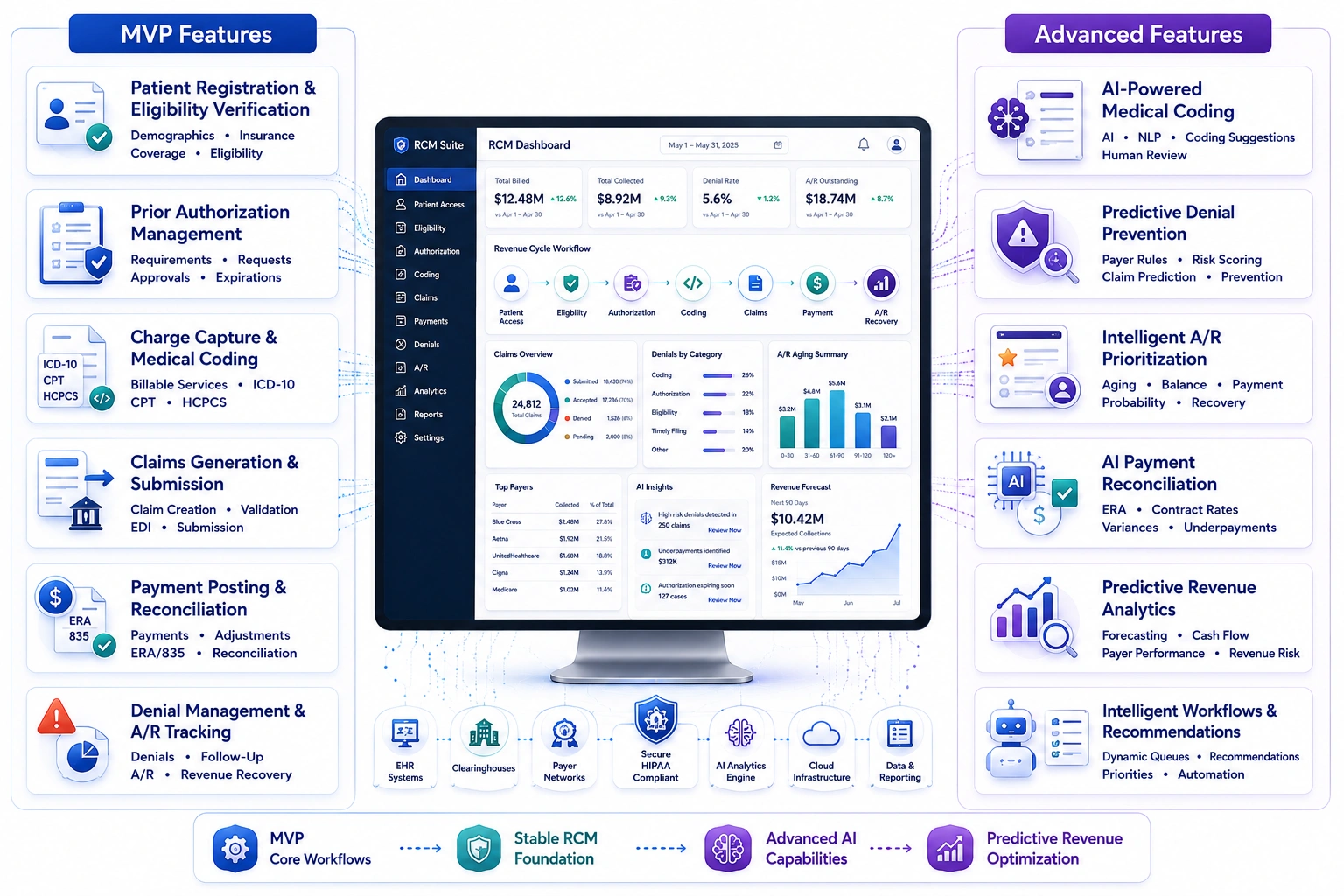
A phased approach is more practical and that’s why the MVP should cover charge capture, clean claims, payments, and A/R, while later phases add AI prediction, automation, forecasting, and revenue optimization.
A. MVP Features for RCM Software
An RCM software MVP should establish the core revenue cycle from patient registration to payment collection. These capabilities create the operational foundation required to capture billable activity accurately, submit claims efficiently, track reimbursement, and manage outstanding revenue.
| Feature | What It Does | Business Value |
| Patient Registration & Eligibility Verification | Captures demographics, insurance, and coverage details, then verifies eligibility before services. | Reduces registration errors, eligibility issues, and claim problems. |
| Prior Authorization Management | Tracks requirements, requests, approvals, expirations, documentation, and payer responses. | Reduces authorization delays and denials while preventing non-reimbursable services. |
| Charge Capture & Medical Coding | Captures billable services and converts clinical documentation into appropriate billing codes. | Improves charge accuracy, reduces missed revenue, and supports consistent reimbursement. |
| Claims Generation & Submission | Generates claims from patient, clinical, coding, and insurance data and submits them electronically. | Accelerates submission, reduces manual processing, and improves first-pass acceptance. |
| Payment Posting & Reconciliation | Records payments, adjustments, contractual amounts, and remittances while matching payments against expected reimbursements. | Speeds reconciliation, identifies discrepancies, and improves revenue visibility. |
| Denial Management & A/R Tracking | Tracks denials, categorizes causes, manages follow-ups, and monitors outstanding A/R. | Recovers unpaid revenue, reduces A/R aging, and identifies recurring revenue leakage. |
Note: The MVP should not attempt to automate every revenue-cycle activity from day one. Development should first prioritize the workflows that directly influence claim accuracy, reimbursement, collections, and A/R visibility. Once these foundations are stable, advanced automation can be introduced without creating unnecessary complexity in the initial product.
B. Advanced Features for RCM Software
Once the core revenue cycle is operational and sufficient data has accumulated, advanced capabilities can make the platform more proactive. Rather than simply processing transactions, these features can help RCM teams predict denials, prioritize revenue opportunities, automate complex decisions, and identify financial risks earlier.
| Feature | What It Does | Business Value |
| AI-Powered Medical Coding | Uses AI and NLP to analyze clinical documentation, identify coding information, and provide coding suggestions for review. | Reduces repetitive work, improves coding consistency, and accelerates billing while retaining human oversight. |
| Predictive Denial Prevention | Analyzes payer rules, eligibility, documentation, coding patterns, and claims history to flag high-risk claims before submission. | Shifts RCM from reactive recovery to proactive prevention, improving clean claim rates and protecting revenue. |
| Intelligent A/R Prioritization | Scores outstanding accounts using balance, aging, payer behavior, payment probability, and recovery potential. | Directs staff toward high-impact accounts and improves collections without proportionally increasing staffing. |
| AI Payment Reconciliation | Matches payments, remittances, contractual rates, and expected reimbursements while flagging unexplained variances. | Reduces reconciliation effort and identifies underpayments, posting errors, and reimbursement discrepancies faster. |
| Predictive Revenue Analytics | Uses historical and real-time data to forecast collections, cash flow, denial trends, payer performance, and revenue risks. | Provides earlier revenue visibility and supports decisions before issues materially affect cash flow. |
| Intelligent Workflows & Recommendations | Creates dynamic work queues and recommends actions based on claim status, payer behavior, financial impact, and priorities. | Focuses teams on high-value tasks, reducing administrative workload and standardizing RCM decisions. |
The right feature set depends on the healthcare specialty, payer mix, transaction volume, EHR/EMR infrastructure, workflows, compliance requirements, and business goals. Start with a focused MVP, validate results, then expand with AI and predictive capabilities.
How Much Does RCM Software Development Cost?
RCM software costs vary significantly depending on whether an organization chooses to buy an existing platform or build a customized solution. The decision depends on healthcare revenue cycle management companies, development expenses, implementation time, integration costs, maintenance requirements, and long-term ownership, making cost a key factor in selecting the right approach.
A. Development Phase-Wise Cost Table
A phase-wise estimate helps businesses understand where development budgets are allocated, from initial product planning and architecture to engineering, integrations, testing, deployment, and ongoing optimization.
| Development Phase | MVP Estimation | Enterprise Estimation | What This Phase Covers |
| Discovery & Requirements | $5,000–$10,000 | $25,000–$50,000 | Defines workflows, user roles, integrations, compliance requirements, and technical specifications. |
| UI/UX Design | $7,000–$15,000 | $30,000–$60,000 | Designs patient, billing, administrative, analytics, and revenue-management interfaces. |
| Backend & Core Development | $18,000–$40,000 | $150,000–$300,000 | Builds core RCM workflows, databases, APIs, business rules, and platform infrastructure. |
| Healthcare Integrations | $8,000–$20,000 | $80,000–$180,000 | Connects EHRs, EMRs, payers, clearinghouses, payment systems, and healthcare data services. |
| AI & Advanced Automation | $4,000–$15,000 | $60,000–$150,000 | Implements coding assistance, denial prediction, reconciliation, forecasting, and intelligent workflow automation. |
| Testing & Security | $5,000–$15,000 | $75,000–$150,000 | Tests functionality, interoperability, security, performance, access controls, and compliance workflows. |
| Deployment & Launch | $3,000–$15,000 | $30,000–$110,000 | Configures production infrastructure, deployment pipelines, monitoring, documentation, and launch support. |
| Estimated Total | $60,000–$130,000 | $500,000–$1M | Covers major development activities required to launch and scale an RCM platform. |
Note: These are indicative development ranges, not fixed market prices. Actual costs can vary based on the number of integrations, AI complexity, compliance scope, platform architecture, team location, and development timeline.
B. Estimated Cost by RCM Platform Complexity
Platform complexity provides another practical way to estimate an RCM development budget. A basic platform may automate essential billing workflows, while advanced and enterprise systems require deeper interoperability, AI, analytics, security, and scalability.
| Platform Type | Approx. Development Cost | Typical Features Covered |
| Basic RCM Platform | $60,000–$130,000 | Patient registration, eligibility verification, charge capture, basic coding, claims submission, payment posting, and basic reporting |
| Mid-Level RCM Platform | $130,000–$250,000 | Prior authorization, coding automation, claim scrubbing, denial management, A/R tracking, clearinghouse/EHR integrations, patient billing, and advanced reporting |
| Advanced AI-Powered RCM | $250,000–$500,000+ | AI-assisted coding, denial prediction, predictive A/R, automated prior authorization, intelligent claim scrubbing, workflow automation, and AI-powered analytics |
| Enterprise RCM Ecosystem | $500,000–$1M+ | Multi-facility workflows, multiple EHR/payer integrations, advanced AI/ML, custom business rules, enterprise BI, high availability, security, compliance, and scalable infrastructure |
Note: These figures should be treated as development estimates rather than fixed market prices. Integrations, AI models, compliance requirements, workflow complexity, development location, and infrastructure choices can significantly affect the final quote.
C. Factors That Influence RCM Development Cost
The development budget can change substantially depending on what the platform needs to automate, integrate, and support. The following factors typically have the greatest impact on an RCM software project’s final cost.
- Platform Scope & Workflow Complexity: A six-module MVP may cost $40,000–$80,000, while multi-specialty enterprise workflows can push development beyond $300,000.
- EHR, Payer & Clearinghouse Integrations: Each integration adds engineering, testing, and maintenance work, with complex healthcare connectivity potentially adding $10,000–$50,000+.
- AI & Machine Learning Requirements: Basic AI assistance may add $10,000–$30,000, while predictive denials, coding intelligence, and forecasting can exceed $50,000.
- Security & Compliance Requirements: HIPAA-oriented architecture, encryption, audit trails, access controls, and security testing can add $10,000–$40,000 depending on system complexity.
- Data Migration & Interoperability: Migrating historical claims, patient, payment, and A/R data can add $5,000–$30,000 depending on volume and source-system complexity.
How IdeaUsher Will Help You to Build Healthcare RCM Software
IdeaUsher operates as an enterprise product engineering partner and digital health innovator, leveraging 11+ years of hyper-focused industry mastery across 50+ countries. Driven by a globally distributed brain trust of 250+ niche experts, over 1,000+ completed projects, and a top-tier 4.9/5 Clutch credential, we engineer bespoke Revenue Cycle Management (RCM) platforms entirely from scratch.
We skip generic white-label templates to handcraft scalable, cloud-native billing architectures equipped with sub-second claim validation, multi-payer EDI routing, deep EHR interoperability, and automated denial management pipelines to maximize clean claim rates and secure your enterprise’s financial dominance.
A. RCM Architecture Designed Around Your Revenue Workflows
Rather than forcing complex multi-specialty practices into rigid billing templates, we design modular, cloud-native architectures tailored directly to your clinical care pathways and financial operations.
- Specialty-Specific Rule & Charge Capture Engines: We engineer flexible billing logic and automated charge capture modules configured to handle multi-facility rules, complex specialty fee schedules, and split billing workflows.
- Automated Patient Access & Financial Clearance: Our engineers build self-service digital intake modules that verify insurance eligibility instantly, generate upfront out-of-pocket cost estimates, and collect pre-service copays.
- Granular Role-Based Workqueues: We construct role-specific billing dashboards and automated task prioritization queues for billers, coders, and collection specialists, eliminating operational bottlenecks.
B. AI-Powered RCM Automation & Revenue Intelligence
We integrate production-grade machine learning models to automate repetitive administrative tasks and proactively eliminate claim leakage before submission.
- Predictive Denial Prevention & Pre-Claim Scrubbing: We build predictive ML models trained on historical remittance data to identify high-risk claims, flag missing clinical documentation, and scrub codes against dynamic LCD/NCD policies prior to payer transmission.
- Autonomous Appeal Generation & Workflows: Our developers deploy contextual natural language processing (NLP) pipelines that parse 835 denial reason codes (CARCs/RARCs) and automatically draft targeted appeal packages with attached clinical support.
- Real-Time Revenue Analytics & Executive Intelligence: We engineer comprehensive BI dashboards that track critical KPIs in real time—including Days in Accounts Receivable (DAR), Clean Claim Rates, First-Pass Yield, and Payer Denial Velocity.
C. Healthcare Integrations Built for Production-Grade RCM
We construct resilient, low-latency integration pipelines that connect your billing engine seamlessly with existing clinical databases and payer networks.
- High-Throughput EHR/EMR Connectors: We build compliant bi-directional bridges integrating with major clinical platforms (Epic, Cerner, Athenahealth, MEDITECH) utilizing modern FHIR, HL7, and SMART on FHIR protocols for real-time chart retrieval.
- Comprehensive X12 Clearinghouse Pipelines: Our architects engineer fault-tolerant EDI pipelines handling high-concurrency transaction sets including 270/271 (eligibility), 278 (prior authorization), 837P/837I (claim submission), 276/277 (claim status), and 835 (electronic remittance advice).
- Direct Multi-Payer API Connectivity: We build direct API integrations with national commercial insurers and CMS government payer clearinghouses (such as Availity, Change Healthcare, and Waystar) for sub-second claim acknowledgment.
D. From RCM MVP to Enterprise-Ready Platform
We implement a disciplined, agile software development lifecycle designed to validate core financial workflows rapidly while engineering for enterprise reliability.
- Rapid MVP Deployment & Workflow Prioritization: We prioritize the most critical operational modules first patient eligibility verification, core charge capture, and primary clearinghouse claims submission to launch a functional, revenue-generating MVP rapidly.
- HIPAA-Compliant, Isolated Cloud Architecture: We deploy containerized microservices across AWS and GCP configured with end-to-end AES-256 encryption, TLS 1.3+ protocols, comprehensive audit logging, and full HIPAA/HITECH compliance frameworks.
- Zero Vendor Lock-In Asset Delivery: We maintain complete operational transparency by delivering fully clean, well-documented, and audited source code packages, ensuring your healthcare organization retains 100% intellectual property and platform ownership from day one.
Ready to build a resilient, automated healthcare RCM platform tailored to your organization’s exact revenue workflows? Partner with Idea Usher’s principal healthtech and cloud software architects to map out your custom product build today.
Conclusion
The right healthcare revenue cycle management companies can determine how effectively financial workflows translate into measurable revenue performance. IdeaUsher stands out with its healthcare expertise, AI capabilities, integration experience, and end-to-end product engineering approach. The right platform should support essential RCM workflows while leaving room for predictive analytics, intelligent automation, and enterprise scalability. A clear understanding of business requirements, technology needs, compliance, and budget can help healthcare enterprises select the right partner and move toward a more connected revenue cycle.
FAQs
A.1. Healthcare RCM software should cover registration, eligibility, authorization, coding, claims, payments, denials, A/R, collections, and financial analytics to support the complete revenue cycle.
A.2. RCM software development typically ranges from $60,000 to $1 million+, depending on platform complexity, healthcare integrations, AI capabilities, compliance requirements, data migration, and enterprise scalability.
A.3. AI can strengthen RCM platforms through predictive denial prevention, coding assistance, A/R prioritization, payment reconciliation, revenue forecasting, and intelligent workflows that help prevent financial problems earlier.
A.4. A production-ready RCM platform typically requires EHR and EMR systems, clearinghouses, payer networks, payment gateways, healthcare APIs, and patient portals for continuous financial data exchange.