 (+971) 8007 4267
 (+91) 946 340 7140
 (+1) 628 432 4305

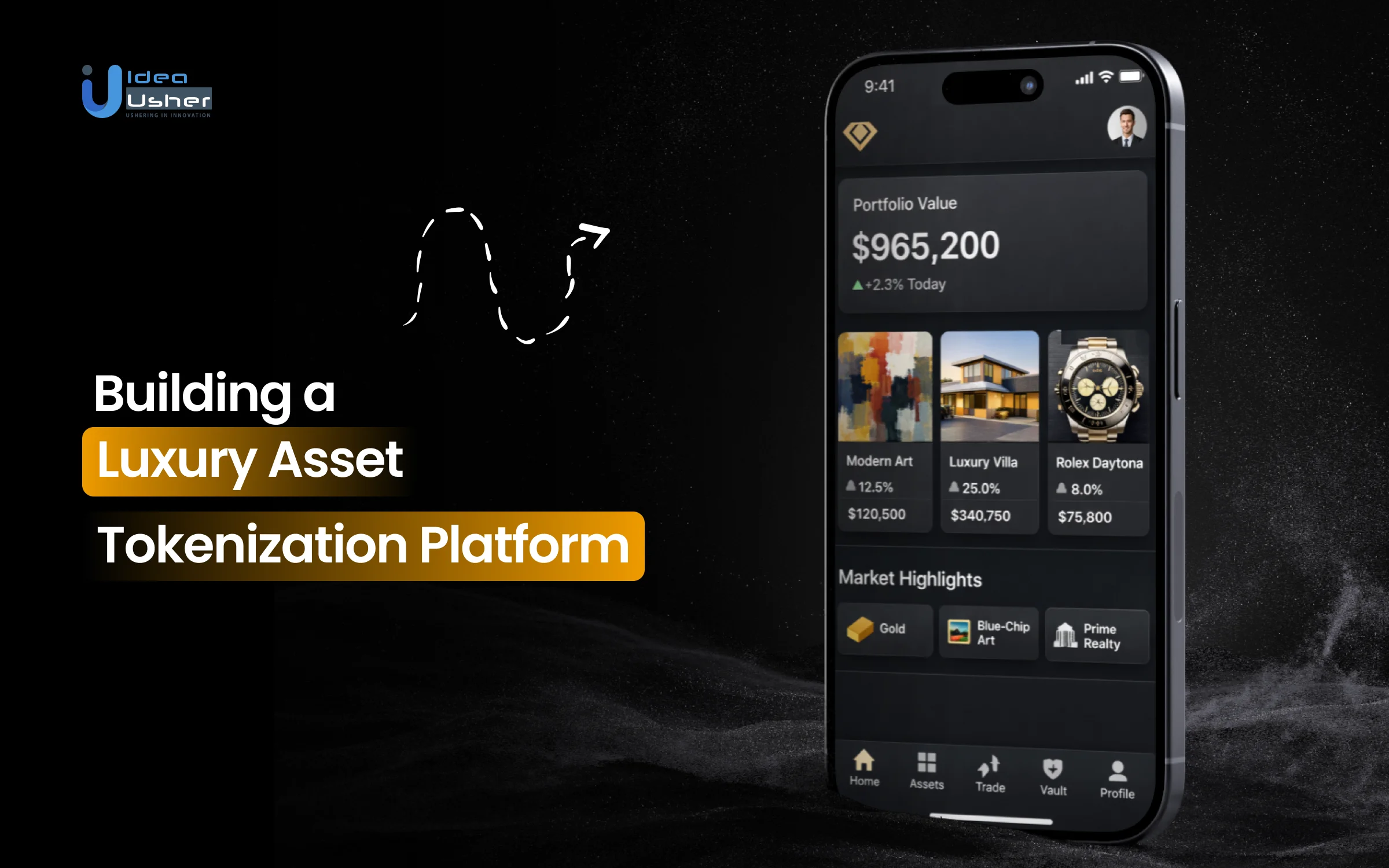
Owning luxury once felt like a milestone, but over time, it became burdensome. Storage, insurance, and resale delays quietly turned prized assets into operational burdens. As a result, more people began turning to luxury asset tokenization platforms for a simpler way to participate. These platforms reduce friction by removing physical handling and shortening liquidity cycles.
As wealth moved faster, digitally native investors expected ownership to follow suit. Traditional models struggled while tokenization embedded trust directly into systems. It enabled fractional access, verifiable ownership, and controlled liquidity without compromising compliance.
Over the years, we’ve developed numerous luxury asset tokenization solutions, powered by permissioned blockchain frameworks and digital identity-driven compliance systems. Given our deep expertise in this space, we’re sharing this blog post to outline the steps for developing a luxury asset tokenization platform.
Key Market Takeaways for Luxury Asset Tokenization Platforms
According to FortuneBusinessInsights, the global tokenization market is expanding steadily, with valuations rising from about USD 3.95 billion in 2025 to an expected USD 15.9 billion by 2034, growing at over 16 percent annually. Within this broader growth, luxury asset tokenization is carving out a distinct niche by turning fine art, classic cars, watches, jewelry, and luxury real estate into fractional digital assets.

Source: FortuneBusinessInsights
On the platform side, purpose-built luxury tokenization stacks are moving beyond experiments into structured financial infrastructure.
Firms such as Antier have developed end-to-end solutions that combine insured custody, compliance layers, smart contracts, and provenance tracking, enabling high-value assets to be fractionalized and traded without losing their real-world linkage.
Ecosystem partnerships are further accelerating adoption by linking luxury tokenization to broader Web3 and capital markets networks. Collaborations such as Hang Feng Technology Innovation’s work with Animoca Brands on the NUVA platform signal a move toward chain-agnostic vaultsfor regulated fractional ownership.

What Is a Luxury Asset Tokenization Platform?
A luxury asset tokenization platform is a regulated digital system that converts high-value physical assets, such as art, watches, real estate, or collectibles, into legally backed digital tokens. Each token represents fractional ownership tied to verified provenance, custody, and compliance rules.
This allows investors to access premium assets with transparency, liquidity, and enforceable ownership rights, while the assets themselves remain securely held.
How Luxury Tokenization Differs from Standard Asset Tokenization?
While the underlying technology may be similar, tokenizing a luxury asset is fundamentally different from tokenizing commercial real estate or a debt instrument. It operates at the intersection of high finance and high emotion.
| Aspect | Standard Asset Tokenization (e.g., Real Estate, Funds) | Luxury Asset Tokenization (e.g., Art, Supercars, Jewelry) |
| Primary Driver | Financial yield and operational efficiency | Emotional value, status, and scarcity |
| Core Motivation | Focused on ROI, rental income, and broad investor access | Driven by passion, collection, cultural capital, and prestige of ownership |
| Value Sensitivity | Sensitive to macroeconomic factors | Highly sensitive to condition and provenance |
| Value Dynamics | Prices fluctuate with interest rates and market cycles | A single flaw, missing record, or provenance gap can significantly impact value |
| Custody and Care | Transactional and largely passive | High-touch and active stewardship |
| Asset Management | Assets generally maintain themselves | Requires expert insurance, climate control, maintenance, and security |
| Compliance Focus | Securities regulations and investor eligibility | Secrecy laws, strict AML, cross-border movement, and patrimony regulations |
| Investor Controls | KYC and AML primarily at the investor level | Balancing privacy of HNW clients with enhanced AML and jurisdictional rules |
| Liquidity Challenge | Achieving scale through smaller fractions | Limited market depth and emotional attachment to unique items |
| Buyer Dynamics | Large pool of financially motivated buyers | Niche buyers who value the asset’s unique story and heritage |
Types of Luxury Assets Suitable for Tokenization
Luxury asset tokenization typically works best for assets with clear ownership and lasting value. These may include property, collectibles, rare items, and tangible assets that trade privately. When structured properly, tokenization can quietly add liquidity without weakening legal control.
1. Luxury Real Estate
High-end residential and commercial properties are well-suited to tokenization because they offer stable valuation, predictable yields, and long-term appreciation. Fractional ownership allows investors to access prime locations while legal ownership is structured through an SPV to maintain enforceability and regulatory clarity.
Example platform: RealT
Enables fractional ownership of income-generating real estate using blockchain-based tokens tied to legal entities.
2. Fine Art and Collectibles
Blue-chip artworks and museum-grade collectibles are ideal candidates for tokenization due to their scarcity and strong secondary-market demand. Tokens represent beneficial ownership while custody, provenance, and insurance are managed off-chain to preserve authenticity and protect investor interests.
Example platform: Masterworks
Allows investors to buy fractional shares in iconic artworks held in regulated, professionally managed structures.
3. Luxury Watches
Rare and limited-edition watches are highly liquid luxury assets with transparent market pricing and global demand. Tokenization enables shared ownership of authenticated timepieces stored in insured vaults, while investors gain exposure without the complexities of resale or storage.
Example platform: LuxTag
Focuses on tokenizing authenticated luxury items with emphasis on provenance, custody, and digital ownership records.
4. Rare Jewelry and Precious Gems
Certified gemstones and heritage jewelry retain intrinsic value and act as long-term stores of wealth. Through tokenization, ownership can be fractionalized while valuation is anchored to independent gem certification, and assets remain secured under regulated custodial arrangements.
Example platform: Everledger
Uses blockchain to track provenance, authenticity, and lifecycle data for diamonds and high-value gemstones.
5. Luxury Cars and Classic Automobiles
Vintage and limited-production luxury cars are appreciating assets driven by rarity and brand legacy. Tokenization allows investors to participate in these markets while professional custodians manage storage, maintenance, insurance, and future resale execution.
Example platform: CurioInvest
Enables fractional investment in rare collector cars held, insured, and maintained by specialized custodians.
6. Fine Wine and Rare Spirits
Investment-grade wine and aged spirits appreciate through controlled maturation and limited supply. Tokenization provides fractional exposure while professional storage, provenance tracking, and condition monitoring ensure asset quality and valuation integrity over time.
Example platform: Vinovest
Offers managed access to fine wine and spirits investments with professional storage and resale execution.
7. Luxury Yachts and Private Aviation Assets
High-value yachts and aircraft can generate charter revenue in addition to long-term resale value. Tokenization enables structured shared ownership where usage rights, operating costs, and income distribution are governed by clear legal and on-chain frameworks.
Example platform: Blocksquare
Provides tokenization infrastructure for real-world assets, enabling compliant fractional ownership and revenue sharing.
8. Luxury Fashion and Iconic Accessories
Select fashion assets, such as limited-edition handbags and archive pieces, have evolved into alternative investment assets. Tokenization brings liquidity to this market while authenticity verification, insured custody, and controlled resale preserve asset credibility.
Example platform: Tessera
Supports on-chain fractional ownership of high-value collectibles and luxury assets through NFT-based structures.
How Do Luxury Asset Tokenization Platforms Work?
A luxury asset tokenization platform takes a real asset and places it into a legal structure that can be represented on-chain. The ownership can then be divided into compliant digital tokens that can be traded securely between verified investors.

1. Asset Onboarding & Legal Wrapping
This is where the physical meets the contractual. The platform does not just take a photo of the asset. It legally reconstructs it for the digital world.
Due Diligence & Valuation
Independent experts authenticate and appraise the asset, such as a two-million-dollar vintage watch. Its full provenance is documented.
SPV Creation
The asset is placed into a Special Purpose Vehicle, usually an LLC. This is the masterstroke. You are no longer tokenizing a watch. You are tokenizing shares in the legal entity that owns the watch. This provides clear, established legal protection for fractional owners.
Insurance & Custody
The asset is insured at an agreed value and placed with a regulated high-security custodian, such as a vault, managed garage, or freeport.
2. Tokenization & Digital Twin Creation
Here, the legal share is translated into a programmable digital token.
Choice of Standard
The platform typically uses a security token standard such as ERC 3643 or ERC 1400. These are permissioned tokens with compliance built into their code. They cannot be transferred to an unverified or non-KYC wallet.
Minting the Digital Twin
A token is minted on the blockchain. Its metadata includes not only an image but also the hashes of SPV documents and appraisal reports, and a unique identifier linked to a physical NFC or RFID tag on the asset.
Fractionalization
The total token supply is divided into shares. For example, ten thousand tokens for a two-million-dollar asset means two hundred dollars per token. These tokens represent fractional ownership as digital securities.
3. The Compliance & Identity Layer
Before a single token can trade, the platform ensures it operates within regulatory boundaries.
- KYC AML Onboarding: Every investor completes identity verification. Their verified status is linked to their blockchain wallet using decentralized identity solutions such as ONCHAINID.
- Programmable Compliance: The smart contract is pre-coded with rules such as only accredited investors in permitted jurisdictions may hold the token. The token itself enforces the law.
4. The Phygital Bridge Oracles & Stewardship
This layer separates a luxury platform from static digital security. The platform maintains a live connection to the physical asset.
| Component | Description |
| IoT Oracles | Sensors send signed condition and location data on-chain through secure oracles such as Chainlink. |
| Dynamic NFTs | Live data updates asset metadata, including condition status and service history. |
| Automated Stewardship | Smart contracts automatically pay for insurance, storage, and maintenance from a shared treasury. |
5. Trading, Utility & Redemption
At this stage, the token becomes a fully functional asset.
Trading on Secondary Markets
Token holders trade their fractions on licensed secondary marketplaces. Settlement occurs in minutes, and compliance is enforced automatically.
Utility Execution
For experiential assets, the platform manages usage rights. If you own five percent of a yacht, the smart contract calculates annual usage credits and enables booking by consuming a usage token.
Physical Redemption
If a single buyer accumulates all tokens, they can trigger a redemption smart contract. Burning all tokens dissolves the SPV and transfers legal ownership of the physical asset. The custodian releases the asset after final on-chain verification.
How to Build a Luxury Asset Tokenization Platform?
Building a luxury asset tokenization platform usually starts with legal structuring that clearly defines ownership before any code is written. You should then design a digital twin and permissioned token logic so only verified participants can hold or transfer value.
We have delivered several luxury asset tokenization platforms, and this is the process we follow.

1. Legal Wrappers
We structure asset-specific SPVs to clearly separate ownership and risk. Token economics are mapped directly to shareholder or beneficiary rights defined in the legal documents. This ensures ownership and distributions remain enforceable at all times.
2. Digital Twin
We create a digital twin that represents the asset identity, condition, and lifecycle on-chain. Update triggers are defined for appraisals, inspections, and custody changes. Verified data sources ensure the on-chain record stays accurate.
3. Token Standards
We implement permissioned token standards that enforce compliance within the protocol itself. Investor eligibility, transfer rules, and jurisdiction logic are embedded at the token level. Decentralized identity ensures only verified wallets can participate.
4. Ownership Engine
We build fractional ownership logic that calculates precise ownership in real time. Usage and access rights are derived directly from token holdings. Control systems ensure benefits are granted only to eligible holders.
5. Custody and Lending
We integrate custody workflows that manage storage, audits, and asset control. Insurance coverage adjusts automatically to asset value and risk. Lending rails allow token holders to access liquidity without selling ownership.
6. Exit Flows
We design redemption and exit paths from the start, so nothing is left to chance. Buyback-and-burn logic is designed to mirror the legal settlement process on-chain. Asset release occurs only when all contractual conditions are fully met.
Which Token Standards Are Ideal for Regulated Luxury Asset Ownership?
Choosing the right token standard is not a technical footnote. It is the foundational legal and architectural decision that determines whether your luxury platform attracts institutional capital or faces regulatory shutdown. For regulated luxury assets, the ideal standards are those engineered not only for functionality but also for enforceable compliance.

The Core Challenge: Security vs. Collectible
Luxury assets such as fine art, vintage cars, and high-value real estate typically fall under securities regulations when fractionalized and offered for investment. This means the token must be more than a simple deed. It must be a programmable financial instrument that enforces laws at the protocol level.
Here is a breakdown of the leading standards and why one stands above the rest for regulated luxury.
The Contenders: A Comparative Analysis
| Token Standard | Primary Design Purpose | Key Feature for Luxury | Regulatory Suitability | Ideal Use Case in Luxury |
| ERC-3643 (T-REX) | Regulated Security Tokens | On-chain KYC and AML are enforced on a per-transfer basis. | Highest | Fractional ownership of high-value assets where investor eligibility and jurisdiction rules must always apply. |
| ERC-1400 / 1404 | Security Tokens and Capital Markets | Modular compliance via transfer restrictions. | High | Multi-tiered ownership structures with different investor rights. |
| ERC-1155 (SFTs) | Semi Fungible Tokens | Combines fungible shares and usage rights. | Medium | Fractional ownership paired with limited experience or access tokens. |
| ERC-721 | Non-Fungible Tokens | Provenance and uniqueness. | Low | Authenticity tracking for single, non-fractionalized luxury assets. |
Why ERC-3643 (T-REX) Is the Industry Benchmark?
For a platform targeting serious institutional and high-net-worth investors, ERC-3643 is not just an option. It is becoming the industry standard. Here is why it is ideally suited for regulated luxury.
1. Identity Is Decentralized and Integral
Instead of relying on an off-chain database for KYC, ERC-3643 uses ONCHAINID. These are decentralized identity wallets that store verified credentials, such as accredited investor status and jurisdiction, on-chain and are signed by licensed providers.
The Luxury Advantage
When a user tries to buy a tokenized Picasso fraction, the smart contract checks the buyer’s ONCHAINID before the trade executes. If the credential is missing or invalid, the transaction reverts at the protocol level. Compliance is a precondition, not a later check. This satisfies strict know-your-transaction requirements enforced by financial regulators.
2. Granular, Programmable Transfer Rules
The standard allows issuers to set complex rules. For example, tokens can be held only by wallets with accredited U.S. status, and no single wallet may hold more than 10% without board approval.
The Luxury Advantage
This enables features critical to luxury markets.
- Preemption rights: Rights of first refusal can be encoded for existing co-owners.
- Jurisdiction locking: Tokens can be prevented from flowing into countries with unfavorable tax or regulatory treatment.
- Velocity limits: Rapid speculative flipping can be restricted to preserve a stable long-term ownership base.
3. Built-In Agent and Enforcement Roles
The standard formalizes roles such as Transfer Agent and Enforcement Agent within the smart contract. These agents may be multi-signature wallets controlled by legal entities and are authorized to force-transfer tokens in response to court orders or to correct errors.
The Luxury Advantage
This creates a direct legal bridge. If a court rules that an asset was fraudulently tokenized, a recognized Enforcement Agent can freeze or reallocate tokens. This ensures the blockchain state can be reconciled with the legal system, which is a critical requirement for assets valued in the millions.
The Strategic Token Architecture: A Hybrid Approach
The most sophisticated platforms do not rely on a single standard. They use a hybrid model.
- ERC-3643 for the Security Token: Represents fractional financial ownership of the asset held in an SPV. This is a regulated and tradeable security.
- ERC-1155 for Utility and Proof: Mints non-transferable experience tokens for usage rights and can bundle them with the security token. It may also link to a master ERC-721 digital twin that acts as the immutable provenance passport for the physical asset.
This architecture cleanly separates responsibilities. Regulation governs the investment layer. Dynamic NFTs capture the story and condition. Utility tokens enable access and experience. All layers interoperate without compromising compliance.
What Happens If a Single Investor Wants Full Ownership of a Tokenized Luxury Asset?
If one investor seeks full ownership, they may acquire most tokens, triggering a redemption process. Remaining holders may be settled at a fair on-chain price. The tokens are then burned, and legal ownership transfers.

The Buyout and Burn Process
The mechanism is elegant, transparent, and hard-coded into the platform’s smart contracts. It is not a manual negotiation. It is a governed, automated process often referred to as a Redemption or Buyout function.
1. The Accumulation Phase
An investor known as the redeemer begins acquiring tokens on the secondary market, similar to buying shares of a stock. They may own 30 percent, 60 percent, or 90 percent through open market purchases.
Take, for example, platforms like Rally or Collectable, where users trade fractions of sports memorabilia or rare cars.
An investor could steadily buy shares of a tokenized 1965 Ford GT40 over several months on the platform’s secondary market, gradually increasing their stake toward majority control.
2. Triggering the Redemption Smart Contract
Once the redeemer reaches a predefined threshold, such as 90 percent ownership or a simple majority as defined in the SPV operating agreement, they can activate a special function in the smart contract called the Redemption Offer.
This is a formal on-chain offer to purchase all remaining tokens at a specified price.
Crucially, this offer is often structured as a Dutch Auction or a Fair Value Offer.
- Dutch Auction: The offer starts at a high price and automatically decreases over a set period, such as 72 hours. This encourages remaining holders to sell earlier for a better price.
- Fair Value Offer: The price is set using a predefined valuation method. This may involve an oracle or a valuation committee, informed by recent appraisals and market data. The goal is to establish a legally defensible fair market value.
Platforms such as Arca or Securitize that focus on regulated security tokens often follow this model. If an investor seeks full ownership of a tokenized luxury asset on these platforms, a third-party appraiser establishes the current fair market value. That value becomes the binding offer price for all remaining token holders.
3. The Forced Sale and Automatic Settlement
This is where token programmability becomes critical. The smart contract automatically notifies all remaining token holders about the offer and the deadline.
Holders can choose to sell their tokens directly to the redemption contract at the offered price.
If a minority holder refuses to sell, the platform’s legal framework and smart contract logic address the issue.
Once a supermajority, such as 95 percent, accepts the offer, the contract can force the sale of the remaining tokens at the same fair price. This protects the redeemer’s right to full ownership as defined in the original SPV legal documents.
All funds are held and distributed automatically through smart contract escrow. Settlement is instant and trustless.
4. The Burn and Legal Transfer
Once 100 percent of the tokens are collected by the redemption contract, the final transition begins.
- Token Burn: The smart contract permanently burns all tokens. This provides definitive on-chain proof that fractional ownership has ended. The digital representation no longer exists.
- Legal Trigger: The burn event serves as a cryptographic trigger for the SPV’s legal wrapper.
Smart legal clauses are activated.
The SPV is formally dissolved. Its sole asset, the physical luxury item, is legally transferred to the redeemer, who is the only remaining shareholder.
Physical Release:
The platform custodian receives immutable on-chain proof of the burn along with signed legal instructions. The physical asset is released to the redeemer or their authorized agent, completing the full digital-to-physical ownership loop.
Top 5 Luxury Asset Tokenization Platforms
We have closely studied how luxury asset tokenization platforms are evolving from a system and infrastructure perspective. What stood out was how these platforms could securely link physical luxury assets with on-chain ownership while still supporting fractional access.
1. Tiamonds

Tiamonds focuses on tokenizing high-value luxury assets, including diamonds, gemstones, gold, and collectibles. The platform enables fractional ownership with on-chain provenance, making it easier for investors to buy, sell, and trade authenticated luxury assets across supported blockchains while preparing for deeper DeFi integrations.
2. The Artisan

The Artisan is built around premium luxury goods, especially high-end watches and collectibles. It enables fractional ownership, allowing investors to access exclusive assets with smaller capital, while on-chain trading ensures transparency, traceability, and secure ownership transfers.
3. BlockCellar

BlockCellar specializes in tokenizing investment-grade wine and spirits by linking physical bottles to blockchain-backed tokens. Each asset is securely stored and authenticated, giving global investors access to provenance-verified wine assets with the ability to trade ownership digitally.
4. Aconomy Marketplace

Aconomy Marketplace operates as a decentralized peer-to-peer platform for tokenizing luxury goods, including watches, handbags, and jewelry. Assets are authenticated before being tokenized, and on-chain verification helps ensure transparent and secure trading between participants.
5. Tokeny

Tokeny is known for enabling compliant fractional ownership of high-value assets like rare diamonds and collectibles. Its focus on security token standards and regulatory alignment makes it well-suited for luxury asset tokenization, where legal enforceability and investor protection are critical.
Conclusion
Luxury asset tokenization is no longer speculative, and it is quietly becoming infrastructure you can rely on. Platforms that combine trust, compliance, and usability will likely set the standard and scale with confidence. Enterprises that invest early may build defensible systems and unlock premium revenue in a controlled way. The future of luxury ownership will be programmable, compliant, and global, and it can increasingly operate securely across borders.
Looking to Develop a Luxury Asset Tokenization Platform?
IdeaUsher can help you build a luxury asset tokenization platform by first aligning legal structuring with protocol design so the asset stays enforceable from day one. We may then design permissioned token logic with identity and compliance embedded at the protocol level, rather than adding them later.
Why Partner With Us?
We have over 500,000 hours of proven engineering experience delivered by ex-MAANG and FAANG teams building Silicon Valley-grade systems.
- Beyond NFTs. We build the full phygital stack.
- Legal SPV and compliance engines using ERC 3643
- IoT to blockchain oracles for real-world proof
- Fractional utility and liquidity layers
- White glove custody and redemption systems
Explore our latest projects to see the caliber we bring to transformative ventures like yours.


FAQs
A1: Luxury asset tokenization is built around real ownership rather than digital proof of uniqueness. The asset is legally placed into a regulated structure, and the token represents enforceable rights. NFTs typically track provenance but do not transfer legal title. In tokenization, the platform can actively enforce compliance and custody, which NFTs generally cannot do.
A2: They can be legally enforceable when the structure is done correctly. The asset is typically held in an SPV, and token holders are assigned recognized ownership rights. Courts can rely on these agreements if needed. This approach may quietly align blockchain records with existing legal systems.
A3: Yes, redemption can be built into the token lifecycle. A buyout event may be triggered when conditions are met. Tokens are then burned to release ownership of the underlying asset. This process can work smoothly if it is clearly defined from the start.
A4: Ethereum-based ecosystems are often preferred for this use case. They offer mature security models and widely tested compliance tooling. Developers can reliably implement permissioned transfers and audits. This makes Ethereum a practical choice for regulated luxury assets.


