

Key Takeaways
- To build a sports prediction exchange like Railbird, develop a platform where users can trade contracts based on sports outcomes.
- Start by defining the market model, contract types, trading rules, and target jurisdictions.
- Build the core exchange infrastructure, including order matching, pricing, wallets, settlement, and real-time trading.
- Integrate reliable sports data feeds and add liquidity, risk management, KYC, and compliance controls.
- See how IdeaUsher can help you build a sports prediction exchange like Railbird with custom trading and exchange infrastructure.
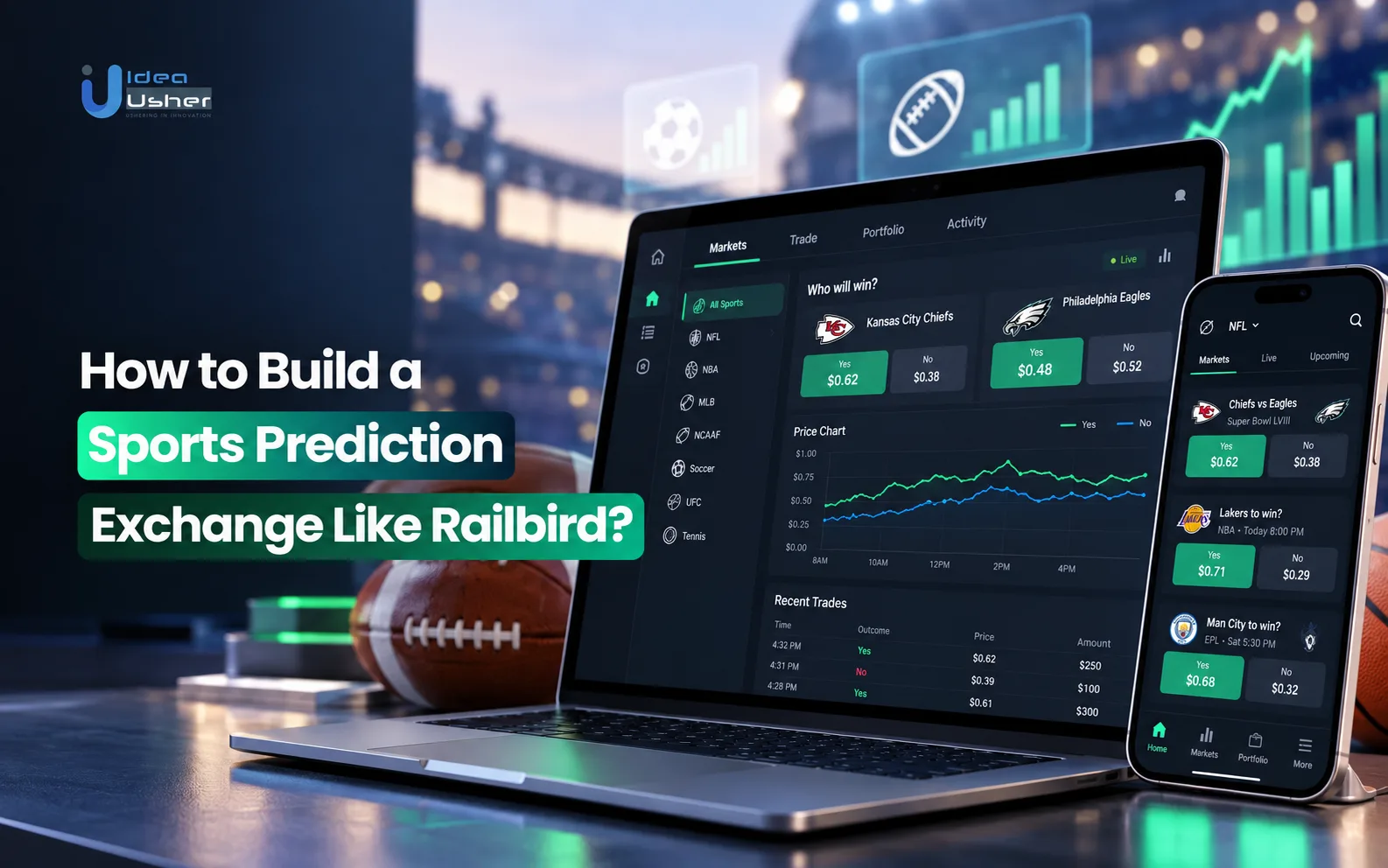
Developing a sports prediction exchange like DraftKings’ Railbird requires a scalable order-matching system, strong regulatory controls, and real-time sports data infrastructure. What may look like a simple platform where users predict game outcomes is actually a live trading environment, where prices change, orders are matched, and contracts are settled based on real-world sports events.
As more users look for ways to trade sports outcomes instead of simply placing fixed-odds bets, prediction exchanges are creating a different kind of sports market. Building one means bringing together trading technology, reliable data feeds, liquidity, secure wallets, and compliance into one seamless experience. This blog explores what it takes to build a sports prediction exchange like Railbird and turn the idea into a scalable platform.
Market Demand for Sports Prediction Exchanges
Demand for sports prediction exchanges is rising rapidly. According to Future Market Insights, the sports betting market is projected to grow from USD 111.9 billion in 2025 to USD 298.1 billion by 2035, at a 10.3% CAGR. Fixed-odds wagering is expected to account for 34.6% of revenue in 2025. As the market expands, prediction exchanges are attracting users who want to trade live prices rather than accept fixed bookmaker lines.
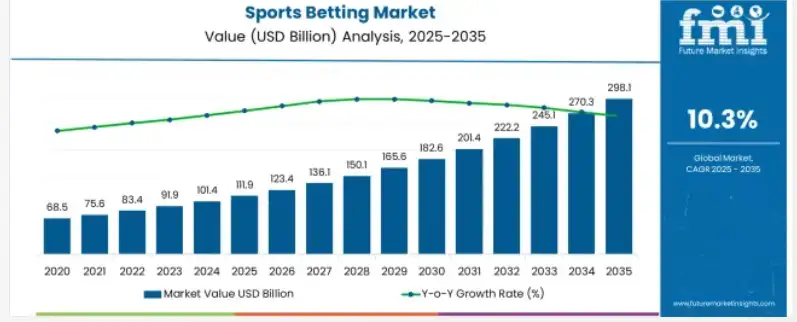
Source: Future Market Insights
Growth of Sports Prediction Markets
Pew Research Center found that monthly prediction-market trading volume rose from under $5 billion in mid-2025 to nearly $24 billion in April, with sports accounting for a major share. Since July 2024, sports represented 80% of Kalshi’s trading volume and 39% of Polymarket’s. Around the FIFA World Cup, combined monthly volume on both platforms more than doubled between May and July, while sports trading exceeded $58 billion on Kalshi and nearly $22 billion on Polymarket in June and July.
| Metric | Figure | Source |
| Combined lifetime volume (Kalshi + Polymarket) | Crossed $150 billion in April | NextPredict |
| Prediction market volume in one quarter | $111 billion in Q2 | Artemis via Sporting Crypto |
| Biggest single month | $52.7 billion in June | Artemis via Sporting Crypto |
| Kalshi volume from sports | 86% in Q2 | Artemis via Sporting Crypto |
| US adults trading sports | 5% overall; 11% of men aged 18–34 | SSRS Sports Poll |
Sports-Only Exchanges Are Emerging
Novig is another example of this growth. The sports-only platform launched its federally regulated prediction market across the U.S. in early August after receiving CFTC approval in June. Its exchange entity, Ludlow Exchange, was designated as a contract market. Novig later became the Exclusive Official Prediction Market Partner of the New York Mets and an MLB Authorized Prediction Market. Its sports-focused, peer-to-peer model shows how specialized exchanges can build partnerships around regulated markets.
Rising Demand for Real-Time Sports Trading
Prediction exchanges let users trade as prices move during a game and exit positions before settlement. This has helped drive major event volumes. The Spain–Argentina World Cup final generated more than $1.27 billion in Kalshi trading volume before kickoff, while NFL opening weekend generated more than $3 billion in prediction-market volume across Saturday and Sunday.
What Traders Are Trading
- Football drives volume: Football accounted for 42% of Kalshi’s volume last season, worth roughly $14 billion across NFL and college football.
- Combos are growing: Kalshi’s combination markets exceeded $100 million in their first week and reached 30% of notional volume in Q2.
- Individual markets can scale: Polymarket’s World Cup winner market passed $3 billion in total volume by late June.
Robinhood’s Rothera exchange shows how quickly retail platforms are expanding sports prediction trading. Its World Cup contracts covered match results, tournament winners, spreads, totals, player contracts, and combos. Robinhood reported that more than 3.5 billion contracts had been traded on Rothera since its June launch. From September 8, it also began routing selected football contracts to Crypto.com’s exchange alongside Kalshi, ForecastEx, and Rothera.
Shift From Sportsbooks to Prediction Exchanges
The growth is also changing how traditional sportsbooks approach the market. H2 Gambling Capital estimated that prediction markets represented about 27% of legal U.S. sports-betting volume during the World Cup, compared with roughly 9% at the start of the year.
| Factor | Traditional Sportsbook | Prediction Exchange |
| Who sets the price | Bookmaker | Traders through bids and offers |
| Counterparty | Usually the sportsbook | Other participants and market makers |
| Operator revenue | Margin in the odds | Transaction fees |
| Exiting a position | Limited cash-out options | Sell before settlement |
| U.S. regulator | State gaming authorities | CFTC at the federal level |
Major Sportsbooks Are Entering
DraftKings launched a Predictions app across 38 states, including California and Texas. FanDuel launched FanDuel Predicts through CME and later added contracts from Crypto.com’s federally regulated exchange. DraftKings described prediction markets as a “massive incremental opportunity.”
New platforms are also gaining traction. Polymarket US increased from 3% to 27% of total Polymarket volume in six months. Together, these developments show growing demand for exchange-style sports products and create an expanding opportunity for businesses building specialized prediction-market infrastructure.
What Is a Sports Prediction Exchange?
A sports prediction exchange is a regulated marketplace where users buy and sell contracts tied to sports outcomes, such as game results, player performance, or championships. Unlike a sportsbook, traders set prices through bids and offers, while the exchange matches orders rather than taking the opposite side. Contracts settle at a fixed value once the outcome is verified.
Prediction Markets vs Sportsbooks
The main difference is who sets the price and who takes the other side. Sportsbooks set their own odds and typically act as the counterparty. Exchanges let buyers and sellers determine prices, while the platform operates as a neutral marketplace.
| Factor | Traditional Sportsbook | Sports Prediction Exchange |
| Price setter | Bookmaker | Buyers and sellers |
| Your counterparty | Usually the sportsbook | Another trader or market maker |
| Operator revenue | Margin in the odds | Trading fees |
| Exiting early | Limited cash-out | Sell before the event ends |
| U.S. oversight | State gaming regulators | CFTC, at the federal level |
ProphetX illustrates this model. Its launch materials say it went live as a federally regulated sports prediction market on June 17, serving eligible users in 49 states. It raised $35 million on July 28, led by Parlay Capital and Data Point Capital. The platform supports limit and market orders and has added distribution partners including Players’ Lounge, Pikkit, Boom Sports, and Agg Market, which brings ProphetX contracts to Solana.
How Sports Contracts Work
A sports event contract is typically a Yes-or-No contract tied to a specific outcome. Contracts can range from $0.01 to $0.99, with a winning contract paying $1.
A Typical Trade
- Pick a market: Choose a game result, spread, total, player prop, or future.
- Choose a side: Buy Yes if you expect the outcome to happen or No if you expect it won’t.
- Place an order: Market orders fill at available prices, while limit orders execute at your chosen price.
- Hold or sell: Sell before the event ends if the market price changes.
- Settlement: The contract pays $1 if correct and $0 if incorrect.
Fees affect the final return. For example, Robinhood’s example shows a $0.47 Yes contract costing $0.49 after a $0.01 exchange fee and $0.01 commission. Another platform’s guide shows a $0.20 contract costing $0.23 after fees.
How Exchange Pricing Works
On an exchange, the contract price reflects the market’s implied probability. A $0.60 contract represents roughly a 60% implied probability. Prices change as traders respond to injuries, lineups, goals, and other information. Underdog shows how owning exchange infrastructure can give an operator greater control over its product and trading economics.
After initially offering prediction markets through other exchanges, it launched its own CFTC-licensed exchange in July after acquiring a designated contract market and clearing organization.
| Contract Price | Implied Probability | Profit If Right* |
| $0.25 | 25% | $0.75 |
| $0.50 | 50% | $0.50 |
| $0.67 | 67% | $0.33 |
| $0.75 | 75% | $0.25 |
*Before fees.
How a Railbird-Style Sports Exchange Works?
A Railbird-style sports exchange turns sporting events into Yes-or-No contracts that traders buy and sell through a central order book. Traders post prices, the matching engine pairs compatible orders, and prices move as new orders enter. Positions can be tracked or sold before the event ends. Once the result is confirmed, contracts settle at a fixed value and winners are paid. The exchange operates the market and clearing process rather than setting the odds.
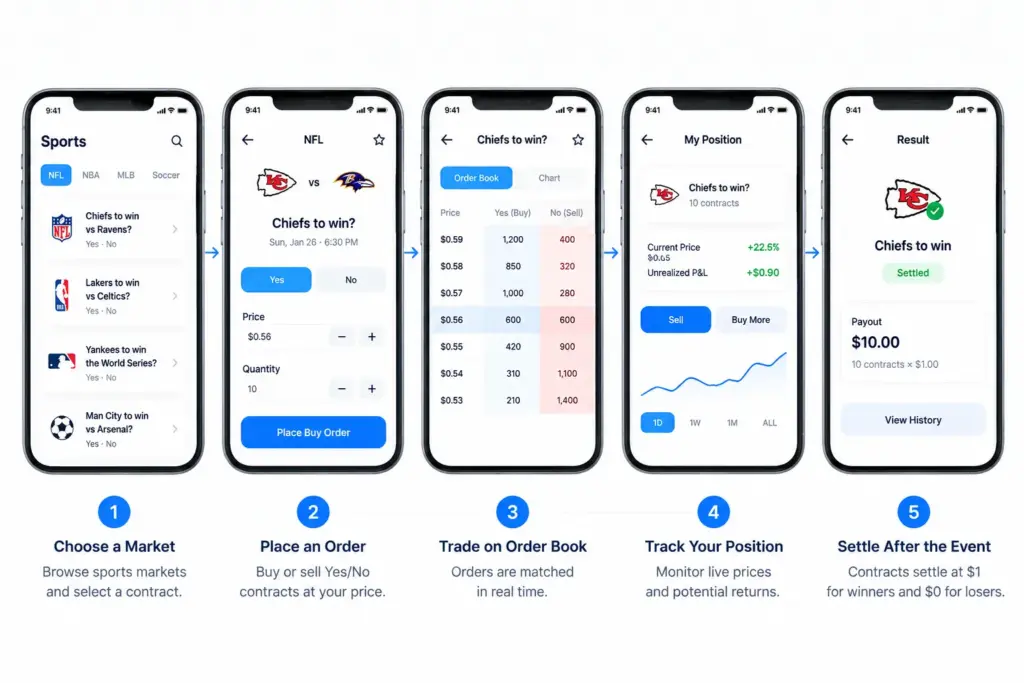
1. Turning Sports Events Into Contracts
Contract design is the foundation. Railbird Exchange, now doing business as DKeX, is a CFTC-registered designated contract market. Six product certifications filed on May 26 covered game winners, spreads, game and player props, and head-to-head markets. The templates can be used for different teams, players, competitions, and time periods across football, basketball, baseball, hockey, golf, MMA, motorsports, soccer, and tennis.
| Filing | What It Covers | Sportsbook-Style Equivalent |
| GAMEWIN | Whether a team, player, or competitor wins | Moneyline, period winner, tournament winner |
| GAMESPREAD | Whether a score differential meets a threshold | Point spread, run line, puck line |
| GAMEPROPERTY | Whether a specific game event occurs | Game props, exact-score props |
| ENTITYSTAT | Whether a team or player reaches a statistic | Player props, team stat props |
| ENTITYACHIEVEMENT | Whether a team or player reaches an award or milestone | Futures, awards, playoff qualification |
| ENTITYOUTPERFORM | Whether one competitor beats another on a metric | Head-to-head and matchup props |
Each contract family includes schedules, settlement rules, contingencies, and examples. This ensures traders know exactly what qualifies as a winning outcome.
2. Creating Buy and Sell Orders
Once a contract is listed, traders can buy Yes or No. A market order fills at the best available price, while a limit order waits for the trader’s specified price. A limit buy is called a bid, while a sell order is an offer. Railbird’s fee structure includes:
- Placing, canceling, or modifying orders: Free, with no settlement fees.
- Taker fees: 0.005–0.01 per contract, depending on contract price.
- Maker fees: $0.0025 per contract for resting orders.
Because fees apply when trades match, the structure can encourage traders to provide liquidity through resting orders.
3. Matching Orders Through a CLOB
The exchange’s core is a central limit order book or CLOB containing outstanding buy and sell orders. Its matching engine typically follows price-time priority: the highest bid and lowest ask are matched first, while orders at the same price are filled based on arrival time.
Simple Order Match
- A trader bids $0.55 for Yes on a game-winner contract.
- Another trader offers Yes at $0.57, so the orders remain unmatched.
- A market buy then fills against the $0.57 offer.
- Alternatively, the first trader raises the bid to $0.57, triggering a match.
Railbird also filed a market maker program designed to improve CLOB liquidity. Market makers generally need to quote both sides, maintain maximum spreads, and provide minimum depth to qualify for incentives.
4. Tracking Prices and Positions
After execution, a position remains open while its value changes with the market. Traders monitor the best bid, best offer, last traded price, and order depth. A $0.55 contract implies roughly a 55% market probability, while a move to $0.65 can reflect new information such as an injury, lineup change, or goal.
| What the Trader Sees | What It Means |
| Best bid and best offer | Highest buyer price and lowest seller price |
| Last traded price | Most recent matched price |
| Order depth | Contracts available at each price |
| Open position | Contracts currently held |
| Unrealized gain or loss | Difference between current and entry price |
For example, buying Yes at $0.40 and seeing it rise to $0.55 creates an unrealized gain of $0.15 per contract before fees. The trader can sell or hold for the potential $1 payout.
5. Resolving and Settling Contracts
When an event ends, the exchange verifies the result and settles open contracts. A winning contract pays $1, while a losing contract pays $0. Settlement rules must address edge cases in advance, such as whether a total landing exactly at a threshold counts as over or under. Railbird’s filings handle these situations through settlement rules, contingencies, and examples for each contract family.
From Railbird to DKeX
DraftKings acquired Railbird last fall and launched its proprietary exchange, DKeX, within its DraftKings: Sports & Casino app. The deal reportedly included $50 million upfront and up to $200 million in incentives. Before DKeX, DraftKings Predictions offered contracts from CME Group and Crypto.com.
Owning the exchange gives DraftKings greater control over contract design, pricing, fees, and trading infrastructure, while allowing it to collect trading fees directly.
Choosing a Sports Market Structure for Your Exchange
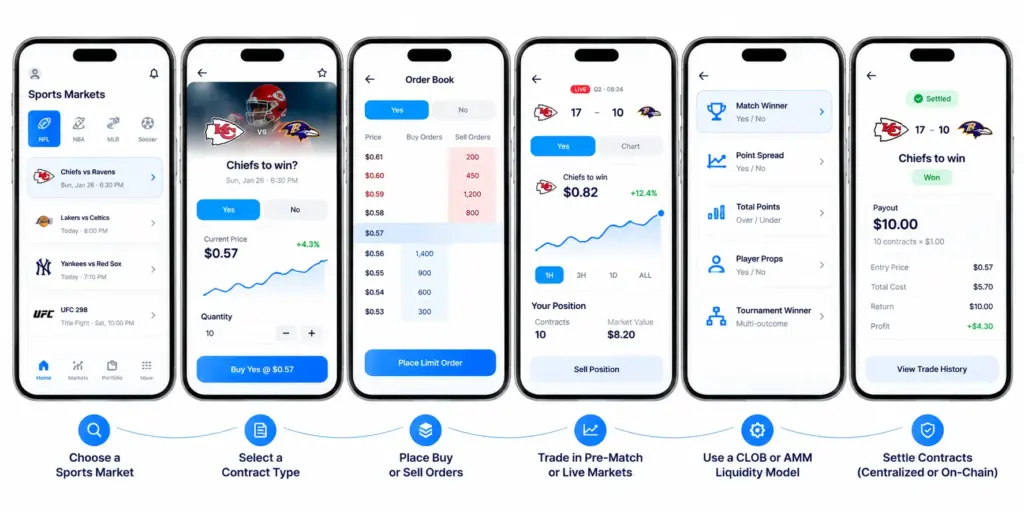
For most new sports exchanges, a simple structure works best. Start with binary Yes/No contracts on a CLOB, keep matching fast and off-chain, and use regulated clearing for settlement. Add multi-outcome markets when liquidity improves and introduce in-play trading once the engine can handle rapid price changes. AMMs and on-chain settlement can be added for specific use cases, but both increase complexity, cost, and regulatory considerations.
1. Binary Sports Contracts
A binary contract asks a Yes/No question and pays $1 if Yes and $0 if No. Prices usually range from $0.01 to $0.99 and directly represent implied probability. Buying 100 Yes contracts at $0.57 costs $57 and pays $100 if correct, creating a $43 gross profit. A $2 fee reduces that to $41.
This simple structure makes contracts easy for users to understand and easier to define and regulate.
Railbird, now operating as DKeX, self-certified six contract templates:
- GAMEWIN: Whether a team or player wins.
- GAMESPREAD: Whether a score difference meets a threshold.
- GAMEPROPERTY: Whether a specific game event occurs.
- ENTITYSTAT: Whether a player or team reaches a statistic.
- ENTITYACHIEVEMENT: Whether a player or team reaches an award or milestone.
- ENTITYOUTPERFORM: Whether one competitor beats another.
All six ultimately resolve as Yes or No. Railbird’s filed fees include 0.005–0.01 per contract for takers and $0.0025 for makers.
2. Multi-Outcome Markets
Multi-outcome markets offer several possible answers to one question, such as who wins a tournament. They can behave like linked binary contracts, but the relationship between outcomes must be clearly defined.
| Structure | How It Resolves | Price Check | Sports Example |
| One-winner | One outcome resolves Yes | Prices usually total slightly above $1 | Championship winner |
| Bracketed | One range contains the result | Usually behaves like one-winner | Total game points |
| Ladder/directional | Multiple outcomes can resolve Yes | Total can exceed $1 | Over thresholds |
For example, four asks of $0.44, $0.31, $0.18, and $0.12 total $1.05. The extra $0.05 can represent trading costs across the rows. Commentary on Polymarket’s World Cup winner market, covering 48 teams plus an “Other” outcome, reported totals around 1.05–1.12.
For builders, outcomes should be mutually exclusive and exhaustive. Missing an edge case or leaving gaps between ranges can create settlement disputes.
3. Pre-Match vs In-Play Markets
Pre-match markets allow trading before an event, while in-play markets remain active as the game unfolds. A contract priced at $0.58 before a game could rise to $0.82 as the favorite takes a lead. Kalshi’s sports markets show strong live-trading activity. The Masters had generated more than $33 million in volume by its second round, with analysts noting that closer games can produce more trading.
The engineering requirements increase as you move toward live markets:
- Pre-match only: Lower infrastructure demands and slower price movement.
- Add in-play: Requires fast matching, live data, and market-pause rules.
- Design for live trading: Short-resolution markets such as next-score or period-winner contracts become useful.
A practical approach is to launch pre-match markets first, then introduce in-play trading for selected high-volume sports.
4. CLOB vs AMM Liquidity Models
A CLOB matches buyer and seller orders by price and time. An AMM uses a pricing formula and liquidity pool to provide continuous trading. One well-known prediction-market model is the Logarithmic Market Scoring Rule or LMSR, proposed by economist Robin Hanson in 2002.
Polymarket initially used an AMM to address the cold-start problem before moving to a CLOB in late 2022 to attract professional market makers and improve spreads. Kalshi and Railbird also use order-book models.
| Factor | CLOB | AMM |
| Liquidity source | Market makers and resting orders | Algorithmic liquidity pool |
| Busy markets | Tighter spreads | More slippage |
| Thin markets | Can lack liquidity | Always tradable |
| Scaling cost | Lower once makers participate | Requires market funding |
| Regulatory fit | Familiar to CFTC framework | Less familiar |
Academic research highlights a key limitation of AMMs: liquidity must be funded upfront, which becomes difficult across thousands of simultaneous markets.
AMMs still have use cases. Limitless allows permissionless market creation with seed liquidity from a minimum of $10, while Azuro uses shared pools and virtual AMMs. For a regulated sports exchange, however, a CLOB with a formal market-maker program is a practical model.
5. Centralized vs On-Chain Settlement
Settlement determines how a contract becomes a payout. In a centralized model, the exchange and clearinghouse determine the result using defined sources and settle the contract. Kalshi follows this model and has been registered with the CFTC as a clearing organization since August 2024.
On-chain systems use blockchain-based resolution. Polymarket International uses UMA’s Optimistic Oracle, where a proposer posts a $750 USDC bond and a two-hour challenge window follows. About 98% of Polymarket markets reportedly resolve without disputes, while contested markets can take days.
- Centralized Settlement: Centralized settlement offers faster resolution and clear legal accountability but relies on the exchange’s resolution process.
- On-Chain Settlement: On-chain settlement provides transparency but introduces oracle and governance risks. In one reported case, a holder controlling roughly 5 million UMA tokens across three accounts cast about 25% of the votes on a $7 million market.
Polymarket’s U.S. expansion took another route. It acquired QCEX for $112 million, gaining a CFTC-licensed contract market and clearinghouse. Polymarket US uses centralized clearing rather than UMA for settlement.
6. Hybrid Settlement Models
Hybrid models combine centralized trading with blockchain distribution. ProphetX keeps trading on its CFTC-regulated exchange and clears through its registered clearinghouse while exposing contracts on Solana through Agg Market.
A practical build path is:
- Start with an off-chain CLOB and centralized clearing for speed and regulatory clarity.
- Define settlement rules for every contract, including data sources, ties, and postponements.
- Add on-chain access later if transparency or crypto-native users justify the added complexity.
How to Build a Sports Prediction Exchange Like Railbird?
To build a sports prediction exchange like Railbird, start with a clear market model and well-defined sports contracts, then develop a high-speed matching engine, real-time sports data infrastructure, liquidity systems, secure wallets, and compliance controls. Launch with a focused set of high-demand sports, test the platform under heavy trading loads, and gradually expand markets, features, and user access.
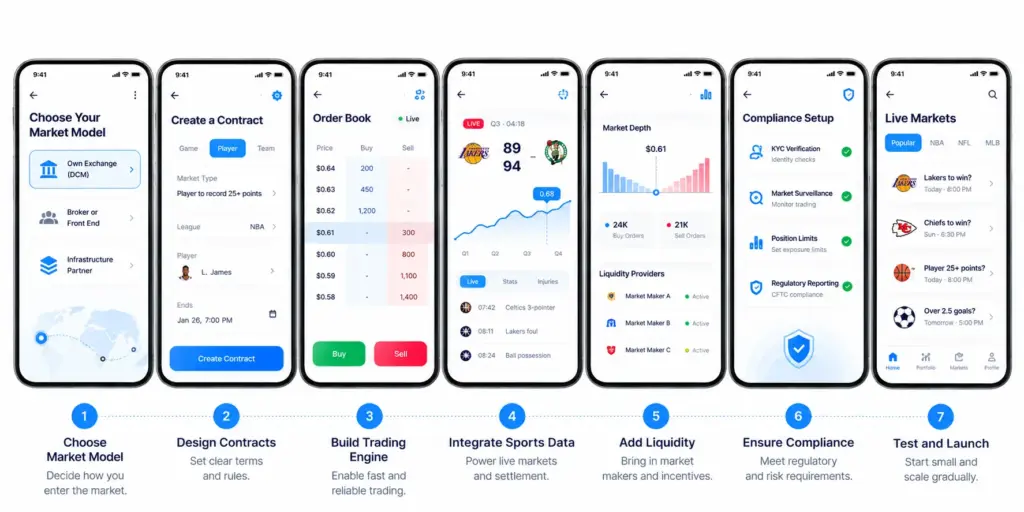
1. Define Your Sports Market Model
Your first decision is how you will enter the market because it affects cost, timeline, and control. DraftKings first used contracts from exchanges such as Crypto.com and CME Group, reaching users faster but with less control. It later acquired Railbird, a CFTC-registered designated contract market, and used it to launch sports contracts through DKeX.
You also need to decide whether to cover every sport or focus on high-demand markets such as football and basketball.
| Route | What It Means | Trade-Off |
| Own exchange (DCM) | Hold the license and list your own contracts | Maximum control but the heaviest compliance path |
| Broker or front end | Route users to other exchanges | Fast launch but less control |
| Infrastructure partner | Connect to a regulated exchange through B2B infrastructure | Lower build effort but depends on partner liquidity |
2. Design Contracts and Settlement Rules
Contract design is one of the areas regulators and traders examine most closely. On a CFTC-regulated exchange, contracts are generally listed through self-certification, with terms and compliance certification filed under the Commodity Exchange Act and CFTC regulations.
Railbird’s filings include sport-specific schedules, settlement rules, contingencies, and examples for each contract family.
Define Every Contract Clearly
Every contract should specify:
- Exact question: What counts as a win, cover, or statistical threshold.
- Settlement source: The official feed or league record used.
- Contingencies: Rules for postponed, shortened, suspended, or forfeited games.
- Trading window: When trading opens, closes, and freezes.
- Worked example: A simple example showing how the contract resolves.
3. Build the Core Trading Engine
The trading engine is the heart of the exchange and should be built like financial infrastructure. A microservices architecture can separate matching, accounts, market management, and market data, with Kafka or another event log connecting services. The matching engine can keep the order book in memory and stream updates through WebSockets.
Performance-sensitive components are commonly built with Rust, Go, or C++. Sports traffic can surge within three to five seconds after a major event, so testing should focus on peak and tail latency.
| Component | Role |
| Order gateway | Validates and authenticates orders |
| Matching engine | Matches bids and offers by price and time |
| Risk and margin | Checks funds and position limits |
| Ledger and event log | Records trades and state changes |
| Market data | Streams prices, depth, and trades |
| Fee engine | Applies maker and taker fees |
Railbird Fee Model
DKeX charges no fees for placing, canceling, or modifying orders and no settlement fees. It charges 0.005–0.01 per contract for takers and $0.0025 for makers. A key testing lesson is that an engine handling 100 orders per second in testing may fail at 1,000, so capacity tests should exceed expected launch traffic.
4. Connect Real-Time Sports Data
Sports data powers both pricing and settlement, so exchanges typically use licensed official feeds instead of public scraping. Kalshi signed a multi-year Sportradar agreement in June covering official data, live odds, and integrity monitoring. Genius Sports also signed agreements with Polymarket on August 4 and Kalshi on August 5, with its data used for covered contract outcomes. Sportradar’s Polymarket partnership has expanded to more than 20 global leagues and competitions.
Core Data Requirements
- Live scores and play-by-play: Power in-play markets and pauses.
- Official results: Determine settlement.
- Odds and pricing references: Help market makers quote prices.
- Integrity monitoring: Tools such as Sportradar’s UFDS AI and Integrity Exchange.
Kalshi and Polymarket have also agreed to share sports trading information with Genius Sports to help combat match-fixing.
5. Engineer Liquidity and Market Making
An empty order book cannot support an exchange, so liquidity must be planned from launch. Railbird filed a market maker program for its CLOB, generally requiring two-sided quotes, maximum spreads, and minimum market depth in exchange for incentives.
| Incentive | How It Works | Example |
| Reduced fees and higher limits | Lower costs and greater trading capacity | Susquehanna became Kalshi’s first dedicated institutional market maker in April 2024 |
| Equity stakes | Ownership offered for providing liquidity | Jump Trading was reported to be taking stakes in Kalshi and Polymarket |
| Cash rewards or rebates | Rewards tight quoting or returns fees | Polymarket launched a $1 million liquidity rewards program |
| In-house market making | Operator or parent provides quotes | DraftKings launched market making; FanDuel and Kalshi also have market-making arms |
When Susquehanna joined, Kalshi said it would provide nearly 30 times the previous liquidity in select markets. For a new exchange, starting with a few high-volume sports is more practical than trying to make every market liquid.
6. Add Compliance and Risk Controls
Compliance needs to be part of the product from the beginning. Exchanges must meet 23 CFTC core principles, including market surveillance under Core Principle 4 and position limits under Core Principle 5. The CFTC’s Division of Market Oversight issued an advisory on event contracts alongside an advance notice of proposed rulemaking containing 40 numbered questions. The advisory recommends that exchanges contact sports leagues and governing bodies before self-certifying sports contracts.
Novig, for example, is an MLB Authorized Prediction Market and participates in the league’s integrity program.
| Control Area | What to Build | Reference Point |
| Market surveillance | Detect manipulation and unusual trading | Core Principle 4 |
| Position limits | Cap trader exposure | Core Principle 5 |
| Contract review | Screen manipulation-prone contracts | Core Principle 3 |
| KYC checks | Verify identity and location | Age and eligibility requirements |
| Responsible trading | Limits and cooling-off tools | DraftKings and Novig programs |
| Integrity partnerships | Data sharing and monitoring | MLB, Genius Sports, Sportradar |
State-Level Legal Risk
Federal registration does not remove all state-level legal questions. On August 4, a federal judge granted Utah summary judgment against Kalshi in a case involving sports contracts; Kalshi is appealing. Founders should therefore budget for legal counsel alongside technical development.
7. Test, Launch, and Scale the Exchange
A phased launch reduces technical and market risk. Novig’s Ludlow Exchange was designated a contract market on June 16, signed its first team partnership with the New York Mets on July 30, and launched nationwide on August 4. Railbird followed a similar path: DraftKings acquired it in October, filed its first sports contract templates on May 26, and launched DKeX inside the DraftKings app in late June. Robinhood’s Rothera began with test contracts on May 21 before expanding.
A Practical Launch Plan
- Test at scale: Simulate traffic beyond expected launch demand.
- Run a soft launch: Start with limited sports and users with market makers active.
- Open the catalog: Add sports, props, and futures gradually.
- Add advanced products: Kalshi’s combination markets surpassed $100 million in their first week.
- Grow distribution: Add league partnerships, data providers, and B2B connections.
Regulatory Framework for Your Sports Prediction Exchange
A strong regulatory framework for a sports prediction exchange should cover CFTC registration, state-level access rules, KYC and AML controls, geofencing, market surveillance, and clear contract resolution rules. Founders should define these requirements early because regulatory classifications and sports-market access can vary by jurisdiction and continue to change.
1. Event Contracts vs Sports Betting
The key legal question is how sports event contracts are classified. The CFTC treats sports-related event contracts as swaps under the Commodity Exchange Act, while state gaming regulators may view the same contracts as sports wagers requiring state licenses. Courts remain divided.
| Court | Date | Outcome |
| Third Circuit | April 6 | Held Kalshi’s sports contracts are swaps and federal law preempts New Jersey gambling laws |
| Ninth Circuit (Nevada) | August 28 | Found Kalshi unlikely to show its contracts are swaps and allowed Nevada gaming rules |
| Ninth Circuit (tribal lands) | September 16 | Ruled Kalshi’s tribal-land contracts violate the Indian Gaming Regulatory Act |
| Sixth Circuit (Ohio and Tennessee) | September 25 | Found the contracts are not swaps and federal law does not preempt state gambling laws |
New Jersey has asked the U.S. Supreme Court to weigh in, while at least four states have obtained rulings restricting Kalshi. For founders, federal registration may not be sufficient everywhere.
2. Federal vs State Regulatory Paths
The federal path runs through the CFTC. Railbird Exchange is a CFTC-registered designated contract market and filed six sports contract templates through self-certification. The state path involves gaming regulators. DraftKings’ sportsbook, for example, operates in 30 states plus D.C., Puerto Rico, and Ontario.
The main routes are:
- Own a federally registered exchange: Maximum control but the highest compliance burden.
- Operate as a registered broker: DraftKings Predictions uses a CFTC-registered introducing broker and NFA member for faster market access.
- Add state licensing: Kalshi settled with the Nevada Gaming Control Board and agreed to geofence certain contracts.
- Plan for tribal gaming law: Tribal lands require additional access controls.
Massachusetts, Michigan, and Washington have limited sports contracts through court orders, while Nevada has taken a particularly restrictive approach.
3. KYC and AML Controls
Because exchanges handle customer funds, they need strong identity, AML, and transaction-monitoring controls. The Bank Secrecy Act requires futures commission merchants and introducing brokers to maintain AML programs, report suspicious activity, and verify customers.
A platform such as Kalshi may require a government ID, Social Security number or equivalent, address, and age verification of 18 or older. Prediction exchanges may also need geolocation, self-exclusion, and other gaming-style controls.
| Control | What It Does | Basis |
| Customer identification | Verifies identity and maintains records | Bank Secrecy Act and FinCEN |
| Sanctionxxxs screening | Checks restricted-party lists | OFAC |
| Transaction monitoring | Flags unusual activity | AML requirements |
| Suspicious activity reporting | Escalates concerning transactions | Bank Secrecy Act |
| Age and eligibility | Blocks restricted users | Minimum age is 18 on most apps |
| Self-exclusion and limits | Restricts user access | Gaming-style protection |
The consequences of weak controls can be significant. In 2021, FinCEN assessed a $100 million civil penalty against a crypto derivatives exchange for Bank Secrecy Act violations. KYC and AML should therefore be built into onboarding from day one.
4. Geofencing and Market Access
Geofencing converts legal restrictions into technical controls using IP checks, device location, and account verification. Novig launched its CFTC-regulated contracts in 47 states, blocking Arizona, Michigan, and Nevada. ProphetX launched as a federally regulated sports market for eligible users in 49 states.
Kalshi has agreed to geofence Nevada, faces restrictions in Michigan and Washington, blocks sports contracts in Massachusetts, and restricts access at three tribal casino properties in California.
Core Geofencing Controls
- Check location at signup and trade time.
- Use state- and contract-level switches for rapid legal changes.
- Match KYC addresses with device location.
- Add tribal land and venue controls.
- Maintain audit logs showing when access was blocked.
The system should assume the regulatory map will continue changing, with more than a dozen states involved in active lawsuits.
5. Contract Resolution Rules
Clear resolution rules prevent costly disputes. CFTC staff have encouraged rigorous settlement protocols and coordination with sports leagues. Railbird’s filings include sport-specific schedules, settlement rules, contingencies, and worked examples. Kalshi names source agencies such as the governing league, Associated Press, or ESPN in its contracts.
A notable example involved a Super Bowl halftime market asking whether Cardi B would perform. Kalshi’s rules distinguished between singing/dancing as a performance and background dancing. After ambiguity, Kalshi used Rule 6.3(c) and settled at the last traded price, paying $0.26 to Yes holders and $0.74 to No holders. Polymarket resolved the same event as Yes at $1, while Kalshi’s market recorded $47.3 million in volume.
What Resolution Rules Should Cover
- Name the source: Official league record or data feed, with a fallback.
- Define key terms: Explain terms such as “performing,” “starting,” or “winning.”
- Cover edge cases: Ties, overtime, postponements, forfeits, and stat corrections.
- Explain fallback settlement: For example, last price, $0.50, or refund.
- Provide an appeals process: An independent review process can help address disputes.
Connecting the Sports Prediction Exchange to Data
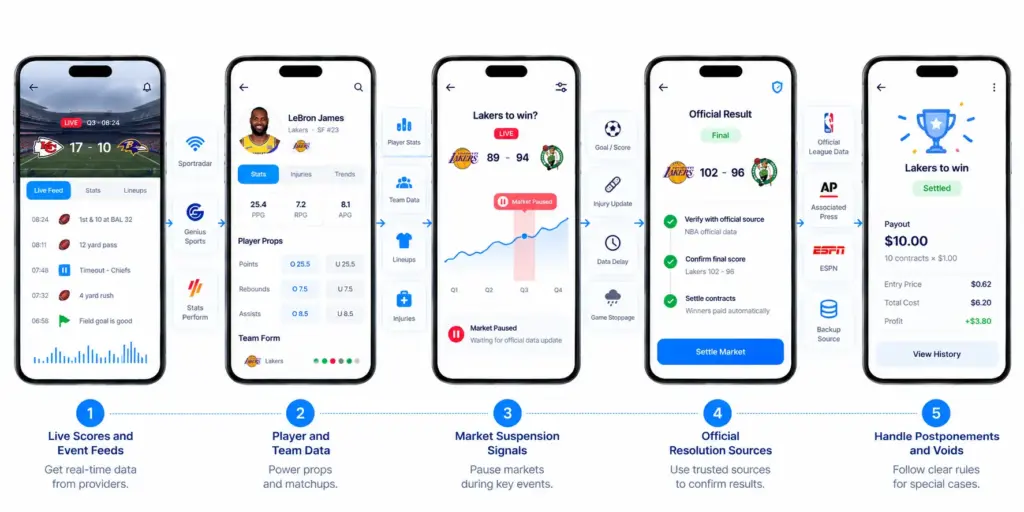
A sports prediction exchange needs licensed real-time data for pricing, in-play trading, market suspension, and settlement. Live feeds power trading, player and team data support props, and official sources determine outcomes. Every contract also needs rules for postponed, shortened, or canceled games because inaccurate or delayed data can misprice markets or trigger incorrect payouts.
1. Live Scores and Event Feeds
Providers such as Sportradar, Genius Sports, and Stats Perform distribute play-by-play data through APIs and WebSockets. Speed is critical. Competitive live betting often targets under 300 milliseconds from event to user, while some markets can operate with latency under one second. Major U.S. events can generate tens of thousands of live messages per second.
Official feeds may include deliberate delays to reduce courtsiding, where people at venues act before the feed updates. One example found an over-the-air broadcast 19 seconds behind the action and cable 38 seconds behind.
Data Ingestion Flow
- Receive: Connect to provider streams through APIs or WebSockets.
- Validate: Check timestamps, event order, and conflicting updates.
- Map: Match provider event IDs with your market IDs.
- Publish: Send confirmed states to pricing, market makers, and users.
2. Player and Team Data
Detailed player and team data enable props, spreads, and head-to-head contracts. Railbird’s ENTITYSTAT covers statistical thresholds, while ENTITYOUTPERFORM compares competitors. Stats Perform’s Opta Player Betting Feed covers more than 11,000 matches, supporting markets on shots, passes, tackles, expected goals, fouls, and saves. Its prediction-market product covers 15 sports and 500,000 events annually.
| Data Type | What It Powers | Example |
| Team results and standings | Winners, spreads, futures | Game winner, playoff qualification |
| Player statistics | Props and thresholds | Shots, passes, points, saves |
| Lineups and injury news | Pricing and pauses | Starter ruled out |
| Historical matchups | Pricing and research | Head-to-head records |
| In-play metrics | Live contracts | 80+ metrics through Dynamic Stats API |
Injury data needs additional care. CFTC guidance has identified contracts based on individual player injuries as carrying heightened manipulation risk, so injury feeds are better used for pricing and market pauses than contract definitions.
3. Market Suspension Signals
Live markets need automatic suspension signals after major events. Without them, traders can be filled against stale prices. Betfair, for example, uses an in-play delay of one to twelve seconds, allowing orders to lapse when material events occur during the delay.
The standard approach is to suspend when data is uncertain, switch to a backup source when available, and reopen after confirmation.
| Signal | Trigger | Typical Action |
| Score or major play | Goal, touchdown, red card, penalty | Pause or delay, then reopen |
| Feed lag or gap | Missing updates | Suspend and switch feeds |
| Source conflict | Feeds disagree | Hold until confirmed |
| Injury or lineup change | Key player ruled out | Pause affected props |
| Game stoppage | Weather, suspension, review | Freeze until play resumes |
Market makers also need time to cancel stale quotes. Some platforms hold taker orders during an in-play delay while maker orders remain visible. Professional market makers target sub-10 millisecond round trips, while order-book updates can reach 50 milliseconds. Railbird’s program requires two-sided quotes, maximum spreads, and minimum depth, making effective suspension logic essential.
4. Official Resolution Sources
Settlement requires a higher standard than pricing. Each contract should name an official resolution source. Kalshi uses sources such as governing leagues, the Associated Press, or ESPN. It signed a multi-year Sportradar partnership in June, while Genius Sports signed agreements with Polymarket on August 4 and Kalshi on August 5. Polymarket’s Sportradar partnership now covers more than 20 global leagues and competitions.
Resolution Hierarchy
- Primary: Official league record or licensed data feed.
- Secondary: Backup feed or league statement.
- Manual review: Documented process for unresolved cases.
- Audit trail: Timestamped source records for disputes.
CFTC guidance also asks exchanges to document data sources during self-certification and coordinate with sports leagues on settlement protocols.
5. Handling Postponements and Voids
Contracts need clear rules for games that are postponed, suspended, or abandoned. Kalshi’s terms provide examples: a baseball game played within 48 hours remains open; if it does not begin within that window, it settles at the last fair price. A football game abandoned before 55 minutes generally settles at the last fair price unless the result is already determined, while a game abandoned after 55 minutes can settle using accumulated statistics. Tennis matches canceled before the first set can also settle at the last fair price.
| Scenario | Typical Rule |
| Postponed, played within window | Remains open and settles on final result |
| Postponed, not played | Last fair price |
| Suspended and resumed | Completed game |
| Abandoned early | Last fair price |
| Abandoned late | Statistics accumulated so far |
| Long tournament delay | May remain open for an extended period |
If rules do not cover a case, Kalshi can fall back to the last traded price. For example, a contract last traded at $0.10 would pay long holders 10 cents and short holders 90 cents. If that price is unavailable or unfair, an Outcome Review Committee must reach a final outcome within 24 hours.
Solve Liquidity Before Launching Your Sports Prediction Exchange
Secure professional market makers and launch incentives before your first users arrive. Start with a few high-interest sports, seed them with resting orders, and use an automated backstop for thin markets. Track spreads and depth from day one because liquidity is a launch requirement, not something to fix later.
Why Empty Order Books Kill Markets
An empty order book creates a difficult cycle: few orders lead to wide spreads, poor execution drives users away, and lower activity makes liquidity even weaker. Peer-to-peer exchanges such as ProphetX face this challenge, with NFL and NBA markets generally seeing stronger activity than smaller sports.
The Liquidity Cycle
- No resting orders: The book launches empty or nearly empty.
- Wide spreads: Limited depth creates poor prices and slippage.
- Traders leave: Users move to deeper markets.
- Liquidity falls further: Market makers see less flow and quote less.
Railbird’s experience illustrates the challenge. Before DraftKings launched DKeX, Citizens analysts noted limited market-making activity and little exchange volume. A licensed exchange does not create liquidity automatically.
Market Makers vs Organic Liquidity
Organic liquidity comes from traders placing their own orders, but it takes time to develop. Market makers provide continuous bids and asks so users can trade even without another customer on the opposite side. Susquehanna became Kalshi’s first dedicated institutional market maker in April 2024, and Kalshi said it would provide nearly 30 times the liquidity previously available in select markets. Most exchanges combine professional and organic liquidity as volume grows.
| Factor | Market Makers | Organic Liquidity |
| Launch availability | Can be contracted beforehand | Minimal initially |
| Cost | Fees, rebates, limits, or equity | No direct cost |
| Consistency | Scheduled quotes and depth | Depends on user activity |
| Risk | Quotes may be pulled during volatility | Can disappear in fast markets |
| Examples | Susquehanna on Kalshi; Jump Trading | Retail orders on NFL and NBA markets |
Railbird’s market maker program requires two-sided quotes, maximum spreads, and minimum depth. Its fees include a $0.0025 maker fee versus 0.005–0.01 taker fees. Polymarket also launched a $1 million liquidity rewards program with its CLOB v2 upgrade.
Using AMMs for Thin Markets
An automated market maker or AMM can support markets that are too new or niche for professional market makers. Instead of matching traders, an algorithm sets prices while a funded pool provides liquidity. The logarithmic market scoring rule or LMSR, proposed by Robin Hanson in 2002, is a well-known prediction-market model. Polymarket initially used an AMM for its cold-start problem before moving to a CLOB to attract professional market makers.
AMM Benefits and Limits
- No cold start: Markets can trade immediately.
- Long-tail support: Limitless allows market creation with a minimum $10 seed, refundable at market end; Azuro uses shared liquidity pools with virtual AMMs.
- Funding requirement: Liquidity must be funded upfront, making thousands of markets expensive.
- Adverse selection: Informed traders can trade profitably against the formula, and research found many early Polymarket AMM liquidity providers ended up net negative.
For sports exchanges, a hybrid model can bootstrap new markets with an AMM and shift active markets to the order book as volume grows.
Managing Bid-Ask Spreads
The bid-ask spread is a key liquidity measure. Practitioner guides suggest 1–2 cents for liquid markets, 3–5 cents for moderate liquidity, and above 5–6 cents for thin markets. Spread should always be measured with depth. One Polymarket analysis found median spreads of 8–15 cents, compared with 5–10 cents on Kalshi, although top markets can trade at 1–3 cents.
| Spread | Signal | Typical Response |
| 1–2 cents | Healthy liquidity | Maintain incentives |
| 3–5 cents | Moderate liquidity | Tighten requirements or raise rebates |
| 6–10 cents | Thin book | Add depth, AMM, or market makers |
| Above 10 cents | Effectively illiquid | Consider pausing or delisting |
For example, a $0.59 bid and $0.65 ask creates a 6-cent spread. If only 40 shares are available at $0.65 and the next 80 are at $0.69, larger orders receive worse prices. Track both spread and depth near the best prices.
Seeding Your First Sports Markets
Seeding means selecting initial markets and placing resting orders before users arrive. Start narrow and focus on marquee events. Robinhood’s Rothera began with test contracts covering baseball games, core PCE inflation, and weekly jobless claims. Its first weekend generated $2.1 million in trading, with almost all volume coming from four baseball games.
Railbird’s filings show a much broader potential catalog, including winners, spreads, props, and head-to-head markets, but a new exchange does not need to launch everything at once.
Initial Liquidity Checklist
- Choose high-demand sports: Start with markets such as NFL and NBA.
- Contract market makers early: Define spreads, depth, and incentives.
- Seed both sides: Place resting bids and asks before opening markets.
- Use an AMM backstop: Support props and long-tail markets.
- Expand gradually: Track spread and depth before adding new contract types.
How Much Does It Cost to Build Like Railbird?
A Railbird-style sports prediction exchange can cost 300,000–1 million in the first year when launched through a licensed exchange. Building your own platform before licensing can cost 600,000–1.5 million, while owning a federally licensed exchange can require 6million–15 million+. The biggest cost drivers are regulation, sports data, liquidity, and compliance rather than software alone.
What Drives Exchange Development Cost?
Published estimates range from $8,000 for a basic MVP to $800,000+ for a scalable platform with its own markets and integrity tools. Experienced developers may charge 80–150/hour, while post-launch operations can add 15%–25% of the initial build cost annually.
Key cost drivers include:
- Regulatory route: Partner exchange, pre-license platform, or fully licensed exchange.
- Contract catalog: Basic winners versus spreads, props, stats, and head-to-head markets.
- In-play trading: Requires faster data and suspension infrastructure.
- Data quality: Official settlement-grade feeds cost more.
- Liquidity: Market-maker incentives and seed capital can exceed software costs.
- Compliance: KYC, surveillance, security, legal, and audits.
Matching Engine Development Cost
The matching engine is the exchange’s technical core. Vendor estimates put a custom order-book engine around 30,000–120,000. TRUEPREDICT cites 40,000–80,000, Techfyte 30,000–80,000, and IdeaUsher 50,000–120,000.
| Item | Estimated Cost |
| Core CLOB matching engine | 40,000–120,000 |
| Order gateway, risk checks, ledger | 50,000–150,000 |
| Market data and WebSockets | 20,000–60,000 |
| Admin, surveillance, back office | 40,000–120,000 |
| Full centralized trading stack | 300,000–550,000 |
| Platform with own markets | 250,000–800,000+ |
These are planning estimates and should be validated with vendor quotes. Railbird’s fee model requires support for free order placement, cancellation, and modification, plus 0.005–0.01 taker fees and a $0.0025 maker fee.
Sports Data and API Costs
Entry-level sports APIs can cost 19–50/month, mid-tier real-time feeds 100–500/month, while enterprise providers such as Sportradar, Genius Sports, and Stats Perform can reach $10,000+/month.
| Tier | Typical Cost | Best For |
| Developer APIs | 19–50/month | Prototypes |
| Mid-tier real-time feeds | 100–500/month | Early markets |
| Sportradar API plans | ~$1,250/month+ | Live scores and stats |
| Enterprise official data | $10,000+/month | Settlement and in-play |
For budgeting, plan around 2,000–25,000/year for MVP data and 120,000–500,000+/year for official multi-sport data at scale.
Liquidity Infrastructure Costs
Liquidity is often underestimated because much of the budget goes toward capital and incentives rather than software. Practitioner guidance suggests 10,000–30,000 of working capital per market. Susquehanna became Kalshi’s first institutional market maker, while Polymarket launched a $1 million liquidity rewards program.
Liquidity Budget
- MVP: 100,000–300,000 for 10–20 marquee markets and rebates.
- Growth: 300,000–1 million for broader markets and maker incentives.
- Full scale: 1million–5 million+ for formal agreements and in-house market making.
These are planning estimates, and liquidity spending may eventually be offset by trading fees.
Compliance and Security Costs
The regulatory route creates the largest cost difference. An introducing broker can take 6–12 months with no CFTC-mandated minimum capital. An FCM generally needs $1 million+, while a DCM can take 12–24 months+ and typically requires $5 million+ in financial resources. A DCO may require $10 million+.
| Item | Estimated Cost | Notes |
| KYC setup | 15,000–30,000 | Integration and workflows |
| KYC per user | 0.50–5 | Ongoing verification |
| Penetration testing | 10,000–30,000/year | Testing and remediation |
| SOC 2 Type II | 60,000–150,000 | First year |
| Introducing broker | Legal fees only | 6–12 months |
| DCM resources | $5 million+ | 12–24+ months |
| DCO resources | $10 million+ | 12–24+ months |
Legal counsel adds another major cost. A planning range of 250,000–1 million for DCM-related counsel and consultants is reasonable, although actual fees vary.
MVP vs Full-Scale Exchange Cost
The development route determines both cost and timeline. For many founders, starting with a licensed partner, proving demand and liquidity, and later considering exchange ownership can reduce initial capital requirements. Also budget 15%–25% of the build cost annually for maintenance and operations.
| Route | What You Get | Estimated First-Year Cost | Timeline |
| Partner front end | Branded app on licensed exchange | 300,000–1 million | 6–12 months |
| Own platform, pre-license | Trading, data, liquidity, compliance | 600,000–1.5 million | 9–18 months |
| Own licensed exchange | Full control like DKeX | 6million–15 million+ | 12–24+ months |
| Acquire licensed exchange | License and technology | Tens of millions | Deal-dependent |
Build a Sports Prediction Exchange With IdeaUsher
IdeaUsher can help you build a scalable sports prediction exchange with the trading, data, liquidity, and settlement infrastructure needed for real-time sports markets. With 500,000+ hours of coding experience and a team of ex-MAANG and FAANG developers, we bring experience in building complex, high-performance digital platforms.
Custom Trading Engine Development
We build high-performance matching engines, order gateways, risk checks, ledgers, and real-time market data systems to support fast and reliable sports contract trading. The infrastructure can support market and limit orders, price-time matching, partial fills, cancellations, and real-time order-book updates. This gives your platform the foundation needed to handle active trading and growing market volumes.
Sports Data and Resolution Integration
Integrate real-time sports data, official results, player statistics, and event feeds to power live markets, market suspensions, and accurate contract settlement. We can connect data providers and build the workflows needed to validate incoming events, trigger market updates, and determine final contract outcomes.
CLOB and Liquidity Infrastructure
Develop central limit order books, market-maker infrastructure, liquidity controls, spread management, and AMM backstops to help keep markets active and tradable. The platform can be designed to support initial market seeding, two-sided quotes, minimum market depth, and liquidity incentives.
Wallet and Settlement Systems
Build secure wallets, transaction ledgers, contract settlement, payouts, and withdrawal systems that support accurate fund movement and reliable post-event settlement. We can also design automated settlement workflows that connect contract outcomes with user balances and transaction records. The goal is to provide a transparent financial layer that supports secure deposits, trading activity, payouts, and withdrawals.
Conclusion
Building a sports prediction exchange like Railbird is not just about letting people predict games. The real challenge is making the trading experience fast and trustworthy. If users can easily find markets and trade without worrying about delays or unclear results, you have a much stronger product. Start with a focused set of sports and build from there as your user base grows.
FAQs
A1: A sports prediction exchange lets users trade contracts based on sports outcomes. Users can buy or sell Yes/No contracts through an order book while prices change as traders react to new information. Once the game ends, the contract is settled using an official result. This gives users a trading experience instead of a simple fixed-odds bet.
A2: A sportsbook sets the odds and usually takes the other side of a bet. A prediction exchange lets traders set prices and trade with other users or market makers. Users can also sell their contracts before the event ends if the market moves in their favor. The main difference is that prices come from market activity rather than being set only by the sportsbook.
A3: A CLOB, or Central Limit Order Book, is the system that matches buyers and sellers. Traders place bids and offers, and the matching engine pairs them based on price and time. This helps the exchange show live prices and available market depth. It is one of the core systems behind a real-time prediction exchange
A4: Exchanges usually rely on market makers to provide buy and sell orders, especially when a market is new. They can offer incentives such as reduced fees or rebates to keep markets active. As more traders join, organic orders can add more liquidity. Starting with popular sports and major events can also help attract trading activity faster.
A5: Sports contracts are settled after the event using a clearly defined official data source. The contract rules explain what happens in cases such as postponements, ties, or abandoned games. The winning side then receives the contract’s stated payout. Clear settlement rules help prevent confusion and disputes after the event.
A6: A sports prediction exchange typically needs APIs for live scores, player statistics, event updates, official results, payments, identity verification, and market data. WebSocket connections are also useful for sending price and order-book updates to users in real time. Reliable APIs are especially important when the platform supports live sports trading.