 (+971) 8007 4267
 (+91) 946 340 7140
 (+1) 628 432 4305

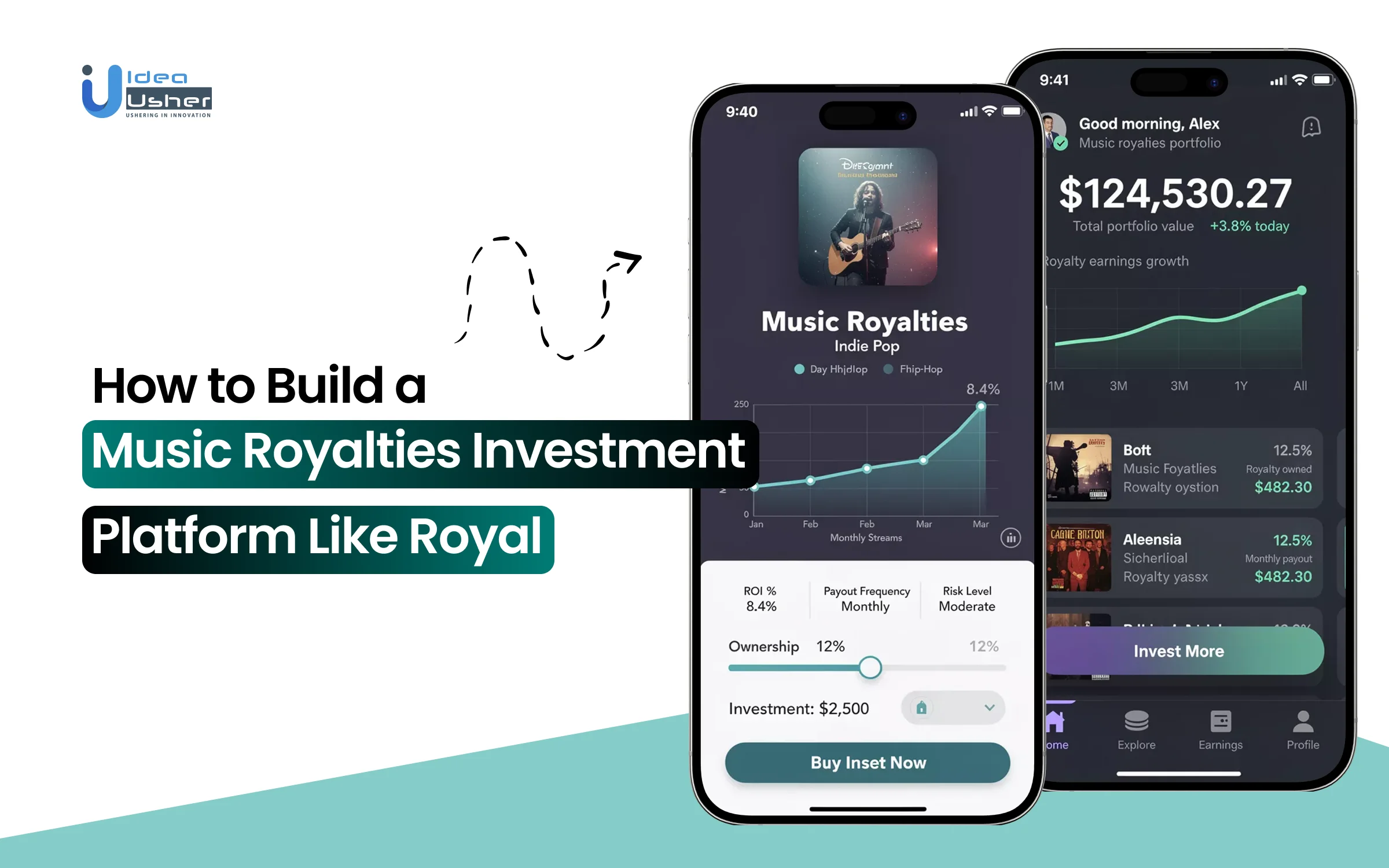
For years, music fans stayed outside the value chain and were treated only as end consumers. They streamed and promoted music every day without sharing in the revenue layer. Over time, that passive support turned into a clear demand for ownership, pushing many fans toward music royalties investment platforms like Royal.
As digital ownership became more familiar, people grew comfortable holding value through tokens and fractional assets. Moreover, artists began looking for alternatives to rigid label structures. Blockchain systems and smart contracts brought clearer ownership logic and transparent payout flows.
Over the past decade, we have developed several music-royalty investment solutions that leverage blockchain-based digital asset infrastructure and financial data orchestration systems. Given our expertise, we’re writing this blog to outline the steps to develop a music royalty investment platform like Royal. Let’s start!
Key Market Takeaways for Music Royalties Investments
According to MarketMonitorGlobal, the global music royalties investment platform market is projected to reach approximately US$349 million by 2031, growing at a CAGR of 8.3%. This steady expansion mirrors the broader growth of streaming-led music revenues and reflects a shift in how music rights are viewed.

Source: MarketMonitorGlobal,
Royalties are increasingly treated as an investable asset that can deliver recurring income with relatively low correlation to traditional markets, making them attractive to investors seeking diversification.
This demand is clearly visible in the rise of dedicated platforms. Royalty Exchange has demonstrated how a structured marketplace can connect artists and investors directly, enabling creators to monetise future royalties while giving investors access to established income streams.
In parallel, platforms such as anotherblock are broadening participation by allowing fractional ownership of music royalties, blending investment with fan engagement and digital ownership models.
The ecosystem is also becoming more mature and specialised. Partnerships like the collaboration between anotherblock and Polytrade highlight a growing focus on payout infrastructure, transparency, and operational reliability.
This shift signals that music royalty investing is moving beyond experimentation toward a more robust, investable market built on scalable technology and clearer trust mechanisms.

What is the Royal Platform?
Royal is a blockchain-based platform that allows fans to purchase ownership rights in songs as Limited Digital Assets. These assets enable holders to earn streaming royalties alongside artists, creating a direct financial and cultural connection between creators and fans. The platform, founded in 2021 by DJ 3LAU (Justin Blau) and JD Ross, is built on the Polygon blockchain to enable scalable, low-cost transactions.
Royal originally operated a primary marketplace for song drops, which was sunset in 2024, after which the platform shifted its focus toward new music crypto products, particularly those addressing emerging challenges around AI-generated music and rights attribution.
Here are some of its key features,
- Royalty Sharing: Collectors earn proportional streaming royalties directly alongside artists, aligned with actual song performance.
- Limited Digital Assets (LDAs): NFT-based assets that bundle economic rights, access benefits, and artist-selected rewards into a single on-chain instrument.
- Tiered Ownership Model: Three distinct song-rights tiers enable participation at different investment levels, unlocking varying royalty shares and fan privileges.
- Seamless Onboarding: Fans can purchase assets using credit or debit cards, with crypto wallets created automatically in the background.
- Secondary Market Trading
LDAs can be freely bought and sold on OpenSea after the initial artist drop. - Artist Drops: Time-limited releases that combine music ownership with exclusive fan engagement opportunities.
- Song Valuation Tool: A data-driven tool launched in 2023 that helps estimate future royalty potential for songs, supporting more informed purchase decisions.
How Does the Royal Platform Work?
Royal operates as a music royalties investment platform built on blockchain infrastructure. It allows listeners and fans to buy fractional shares of songs as Limited Digital Assets and earn proportional streaming royalties from platforms such as Spotify. These payouts flow automatically as artists continue to release and promote their music.
As of late 2025, Royal has confirmed it is preparing new products for 2025, building on earlier traction, including $7.5M in total trading volume and $156K in royalties paid out. The platform continues to operate on the Polygon blockchain, with a long-term mission to democratize music ownership beyond traditional label structures.

The Original Royal Model Explained
The Core Offering
Royal introduced Limited Digital Assets as blockchain-based tokens representing a verifiable fractional share of a song’s streaming royalties, typically tied to the master recording. These assets were not marketed solely as collectibles. They were designed as income-generating digital assets with transparent ownership tracking.
How Artists Used the Platform
Artists could choose to sell a specific percentage of future streaming revenue, such as 10 percent or 50 percent, from a new or existing song. They would then release a fixed supply of LDAs through a public drop on Royal’s platform. This gave artists upfront capital while preserving creative control and long-term upside.
How Fans Participated
Fans could purchase LDAs directly, often using standard payment methods like credit cards. Royal abstracted the crypto complexity behind the scenes. By holding LDAs, fans received ongoing royalty payouts, automatically distributed through smart contracts as streaming revenue was collected.
The Fan to Investor Shift
This structure transformed fans into economic participants. Ownership created a direct financial link between listeners and artists. As the song performed better, both the artist and LDA holders benefited. Support was no longer emotional alone. It became financially aligned.
The Transition Toward 2025
Royal is currently in an active transition phase. Its official messaging confirms the team is finalizing new products for 2025. This signals that the original LDA mechanics are being refined rather than abandoned.
What Is Clear for 2025
All upcoming initiatives will remain at the intersection of music and crypto, with a consistent goal of unlocking economic value for both musicians and listeners. Shared upside remains central to the platform’s direction.
What the Industry Is Watching
The focus now is on how Royal will evolve the investment mechanics, expand accessibility, and possibly introduce new forms of fan utility beyond pure royalty income. The next phase is expected to move from experimentation toward a more scalable and sustainable model.
What is the Business Model of the Royal Platform?
Royal enables artists to tokenize a portion of their future streaming royalties and sell them directly to fans as NFTs on the Polygon blockchain. When a song streams on platforms like Spotify, LDA holders receive proportional royalty payouts.
Beyond financial returns, many drops include fan utility perks such as exclusive merchandise, VIP access, or private experiences. Artists decide how much of the royalty share to sell and receive upfront capital, while retaining ownershipand avoiding traditional label structures that often capture the majority of revenue.
Platform Fees
Royal earns fees from primary LDA sales and secondary market trades. While exact percentages are not publicly disclosed, artists control pricing during drops. A notable example is the Nas and 3LAU drop, which generated $560,000 in sales.
Royalty Facilitation Ecosystem
Royal does not publicly state a direct royalty cut. Instead, it provides the infrastructure for ongoing automated payouts. Collectors earned $36,000 in royalties across four songs in July 2022.
Artist Drops & Bundled Perks
High-demand artist drops and bundled fan experiences drive transaction volume. By January 2023, the platform had facilitated $7.5 million in music rights trades across 111 countries.
Financial Performance
Royal reported approximately $1 million in annual revenue with a team of around 20 employees. By January 2023, artists on the platform had distributed over $156,000 in royalties to collectors and raised $2.5 million directly through LDA sales.
In April 2024, Royal sunset its native marketplace and shifted focus toward onchain data infrastructure and AI-driven music challenges. Immediately, royalty payouts continued through secondary marketplaces such as OpenSea and via Royal’s on-chain systems.
Funding Rounds
- Seed Round (August 2021): Raised $16 million from investors including Coinbase Ventures and Paradigm.
- Series A (November 2021): Raised $55 million, led by a16z crypto, with participation from artists such as Nas and The Chainsmokers.
Total funding reached $71 million across three rounds. These funds supported ecosystem tools, including the Song Valuation Calculator, launched in June 2023, which aimed to bring transparency to music royalty pricing and performance modeling.
How to Build a Music Royalties Investment Platform Like Royal?
Building a music royalties investment platform like Royal starts with structuring compliant royalty ownership that can reliably map real music rights to digital assets. The system should securely validate metadata and stream revenue data to ensure payouts are accurate and consistent over time.
We have designed and built music royalties investment platforms aligned with the Royal model, and this is how we execute them for our clients.

1. Legal Structuring
We begin by defining which music rights are tokenized and how royalty flows are contractually enforced. The structure is designed to align with licensing laws and financial regulations from day one. This allows the platform to scale without legal rework later.
2. Metadata Verification
Before minting any asset, we validate ISRCs, distributor records, and ownership splits. This verification layer ensures that only legitimate and revenue-generating catalogs enter the platform. It reduces disputes and protects investor confidence.
3. Ownership Contracts
Smart contracts are built to manage fractional ownership, payout rules, and transfer restrictions. These contracts automate royalty distribution while enforcing compliance constraints. The system stays transparent and deterministic at all times.
4. Revenue Ingestion
We integrate streaming and distributor data directly into structured pipelines. Revenue statements are normalized and passed through secure Oracle layers. This guarantees accurate and timely payout calculations.
5. User Onboarding
Onboarding is designed to feel familiar and frictionless. Users can sign up with email, pay using fiat, and receive wallets automatically. Blockchain complexity stays invisible while ownership remains on-chain.
6. Secondary Trading
To support liquidity, we design controlled secondary trading mechanisms. This may include internal marketplaces or structured liquidity pools. Compliance and pricing logic remain embedded throughout the trading flow.
How Music Royalty Platforms Protect Investors When Artists Move?
Music royalty platforms protect investors by legally tying royalty rights to the asset rather than the artist relationship. When artists move distributors, payments should continue to be made automatically because the direction-to-pay agreements follow the rights.
Strong platforms may also actively onboard new distributors, so reporting resumes quickly and income stays stable.

1. Understanding the Risk
To understand protection, it helps first to understand the risk. Royalty payments follow a defined pipeline.
Streaming Service (e.g., Spotify) → Distributor/Label → Royalty Platform’s Collection Account → Investor
When an artist switches distributors, the origin of both royalty data and payments changes. If the platform’s agreements or smart contracts are linked only to the previous distributor, the payment flow can pause. The new distributor has no automatic obligation to route royalties unless a binding structure already exists.
The real risk is not losing ownership of royalties. The risk is temporary payment interruption and loss of reporting visibility.
2. The Solution Framework
Strong platforms solve this problem using a dual approach. One part is legal. The other part is operational and technical. This combination ensures investor income stays protected during real-world transitions.
A. The Legal Foundation
The most important safeguard is a legal document executed at the time the royalty share is sold. This is commonly known as an Irrevocable Direction to Pay or Notice of Assignment.
This agreement is critical because it does three things.
- First, it legally binds the artist and the current distributor to route the agreed royalty percentage to the platform’s collection account.
- Second, it is written to survive future contractual changes. When an artist moves to a new distributor or label, the obligation does not disappear.
- Third, the obligation follows the rights themselves. By selling a portion of the royalties, the artist agrees that any future distributor must honor this structure. This condition becomes part of the asset’s ownership history.
This ensures investors retain their legal claim even when the commercial partner changes.
B. Proactive Systems Notification
Legal protection alone is not enough. Strong platforms also run active rights management operations.
- The artist is contractually required to notify the platform within a defined timeframe after signing with a new distributor.
- Once notified, the platform engages directly with the new distributor’s royalty team. Legal documentation is shared. Payment routing details are established. Reporting formats are aligned.
This process is logged end-to-end.
Every step creates an audit trail. Investors will be notified via the asset dashboard once the transition is complete. This visibility reassures investors and prevents uncertainty.
How Music Royalty Platforms Handle Catalog-Level Investments?
Music royalty platforms typically group many tracks into a single catalog, enabling returns from multiple revenue streams simultaneously. This structure may reduce volatility and can steadily smooth payouts when individual songs slow down.
From a system-wide view, royalties are aggregated at the catalog level and then distributed programmatically so investors can reliably track performance.

Song Shares vs Catalog Shares
The difference between single-song and catalog investing closely mirrors the difference between individual stocks and diversified funds.
| Feature | Song Shares | Catalog Shares |
| Investment Focus | A single specific track | A curated collection of many tracks |
| Risk and Volatility | Higher since outcomes are trend-driven and binary | Lower because risk is spread across multiple assets |
| Return Profile | Potentially high but unpredictable and hit-dependent | More stable and designed for a consistent yield |
| Ideal For | Thematic bets fans and active traders | Portfolio diversification, passive income, and institutional strategies |
| Management Overhead | Higher due to tracking individual song performance | Lower with focus on overall portfolio health |
How Platforms Manage Catalog Investments?
Catalogs are not assembled randomly. Each one follows a defined legal and technical framework.
- Acquisition and securitization come first. Rights to a collection of songs are acquired and placed into a dedicated legal entity, commonly a Special Purpose Vehicle. This entity issues digital shares or tokens that represent fractional ownership of the full catalog.
- Revenue aggregation and automated distribution handle ongoing payouts. Royalties from streaming platforms, performance rights organizations, and sync deals are pooled at the catalog level. Smart contracts then distribute earnings proportionally to investors, often using stable digital currencies. This automation significantly reduces delays and accounting complexity.
- Ongoing performance tracking and reporting give investors a portfolio-level view. Instead of song-by-song noise, platforms report key metrics such as total revenue, yield, and royalty growth. This allows investors to assess asset health and long-term trajectory clearly.
Revenue Potential of a Music Royalties Investment Platform
Revenue potential in a music royalties investment platform often grows with scale rather than hype. When transaction flow remains consistent, and assets perform steadily on the platform, it can generate recurring income through fees and servicing logic. With the right infrastructure in place, revenue may increase gradually as liquidity and trust strengthen.
1. Transaction Fees
Transaction fees are the largest and most reliable revenue driver.
- Primary market fees are charged when a song or catalog is first fractionalized and sold to investors. Platforms typically take a percentage of the total capital raised. For example, facilitating a $1 million catalog sale at a 5 percent fee generates $50,000 in immediate revenue.
- Secondary market fees apply to investor-to-investor trades on the platform’s exchange. These are usually small, around 1-2% per trade. At scale, high trading volume turns this into a powerful recurring income stream. Platforms such as ANote Music and Sonomo lean heavily on this liquidity-driven model.
Key takeaway: volume matters more than margins. Liquidity compounds revenue.
2. Asset Management & Servicing Fees
Platforms that administer assets earn predictable recurring revenue, similar to fund managers.
- Annual management fees typically range from 0.5 to 2 percent of assets under management. A platform managing $100 million at a 1 percent fee generates $1 million in annual revenue from this stream alone.
- Royalty collection and distribution fees are deducted from royalty payouts before investor distribution. These fees, often 5 to 10 percent, compensate the platform for tracking, reconciling, and distributing global royalty flows.
3. Ancillary and Premium Services
Mature platforms unlock high-margin expansion revenue through value-added services.
- Data and analytics subscriptions provide professional investors and labels with royalty forecasts, valuation tools, and performance insights.
- Advisory and capital solutions support artists and rightsholders with catalog valuation, securitization, and structured exits, often priced as fixed retainers or success fees.
- White-label licensing allows labels or funds to launch branded investment products using the platform’s infrastructure.
Estimating Revenue. A Real-World Scenario
Below is a simplified model of a scaled platform.
Assumptions
| Metric | Value |
| Assets under management | $250 million |
| Annual primary sales volume | $75 million |
| Annual secondary trading volume | $30 million |
| Annual royalty yield | 5 percent of AUM |
Fee Structure
- Primary sale fee: 4 percent
- Secondary trading fee: 1.5 percent
- Management fee: 1 percent of AUM
- Royalty servicing fee: 7 percent
Annual Revenue Breakdown
- Primary market fees: $3,000,000
- Secondary trading fees: $450,000
- Management fees: $2,500,000
- Servicing fees: $875,000
Total estimated annual revenue: $6.83 million
This profile closely mirrors real platforms.
Royalty Exchange has facilitated over $200 million in primary sales. Even a conservative 3 percent fee implies more than $6 million in cumulative transaction revenue.
Sonomo reports over €4 million in monthly trading activity. A 1.5 percent fee on that volume produces over €700,000 annually from secondary trading alone.
Factors That Define Revenue Potential
Volume and Liquidity
Total volume is the dominant driver of revenue. Platforms that maintain liquidity consistently outperform those with higher fees but lower activity. Frequent payouts and transparent reporting encourage reinvestment and trading velocity.
Market Growth
The broader music industry directly impacts platform performance. According to Goldman Sachs, global music revenue is projected to exceed $150 billion by 2030, driven primarily by streaming growth. Rising catalog values increase issuance activity and investor participation.
Regulatory Structure
Platforms operating under securities frameworks incur higher compliance and reporting costs. These expenses reduce margins but significantly increase credibility, institutional participation, and long-term scalability.
Differentiation Strategy
Platforms that clearly define their niche perform better. Examples include ETF-style bundled products, fan-centric ownership models, or fast-settlement royalty cycles.
Risks That Impact Revenue Stability
Asset Performance Risk
If catalogs underperform and yields decline, investor demand weakens. This reduces both primary issuances and secondary trading activity.
Concentration Risk
Early-stage platforms often depend on a small number of large catalog sales or active traders. Revenue stabilizes only after diversification across assets and investor segments.
Regulatory and Technology Shifts
Changes in securities law or royalty infrastructure may force expensive platform redesigns. Staying adaptable is essential for long-term survival.
Conclusion
Building a music royalties investment platform like Royal requires far more than minting NFTs. It demands deep legal understanding, financial accuracy, scalable blockchain infrastructure, and user-centric design. As music continues to evolve into an investable asset class, businesses that move early will define the future of creator-driven finance. With the right technical partner, this opportunity is both achievable and highly scalable.
Looking to Develop a Music Royalties Investment Platform?
IdeaUsher can help build a music royalties investment platform by structuring compliant asset flows and on-chain ownership models from day one. We will design the royalty logic smart contracts and payout engines that can operate reliably and scale steadily over time.
Why build with us?
With over 500,000 hours of coding experience, our ex-MAANG/FAANG developers bring battle-tested expertise in:
- Blockchain & Tokenization – Creating transparent, self-custody models on networks like Base or Polygon.
- Royalty Automation – Integrating smart contracts and oracle systems for real-time, trustless revenue splitting.
- Multi-Source Data Pipelines – Aggregating royalties from 15+ streams (streaming, radio, sync deals) into one dashboard.
- Secondary Marketplace Engines – Building liquid, on-chain trading with order-book or AMM models.
Check out our latest projects to see how we’ve delivered fintech and Web3 platforms that users trust and scale with.


FAQs
A1: To develop a music royalties investment platform, you start by structuring music rights as investable assets with clear ownership, payout logic, and compliance baked in from day one. This involves integrating royalty data sources, building secure investor onboarding and KYC flows, designing payout engines for periodic distributions, and ensuring legal compliance with applicable securities regulations. Platforms like Bolero Music demonstrate how finance, culture, and technology can be engineered together into a reliable system.
A2: A robust platform typically includes asset listing and due diligence dashboards, fractional ownership management, automated royalty collection and distribution, investor portfolios, and performance analytics. Transparent reporting and audit-ready payout histories are essential to build investor trust. The core focus is on making music rights function like structured financial products with clear visibility.
A3: The cost of development depends on the platform’s scope, regulatory requirements, and level of automation. A basic MVP with core investment, payout, and compliance features costs less than a fully scaled platform with secondary trading and advanced analytics. Founders should also account for ongoing expenses related to data providers, security, and regulatory maintenance.
A4: Development timelines usually range from four to eight months, depending on complexity and compliance depth. An MVP focused on core investment flows can be launched faster, while a production-ready platform with advanced reporting and scalability takes longer. With the right technical foundation and delivery partner, founders can scale steadily and confidently over time.


