

Key Takeaways
- AI health assistants provide continuous chronic care through conversational symptom tracking, predictive insights and personalized daily guidance.
- Core capabilities include longitudinal health memory, wearable integration, flare prediction and clinician-ready health summaries.
- AI supports patients and clinicians by improving monitoring, personalization and proactive chronic disease management between appointments.
- Secure healthcare integrations, predictive AI and regulatory compliance are essential for building reliable AI health platforms.
- How Idea Usher can help you build AI health assistant like Juno with conversational AI, predictive analytics and healthcare-compliant infrastructure.
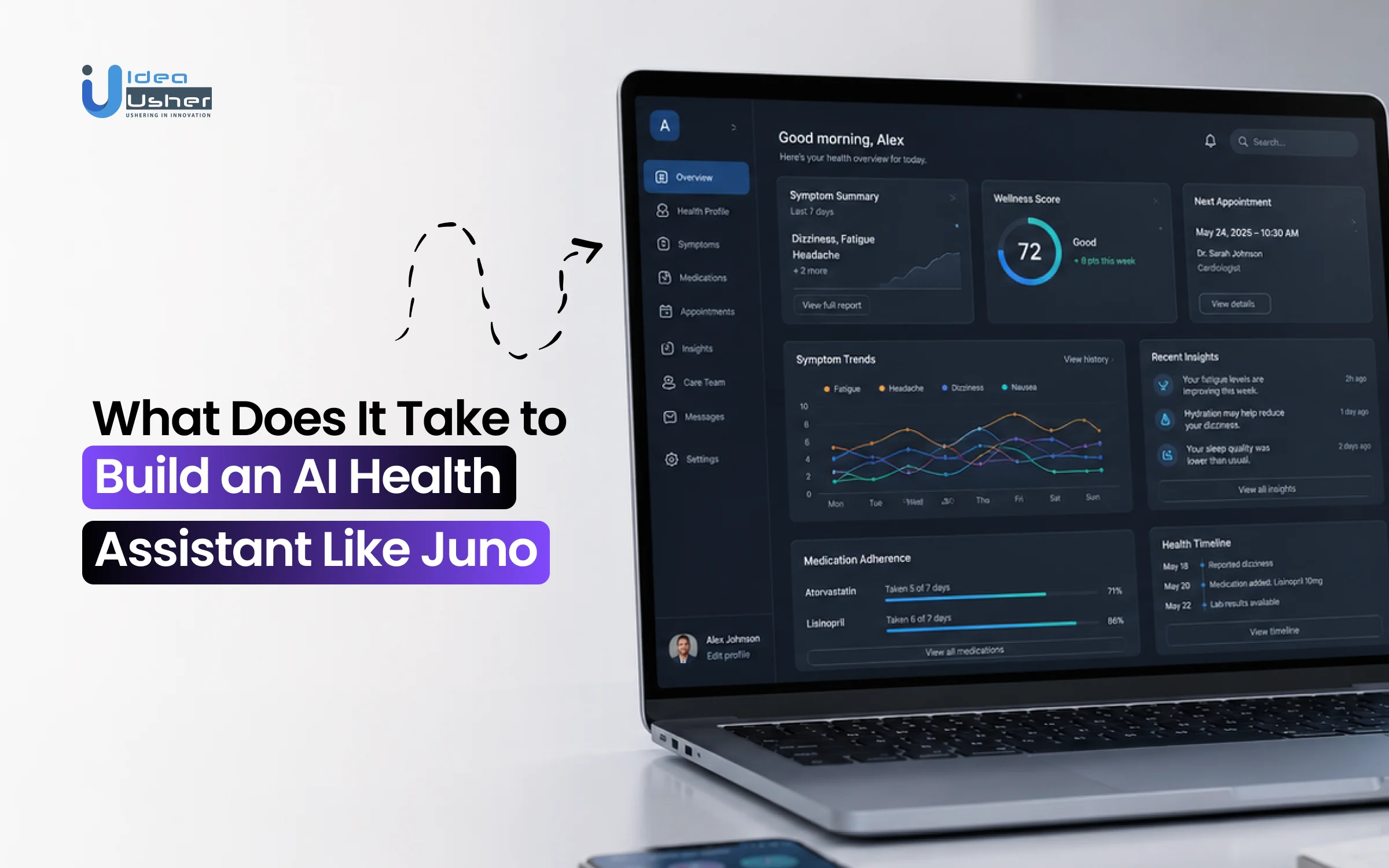
Healthcare is increasingly recognizing that the most important moments in chronic care happen between clinical appointments, not during them. This shift is accelerating AI health assistant development as healthcare innovators build intelligent companions that continuously monitor health, identify patterns and support patients long before symptoms escalate into medical interventions.
Traditional chronic care relied on episodic consultations, manual symptom diaries, and fragmented health records. Modern AI health platforms unify symptom tracking, longitudinal health memory, conversational health logging, wearable integration, medical record aggregation, proactive flare prediction, energy pacing, and clinician-ready summaries. Their value lies in turning continuous health data into personalized guidance for better long-term disease management and clinical decision-making.
This blog explores what it takes to build an AI health assistant like Juno, covering its core features, AI architecture, health data workflows, technology stack, development costs, and how IdeaUsher builds enterprise-grade AI health platform that support AI-driven preventive care alongside traditional healthcare instead of replacing it.
Why AI Health Assistants Are Becoming Essential for Chronic Care
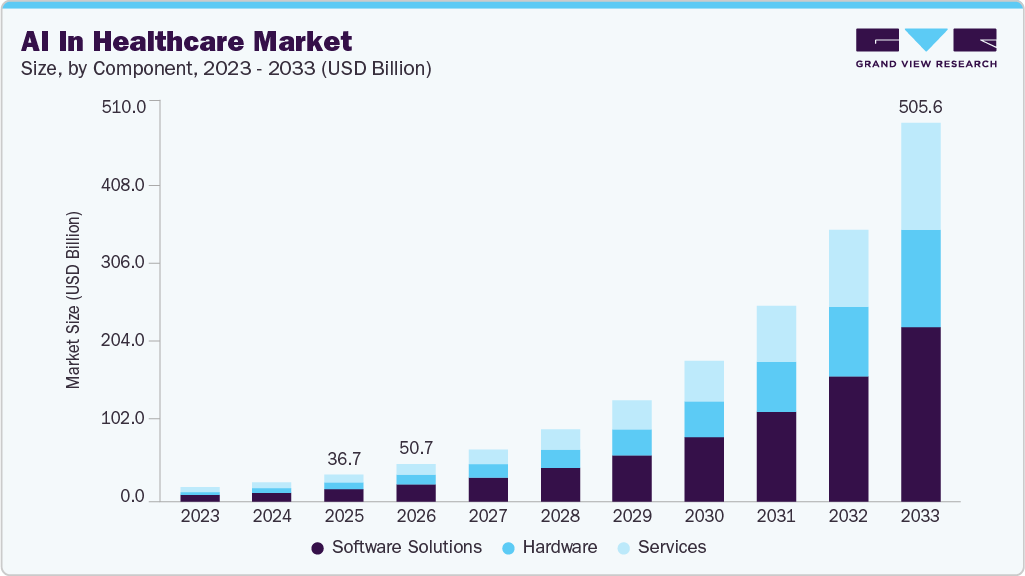
AI-powered health assistants are becoming essential to digital healthcare. According to Grand View Research, the global AI in healthcare market is projected to grow from USD 50.7 billion in 2026 to USD 505.6 billion by 2033 at a 38.9% CAGR, fueling demand for intelligent assistants like Juno that offer symptom assessment, personalized guidance, medication reminders, and continuous patient engagement.
This shift reflects the move away from the traditional “sick-care” model, where patients seek help only after symptoms worsen. It is inefficient and costly. According to the World Health Organization (WHO), non-communicable chronic diseases (NCDs) like diabetes, cardiovascular diseases, and chronic respiratory issues account for roughly 71% of all global deaths, killing 41 million people annually.
For instance, the AI chronic illness assistant Juno managed to scale to over 125,000 active global patients within its initial release phase, capturing $85,000 in Monthly Recurring Revenue (MRR).
A. Why Traditional Care Leaves Long Gaps Between Appointments
The structural architecture of traditional care inherently isolates the chronic patient. Relying on outpatient appointments scheduled months apart creates high-friction vulnerabilities that actively disrupt patient compliance:
- The Care Avoidance Gap: Data reveals that 55% of patients have actively delayed or avoided care due to complex scheduling systems and long provider waitlists.
- The Travel & Logistical Hurdle: 1 in 4 individuals living with or at risk of a chronic disease completely miss their scheduled in-person consultations due to travel logistics, indirect costs, or sudden pain flares.
- The Cognitive Overload Trap: When a patient finally does see a doctor, they are forced to summarize months of fluctuating symptoms on the spot. This creates fragmented, incomplete histories that compromise accurate diagnostic adjustments.
B. The Shift Toward Continuous AI-Powered Health Monitoring
AI health assistants like Juno resolve this fragmentation by replacing sporadic clinic visits with a continuous digital care layer.
Instead of treating health as an annual event, cloud-based models which account for 63.2% of the digital health deployment architecture passively ingest ongoing biometric data streams in the background of daily life.
- Eliminating Friction: Conversational AI captures daily health variables automatically through voice and natural text, removing the cognitive strain of manual logging.
- Preventing Crashes: By monitoring subtle, day-to-day shifts in physiological baselines (like HRV or sleep architecture), platforms catch oncoming flares before they manifest.
- Reducing Clinical Backlog: By feeding structured summaries directly to connected care teams, these platforms shrink clinical note and documentation workloads by 20% to 30%.
C. Market Demand for AI Chronic Care Platforms
The consumer demand for highly responsive, continuous health tracking is skyrocketing. Patients are no longer willing to tolerate repetitive administrative hurdles or disconnected data profiles.
Large-scale consumer experience research highlights a profound shift in modern patient expectations:
| Patient Friction Point | Metric | The Consumer Reality |
| Rising Expectations | 95% | Expect digital healthcare interactions to match the seamless, personalized standards of top-tier consumer brands. |
| Provider Churn Risk | 85% | State they would consider switching their primary provider over inconsistent health profiles across departments. |
| Administrative Fatigue | 81% | Report intense frustration over having to repeat their medical history multiple times to different care wings. |
| System Isolation | 68% | Report feeling like they are “starting from scratch” every single time they interact with a new wing of the healthcare ecosystem. |
Because chronic care requires daily adjustments rather than seasonal reactions, the market is aggressively pivoting toward empathetic platforms that act as a continuous, continuously remembering companion.
What Is Juno & Why Is It Different?
Managing a chronic condition often feels like a second full-time job. For the 1 billion+ people living with illnesses such as fibromyalgia, POTS, ME/CFS, endometriosis, or long COVID, diagnosis takes an average of 7.6 years, followed by long wait times and brief consultations.
Juno addresses this gap as a 24/7 AI health companion for chronic disease management, providing continuous support between doctor visits through personalized symptom tracking, health insights, and proactive care guidance. It builds a longitudinal understanding by combining diagnostic reports, blood tests, wearable data, and daily symptom logs to deliver personalized insights into a unified health profile that support both patients and their clinical teams.
The unique feature of Juno is that the energy pacing and flare prevention system stands out by analyzing biometrics, crash history, and schedules to recommend rest and adjust activities, proactively reducing symptom flare-ups.
A. An AI Companion Built for Chronic Illness Management
Unlike typical wellness trackers designed around counting steps or calories, Juno is built to navigate the unpredictable, volatile realities of “invisible” and systemic illnesses.
- Empathetic Crisis Support: Built by founders living with chronic conditions, Juno avoids the “toxic positivity” common in many health apps. It provides judgment-free voice and text support during pain flares, crashes, and other difficult moments.
- Clinical Summary Automation: Explaining months of symptoms during a short appointment can be challenging. Juno converts daily conversations, symptom logs, medication changes, and sleep patterns into an appointment-ready PDF summary, giving clinicians structured context before every visit.
- Active Energy Pacing: For energy-limiting conditions such as ME/CFS, Juno combines Heart Rate Variability (HRV) with historical activity patterns to recommend proactive rest breaks, helping users manage their daily workload and reduce the risk of symptom crashes.
B. How Longitudinal Health Memory Improves Personalization
Standard AI chatbots evaluate prompts in isolation without retaining long-term context. For chronic conditions, this often results in generic guidance. Juno overcomes this with a longitudinal health memory, maintaining a continuous conversational history to deliver more personalized and context-aware support.
The Power of Retrospective Context: Juno treats health as a continuous timeline. It constantly cross-references immediate complaints against a deep historical baseline to detect subterranean patterns that humans or standard software easily miss.
By archiving and cross-analyzing data across months of check-ins, the AI maps clear correlation matrices across four core pillars:
| Data Input Stream | What Longitudinal Memory Tracks | Predictive Insight Generated |
| Doctor Notes & Labs | Multi-year history of GP notes, blood panels, and imaging. | Establishes the concrete clinical baseline and diagnostic boundaries. |
| Biometric Signals | Ongoing trends in sleep, resting heart rate, and stress markers. | Detects physiological strain days before physical symptoms manifest. |
| Daily Check-ins | Granular logs of dietary habits, active hours, and medications. | Isolates direct environmental and lifestyle triggers for flares. |
| Medical History | Evolving trajectory of past symptom severity and recovery rates. | Quantifies the long-term efficacy of specific treatment interventions. |
C. Why Conversational Health Tracking Outperforms Manual Logging
Traditional symptom-tracking apps rely on rigid, manual input forms, requiring patients to navigate dropdowns, rate pain scales from 1 to 10 across dozens of checkboxes, and complete lengthy text fields. This manual approach creates cognitive burden and leads to high logging drop-off rates, especially when patients are at their worst.
Conversational tracking completely reverses this dynamic by replacing clinical forms with natural, low-friction dialogue.
- Zero-Friction Voice Logging: During a migraine or pain flare, users can log symptoms, emotions, and medication timing through voice, eliminating the need to interact with a screen.
- Dynamic, Contextual Follow-ups: Instead of accepting a simple entry like “I have a headache,” Juno asks personalized follow-up questions based on the user’s health history (e.g., “Is this the throbbing pain on the left side similar to your flare last Tuesday?”).
- Messy-to-Structured Data Conversion: Users can speak naturally using everyday language or fragmented thoughts. Juno converts unstructured voice and text into structured clinical data, automatically extracting relevant health information without requiring manual data entry..
How an AI Chronic Care Companion Like Juno Works
Standard digital health tools are reactive, responding to individual queries without retaining context. In contrast, AI health assistants like Juno use a longitudinal health architecture that continuously connects patient data to deliver personalized, context-aware chronic care support.
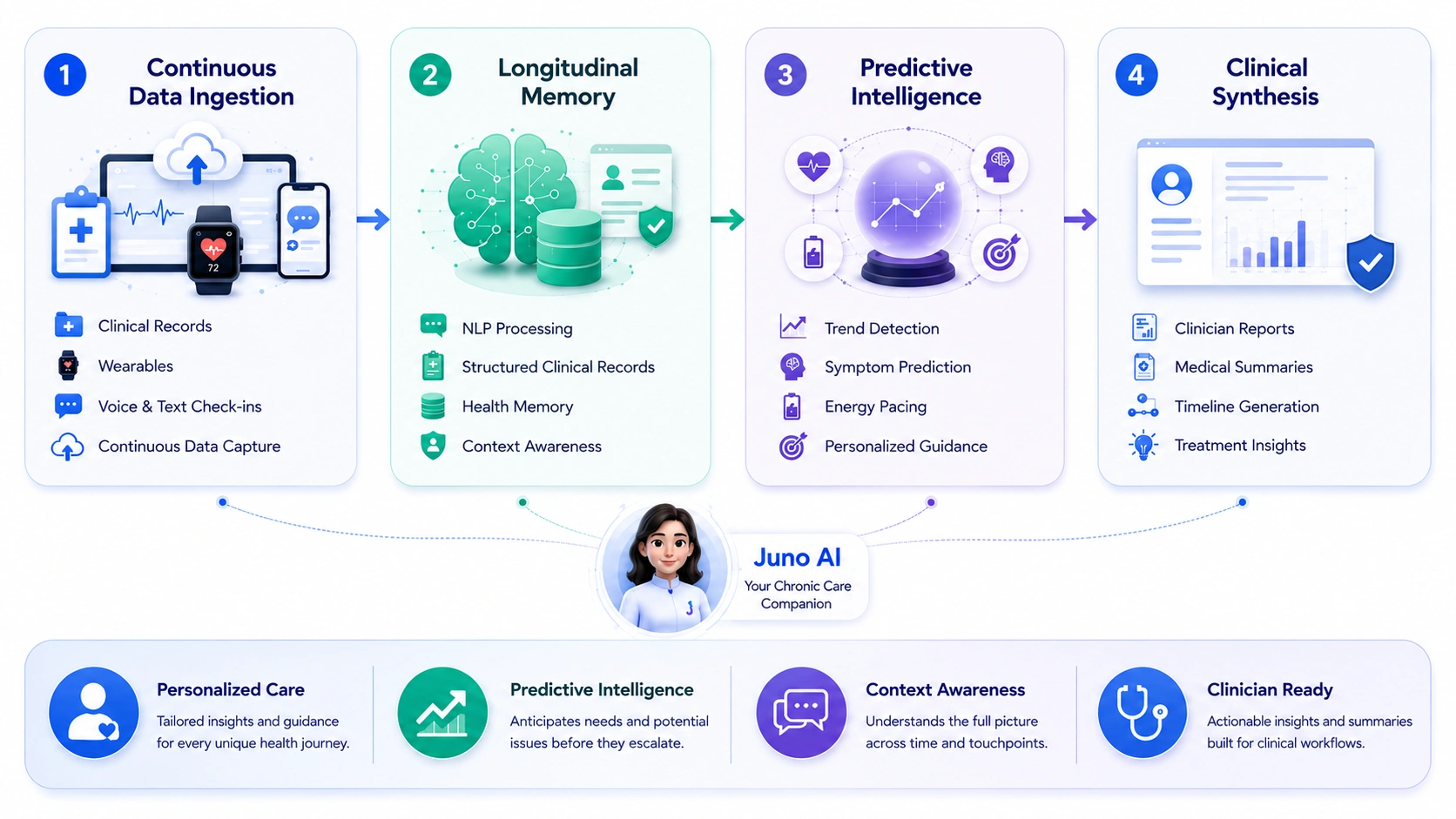
Instead of treating your health as a series of random events, the platform functions as an interconnected system built on four distinct operational layers: continuous ingestion, contextual sensemaking, predictive reflection, and clinical synthesis.
A. The Four-Layer Architecture of Adaptive Care
An AI health assistant delivers personalized, proactive care through a structured workflow that captures health data, builds long-term patient context, predicts potential risks, and generates clinically actionable insights in real time.
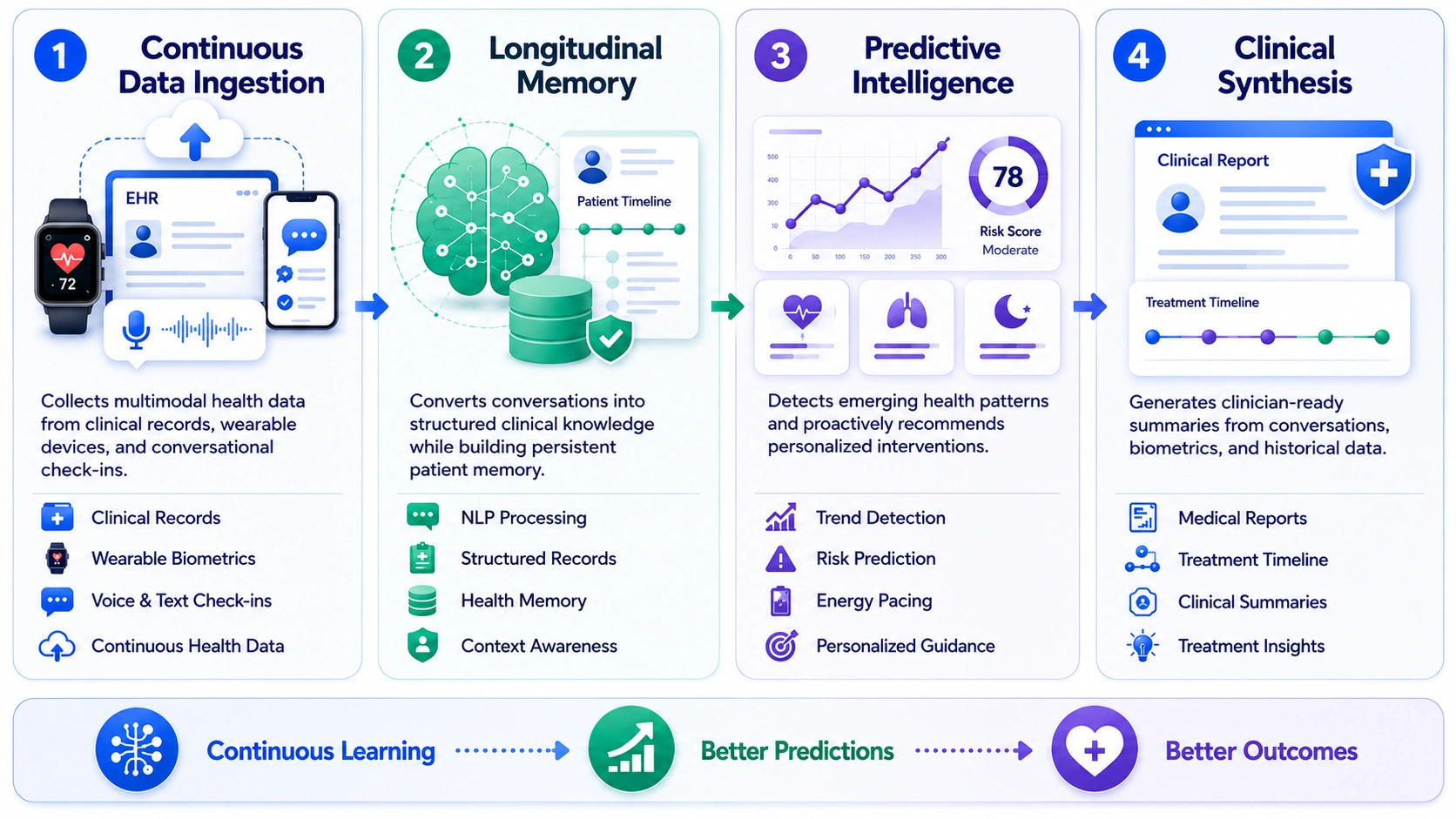
1. Continuous Multimodal Ingestion (Real-time Data Capture)
Juno combines three disparate streams of health data such as clinical records (GP notes, blood tests, imaging), wearable biometrics (HRV, resting heart rate, sleep), and unstructured speech or text check-ins into a unified, continuously updated health record.
2. Longitudinal Coherence & Sensemaking (Memory Graph Building)
Rather than dumping information into a generic text log, the AI runs natural language processing (NLP), converting conversational health updates into structured clinical data and links them to a longitudinal health memory graph, helping track symptoms, trends, and health changes over time.
3. Predictive Analysis & Energy Pacing (Cognitive Reflection)
Using predictive analytics and machine learning, Juno compares new symptom logs with historical baseline trends. When it detects a potential crash signature, it proactively recommends rest and adjusts daily activities to help prevent symptom flare-ups.
4. Clinical Document Synthesis (Actionable Output)
Before appointments, the platform transforms continuous biometric data, symptom history, and conversation logs into a clinician-ready summary, translating everyday language into clinical terminology while highlighting timelines, triggers, and treatment responses.
B. From Unstructured Mess to Diagnostic Clarity
The core engine driving this process is the translation of subjective, messy human experiences into objective, mathematically modelable trends. When managing complex conditions like POTS, fibromyalgia, or long COVID, small variables matter immensely.
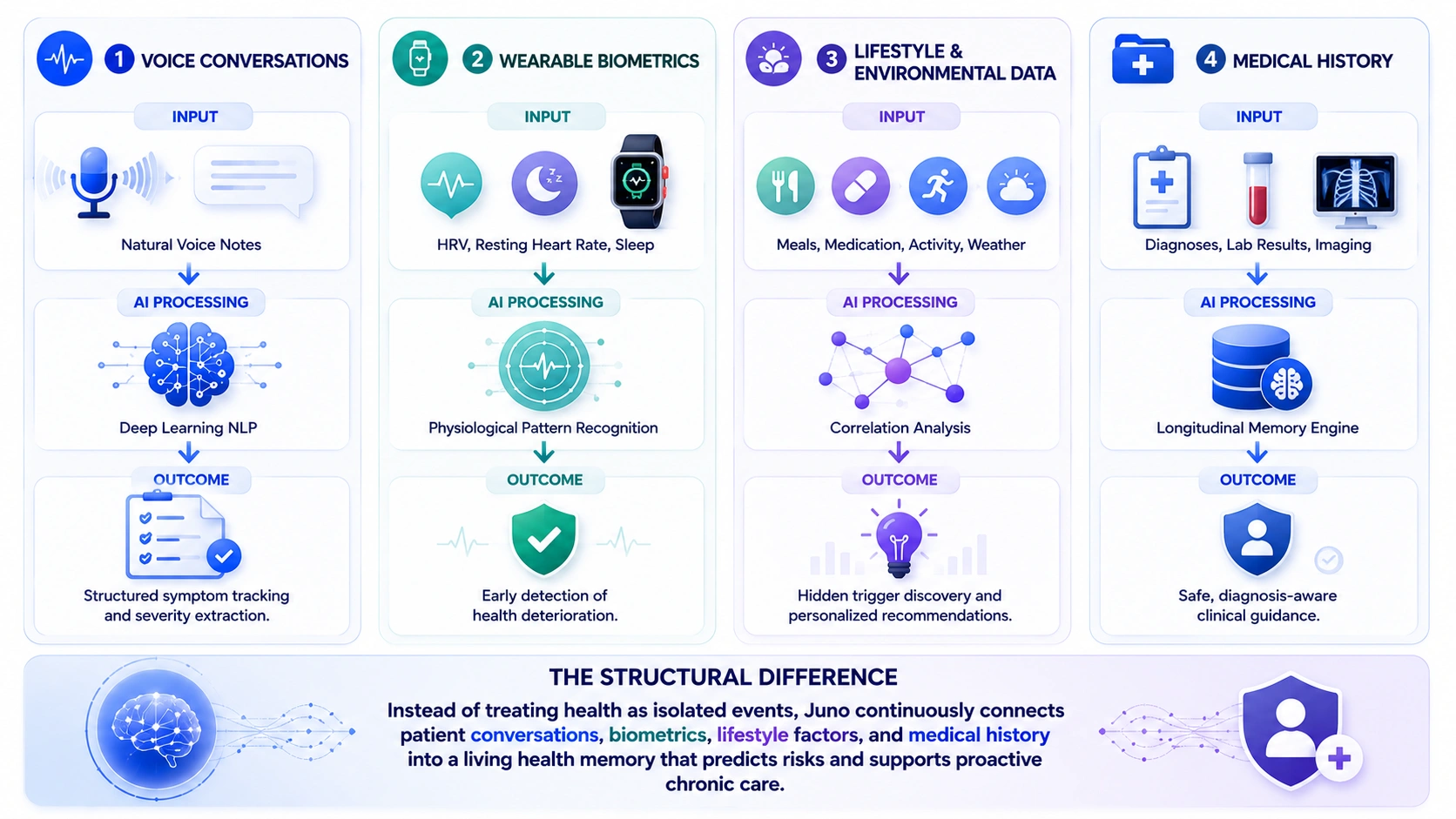
The machine learning framework acts as an interpretive filter, continuously mapping personal lifestyle choices directly against underlying physiological strain:
| Data Ingestion Stream | AI Processing Method | Practical Outcome for the Patient |
| Natural Voice Notes(e.g., “My legs feel like lead today and I’m dizzy.”) | Deep learning NLP extracts symptom severity, pairing it with historical timelines. | Eliminates manual typing; accurately logs severe pain flares even during screen-induced migraines. |
| Wearable Biometrics(e.g., Continuous HRV, sleep stages, resting heart rate.) | Attributable components analysis identifies subterranean physiological patterns. | Detects systemic autonomic nervous system strain days before you physically feel a crash coming. |
| Lifestyle & Environmental Logs(e.g., Meal timing, medication changes, weather.) | Statistical correlation matrices map environmental variables against symptom spikes. | Exposes hidden triggers, proving exactly how a specific food choice or barometric pressure drop impacts energy limits. |
| Historical Health Data(e.g., Past clinical diagnoses, lab work, scan results.) | Vector-embedded longitudinal memory retains core clinical boundaries. | Ensures every single piece of advice given by the AI remains safe, relevant, and bound to your actual diagnosis. |
The Structural Difference: By operating across these unified layers, Juno converts the fragmented, stressful chaos of tracking an invisible illness into a continuous, predictable, and deeply protective care system that works silently in the background of your life.
Core Features Every AI Health Assistant Like Juno Needs
The AI health assistant for chronic care requires more than adding a chatbot to a healthcare app. Effective AI health assistant development focuses on systems that continuously learn from patient data, predict health changes, and deliver personalized support that improves self-management while helping clinicians make better-informed treatment decisions.
Together, these features showcase how modern AI health assistants like Juno are transforming chronic care into a proactive, personalized, and data-driven experience.
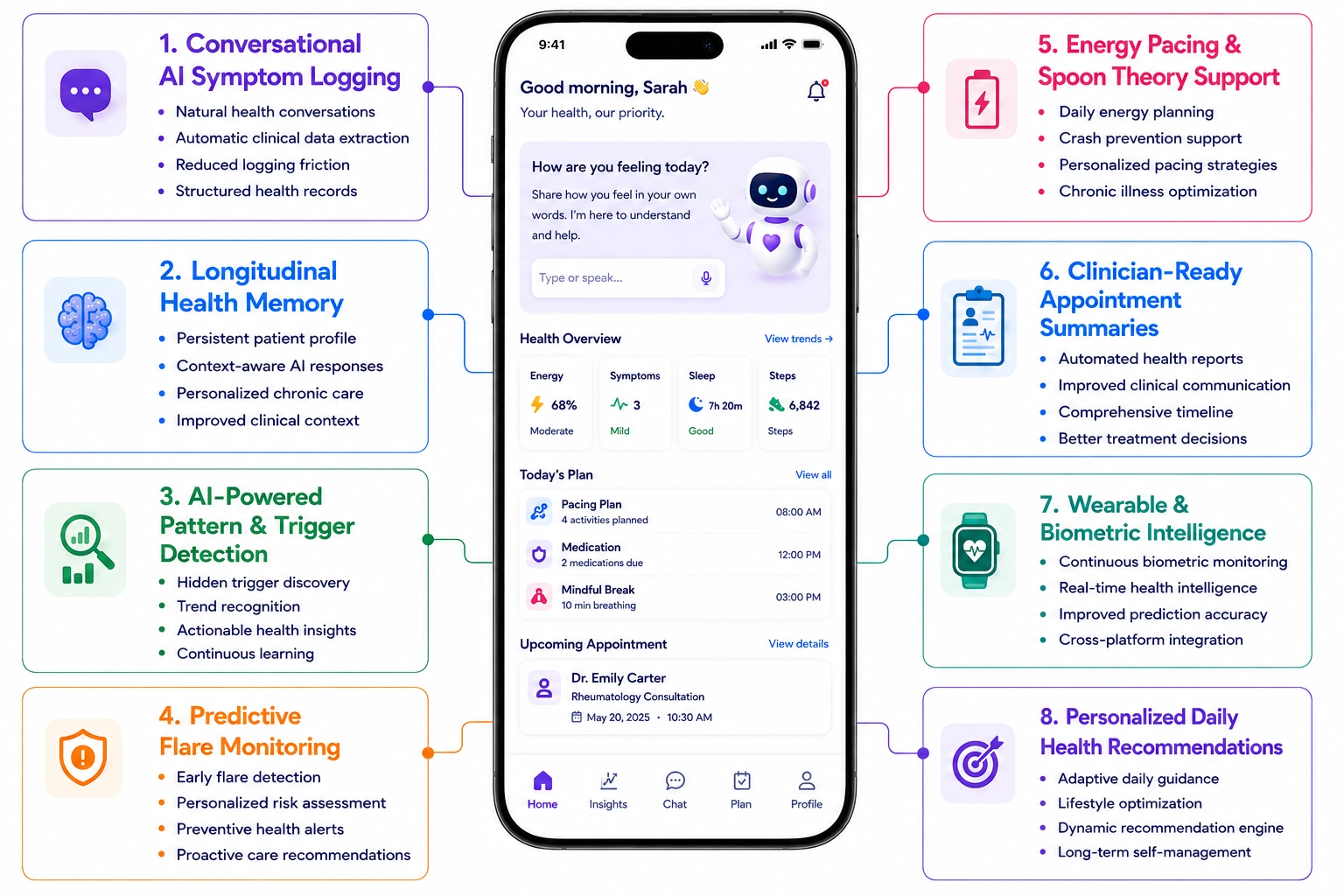
1. Conversational AI Symptom Logging
Conversational AI symptom logging enables users to describe their health naturally through everyday conversations instead of completing lengthy forms. The AI automatically captures meaningful clinical information, making symptom tracking easier, more accurate, and sustainable for long-term chronic illness management.
- Natural Health Conversations: Enables users to report symptoms through everyday conversations instead of manually filling structured symptom tracking forms.
- Automatic Clinical Data Extraction: Identifies symptoms, severity, duration, medications, triggers, and contextual information from every user interaction automatically.
- Reduced Logging Friction: Simplifies daily health tracking, encouraging consistent engagement and improving long-term patient adherence across chronic care journeys.
- Structured Health Records: Converts conversational inputs into organized health records that support future AI analysis and clinical reporting.
2. Longitudinal Health Memory
Longitudinal health memory allows the AI to remember a patient’s evolving health history instead of treating every conversation independently. This persistent understanding enables highly personalized recommendations, more accurate insights, and continuous care tailored to each individual’s condition.
- Persistent Patient Profile: Maintains an evolving health profile by combining historical symptoms, treatments, conversations, and medical records over time.
- Context-Aware AI Responses: Uses previous interactions to deliver recommendations that reflect the user’s complete health journey instead of isolated conversations.
- Personalized Chronic Care: Continuously adapts guidance as new health information becomes available, improving personalization and long-term patient outcomes.
- Improved Clinical Context: Provides clinicians with comprehensive historical information that supports more informed treatment decisions during consultations.
3. AI-Powered Pattern & Trigger Detection
AI-powered pattern detection analyzes health information across multiple data sources to identify recurring symptom patterns and hidden triggers. These insights help patients better understand their condition and make informed lifestyle adjustments that support long-term disease management.
- Hidden Trigger Discovery: Identifies relationships between symptoms, medications, activities, sleep, nutrition, and environmental factors using AI-driven analysis.
- Trend Recognition: Detects recurring symptom patterns that may remain unnoticed through traditional manual health tracking methods.
- Actionable Health Insights: Provides meaningful recommendations based on identified correlations to support better daily health decisions.
- Continuous Learning: Improves analytical accuracy as additional patient data and health history become available over time.
4. Predictive Flare Monitoring
Predictive flare monitoring continuously evaluates historical trends and real-time health signals to detect early signs of symptom deterioration. Proactive alerts help patients take preventive actions before flare-ups significantly affect their daily activities and overall wellbeing.
- Early Flare Detection: Identifies subtle health changes that indicate an increased likelihood of future symptom flare-ups.
- Personalized Risk Assessment: Evaluates current health status against individual baselines instead of relying on generic population averages.
- Preventive Health Alerts: Delivers timely notifications that encourage early interventions before symptoms become severe.
- Proactive Care Recommendations: Suggests personalized actions that may reduce flare frequency and improve long-term health stability.
5. Energy Pacing & Spoon Theory Support
Energy pacing helps individuals living with chronic illnesses manage limited daily energy more effectively. AI recommendations balance activities with planned recovery periods, reducing overexertion while supporting healthier routines and improved quality of life.
- Daily Energy Planning: Recommends balanced activity schedules based on historical energy levels and upcoming daily commitments.
- Crash Prevention Support: Identifies situations that could lead to overexertion and recommends timely recovery breaks.
- Personalized Pacing Strategies: Adapts pacing recommendations according to individual symptom severity, recovery history, and health progression.
- Chronic Illness Optimization: Supports conditions requiring careful energy management, including ME/CFS, POTS, Long COVID, and fibromyalgia.
6. Clinician-Ready Appointment Summaries
Clinician-ready appointment summaries automatically organize patient health information into structured reports before medical visits. This improves communication, reduces information gaps, and enables healthcare providers to quickly understand meaningful changes in the patient’s condition.
- Automated Health Reports: Generates structured summaries containing symptoms, medications, flare history, and recent health developments before appointments.
- Improved Clinical Communication: Helps patients communicate complex health information more accurately during limited consultation time.
- Comprehensive Health Timeline: Organizes historical events into an easy-to-review chronological format for clinicians.
- Better Treatment Decisions: Enables healthcare providers to access clearer patient information for more informed clinical recommendations.
7. Wearable & Biometric Intelligence
Wearable integration enhances AI decision-making by combining biometric signals with patient-reported health information. Continuous physiological monitoring provides richer context, enabling more accurate personalization, health predictions, and proactive chronic disease management.
- Continuous Biometric Monitoring: Collects heart rate, sleep, activity, HRV, oxygen saturation, and additional physiological health metrics automatically.
- Real-Time Health Intelligence: Combines wearable data with symptom history to improve AI-driven health assessments and recommendations.
- Improved Prediction Accuracy: Uses continuous physiological information to strengthen flare prediction and personalized health analysis models.
- Cross-Platform Integration: Connects wearable ecosystems and health platforms to create a unified patient health experience.
8. Personalized Daily Health Recommendations
Personalized daily recommendations transform collected health data into practical actions users can follow every day. AI continuously adapts guidance according to changing health conditions, helping patients make smarter decisions that improve long-term disease management.
- Adaptive Daily Guidance: Delivers personalized recommendations based on symptoms, biometrics, medications, routines, and longitudinal health history.
- Lifestyle Optimization: Suggests improvements related to sleep, hydration, exercise, nutrition, and daily activity planning.
- Dynamic Recommendation Engine: Continuously updates health guidance as new patient information becomes available through ongoing monitoring.
- Long-Term Self-Management: Empowers patients to make informed daily decisions that support healthier chronic illness management outcomes.
Development Process for an AI Health Assistant Like Juno
Developing an AI health assistant like Juno requires a structured approach that combines healthcare expertise, AI engineering, predictive analytics, and secure infrastructure. Each development phase contributes to creating a clinically reliable platform that delivers personalized chronic care while supporting long-term patient engagement and clinician collaboration.
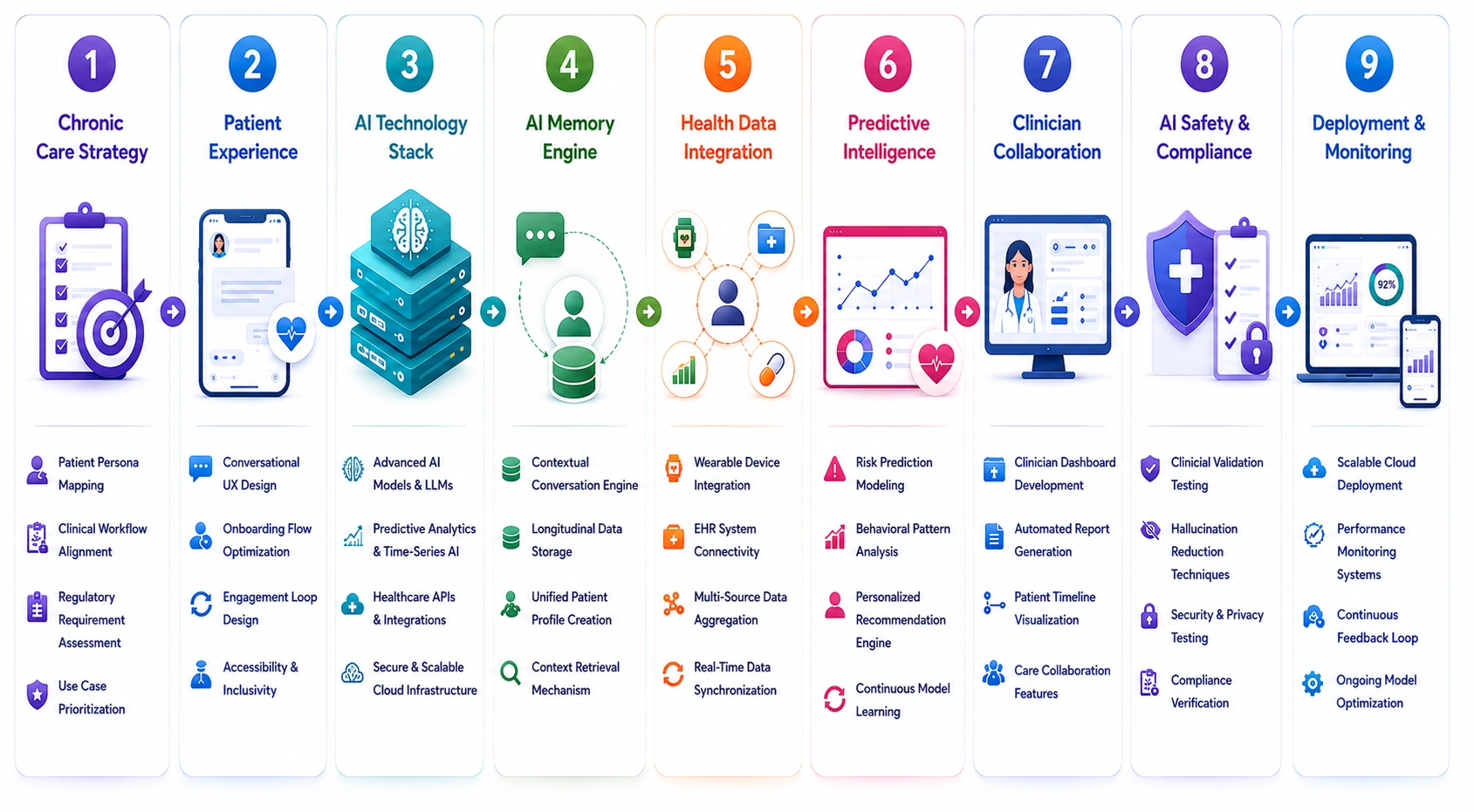
1. Define Target Chronic Conditions & Care Workflows
We begin by identifying chronic conditions, studying patient journeys, mapping clinical workflows, and defining product requirements. This foundation ensures every AI capability aligns with real healthcare needs and measurable business objectives.
- Patient Persona Mapping: Defines target user segments, chronic condition profiles, and behavioral patterns to guide product design decisions.
- Clinical Workflow Alignment: Maps real-world care pathways, treatment protocols, and provider interactions to ensure platform relevance and usability.
- Regulatory Requirement Assessment: Identifies compliance needs such as HIPAA, GDPR, and regional healthcare regulations before development begins.
- Use Case Prioritization: Focuses on high-impact features like symptom tracking, medication adherence, and early risk detection for faster value delivery.
2. Design Conversational Patient Experiences
Our team designs intuitive conversational experiences that make symptom tracking effortless through natural interactions. We create onboarding journeys, daily check-ins, and personalized prompts that drive consistent engagement while reducing user friction.
- Conversational UX Design: Builds natural, human-like interactions that simplify symptom reporting and reduce cognitive effort for patients.
- Onboarding Flow Optimization: Creates guided onboarding experiences that quickly capture patient history and personalize initial interactions.
- Engagement Loop Design: Implements daily check-ins, reminders, and nudges that encourage consistent long-term patient participation.
- Accessibility & Inclusivity: Ensures platform usability across age groups, literacy levels, and accessibility needs for broader adoption.
3. AI Tech Stack for an AI Health Assistant Like Juno
Next, we select AI technologies that power the platform’s intelligence, scalability, and security. The right combination of language models, predictive AI, healthcare APIs, and cloud infrastructure during AI health assistant development ensures reliable performance and future scalability.
| Technology Component | Purpose in Platform |
| Large Language Models (LLMs) | Enables natural language understanding, conversational AI, and contextual patient interactions across multiple healthcare scenarios. |
| Retrieval-Augmented Generation (RAG) | Combines real-time medical knowledge retrieval with AI responses to improve accuracy and reduce hallucinations. |
| Predictive AI Models | Analyzes patient data to forecast health risks, symptom flare-ups, and disease progression patterns. |
| Time-Series Analytics | Processes continuous biometric and behavioral data from wearables to detect trends and anomalies over time. |
| Recommendation Engines | Generates personalized care plans, lifestyle suggestions, and medication reminders based on patient-specific data. |
| Vector Databases | Stores and retrieves patient context, embeddings, and historical interactions for faster and relevant AI responses. |
| Wearable Integration APIs | Connects devices like Apple Watch and Fitbit to collect real-time health metrics and activity data. |
| FHIR APIs | Enables secure integration with Electronic Health Records and healthcare systems using standardized data formats. |
| Secure Cloud Infrastructure | Provides a scalable, compliant, and secure hosting environment for handling sensitive healthcare data and AI workloads. |
4. Build AI Conversation & Longitudinal Memory
Our developers build an AI conversation engine capable of understanding patient inputs, retaining long-term health context, and continuously learning from new data. This enables deep personalization across the patient’s healthcare journey.
- Contextual Conversation Engine: Processes patient inputs with medical context awareness to deliver accurate and relevant responses.
- Longitudinal Data Storage: Maintains historical conversations, symptoms, and health events for continuous patient understanding.
- Unified Patient Profile Creation: Aggregates all patient data into a single structured profile for consistent AI decision-making.
- Context Retrieval Mechanism: Fetches relevant past interactions and health data to enhance real-time conversational accuracy.
5. Integrate Wearables, EHRs & Health Data
We connect wearable devices, Electronic Health Records, lab reports, and medications into a unified patient profile. This centralized health intelligence provides comprehensive context for accurate AI analysis and personalized recommendations.
- Wearable Device Integration: Connects fitness trackers and smart devices to capture real-time biometric and activity data streams.
- EHR System Connectivity: Integrates clinical records, diagnoses, and treatment history using standardized healthcare data protocols.
- Multi-Source Data Aggregation: Combines lab reports, medications, and lifestyle inputs into a unified patient data ecosystem.
- Real-Time Data Synchronization: Ensures continuous updates across all connected systems for accurate and timely AI insights.
6. Develop Predictive Intelligence & Personalized Care
Our AI engineers develop predictive models that analyze symptoms, biometrics, medications, and behavior patterns to identify risks, anticipate flare-ups, and deliver personalized care recommendations that evolve over time.
- Risk Prediction Modeling: Uses historical and real-time data to identify potential health risks before symptoms escalate.
- Behavioral Pattern Analysis: Evaluates lifestyle habits, adherence patterns, and daily routines to improve care recommendations.
- Personalized Recommendation Engine: Delivers tailored health advice, reminders, and interventions based on individual patient profiles.
- Continuous Model Learning: Updates predictive models using new patient data to improve accuracy and personalization over time.
7. Build Clinician Collaboration & Reporting Tools
We develop clinician-focused tools that convert patient data into structured summaries, health timelines, and actionable insights. These features improve communication, consultation efficiency, and clinical decision-making.
- Clinician Dashboard Development: Provides healthcare providers with real-time patient insights, alerts, and comprehensive health summaries.
- Automated Report Generation: Creates structured reports including symptom trends, medication adherence, and patient progress summaries.
- Patient Timeline Visualization: Displays chronological health events and interactions for better clinical understanding and decision-making.
- Care Collaboration Features: Enables seamless communication between patients and clinicians through shared insights and updates.
8. Validate AI Accuracy, Safety & Compliance
Before deployment, we rigorously validate AI accuracy, clinical reliability, security, and regulatory compliance. This ensures the platform delivers safe, trustworthy recommendations aligned with healthcare standards.
- Clinical Validation Testing: Evaluates AI outputs against medical guidelines and expert reviews to ensure clinical reliability.
- Hallucination Reduction Techniques: Implements safeguards to minimize incorrect or misleading AI-generated medical information.
- Security & Privacy Testing: Conducts penetration testing and data protection audits to safeguard sensitive patient information.
- Compliance Verification: Ensures adherence to healthcare regulations such as HIPAA, GDPR, and regional data protection laws.
9. Deploy, Monitor & Continuously Improve
Once launched, we continuously monitor AI performance, system reliability, user engagement, and security metrics. Ongoing model updates, feature enhancements, and optimization after AI health assistant development ensure long-term scalability and effectiveness.
- Scalable Cloud Deployment: Launches platform on secure infrastructure capable of handling growing user demand and data volume.
- Performance Monitoring Systems: Tracks AI accuracy, uptime, latency, and user engagement metrics in real-time.
- Continuous Feedback Loop: Collects user and clinician feedback to refine features and improve overall platform experience.
- Ongoing Model Optimization: Regularly updates AI models using new data to enhance prediction accuracy and personalization.
How Much Does It Cost to Build an AI Health Assistant Like Juno
The cost of developing an AI health assistant like Juno depends on the platform’s complexity, AI capabilities, healthcare integrations, compliance requirements, and overall product scope. Features such as conversational AI, longitudinal health memory, predictive analytics, and wearable connectivity significantly influence the overall development budget.
A typical AI health assistant is developed in multiple phases, with each stage contributing to the final product’s functionality, scalability, and clinical reliability. The table below provides an estimated AI health assistant development cost breakdown aligned with platform-level investments (MVP to Enterprise).
| Development Stage | Estimated Cost (MVP → Enterprise) | What the Phase Covers |
| Planning & Requirement Analysis | $5,000 – $15,000 | Researches target patients, healthcare workflows, compliance requirements, business goals, and feature priorities before product development begins. |
| UI/UX Design | $8,000 – $25,000 | Designs conversational interfaces, onboarding flows, symptom tracking journeys, accessibility, and personalized user engagement experiences. |
| AI Development | $25,000 – $90,000 | Develops conversational AI, persistent health memory, contextual understanding, and personalized patient interaction capabilities. |
| Data Integration | $15,000 – $70,000 | Connects wearable devices, Electronic Health Records, laboratory systems, medications, and health data synchronization services. |
| Predictive Model Development | $20,000 – $80,000 | Builds predictive models, risk detection systems, flare prediction, and personalized recommendation engines using patient health data. |
| Backend & Clinician Tools Development | $12,000 – $50,000 | Develops clinician dashboards, appointment summaries, patient timelines, reporting systems, and healthcare collaboration features. |
| Testing & Compliance Validation | $10,000 – $40,000 | Performs AI validation, security testing, regulatory compliance verification, clinical evaluations, and quality assurance testing. |
| Deployment & Maintenance | $8,000 – $30,000 | Deploys production infrastructure, monitors AI performance, scales cloud resources, and continuously improves platform capabilities. |
| Total Estimated Cost | $75,000 – $420,000+ | Combined cost across all development phases (aligned with MVP to Enterprise levels) |
Note: These estimates represent approximate AI health assistant development costs and may vary depending on AI model complexity, healthcare integrations, compliance requirements, third-party services, geographic location of the development team, and overall project scope.
Development Cost According to Platform Level
The final investment largely depends on the product maturity you plan to launch. Businesses typically start with an MVP to validate their idea before expanding into a fully featured enterprise-grade AI healthcare platform.
While the ranges below are realistic for most AI healthcare products, actual costs can vary based on customization depth, regulatory requirements, and AI sophistication. These AI health assistant development estimates are aligned with current industry benchmarks for AI-driven healthcare platforms.
| Platform Level | Estimated Cost | What Features Include in That Platform Level |
| MVP | $75,000 – $130,000 | Conversational AI, symptom logging, patient profiles, basic AI memory, appointment summaries, authentication, and essential healthcare integrations. |
| Mid-Level | $130,000 – $240,000 | Longitudinal health memory, wearable integration, predictive analytics, personalized recommendations, clinician dashboards, advanced reporting, and scalable backend infrastructure. |
| Enterprise | $240,000 – $420,000+ | Multi-condition support, advanced predictive AI, extensive EHR integrations, enterprise security, multilingual support, analytics dashboards, compliance automation, and highly scalable cloud architecture. |
Note: These ranges are more reflective of real-world AI health assistant development costs, especially when factoring in compliance, data integrations, and advanced AI capabilities. Most startups begin with an MVP and gradually scale to mid-level or enterprise platforms based on user adoption and funding.
Key Cost Drivers in Building an AI Health Assistant
The overall AI health assistant development budget is heavily influenced by specific technical implementations and product decisions. Below are the most impactful cost drivers that directly affect how much you will invest in building a platform like Juno:
- Number of AI Models Deployed: Using multiple LLMs, predictive models, and recommendation engines increases development and infrastructure costs, typically adding $10,000–$40,000 to initial development, along with higher ongoing cloud expenses.
- Depth of EHR & Wearable Integrations: Integrating platforms such as Epic, Cerner, Apple Health, and Fitbit requires custom APIs, testing, and compliance validation, adding approximately $5,000–$15,000 per integration.
- Real-Time Data Processing Requirements: Processing continuous heart rate, glucose, and sleep data requires advanced backend infrastructure, increasing cloud costs by $3,000–$10,000+ annually, depending on scale.
- Regulatory Certification Scope: Meeting standards such as HIPAA, GDPR, and FDA requirements adds legal, engineering, and compliance costs of approximately $8,000–$25,000.
- User Base Scale & Infrastructure Load: Supporting thousands to millions of users requires scalable server architecture, load balancing, and cloud infrastructure, increasing investment by $10,000–$50,000+.
- Third-Party API & Licensing Costs: Using services such as OpenAI, AWS HealthLake, Google Health APIs, and healthcare data providers typically costs $500–$5,000+ per month, depending on usage.
Regulatory Compliance for an AI Chronic Health Assistant
AI health assistants handle highly sensitive medical and personal data, making regulatory compliance a fundamental part of the AI health assistant development process. Following healthcare and data privacy standards helps protect patient information, enables secure data exchange, minimizes legal risks, and builds long-term trust among users, healthcare providers, and enterprise partners.
| Regulation / Standard | Why It Is Important | Applies During Development |
| HIPAA | Protects Protected Health Information (PHI) through privacy and security requirements. | Encryption, secure storage, access control, audit logs, and user authentication. |
| GDPR | Governs the collection, processing, storage, and transfer of personal and health data. | Consent management, data minimization, encryption, deletion requests, and privacy controls. |
| FHIR | Standardizes healthcare data exchange between EHRs and digital health platforms. | EHR integration, patient record synchronization, and interoperability. |
| HL7 | Standardizes communication across healthcare systems. | Clinical data exchange, hospital integrations, and workflow interoperability. |
| SOC 2 Type II | Validates security, availability, confidentiality, and operational controls. | Infrastructure security, cloud operations, monitoring, and disaster recovery. |
| FDA SaMD Guidance | Applies to AI software performing regulated medical functions or supporting clinical decisions. | Clinical validation, risk management, AI testing, documentation, and regulatory submissions. |
| ISO 27001 | Establishes an information security management system (ISMS) for protecting sensitive data. | Security governance, risk assessment, access management, incident response, and compliance management. |
Note: The compliance requirements for an AI health assistant depend on the target market, healthcare use case, data processing activities, and whether the platform functions as a wellness application or a regulated medical device.
How AI Chronic Illness Assistant like Juno Make Money?
To build a sustainable digital health ecosystem, platforms balance high-volume consumer subscriptions with high-margin enterprise reimbursements. The lifetime value (LTV) of a chronic care user is exceptionally high because conditions like POTS or fibromyalgia require long-term, continuous tracking rather than a quick seasonal checkup.
| Monetization Layer | Primary Target | Pricing Structure | Key Financial Driver |
| B2C Consumer App | Individual Patients | $15 – $45 / month (Freemium conversion) | Drives organic user acquisition; lowers overall Patient Acquisition Cost (PAC). |
| Telehealth Integration | Virtual Care Users | $45 – $75 / per-visit fee (or co-pay) | Generates instant, on-demand transactional revenue at the point of need. |
| Remote Monitoring (RPM) | Insurance / B2B2C | $47 – $52 / patient / month (CMS Reimbursement) | Enterprise-scale, recurring contractual revenue via direct clinical networks. |
| Employer Wellness (SaaS) | B2B Enterprises | $2 – $8 / employee / month (PEPM Licensing) | Large-volume contract wins paid directly by corporate benefits budgets. |
1. The B2C Freemium & Subscription Model
At its core, Juno operates on a premium subscription model (offering weekly and monthly tiers). Because chronic illness management requires consistent, daily engagement rather than a one-time transaction, a recurring revenue model provides the most stable cash flow.
- The Free Tier: Focuses on low-computing-cost features to drive user acquisition. Users can access basic symptom logging, day-to-day conversational check-ins, and standard health tracking tools.
- The Premium Tier: Gates the most advanced, high-compute AI features behind a paywall. This typically includes:
- Unlimited Voice Interactions: Utilizing low-latency audio pipelines for real-time crisis or flare support.
- Advanced Longitudinal Analytics: Running deep statistical correlation matrices across months of data to isolate specific environmental or dietary triggers.
- Clinical Document Generation: Automatically compiling messy conversational history into structured, appointment-ready PDFs for doctors.
2. The Vertically Integrated B2B2C Care Pathway
As digital health platforms scale, the most lucrative monetization strategy shifts from the patient to the broader healthcare ecosystem. Platforms like Juno position themselves as the “Health OS” or the primary digital layer connecting patients to actual clinical infrastructure.
- Telehealth & GP Consultations: By partnering with or employing general practitioners (GPs), the platform can offer virtual consultations when the AI detects significant health risks or trends. Clinicians receive the AI-generated health summary, while revenue is generated through per-visit fees or premium memberships.
- Pharmacy & Prescription Fulfillment: By integrating with pharmacy partners, the platform can coordinate prescription fulfillment and home delivery when a patient’s treatment plan changes, creating an additional revenue stream.
3. Remote Patient Monitoring (RPM) & Insurance Reimbursement
The holy grail of monetization for chronic care platforms is getting health insurance providers or government programs to foot the bill. By serving as the digital middleman for clinics, the platform taps into massive institutional budgets.
- CCM & RPM Billing Codes: In healthcare systems such as U.S. Medicare and Medicaid, providers can receive reimbursement for Remote Patient Monitoring (RPM) and Chronic Care Management (CCM) services.
- The Code Breakdown: By streaming device data, clinics can bill CPT 99454 (approximately $47/month for remote monitoring) and CPT 99457 (approximately $52/month for 20 minutes of care management).
- The Enterprise Play: By partnering with clinics and hospital networks, the AI platform provides patient monitoring software that supports RPM and CCM billing, generating revenue through licensing fees or a per-patient subscription model.
4. Enterprise B2B SaaS (Employer Wellness)
To capture large volumes of users at zero cost to the individual, health tech platforms sell their services directly to corporations as an employee benefit.
Large enterprises pay a monthly licensing fee per employee to offer advanced chronic care and mental wellness platforms. For the employer, this reduces overall employee absenteeism and lowers corporate healthcare insurance premiums by proactively catching chronic health failures before they require expensive emergency room visits.
Challenges in Building an AI Chronic Care Platform
The AI chronic care platform like Juno involves solving complex engineering, healthcare, and AI challenges simultaneously. From maintaining accurate long-term patient memory to securely integrating fragmented healthcare data, every AI health assistant development challenge requires specialized expertise to deliver a reliable, scalable, and clinically trustworthy platform.
1. Accurate Longitudinal Health Memory
Challenge: Building an AI that consistently remembers years of patient history while retrieving relevant health context without losing accuracy or personalization.
Solution: Our developers implement vector databases, Retrieval-Augmented Generation (RAG), structured patient profiles, and memory orchestration techniques to preserve long-term health context while delivering accurate, personalized responses throughout every patient interaction.
2. Fragmented Healthcare Data Integration
Challenge: Combining Electronic Health Records (EHRs), wearable devices, laboratory reports, medications, and patient conversations into one synchronized health profile is technically complex.
Solution: We build standardized integration pipelines using FHIR APIs, wearable SDKs, secure synchronization services, and unified data models during AI health assistant development process that continuously aggregate healthcare information into a reliable patient intelligence layer.
3. AI Hallucinations in Clinical Responses
Challenge: AI models can occasionally generate inaccurate or unsupported medical information, creating significant risks within healthcare applications.
Solution: Our team minimizes hallucinations by implementing Retrieval-Augmented Generation (RAG), medical knowledge validation, prompt engineering, confidence scoring, and human review mechanisms to produce safer, evidence-based AI responses.
4. Healthcare Security & Regulatory Compliance
Challenge: Protecting sensitive patient information while complying with regulations such as HIPAA and GDPR requires strict security and governance throughout development.
Solution: We incorporate end-to-end encryption, role-based access control, secure cloud architecture, audit logging, continuous security testing, and compliance-first development practices during AI health assistant development to safeguard healthcare data while meeting global regulatory standards.
Partner With Idea Usher for AI Chronic Illness Assistant
IdeaUsher is a premier digital product engineering partner with 11+ years of experience building successful software across 50+ countries. Driven by a team of 250+ experts, over 1,000+ completed projects, and a 4.9/5 Clutch rating, we excel at turning big tech ideas into highly profitable SaaS platforms. We skip generic, off-the-shelf templates to build custom, high-performance engines from the ground up.
By combining easy-to-use digital health tools with advanced generative AI models, we help you launch a world-class virtual care companion that gives your company a massive competitive edge.
Why Enterprises Partner With Us
Business leaders choose us because we make chronic condition care completely simple for patients while keeping the underlying system fast, secure, and highly scalable.
- Advanced Patient Context Preservation: We build intelligent long-term memory modules that continuously track months of text and voice interactions, ensuring the AI deeply understands a user’s unique illness history without making them repeat themselves.
- Smart Medical Summary Generators: The platform features an automated data compiler that translates messy, day-to-day symptom logs and pain diaries into clean, organized summaries that patients can share with their doctors during short clinical visits.
- Isolated Multi-Tenant Security Runtimes: We deploy highly secure, private cloud container instances for every enterprise client, ensuring sensitive patient records stay strictly protected and completely isolated to maintain total data integrity.
- Empathetic Voice and Text Workflows: Our designers create specialized conversational frameworks that automatically adapt to a user’s energy and pain levels, offering gentle check-ins and symptom tracking without overwhelming the patient.
Ready to change how chronic illness care is managed with an easy-to-use, AI-powered health assistant? Partner with Idea Usher’s product experts to map out your platform design today.
Conclusion
The future of chronic care lies in AI systems that provide continuous, personalized support instead of limiting care to occasional clinical visits. An AI health assistant like Juno demonstrates how conversational intelligence, predictive analytics, longitudinal health memory, and wearable integrations can improve patient outcomes while strengthening clinician collaboration. At IdeaUsher, we combine healthcare domain expertise with advanced AI development to help businesses build secure, scalable, and compliant AI health platforms that are ready for real-world adoption and long-term growth.
FAQs
A.1. An AI health assistant should include conversational symptom tracking, longitudinal health memory, wearable integration, predictive flare detection, personalized recommendations, clinician-ready reports, and secure health data management to support continuous chronic care.
A.2. The AI health assistant development cost typically ranges from $75,000 to $420,000+, depending on AI capabilities, healthcare integrations, regulatory compliance, predictive analytics, platform scalability, and the overall product scope.
A.3. Regulatory compliance in AI health assistant development protects sensitive patient data, ensures secure data handling, supports legal healthcare operations, and increases trust among patients, healthcare providers, investors, and enterprise partners adopting the platform.
A.4. Longitudinal health memory enables AI to understand historical symptoms, treatments, medications, and patient behaviors, delivering personalized recommendations and more accurate health insights instead of isolated conversational responses.