

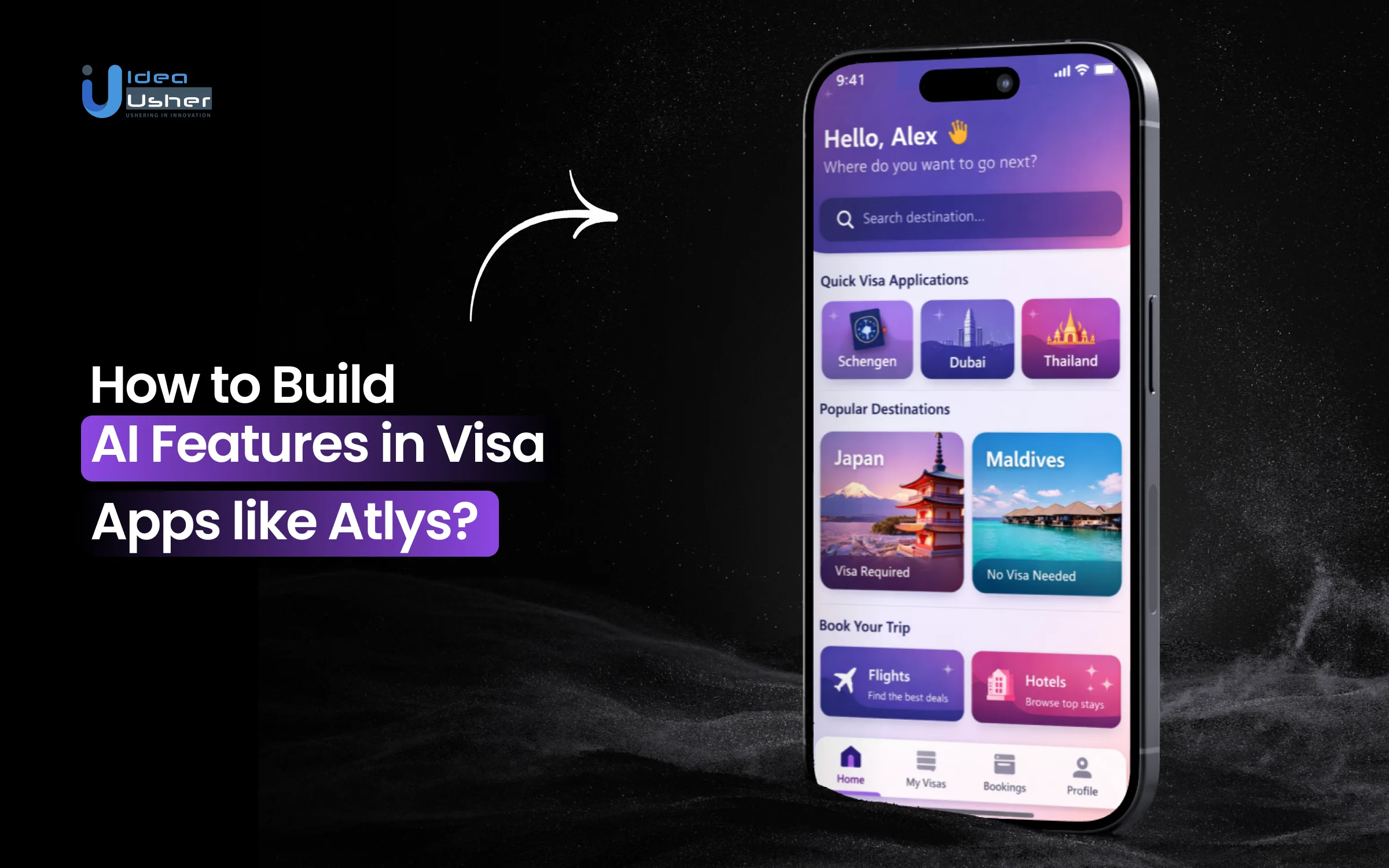
Most travellers do not resist the visa form itself, they resist how long the process seems to take. Repeated inputs and silent waiting can slowly stretch the experience beyond its actual timeline. The AI features for visa apps should be built properly because they can directly reduce perceived delays and improve data accuracy.
Document recognition may capture data instantly and reduce manual repetition. Predictive status updates can quietly inform users before uncertainty builds. When these systems are designed properly, they usually create a smoother cognitive flow. If implemented poorly, they may introduce errors and gradually reduce user trust.
We’ve built several AI-driven visa apps that use technologies like workflow orchestration systems and computer vision-based OCR pipelines. As we’ve this expertise, we’re sharing this blog to discuss how to build AI features in visa apps like Atlys.
Market Demand for AI-Powered Visa Apps Is Surging
According to Research Nester, the E-Visa Market size was valued at USD 1.3 billion in 2025 and is projected to reach USD 4.2 billion by the end of 2035, rising at a CAGR of 12.5% during the forecast period, i.e., 2026–2035. The industry size of e-visa is currently assessed at USD 1.4 billion. This growth reflects a structural shift toward digital-first global mobility.
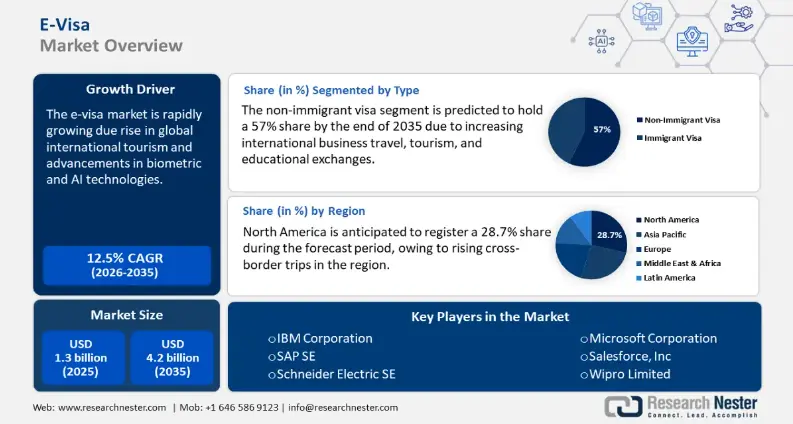
Source: Research Nester
Demand for AI-driven visa solutions is fueled by a shift in traveler behavior and government policy. Modern travelers view administrative friction as a primary barrier. While travel demand has surpassed records, underlying infrastructure remains largely archaic.
AI platforms act as middleware, bridging complex regulations and the desire for a one-click experience. These systems deploy machine learning for document OCR, real-time compliance checks, and biometric verification. Processes that once required days of manual oversight are now handled in seconds.
Global Travel And Digital-First Expectations
Today’s traveler manages their life via smartphone and expects the visa process to be as seamless as booking a flight. Digital-first is the baseline requirement. Travelers are increasingly unwilling to visit physical centers or mail original passports.
An AI-powered app capitalizes on this by offering proactive application management. By reducing a three-week manual process to a 15-minute digital submission, a platform captures the high-value, time-poor market. Atlys has successfully scaled this model by using AI to automate document verification and drastically lower processing times.
Frustration With Traditional Visas
Traditional processing is defined by rejection anxiety and opaque timelines. In 2024, Indian citizens faced a 15% rejection rate for Schengen visas, often due to minor inconsistencies an AI could have flagged instantly.
- Document Mismatch: Manual filing leads to discrepancies in travel and financial records.
- Opaque Communication: Applicants lack visibility into their status within a consulate.
- High Opportunity Cost: For professionals, a delayed visa results in lost contracts or missed meetings.
Global E-Visa Adoption Trends
Governmental shifts toward digitalization provide a strong investment tailwind. In 2025, 82% of Indian visa applications were for e-visas. Countries like the UK have already transitioned to digital-only immigration systems.
| Region | Key Movement (2025-2026) | Strategic Insight |
| Asia-Pacific | 14.8% CAGR; massive outbound growth. | Focus on high-volume tourist corridors. |
| Africa | 31+ countries now offer e-visas. | Market for localized payment tools. |
| Middle East | GCC unified visa implementation. | Hub for stopover visa automation. |
| Europe | Expansion of ETIAS and UK e-visas. | Essential for global scale. |
Opportunities In Emerging Markets
Emerging markets offer high ROI. Countries like Vietnam and Indonesia are lowering entry barriers to boost GDP. Their local infrastructure often lacks the last-mile connectivity that a third-party AI platform provides.
Platforms like Sherpa dominate by embedding AI-driven visa requirements directly into airline booking flows. This creates a native experience for the traveler while capturing revenue at the point of intent.
The Digital Nomad segment is also a rapidly growing niche. Countries like Portugal and Sri Lanka have launched specific visas. Building a platform for these high-yield categories allows an entrepreneur to dominate a lucrative market before it becomes commoditized.
Why AI Is Redefining Modern Visa Applications?
AI redefines this sector by shifting the burden of accuracy from the applicant to the software. Modern visa apps use Natural Language Processing to translate complex jargon into intuitive prompts. This reduces user cognitive load while ensuring data meets strict sovereign standards.
Computer Vision has also revolutionized document handling. AI-driven OCR extracts data from passports with 99.9 percent accuracy. For an entrepreneur, this translates to lower operational costs and a reduced need for manual support staff.
Embassy to Digital Shift
The move from physical embassy visits to digital workflows represents a collapse of the traditional “time-to-visa” metric. Where travelers once spent weeks gathering documents, AI-enabled platforms allow for a scan-and-submit experience.
These workflows rely on automated API integrations with government portals. When a user uploads a document, the AI validates its authenticity and cross-references it against the latest policy changes.
iVisa exemplifies this by providing a digital vault that matches user profiles with requirements across 180 countries instantly.
AI Solving Visa Pain Points
AI addresses Application Anxiety: the fear of rejection due to minor technicalities. It serves as a pre-submission auditor for errors humans frequently overlook.
- Photo Compliance: AI checks if a selfie meets specific background and lighting requirements.
- Data Consistency: It ensures names on bank statements match passports and tickets exactly.
- Dynamic Eligibility: It monitors real-time policy changes to prevent applications for closed categories.
Automation as User Expectation
The expectation of automation is driven by the seamless nature of other service sectors. Travelers no longer compare visa agencies against each other. They compare the visa experience to their most efficient digital interactions.
Manual forms are now viewed as a sign of institutional incompetence. Travelers prioritize platforms offering “set-and-forget” functionality where data is remembered for future trips.
Boundless has utilized this in the immigration space, guiding users through complex applications with the ease of a consumer tax app. This provides investors with high Lifetime Value from every acquired user.
What Makes Apps Like Atlys Stand Out Today?
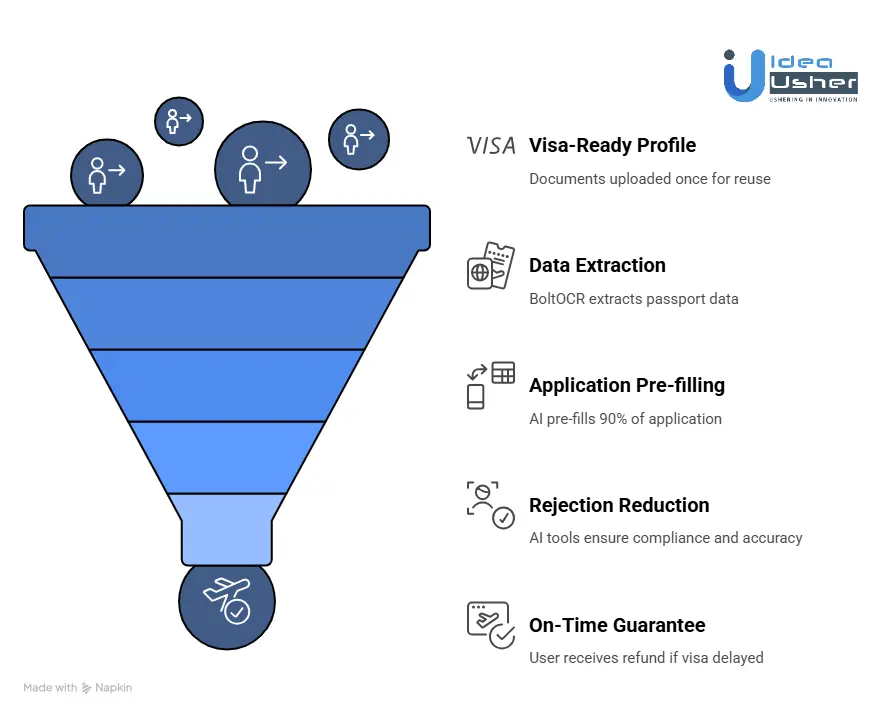
Atlys treats the visa process as a logistics challenge. The platform uses a Visa-Ready Profile where documents are uploaded once and reused for all future travel. This shifts the product from a one-time service to a lifetime travel companion.
The app integrates with global government portals via proprietary APIs. For an entrepreneur, this level of integration is a significant barrier to entry, requiring heavy technical investment. To ensure data precision, Atlys developed BoltOCR, a specialized model that extracts passport data with 99.08 percent accuracy, outperforming general AI tools.
“Apply In Minutes” As A Product Promise
The core appeal is a radical reduction in time-to-submission. Atlys has compressed hours of paperwork into under 10 minutes. By using AI to pre-fill 90 percent of applications from a single passport scan, the platform captures users at the peak of travel-planning intent.
This one-click philosophy has allowed the startup to process over 500,000 visas. The platform even includes a Schengen Appointment Checker to help users find rare slots, proving that solving specific friction points is a top-tier growth driver.
Reducing Visa Rejections
Rejection is the industry’s biggest pain point. Top apps solve this with AI-powered evaluators that audit applications before they reach an embassy.
- No More Visa Photos: This tool adjusts backgrounds and dimensions in real time to ensure 100 percent compliance.
- Forex Fairness: Atlys automatically refunds currency exchange differences if government fees drop, ensuring price transparency.
- Visa Probability Evaluator: By analyzing millions of data points, this tool predicts approval odds and helps users strengthen their applications.
Trust Through Transparency
To differentiate from opaque agencies, top-tier apps now offer an On-Time Guarantee. If a visa does not arrive by the promised date, the user receives a 100 percent refund. This shifts financial risk from the traveler to the platform’s data accuracy.
The use of a Real-Time Systems Tracker further solidifies this trust, showing users if a government portal is experiencing delays. For more complex needs, the Atlys Express service provides faster appointments for last-minute trips. For an investor, this transparency reduces support overhead and builds a brand moat that manual competitors cannot replicate.
Core AI Features Powering Visa Apps Like Atlys
The underlying engine of modern visa apps is the ability to handle high-stakes compliance at scale. By reducing human error to near zero, these platforms achieve the operational efficiency required to dominate the global mobility market.
These features move beyond simple automation into predictive governance. The goal is to solve problems before the user or the embassy even notices them.
1. AI-Powered Passport Scanning
Standard OCR often fails on passports due to holographic overlays. Atlys solved this with BoltOCR, a specialized 3-billion parameter model. This tool is engineered to read passport fields exactly as they appear, avoiding common errors like confusing birthplace with issue location.
- 99.08% Field Accuracy: This proprietary model significantly surpasses general-purpose AI benchmarks.
- MRZ Validation: The system cross-checks extracted text against the Machine Readable Zone to ensure zero data mismatch.
- Reduced Latency: Processing is 3.5 times faster than standard models, delivering results in a median time of 2.3 seconds.
2. Smart Photo Validation
Non-compliant photography is a leading cause of visa rejection. Modern apps solve this through advanced image analysis. When a user takes a selfie, the AI analyzes the image against thousands of specific embassy rules in real time.
The system automatically handles background removal, head-tilt correction, and lighting normalization. This ensures every photo meets the strict biometric standards required for digital systems like the Schengen or UK e-visa portals.
3. Visa Approval Prediction
Data is the ultimate risk-mitigation tool. By analyzing millions of historical outcomes, platforms have developed predictive engines. These give users a real-time risk report before they pay for their application.
If data suggests a high risk of rejection, the AI suggests ways to strengthen the profile. This predictive layer protects the user’s travel record and maintains the platform’s high overall success rate.
4. AI Chat Assistants
Support in the visa space must be accurate and immediate. Advanced platforms use post-checkout assistants to handle nearly 38 percent of user interactions. These bots are trained on official government circulars rather than general web data.
Unlike generic chatbots, these assistants provide country-specific guidance on complex prompts like NOC requirements or local address formats. This reduces the need for expensive human-led teams while keeping resolution times under four minutes.
5. Interview Simulation Tools
For visas requiring physical interviews, the barrier is often psychological. Atlys offers a U.S. Visa Mock Interview tool trained by experienced former consular officers to bridge this gap.
The system uses NLP and voice analysis to simulate a real-world interview environment. It assesses answers for consistency and tone, providing detailed performance analysis. This high-value feature turns a stressful event into a practiced routine, significantly boosting final approval odds.
How to Build AI Features in Visa Apps like Atlys?
Building AI features for a visa app usually starts with a document intelligence layer that can extract and validate data accurately. The system should gradually learn from past submissions and may improve decision accuracy through continuous feedback loops.
We have built several AI-driven visa platforms like Atlys, and this is how we approach developing their core AI features.
1. Defining High-Impact Use Cases
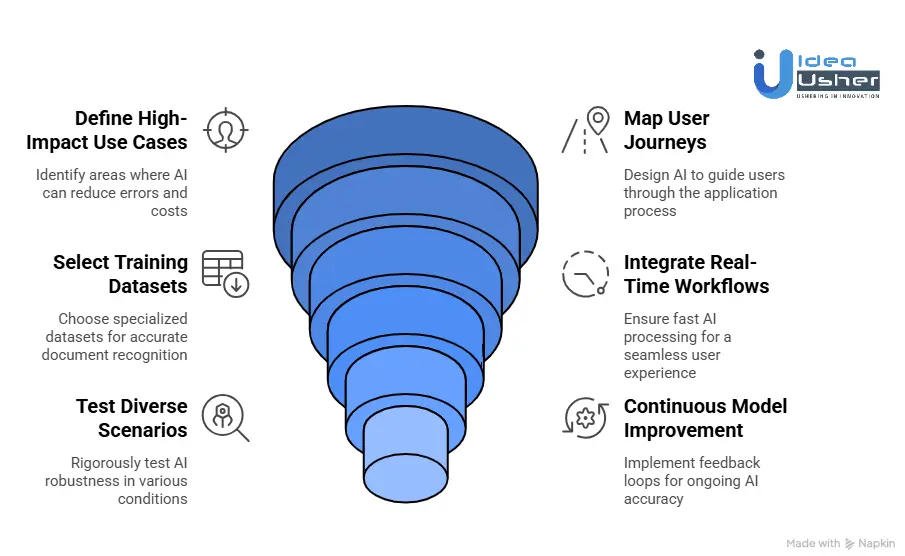
We start by identifying exactly where human error leads to embassy rejections for your specific target market. Whether it’s extracting data from obscure passports or fixing non-compliant selfies, we prioritize features that slash manual support costs. This strategic mapping ensures that every dollar spent on AI development directly improves your bottom line and user retention.
2. Mapping User Journeys
We design your app’s flow so that AI acts as a proactive guide. From the moment your client selects a destination, our system anticipates the required documents and triggers “scan-and-verify” prompts in real-time. This eliminates the “form fatigue” that kills conversion rates, allowing your users to move from a passport scan to a completed submission in under five minutes.
3. Selecting Training Datasets
To ensure your app works globally, we utilize specialized datasets containing thousands of document variations, including complex watermarks and holographic overlays. We don’t rely on generic vision tools; we train models specifically for the unique layouts of over 150 countries. This ensures your platform distinguishes between “Place of Birth” and “Place of Issue” with the high accuracy required for official filings.
4. Integrating Real-Time Workflows
We build your backend using a high-concurrency microservices architecture to ensure that heavy AI inference, like biometric liveness detection, happens in milliseconds. By offloading these tasks to optimized GPU clusters, we keep your frontend lightning-fast. This real-time feedback loop tells your users their document is “embassy-ready” before they even reach the checkout screen.
5. Testing Diverse Scenarios
Our QA process involves “stress-testing” the AI against real-world chaos: low-light environments, blurry camera lenses, and damaged documents. We ensure your app remains robust across different smartphone hardwares and user demographics. This rigorous testing phase minimizes “false negatives” and ensures your app provides a premium experience for every traveler, regardless of their technical literacy.
6. Continuous Model Improvement
Once your app is live, we implement a closed-loop feedback system that learns from every application outcome. If a specific embassy changes its photo requirements or data formatting, your AI models are retrained and deployed automatically. This creates an “intelligence moat” for your business, where the more visas you process, the more accurate and unbeatable your platform becomes.
Cost to Build AI Features in Visa Apps
When we build visa apps for our clients, we approach the budget as an investment in a high-margin digital asset. The goal is to balance the high upfront cost of custom AI development with the long-term savings of near-zero manual processing.
Investing in a visa platform requires a clear understanding of the “AI Premium.” While a standard app might focus on UI, a competitive visa engine allocates 60% of its resources to the data processing layer.
Timeline Estimates For MVP To Full-Scale App
Building a market-ready visa platform typically follows a phased rollout to manage risk and validate data accuracy.
- Phase 1: Discovery & Data Acquisition (4–6 Weeks): Sourcing regional passport datasets and defining compliance logic for the first 5-10 countries.
- Phase 2: MVP Development (3–5 Months): Launching a core “Scan-to-Submit” engine with basic OCR and photo validation.
- Phase 3: Scaling & Optimization (6–12 Months): Integrating complex predictive models, real-time embassy trackers, and multi-language support.
Cost Breakdown By Feature Complexity
Budgeting for AI features depends on whether you are using “off-the-shelf” wrappers or proprietary trained models.
| Feature Type | Complexity | Estimated Cost (USD) |
| Basic OCR & Data Mapping | Low | $15,000 – $25,000 |
| Custom Biometric Photo Engine | Medium | $30,000 – $50,000 |
| Visa Probability Evaluator | High | $50,000 – $80,000 |
| Interview Simulation (NLP/Voice) | Very High | $70,000 – $120,000+ |
Pro Tip: Starting with a “Wrapper” approach using existing APIs can lower initial costs to $40,000, but long-term API call fees will eventually erode your margins compared to a custom-built model.
Factors That Impact AI Development Budgets
The total investment for a full-scale app usually ranges from $150,000 to $450,000+, influenced by several technical levers:
1. Data Density: The cost of acquiring or labeling rare passport types (e.g., specific African or Central Asian visas) significantly impacts training budgets.
2. Accuracy Requirements: Moving from 95% to 99% accuracy often doubles the development time due to the intensive “edge-case” training required.
3. Infrastructure Needs: Real-time AI inference requires GPU-based cloud hosting (AWS/Google Cloud), which adds to your ongoing monthly operational burn.
AI Architecture Behind Scalable Visa Apps Like Atlys
The technical foundation of modern visa apps is what separates a simple form-filler from a global mobility giant. Building a platform that mimics the efficiency of Atlys requires a shift from “human-in-the-loop” to “AI-at-the-core” architecture.
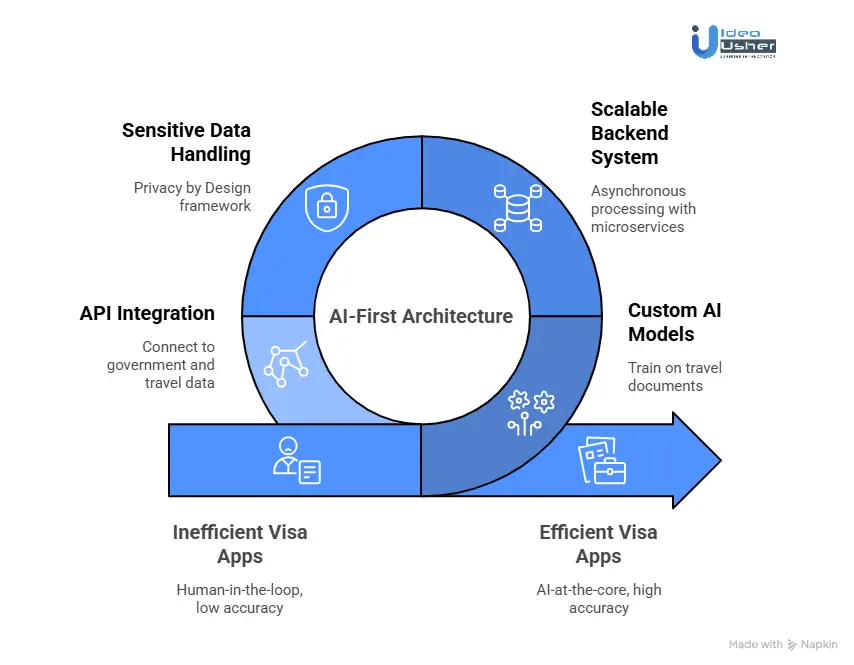
1. Pre-Trained Vs Custom AI Models
Most startups begin by using general-purpose tools like AWS Textract or Google Document AI. While these are excellent for standard invoices, they often struggle with the complex holograms and varying layouts of international passports.
General LLMs are powerful, but they weren’t built for the 99% accuracy required in immigration. They hallucinate names and swap birthdates with issue dates.
To truly compete, a custom-trained vision-language model is essential. By training on a diverse dataset of millions of travel documents, you can achieve field-level accuracy exceeding 99%.
This specialized approach reduces the “hallucination” rate of general AI, ensuring that a “zero-error” submission is the default, not the exception.
2. Scalable AI-First Backend System
A scalable backend must treat document processing as an asynchronous workflow. When a user uploads a passport, the system shouldn’t block the UI. Instead, use a microservices architecture where:
- The Ingestor: Handles raw uploads and triggers an image-enhancement pipeline to fix lighting or blur.
- The Worker Pool: Distributes the OCR and validation tasks across GPU-accelerated instances (using tools like Docker or Kubernetes).
- The Check-Stop Logic: Before any data is sent to a government portal, a final “gatekeeper” service cross-references the OCR results with the Machine Readable Zone (MRZ) checksums.
This structure allows the app to scale from 100 to 100,000 applications a day without a full system redesign.
3. Handling Sensitive Data
In visa apps, data is both your greatest asset and your biggest liability. Handling PII or Personally Identifiable Information requires a “Privacy by Design” framework.
| Security Layer | Technical Implementation | Purpose |
| Data At Rest | AES-256 Encryption | Protects stored passport scans. |
| AI Inference | TEE (Trusted Execution Environments) | Processes data in isolated enclaves. |
| Access Control | OAuth 2.0 & IAM Roles | Ensures only authorized services touch PII. |
| Compliance | SOC 2 & GDPR | Essential for global expansion and trust. |
Always implement an automated deletion policy: once a visa is granted and the traveler has safely returned, intermediate processing files and unencrypted scans should be purged from the active system.
4. APIs For Embassy And Travel Data
The “magic” of a one-click visa app comes from its connectivity. Since many governments lack modern APIs, your system must act as a translator between legacy portals and your modern backend.
- Sovereign Portals: Use headless browser automation or direct API handshakes where available to push data into government systems.
- Global Distribution Systems: Integrate with providers like Amadeus or Sabre to pull real-time flight and hotel data, which the AI can then use to pre-fill “proof of stay” requirements.
- Identity Verification: Use third-party tools for liveness detection to ensure the person holding the phone is the same person on the passport.
By stitching these fragmented data sources together into a single, cohesive API, you create a platform that feels like magic to the user and a fortress to the competition.
Building OCR That Works in Real-World Conditions
When we develop visa apps for our clients, the most critical technical challenge is ensuring the OCR remains robust outside of a laboratory setting. In the real world, users don’t have flatbed scanners; they have smartphones, shaky hands, and overhead kitchen lights.
Our goal is to build a “frictionless” entry point where the technology compensates for poor user environments, ensuring that every document scan is “embassy-ready” on the first try.
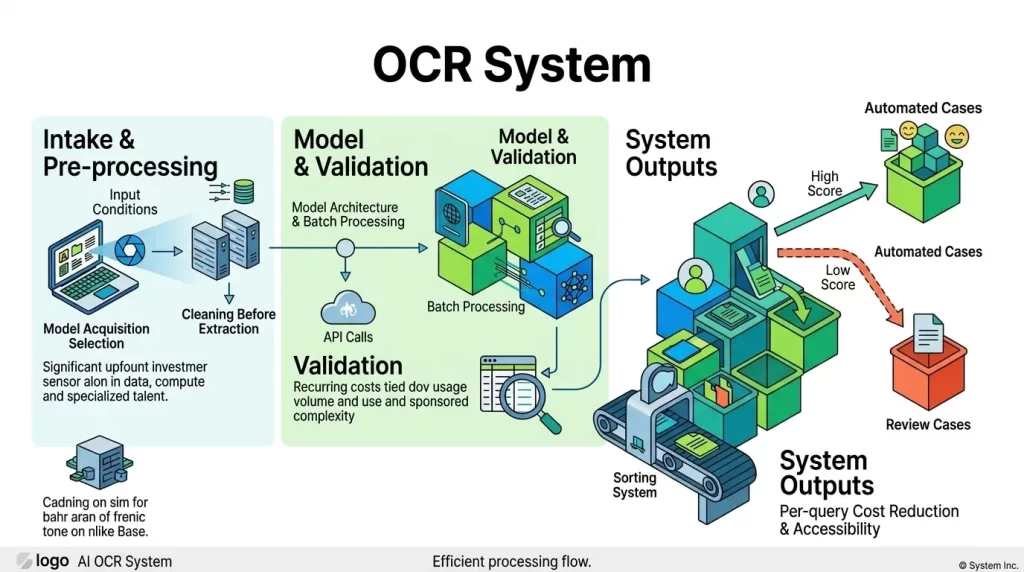
1. Managing Blur, Glare, and Light
A raw photo of a passport is rarely perfect. To combat this, we integrate a “Pre-Processing Layer” that cleans the image in milliseconds before it hits the AI model.
- Glare Suppression: We use specialized filters to detect and neutralize “white spots” caused by camera flashes on glossy passport lamination.
- Adaptive Binarization: In low-light scenarios, our system intelligently adjusts contrast and brightness to separate faint text from dark backgrounds.
- Perspective Correction: If a user captures the document at an angle, the AI automatically “flattens” the image, ensuring the text lines are perfectly horizontal for the reader.
2. Training Global Formats
There is no single “standard” for passport layouts. A Greek passport looks nothing like one from Vietnam. We move beyond generic “text readers” by training specialized models on the unique typography and layouts of over 150 countries.
The 99% Rule: We don’t just read text; we validate it. Our models are trained to cross-reference the Visual Inspection Zone (the part humans read) with the Machine Readable Zone at the bottom.
If the name extracted from the top doesn’t match the encoded string at the bottom, the system flags it instantly, preventing a 100% certain rejection.
3. Using Confidence Scoring
To make your operations scalable, your team shouldn’t have to look at every scan. We implement a Confidence Scoring System that acts as an automated quality gate.
| Confidence Score | System Action | Business Impact |
| 0.95 – 1.00 | Straight-Through Processing | Zero human overhead; instant submission. |
| 0.80 – 0.94 | Highlighted Field Review | Staff only check specific “uncertain” words. |
| Below 0.80 | Instant User Re-take | Prevents bad data from entering the system. |
By setting these thresholds, we typically reduce manual data entry by over 85%, allowing your business to process thousands of visas with a tiny, specialized support team.
Designing AI Photo Tools That Meet Visa Rules
Modern visa apps prioritize high-quality biometric photos to eliminate a major source of application rejection. Most denials stem from shadows, incorrect backgrounds, or improper head positioning.
Automated AI photo tools solve these issues by turning a standard smartphone selfie into a compliant, embassy-ready document in milliseconds.
1. Background and Light Correction
Standard selfies often contain “visual noise” like wallpaper, shadows, or uneven lighting. AI-driven segmentation models instantly isolate the subject and replace the background with a flat, neutral color required by most consulates.
- Background Removal: Neural networks identify the precise outline of the hair and shoulders to swap cluttered backgrounds for stark white or light grey.
- Luminance Normalization: Image enhancement algorithms detect “hot spots” from camera flashes and soften them, while simultaneously lifting shadows under the eyes and chin.
- Auto-Cropping: The system identifies eye levels and chin positions to crop the image according to specific millimeter-based aspect ratios.
2. Real-Time Compliance Logic
Visa rules vary drastically by destination.
A photo for a US visa requires a 2×2 inch square, while a Schengen visa demands a 35×45 mm rectangle. Implementing a dynamic rules engine allows the app to adapt its validation logic based on the user’s selected destination.
The tool checks for “biometric landmarks” instantly. If the subject is wearing glasses, headgear (unless for religious reasons), or has a wide smile that obscures facial features, the AI blocks the capture. This real-time gating ensures that only 100% compliant data enters the submission pipeline, protecting the applicant’s record.
3. Frictionless Capture UX
The most advanced AI is useless if the user interface is confusing. To ensure a high success rate on the first attempt, the camera UI should provide active feedback during the “live” view rather than after the photo is taken.
- Guided Overlays: A transparent “ghost” silhouette on the screen helps the user align their face and eyes perfectly within the frame.
- Level Indicators: Built-in accelerometers warn the user if the phone is tilted, ensuring a perfectly centered, front-facing portrait.
- Instant Feedback: Instead of generic error messages, the UI provides specific instructions like “Move to a brighter area” or “Remove your glasses” before the shutter even clicks.
How Visa Prediction Engines Actually Work?
Visa prediction engines are the “early warning systems” of the immigration world. They move visa apps from being simple submission portals to becoming strategic advisors.
By calculating the likelihood of approval before a user even pays their government fee, these engines save travelers time and protect them from the permanent “black mark” of a visa rejection on their travel history.
1. Scoring Data Points
A prediction engine doesn’t just look at a name; it evaluates a complex web of “trust signals.” These are quantified into a probability score (typically 0–100%) that reflects how well the profile aligns with a country’s current immigration sentiment.
- Travel Velocity: Frequency of previous international trips and adherence to stay durations.
- Economic Stability: Automated analysis of income levels, employment status, and financial ties to the home country.
- Demographic Alignment: Matching the applicant’s profile against the specific labor or tourism needs currently prioritized by the destination country.
- Document Integrity: A “health check” on the consistency of data across passports, IDs, and financial statements.
2. Training on Historical Outcomes
To build an evaluator, models are trained on millions of anonymized data points from past applications. This allows the AI to learn the unspoken rules of different embassies, such as which specific regions have higher scrutiny or which types of invitation letters carry the most weight.
Pattern Recognition:
The AI identifies that certain combinations of variables, like a specific job title combined with a specific travel history, result in a 90% higher approval rate. The system then guides new users to replicate these success clusters.
3. Avoiding Systemic Bias
The biggest challenge in building these engines is preventing the AI from mirroring human prejudices. Since historical data may reflect past biases, the development process must include rigorous “de-biasing” protocols.
| Strategy | Technical Implementation | Purpose |
| Anonymization | Removing sensitive tags like race or religion. | Ensures decisions are based on merit, not identity. |
| Adversarial Testing | Challenging the model with diverse edge cases. | Spots if the AI is unfairly penalizing specific age or gender groups. |
| Human Oversight | Consular-expert-in-the-loop validation. | Prevents “hallucinations” and keeps the engine grounded in real law. |
By constantly auditing these models, businesses can ensure that the prediction engine remains a tool for fairness rather than a reinforcement of outdated stereotypes.
Creating AI Assistants For Visa Guidance
The next generation of visa apps relies on intelligence that goes beyond simple FAQ search. By deploying AI assistants that act as personalized immigration consultants, platforms can resolve 80% of user queries without human intervention. This saves thousands of hours in support costs while providing travelers with the immediate, accurate answers they need to navigate complex global borders.
Other leaders in this space, such as Sherpa, have successfully integrated these models directly into airline booking flows to provide real-time requirement updates.
Similarly, platforms like iVisa use automated assistants to streamline the often confusing supporting document phase for travelers.
1. Building Contextual Chatbots
Generic bots provide generic answers. We build Profile Aware assistants that ingest the user’s specific data like, nationality, current location, and travel history, before answering a single question.
- Zero Start Context: The assistant already knows the user is an Indian citizen applying for a French Schengen visa, so it skips basic qualifying questions.
- Predictive Assistance: If a user pauses on the Financial Documents section, the bot proactively offers a checklist of acceptable bank statement formats.
- Memory Persistence: The AI remembers previous interactions, allowing a user to resume a complex conversation over several days without repeating details.
2. Handling Edge Cases
Visa law is defined by its exceptions. A standard requirement might change if a traveler has a dual nationality or a specific transit stop. We train our assistants to identify these red flag scenarios instantly.
Edge Case Detection: If a user mentions a 24-hour layover in a third country, the AI cross-references transit visa requirements for that specific port of entry. It doesn’t just answer the primary question; it identifies potential travel disruptions the user hadn’t even considered.
3. Combining LLMs With Rule-Based Systems
Relying solely on Large Language Models is risky due to hallucinations. To ensure 100% legal accuracy, we use a hybrid architecture known as RAG (Retrieval Augmented Generation).
- The LLM Layer: Handles the human side of the conversation, interpreting slang, typos, and intent.
- The Rules Engine: Acts as the source of truth. The LLM is restricted to fetching answers only from a verified database of government circulars and embassy manuals.
- The Validation Gate: Before a response is sent to the user, a secondary logic checker ensures the advice doesn’t contradict the hard-coded visa rules for that specific corridor.
This hybrid approach ensures the assistant is as friendly as a human agent but as precise as a legal document.
AI Mock Interviews for High-Stakes Visas
For high-stakes categories like student, work, or immigrant visas, the interview is the ultimate “make or break” moment. Leading visa apps are now integrating AI-driven simulators to bridge the gap between paperwork and the physical consulate booth.
By turning a high-pressure event into a repeatable digital drill, these tools help travelers walk into their appointments with the confidence of a seasoned pro.
1. Simulating Real Embassy Scenarios
We design these features to replicate the actual constraints of a visa window. The AI doesn’t just read from a static script; it adapts based on the user’s visa type and personal background.
- Dynamic Follow-ups: If a traveler mentions a relative in the destination country, the AI instantly pivots to ask about their status and occupation, mimicking how real officers probe for “immigrant intent.”
- Officer Personalities: Users can toggle between “Friendly,” “Neutral,” or “Strict” AI personas. Practicing with a strict officer helps users stay calm even when faced with short, clipped questions.
- Timed Responses: Just like a real 2-minute interview, the system enforces strict time limits, teaching users to be concise and impactful without rambling.
2. Voice and Sentiment Analysis
The tech stack behind these simulations uses advanced Natural Language Processing and vocal acoustics to look beyond the literal words spoken.
Beyond the Script: Our systems analyze vocal jitter and pitch modulation to detect signs of extreme nervousness or hesitation. If a user’s voice falters when discussing finances, the AI flags this as a “low-confidence zone” that needs more practice.
The app transcribes the speech in real time, identifying the use of filler words (like “um” or “uh”) and assessing the overall “fluency” of the response. This ensures the traveler sounds natural and prepared, rather than like they are reciting a memorized script.
3. Delivering Actionable Feedback
The true value of an AI mock interview lies in the post-session report. Instead of a generic “Good Job,” the app provides a granular breakdown of the performance.
| Feedback Category | What the AI Analyzes | Actionable Tip Provided |
| Content Accuracy | Consistency with the DS-160 or application form. | “Your spoken income doesn’t match your uploaded bank statement.” |
| Delivery & Tone | Pacing, volume, and eye contact (if using camera). | “You are speaking too fast. Slow down to improve clarity.” |
| Red Flag Detection | Answers that might trigger a 214(b) rejection. | “Avoid over-explaining your ties to the host country; be more direct.” |
By reviewing these scores, users can see a measurable “Readiness Meter” that tells them exactly when they are ready for the real thing.
Why Choose IdeaUsher for AI Visa Apps?
Building a compliant and scalable visa engine requires more than just standard app development. It demands a partner who understands the intersection of global immigration law and cutting-edge machine learning.
Proven AI Delivery
With over 500,000 hours of coding experience, our team of ex-MAANG/FAANG developers has a track record of launching high-impact travel and automation products. We don’t just build features; we build competitive moats that help our clients dominate their niche, as seen in the success of major players like Atlys, Sherpa, and iVisa.
Deep AI Expertise
Our technical core is rooted in deep expertise across Computer Vision for passport scanning, Natural Language Processing for document intelligence, and predictive modeling for approval scoring. We engineer proprietary pipelines that achieve 99% accuracy in real-world conditions, significantly reducing the error rate that plagues traditional visa processing.
Full Cycle Ownership
We take full responsibility for your product’s journey, from the initial architectural strategy to global scaling. Our developers ensure your backend is optimized for high concurrency and real-time processing, allowing your app to handle thousands of simultaneous applications without a dip in performance or speed.
Global Compliance Focus
Navigating the legal landscape of over 150 countries requires a Privacy by Design philosophy. We implement rigorous security protocols, including SOC 2 and GDPR compliance, ensuring that sensitive biometric data is handled with the highest level of integrity. This compliance-first mindset protects your business and builds ironclad trust with your users.
Conclusion
Building a visa app like Atlys requires blending AI automation with rigid compliance to simplify complex legal processes. By integrating advanced OCR, biometric photo validation, and real-time approval prediction engines, developers can drastically reduce manual errors and processing times. Success depends on a frictionless entry point that ensures every application is embassy-ready before submission.
FAQs
A1: Modern visa apps use AI to automate the most tedious parts of the application process, such as using Computer Vision to scan passports and extract data with 99% accuracy. They also deploy generative AI assistants to guide users through complex requirements and use predictive models to evaluate the probability of a visa being approved before submission.
A2: Development begins with a Compliance First strategy, mapping out the specific visa rules for target countries to create a logical rules engine. Teams then build specialized data pipelines for document OCR and biometric photo validation, often using a hybrid approach that combines LLMs with verified government databases to ensure 100% legal accuracy.
A3: AI is generally classified into four categories: Reactive Machines, which respond to immediate inputs without memory; Limited Memory, which learns from historical data; Theory of Mind, which understands human emotions; and Self-Aware AI, a theoretical level where machines possess their own consciousness.
A4: The cost typically ranges from $40,000 to $150,000+, depending on complexity and the depth of custom model training. While basic API integrations for chatbots are more affordable, building proprietary Visa-grade OCR or predictive risk-scoring engines requires significant investment in data labeling, specialized talent, and secure cloud infrastructure.