


Key Takeaways
- Vehicle financing is becoming more convenient as AI-based auto loan marketplaces connect borrowers with suitable lenders based on their financial profiles.
- These platforms use AI matching, automated verification, risk assessment, fraud detection, and personalized offer comparisons to improve the lending experience.
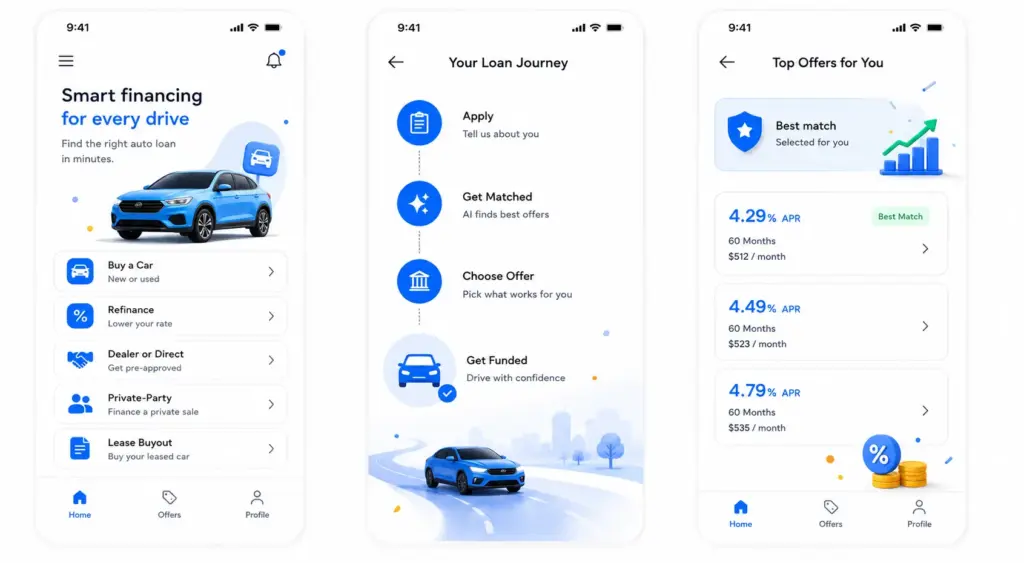
- Supporting multiple financing options such as new and used cars, refinancing, dealer financing, private-party loans, and lease buyouts expands marketplace opportunities.
- Successful platforms need secure financial integrations, explainable AI, compliance controls, scalable infrastructure, and continuous model optimization.
Borrowers today expect a faster way to understand their auto financing options. Instead of filling out multiple applications and comparing lenders on their own, they want a platform that can do much of the work for them. AI-based auto loan marketplaces can make this possible by understanding a borrower’s financial profile and matching it with suitable loan options. But the real challenge goes beyond adding AI to the platform. The system needs to understand how different lenders assess borrowers and turn that complexity into clear and useful recommendations. This makes the quality of the AI matching and decision-making layer one of the most important parts of the platform.
Finding the right auto loan can still feel like a process of trial and error for borrowers. We’ve worked on AI auto loan marketplaces that use intelligent matching and financial data integration to make this process more efficient. In this blog, we’ll explore how to build an AI-based auto loan marketplace and what it takes to turn the concept into a scalable product.
What Is Driving Demand for AI-Powered Auto Financing?
According to SNSInsider, the Automotive Finance Market was valued at USD 330.11 billion in 2025 and is expected to reach USD 667.83 billion by 2035 at a 7.3% CAGR from 2026 to 2035. This growth shows a clear shift toward faster and more convenient vehicle financing. AI-based auto loan marketplaces can tap into this demand by helping borrowers find suitable financing faster while making the lending process more efficient.
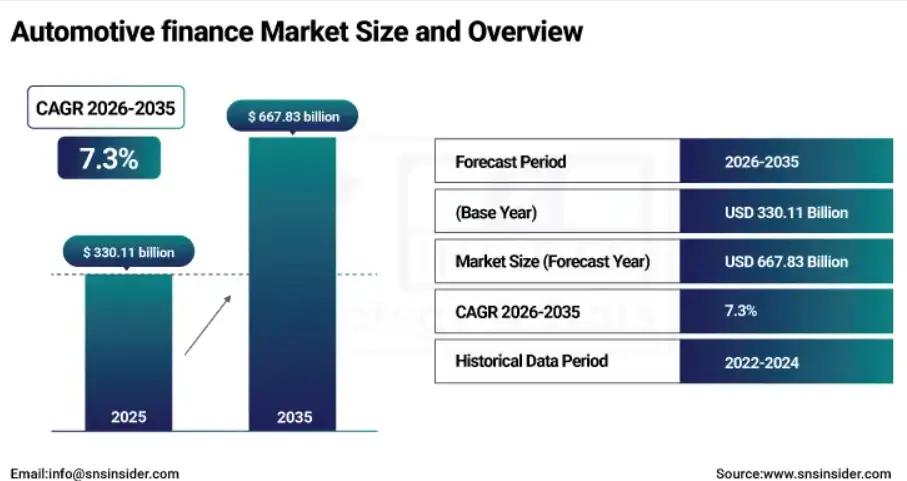
Source: SNSInsider
Platforms like Upstart have proven how profitable this model can be. Upstart applies machine learning to auto lending and non-prime risk assessment, driving over $950 million in annual revenue by automating credit decisions for partner banks. The demand for intelligent auto finance platforms stems from three major industry shifts.
Borrowers Expect Faster Financing
Modern car buyers expect auto financing to match the seamless speed of online retail. They want instant approvals and clear payment structures directly on their phones. Traditional dealership finance offices take hours to process paperwork, causing deal drops and lost revenue. AI-driven platforms solve this bottleneck by making approval instant and invisible. Automating key underwriting steps keeps buyers engaged:
- Instant Document Verification: Optical character recognition and document AI verify paystubs, bank statements, and tax forms in seconds.
- Automated Identity and Fraud Checks: Biometric matching and device intelligence flag synthetic identities and fraud instantly.
- Direct Bank Linking: Secure API connections pull income and cash-flow data directly from borrower accounts, eliminating manual uploads.
Rising Costs Demand Personalized Offers
Higher interest rates and elevated vehicle prices make standard, rigid loan terms unworkable for many buyers. When lenders rely solely on traditional credit scores, they often overprice risk or reject creditworthy borrowers. Machine learning models evaluate thousands of alternative data points to risk-profile applicants accurately.
Lenders can then price risk down to the individual rather than relying on broad credit tiers. By factoring in debt-to-income trends, employment stability, and alternative payment histories, an AI engine matches borrowers with terms they can actually afford. This precise risk alignment increases origination volume while controlling default rates.
AI Makes Loan Matching Scalable
Scaling an auto lending business used to require hiring large teams of underwriters, loan officers, and compliance reviewers. AI changes this operational model completely by automating decision engine logic across thousands of lending parameters. To see the financial upside of this operational scale, consider platforms like AutoFi. AutoFi connects digital car buyers directly with network lenders and generates an estimated $25M+ in annual recurring revenue by automating point-of-sale financing.
An automated loan engine evaluates a borrower’s profile against multiple lender guidelines at once, delivering real-world business advantages:
- Multi-Lender Smart Routing: Algorithmically matches applicants to the lenders most likely to approve them on competitive terms.
- Dynamic Risk-Adjusted Pricing: Calculates precise interest rates and down payment options in real time based on vehicle depreciation models.
- Continuous Algorithm Retraining: Updates underwriting rules automatically as default patterns shift, protecting capital without slowing down deal flow.

How Does an AI-Based Auto Loan Marketplace Work?
An AI loan marketplace operates as a smart orchestration layer sitting between retail car shoppers and institutional credit funds. Instead of routing loan applications through slow batch processes, the engine runs parallel API calls to verify income, assess collateral risk, and match loan criteria in milliseconds. This infrastructure transforms complex credit underwriting into a seamless digital transaction.
The platform architecture relies on three core operational stages.
1. Onboarding and Financial Verification
The user experience starts with friction-free data intake. Traditional pre-approval forms drag users through endless manual fields. An AI marketplace requests only essential identifiers like name, date of birth, and home address, using soft credit pulls to surface background financial records instantly.
To keep completion rates high while maintaining fraud defenses, the system automates backend validation checks:
- Real-time Payroll Connection: Secure integrations connect directly to payroll databases like ADP or Workday, confirming current employment without requiring paystubs.
- Cash Flow Analysis: Open banking APIs scan recent bank transactions to evaluate liquid balances, spending habits, and non-traditional income streams.
- Synthetic Fraud Detection: Neural networks analyze device location, IP metadata, and social security usage history to block identity theft instantly.
By removing manual document uploads, the platform moves borrowers through credit qualification before drop-off can occur.
2. AI Lender Matching and Eligibility Checks
Once the financial profile clears verification, the matching algorithm routes the file across connected lending networks. Standard dealer platforms simply blast user data to dozens of banks, causing unnecessary hard credit inquiries and high rejection rates. An AI engine evaluates lender appetite beforehand.
- Rule Engine Scoring: Compares applicant credit metrics against active buy-boxes for prime banks, credit unions, and subprime lenders simultaneously.
- Predictive Approval Modeling: Calculates the exact probability of loan approval based on historical funding patterns from each capital partner.
- Collateral Risk Adjustment: Evaluates vehicle VIN data, current wholesale valuation, and mileage depreciation curves to confirm loan-to-value limits.
This targeted routing preserves borrower credit scores while delivering pre-screened applicants directly to capital providers.
3. Personalized Offer Comparison and Application
The platform processes approval feeds from various lenders and translates raw loan terms into clear, actionable choices. Borrowers compare monthly payments, interest rates, and loan durations side by side on a unified interface. To see how profitable wholesale digital financing operations can become, look at OPENLANE. OPENLANE uses automated digital financing and marketplace infrastructure for wholesale auto transactions, generating over $1.9 billion in annual revenue.
After selecting a preferred loan structure, the borrower locks in terms by electronically signing contracts directly within the platform interface. The system packages all verifying data and sends an audit-ready loan file straight to the selected lender, enabling instant funding.
What Types of Auto Loans Can the Marketplace Support?
Building an AI financing platform can help businesses serve more parts of the automotive market. Instead of focusing only on dealership purchases, the platform can support different types of vehicles and borrowers through one system. This gives operators more opportunities to grow while making financing easier to manage. A modern platform can cover five key auto financing areas.
1. New and Used Car Financing Options
New and used vehicle purchases make up the foundation of auto lending volume. Each category presents unique underwriting challenges that rigid traditional systems struggle to balance effectively.
- New Vehicles: Involve higher total loan balances but benefit from predictable asset depreciation and manufacturer incentives. Algorithms calculate promotional rates and factory rebates in real time.
- Used Vehicles: Require precise collateral appraisal. Automated systems evaluate vehicle condition reports, mileage thresholds, and historical resale values from regional auctions to prevent over-leveraging.
By connecting live asset valuation feeds with real-time borrower risk profiles, the marketplace approves loans that match realistic collateral values.
2. Auto Loan Refinancing
High interest rate environments create massive demand among existing vehicle owners looking to lower monthly obligations. Refinancing allows platforms to acquire borrowers directly at low customer acquisition costs without relying on physical car dealerships. An AI marketplace scans current loan terms and compares them against market rates. The system flags savings opportunities automatically and transfers balances to low-cost lenders within minutes.
3. Dealer-Arranged and Direct Lender Financing
A scalable platform supports both direct-to-consumer and indirect dealer lending models without creating operational friction.
- Direct Financing: Borrowers get pre-approved directly on the consumer marketplace before stepping foot on a dealership lot, giving them maximum buying power.
- Indirect Dealer Networks: Dealership finance managers submit customer applications through the platform backend to find competitive lender matches instantly.
LendingTree uses this hybrid marketplace framework to connect millions of auto loan seekers with competing banks and credit unions across the country. Their platform routes requests to specialized capital providers based on geography and borrower credit profiles.
4. Private-Party Vehicle Financing
Private-party car sales offer a strong opportunity for AI-based auto loan marketplaces. The biggest challenge is making these transactions safe and reliable. AI can help verify vehicle titles and liens while managing escrow until the buyer and seller complete the required checks. This gives lenders more confidence and makes private car financing easier for customers.
5. Lease Buyout and Other Auto Loans
At the end of a lease contract, many drivers prefer buying their current vehicle rather than returning it to the dealership. Traditional lease buyouts involve complex dealer fees and administrative delays. Automated marketplace workflows calculate residual lease values, evaluate current market equity, and issue replacement loans without requiring physical dealership visits. The engine can also expand into niche finance products like commercial fleet additions and specialty vehicle loans through minor adjustments to its risk algorithms.
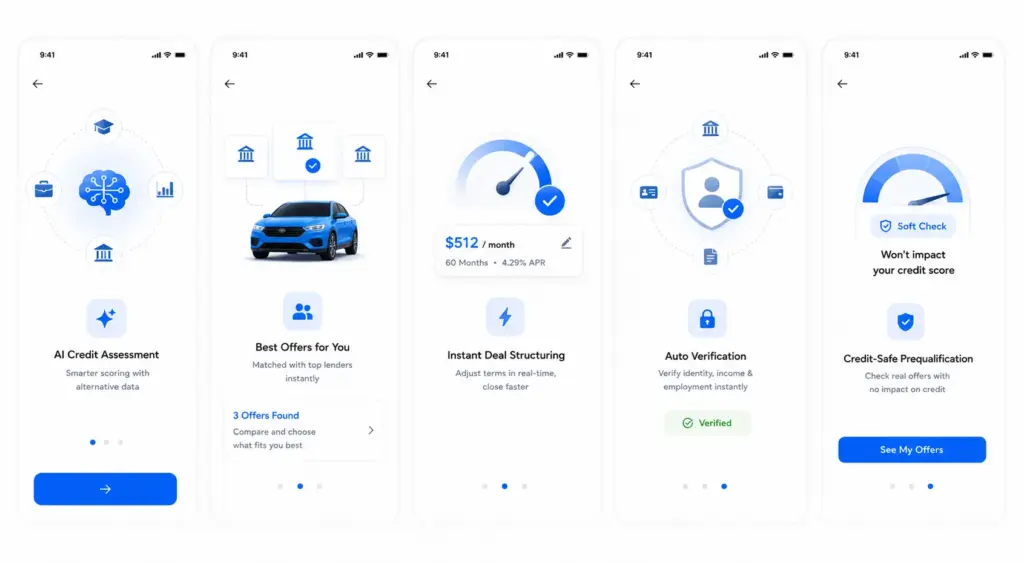
Key Features of an AI-Based Auto Loan Marketplace
Building a competitive AI-based auto loan marketplace requires technical components that streamline decisions for lenders while keeping conversion high for borrowers. Integrating intelligent risk scoring with real-time connectivity lets operators scale transaction volume without taking on extra credit risk. Here are the core features powering modern auto finance platforms.
1. AI-Powered Credit Assessment
Traditional scoring models often reject creditworthy applicants simply because they lack long credit histories. AI models analyze non-traditional variables to measure repayment probability accurately. Upstart models alternative data points to price risk beyond standard credit scores:
- Educational and Employment History: Factor in earning potential and job stability.
- Banking Insights: Analyze spending trends and cash flow health.
- Predictive Risk Scoring: Price risk precisely to approve more borrowers at lower default rates.
2. Multi-Lender Offer Matching
A strong platform matches applicants with the right capital providers instantly. Rather than blasting data to endless banks, smart routing algorithms submit profiles only to lenders likely to fund the deal. Caribou demonstrates this by collecting basic borrower details and scanning a vast network of credit unions and community banks. The platform returns personalized pre-qualified offers side by side, letting users choose terms that fit their budget.
3. Instant Deal Structuring
Dealership transactions often stall when payment structures change at the sales desk. Real-time deal structuring lets users and sales reps tweak down payments or loan terms without starting the underwriting process over. Upstart Auto Finance enables instant rehashing directly on the showroom floor. Dealers adjust financing structures on the fly and lock in approved rates without waiting for lender callbacks.
4. Automated Identity and Income Verification
Manual document processing creates severe drop-off during onboarding. Automating data intake speeds up funding schedules and lowers administrative costs. Upstart uses machine learning to verify income, employment, and identity instantly through payroll and open banking APIs. If a file requires manual review, the system prompts the user for specific document uploads without halting the entire application flow.
5. Credit-Safe Prequalification
Borrowers hesitate to shop for auto loans when every application impacts their credit score. Offering soft credit checks encourages early-stage shoppers to explore financing options safely. Caribou uses soft pull credit technology during initial onboarding. Users preview actual rates and monthly estimates without impacting their credit scores, driving higher top-of-funnel conversion rates.
6. Dealer Network Connectivity
Connecting software platforms with physical retail networks creates built-in deal flow. Lenders gain direct access to motivated buyers at the point of purchase. Upstart Auto Retail bridges this gap by linking capital providers with thousands of participating dealerships. Lenders automatically gain access to ready-to-buy consumers, while dealers close sales faster using automated financing options.
7. AI Fraud and Compliance Checks
Fraud prevention must run silently in the background without adding friction for legitimate buyers. Embedded compliance tools flag identity theft and income manipulation before funding occurs. Upstart embeds biometric identity matching, synthetic profile detection, and automated regulatory checks directly into the checkout flow, blocking fraudulent applications before they hit partner balance sheets.
How to Build an AI-Based Auto Loan Marketplace?
Building a scalable auto financing platform requires a reliable engineering roadmap. Businesses must connect legacy banking systems, real-time data feeds, and machine learning models into a clear consumer interface. Here is how to structure the product development process from concept to scale.
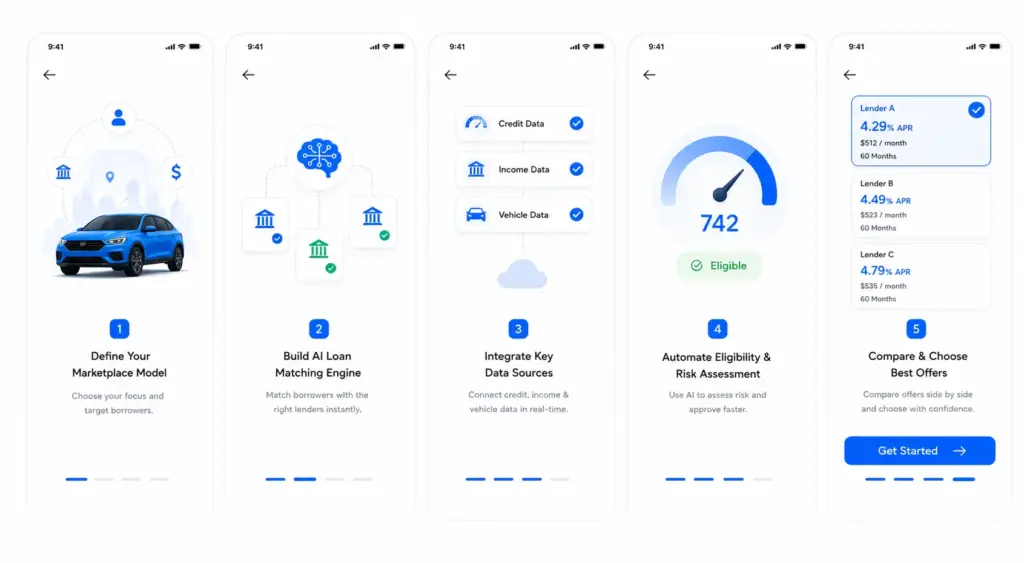
1. Define Marketplace Model
Start by deciding how capital flows through your platform. A marketplace can focus on direct consumer refinancing, point-of-sale dealership financing, or a hybrid model that serves both. Clarify your target borrower segments early on. Defining whether you will focus on prime, non-prime, or specialty vehicle loans helps attract the right funding partners to your network.
2. Design AI Loan Matching Engine
The core value of your product lies in its matching algorithm. Standard routing rules waste time sending applications to lenders who will reject them. An intelligent engine predicts approval probabilities before submitting data.
- Lender Buy-Box Mapping: Convert complex credit policies from partner banks into programmatic decision logic.
- Predictive Match Algorithms: Route borrower files based on approval likelihood, interest rates, and lender capacity.
- Smart Fallbacks: Redirect declined applications automatically to secondary and subprime lenders to maximize conversion.
3. Integrate Credit, Income, and Vehicle Data
Your platform needs real-time data access to evaluate borrowers and vehicle collateral accurately. Build secure API connectors to pull essential records instantly:
- Credit Bureau APIs: Connect to Experian, Equifax, or TransUnion for credit reports and soft scoring.
- Open Banking Connections: Use services like Plaid to verify income, cash flow, and account balances directly.
- Vehicle Valuation Feeds: Tap into Black Book or Kelley Blue Book APIs for real-time market value and depreciation tracking.
4. Automated Eligibility and Risk Assessment
Once data flows into the engine, automated underwriting rules process the application. Machine learning models run alternative risk scoring alongside traditional credit metrics to evaluate repayment capacity. The system evaluates debt ratios, employment longevity, and cash reserves to calculate a dynamic risk score. This allows lenders to price loans accurately based on complete borrower profiles rather than static credit tiers.
5. Create Lender Offer Comparison Layer
Presenting multiple complex financing packages to a user can easily cause decision fatigue. Normalize incoming lender feeds so borrowers can evaluate offers side by side without confusion.
- Clear Payment Dashboards: Display monthly costs, interest rates, total loan amounts, and term lengths clearly.
- Interactive Calculators: Let users adjust down payments or term lengths in real time to see how their monthly costs change.
- One-Click Accept: Allow borrowers to lock in chosen terms instantly and trigger final contract generation.
6. Explainable AI and Compliance Controls
Financial regulators require clear explanations for loan denials. Black-box machine learning models that cannot explain their decisions create severe legal risks for platform operators. Integrate explainable AI frameworks to log exact decision factors for every applicant. Systematically track fair lending compliance, auto-generate adverse action notices, and maintain audit-ready records for regulatory checks.
7. Test and Scale the Marketplace
Launch with a minimal viable product focus. Test your API integrations and matching logic with a small network of regional credit unions before bringing on major institutional lenders. Monitor underwriting accuracy continuously as transaction volume grows. Retrain your risk models regularly on real repayment performance, making sure your platform scales safely without increasing default rates.
Cost to Build an AI-Based Auto Loan Marketplace
The cost of building an AI auto loan marketplace depends mainly on the platform’s scope and the level of automation you need. A basic loan matching platform can be relatively affordable. A full-scale solution with automated underwriting and bank integrations will require a much larger investment.
Detailed Cost Breakdown
Industry analysis from custom software teams like IdeaUsher reflects similar budget spreads. A initial minimum viable product starts near the lower range, while enterprise builds with custom machine learning pipelines quickly exceed top-tier estimates. For businesses entering the market, the final cost largely depends on the platform’s AI capabilities, lender integrations, compliance needs, and overall product complexity.
| Development Component | Estimated Cost ($) |
| UI/UX and Marketplace Design | 8,000–15,000 |
| Borrower Onboarding and KYC | 10,000–20,000 |
| Lender Marketplace and Dashboards | 15,000–30,000 |
| AI Loan Matching Engine | 20,000–40,000 |
| Credit and Risk Assessment | 20,000–40,000 |
| Third-Party API Integrations | 15,000–30,000 |
| Loan Application Workflow | 12,000–25,000 |
| Security and Compliance | 15,000–30,000 |
| Testing and Deployment | 10,000–20,000 |
| Estimated Total | 125,000–250,000+ |
Key Factors Driving Development Costs
Building financial software involves complex backend work that directly influences your final budget. Three core areas drive engineering expenses up:
- Custom AI Model Training: Proprietary risk algorithms require massive data pipelines and extensive model testing, increasing development time compared to off-the-shelf scoring tools.
- Complex Banking Integrations: Connecting legacy core banking systems and credit unions requires custom middleware and rigorous data mapping.
- Strict Regulatory Infrastructure: Automated compliance tracking, encryption standards, and automated adverse action reporting demand specialized fintech security engineering.
Reduce Costs Without Limiting the MVP
Launching a profitable marketplace does not require building every feature at once. Strategic founders prioritize core workflows and leverage pre-built fintech infrastructure to conserve capital:
- Leverage Third-Party Verification APIs: Use established integrations like Plaid for income checks and Experian for soft credit pulls rather than building custom intake channels.
- Focus on Standard Lender Rules First: Start with rule-based buy-box matching before rolling out deep machine learning credit models.
- Target a Specific Lending Niche: Launch initially with a focus on prime refinancing or credit union partnerships before expanding into complex subprime market segments.
Partnering with specialized development firms like IdeaUsher allows teams to deploy pre-tested fintech frameworks. This modular approach accelerates time to market while keeping early capital requirements lean.
What KPIs Determine Auto Loan Marketplace Success?
To evaluate the strength of an AI auto financing platform, founders and investors look far beyond simple user traffic. Sustainable platform value depends on algorithm efficiency, conversion rates, and capital health across both sides of the marketplace. Tracking the right metrics helps operators optimize matching logic and protect profit margins.
Platforms like AutoFi show how tracking core performance metrics drives scalability. AutoFi uses performance analytics to streamline dealer workflows, generating around $25 million in annual revenue by optimizing conversion rates at point of sale.
Here is the operational framework for measuring marketplace performance.
1. Matching and Approval Performance
The initial efficiency of your AI engine relies on turning raw user submissions into clear lender approvals. High drop-off at this stage points to broken routing rules or misaligned lender buy-boxes. To maintain high platform velocity, monitor three vital performance ratios:
- Platform Match Rate: The percentage of incoming applicants matched with at least one lender. Target 85% or higher.
- Underwriting Approval Rate: How often partner banks approve matched profiles. A low rate means your AI engine misjudged lender risk criteria.
- Algorithmic Decision Speed: Average time to return clear loan offers. Leading platforms deliver pre-qualified rates in under 5 seconds.
2. Funded Loans and Unit Economics
Pre-approvals mean very little if borrowers abandon the platform before funding. Platform revenue connects directly to completed origination fees and loan delivery.
- Funded-Loan Conversion Rate: The percentage of approved applicants who e-sign contracts and receive funding. High rates signal strong pricing competitiveness.
- Revenue per Application (RPA): Total fee revenue divided by total incoming applications. This measures overall platform monetisation.
- Customer Acquisition Cost (CAC): Total marketing spend divided by funded borrowers. Keeping CAC below origination fee revenue guarantees healthy gross margins.
Understanding unit economics helps explain the massive valuation of platforms like LendingTree. LendingTree connects consumers with a broad network of auto lenders, earning referral and origination fees that drive over $800 million in annual revenue.
3. Retention and Capital Growth
A successful auto loan marketplace needs to keep both borrowers and lenders engaged. Lenders should continue funding loans while borrowers should return when they need refinancing or another vehicle. Tracking these patterns helps the platform maintain strong liquidity and build long-term customer value. Strong lender retention also helps the marketplace maintain a steady supply of loan offers for borrowers.
Top 5 AI-Based Auto Loan Marketplaces in the USA
We researched the current auto-finance landscape and found several platforms using AI, automated matching, or digital lending infrastructure to simplify the borrowing process. The examples below are useful because they show different ways an AI-based marketplace can connect borrowers with lenders and make financing faster.
1. Upstart
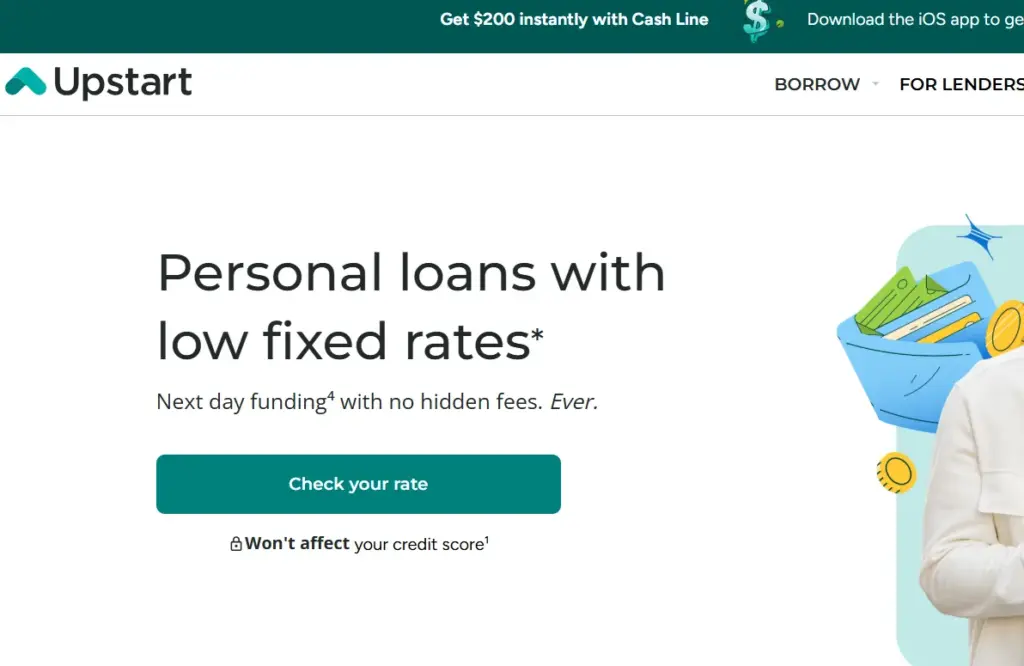
Upstart is one of the strongest examples of an AI-first lending marketplace with an expanding auto-finance business. Its AI models evaluate more than 2,500 variables, and its lending partners have originated more than $61 billion through the platform as of June 2026. In 2025, Upstart facilitated 1.49 million loans worth about $11 billion, while its auto and home originations each grew roughly 5× during the year. The company also reported that 91% of loans were fully automated in 2025, showing how AI can be used beyond matching to automate major parts of the lending journey.
2. Caribou

Caribou demonstrates how an AI-enabled marketplace can focus on personalized auto refinancing rather than traditional vehicle purchases. The platform has supported more than 140,000 borrowers and facilitated over $4 billion in refinance loans. Caribou says its customers who funded a refinance between January and June 2026 saved an average of $162 per month and reduced their APR by an average of 3.94 percentage points. Its marketplace model connects borrowers with banks, credit unions, and other lending partners based on their financial profile.
3. LendingTree
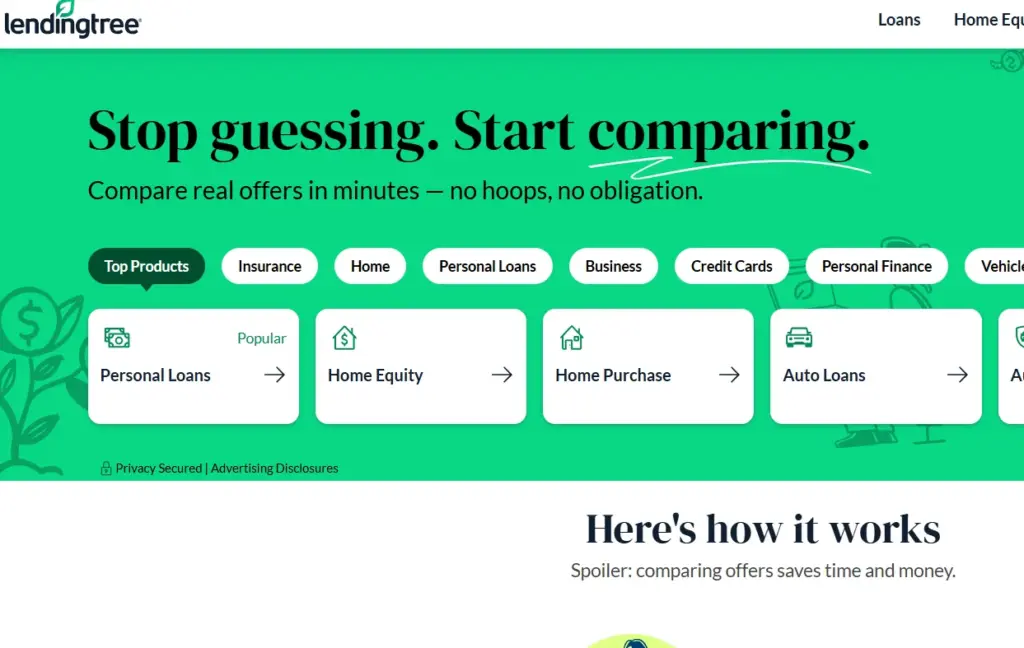
LendingTree provides a broader financial marketplace that includes auto loans and is increasingly incorporating AI into its customer experience and offer-personalization strategy. Its auto marketplace analyzed more than 400,000 loan offers in July 2025 and found that borrowers could save an average of $2,346 by selecting the lowest APR offer. The company says its marketplace connects consumers with a network of 300+ lenders, while its 2026 strategy specifically calls for using AI to improve transaction funnels and personalize offers.
4. AUTOPAY

AUTOPAY is a technology-driven auto financing marketplace that allows borrowers to submit one application and be considered by multiple lenders. It has helped more than 700,000 customers and offers financing through a network of 150+ lenders. The platform supports new and used vehicle purchases as well as refinancing and lease buyouts, with loan terms ranging from 24 to 96 months and amounts from $2,500 to $100,000. AUTOPAY describes its system as a technology-driven loan and product matching platform that handles application matching and parts of origination fulfillment.
5. RateGenius

RateGenius is another useful benchmark for founders considering an AI-powered auto refinance marketplace. The platform works with more than 150 lenders and has facilitated over 400,000 loans. RateGenius also reports more than $8.5 billion in funded auto loans and more than 50,000 applications per month. Its marketplace model collects borrower information once and searches its lender network for refinance opportunities, giving developers a useful example of how automated matching and lender competition can simplify the borrower journey.
Build an AI-Based Auto Loan Marketplace with IdeaUsher
Launching a fintech marketplace requires an engineering team that understands real-time data flows, financial compliance, and credit risk scoring. IdeaUsher delivers end-to-end software development to turn lending concepts into high-yielding digital platforms. With over 500,000 hours of coding experience, our team of ex-MAANG/FAANG developers builds secure, high-throughput financial software designed for institutional scale.
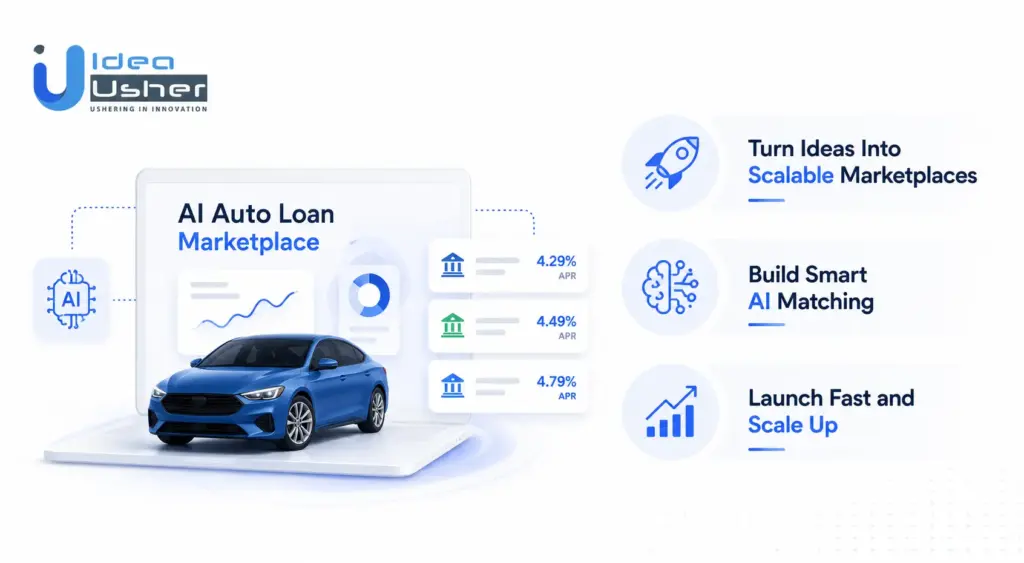
Turn Ideas Into Scalable Marketplaces
Turning an investment idea into a working AI auto loan marketplace requires more than just building the product. The platform must be secure and scalable while meeting lending regulations. IdeaUsher helps founders shape the right marketplace strategy and build an architecture that can support growing transaction volumes and evolving business needs.
Build Smart AI Matching
A successful auto loan marketplace requires seamless connections between credit bureaus, open banking APIs, and dealership management systems. IdeaUsher integrates secure backend pipelines that run complex risk assessments in milliseconds. Key integration components include:
- Credit and Verification APIs: Direct links to Experian, TransUnion, Plaid, and automated identity verification systems.
- Valuation Data Feeds: Real-time asset pricing from Black Book and Kelley Blue Book for instant loan-to-value calculations.
- Lender Buy-Box Engines: Programmatic rules that route files directly to the most profitable capital source.
Launch Fast and Scale Up
Conserve capital and reduce risk by launching with a targeted minimum viable product. IdeaUsher builds lean initial versions focused on high-conversion core features, allowing operators to prove unit economics before expanding network reach.
- Deploy Core Features: Build essential onboarding, basic matching logic, and primary credit integrations.
- Validate Unit Economics: Test conversion rates and lender onboarding with early transaction flow.
- Expand and Automate: Roll out proprietary machine learning models and automated compliance tools as volume scales.
Conclusion
Success with an AI-based auto loan marketplace begins with a clear understanding of the borrowers and lenders you want to serve. The next step is to choose the right AI capabilities and build a secure platform that can handle loan matching and underwriting at scale. With the right technology partner, you can turn this model into a reliable financing platform that is ready to grow.
Things to Know About AI-Based Auto Loan Marketplaces
A1: An AI-based auto loan marketplace is a digital platform that connects borrowers with multiple lenders and uses AI to improve how loan options are evaluated and matched. Instead of making borrowers approach lenders individually, the platform can analyze their financial profile and help identify suitable financing options. It can also automate parts of verification, application processing, and offer comparison.
A2: The platform can analyze information such as credit history, income, loan amount, vehicle details, and lender eligibility criteria to determine which financing options may be suitable. An AI matching engine can then rank available offers based on factors such as eligibility, estimated rates, loan terms, and borrower preferences. This can make the comparison process more relevant than simply displaying a long list of lenders.
A3: AI and machine learning models can identify patterns in financial and credit data to estimate credit risk and potential eligibility. However, an AI prediction should not be presented as a guaranteed approval because the final decision depends on the lender’s underwriting rules and verification process. Machine learning can improve underwriting efficiency and identify patterns that traditional models may miss.
A4: A platform may use borrower information such as income, employment details, credit history, requested loan amount, down payment, and vehicle information. It can also need lender-specific criteria and historical loan performance data to improve matching. Data quality is particularly important because inaccurate or biased training data can affect AI predictions and lending outcomes.