


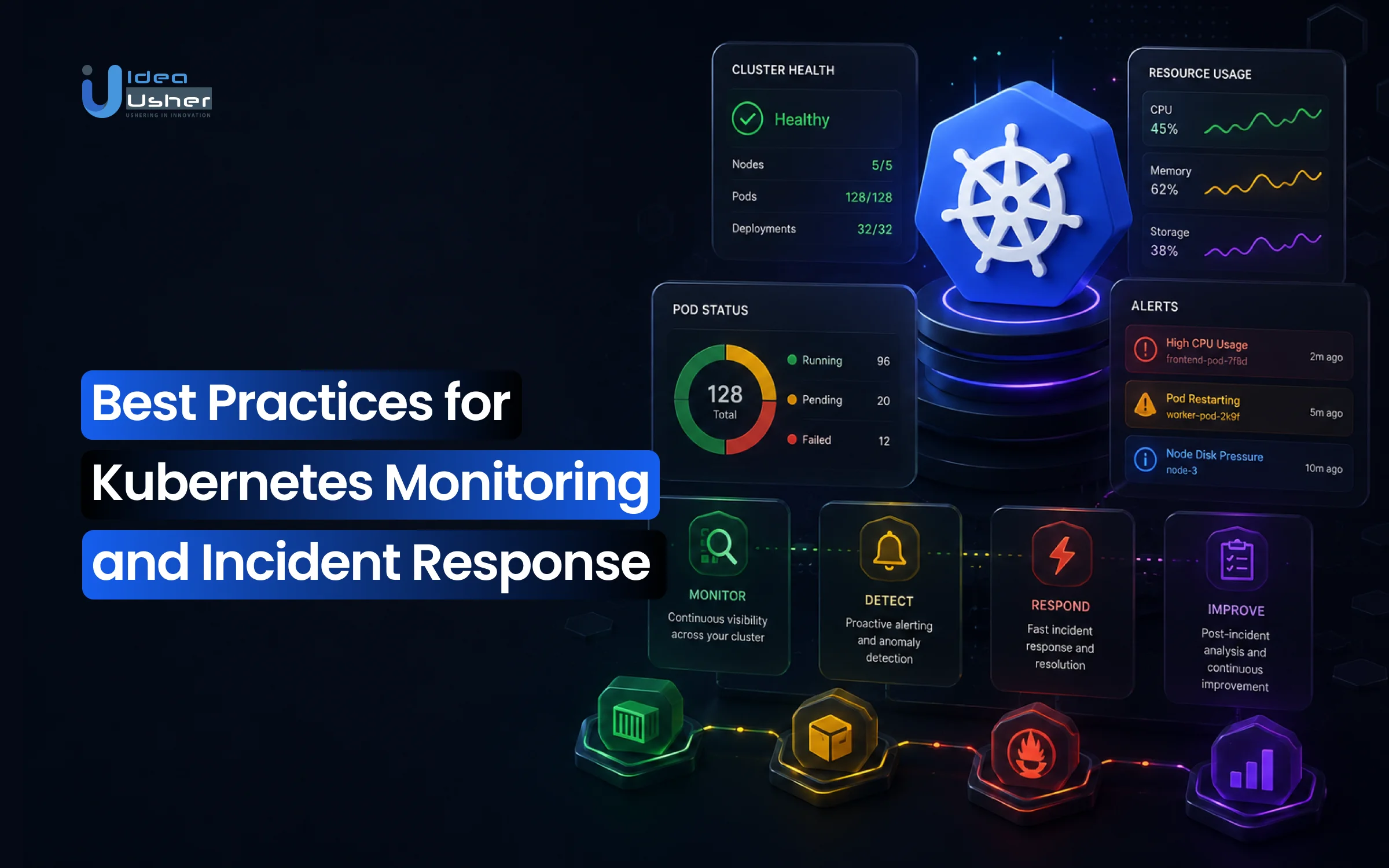
Key Takeaways
- Kubernetes monitoring focuses on reducing downtime through proactive observability, alerts, and faster incident response instead of reactive management.
- Poor visibility, alert fatigue, fragmented systems, and slow root-cause analysis increase cloud costs, instability, and customer-facing failures.
- Modern Kubernetes reliability depends on observability, monitoring, tracing, automated remediation, and scalable stacks for cloud-native systems.
- Standardized incident workflows, automated rollbacks, self-healing infrastructure, and centralized monitoring help teams maintain service availability.
- How Idea Usher helps businesses implement Kubernetes monitoring and incident response best practices with developers, observability systems, and automated workflows.
What is the value of Kubernetes monitoring if teams still discover critical failures after users are already affected? That question is exposing a growing weakness in modern infrastructure operations. Most monitoring systems produce endless metrics and alerts, but very little actionable clarity. As Kubernetes environments become more distributed and deployment cycles become faster, traditional reactive monitoring is no longer enough.
Even short disruptions now impact revenue, user trust, and operational stability. This makes incident response a business-critical function rather than a backend maintenance task. Effective Kubernetes monitoring is no longer about tracking everything. It is about identifying meaningful issues early, reducing response time, and building infrastructure that scales without increasing operational chaos.
We’ve helped businesses improve Kubernetes monitoring and incident response by reducing alert fatigue, improving visibility across clusters, and enabling faster issue resolution. In this blog, we’ll explore practical best practices for building reliable monitoring systems and response workflows that help teams minimize downtime and operate Kubernetes environments more efficiently.
Why Kubernetes Incidents Escalate Fast?
According to Mordor Intelligence, the Kubernetes market is expanding rapidly, with its valuation expected to reach USD 8.41 billion by 2031. For investors, this growth represents a fundamental shift toward container orchestration. However, this scalability introduces a high-velocity failure environment where automated self-healing can inadvertently trigger feedback loops. Unlike traditional localized failures, a single configuration error in Kubernetes can cause a cascading thundering herd effect, potentially dismantling an entire cluster in minutes.

Source: Mordor Intelligence
For the modern entrepreneur, investing in Kubernetes means managing a system where the speed of failure matches the speed of delivery. This volatility requires strategic oversight because dependencies are deeply interconnected and resources are ephemeral. Without sophisticated tooling, the very mechanisms designed to ensure uptime can become the primary drivers of infrastructure-wide instability, making proactive architectural management a critical business priority.
- Cascading Dependencies: Because services are decoupled, a latency issue in a minor background worker can cause backpressure that eventually crashes the user-facing API.
- Ephemeral Nature: Resources in Kubernetes are designed to be short-lived. By the time an engineer notices an error, the container may have already been terminated, making retrospective forensics nearly impossible without sophisticated tooling.
- Resource Contention: Shared clusters mean that a noisy neighbor—one application consuming more than its fair share of CPU—can starve critical business logic of the resources it needs.
The Complexity Behind Outages
The primary challenge for investors and founders lies in the abstraction gap where Kubernetes hides hardware complexity to boost productivity, yet masks the seeds of catastrophic failure. Outages are rarely isolated incidents; they are typically emergent properties of minor, overlapping misconfigurations that interact in ways never predicted during the design phase.
For instance, because Kubernetes manages networking dynamically, a simple security update can accidentally blind the service discovery layer, causing the platform to fail even when every individual server appears healthy. Strategic risk also centers on the control plane, the brain of the entire operation. If the API server or state database experiences even slight latency, the platform can enter a split-brain scenario where the actual state and the desired state diverge.
For a stakeholder, this means the reliability of the investment is no longer just about the application code. Instead, business continuity is tied directly to the sophistication of the DevOps architecture and its ability to maintain stability within a highly fluid environment.
The Business Cost of Monitoring Gaps
For decision-makers, the impact of a Kubernetes outage is measured in more than just downtime. It is measured in customer churn, missed SLAs, and eroded brand equity. In a containerized world, partial outages are common. A platform might stay online, but its checkout process slows down, or its data processing lag increases. These grey failures are often more damaging than a total blackout because they go undetected by basic health checks while silently destroying the user experience.
The financial implications of an unmonitored or poorly monitored cluster include:
- Exploding Cloud Bills: Without granular visibility, auto-scaling groups may scale up unnecessarily to compensate for inefficient code, leading to thousands of dollars in wasted compute spend.
- Engineering Burnout: When incidents are hard to diagnose, senior engineers spend their time firefighting rather than building new features that drive revenue.
- Compliance Risks: In sectors like FinTech or HealthTech, an unrecorded failure in data routing could lead to compliance breaches that carry heavy legal penalties.
Investing in a platform without a robust observability strategy is akin to flying a high-performance jet without a cockpit display. You might be moving fast, but you have no way of knowing how close you are to a stall until it is too late to recover.
Why Legacy Monitoring Fails
The tools that worked for the last twenty years, such as standard heartbeats and simple CPU or Memory thresholds, are fundamentally ill-equipped for the Kubernetes era. Traditional monitoring treats servers as pets, which are unique entities that we care for individually. In Kubernetes, servers and applications are cattle, meaning they are disposable, interchangeable, and constantly moving.
Standard monitoring fails for three primary reasons:
- Static vs. Dynamic Environments: Traditional tools expect static IP addresses and long-lived instances. Kubernetes rotates these constantly. A monitoring tool that cannot hook directly into the Kubernetes API to track these movements in real-time will provide data that is instantly outdated.
- The Everything is Green Fallacy: A pod can be running according to Kubernetes, but it may be stuck in a logic loop. Traditional uptime monitors see the Running status and report that everything is fine, while the end-user sees a 500 error.
- Lack of Context: Knowing that a node is at 90% CPU usage is useless if you do not know which of the 50 containers on that node is responsible and why. Kubernetes requires observability, the ability to infer internal states from outputs, rather than just monitoring.

The Core Pillars of Kubernetes Observability
Kubernetes observability is the strategic framework that allows organizations to navigate the inherent volatility of containerized environments by converting raw system data into actionable business intelligence. Unlike traditional monitoring, which merely reports whether a system is up or down, a robust observability stack provides the deep contextual insight necessary for stakeholders to maintain platform reliability, optimize cloud spend, and ensure a seamless user experience during rapid scaling.
1. Building Full-Stack Visibility
True full-stack visibility in a containerized environment requires a vertical slice of the entire infrastructure. Decision-makers should look for architectures that provide insights across three distinct layers. This layered visibility helps organizations identify performance bottlenecks early and maintain operational consistency as workloads scale.
| Layer | Focus Area | Business Impact |
| Infrastructure | Node health, CPU/Memory saturation, and disk I/O. | Prevents over-provisioning and reduces cloud waste. |
| Orchestration | Pod scheduling, API server latency, and etcd health. | Ensures the brain of the platform is functioning correctly. |
| Application | Request rates, error codes, and business logic performance. | Direct correlation to user satisfaction and revenue. |
Achieving this level of depth means moving beyond basic health checks. It involves implementing eBPF-based tools that can see into the Linux kernel or utilizing sidecar proxies that intercept and analyze every bit of traffic moving between services. For an entrepreneur, investing in this level of visibility ensures that as the platform grows, the complexity does not become a black box that hides inefficiency or burgeoning technical debt.
2. Combining Metrics, Logs, and Traces
A robust observability strategy is often referred to as the three pillars, yet the real value lies in their correlation. If these data sources remain in silos, the engineering team will waste time manually stitching together a timeline during a crisis. This lack of integration slows incident response and increases the risk of prolonged service disruptions.
- Metrics (The What): These are numerical representations of data over time, such as a 15% spike in memory usage. They are the first line of defense, triggering alerts when thresholds are breached.
- Logs (The Why): These are the granular records of events. When a metric shows a spike, logs provide the specific error message or stack trace that explains what the application was doing at that exact moment.
- Traces (The Where): In a microservices mesh, a single user request might pass through ten different services. Traces provide a map of that journey, identifying exactly which service in the chain caused a delay.
The strategic goal is exemplar-based correlation. This allows a developer to click on a spike in a metric graph and immediately see the specific logs and traces associated with that anomaly. By funding the integration of these streams, you are essentially buying back the time of your most expensive engineering talent, allowing them to solve problems with surgical precision rather than guesswork.
3. Scaling Observability Across Clusters
As a business expands into multi-cluster or multi-cloud environments, scaling observability becomes a significant operational hurdle. Centralization is the primary solution, providing a unified view across different regions and providers. This is a strategic necessity for global operations, enabling stakeholders to perform cross-cluster benchmarking and identify localized performance issues before they impact the broader enterprise.
Effective scaling also requires rigorous cardinality management to prevent telemetry costs from eroding profit margins. High-growth platforms must implement intelligent data sampling and retention policies to balance deep visibility with fiscal responsibility. For an investor, a well-defined plan for scalable observability is a key indicator of a mature, production-ready enterprise capable of sustainable growth.
Kubernetes Monitoring Best Practices
Operational excellence in a containerized world is not achieved by collecting the most data but by collecting the right data through a sophisticated Kubernetes strategy. At IdeaUsher, we believe the goal is to move away from vanity metrics and toward a system that reinforces platform reliability. By leveraging our pre-vetted developers, we help businesses implement best practices that ensure engineering resources are spent on innovation rather than drowning in the noise of a complex infrastructure.

1. Define SLIs and SLOs First
Strategic monitoring begins with a clear understanding of what success looks like. Before a single dashboard is built, we work to define Service Level Indicators and Service Level Objectives. This ensures monitoring efforts remain aligned with real business outcomes rather than isolated infrastructure metrics. Clearly defined reliability targets also help teams prioritize operational improvements and incident response more effectively.
- SLIs (Service Level Indicators): The specific metrics that represent a successful user experience, such as the latency of a checkout request.
- SLOs (Service Level Objectives): The target values for those metrics, such as 99.9% of requests completing in under 200ms.
By defining these early, we create a direct link between technical performance and core outcomes. This allows us to provide the data-driven insights management needs to decide when to push for new features and when to pause development to focus on stability.
2. Focus on Actionable Alerts
The most common failure in Kubernetes management is alert fatigue. If engineers receive a notification every time a pod restarts, which is a normal occurrence in a self-healing system, they will eventually ignore the alerts that actually matter. Over time, excessive low-priority alerts reduce response efficiency and increase the risk of missing critical production incidents.
The Golden Rule of Alerting: If an alert does not require immediate human intervention to prevent a breach of an SLO, it should not be an alert. It should be a line item in a weekly report.
We focus our alerting strategies on symptoms that impact the user, not the underlying cause. For instance, alerting on high CPU is often a distraction, while alerting on an increase in 5xx error codes is a critical call to action. Our approach keeps the team focused, reduces burnout, and ensures that when a notification arrives, it is treated with the necessary urgency.
3. Monitor Critical Components
While application performance is paramount, the health of the Kubernetes Control Plane is the foundation upon which everything else rests. Our developers keep a close watch on the following. Even minor instability within control plane components can impact deployments, scaling operations, and workload availability across the cluster.
- API Server Latency: If the API server is slow, the entire orchestration layer becomes unresponsive.
- etcd Health: This database stores the state of the cluster. Any corruption or latency here can lead to catastrophic cluster instability.
- Kube-Scheduler: Monitoring whether pods are being scheduled efficiently prevents resource bottlenecks and deployment delays.
4. Implement Golden Signals
Borrowing from Google SRE principles, we utilize Golden Signals to provide a high-level view of service health that is easily understood across the organization. These signals help teams quickly identify performance degradation before it affects critical business operations. They also create a standardized framework for evaluating reliability across different services and infrastructure environments.
| Signal | Description | Impact |
| Latency | Time taken to service a request. | High latency leads directly to customer churn. |
| Traffic | The demand placed on the system. | Helps in predicting future infrastructure costs. |
| Errors | The rate of failed requests. | A primary indicator of code or infrastructure bugs. |
| Saturation | How full your resources are. | Prevents outages by signaling when to scale up. |
Implementing these signals across all microservices ensures we maintain a consistent language for evaluating the health of different departments or product lines.
5. Use AI-Assisted Monitoring
As clusters grow, the volume of telemetry data becomes too large for humans to process in real-time. This is where we integrate AI-assisted monitoring and AIOps to provide a significant competitive advantage. By using machine learning to establish a baseline of normal behavior, these systems can detect anomalies that a human operator might miss.
Our AI tools can automatically correlate disparate events, such as a code deployment in one service and a sudden latency spike in another, pinpointing the root cause of an issue before it escalates. When you hire from our pool of specialized talent, you are moving toward automated risk mitigation, allowing your platform to maintain high availability with a leaner, more efficient operations team.
Common Kubernetes Incident Response Failures
Success in a containerized environment is often defined by what happens during a crisis. At IdeaUsher, we have observed that even the most well-funded ventures struggle when their Kubernetes response strategies remain rooted in legacy mindsets. When an incident occurs in a cluster, the speed of the system demands a response that is equally agile.

We help organizations move beyond the common pitfalls of incident management by providing pre-vetted developers who understand that in a distributed system, a slow response is often worse than no response at all.
1. Why Incident Runbooks Fail
Static documentation is the silent killer of platform reliability. Traditional runbooks are often treated as a set-it-and-forget-it asset, yet the infrastructure they describe is a moving target. As Kubernetes environments evolve rapidly, outdated operational procedures can significantly slow incident response and recovery efforts. We find that most runbooks fail for three specific reasons:
- Lack of Contextual Automation: A runbook that tells a human to manually check logs in a system with five thousand pods is a recipe for failure. Effective response requires executable code and automated scripts that can verify system state in milliseconds.
- Version Drift: As the platform evolves, the instructions in the runbook often fall behind the actual state of the infrastructure. If documentation refers to a service mesh or an ingress controller that was replaced months ago, it becomes a liability rather than an asset.
- Complexity Overload: During a high-pressure outage, engineers do not have time to read twenty pages of theory. We advocate for modular, concise, and searchable response guides that provide immediate, actionable steps.
When you hire from our pool of specialized talent, we focus on transforming these static documents into living, automated procedures. We ensure that your response strategies are as dynamic as the clusters they protect, reducing the cognitive load on your team when every second counts.
2. Frequent Cluster Incidents
Understanding the landscape of failure is the first step toward preventing it. In our experience building and maintaining high-growth platforms, we see several recurring patterns that catch unprepared teams off guard. Identifying these common incident patterns early helps organizations strengthen reliability and reduce unexpected production disruptions.
| Incident Type | Root Cause | Symptom |
| CrashLoopBackOff | Misconfiguration or resource limits. | Pods fail repeatedly during startup, preventing service availability. |
| OOMKilled | Memory leaks or improper limit setting. | The kernel terminates processes to protect the node, leading to sudden service drops. |
| ImagePullBackOff | Registry authentication or network errors. | New deployments fail to launch because the cluster cannot fetch the required software. |
| DNS Resolution Failures | CoreDNS saturation or misconfigured names. | Services are healthy but cannot find each other, breaking the entire application flow. |
Our developers specialize in diagnosing these issues at their source. Instead of just restarting the failed pod, we dig into the underlying resource requests or network policies to ensure the issue does not recur, protecting the stability of your investment.
3. The Risks of Reactive Operations
Operating in a reactive state is the most expensive way to manage a platform. When a business waits for a failure to happen before taking action, it is already losing money through downtime and engineering distraction. This firefighting culture prevents the team from working on revenue-generating features and eventually leads to high turnover among senior staff.
Reactive operations also introduce significant technical risk:
- Ad-hoc Patching: Under pressure, engineers often implement quick fixes that bypass standard security or architectural protocols, creating long-term technical debt.
- Inconsistent State: Manual interventions during an outage can leave the cluster in a state that no longer matches the configuration stored in Git, making future updates unpredictable.
- Lack of Root Cause Analysis: If the goal is simply to get the system back up, the team rarely takes the time to understand why it failed in the first place, ensuring the same incident will happen again.
Best Practices for Kubernetes Incident Response
Resilience is not the absence of failure but the ability to recover with precision. At IdeaUsher, we recognize that the high-velocity nature of Kubernetes demands a formalized response strategy that minimizes human error. We provide businesses with pre-vetted developers who specialize in building these frameworks, ensuring that when an anomaly occurs, your team follows a proven path to resolution rather than improvising under pressure.
1. Standardize Workflows
Chaos during an outage is usually the result of a lack of clear ownership. We help organizations establish a tiered response structure that removes ambiguity the moment an alert is triggered. A standardized workflow ensures that every stakeholder, from DevOps to executive leadership, knows exactly where to look for information and who is responsible for the next action.
- Triage: Assign a designated Incident Commander to filter noise from genuine threats.
- Communication: Establish a single source of truth to prevent fragmented information.
- Escalation: Define clear technical triggers that dictate when a specialized senior engineer from our pool should be brought in to handle complex Control Plane issues.
By standardizing these paths, we eliminate the delay usually spent deciding who should be on the call. This organizational discipline is what separates professional enterprises from high-growth startups that struggle with recurring instability.
2. Reduce MTTR With Automation
The Mean Time to Recovery is the most critical metric for any digital platform. In a distributed environment, manual recovery is a bottleneck that your business cannot afford. We work with you to implement automated remediation, the practice of using code to fix known failure patterns without human intervention.
- Self-Correcting Infrastructure: We configure automated horizontal scaling and pod eviction policies that handle resource exhaustion before a human even sees the alert.
- Automated Rollbacks: If a new deployment causes a spike in error rates, we implement GitOps pipelines that automatically revert to the last known stable state.
- Healing Scripts: For common issues like orphaned volumes or stuck nodes, we deploy specialized operators that detect and resolve the state mismatch automatically.
When you hire from IdeaUsher, our experts focus on building these automated safety nets. We aim to turn every incident into a one-time event by coding the solution directly into the infrastructure.
3. Improve Incident Visibility
You cannot fix what you cannot see. During an active incident, your team needs a specialized view that cuts through the thousands of standard metrics to show the immediate blast radius of the failure. We help you build live-updating incident dashboards that focus on the health of the request flow rather than individual server stats.
Effective real-time visibility includes distributed tracing that shows exactly where a request is dying in the microservice chain. It also involves live log streaming that is filtered by the specific error IDs related to the outage. Our developers ensure that your observability stack is tuned to provide these high-resolution insights, allowing for surgical fixes that target the root cause without affecting healthy parts of the cluster.
4. Build Better Post-Mortems
The real value of an incident lies in the lessons it provides for the future. At IdeaUsher, we advocate for a blameless post-mortem culture. The goal of a post-incident review is not to find a person to blame but to identify the systemic weakness that allowed the failure to occur. This approach encourages transparency, continuous improvement, and stronger long-term operational resilience.
| Review Phase | Focus Detail | Objective |
| Timeline Reconstruction | Exact timestamps of detection, escalation, and fix. | Identify delays in the communication chain. |
| Root Cause Analysis | The five whys of the technical failure. | Find the architectural flaw, not just the symptom. |
| Action Items | Concrete engineering tasks to prevent recurrence. | Turn the failure into a permanent platform upgrade. |
| SLO Impact | How much of the error budget was consumed. | Inform business decisions on feature velocity vs. stability. |
Building a Scalable Kubernetes Monitoring Stack
A scalable infrastructure is only as effective as the eyes watching over it. At IdeaUsher, we recognize that as your platform grows, monitoring requirements evolve from simple status checks to complex data orchestration. We provide pre-vetted developers who specialize in architecting Kubernetes stacks that do not just store data but transform it into a competitive advantage. By leveraging our expertise, we ensure your monitoring environment scales horizontally alongside your business, preventing visibility gaps that could lead to costly downtime.

1. Choosing the Right Tools
The marketplace for observability is crowded, and making the wrong choice early can lead to expensive migrations later. We help you navigate this landscape by selecting tools that align with your specific technical goals and performance requirements. Whether your priority is open-source flexibility or managed service reliability, we ensure your stack is built on a foundation of interoperability.
- Prometheus & Grafana: The industry standard for metric collection and visualization. We implement these to provide high-resolution insights into cluster health.
- OpenTelemetry: We utilize this vendor-neutral framework to ensure your traces and logs remain portable, preventing vendor lock-in.
- Loki & Tempo: For high-volume log aggregation and distributed tracing that integrates seamlessly with your existing metric dashboards.
When you hire from our pool of specialized talent, we do not just install tools. We integrate them. We ensure that your developers spend less time toggling between tabs and more time understanding the unified state of the application.
2. Multi-Cloud Architectures
In a multi-cloud or hybrid-cloud strategy, monitoring becomes a fragmented nightmare without a centralized design. We help businesses build a unified observability plane that abstracts away the underlying cloud provider. This ensures that whether a pod is running on AWS, Azure, or an on-premise data center, the data looks and acts the same in your central command center.
- Centralized Metrics Aggregation: We deploy global query layers like Thanos or Cortex to provide a long-term, unified view of metrics across multiple clusters.
- Edge Pre-Processing: To reduce egress costs and latency, we implement edge agents that filter and compress telemetry data before it leaves the local cloud region.
- Cross-Cloud Benchmarking: We design dashboards that allow you to compare performance and cost-efficiency across different providers in real-time.
Our approach ensures that your leadership team has a single pane of glass to view the entire global operation. By standardizing the monitoring architecture, we make it possible to move workloads between clouds without losing the historical data or alerting logic that keeps the platform stable.
3. Security and Compliance
Monitoring data often contains sensitive information, from IP addresses to PII hidden in application logs. At IdeaUsher, we treat observability as a security tier. We implement rigorous standards to ensure that your monitoring stack does not become a backdoor for data leaks or a compliance liability.
| Security Layer | Implementation Strategy | Business Benefit |
| RBAC Integration | Linking monitoring access to your central identity provider. | Ensures only authorized personnel view sensitive telemetry. |
| Log Masking | Automated redaction of sensitive data before it hits the disk. | Maintains compliance with GDPR, HIPAA, and SOC2. |
| Encryption | Ensuring all telemetry data is encrypted in transit and at rest. | Protects against data interception in distributed environments. |
| Audit Logging | Tracking who accessed what monitoring data and when. | Provides a clear trail for security audits and investigations. |
How Idea Usher Builds Kubernetes Monitoring Systems?
We approach infrastructure not as a collection of servers but as the engine of your business growth. At IdeaUsher, our strategy for building Kubernetes monitoring systems is rooted in the belief that observability must provide a clear return on investment. By deploying our pre-vetted developers into your workflow, we create a bespoke monitoring environment that prioritizes system health and fiscal efficiency, ensuring your platform remains a reliable asset as you scale.

1. Focus on Critical Workloads
Every microservice is not created equal. We recognize that an outage in your payment gateway is far more catastrophic than a delay in a background analytics worker. Our developers architect monitoring systems that are tiered based on the business impact of each workload.
- Priority Tiering: We assign higher granularity and faster alerting frequencies to your revenue-generating services.
- Custom Health Logic: We go beyond standard uptime checks by writing custom probes that verify the actual business logic of the application.
- Business Metric Integration: We bridge the gap between DevOps and the boardroom by pulling data like successful transactions per second into your technical dashboards.
This focused approach ensures that your team is never distracted by minor issues while a critical business process is failing. When you hire from us, you get a team that understands the why behind the code, ensuring the monitoring stack serves your primary commercial objectives.
2. Unified Cluster Monitoring
As your enterprise expands globally, the complexity of managing multiple clusters can lead to fragmented visibility. We solve this by implementing a unified monitoring plane that aggregates data from every region into a single, cohesive view. This architectural choice is vital for maintaining a consistent user experience regardless of where your customers are located.
- Global Querying: We utilize advanced tools to query multiple data sources simultaneously, providing a holistic view of your global footprint.
- Standardized Alerting: We ensure that an incident in a European cluster triggers the same high-standard response as one in a North American cluster.
- Resource Benchmarking: By unifying your data, we allow you to compare the performance and cost of different clusters, identifying optimization opportunities that would be invisible in a fragmented system.
Our goal is to eliminate the fog of war that often accompanies multi-cluster growth. With our experts managing the integration, your leadership team gains a reliable, real-time overview of the entire digital estate, facilitating faster and more informed decision-making.
3. Reducing Tool Sprawl
One of the greatest hidden costs in modern infrastructure is tool sprawl, the accumulation of multiple, overlapping subscription services that drive up costs and confuse engineering teams. At IdeaUsher, we audit your existing stack to consolidate functionality into a streamlined, high-performance toolkit.
Consolidation is the key to both clarity and cost-control.
| Problem | Our Solution | Business Result |
| Overlapping Tools | Consolidation into a unified OpenTelemetry-based stack. | Reduced monthly SaaS licensing fees. |
| Data Silos | Integrated correlation between metrics, logs, and traces. | Faster troubleshooting and lower MTTR. |
| Inconsistent Dashboards | Standardized visualization templates across all teams. | Reduced training time for new engineers. |
| High Egress Costs | Intelligent data filtering at the cluster edge. | Massive reduction in cloud provider bills. |
How Idea Usher Improves Incident Response?
In the high-stakes world of container orchestration, the speed of your response determines the impact on your bottom line. At IdeaUsher, we move beyond simple troubleshooting by engineering comprehensive response frameworks. By integrating our pre-vetted developers into your organization, we transform Kubernetes from a complex source of anxiety into a resilient, self-stabilizing asset that protects your digital revenue.
1. Incident Workflows That Scale
Scaling a platform is impossible if your response team is bogged down by manual coordination. We establish rigid yet agile workflows that ensure every second of an outage is spent on resolution rather than discussion. Our developers help you move away from the “all hands on deck” chaos by assigning specific roles within the cluster management hierarchy.
- Standardized Escalation: We eliminate guesswork by defining technical triggers that ensure the right expertise is engaged at the right time.
- Engineering Coordination: We implement integrated hubs where real-time cluster data is streamed directly into coordination channels, ensuring every engineer sees the same live telemetry.
- Clear Ownership: We define roles such as Incident Commanders and Technical Leads to ensure a synchronized effort to restore service without overlapping efforts.
By standardizing these paths, we eliminate the delay usually spent deciding who should be on the call. This organizational discipline is what separates professional enterprises from high-growth startups that struggle with recurring instability.
2. Automating Kubernetes Recovery
The true power of Kubernetes lies in its ability to be programmed. At IdeaUsher, we believe that if a human has to fix the same problem twice, the system is not yet finished. We build automation that acts as a 24/7 digital first-responder for your infrastructure. This proactive approach helps organizations reduce downtime, improve recovery speed, and minimize repetitive operational overhead.
- Auto-Remediation: We write specialized scripts that watch for known failure patterns. If a service leaks memory, our triggers can gracefully restart pods or increase limits to prevent a total crash.
- Automated Rollbacks: We integrate GitOps-driven mechanisms that instantly detect spikes in error rates and revert the cluster to the last known healthy state.
- Self-Healing Workflows: We optimize the orchestrator’s native capabilities, including fine-tuned liveness probes and automated workload movement before nodes become unresponsive.
When you hire from IdeaUsher, our experts focus on building these automated safety nets. We aim to turn every incident into a one-time event by coding the solution directly into the infrastructure.
3. Faster Root-Cause Analysis
Fixing the symptom is a temporary patch; finding the root cause is a long-term investment. We provide the tools and expertise necessary to look past the surface of an incident and understand the underlying architectural failure. Investigation time is the biggest variable in downtime. We reduce it by replacing guesswork with data correlation.
- Telemetry Correlation: We implement unified stacks where a single trace ID can be followed across your entire microservice mesh, connecting metric spikes to specific log errors.
- Dependency Mapping: We deploy live mapping tools that visualize how services interact. This allows us to see the ripple effect of a failure and identify how a minor bottleneck causes a total blackout.
- Reduced Investigation Fatigue: By having data pre-correlated, your team receives a curated view of the incident footprint rather than searching through millions of raw log lines.
How Idea Usher Reduces Kubernetes Downtime?
At IdeaUsher, we view downtime as a direct threat to your market position and capital efficiency. Our approach to Kubernetes is built on the principle of active resilience—moving beyond hope-based infrastructure to a deterministic, observable environment. By integrating our pre-vetted developers into your technical core, we eliminate the systemic vulnerabilities that lead to outages, ensuring your platform remains available and performant for your global user base.
1. Preventing Incidents Early
The most cost-effective incident is the one that never happens. We help businesses shift their operational focus from response to prevention by implementing rigorous architectural standards before code ever hits the production cluster. Our developers act as a strategic shield, identifying configuration drifts and resource bottlenecks that often go unnoticed by standard testing suites.
- Policy as Code: We implement automated guardrails that prevent insecure or unstable configurations from being deployed.
- Predictive Scaling: By analyzing historical traffic patterns, we configure your cluster to scale up before the surge hits, rather than reacting to it.
- Chaos Engineering: We perform controlled, small-scale failure simulations to identify how your system behaves under stress, fixing weak points in a safe environment.
This proactive stance ensures that your platform is hardened against the most common causes of cluster failure. When you hire from our talent pool, you are not just getting developers. You are getting architects who prioritize stability as a core feature of the product.
2. Lowering MTTD and MTTR
When an anomaly does occur, the financial impact is dictated by two variables: the Mean Time to Detection and the Mean Time to Recovery (MTTR). We specialize in compressing these windows through a combination of high-resolution observability and automated remediation.
| Metric | Our Strategy | Strategic Benefit |
| MTTD | Real-time anomaly detection and eBPF-based deep visibility. | Issues are identified in seconds, often before users notice. |
| MTTR | Automated rollback triggers and self-healing operators. | Service is restored instantly while the team investigates the cause. |
| Noise Control | Noise-reduction filters and alert correlation. | Engineers stay focused on real threats, reducing burnout and error. |
By reducing the time it takes to see a problem and the time it takes to fix it, we protect your SLAs and your reputation. Our goal is to make recovery a background process rather than a front-page crisis.
3. Reliability During Scaling
Scaling is the ultimate stress test for any Kubernetes environment. As you increase your node count and user volume, the complexity of the networking and storage layers grows exponentially. We ensure that your growth does not outpace your reliability by designing a monitoring and response stack that scales elastically with your cluster.
- Distributed Observability: We implement decentralized data collection to ensure that even a massive cluster remains fully visible without overwhelming the control plane.
- Resource Quota Management: We prevent noisy neighbor scenarios by enforcing strict resource limits and fair-share scheduling, ensuring critical workloads always have the CPU and memory they need.
- Global Traffic Management: As you move to multiple regions, we set up intelligent load balancing that can automatically route traffic away from a failing cluster to a healthy one.
Why Businesses Need Kubernetes Experts Instead of DIY Monitoring?
Attempting to build and maintain a production-grade orchestration layer in-house often leads to the DIY Trap, where engineering teams spend more time managing the infrastructure than building the actual product. At IdeaUsher, we see businesses struggle under the weight of maintaining complex monitoring stacks that were never designed for enterprise scale. Hiring pre-vetted Kubernetes experts allows your organization to offload the high-risk operational burden, ensuring that your capital is invested in innovation rather than infrastructure maintenance.
1. Hidden In-House Costs
Many entrepreneurs underestimate the total cost of ownership associated with self-managed Kubernetes operations. Beyond the base salary of a DevOps engineer, the hidden costs can quickly cannibalize your project margins. When you attempt to manage these environments without specialized external support, you face several compounding financial risks:
- Opportunity Cost: Every hour your senior developers spend debugging a Prometheus scraping issue is an hour they are not developing features that drive market share.
- Recruitment and Retention: The market for top-tier Kubernetes talent is hyper-competitive. Training junior staff in-house often results in a leaky bucket where employees leave for higher offers once they gain proficiency.
- Infrastructure Waste: Without expert tuning, Kubernetes clusters often run at 20% efficiency, leading to cloud bills that are much higher than necessary.
By partnering with us, you replace these variable, high-risk expenses with a predictable, high-performance solution. We provide the expertise needed to optimize your resource utilization from day one, turning your infrastructure from a cost center into a lean, efficient foundation for growth.
2. Choosing a Partner
Choosing a partner to manage your infrastructure is a high-stakes decision. A generic development shop is rarely equipped to handle the nuances of container orchestration. We believe an ideal partner must demonstrate depth across three specific domains. The right expertise can significantly reduce operational risk while improving long-term platform scalability and reliability.
- Observability Maturity: They should not just offer monitoring but a comprehensive observability strategy that includes tracing, logging, and metrics correlation.
- Incident Track Record: Look for a partner who can demonstrate a structured approach to MTTR reduction and a history of building self-healing systems.
- Strategic Alignment: Your partner must understand your business goals. If you are a FinTech platform, they must prioritize security and compliance. If you are a streaming service, they must prioritize low-latency throughput.
At IdeaUsher, we pride ourselves on being more than just a talent provider. We act as a strategic extension of your team. Our developers are pre-vetted not just for their coding ability but for their ability to design systems that support long-term business viability and technical resilience.
3. Accelerating Reliability
We accelerate your path to a production-ready environment by bypassing the standard trial-and-error phase of infrastructure management. Our developers arrive with a battle-tested blueprint for Kubernetes reliability, allowing us to implement a professional-grade monitoring and response stack in a fraction of the time it would take an in-house team to build from scratch.
| Our Focus | Implementation Strategy | Your Business Outcome |
| Rapid Deployment | Use of pre-configured, modular observability templates. | Faster time-to-market for new platform features. |
| Expert Oversight | Access to developers who have managed clusters at scale. | Reduced risk of catastrophic black swan outages. |
| Cost Optimization | Rigorous resource auditing and rightsizing. | Immediate and sustainable reduction in cloud spend. |
| Knowledge Transfer | Clear documentation and collaborative workflows. | Your internal team learns best practices alongside our experts. |
When you hire from IdeaUsher, you are not just filling a seat. You are acquiring a sophisticated operational framework. We ensure that your Kubernetes investment is protected by the highest standards of monitoring and incident response, giving you the peace of mind to focus on scaling your business to a global audience.
Contact Idea Usher for Kubernetes Monitoring
Resilience is not a product you buy but a standard we help you achieve. At IdeaUsher, we bring the rigor of high-scale engineering to your Kubernetes environment, ensuring your platform is prepared for the demands of a global market. With over 500,000 hours of coding experience, our team of ex-MAANG/FAANG developers understands exactly what it takes to move from a fragile cluster to a world-class, self-healing infrastructure.
Build Reliable Systems
Reliability is built into the foundation, not bolted on as an afterthought. We work alongside your team to engineer monitoring and response systems that prioritize what truly matters: your users. By focusing on the intersection of technical performance and business outcomes, we ensure that your infrastructure supports your growth rather than hindering it.
- Surgical Monitoring: We implement deep-visibility tools that catch silent failures before they impact your revenue.
- Proactive Defense: Our systems are designed to identify and remediate bottlenecks automatically.
- Actionable Insights: We replace thousands of noisy alerts with clear, prioritized signals that your team can actually act upon.
Hire Pre-Vetted Experts
The gap between a functional cluster and an optimized one is vast. When you partner with us, you gain immediate access to a pool of specialized talent that has seen and solved the most complex orchestration challenges in the industry. We handle the vetting, the training, and the high-level strategy so you can focus on your product.
Our developers are not just operators; they are architects. We bring 500,000 hours of collective experience to your codebase, applying the same high standards for documentation, testing, and automation used by the world’s leading tech giants.
Scale with Cloud-Native Expertise
Scaling is a double-edged sword that brings both opportunity and risk. As your user base grows, the complexity of your Kubernetes networking, security, and storage grows with it. We provide the cloud-native expertise required to navigate this expansion without the typical growing pains of downtime or performance degradation.
- Horizontal Scalability: We ensure your monitoring stack grows as fast as your traffic without adding massive overhead.
- Architectural Foresight: We anticipate the challenges of multi-region and multi-cloud deployments, building a unified plane that keeps you in control.
- Efficiency Audits: Our experts constantly refine your resource requests and limits to ensure you are not overpaying for idle cloud capacity.
Conclusion
Ultimately, mastering Kubernetes requires a shift from reactive firefighting to proactive, automated resilience. By combining standardized workflows, deep observability, and the expertise of seasoned developers, businesses can transform their infrastructure into a self-healing engine of growth. Partnering with a team that brings hundreds of thousands of hours of experience ensures that your platform remains stable, secure, and ready to scale alongside your ambitions.
FAQs
Q1: What are the most important metrics to monitor in a Kubernetes cluster?
A1: To maintain a healthy environment, we focus on the four Golden Signals: latency, traffic, errors, and saturation. Monitoring these at both the application level and the control plane level ensures that we catch performance bottlenecks before they impact users. By prioritizing these metrics, our developers can distinguish between minor background noise and critical system failures that require immediate attention.
Q2: How can businesses effectively reduce their Mean Time to Recovery?
A2: The most effective way to lower MTTR is through automated remediation and standardized incident workflows. At IdeaUsher, we implement self-healing scripts and automated rollback strategies that allow the cluster to recover from known failure patterns without human intervention. This shift from manual troubleshooting to automated response ensures that services are restored in seconds, drastically reducing the cost of downtime.
Q3: Why is distributed tracing necessary for microservices in Kubernetes?
A3: In a complex microservice architecture, a single user request can pass through dozens of different services. Distributed tracing allows us to follow that request’s journey, providing a clear visual map of where delays or errors are occurring. This deep visibility is essential for root-cause analysis, as it connects disparate log entries into a single, cohesive narrative that helps our experts fix the right problem the first time.
Q4: What is the difference between proactive and reactive monitoring?
Q4: Reactive monitoring waits for a failure to occur before triggering an alert, while proactive monitoring uses anomaly detection and trend analysis to identify issues before they cause an outage. At IdeaUsher, we build proactive systems that monitor for early warning signs, such as gradual memory leaks or unusual traffic spikes. This allows our ex-MAANG developers to intervene early, maintaining 99.9% uptime and protecting your brand reputation.


