


Key Takeaways
- Off-the-shelf credentialing software suits organizations with standard workflows, with pricing around $15–$50 per provider/month for small practices and $150+ for enterprise plans.
- Custom credentialing software is useful for complex, multi-facility workflows, specialized approval rules and real-time system integrations.
- Custom healthcare credentialing software development can cost $35,000–$550,000+, depending on platform complexity, integrations and features.
- Off-the-shelf software can be launched in two to eight weeks. Custom healthcare credentialing software development may take four to eighteen months or even longer.
- A healthcare credentialing software development approach mixes credentialing APIs with a custom app. This balances deployment with greater control over workflows and the user experience.
- The right choice between custom vs off-the-shelf credentialing software depends on provider volume, workflow complexity, integration needs and whether existing software creates real operational problems.
A credentialing platform that works for one healthcare organization may create friction for another. Differences in provider volume, verification workflows, payer requirements and existing systems make custom versus off-the-shelf credentialing software a business decision, not a technology choice. “Should organizations choose custom vs off-the-shelf credentialing software for their operations and workflows?” and the answer depends on how each option fit properly according to current needs and future growth.
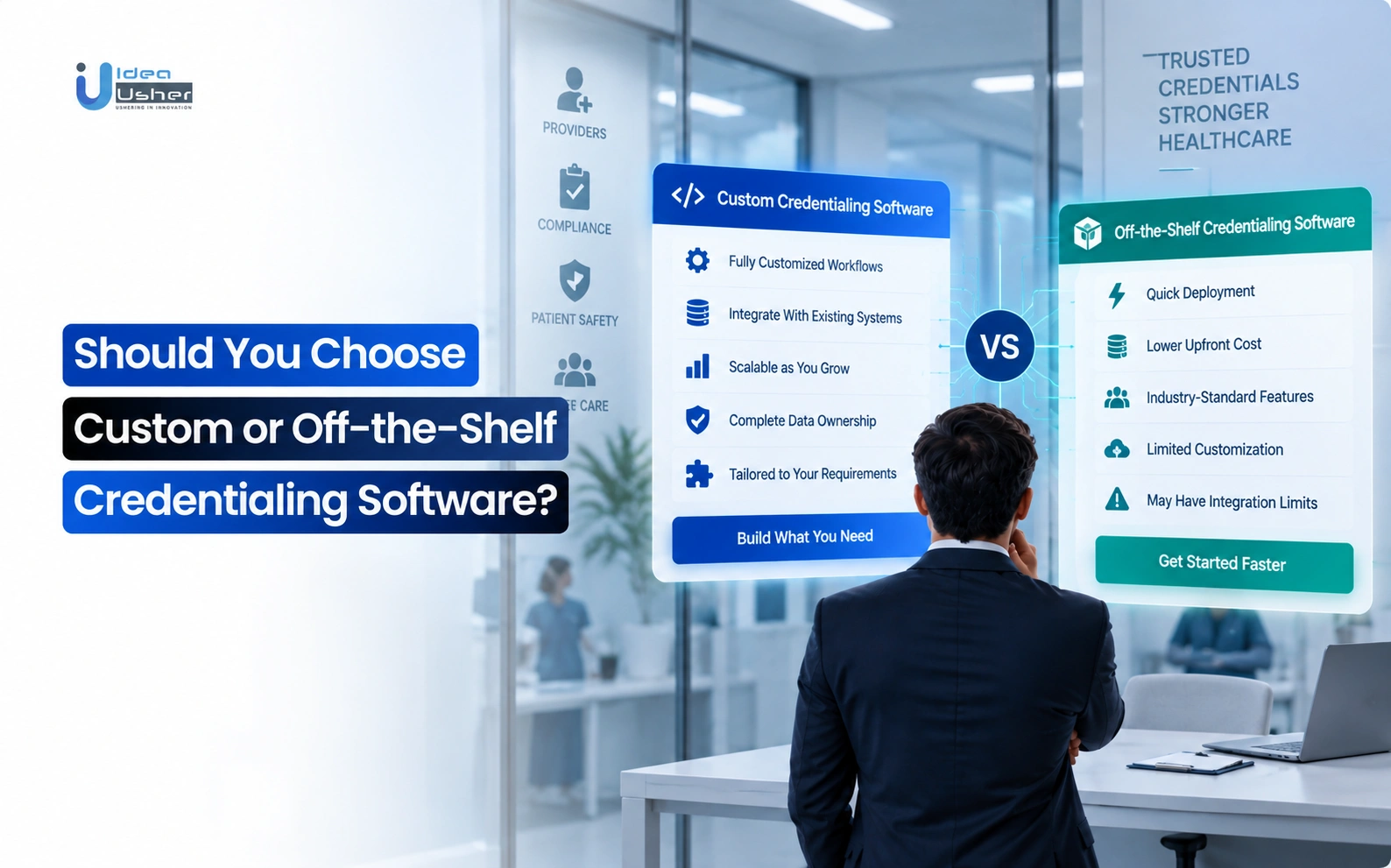
Off-the-shelf tools can offer deployment and established features but may require process compromises or workarounds. Custom credentialing software provides control over workflows and integrations while demanding more time, investment and ongoing maintenance.
In this blog, we will talk about the differences between custom and off-the-shelf healthcare credentialing software, comparing their features, costs, implementation timelines, integration needs and trade-offs to help you assess which approach fits your organization.
What Is Healthcare Credentialing Software and Why Is It Growing?
Healthcare credentialing software is an automated technology platform used by hospitals, health systems, group practices, and payer networks to verify, manage, and track the qualifications and regulatory compliance of medical providers.
The software serves as a single source of truth for provider data, replacing manual, paper-intensive tasks with automated primary source verifications, digital application processing, continuous sanction monitoring, and payer enrollment workflows.
Core Functions: PSV, Licensing, Enrollment and Monitoring
Modern credentialing platforms unite four core operational pillars to manage the complete provider lifecycle. These pillars work together to streamline verification, compliance, enrollment and ongoing provider monitoring across the organization.
| Functional Pillar | Core Capability | Automation Mechanism |
| Primary Source Verification (PSV) | Verifies credentials with universities, medical boards and training hospitals. | API connectors and bots retrieve and verify records, reducing manual calls and letters. |
| Licensing & Privileges | Tracks state licenses, DEA registrations and facility-specific clinical privileges. | Expiration alerts notify teams ahead of renewal deadlines. |
| Payer Enrollment & Rostering | Prepares provider applications for commercial and government payers, including Medicare and Medicaid. | Form automation maps provider data into payer applications and standard rosters. |
| Sanction Monitoring | Checks providers against exclusion lists and adverse-action databases. | NPDB and OIG/SAM checks run daily or monthly to flag disciplinary actions or potential fraud. |
The Healthcare Credentialing Software Market Is Growing
The global healthcare credentialing software and services market is projected to grow from $1.03 billion in 2026 to $2.10 billion by 2035, registering a CAGR of approximately 8.3% from 2026 to 2035. This trajectory reflects a category moving quickly past spreadsheets and manual verification toward purpose-built automation.

According to Reports, a full-time specialist represents more than $122,000 in lost income across a standard 120-day credentialing window, while the organization still pays full base salary and overhead costs, a gap now fueling enterprise investment in automation.
- Physician Shortage Pressure: The AAMC projects a shortfall of up to 86,000 physicians by 2036, pushing health systems to onboard new providers faster through automated verification systems.
- Claim Denial Exposure: MGMA data shows 41% of providers now report denial rates above 10%, and credentialing errors are a direct contributor to that revenue leakage.
- Nationwide Staffing Shortages: More than 90% of US healthcare facilities report ongoing staffing shortages, increasing pressure to onboard both locum and permanent providers without unnecessary delay.
- Multi-State Licensing Growth: Over 62,000 physicians now hold licenses through the Interstate Medical Licensure Compact, with more than 215,000 licenses issued across 44 participating member states nationwide.
- Denied Claims Revenue Loss: MGMA reports that 65% of denied claims are never reworked at all, meaning credentialing-driven denials often become permanently written-off revenue for practices.

When Does Off-the-Shelf Credentialing Software Make Sense?
For many healthcare providers, investing tens or hundreds of thousands of dollars and months of engineering time into building custom credentialing infrastructure is unnecessary. Off-the-shelf (COTS) SaaS platforms offer an immediate, battle-tested solution that solves the core administrative bottlenecks of provider verification without writing a single line of code.

Commercial platforms make the most financial and operational sense when an organization’s credentialing workflows adhere to standard regulatory playbooks and predictable scaling patterns.
A. Standardized Workflows Across a Small Provider Network
Small-to-midsize practices, community clinics, single-state provider groups, and regional ambulatory centers rarely require unique clinical hierarchies or bespoke algorithms.
- Standard Provider Types: Credentialing MDs, DOs, PAs and NPs follows established regulatory workflows, which off-the-shelf platforms already support through standard provider taxonomies.
- Fixed Committee Cycles: Monthly or quarterly MEC reviews suit off-the-shelf tools designed to package dossiers for scheduled votes, rather than on-demand, algorithmic privileging.
- Limited Geographic Scope: Operating within one state or region avoids the complex licensing matrices and multi-state telehealth routing that may warrant custom engineering.
B. Faster Deployment With Existing Credentialing Features
Building proprietary credentialing software requires extensive requirements mapping, data modeling, and regulatory review before writing code. In contrast, commercial SaaS delivers near-instant time-to-value:
- Go-Live in Weeks: Turnkey solutions can be configured, branded, and operational in 2 to 8 weeks, compared to 6 to 18 months for a custom build.
- Minimal Engineering Effort: Clinical operations and Medical Staff Services (MSS) teams manage workflows through admin dashboards, without diverting product managers or backend engineers from core revenue-generating products.
- Faster Revenue Realization: Manual credentialing can take 90 to 120 days per provider, delaying billing. Off-the-shelf tools automate applications and primary source verification, helping accelerate payer enrollment and cash flow.
C. Predictable Requirements and Limited Customization Needs
Custom software shines when business logic is proprietary. However, regulatory compliance is the exact opposite of proprietary, it is heavily standardized:
- Regulatory Alignment: NCQA, The Joint Commission and URAC set PSV standards and timelines. COTS platforms offer preconfigured validation workflows and audit trails aligned with these requirements.
- Standardized Payer Enrollment: CMS-855 forms, CAQH rosters and payer applications use repeatable data mapping. SaaS tools provide prebuilt form libraries, avoiding the need to reverse-engineer each application.
- Predictable Roster Volumes: For organizations onboarding dozens of clinicians annually, per-provider SaaS subscriptions can cost less than building and maintaining custom infrastructure.
D. What Existing Credentialing Platforms Already Cover
Modern commercial platforms (such as Symplr, Modio Health, MD-Staff, Medallion, and Assured) offer mature, out-of-the-box feature suites that address 90%+ of standard credentialing demands:
| Core Capability | Out-of-the-Box Coverage |
| Self-Service Provider Portals | Digital onboarding forms, document upload vaults, e-signatures, and CAQH data ingestion. |
| Automated PSV Connectors | Pre-built integrations and web-scraping pipelines for state licensing boards, DEA, NPDB, and ABMS. |
| Continuous Sanction Screening | Automated monthly sweeps against federal and state exclusion registries (OIG-LEIE, SAM.gov, state Medicaid lists). |
| Expiration Alerts & Ticklers | Automated SMS and email notifications triggering at 90, 60, and 30 days prior to license or certification lapses. |
| Audit-Ready Dossiers | Immutable, timestamped verification logs and PDF capture ready for NCQA or Joint Commission survey inspections. |
For organizations whose primary goal is achieving compliance, eliminating paper files, and billing payers quickly without unique clinical routing logic, off-the-shelf software is the clear operational choice.
When Should Healthcare Organizations Build Custom Software?
Commercial off-the-shelf software works for standard, single-facility credentialing. However, expanding healthcare organizations like national telehealth platforms, MSOs, provider networks, and large health systems face limits when turnkey SaaS cannot support their complex operations.
Building custom credentialing software shifts provider operations from an administrative cost center into a core proprietary advantage, unlocking real-time clinical scheduling, programmatic payer enrollment, and seamless multi-state scaling.
A. Complex Credentialing Across Multiple Facilities
Traditional SaaS assumes a single provider works at a fixed, physical facility with a static scope of practice. Modern healthcare delivery models violate this assumption daily:
- Multi-Facility Privileging: Hospital networks manage tiered clinician privileges across hospitals, surgery centers and clinics, each with unique bylaws, committee schedules and department chairs. Custom multi-tenant, parent-child hierarchies reduce duplicate data entry across facilities.
- 50-State Telehealth Routing: Virtual care networks match active state licenses, DEA registrations and collaborative practice agreements with patient schedules in real time to support compliant cross-state coverage.
- Locum Tenens & Floating Pools: Temporary staff, travel nurses and roving hospitalists need rapid, automated onboarding across facilities, which standard software may struggle to coordinate dynamically.
B. Unique Verification and Recredentialing Workflows
When an organization’s clinical standards diverge from baseline accrediting minimums, rigid COTS workflows force teams back into offline spreadsheets:
- Rules-Based Privileging: Deterministic rules engines can instantly approve routine, unencumbered renewals instead of waiting for monthly committee meetings, while routing complex cases for human peer review.
- Custom Competency Scoring: Embeds organization-specific checks for specialized skills such as robotic surgery volumes, simulation scores and peer-case reviews, directly into data intake.
- Risk-Triggered Recredentialing: Monitors clinical indicators, including safety incidents, outcomes and peer evaluations, to trigger early re-evaluation instead of relying solely on fixed 2-to-3-year cycles.
C. Integrating EHR, HR, RCM and Payer Systems
Off-the-shelf software typically offers brittle batch SFTP exports or shallow, one-way webhook connectors. A custom platform integrates directly into the organization’s operational core:

Zero-Latency Clinical Unlocking: The moment a provider’s credentialing packet is approved, the custom system triggers an API call to the EHR to update PractitionerRole resources, provisioning e-prescribing and scheduling permissions without manual IT intervention.
Revenue Protection Integration: Real-time synchronization with Practice Management and Revenue Cycle Management (RCM) billing engines prevents claims from dropping until the clinician’s in-network effective date is confirmed, eliminating billing write-offs.
D. Custom Provider Portals, Dashboards, and Approval Rules
The clinician onboarding experience sets the tone for provider satisfaction and retention. Commercial tools often present dated, clunky UIs that frustrate busy physicians:
- Branded Clinician Onboarding: Embeds a white-labeled intake portal in the clinician app or intranet, with auto-save, smart document scanning and no duplicate forms.
- Role-Based Access Control (RBAC): Tailors dashboards for medical directors, department chairs, credentialing analysts and legal teams, showing only role-relevant metrics and actions based on clearance level.
- Configurable Approval Routing: Routes high-risk files, such as malpractice settlements or board disciplinary actions, through custom escalation paths with conditional approval stages.
E. When Standard Software Becomes an Operational Bottleneck
Healthcare leaders should evaluate custom development when COTS limitations directly threaten growth, unit economics, or compliance:
| Bottleneck | SaaS Limitation | Custom Platform Solution |
| Roster-Based Pricing | Per-provider fees scale sharply with thousands of clinicians. | Fixed infrastructure and maintenance costs can improve margins at scale. |
| Credentialing Delays | 90–120-day manual cycles leave clinicians unable to bill. | Automation can cut credentialing time by 50%–70%, accelerating billing. |
| Roadmap Stagnation | Vendor release schedules delay critical features for months. | Direct roadmap control enables faster adaptation to new services and state regulations. |
| Fragmented Data | Credentialing, scheduling and billing silos require manual re-entry. | A unified provider source of truth connects the operational stack. |
Custom vs Off-the-Shelf Credentialing Software: Feature Comparison
Feature comparisons between custom vs off-the-shelf credentialing software make it easier to see where off-the-shelf credentialing platforms handle standard workflows well and where their limitations start to surface. The table below breaks this down across core capability areas that most directly affect provider onboarding speed, payer enrollment accuracy, and ongoing compliance monitoring for growing health organizations.
| Feature Area | Off-the-Shelf Platforms | Custom-Built Software |
| Verification & Data Coverage | Prebuilt NPDB/ABMS connectors; gaps in state-board coverage may require manual checks. | Integrates required state boards, OIG and SAM.gov into one verification engine. |
| License & Expiration Tracking | Fixed alerts (e.g., 30/60/90 days), with limited state, specialty or risk-based customization. | Configurable alerts based on jurisdiction, specialty and payer renewal rules. |
| Payer Enrollment & CAQH | Basic, often one-way CAQH sync; manual re-entry into practice management and EHR systems. | Two-way CAQH, practice management and EHR sync, with automated roster updates. |
| Sanctions & Recredentialing | Fixed monthly or quarterly checks; calendar-based recredentialing. | Continuous sanctions monitoring and expiration-triggered recredentialing for each provider. |
| Audits & Provider Data | Standard reports and provider data siloed across modules. | Unified provider data with configurable audit trails for accreditation and payer requirements. |
This custom vs off-the-shelf credentialing software comparison highlights a pattern rather than isolated gaps: off-the-shelf tools generally handle single-location, standard workflows adequately, while custom platforms become more valuable once verification volume, jurisdictional complexity, and integration needs scale across multiple systems, facilities, and payer relationships.
Which Feature Gaps Actually Justify Custom Development?
A missing feature alone doesn’t automatically justify building software from scratch. The gap only becomes a real signal when it starts costing time, blocking integrations, or putting compliance at risk.
A feature gap is worth acting on when it: A feature gap is worth acting on when it creates recurring operational friction, limits essential integrations, restricts required workflows or prevents teams from maintaining reliable provider data.
- Creates repeated manual work — staff re-key or reconcile the same data across systems on a recurring basis
- Blocks essential integrations — the platform can’t connect to a required EHR, PM system, or payer portal
- Restricts required workflows — approval chains, multi-facility rules, or credentialing paths don’t match how the organization actually operates
- Makes provider data hard to manage — records stay siloed instead of forming one reliable source of truth
Quick test: Does this gap force someone to redo work by hand, or does it just look less polished than you’d like?
| Scenario | Verdict |
| Wants a different dashboard layout or report style | Skip custom build — configure or work around it |
| Runs credentialing across multiple facilities with unique approval rules | Worth evaluating a tailored solution |
| Needs data synchronized across several internal systems in real time | Worth evaluating a tailored solution |
| One payer’s portal is slow to load | Skip custom build — not a systemic issue |
A single missing dashboard view is a preference. A credentialing process that spans multiple facilities, runs on non-standard approval rules, and needs several systems talking to each other in sync is a structural limitation, and that’s the kind of gap custom development is actually built to solve.
What Does Credentialing Software Development Cost?
Credentialing software cost isn’t a single number; it depends on whether an organization buys per-provider access to an existing platform or commissions a system built around its own workflows. Off-the-shelf tools charge recurring fees that scale with provider count, while custom development is a larger upfront investment with a different long-term cost curve.
A. Off-the-Shelf Costs: Licensing, Setup and Add-Ons
Pricing tiers vary sharply by organization size and feature depth, with provider volume, verification requirements, workflow automation and integration needs influencing the total subscription and implementation costs.
| Organization Size | Typical Pricing | Example Platforms |
| Small practice (under 10 providers) | $15–$50 per provider/month | Medwave-tier tools, basic per-source pricing |
| Mid-size group (10–50 providers) | $75–$150 per provider/month | QGenda, IntelliCred |
| Enterprise / hospital network | $150–$200+ per provider/month, or $2,000–$10,000+/month flat | Symplr Provider, Modio Health |
On top of licensing, most vendors charge separately for implementation, data migration from legacy or paper-based records, and premium add-ons like advanced analytics or committee-based privilege modules, costs that rarely appear in the advertised per-provider rate.
B. Custom Development Costs: Discovery to Deployment
Custom builds are typically scoped in tiers based on complexity rather than provider count. A $150,000–$550,000+ healthcare credentialing software build typically spans discovery, design, development, integrations, testing and deployment.
- Mid-level platform: $150,000–$350,000, driven mainly by privilege libraries and multi-facility workflow logic, with a typical timeline of four to seven months.
- Enterprise platform: $220,000–$550,000+, where API infrastructure, multi-tenant architecture, and committee workflows account for most of the added cost.
The following breakdown shows how costs can be distributed across each development phase.
| Development Phase | Estimated Cost | What It Covers |
| Discovery & Workflow Mapping | $12,000 – $66,000 | Requirements gathering, approval-chain mapping, compliance scoping |
| UI/UX Design | $15,000 – $83,000 | Provider and admin dashboards, mobile-friendly credentialing views |
| Core Development (Backend/API) | $53,000 – $248,000 | PSV engine, licensing tracker, sanctions monitoring logic |
| Third-Party Integrations | $23,000 – $110,000 | CAQH, NPDB, EHR, PM system, payer portal connections |
| QA & Compliance Testing | $15,000 – $83,000 | HIPAA compliance checks, data accuracy validation, load testing |
| Deployment & Post-Launch Support | $12,000 – $66,000 | Go-live, staff training, first 60–90 days of support |
Note: The costs shown above are estimated development ranges and may vary based on project scope, platform complexity, required integrations, customization levels, compliance requirements, development team location and post-launch support needs.
C. Buy vs. Build: Subscription Pricing vs. Custom Development
Before committing to a custom build, it’s worth knowing what off-the-shelf credentialing software actually costs to license, since for some organizations, subscribing is the more rational choice.
| Option | Pricing Model | Typical Cost | Best Fit |
| Off-the-shelf, small practice tier | Per provider or per user, per month | $15 – $50 per provider/month | Small practices with straightforward, single-location verification needs |
| Off-the-shelf, automation-focused tier | Per provider, per month | $75 – $125 per provider/month | Practices wanting automated renewal tracking without a custom build |
| Off-the-shelf, enterprise tier | Custom or per-provider, per month | $150+ per provider/month | Large health systems needing deep features, while still operating on a vendor’s platform |
| Custom-built platform | One-time development cost | $35,000 – $550,000+ depending on tier | Organizations needing workflow ownership, specific integrations, or a resellable multi-tenant product |
D. Hidden Costs of Integrations and Workflow Changes
Two cost drivers are easy to underestimate during initial scoping: integration complexity and workflow changes, both of which can increase development effort, extend implementation timelines and require additional technical resources during deployment.
- EHR integration testing: Often the single biggest factor determining whether a project lands on the low or high end of its cost tier, since it directly extends the four-to-seven-month build timeline.
- Legacy data migration: Digitizing paper files and cleaning up records pulled from outdated systems is frequently billed as a separate professional-services line item, not bundled into the core software cost.
- Workflow redesign: Mapping unique approval chains and multi-facility rules into the new system takes discovery time that generic implementation estimates don’t always account for.
How Do Both Approaches Handle Compliance and Security?
In healthcare credentialing, compliance and security are foundational operational risks. A failure in credential verification can result in unlicensed clinicians treating patients, immediate accreditation loss, uncompensated care write-offs, or federal civil monetary penalties.
Whether choosing custom vs off-the-shelf credentialing software, both models must satisfy the same regulatory frameworks (NCQA, The Joint Commission, URAC, CMS). The fundamental difference lies in who bears the engineering and administrative burden of executing, monitoring, and updating those controls.
A. Primary Source Verification and Accreditation Requirements
Accrediting bodies mandate not only that qualifications are verified, but that they adhere to strict verification methods and time-limit windows (typically within 120 to 180 days prior to committee review or provisional approval).
| Dimension | Off-the-Shelf (COTS) SaaS | Custom Credentialing Platform |
| Verification Logic | Preconfigured for NCQA and Joint Commission standards, with required metadata such as source URL, query date and status. | Requires custom rules for source validation, timestamps and registry-specific field mapping. |
| Time-Limit Enforcement | Built-in expiration clocks flag dossiers exceeding 120- or 180-day limits and block them from committee review. | Requires scheduled jobs to recalculate credential age daily and lock expired files. |
| Source Integration | Vendor-maintained API connectors or browser workflows cover state boards and federal sources. | Internal teams build and maintain integrations, including patches when portals change markup or CAPTCHA rules. |
B. Continuous Sanctions Monitoring and Expiration Alerts
Credentialing is no longer an episodic, once-every-two-years event. Federal guidelines and accreditation standards require active, ongoing oversight to ensure debarred or sanctioned clinicians are identified immediately.
COTS Solutions: Vendors maintain automated sweeps against OIG-LEIE, SAM.gov, OFAC and state Medicaid exclusion lists. Pre-configured 90-, 60- and 30-day alerts notify providers and staff about DEA, CDS and license renewals.
Custom Architectures: Organizations implement event-driven architectures with worker queues and webhooks for continuous exclusion-feed ingestion. Custom platforms require dedicated data engineering but can connect exclusion alerts directly to EHR scheduling, instantly freezing slots after an adverse action.
C. HIPAA Considerations for Credentialing Software
While credentialing data primarily concerns healthcare practitioners rather than patient medical records, HIPAA still directly applies across several operational intersections:
- PHI in Credentialing Files: Records may contain physician health screenings, immunizations, TB results, substance-use evaluations or peer-review cases referencing patient charts.
- Business Associate Agreements (BAAs): Vendors and cloud providers (AWS, GCP, Azure) handling PHI on behalf of a covered entity generally require an executed BAA.
- Minimum Necessary Access: Role-based controls limit staff to documentation needed for their review stage, restricting non-clinical personnel from sensitive physician health and peer-review records.
D. Who Maintains Compliance Updates and Verification Rules?
Healthcare regulations and authoritative source registries change constantly. Determining who manages these updates is often the deciding factor in the custom vs off-the-shelf credentialing software:
Off-the-Shelf (Vendor-Maintained): The vendor’s regulatory and engineering teams track NCQA/Joint Commission updates, federal exclusion schema changes and state licensing connections. When a portal changes its API or layout, the vendor fixes the integration centrally, without client intervention.
Custom (Internally Maintained): Internal compliance teams track regulatory changes, while engineers implement updates in production. Changes to federal data exports or state-board bot detection require developers to prioritize fixes over new features to prevent credentialing disruptions.
Should You Build, Buy or Choose a Hybrid Platform?
Choosing between custom vs off-the-shelf credentialing software is a critical capital decision. Buying a rigid SaaS platform can throttle growth and force manual workarounds, while building custom software risks turning internal engineering into a government web scraper maintenance crew.
Making the optimal build, buy, or hybrid decision requires evaluating three core variables: organizational scale, workflow uniqueness, and where the company’s proprietary value actually lies.
| Evaluation Factor | Buy (Turnkey SaaS) | Build (Custom Platform) | Hybrid (Headless APIs + Custom App) |
| Typical Profile | Regional hospitals, clinics, traditional group practices. | Massive healthcare enterprises (10k+ providers), custom clinical staffing networks. | Fast-scaling digital health startups, tech-enabled MSOs, multi-state telehealth. |
| Time to Deployment | 2–8 weeks | 9–18 months | 8–16 weeks |
| Initial Upfront Cost | Low (configuration & onboarding fees). | High ($500k–$2M+ in dedicated engineering). | Moderate (API integration & frontend build). |
| Long-Term Scaling Cost | High (linear per-provider SaaS seat fees). | Low (amortized infrastructure hosting & maintenance). | Predictable (metered API calls + cloud infrastructure). |
| Workflow Customization | Low (locked to vendor-defined stages and UI). | Total (100% bespoke logic and interfaces). | High (custom UX and business logic over standardized data). |
| Source Maintenance Effort | Zero (handled completely by vendor). | Severe (internal team manages all board scrapers). | Zero (handled by headless infrastructure provider). |
A. When Buying an Existing Platform Is Sufficient
Buying a turnkey, commercial off-the-shelf (COTS) SaaS solution (such as Symplr, Modio Health, or MD-Staff) is the most prudent and cost-effective choice when operations follow standard, well-trodden healthcare pathways:
- Stable Provider Networks: Single-state hospitals, regional systems, community clinics and outpatient groups with fixed facilities and monthly committee cycles can typically use SaaS designed for these workflows.
- Routine Compliance Needs: When credentialing is a back-office requirement, not a competitive differentiator, custom development may waste capital. If 60–90-day turnaround times fit the business model, standard SaaS may suffice.
- Limited Engineering Resources: Without dedicated developers, data engineers and regulatory product managers, building in-house can strain IT. Turnkey SaaS lets clinical teams manage onboarding, automated Primary Source Verification (PSV) and payer enrollment.
- Small, Stable Rosters: Organizations managing dozens or hundreds of clinicians, rather than thousands of high-turnover contractors, may find per-provider SaaS pricing economically viable.
B. When Custom Credentialing Software Is Worth Building
Building a proprietary, ground-up platform is justified only when standard software actively caps top-line revenue, degrades clinician unit economics, or cannot support the enterprise’s core operational mechanics:
- Real-Time, Cross-State Clinical Routing: Telehealth platforms and on-demand health networks need live provider matching across 50-state licenses, multi-state DEA registrations and active collaborative practice agreements. Off-the-shelf tools often lack real-time integration with patient scheduling.
- Large-Scale Cost Efficiency: For rosters of 5,000 to 50,000+ providers, SaaS per-provider fees can become costly. Custom platforms spread upfront engineering costs across scalable infrastructure.
- Specialized Competency & Privileging: Requirements such as procedure-volume thresholds, peer simulation scores and quality-adjusted privileges need custom data schemas and approval logic that standard platforms may not support.
- Native System Integration: Credentialing approvals can trigger EHR access, e-prescribing permissions and billing rules through private microservices, reducing reliance on third-party middleware and its latency.
C. How a Hybrid Credentialing Software Fit?
For most modern, high-growth digital health companies, the binary choice between building from scratch and buying closed SaaS is flawed. The hybrid model pairing “headless” credentialing APIs with custom frontend applications and internal business logic, delivers the optimal balance between speed, cost, and customization.
Why the Hybrid Approach Wins for Digital Health
- Best-of-Both-Worlds Utility: Engineering teams use specialized verification APIs (such as CertifyOS or Medallion’s developer platform) to handle the complex, fragile integrations with hundreds of state licensing boards and federal registries.
- Focus on Core Differentiation: Developers can focus their sprints on patient-matching algorithms, custom clinician dashboards, and EHR integration rather than maintaining web scrapers for 50 distinct state medical boards.
- Speed with Customization: Delivers the rapid launch capabilities of SaaS while preserving the deep architectural integration and white-label UX of custom software.
How IdeaUsher Helps Build Healthcare Credentialing Software
IdeaUsher operates as an enterprise product engineering partner, backed by 11+ years of software expertise, 250+ technical specialists and a 4.9/5 Clutch rating across 1,000+ delivered builds. We engineer custom, cloud-native credentialing software that transforms complex provider onboarding into automated, auditable digital workflows.
A. Credentialing Workflow Mapping
We deconstruct your operational bottlenecks from initial application intake and primary source verification (PSV) to committee evaluations, translating multi-step compliance rules into clear software architecture, defined role-based user flows, and a predictable technical roadmap.
B. Provider Data & Verification Workflow Design
Our engineers structure relational schemas to track medical licenses, DEA registrations, board certifications, and work histories. We automate document parsing via OCR, configure auto-expiring credential alerts, and build structured review queues to eliminate manual tracking.
C. Healthcare System & Verification Service Integration
We connect your platform directly to external databases and clinical platforms, engineering secure API bridges for:
- State medical boards and the National Practitioner Data Bank (NPDB).
- CAQH data import pipelines and payer enrollment platforms.
- Internal hospital EHRs, practice management platforms, and HR software.
D. Secure, Scalable Credentialing MVP Development
We prioritize high-impact intake and primary verification tools for a lean initial MVP, ensuring rapid validation before scaling into complex multi-facility modules. Every deployment utilizes end-to-end AES-256 encryption, granular access controls, immutable audit trails, and zero vendor lock-in code ownership.
Planning to build healthcare credentialing software? Connect with Idea Usher’s software architects today to review your verification workflows, required system integrations, and custom development roadmap.
Conclusion
The right credentialing software should support your organization’s operational needs, compliance requirements and long-term growth. Off-the-shelf platforms offer ready-made capabilities, while custom solutions provide greater control over complex workflows, integrations and provider data. A hybrid approach can combine established verification services with tailored functionality. Ultimately, custom vs off-the-shelf credentialing software development depends on workflow complexity, total ownership costs, scalability and integration requirements. A clear evaluation of these factors can help healthcare organizations choose an approach that supports efficient credentialing and sustainable growth.
FAQs
A.1. Healthcare credentialing software development typically costs $150,000 to $550,000+ for mid-level and enterprise platforms, while simpler custom builds may start at $35,000, depending on complexity and integrations.
A.2. Essential features include provider profiles, primary source verification, license tracking, document management, credential expiration alerts, enrollment workflows, compliance monitoring and reporting to support efficient credentialing operations.
A.3. Off-the-shelf software supports standard workflows with ready-made features, while custom solutions accommodate specialized processes and integrations. The choice depends on operational complexity, budget, scalability and ownership requirements.
A.4. Custom credentialing software can automate primary source verification through integrations with credentialing databases and licensing authorities. Automation depends on source accessibility, available APIs, data quality and verification requirements.


