 (+971) 8007 4267
 (+91) 946 340 7140
 (+1) 628 432 4305

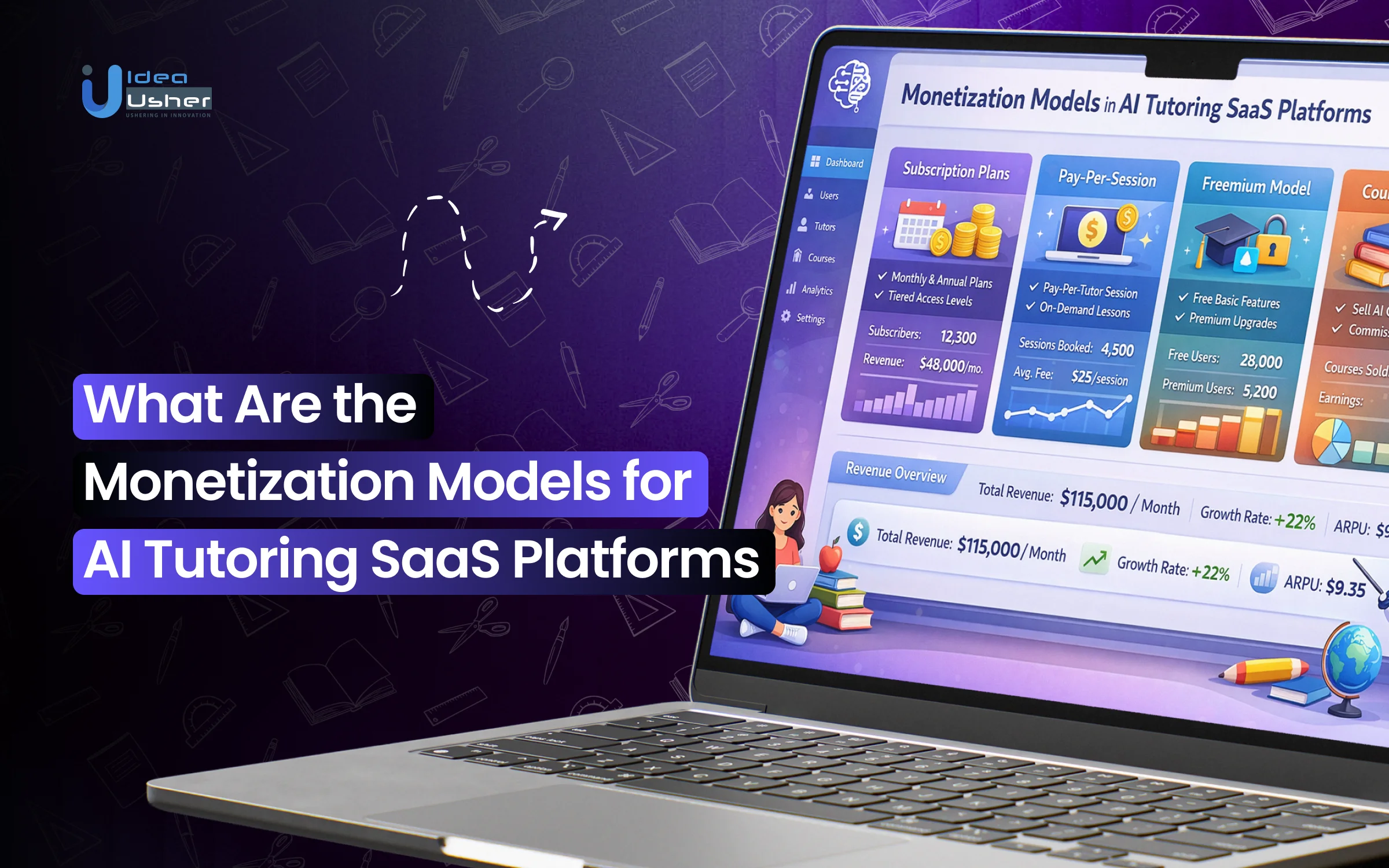
AI tutoring platforms are reshaping personalized learning, but their long-term success relies on capturing value from that experience. While the technology scales instruction and feedback for thousands, the business must still balance costs, user expectations, and pricing, bringing AI tutoring SaaS monetization into focus, where the right revenue model determines whether the platform can grow without eroding margins.
Different user segments interact with tutoring platforms in distinct ways. Individual learners may prefer flexible subscriptions, schools might look for institutional licensing, and education companies often require API access or white-label deployments. Each approach affects revenue stability, customer acquisition strategy, and cost management in different ways.
In this blog, we explore the monetization models for AI tutoring SaaS platforms by examining common pricing structures, revenue drivers, and the factors that influence sustainable growth in AI-powered education software.

What is an AI Tutoring SaaS Platform?
An AI Tutoring SaaS Platform is a cloud-based, Software-as-a-Service (SaaS) model that uses artificial intelligence to deliver personalized, 24/7 educational support. It functions as a digital “study buddy” that adapts to a student’s unique learning pace and style using technologies like Machine Learning (ML) and Natural Language Processing (NLP).
Core Capabilities
AI-driven tutoring platforms transcend traditional digital classrooms by offering a dynamic, responsive learning environment. These core features ensure that every student receives high-fidelity, personalized instruction precisely when they need it most.
- Personalized Learning Paths: The platform analyzes strengths and weaknesses to tailor lessons and difficulty levels in real-time.
- Instant Feedback: It provides immediate corrections and step-by-step explanations, preventing misconceptions from taking root.
- 24/7 Availability: Unlike human tutors, these platforms are accessible anytime, allowing for late-night study or flexible scheduling.
- Data Analytics: It tracks performance over time, providing “actionable insights” for both students and human educators.
Why Monetization Strategy Matters in AI Tutoring SaaS?
A precise AI tutoring SaaS monetization strategy balances high computational AI costs with scalable revenue, ensuring your platform maintains healthy margins while delivering personalized, high-value learning experiences to a global audience.
1. Growth of AI-Powered Learning Platforms
The global demand for personalized, 24/7 education is driving a massive shift toward AI-integrated ecosystems. Modern platforms are moving beyond static video libraries to offer intelligent, adaptive environments that scale educational expertise to millions simultaneously.
2. The Economics of AI Tutoring Products
Unlike traditional software, AI tutoring involves high computational overhead and API token costs. A precise monetization strategy ensures that the platform maintains healthy margins while reinvesting in model fine-tuning and specialized infrastructure for students.
3. Why Traditional EdTech Pricing Models Fail With AI
Legacy flat-fee models do not account for the variable costs of real-time AI inference. Without usage-based or tiered structures, high-frequency users can quickly turn profitable accounts into net losses due to significant backend processing expenses.
4. The Shift Toward Outcome-Based AI Pricing
Future-ready platforms are moving away from access-only fees toward pricing based on verifiable student mastery. By leveraging AI to track objective skill acquisition, marketplaces can charge premium rates for guaranteed learning outcomes and professional certifications.
Global Market Growth of AI Tutoring SaaS Platforms
The worldwide market for AI tutors was valued at USD 1.63 billion in 2024 and is expected to grow to USD 7.99 billion by 2030, with a CAGR of 30.5% from 2025 to 2030. This swift expansion is driven by rising demand for customized learning options and technological progress in artificial intelligence.

The strong impact of AI tutors on learning outcomes drives this rapid expansion. AI-powered personalized learning can boost student achievement by up to 20%. Students using AI tutors show learning gains more than double those of learners in traditional active learning environments.
Adaptive AI learning platforms boost test scores by over 62%, proving their effectiveness in improving academic performance. Instant feedback from AI tutors can reduce learning time by 40–60%, and AI-powered tutoring systems increase student retention by up to 21%.
Platforms like Khan Academy’s “Khanmigo” already demonstrate the global scalability of AI tutoring, serving over 120 million learners worldwide with 24/7 learning support. One of the biggest advantages of AI tutoring is its affordability, as it can deliver 90–95% cost savings compared to traditional human tutoring.
While human tutors typically charge $50–$100 per hour, most AI-based SaaS learning tools are available for just $10–$50 per month, making high-quality tutoring far more accessible to students across the world.
Core Use Cases of AI Tutoring SaaS Platforms
AI tutoring is no longer just about “getting the answer” with a simple chat interface to sophisticated “Agentic” systems; it is about diagnostic precision, teacher empowerment, and 24/7 accessibility. Platforms today prioritize Socratic guidance, helping students think over automated completion instead of the “one-size-fits-all” limitation of traditional classrooms

1. Hyper-Personalized Learning Paths
Modern SaaS platforms use AI to map a student’s “Knowledge Space” in real-time, identifying the exact root of a conceptual misunderstanding.
- Dynamic Scaffolding: Instead of providing solutions, the AI offers “scaffolding”, a series of leading questions that guide a student to discover the answer themselves.
- Adaptive Pacing: For subjects like mathematics or coding, the AI identifies when a student is stuck on a specific logic gate and automatically adjusts the curriculum to provide extra practice in that exact sub-skill.
Real-World Example: Khan Academy’s Khanmigo acts as a 24/7 Socratic coach, integrated directly into their vast database to provide guidance without “spoon-feeding” answers.
2. AI Instructor Co-Pilots for Administrative Relief
Institutions are leveraging AI SaaS by 2026 to slash the “shadow work” of teaching such as grading, lesson planning, and reporting by over 70%.
- Automated Differentiated Instruction: Teachers use AI agents to generate three versions of a single lesson plan (Simplified, Standard, and Advanced) in seconds to accommodate diverse classroom needs.
- Predictable Analytics: Dashboards flag “at-risk” students by week 2 of a semester based on engagement patterns and quiz performance, allowing for human intervention before grades actually drop.
Real-World Example: MagicSchool.ai provides dozens of specialized tools for educators to generate rubrics, IEP (Individualized Education Program) suggestions, and student feedback reports.
3. Language and Conversational Roleplay
Language learning platforms have moved beyond flashcards to high-fidelity, native-level voice interaction that simulates real-world stress and context.
- Safe-Fail Environments: Students practice conversational fluency with AI avatars that can simulate specific personas like a demanding business client or a local barista, providing real-time corrections on grammar and tone.
- Multimodal Feedback: Systems now analyze audio input to correct pronunciation and intonation, mimicking the feedback of a native-speaking tutor.
Real-World Example: Duolingo Max features “Roleplay” and “Explain My Answer” to give users a deep, conversational understanding of linguistic nuances.
4. Enterprise & Corporate Workforce Reskilling
In the corporate sector, AI tutoring SaaS is the primary tool for rapid upskilling and compliance training, ensuring that employees master complex enterprise software.
- Sandbox Simulations: New hires use AI-powered replicas of company software to practice workflows and make mistakes without touching live production data.
- Just-in-Time Knowledge Retrieval: Employees can query an internal “Knowledge Agent” trained on proprietary company manuals to get instant answers during their workday.
Real-World Example: Whatfix Mirror creates AI-driven practice environments where employees master enterprise workflows through realistic application simulations.
5. Accessibility and Inclusive Education Tools
AI tutoring platforms act as “personalized translators” for students with diverse learning needs or physical impairments.
- Multimodal Conversion: Real-time speech-to-text for the Deaf or hard of hearing (DHH) and image-to-audio descriptions for the visually impaired are now standard API-driven features.
- Cognitive Load Management: For neurodivergent students, the AI can summarize dense academic text into bulleted, low-stimulation formats to prevent cognitive overwhelm.
Real-World Example: Ello uses proprietary speech recognition to listen to children read physical books, providing gentle, real-time corrections to build early literacy confidence.
Core Monetization Models for AI Tutoring SaaS Platforms
Sustainable AI tutoring SaaS monetization requires balancing high GPU operational costs with accessible pricing. Successful platforms move beyond flat fees, leveraging hybrid models that align value delivery with scalable infrastructure.

1. Subscription-Based Access
The subscription model serves as the primary engine for AI tutoring SaaS monetization strategy, offering students predictable costs while providing the platform with stable cash flow to offset high GPU and API operational expenses.
- Predictable Recurring Revenue (MRR): Establishes a consistent financial baseline, allowing for more aggressive long-term R&D and infrastructure scaling.
- User Retention & Habituation: Monthly or annual commitments encourage students to integrate the AI tutor into their daily routines, increasing platform “stickiness.”
- Tiered Value Perception: Clear differentiation between basic access and “Pro” features like advanced reasoning models or unlimited file uploads.
Real-World Example: Duolingo Max utilizes a high-tier subscription to give users access to GPT-4 powered features like “Explain My Answer” and “Roleplay,” moving beyond the standard ad-free experience.
2. Usage-Based Pricing for AI Tutor Interactions
Usage-based or “pay-as-you-go” models are a natural fit for AI, where income is generated with every API call or image processed, ensuring that the AI tutoring SaaS monetization strategy mirrors its variable compute costs.
- Granular Billing: Users pay specifically for the tokens or query depth used, which feels fair and flexible for casual learners.
- Cost Alignment: Directly offsets the costs of advanced models (e.g., Claude 3.5 or GPT-4o) by charging more for intensive reasoning tasks.
- Guardrails: Effective models include usage tiers or caps to give both the business and the customer better financial control.
Real-World Example: Skooli offers a pay-as-you-go model (approximately $0.65/minute), allowing students to pay only for the exact amount of help they receive during a session.
3. Tiered Pricing Models for Students and Institutions
Effective AI tutoring SaaS monetization tiering segments the market by feature depth and scale, ensuring that individual learners and massive organizations find a price point that matches their specific utility.
- Starter vs. Pro: Personal learners may start on a basic plan with standard LLMs and upgrade for “Pro” features like PDF analysis or custom study plans.
- Institutional Scaling: Organizations require centralized dashboards, teacher oversight, and bulk seat management that individual plans don’t offer.
- Enterprise Security: High-tier plans often include advanced data privacy and “sovereignty” features crucial for school board compliance.
Real-World Example: Chegg offers “Chegg Study” (~$15.95) for basic Q&A, and the “Chegg Study Pack” (~$19.95) which bundles extra tools like math solvers and writing help.
4. Freemium Models to Accelerate User Acquisition
Freemium AI tutoring SaaS monetization strategies focus on building a massive top-of-funnel user base by demonstrating the AI’s “aha moment” like solving a complex equation before hitting a feature or usage paywall.
- Lowered Barrier to Entry: Allows users to experience the AI’s core value proposition without financial commitment.
- Conversion Funnels: Platforms typically convert 2%–5% of free users to paid plans by limiting advanced features (e.g., higher reasoning models).
- Ad-Supported Free Tiers: Generates some revenue from non-paying users while providing a pathway to the premium, ad-free experience.
Real-World Example: Quizlet allows free flashcard creation but gates its “Q-Chat” AI tutor and “Magic Notes” behind the Quizlet Plus paywall.
5. Credit-Based Systems for AI Tutor Sessions
Credit systems serve as a virtual currency in AI tutoring SaaS monetization, selling access upfront and deducting “units” as customers trigger variable-cost actions within the product.
- Upfront Liquidity: Users buy packs (e.g., 50 credits) for use during peak periods like finals week, providing the company with immediate cash.
- Variable Cost Mapping: Different AI tasks can cost different amounts (e.g., 1 credit for a simple chat, 5 credits for a full essay review).
- Psychological Incentives: Bulk credit purchases often offer discounts, encouraging users to “stock up” and commit to the platform.
Real-World Example: Brainly uses a point/credit system where free users must earn points by answering others’ questions, while paid “Plus” users get a set amount of credits to ask their own.
6. Marketplace Commission on Human + AI Tutoring
This model blends AI efficiency with human expertise, creating a transaction-based revenue stream where the platform takes a percentage of every peer-to-peer interaction.
- Hybrid Ecosystem: When the AI reaches its reasoning limit, the system seamlessly refers the user to a verified human tutor.
- Platform Fees: The SaaS provider typically charges a 15%–30% commission on sessions booked through the marketplace.
- Verification Upsells: Tutors can pay for featured placement or “Certified” status, creating a secondary revenue stream from the supply side.
Real-World Example: Wyzant operates as a massive tutor marketplace, taking a percentage of the hourly rate set by independent tutors.
7. Enterprise Licensing for Schools and Universities
Enterprise licensing moves the AI tutoring SaaS monetization focus to B2B, involving high-contract values (ACV) and deep integration into existing educational ecosystems.
- District-Wide Access: Flat-fee or per-student licensing for entire school districts, often including single sign-on (SSO) and LMS integration.
- Administrative Dashboards: Provides educators with data-driven insights into student progress and skill gaps across the entire institution.
- Professional Development: Often bundled with training for teachers on how to effectively use AI tools in the classroom.
Real-World Example: Khan Academy offers Khanmigo for Schools, which includes district-wide data, automatic rostering, and dedicated customer success managers.
How AI Upsells Increase ARPU in Tutoring SaaS Platforms?
Maximizing Average Revenue Per User (ARPU) in the AI era relies on moving beyond static content toward “active” value. By gating high-compute AI features behind premium tiers, platforms transform from simple resource libraries into indispensable, high-margin cognitive partners.

1. AI Premium Features as a Paid Upgrade
Integrating advanced reasoning models allows platforms to monetize “cognitive depth.” This strategy ensures that power users cover the increased API costs while providing the platform with a high-margin revenue stream that scales with usage.
- Monetization Logic: Platforms often see a 2x to 3x increase in subscription price by moving from standard content to “Reasoning” tiers.
- Strategic Advantage: Offering features like “Step-by-Step Logic” or “Contextual Memory” justifies a price hike because the AI provides a level of assistance previously only available from human tutors.
Real-World Example: Duolingo Max is priced at approximately $30/month—roughly double the price of the standard Super Duolingo. Since the launch of its GPT-powered features, Duolingo has reported a 45% increase in year-over-year revenue, largely driven by this higher-tier conversion and a record-high daily active user (DAU) count of over 31 million.
2. AI-Powered Homework Help as a Subscription Add-On
Static “Solution Manuals” are becoming obsolete. AI transforms homework help into a dynamic, interactive conversation, which significantly reduces “subscription churn” by providing immediate, 24/7 value.
- Interactive Value: Rather than a one-off answer, the AI engages in a Socratic dialogue, which increases the time spent on the platform, a key metric for long-term retention.
- Business Impact: Adding AI agents reduces the need for manual content creation for new textbook editions, lowering the cost of goods sold (COGS) over time.
Real-World Example: Chegg reported that by integrating “Chegg 2.0” (their AI-enhanced platform), they saw a significant stabilization in their subscriber base. Early data suggested that users interacting with AI features had 20% higher retention rates compared to those using traditional Q&A, directly boosting the Lifetime Value (LTV) of the customer.
3. AI Exam Prep and Practice Mode Upsells
The “Exam Prep” segment targets a high-stakes pain point where users are most willing to pay a premium. AI allows for the infinite generation of mock exams, creating a “product-led growth” engine where the tool gets smarter the more the student practices.
- Dynamic Personalization: AI analyzes past errors to generate “Weak-Spot” tests, a feature that 80% of students in surveys identify as a “must-have” for premium services.
- Scalability: Generating a practice test via AI costs cents, but it adds dollars in perceived value, making it a high-gross-margin feature.
Real-World Example: Quizlet successfully transitioned from a free flashcard tool to a subscription powerhouse by gating AI features like “Q-Chat.” Their move to an AI-first model contributed to their reaching over 60 million monthly active users, with a substantial portion converting to paid “Plus” plans specifically to access AI-generated study paths and practice modes.
4. Personalized AI Learning Paths as Premium Features
In a crowded market, “Personalization” is the ultimate differentiator. AI acts as a digital curator, organizing fragmented lessons into a logical journey, which justifies “Pro” or “Elite” pricing tiers.
- Data-Driven Upsells: Platforms can use AI to identify a student’s struggle in real-time and trigger a “One-Click Upgrade” to a personalized plan that promises to fix that specific gap.
- Efficiency Metric: AI-driven paths have been shown to help students master concepts 30% faster, a metric that serves as a powerful marketing hook for premium conversions.
Real-World Example: Khan Academy’s Khanmigo pilot programs showed that students using the AI tutor for just 30 minutes a week saw significantly higher gains in math proficiency. This data is now being used to justify the $9/month (or $44/year) donation-based “access fee” for individuals, proving that users will pay for measurable academic improvement.
5. Institution-Level AI Tutoring Packages
B2B (Business-to-Business) licensing is the fastest route to reaching “Unicorn” status in EdTech. Universities are willing to pay six-figure sums for AI tools that can support thousands of students simultaneously without increasing payroll.
- High ACV (Annual Contract Value): Enterprise deals often range from $50,000 to $500,000+ depending on the student body size and integration depth.
- Operational Savings: For a university, an AI tutor costs a fraction of hiring 100 Graduate Teaching Assistants, making the ROI (Return on Investment) an easy sell for SaaS founders.
Real-World Example: Mainstay (formerly AdmitHub) utilizes AI to support student retention. Their platform has helped universities like Georgia State reduce “Summer Melt” (students dropping out before freshman year) by 20%, resulting in millions of dollars in retained tuition revenue for the institution.
Monetization Mistakes That Kill AI Tutoring SaaS Platforms
Poorly structured AI tutoring SaaS monetization models can rapidly drain capital, as high AI operational costs often outpace traditional flat-fee margins, leading to unsustainable growth and platform failure.

1. Underestimating API Token Costs
Many startups fail by offering unlimited AI access without calculating the underlying “cost per query.” High-frequency users can inadvertently turn a profitable subscription into a net loss if the pricing isn’t tiered or usage-capped.
2. Over-Reliance on a Single Revenue Stream
Relying solely on course commissions or basic subscriptions limits your defensive moat. Successful platforms diversify by layering B2B enterprise licenses, premium AI tool add-ons, and certification fees to stabilize cash flow across different market cycles.
3. Ignoring “Platform Leakage” in Tutor Transactions
Failing to incentivize in-platform payments leads to tutors and students taking their business offline. Without features like secure escrow, integrated scheduling, or loyalty-based commission reductions, the marketplace loses its primary value proposition as a trusted intermediary.
4. Neglecting the “Freemium” Value Gap
Offering too much AI utility for free can cannibalize your paid tiers, while offering too little prevents users from experiencing the platform’s “Aha!” moment. Striking this balance is critical to maintaining a healthy conversion rate from free to premium.
5. Overlooking the Value-Based Pricing for Enterprise
Many platforms treat B2B sales as bulk B2C subscriptions, failing to capture the premium value of administrative control. Without specialized organization dashboards, deep analytics, and white-labeling options, you miss high-margin corporate contracts that stabilize long-term revenue.
Conclusion
Developing a sustainable AI tutoring SaaS monetization strategy is about aligning value with student outcomes. Whether you adopt a tiered subscription model for consistent MRR or a usage-based “pay-as-you-learn” approach, the key is to integrate AI features that justify the investment through measurable academic gains. As the EdTech market shifts toward 24/7 automated mentorship, platforms that offer flexible, scalable pricing alongside high-fidelity AI support will capture the highest market share. By balancing accessibility for students with high-margin tools for educators, you can build a profitable, future-proof educational ecosystem.
Why Choose IdeaUsher for AI Tutoring SaaS Development?
Monetizing an AI tutoring platform requires a strategic blend of pricing models, feature packaging, and usage optimization, all built on rock-solid technical foundations.
We build AI-driven products across industries, specializing in performance systems, model integration, and scalable infrastructure. Our expertise helps us create AI tutoring SaaS platforms that balance user acquisition, revenue generation, and long-term profitability.
Our ex-FAANG and MAANG engineers bring over 500,000+ hours of hands-on AI development experience, allowing us to architect subscription-based learning platforms aligned with customer lifetime value, engagement metrics, and diverse monetization strategies.
Why Hire Us:
- SaaS & AI Expertise: We build high-traffic subscription platforms, track usage for consumption-based models, and streamline payments, even with complex pricing tiers.
- Custom Monetization: We build flexible billing, feature-gating, and analytics so you can optimize revenue and stand out from generic solutions.
- Full-Cycle Ownership: We handle infrastructure, PCI-compliant payments, global tax, and SaaS scaling so your AI tutoring platform is ready from launch.


FAQs
A.2. Tiered subscription models typically offer the best retention by providing predictable costs for users. By offering basic, professional, and enterprise tiers, you can cater to different budget levels while maintaining a steady stream of monthly recurring revenue for your business.
A.2. Usage based models charge users based on the number of AI interactions or “tokens” consumed. This is ideal for students who need occasional help rather than a full curriculum. It lowers the entry barrier while ensuring your costs are covered.
A.3. Freemium models are excellent for rapid user acquisition and market penetration. By offering core features for free and locking advanced AI insights or 1:1 sessions behind a paywall, you allow users to experience value before committing to a purchase.
A.4. You can implement a commission based structure where the platform takes a percentage of every successful booking. Alternatively, charging tutors a monthly “Pro” fee for advanced marketing tools and AI assisted course creation features provides an additional high margin revenue stream.


