 (+971) 8007 4267
 (+91) 946 340 7140
 (+1) 628 432 4305


Tax software operates under strict accuracy, auditability, and compliance standards, where even minor errors can lead to legal or financial consequences. As AI takes on responsibilities such as classification, validation, and decision support, technology choices carry far more weight. These pressures shape the AI tax software tech stack, where reliability, traceability, and controlled automation are non-negotiable.
AI-driven tax workflows extend far beyond automated forms or calculations. Data ingestion, rule engines, document processing, model inference, explainability, and secure storage need to operate together under clear governance. The tech stack must also absorb frequent regulatory updates, jurisdiction-specific logic, and structured human review without breaking consistency or trust.
In this blog, we break down the tech stack for AI tax software development by examining core system layers, key technologies, and the architectural considerations involved in building compliant, scalable, and production-ready tax platforms.

What is an AI Tax Software?
AI tax software is a category of financial technology that uses artificial intelligence (AI), machine learning (ML), and natural language processing (NLP) to automatically extract, validate, organize, and process tax data from documents, apply up-to-date tax rules, and support accurate tax calculations and compliance.
Unlike traditional rule-based software that simply applies predefined formulas to user-entered numbers, AI-powered systems can read documents, recognize patterns, and proactively suggest strategies based on evolving tax laws.
Core Technologies
AI tax software uses intelligent technologies to automate tax processes. These core technologies extract data, interpret rules, reduce errors, and support accurate financial decisions.
- Optical Character Recognition (OCR): Automatically extracts data from scanned receipts, W-2s, 1099s, and K-1s, reducing manual data entry by up to 80%.
- Natural Language Processing (NLP): Allows users to ask tax questions in plain English (e.g., “Can I deduct my home office?”) and interprets complex legal text to provide source-backed answers.
- Machine Learning (ML): Learns from historical data to automatically categorize expenses, detect anomalies, and predict audit risks or future tax liabilities.
- Predictive Analytics: Simulates various “what-if” scenarios to help businesses optimize deductions and forecast cash flow impacts of major financial decisions.
How AI Tax Software Works?
AI tax software automates tax preparation by combining data extraction, analysis, and compliance checks. It processes financial documents, applies current tax rules, and delivers accurate calculations with minimal manual intervention.
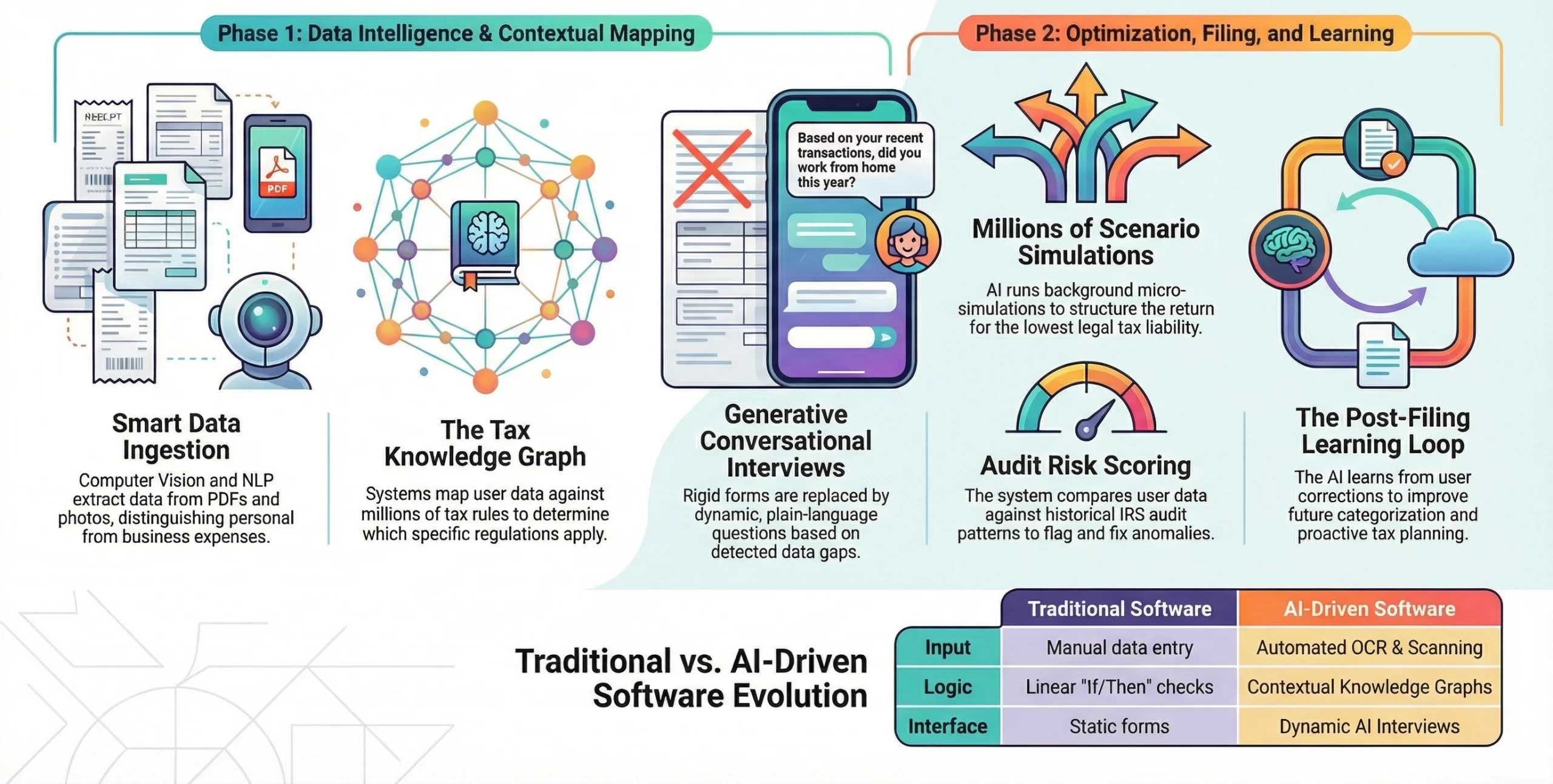
1. Data Ingestion & Aggregation
AI tax software begins by collecting fragmented financial data from documents, accounts, and integrations, transforming raw inputs into structured, usable tax records.
Document Upload/Scanning: The user uploads PDFs (W-2s, 1099s), takes photos of receipts, or connects bank accounts.
AI-Powered OCR (Optical Character Recognition): The software uses Computer Vision and NLP to read these documents. It doesn’t just see text; it understands context. For example, it distinguishes between a “Netflix” charge (personal) and “Adobe Creative Cloud” (potentially a business expense).
Entity Recognition: The AI identifies key entities:
- Who: Taxpayer name, SSN, dependent names.
- What: Employer name, bank name.
- Numbers: Income amounts, taxes withheld, dates.
Categorization: It automatically sorts transactions into tax-relevant categories (e.g., “Medical Expenses,” “Charitable Donations,” “Business Meals”).
2. The Knowledge Graph & Rule Engine
The system maps tax laws, entities, and financial relationships, applying contextual rules to determine which regulations and deductions apply to each taxpayer.
Tax Law Embedding: The software is trained on historical tax codes, IRS publications, court rulings, and millions of anonymized tax returns, creating a “knowledge graph” that maps how tax concepts connect (e.g., Student Loan Interest to Adjusted Gross Income).
Contextual Rule Application: Instead of running linear checks, the AI analyzes the user’s entire financial picture simultaneously to determine which rules apply.
Example: A simple W-2 might trigger a standard deduction but if the AI detects a 1099-NEC (contractor income) and a mileage log, it knows to switch to the logic for Self-Employment tax, Qualified Business Income (QBI) deduction, and Schedule C.
3. Conversational Interview
Generative AI replaces rigid forms with dynamic conversations, asking relevant questions in plain language based on detected data gaps and user intent.
Dynamic Questioning: The AI asks plain-English questions based on data gaps. Instead of “Do you have a Schedule D?”, it asks, “You sold stocks this year. Import broker data to check for capital gains tax?”
Intent Recognition: The user can type or speak naturally: “I started a dog-walking business in June.” The AI understands the intent (“new business,” “June start date”) and immediately opens the relevant workflows (business use of home, start-up costs, depreciation).
4. Calculation & Optimization
Deterministic engines calculate taxes while AI evaluates scenarios, optimizes deductions, and minimizes liability within legally compliant tax boundaries.
Predictive Scenario Modeling: The AI runs millions of micro-simulations in the background. It asks: “What if the user files as Head of Household instead of Single?” “What if we deduct these medical expenses versus taking the standard deduction?”
Anomaly Detection: The AI compares user deductions against similar profiles. If a self-employed graphic designer claims $20,000 in office supplies, it flags this as an audit risk and prompts the user to double-check.
Maximization Algorithms: It automatically structures the return to achieve the lowest legal tax liability (e.g., deciding whether to itemize or take the standard deduction, or optimizing which tax lot of stocks to sell for the best capital gains treatment).
5. Review & Error Checking
Before filing, the system validates completeness, consistency, and audit risk to ensure accuracy, compliance, and defensible tax outcomes.
Completeness Check: The AI ensures no mandatory fields are missing.
Consistency Check: It verifies that the name on the tax return matches the SSN and that the income reported on a 1099 matches what was entered.
Audit Risk Scoring: Using historical IRS audit data, the AI assigns a risk score to the return. If the score is high, it will suggest adding explanatory statements or documentation to substantiate the claim.
6. Generation & Filing
The platform generates official tax forms, submits secure e-filings, and produces clear summaries explaining results and year-over-year changes.
Form Generation: The AI populates the actual IRS forms (1040, Schedule C, etc.) with 100% accuracy.
E-Filing: It packages the data in the secure electronic format required by the IRS and transmits it.
Explanatory Letters: Generative AI creates a plain-English return summary explaining the refund or balance due and highlights key changes from the previous year (e.g., “Last year you were an employee; this year you’re self-employed, which is why your taxes look different”).
7. Post-Filing & Learning Loop
After filing, the AI learns from corrections and historical data to improve future predictions, alerts, and proactive tax planning.
User Feedback Integration: If the user corrects a category (e.g., changing a coffee purchase from “Office Supplies” to “Client Meeting Meals”), the AI learns from this correction for next year.
Data Retention for Future Prediction: The AI retains the structured data to prepare for next year. It can proactively alert the user mid-year: “Based on your Q3 earnings, I predict you will owe $5,000 in April. Would you like to make an estimated tax payment now?”
Why AI Tax Platforms are Gaining Popularity?
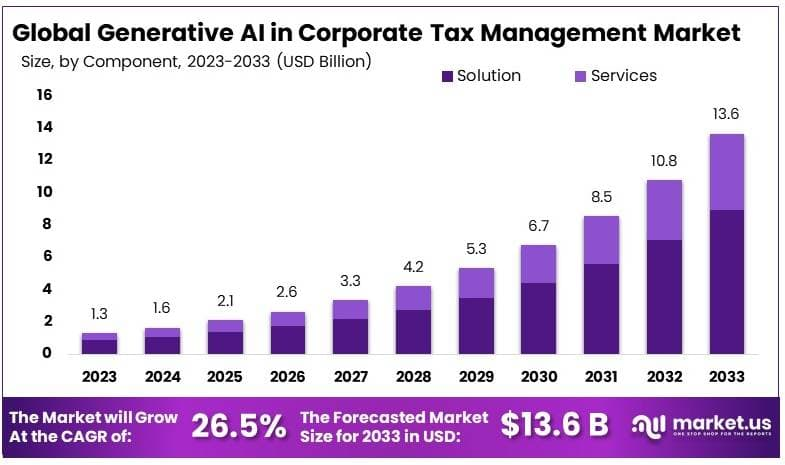
The Global Generative AI in Corporate Tax Management Market is projected to reach about USD 13.6 billion by 2033, up from USD 1.3 billion in 2023, with a CAGR of 26.5% from 2024 to 2033. This growth highlights the need for a scalable, secure, and compliance-ready tech stack capable of supporting advanced AI models, real-time tax calculations, and evolving regulations.
Modern AI-powered tax automation dramatically accelerates workflows, cutting overall preparation time by up to 75%, reducing document processing by 40%, and shortening audit cycles by 30%. Routine tasks such as data entry and reconciliation can be completed up to 70% faster,
AI-driven tax systems achieve 97.3% accuracy, outperforming manual methods, while reducing error rates by 20–40%. Advanced anomaly detection can push indirect tax errors below 1%, with AI users 15% more likely to file accurate returns, according to Thomson Reuters.
This platform can lower tax department operating costs by up to 35%, recover billions in lost revenue, and help taxpayers claim $1.8 billion in missed credits. In some regions, AI-led systems have driven a 14% increase in tax revenue, as noted by McKinsey.
AI is now mainstream in tax and accounting, with 92% of professionals using it in some capacity. Optimism remains high, as 84% see AI as a force for good and 77% expect it to transform their work within five years.
Key Business Benefits of an AI-Powered Tax Platform
AI-powered tax platforms deliver measurable business value by combining intelligent automation with deterministic compliance. They reduce operational risk, improve efficiency, and enable scalable, audit-ready tax operations across complex regulatory environments.

1. Audit-Ready & Traceable Filings
AI-powered tax platforms generate audit-ready filings by maintaining immutable logs, versioned rules, and data lineage, enabling regulators and enterprises to trace every calculation, assumption, and decision with confidence.
Example:
K1x digitizes the Schedule K-1 lifecycle by maintaining a complete data lineage from source documents to final filings, enabling tax teams to trace every figure back to its origin during audits.
2. Lower Compliance Risk
AI tax platforms encode tax laws as deterministic, versioned logic. This approach reduces regulatory risk, ensures consistent rule application across jurisdictions, and allows rapid adaptation to legal changes while maintaining historical accuracy.
Example:
Vertex applies AI-driven logic to manage VAT and GST across thousands of jurisdictions, automatically adapting to legislative changes while preserving versioned tax rules for historical compliance accuracy.
3. Efficient & Accurate Operations
AI automates data ingestion, validation, and reconciliation while deterministic engines preserve calculation precision, enabling teams to process higher volumes efficiently without introducing financial errors or compliance exposure.
Example:
TaxBit automates ingestion and reconciliation of high-volume crypto transactions, using deterministic engines to ensure precise cost-basis calculations while eliminating manual, spreadsheet-based tax workflows.
4. Explainable Decisions
Built-in explainability ensures every AI-assisted recommendation can be justified in human-readable terms, strengthening trust with auditors, tax professionals, and enterprise stakeholders during reviews and regulatory scrutiny.
Example:
Blue J’s Legal AI predicts tax outcomes and provides human-readable explanations citing tax codes and case law, making AI-driven insights transparent and defensible for professionals and auditors.
5. Scalable Peak Performance
Cloud-native, auto-scaling architectures allow AI tax platforms to handle deadline-driven traffic spikes reliably, ensuring uninterrupted filings, consistent performance, and predictable operations during peak tax periods.
Example:
Avalara’s cloud-native platform automatically scales to handle extreme transaction spikes, processing billions of tax calculations annually without latency during peak filing or retail periods.
Why AI Tax Software Demands a Specialized Tech Stack?
AI tax platform operates in a highly regulated, data-intensive environment. A specialized AI tax software tech stack is essential to ensure accuracy, security, scalability, and real-time compliance with frequently changing tax laws.

1. Real-Time Tax Code Parsing
Tax laws change monthly across jurisdictions. Generic AI cannot track federal, state, and local updates. Specialized stacks ingest and parse regulatory changes in real time for accurate calculations.
2. Multi-Jurisdiction Logic
Tax software must resolve overlapping and sometimes contradictory rules across jurisdictions. A specialized stack applies hierarchical logic to determine which code governs each specific transaction or filing scenario.
3. Secure Data & Audit Trails
Tax data requires bank-level encryption and granular access controls. Specialized stacks are built in SOC 2 compliance and immutable audit trails from day one, not as afterthoughts. Every data access and calculation is permanently logged for regulatory review.
4. Explainable Calculation Engines
Filing errors invite penalties. Specialized tax stacks include explainable AI that shows exactly which rules and figures produced each calculation, supporting both taxpayer understanding and regulatory defense.
5. Government Filing Integration
Agencies require specific file formats and submission protocols. Specialized stacks support direct e-filing integrations, eliminating manual export steps and rejection risks associated with generic systems.
Tech Stack for AI Tax Software Development
AI tax platform development relies on advanced technologies for accuracy and compliance. A robust AI tax software tech stack combines AI models, secure data systems, and automation tools to streamline tax calculations, reporting, and regulatory updates efficiently.

1. Data Layer: Scalable Financial & Regulatory Data
An AI tax platform depends on a data layer designed for accuracy, traceability, and audit defensibility. This layer of AI tax software tech stack ensures financial records, tax rules, and documents remain consistent, versioned, and regulator-ready.
| Category | Technology / Tool | Purpose & Notes |
| Primary Database | PostgreSQL / CockroachDB | ACID-compliant relational storage for tax records, transactions, and entity data. CockroachDB for multi-region geo-distributed deployments. |
| Document Store | MongoDB / Elasticsearch | Flexible schema for jurisdiction-specific tax rules, regulatory documents, and unstructured filing metadata. |
| Data Pipeline / ETL | Apache Kafka + Airflow | Real-time ingestion of regulatory updates, IRS feeds, and financial data streams. Airflow for scheduled batch ETL jobs. |
| Data Governance | Apache Atlas / dbt | Data lineage tracking, schema versioning, and transformation documentation critical for tax audit defensibility. |
| Object Storage | AWS S3 / Google Cloud Storage | Storing tax documents, scanned forms, generated PDFs, and model artifacts with lifecycle policies and immutable audit logs. |
2. AI & ML Stack for Tax Intelligence
This AI tax software tech stack powers interpretation, risk detection, and automation without replacing deterministic tax logic. It enables intelligent assistance while remaining constrained, explainable, and grounded in authoritative tax sources.
| Category | Technology / Tool | Purpose & Notes |
| LLM Foundation | Claude API / GPT-4 / Gemini | Natural language understanding of tax queries, document extraction, code generation for rule engines, and taxpayer-facing Q&A. |
| LLM Orchestration | LangChain / LlamaIndex | RAG pipelines for querying tax codes, chaining multi-step compliance workflows, and grounding responses in authoritative sources. |
| Vector Database | Pinecone / Weaviate / pgvector | Semantic search over tax codes, regulations, and prior rulings. Powers the retrieval layer in RAG architecture. |
| Anomaly Detection | Isolation Forest / AutoEncoder | Flagging unusual deductions, audit risk scoring, and identifying discrepancies between reported figures and statistical norms. |
| OCR / Document AI | AWS Textract / Google Document AI | Extracting structured data from W-2s, 1099s, K-1s, invoices, and other tax documents with table and form parsing. |
| Explainability | SHAP / LIME | Audit-ready model explanations for tax recommendations. Regulatory environments require defensible, interpretable AI outputs. |
3. Tax Calculation & Rule Engine Layer
This layer of AI tax software tech stack encodes tax law into deterministic, auditable logic. It ensures every calculation is jurisdiction-aware, reproducible, and legally defensible across tax years, filings, and regulatory updates.
| Category | Technology / Tool | Purpose & Notes |
| Rule Engine Core | Drools / Easy Rules | Business rule management for encoding tax law logic. Supports versioned rule sets for different tax years and jurisdictions. |
| Decision Tables | DMN (Decision Model & Notation) | Standardized format for tax bracket logic, phase-outs, and eligibility rules. Human-readable and auditable by tax professionals. |
| Calculation Runtime | Python (NumPy / Pandas) | Complex financial calculations, tax form computations, and worksheet logic. NumPy for vectorized math on large transaction sets. |
| Workflow Engine | Temporal / Prefect | Orchestrating multi-step tax preparation workflows with durability, retry logic, and state management for long-running processes. |
| Rules-as-Code | OpenFisca | Open-source legislative rules engine for encoding tax and benefit legislation. Enables simulation and policy impact analysis. |
| Form Generation | Apache PDFBox / iText | Programmatic population of IRS and state tax forms, digital signatures, and generating print-ready filings from calculated data. |
4. Frontend & Backend
The application layer delivers secure, scalable experiences for taxpayers and professionals. It balances complex tax workflows, real-time calculations, and high-traffic seasonality without compromising accuracy or reliability.
| Category | Technology / Tool | Purpose & Notes |
| Frontend Framework | Next.js / TypeScript | SEO-friendly server-side rendering with type-safe handling of complex financial and tax data. |
| Backend Framework | FastAPI / Node.js | FastAPI for ML and calculation endpoints; Node.js for high-throughput APIs and WebSocket-based updates. |
| API Architecture | GraphQL / REST + gRPC | Flexible client queries with GraphQL and high-performance internal service communication via gRPC. |
| Infrastructure | Kubernetes / AWS EKS | Auto-scaling infrastructure to handle 10–100× traffic spikes during peak tax seasons. |
| CI/CD Pipeline | GitHub Actions / ArgoCD | Automated testing, compliance checks, GitOps deployments, and safe rollbacks for rule updates. |
5. Security & Compliance Stack (Non-Negotiable)
Tax software handles highly sensitive financial data and must meet strict regulatory standards. This AI tax software tech stack enforces access control, encryption, audit logging, and continuous compliance across every system layer.
| Category | Technology / Tool | Purpose & Notes |
| Identity & Auth | Auth0 / AWS Cognito | MFA-enforced authentication, SSO for enterprise clients, fine-grained RBAC, and OAuth 2.0 / OIDC for third-party integrations. |
| Secrets Management | HashiCorp Vault / AWS Secrets Manager | Centralized management of API keys, database credentials, and encryption keys with automatic rotation and audit logging. |
| Encryption | AES-256 + TLS 1.3 | AES-256 for data at rest; TLS 1.3 for all data in transit; FIPS 140-2 compliant modules. |
| Audit Logging | Immutable Log Store (WORM) | Tamper-proof audit trails for all data access, calculations, and filing actions. Required for IRS e-file compliance and SOC 2 Type II. |
| SIEM / Threat Detection | Splunk / AWS Security Hub | Real-time threat detection, anomalous access pattern monitoring, and automated incident response for sensitive financial data. |
| Compliance Frameworks | SOC 2 Type II / IRS Pub 1075 | SOC 2 for SaaS trust; IRS Publication 1075 for federal tax data handling; PCI DSS for payment components. |
How AI Tax Platforms Prevent Hallucinations in Tax Advice?
AI tax platforms must deliver precise, regulation-compliant guidance. They prevent hallucinations by grounding responses in verified tax data, rule-based validation, and continuous model monitoring to ensure accurate, trustworthy tax advice.
1. Grounded in Verified Tax Data
AI tax platforms use only official IRS sources, tax codes, and rulings for answers. By restricting data to verified government sources, the system prevents invented statutes and ensures each recommendation links to a legal precedent.
2. Retrieval-Augmented Generation (RAG)
RAG systems pull relevant tax law directly from trusted databases before answering. The AI retrieves current regulations for each question, reducing fake citations and misapplied rules common in standard language models.
3. Rules-Based Logic Constraints
A validation layer enforces mathematical consistency and tax form rules. If the AI suggests a deduction that violates circular references or exceeds limits, the logic layer blocks it. This hybrid method combines generative flexibility with rule-based safeguards for compliance.
4. Human-in-the-Loop Review
When the AI makes high-stakes recommendations, it triggers review by a professional accountant. The platform flags ambiguous cases or large refund changes for human verification, preventing subtle errors from reaching taxpayers while keeping routine workflows efficient.
5. Continuous Validation with Filed Returns
Platforms compare AI advice to millions of filed returns. If patterns diverge from accepted outcomes, the system flags the advice for retraining. This feedback loop helps the AI learn from real IRS-approved results, not just theory.
Common Tech Stack Mistakes in AI Tax Software Development
Building AI tax software is complex and error-prone without the right technical approach. Our developers address common AI tax software tech stack mistakes by applying scalable architectures, compliant AI models, and secure data engineering best practices.
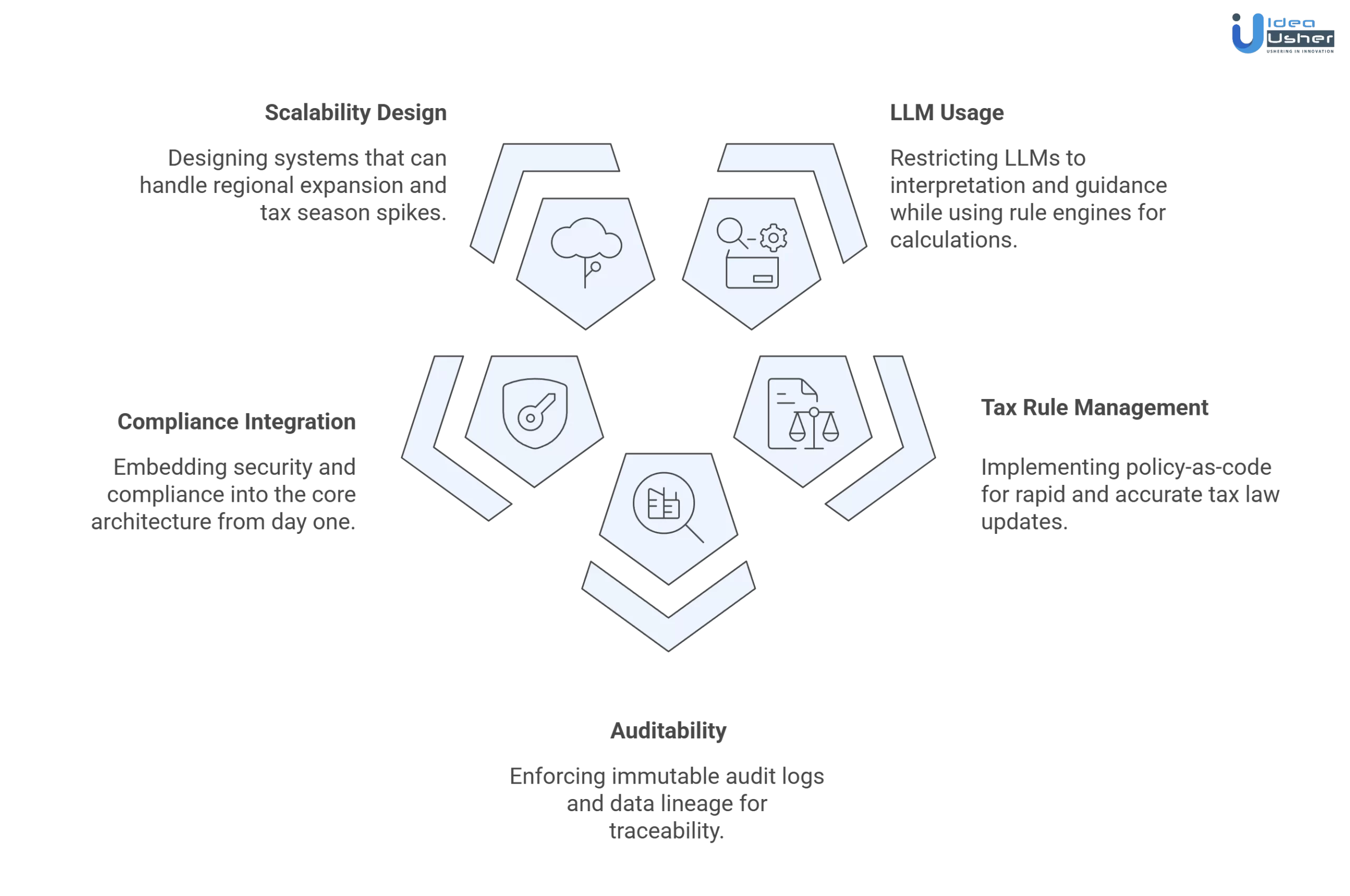
1. Over-Reliance on LLMs
Challenge: Using large language models directly for tax calculations causes hallucinations, inconsistent results, and legally indefensible outputs in regulated tax systems.
Solution: Our developers restrict LLMs to interpretation and guidance while deterministic rule engines handle calculations using versioned logic, strict validations, audit trails, and reproducible computation paths.
2. Hard-Coding Tax Rules
Challenge: Hard-coded tax logic makes regulatory updates slow, error-prone, and expensive when laws change across tax years and jurisdictions.
Solution: We implement policy-as-code using rule engines and decision tables, enabling rapid tax law updates without redeployment while preserving historical accuracy and compliance traceability.
3. Ignoring Auditability and Data Lineage
Challenge: Many tax platforms fail audits because they cannot reproduce calculations or explain which data, rules, and assumptions were used.
Solution: Our architecture enforces immutable audit logs, data lineage, and versioned datasets so every tax outcome remains traceable, reproducible, and legally defensible throughout reviews and regulatory audits.
4. Treating Compliance as an Afterthought
Challenge: Adding security and compliance late creates vulnerabilities, certification failures, and prevents adoption by enterprises and government tax authorities.
Solution: We embed compliance into core architecture using encryption, access control, audit logging, and regulatory frameworks from day one, ensuring certifications, secure operations, and enterprise readiness.
5. Poor Jurisdiction and Scalability Design
Challenge: Tax systems often break when expanding regions or during tax season spikes due to rigid jurisdiction logic and scaling limitations.
Solution: Our developers model jurisdictions as configurable rule layers and deploy auto-scaling infrastructure to support multi-region logic, peak filing traffic, and consistent performance during deadlines.
Conclusion
Building a scalable and compliant AI tax software tech stack requires the right balance of data infrastructure, machine learning models, security frameworks, and regulatory alignment. From intelligent data ingestion to automated compliance and reporting, every layer must support accuracy, performance, and trust. A well-designed AI tax software tech stack not only reduces manual effort but also adapts to changing tax laws and enterprise needs. With the right architecture in place, businesses can deliver reliable, future-ready tax solutions at scale.
Build Enterprise-Grade AI Tax Software with IdeaUsher!
We’ve built and launched numerous AI solutions and products for enterprises across industries. With ex-MAANG/FAANG developers bringing 500,000+ hours of engineering experience, we can build AI-powered tax software tailored to your business objectives that automates calculations, ensures compliance, minimizes errors, and delivers accurate, audit-ready insights.
Why Partner with Us?
- Intelligent Academic Workflow Automation: We build AI agents that automate admissions, grading, compliance checks, and reporting while adapting to institutional policies.
- Policy-Aware Decision Making: Our AI agents align actions with updated academic rules, reducing errors caused by outdated guidelines or manual oversight.
- Seamless System Integration: We ensure AI agents integrate smoothly with existing LMS, SIS, and administrative systems without disrupting operations.
- Scalable & Secure Deployment: Our solutions are designed to scale across departments and institutions while maintaining data security and compliance standards.
Explore our portfolio to see how we’ve built and launched enterprise-grade AI products and intelligent software solutions across industries.
Get in touch with us to discuss your AI tax software requirements and learn how we can build a compliant, scalable solution aligned with your business objectives.


FAQs
A.1. An ideal AI tax software tech stack includes secure cloud infrastructure, structured and unstructured data pipelines, machine learning models, rules engines, and compliance-focused security layers to support accurate tax calculation, filing, and reporting.
A.2. AI tax platforms maintain compliance by combining rule-based engines with machine learning models that update regulatory logic dynamically, supported by audit logs, version control, and validation workflows aligned with jurisdiction-specific tax requirements.
A.3. Natural language processing models, classification algorithms, and anomaly detection systems work best for tax software. These models extract data from documents, interpret regulations, identify errors, and support intelligent tax decision-making.
A.4. Enterprises must design for seasonal usage spikes, high data volumes, and complex calculations. Cloud autoscaling, modular services, and optimized data storage ensure consistent performance during peak tax filing periods.