


Key Takeaways
- Fuel delivery combines mobile fueling, GPS, IoT, and digital logistics to deliver fuel directly to vehicles and equipment.
- Core features include fuel ordering, smart dispatch, GPS tracking, metered dispensing, payments, and digital invoicing.
- Major models include B2C on-demand, B2B fleet fueling, fuel marketplaces, and hybrid fleet-management platforms.
- Development costs range from $30,000 for basic MVPs to $1M+ for advanced enterprise platforms.
- Key cost drivers include real-time tracking, dispatch complexity, IoT integrations, payments, compliance, and fleet management.
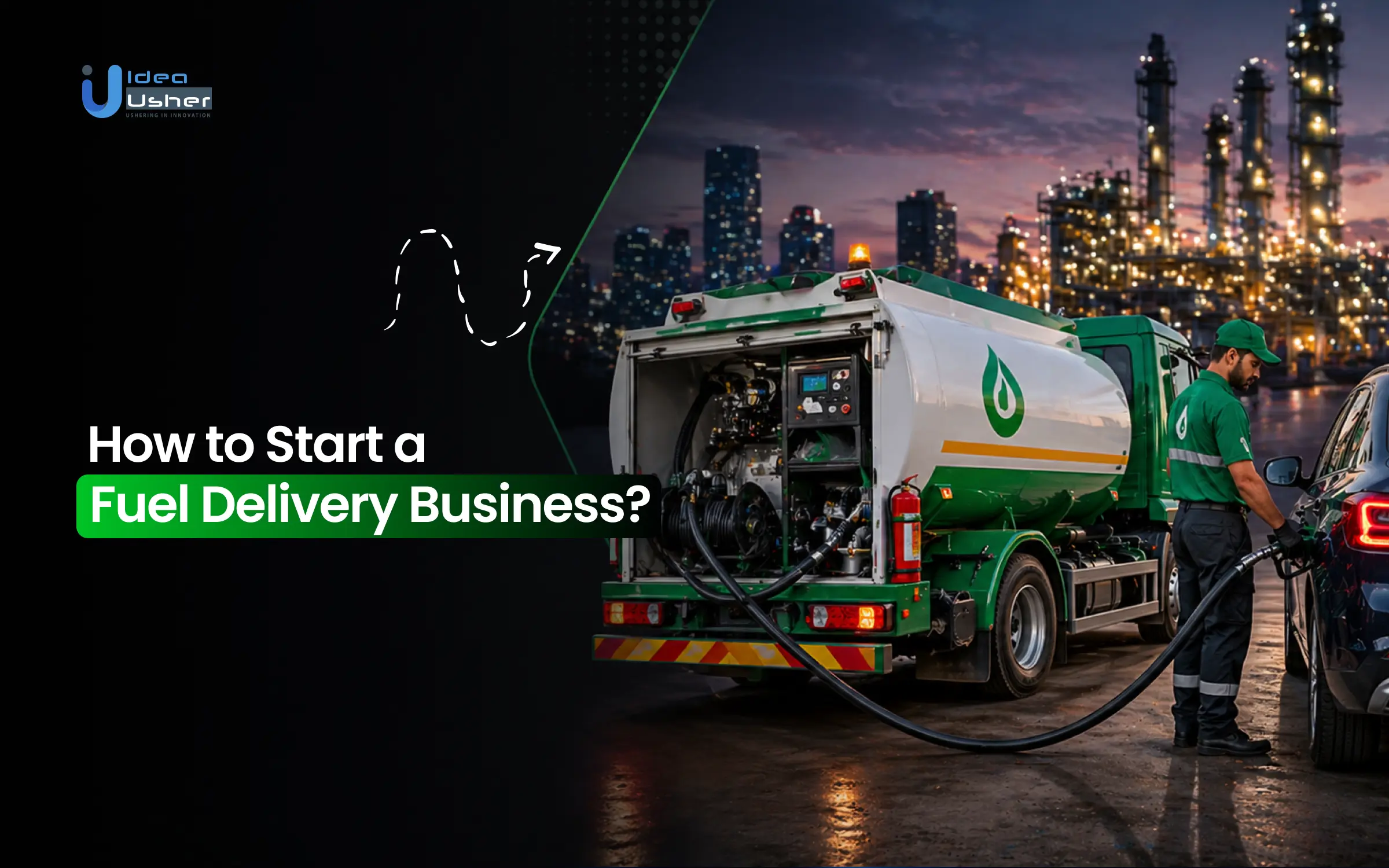
Fuel stations are designed for customers who can come to the fuel, not businesses whose operations cannot stop to refuel. Fleets, construction equipment, farms, generators and industrial operations increasingly need fuel delivered where and when it is required. This creates an opportunity to start a fuel delivery business around mobile refueling, scheduled delivery and on-demand logistics.
A modern fuel delivery platform can connect customers, licensed refueling operators and administrators through GPS dispatch, route optimization, real-time tracking, digital payments, fuel quantity monitoring, automated invoicing and fleet management. The strongest models can also build recurring B2B revenue through fleet accounts, scheduled refueling, centralized billing and fuel consumption analytics while keeping licensing, transportation and dispensing compliance at the core.
In this blog, we will talk about how to start a fuel delivery business, its business model, essential features, technology stack, regulatory requirements, development costs and how IdeaUsher can help you build a scalable fuel delivery platform.
What Is a Fuel Delivery Business?
A modern fuel delivery business (often operating as an on-demand mobile fueling platform) is a logistics and tech-enabled service that transports petroleum products (gasoline, diesel, DEF) directly to parked vehicles, commercial fleets, construction sites, or equipment.
Moving away from the brick-and-mortar retail gas station model, these platforms allow individual consumers and commercial enterprises to schedule automated or on-demand refueling via a smartphone app or web dashboard, eliminating the need to visit a physical gas station.

These models differ primarily in where fuel is delivered, how orders are placed, and how operators create value through convenience, logistics efficiency, pricing, or scale.
| Model | Asset Location | Order Mechanism | Delivery Type | Core Value Driver |
| Mobile Fuel Delivery | Customer location (on-site) | Digital app / API / Scheduled route | Direct-to-vehicle/equipment tank | Eliminates transit downtime; automated tracking |
| Conventional Fuel Station | Fixed retail lot | In-person drive-up | Self-serve or retail attendant pump | Foot-traffic convenience; retail upsells |
| Wholesale Fuel Distributor | Bulk storage tanks | Phone / Contract tender | High-capacity bulk transport (bulk drops) | High-volume discounts; terminal-to-storage transfer |
| Traditional Delivery (Heating/Bulk) | Stationary home/industrial tanks | Phone / Seasonal contract | Bulk hose drop into dedicated storage | Utility replenishment |
This comparison highlights how fuel delivery models differ in access, logistics, and value creation, setting the foundation for understanding how modern on-demand systems operate and deliver fuel efficiently at scale.
A. How On-Demand Fuel Delivery Works
On-demand fuel delivery transforms conventional refueling into a digitally coordinated service, connecting customers, fueling vehicles, connected assets, drivers, and backend systems through one streamlined process.

Mobile fueling integrates IoT hardware, mobile software, and route optimization into a closed-loop operational workflow:
1. Order Placement & Asset Tagging
The customer requests fuel via a mobile app, web portal, or recurring automated schedule. Each target vehicle or piece of equipment is identified via GPS coordinates, vehicle license plate, or an attached RFID/NFC tag on the fuel flap.
2. Intelligent Routing & Dispatch
Central dispatch software pools incoming orders, matching asset locations against fleet availability, hazardous material (HAZMAT) transport regulations, and real-time traffic to generate optimized multi-stop delivery clusters.
3. Mobile Unit Arrival & Verification
The certified driver arrives on-site in a purpose-built mobile fueling vehicle. The driver scans the asset’s RFID tag or bar code to confirm fuel type (e.g., Ultra-Low Sulfur Diesel vs. Regular Unleaded) and prevent misfueling.
4. Precision Metered Pumping
Fuel is dispensed directly into the tank using weights-and-measures-certified digital flow meters equipped with automated shut-off nozzles and spill-containment protocols.
5. Automated Telematics & Invoicing
Real-time dispensing data (exact gallons, timestamp, asset ID) syncs instantly with cloud servers, automatically generating invoices and updating the client’s fleet management dashboard.
B. Who Uses Mobile Fuel Delivery Services?
Mobile fuel delivery services are used across multiple industries and consumer segments that require on-site refueling, operational efficiency, reduced downtime, and reliable access to fuel without visiting stations physically locations
- Commercial Fleets: Delivery vans, municipal transit, utility trucks, and logistics providers utilize overnight “wet-hosing” to ensure vehicles start each shift fully fueled without paid driver detour time.
- Construction Companies: Heavy machinery (excavators, cranes, bulldozers) cannot easily drive to retail stations; mobile delivery fuels equipment directly on active job sites.
- Farms & Agricultural Operations: Tractors, combines, and irrigation pumps spread across large rural acreage receive direct field refueling during critical harvest and planting windows.
- Generators & Emergency Power: Hospitals, data centers, telecom towers, and disaster relief sites maintain continuous backup power through automated top-offs.
- Industrial & Maritime Facilities: Manufacturing plants, mining operations, forklifts, tugboats, and port equipment depend on on-site direct fueling for continuous runtime.
- Individual Consumers: Commuters and residential subscribers use on-demand fueling at office parks or residential driveways for convenience.
C. Why Fuel Delivery Is Becoming a Logistics Business
While early market entrants marketed fuel delivery primarily as a retail convenience for consumers, the sustainable unit economics of the industry rely on B2B logistics, route density, and asset utilization.
- Route Density & Capacity Utilization: Advanced telemetry and dynamic routing group deliveries geographically, reducing detours and saving fleets 20–30 minutes of non-productive driver downtime per vehicle daily.
- Telematics & Fuel Accounting: FMS integrations, consumption telemetry, and tag-based dispensing track fuel usage while reducing reconciliation work, shrinkage, and unauthorized purchases accounting for 2%–5% of fleet fuel spend.
- Just-in-Time Inventory Management: IoT tank sensors and fleet telematics predict fuel demand, maintain safe inventory levels, and reduce emergency runouts and unscheduled top-offs by up to 40%.
- Regulatory & Hazmat Infrastructure: Real-time safety monitoring, compliance management, and geo-fencing support EPA Spill Prevention, Control, and Countermeasure (SPCC), DOT Hazmat 49 CFR, and NFPA 385/30A fire codes requirements, creating a high-barrier fuel delivery operation.

Is Fuel Delivery a Profitable Business in 2026?
The global on-demand fuel delivery market is experiencing rapid acceleration, valued at $5.84 billion in 2025 and is projected to reach $11.93 billion by 2035, registering a CAGR of 7.4% during the 2025–2035 forecast period. The liquid fuel delivery segment accounts for over 53% of total industry demand, with diesel driving commercial adoption due to heavy machinery and fleet logistics operations.

The business opportunity addresses a key operational inefficiency: commercial fleets waste 20 to 30 minutes per vehicle daily on gas station detours. On-demand mobile refueling eliminates transit time, cutting fleet refueling labor costs by up to 30%. Additionally, IoT-metered automated dispensing reduces fuel theft and pilferage, which typically consumes 5% to 10% of commercial fuel budgets.
A. Where Fuel Delivery Businesses Make Money
Mobile fuel delivery companies avoid the heavy capital expenditure of brick-and-mortar gas stations ($2M–$5M+ in real estate and underground storage tanks), operating instead on a dynamic multi-stream revenue model.

Together, these revenue streams allow operators to monetize both the fuel itself and the technology, convenience, logistics, and ongoing services surrounding each delivery:
- Fuel Wholesale-to-Retail Spread: Operators procure fuel directly from regional wholesale bulk terminals at the “rack price” and sell to end customers at or slightly above prevailing retail pump rates, capturing a gross spread of $0.15 to $0.40 per gallon.
- Per-Drop Delivery & Convenience Fees: For ad-hoc or direct-to-consumer (B2C) deliveries, platforms charge a flat service fee ranging from $5 to $15 per dispatch, or a dynamic surge fee during peak traffic hours and extreme weather events.
- Recurring Membership Subscriptions: Consumer-facing and small-business platforms offer monthly or annual subscription plans (e.g., $19–$49/month) that waive per-delivery fees, generating predictable recurring revenue and boosting customer lifetime value (LTV).
- Enterprise Fuel Management & SaaS Fees: Enterprise operators monetize proprietary software portals by charging recurring subscription fees for automated fuel telemetry, carbon accounting reports, and real-time asset tank-monitoring sensors.
B. Why B2B Fuel Delivery Can Scale Faster
On-demand fuel delivery is rapidly emerging as a high-growth logistics sector driven by fleet efficiency, automation, and rising global energy demand in 2026.
While consumer (B2C) fuel delivery faces thin margins due to low drop volumes (10–15 gallons per car), B2B commercial mobile fueling scales significantly faster with superior unit economics:
| Operating Metric | Consumer (B2C) Fuel Delivery | Enterprise Commercial (B2B) Fueling |
| Volume Per Stop | 10 – 20 gallons (single passenger vehicle) | 200 – 2,000+ gallons (entire depot/jobsite) |
| Route Density | Dispersed residential stops; high traffic idle | Clustered industrial yards and corporate hubs |
| Delivery Timing | On-demand daytime windows (high traffic) | Scheduled off-peak yard fueling (night shifts) |
| Contract Retention | Low switching barriers; seasonal churn | 90%+ annual contract renewal rates |
| Billing Mechanism | Single credit card micro-transactions | Consolidated invoicing with Net-30/60 terms |
These operational differences highlight how B2B fuel delivery consistently outperforms consumer models in scale, efficiency, and retention, setting the foundation for higher-margin, contract-driven fleet fueling opportunities across industries.
- Logistics & Construction Fleets: Distribution fleets and construction sites use on-site wet hosing to eliminate fueling detours; Booster reports 1,500 gallons across 150 vehicles in one three-state deployment.
- Agriculture & Critical Infrastructure: Farms, data centers, hospitals, utilities, and emergency services benefit from scheduled mobile fueling, with providers such as Fuel Logic serving these sectors.
- High Gallons-Per-Stop Efficiency: B2B fueling concentrates volume at fleet locations, improving route economics; Booster reports 10+ million gallons delivered to hundreds of customers, demonstrating scalable high-volume operations.
C. What Determines Fuel Delivery Profit Margins?
Profitability in fuel delivery depends on operational efficiency, procurement strategy, fleet utilization, regulatory compliance, and advanced dispatch technology integration systems.
Achieving sustained 12% to 22% EBITDA margins in mobile fuel delivery depends on strict optimization of operational variables:
- Procurement Power & Rack Access: Direct bulk-purchasing agreements with unbranded refiners and fuel terminals lower per-gallon acquisition costs compared to spot-market buying.
- Route Density and Fleet Utilization: Delivery bowsers (specialized mobile fuel trucks) represent major capital investments ($80,000 to $250,000 per certified unit). Maximizing truck pumping uptime to over 75% per 12-hour shift through AI route grouping keeps fixed asset costs low.
- Labor & Hazardous Materials (Hazmat) Drivers: Commercial driver compensation (CDL with Hazmat and Tanker endorsements) represents 30% to 40% of operational expenditure. Tight cluster routing minimizes transit hours between drops.
- Regulatory Compliance & Safety Overhead: Operating mobile fueling requires local fire marshal approvals, spill prevention control and countermeasure (SPCC) compliance, DOT certifications, and comprehensive environmental liability insurance.
- IoT Telemetry & Dispatch Software: Automated dispatch software with real-time tank level sensors (ATGs) prevents dry runs, dynamically re-routing fuel trucks to sites only when fuel levels dip below predetermined thresholds.
The Enterprise Takeaway: On-demand fuel delivery in 2026 is an asset-backed, high-retention logistics play. Success relies on bypassing low-margin, high-friction residential fueling in favor of automated, B2B depot fueling contracts that lock in predictable volume, high gallons-per-stop, and multi-year cash flow.
Choose the Right Fuel Delivery Business Model
Modern fuel delivery ecosystems operate across multiple service layers, combining logistics, software, and asset management to serve diverse customer needs efficiently. Selecting the appropriate operating structure determines software architecture, asset requirements, regulatory compliance, and long-term capital intensity.
| Model | Target Customer | Operational Cadence | Asset Ownership | Revenue Drivers |
| On-Demand B2C | Retail consumers, commuters | Ad-hoc / Variable | Proprietary fleet | Retail markup, delivery/subscription fee |
| B2B Fleet Fueling | Logistics, transit, construction | Predictable overnight/scheduled | Proprietary fleet | High-volume fuel margin, service SLAs |
| Fuel Marketplace | B2B & B2C mixed | Dynamic routing across partners | Asset-light (3rd party) | Commission per gallon, platform SaaS fees |
| Hybrid Fleet & Fuel SaaS | Enterprise fleets, mixed assets | Automated telemetry-triggered | Hybrid / Proprietary | Enterprise software subscription + fuel supply |
Each fuel delivery model differs significantly in customer type, operational complexity, and revenue structure, making it essential to evaluate trade-offs in scalability, asset ownership, and technology requirements before selecting a strategic direction.

A. On-Demand Fuel Delivery Model
This model provides direct-to-consumer (B2C) refueling for personal vehicles parked at homes, workplaces, or commercial parking garages.
- Operational Dynamics: Operates on hyper-local dispatch, servicing single-vehicle stops across dense urban or suburban zones. Orders are placed via a mobile app for immediate (“within 60 minutes”) or windowed time slots.
- Economic Trade-offs: High customer acquisition cost (CAC) and lower drop sizes (typically 10–15 gallons per stop) require high order density within tight geographic radiuses to achieve positive unit economics.
- Core Application Needs: Consumer-facing iOS/Android app, pin-drop geolocation, secure in-app payments, push notifications, and route dispatch for low-capacity, agile delivery trucks (Class 3–5).
B. B2B Fleet Fuel Delivery Model
The B2B model focuses on high-volume wet-hosing (direct-to-truck fueling) for commercial vehicle fleets during off-hours downtime (typically overnight).
- Operational Dynamics: Tanker trucks are dispatched on fixed routes to business depots, distribution hubs, or construction sites. A single stop often distributes between 200 and 2,000+ gallons across dozens of vehicles.
- Economic Trade-offs: Lower margins per gallon compared to retail, but offset by high drop sizes, zero deadhead transit between individual vehicles, and stable, multi-year supply contracts.
- Core Application Needs: Asset barcode/NFC scanning to prevent misfueling, batch job ticketing, certified digital flow meter integration, and driver manifest automation.
C. Fuel Delivery Marketplace Model
An asset-light platform model that connects independent, licensed fuel distributors and certified mobile fueling operators with commercial or retail buyers.
- Operational Dynamics: The platform functions as a digital dispatch, aggregator, and billing engine. The marketplace operator owns no trucks or bulk storage, instead monetizing software, network liquidity, and order processing.
- Economic Trade-offs: Highly scalable across geographic regions with minimal capital expenditure; however, service reliability, compliance adherence, and delivery SLAs depend heavily on third-party carrier performance.
- Core Application Needs: Multi-tenant architecture, operator onboarding portals, dynamic order-bidding/matching algorithms, carrier compliance tracking, and split payment escrow workflows.
D. Hybrid Fuel Delivery and Fleet Management Model
An integrated model merging physical fuel delivery with a complete Telematics and Fleet Management System (FMS).
- Operational Dynamics: Fuel delivery is automated based on real-time data pulled directly from connected vehicle On-Board Diagnostics (OBD-II/J1939) or stationary tank telemetry. The system dispatches fuel automatically when asset levels drop below a configured threshold.
- Economic Trade-offs: High customer lock-in and lifetime value (LTV). Positions the company as an essential operational platform rather than an interchangeable fuel commodity vendor.
- Core Application Needs: Hybrid model integrates telematics, automates fueling, improves efficiency, reduces costs, and increases enterprise customer retention.
- Automated Scheduling: Tank level and engine-hour tracking to auto-generate work orders.
- Consumption Analytics: Anomaly detection (e.g., fuel theft identification, engine idle waste, MPG degradation).
- Centralized Enterprise Billing: Automated IFTA (International Fuel Tax Agreement) reporting, multi-site invoicing, and ERP integrations (e.g., SAP, Fleetio, NetSuite).
What Features Should a Fuel Delivery App Have?
A fuel delivery app needs more than standard ordering and tracking tools. Its MVP must connect fuel ordering, dispatch, mobile dispensing, quantity verification, delivery records, and safety controls into one reliable workflow.
1. Fuel Ordering and Delivery Scheduling
Fuel ordering is the starting point of the platform, allowing customers to specify fuel type, quantity, delivery location, and preferred time slot. Flexible scheduling and clear order details are essential for both on-demand customers and businesses planning regular refueling requirements.
2. Fuel-Aware Dispatch and Route Optimization
Fuel delivery requires dispatch logic built around vehicle availability, fuel type, tanker capacity, location, and delivery windows, rather than generic courier assignment. The platform should help operators select the right refueling vehicle and route for each order to improve utilization and delivery reliability.
3. Real-Time Fuel Truck Tracking and ETA
Real-time tracking gives customers visibility into the assigned refueling vehicle while helping operators monitor active deliveries. The platform should provide GPS location, delivery status, estimated arrival time, and location updates so customers know when the fuel truck will reach the service point.
4. Mobile Fuel Dispensing and Quantity Verification
Mobile dispensing is what separates fuel delivery from conventional last-mile delivery. The platform should connect the order with the refueling vehicle, dispensing equipment, fuel quantity, and delivery record, helping operators verify that the correct quantity was dispensed and reduce errors, spillage, and fuel discrepancies.
5. Digital Proof of Delivery and Invoicing
Every completed refueling should create a reliable digital transaction record containing delivered quantity, delivery status, timestamp, customer confirmation and invoice details. This gives customers transparent records while helping operators simplify billing, reconciliation, refunds, and audit trails for fuel transactions.
6. Fuel Safety and Compliance Controls
Because fuel delivery involves hazardous and regulated products, safety cannot be treated as an optional add-on. The fuel delivery app should incorporate driver safety checks, authorized vehicle workflows, dispensing procedures, required documentation, and delivery controls aligned with the regulations of the target market.
How Much Does It Cost to Build a Fuel Delivery App?
The cost of building a fuel delivery platform typically depends on its product scope, number of user interfaces, operational complexity, integrations, compliance requirements, and level of automation.
A basic MVP can validate the business model, while an advanced platform can support fleet management, IoT monitoring, automated dispatch, and multi-location operations.
Fuel Delivery App Cost by Development Phase
Development costs are easier to estimate when divided into individual phases. Each phase contributes to the final product cost and timeline, with the exact effort depending on the platform’s feature set and technical requirements.
| Development Phase | Estimated Cost | What It Includes |
| Discovery & Business Analysis | $5,000–$35,000 | Business model validation, requirements, user flows, technical architecture, third-party integrations, compliance considerations, and project planning |
| UI/UX Design | $8,000–$50,000 | Customer and driver journeys, wireframes, interface design, prototypes, design system, and usability testing |
| Core App Development | $35,000–$400,000 | Customer app, driver app, admin dashboard, ordering, dispatch, GPS tracking, payments, notifications, fuel management, and backend infrastructure |
| Testing & Quality Assurance | $8,000–$75,000 | Functional, API, performance, security, device, integration, and end-to-end workflow testing |
| Deployment & Launch | $4,000–$40,000 | Cloud setup, production configuration, security setup, app-store deployment, analytics, monitoring, and launch support |
| Maintenance & Updates | $5,000–$100,000+ | Bug fixes, monitoring, security patches, OS compatibility updates, third-party API maintenance, and ongoing feature improvements |
Note: These figures are indicative rather than fixed quotes. A platform integrating IoT fuel sensors, advanced dispatch, telematics, complex B2B workflows, or market-specific compliance systems will require additional development effort.
Fuel Delivery App Cost by Product Level
Fuel delivery platforms now range from simple ordering systems to fully integrated logistics + IoT + enterprise fuel management ecosystems. The table below reflects more accurate 2026 market pricing.
| Platform Level | Estimated Cost | Typical Scope |
| Basic MVP | $30,000 – $70,000 | Single-city operations, customer + driver apps, basic dispatch, live tracking, payments, minimal optimization |
| Mid-Level Platform | $60,000 – $140,000 | Multi-city readiness, route optimization, B2B accounts, recurring deliveries, analytics, integrations, fleet management basics |
| Advanced Fuel Ecosystem | $180,000 – $500,000+ | IoT fuel monitoring, telematics, smart dispensing, enterprise ERP integrations, automation, compliance systems, real-time optimization, multi-region scaling |
| Enterprise / National-Scale Platform | $500,000 – $1,000,000+ | Nationwide or multi-country operations, high-volume real-time dispatch, AI-driven logistics, full ERP + CRM integration, advanced security/compliance, predictive analytics at scale |
| IoT-First Smart Fuel Network | $750,000 – $1.5M+ | Hardware-first ecosystem with connected fuel tanks, sensor networks, automated refueling systems, edge computing, real-time telemetry, and industrial-grade monitoring |
Note on Development Cost Accuracy
The appropriate starting point depends on the business model. A startup testing demand in one service area may only need an MVP, while an established fuel distributor or fleet operator may require deeper fleet management, IoT, inventory, analytics, and enterprise integrations from the beginning.
Fuel delivery platforms are no longer simple logistics applications. In 2026, they are closer to a hybrid system combining logistics, ERP, IoT infrastructure, and real-time safety-critical operations.
This shift explains why:
- MVPs now require stronger architecture than before
- Mid-level platforms include deeper analytics and integrations
- Enterprise systems can exceed $1M+ in total development investment
The cost of building a fuel delivery app depends heavily on ambition:
- A basic MVP validates the market
- A mid-level platform scales operations
- An advanced ecosystem transforms fuel delivery into a fully automated, data-driven infrastructure business
Choosing the right level early helps avoid overbuilding while still leaving room for scalable growth.
Factors That Influence Fuel Delivery App Cost
Several factors can significantly change the development budget. The biggest cost drivers are usually related to the number of platforms involved, real-time operational functionality, physical-device integrations, and the complexity of the business model.
- Number of User Apps & Dashboards: Separate interfaces for customers, drivers, fleet managers, suppliers, and administrators can add $5,000–$15,000 per interface, increasing UX, testing, and maintenance requirements.
- Real-Time GPS & Fleet Tracking: Live locations, route tracking, ETAs, geofencing, and navigation typically add $3,000–$10,000+, plus ongoing mapping and real-time data infrastructure costs.
- Fuel Ordering & Dispatch Complexity: Scheduled/recurring deliveries, dynamic dispatch, driver assignment, multi-stop routing, and real-time statuses can add $8,000–$20,000+ depending on automation and scale.
- Payment & Fuel Pricing Integration: Cards, digital wallets, invoicing, pre-authorizations, taxes, dynamic pricing, discounts, and refunds typically add $4,000–$12,000+, excluding transaction fees.
- IoT & Fuel-Dispensing Integration: Integrating meters, tank sensors, GPS devices, electronic locks, pumps, and telematics can add $10,000–$30,000+ based on device complexity and integration count.
- Compliance, Security & Business Management: Delivery records, driver verification, fuel transaction logs, audit trails, RBAC, reporting, and regulatory documentation can add $5,000–$15,000+ for enterprise-grade implementations.
For most startups, the practical approach is to build the smallest compliant MVP that can complete the full fuel-delivery transaction, validate demand in a defined service area, and then add advanced fleet, IoT, automation and analytics capabilities as the business scales.
What Licenses Does a Fuel Delivery Business Need?
Fuel delivery businesses operate under multiple layers of transport, storage, dispensing, environmental, vehicle, driver, and recordkeeping regulations. Requirements vary by country, state or province, municipality, fuel type, vehicle configuration, and operating model.
Regulatory Notice: The requirements below primarily reflect U.S. federal requirements and commonly referenced model codes such as DOT, EPA, NFPA, and IFC. Local Authorities Having Jurisdiction (AHJs) may impose additional requirements. Always verify applicable rules with federal, state, environmental, fire, transportation, and municipal regulators before purchasing equipment or beginning operations.
| Compliance Area | What It Covers | Key Requirements to Consider |
| Fuel Storage & Transportation | Bulk fuel movement, storage across depots and mobile refueling operations. | HAZMAT registration, DOT/PHMSA compliance, operating authority, storage permits, and applicable IFTA requirements. |
| Mobile Refueling Vehicles | Safety requirements for fuel delivery trucks and mobile dispensing tanks. | Cargo tank standards, emergency shut-offs, rollover protection, grounding/bonding, fire extinguishers, and breakaway hoses. |
| Fuel Dispensing & Fire Safety | Controls governing where and how mobile fuel dispensing occurs. | Fire permits, mobile fueling rules, site approvals, separation distances, ignition controls, and storm-drain protection. |
| Environmental & Spill Prevention | Preventing, containing, and reporting fuel releases affecting soil, water, or drainage. | SPCC requirements, secondary containment, spill kits, drain protection, and spill reporting procedures. |
| Driver Licensing & Safety Training | Required credentials and training for fuel delivery personnel. | CDL, HAZMAT/tank endorsements, HAZMAT training, fuel handling, grounding/bonding, and emergency response training. |
| Digital Records & Compliance Documentation | Traceable records covering fuel movement, dispensing, vehicles, drivers and transactions. | Meter calibration, shipping papers, fuel quantities, vehicle inspections, tank testing, and maintenance records. |
What Should a Fuel Delivery Platform Track for Compliance?
The software should not attempt to replace regulatory approvals, but it can help operators document and manage compliance-related workflows. Depending on the market, the platform can maintain driver credentials, vehicle documents, inspection dates, safety checklists, dispensing records, delivery locations, fuel quantities, incident reports, and transaction histories.
This makes compliance a built-in operational workflow rather than a collection of disconnected spreadsheets and paper records.
How IdeaUsher Can Build Your Fuel Delivery Platform
IdeaUsher operates as an enterprise product engineering partner and on-demand mobility innovator, leveraging 11+ years of software expertise across 50+ countries. Supported by 250+ dedicated experts, over 1,000+ completed builds, and a top-tier 4.9/5 Clutch rating, we construct high-capacity mobile fuel delivery ecosystems entirely from scratch.
We skip generic templates to handcraft scalable, cloud-native logistics architectures equipped with IoT tanker telemetry, AI-powered route optimization, sub-meter GPS tracking, and regulatory-compliant safety frameworks to help you achieve undisputed on-demand market dominance.
A. Validate Your Fuel Delivery Business Model
We help energy brands, fleet operators, and mobility startups shape technical and operational roadmaps before writing production code.
- B2C On-Demand & B2B Fleet Scoping: We define pricing tiers, surge mechanisms, delivery logic, and recurring plans for consumer fueling and high-volume commercial fleet operations.
- Hazmat Regulatory & Safety Workflow Design: Our software architects map safety guardrails, petroleum transport rules, and digital driver HAZMAT compliance workflows for regulatory adherence.
- Interactive UI/UX Prototyping & Flow Validation: We design mobile/web wireframes for rapid delivery scheduling, pin-drop vehicle locations, and streamlined multi-vehicle fleet management.
B. Build Customer, Driver and Admin Platforms
We develop synchronized, multi-tier digital experiences tailored to streamline ordering, guide field drivers, and provide complete central oversight.
- Customer Ordering Apps (iOS, Android & Web): We build intuitive interfaces for vehicle location, fuel type/quantity selection, scheduled contactless delivery, and real-time driver tracking.
- Driver & Hazmat Operator Workstations: Our engineers design high-contrast apps with hazmat navigation, pre-trip safety checklists, tank barcode scanning, and electronic proof-of-delivery (e-POD) capture.
- Admin Dispatch & Fleet Command Center: We build web-based control centers for live tanker tracking, emergency order assignment, fuel inventory, and regional revenue monitoring.
C. Develop Real-Time Dispatch and Fuel Operations
We build high-throughput backend microservices that automate complex hazardous material logistics with millisecond accuracy.
- AI-Powered Route Optimization & Batch Dispatching: We engineer dynamic algorithms that group nearby deliveries while factoring live traffic, hazmat restrictions, bridge/tunnel limits, and truck payload capacity to reduce fuel use and delivery times.
- IoT Smart Meter & Flow Telemetry Integration: Our developers integrate IoT hardware gateways streaming dispensing flow rates, temperature compensation, and tanker volume data into the platform to prevent overfills and inventory loss.
- Geofenced Vehicle Matching & LPR: We implement precision GPS geofencing and automated license plate recognition (LPR) to help drivers verify customer vehicles accurately across crowded parking structures and corporate lots.
D. Scale Into an Enterprise Fuel Management Platform
We engineer scalable cloud architecture, deep B2B integrations, and multi-rail payment systems to support rapid geographic expansion.
- Enterprise B2B Fleet Management & Tax Invoicing: We build enterprise portals with automated fuel tax calculations, consolidated billing, telematics API integration, and multi-driver corporate expense accounts.
- PCI-DSS Level 1 Payments & Multi-Rail Invoicing: We develop secure payment pipelines supporting cards, WEX/Voyager fuel cards, ACH transfers, and corporate Net-30 invoicing.
- Zero Vendor Lock-In Asset Delivery: We deliver clean, fully documented, and auditable source code, granting your enterprise 100% platform ownership from day one.
Ready to revolutionize on-demand refueling with an enterprise-grade mobile fuel delivery platform? Partner with Idea Usher’s principal mobility and software architects to map out your custom product build today.
Conclusion
The fuel delivery opportunity in 2026 extends beyond convenient refueling, with strong potential across individual customers, commercial fleets, construction sites, farms, generators, and industrial operations. A viable model requires regulatory readiness, efficient dispatch, reliable mobile dispensing, transparent transactions, and technology that supports both customers and operators. The right MVP can validate demand without unnecessary complexity, while advanced capabilities such as IoT monitoring, fleet analytics, and automated refueling can support future expansion. A capable technology partner can turn this operational model into a scalable digital platform.
FAQs
A.1. An on-demand fuel delivery app needs fuel ordering, scheduling, fuel-aware dispatch, GPS tracking, mobile dispensing, quantity verification, digital proof of delivery, payments, invoicing, and safety controls.
A.2. Fuel delivery app development typically costs $30,000 to $70,000 for a basic MVP, $60,000 to $140,000 for a mid-level platform, $180,000 to $500,000+ for an advanced ecosystem, and $500,000 to $1.5M+ for enterprise or IoT-first fuel networks.
A.3. A fuel delivery business can combine on-demand deliveries with delivery fees, fuel margins, subscriptions, recurring B2B contracts, and fleet management services to create diversified revenue streams.
A.4. Fuel delivery businesses must follow applicable transportation, storage, dispensing, environmental, vehicle, driver, safety, and recordkeeping regulations, with specific licensing requirements varying across countries, states, municipalities, and fuel types.


