


Key Takeaways
- Building instant casino games like Mines cost around $25,000 to $90,000 or more. While Plinko can cost $35,000 to $95,000 or more depending on the advance features.
- The total instant casino games development cost also covers wallet integration, secure game servers, testing, licensing, hosting and ongoing maintenance.
- Provably Fair technology lets players check the results of the casino game. However in markets you may still need independent testing and certification.
- Casino games can earn money through the house edge, game licensing and revenue-sharing deals. The right setup depends on the business model and target market.
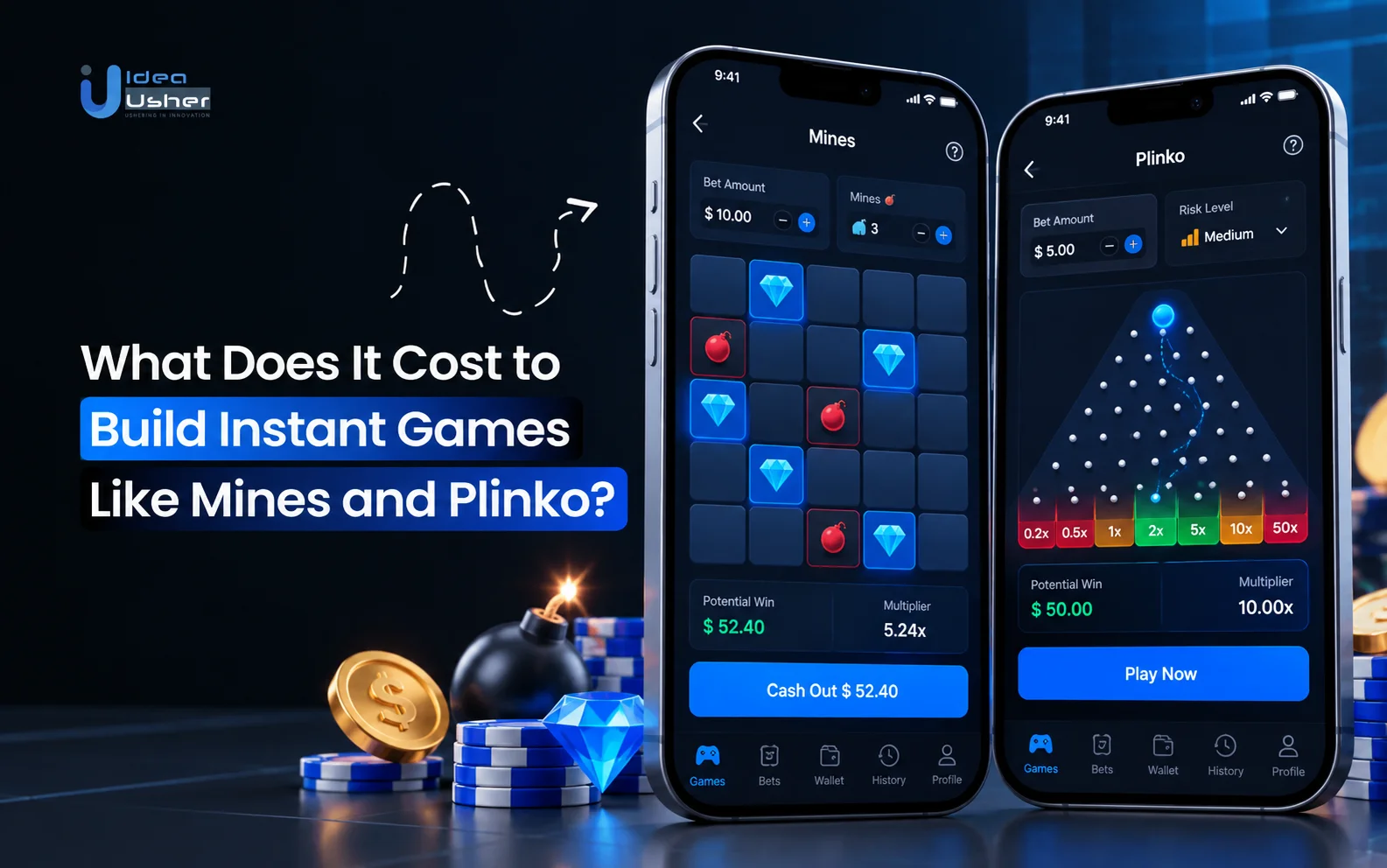
Building an instant or “mini” casino game like Mines or Plinko usually costs between $10,000 and $150,000 or more for the software development alone. Instant casino games development is far faster and less expensive to design than intricate 3D slots or live dealer setups since they rely on very simple 2D graphics and lightweight math models.
However, launching these games in a way that players can actually gamble on them requires an underlying infrastructure. It completely depends on what you choose to build and deploy and your total budget will shift according to that. Additional costs include installing an RNG, wallet connectivity, integrating gaming servers, security testing, certification and licensing, third-party integrations and keeping the system maintained.
In this blog, we will break down the cost of building instant games like Mines and Plinko, covering development estimates, technical infrastructure, integrations and the factors that influence the instant casino games development total investment.
What Are Instant Casino Games?
Instant casino games represent a modern category of casino content defined by immediate outcomes, high-frequency betting cycles, simple mechanics, and active player decision-making. Unlike traditional video slots with multi-second reel spins or table games constrained by dealing speeds, instant games allow players to execute tens to hundreds of wagers per hour, making them heavily favored on mobile and crypto-native platforms.
A. How Mines and Plinko Deliver Fast-Paced Gameplay
Instant games use distinct interaction patterns to keep rounds engaging, from deliberate choices that build suspense to automated sequences that prioritize speed and repeated play.

Titles like Mines and Plinko highlight the two primary mathematical structures that power the instant games category:
1. Mines (Multi-Step Cashout / Grid Shuffle)
Mines builds tension through uncertainty and progressive rewards, making each decision increasingly consequential as players weigh potential gains against the risk of losing their accumulated winnings.
How It Works: Played on a hidden grid (typically 5 x 5 with 25 tiles), the player sets the number of hidden mines (e.g., 1 to 24). Uncovering a safe tile increases the cumulative win multiplier.
Gameplay Speed & Agency: Players can cash out at any moment after revealing a single safe tile. The player directly dictates the pace either clicking through multiple tiles in seconds or taking a conservative 1-tile cashout.
2. Plinko (One-Step High-Frequency Multipliers)
Plinko delivers a probability-driven experience where unpredictable ball movement creates varied outcomes, combining visual suspense with configurable risk levels and rapid repeat-play opportunities.
How It Works: A ball is dropped from the top of a peg pyramid (8 to 16 rows). As the ball bounces off pegs, it follows a random binary distribution path (Left/Right) before landing in a multiplier bucket at the base.
Gameplay Speed & Agency: The round resolves in 1–2 seconds. Players control pre-round parameters such as row count and risk level (Low, Medium, High volatility), allowing them to auto-drop dozens of balls per minute in rapid succession.
B. What Makes Instant Games Different From Traditional Casino Games?
Traditional casino games and instant games differ in round speed, player interaction, outcome transparency and payout mechanics. These differences shape gameplay, technical requirements and the overall mobile gaming experience.
| Feature / Dimension | Traditional Slots & Table Games | Instant Casino Games (Mines, Plinko, Crash) |
| Round Speed & Pace | Slow-to-medium (3 to 10+ seconds per spin/hand). | Instant to 2-second rounds. |
| Player Decision Mechanics | Static wagers; no mid-round choices (outside Blackjack/Poker). | Active Decision-Making, Cash-out timing, tile picks, or volatility parameter shifts. |
| Mathematical Transparency | Black-box RNG audited behind closed doors by third-party labs. | Built on Provably Fair Technology client/server cryptographic commitment hashes (HMAC-SHA256). |
| UI & Resource Weight | Heavy graphics, 3D video assets, audio loops, complex paytables. | Minimal asset overhead, fast loading times, optimized for low-bandwidth mobile. |
| Payout Structures | Fixed paylines, complex bonus triggers, multi-symbol reel grids. | Direct multiplier scaling based on probability math. |
C. What Is Driving Demand for Instant Casino Games?
The global online casino market size was valued at $19.1 billion in 2024, the global online casino market is projected to grow from $23.9 billion in 2026 to $38.0 billion by 2030 (12.2% CAGR from 2025 to 2030). This growth also creates opportunities for casino operators to invest in cost-efficient instant casino games development like Mines and Plinko.

Mobile usage is reshaping online gambling, with mobile devices accounting for 58% of Europe’s online gambling revenue in 2024, up from 56% in 2023, according to the EGBA. This highlights the need for fast-loading, mobile-friendly casino games.
The UK Gambling Commission found that 7–8% of surveyed adults played online instant-win games in 2024, while Mines and Plinko can offer RTPs of up to 99% and house edges near 1%.
The rise of instant casino games like Mines, Plinko, Crash and Dice reflects a shift in global iGaming demand in land-based casinos as well, driven by demographic trends, technological advances and operator economics:
- Demographic Shift Toward Gen Z and Millennials: Younger generations familiar with mobile gaming, esports and short-form videos expect fast, interactive experiences. Many prefer instant games over slower, passive slot spins.
- Active Player Agency & Tension: Unlike passive video slots, instant games offer choices that shape the experience. Players decide when to cash out in Crash or which tiles to select in Mines, creating more interaction around risk and reward.
- Crypto Adoption & Provably Fair Trust: Crypto-native platforms helped popularize instant games. HMAC-SHA256 verification lets players independently check round outcomes, supporting transparent and verifiable fairness.
- Social and Streaming Virality: Multiplayer Crash and Plinko games feature live chat, visible bets and real-time cashouts, creating shareable moments suited to Kick, Twitch and social media streams.

How Much Does Instant Casino Game Development Cost?
The budget for instant casino games development such as Mines, Plinko in the US market ranges from $10,000 for a preliminary frontend prototype to $500,000+ for an enterprise multi-game platform equipped with custom compliance engines, real-time analytics, and proprietary Remote Gaming Server (RGS) capabilities.
In the US online gaming ecosystem (covering both regulated real-money gaming states like New Jersey, Pennsylvania, and Michigan, as well as dual-currency sweepstakes frameworks across broader US jurisdictions).
A. Instant Casino Games Development Cost By Tier
Instant casino games development costs depend on gameplay complexity, backend requirements and launch scope. The following tiers outline estimated budgets, casino app development timelines and deliverables for different development stages.
| Development Tier | Estimated Budget | Typical Timeline | Target Audience | Core Deliverables |
| Frontend Prototype | $10,000 – $20,000 | 3 – 5 Weeks | Investors, prospective operators and UX testers. | Interactive UI/UX, game animations, clickable logic and simulated betting controls. |
| Playable MVP | $30,000 – $60,000 | 8 – 12 Weeks | Beta testers, test-market operators and white-label pilots. | Single playable game (Mines or Plinko), server-side RNG, Provably Fair verification, basic wallet/session APIs and admin dashboard. |
| Production-Ready Real-Money Game | $70,000 – $150,000 | 14 – 20 Weeks | US iGaming operators, sweepstakes platforms and casino aggregators. | Certified RGS integration, multi-currency/crypto payments, GLI-19-aligned backend, polished UI/UX and audit trails. |
| Multi-Game Platform | $200,000 – $500,000+ | 6 – 10 Months | Scale-up operators, platform providers and B2B game studios. | Multiple games (Plinko, Mines, Crash, Dice), centralized PAM, promotional engine and enterprise RGS core. |
Note: These instant casino games development cost figures are estimates, not fixed quotes. Actual costs vary with game mechanics, certification, payment integrations, licensing requirements and infrastructure complexity. Regulatory and compliance expenses may be additional, depending on the target market.
B. What Is Included in an Instant Casino Game Quote?
An instant casino games development quote typically covers the core components needed to build and test a playable game, from interface design and game logic to platform integrations, admin tools and quality assurance.
- Custom UI/UX & Art Assets: Vector assets, animations, responsive design layouts for desktop and mobile viewports.
- Core Game Mechanics & Engine: Game client development (HTML5/Canvas/WebGL), backend gaming logic, state management, and math modeling (Return to Player [RTP] tables and volatility curves).
- API & Platform Integration: Standard wallet protocols (Seamless API / Transfer Wallet API) for connecting to existing casino platforms or aggregators.
- Basic Admin Back-Office: Tools for adjusting game parameters (min/max bet sizes, configurable operator RTP settings), checking player logs, and viewing transactional summaries.
- Initial Quality Assurance (QA): Functional, stress, and security testing prior to delivery.
C. Critical Exclusions to Factor Into Your Overall Budget
Initial software development estimates generally exclude several legal, infrastructure, and operational fees required to go live:
| Cost Category | Estimated Cost | What It Covers |
| Independent Testing Laboratory (ITL) Certification | $15,000 – $40,000 per game title | RNG testing, math model verification, security audits and code integrity checks. |
| Jurisdiction-Specific Licensing | $25,000 – $150,000+ by region | Licensing fees, legal retainers, compliance reviews and sweepstakes bonding. |
| Cloud Hosting and Security Infrastructure | $2,500 – $10,000+ per month | Cloud hosting, auto-scaling, low-latency routing, data sovereignty and DDoS protection. |
| Operator and Aggregator Gateway Fees | 8%–15% GGR share, plus possible fixed fees | Game distribution, integration and maintenance fees. |
| Payment Processing and Fraud Prevention | Varies by provider and volume | Payment gateways, KYC verification, geolocation checks and AML monitoring. |
Takeaway: The overall instant casino games development budget varies by game mechanics, feature complexity and integration requirements. To understand how these factors affect the total cost, the following sections break down the development expenses for Mines and Plinko separately, covering their core mechanics, key features and additional technical requirements.
How Much Does Mines Game Development Cost?
Developing a dedicated Mines instant casino game in the US market typically costs between $25,000 and $90,000+ for a standalone title. The total budget depends heavily on whether you build a standard single-player web MVP or an enterprise-grade, provably fair title with custom animations, dynamic multipliers, and multi-currency backend support.
The following estimates provide a starting point for budgeting different project scopes.
| Development Scope | Estimated Cost | Typical Inclusions |
| Basic Mines Game | $25,000–$40,000 | Core grid mechanics, basic UI, server-side game logic and essential testing |
| Feature-Rich Mines Game | $40,000–$65,000 | Provably fair verification, configurable game modes, custom animations and wallet integration |
| Advanced Mines Game | $65,000–$90,000+ | Scalable backend, advanced fraud controls, operator integrations and enhanced monitoring |
These indicative planning estimates vary based on infrastructure, integration, security, and certification requirements. Tier features may overlap, and testing, gambling licensing and operating fees are charged separately.
A. How Mines Game Mechanics Affect Development Costs
Unlike traditional slots or spin-based casino games, Mines relies on step-by-step conditional probability and continuous real-time state manipulation.
- Grid & Mine Density Algorithms ($5,000 – $10,000): Calculate odds across grid sizes (e.g., 3 x 3, 5 x 5, 7 x 7) and mine configurations (1–24 mines), updating probabilities after each safe tile while maintaining accurate RTP (Return to Player) logic.
- Stateful Session Management ($8,000 – $15,000): Process each tile click with low latency and use Redis or WebSockets with server-side state validation to prevent double-click exploits and client-side tampering.
- Cash-Out & Session Recovery Systems ($6,000 – $12,000): Support cash-outs after any safe tile through atomic wallet transactions and recover active grids after disconnections without duplicating payouts or losing wager state.
B. What Features Increase the Cost of a Mines Game?
Beyond core gameplay, specific technical requirements and player-facing enhancements add to Mines game development costs. These include fairness verification, betting automation, custom animations, RTP configuration and social integrations.
| Feature | Additional Investment | Operational Value & Impact |
| Provably Fair Verification | $8,000 – $18,000 | Lets players verify mine placement using Server Seed, Client Seed and Nonce, building trust for crypto and sweepstakes platforms. |
| Automated Betting & Multi-Tile Pickers | $5,000 – $10,000 | Automates tile selection, cash-out targets and profit or loss limits. |
| Spine 2D / 3D Tile Reveal VFX & Sound Design | $7,000 – $15,000 | Adds custom reveal animations, particle effects and reactive sound to improve engagement. |
| Multi-RTP Operator Settings | $4,000 – $8,000 | Lets admins configure RTP settings, such as 94%, 96% or 98%, based on approved game configurations. |
| Social / Live Feed Integration | $6,000 – $12,000 | Displays live wins, high-value bets and multiplier leaderboards to encourage engagement. |
Note: These costs are estimates and vary with game complexity, integration requirements and operator needs. Prioritize fairness verification, configurable RTP and secure betting controls before investing in advanced visuals or social features.
C. What Makes a Mines Game More Expensive to Build?
Mines game development costs increase with backend scalability, regulatory certification, native mobile support and fraud prevention. These factors add engineering complexity, infrastructure requirements and testing expenses beyond a basic game implementation.

1. High-Concurrency Backend Architecture
Supporting thousands of simultaneous grid sessions requires stateless microservices, auto-scaling WebSocket clusters and sub-50-millisecond state persistence, potentially adding an estimated $10,000–$30,000 to backend development costs.
2. GLI-19 and Regulatory Certification Readiness
Preparing RNG modules for GLI standards audits requires documentation, unit testing and secure seed generation algorithms. Specialized compliance engineering may add an estimated $15,000–$30,000+, depending on jurisdiction and certification scope.
3. Native Mobile App Wrappers (iOS and Android)
Packaging HTML5/WebGL Mines games for native distribution requires API bridge layers, asset compression, touch-gesture handling and biometric transaction support, potentially adding $10,000–$25,000 per platform to development costs.
4. Anti-Fraud and Bot Detection Mechanics
Detecting automated bots and abusive betting patterns requires server-side rate limiting, anomaly detection and automated account flagging, potentially adding an estimated $8,000–$20,000 depending on detection complexity and monitoring requirements.
How Much Does Plinko Game Development Cost?
Developing a standalone Plinko instant casino game in the US market ranges between $35,000 and $95,000+. Building a Plinko game involves unique rendering and state management challenges compared to other instant win games like Mines or Dice: it requires mapping a client-side visual drop path to a pre-determined, server-side cryptographic result.
The following estimates provide a starting point for budgeting different project scopes.
| Development Scope | Estimated Cost | Typical Inclusions |
| Basic Plinko Game | $35,000–$50,000 | Standard peg board, server-side outcome generation, basic animations and essential testing |
| Feature-Rich Plinko Game | $50,000–$70,000 | Configurable board layouts, multiple risk levels, provably fair verification, custom animations and wallet integration |
| Advanced Plinko Game | $70,000–$95,000+ | Advanced WebGL visuals, multi-ball gameplay, scalable backend, enhanced fraud controls and operator integrations |
Note: The figures are estimated costs for individual development components. They are provided to illustrate potential cost drivers and may overlap depending on the project scope. They should not be added together to determine the total development budget.
A. How Plinko Game Mechanics Affect Development Costs
The cost of instant casino games development like Plinko is shaped by the relationship between frontend animation systems and backend math engines.
- Dynamic Board & Peg Array Configuration ($7,000 – $14,000): Support configurable boards with 8–16 rows, recalculating landing-pocket probabilities as row counts change.
- Prize-Slot Mapping & RTP Volatility Curves ($8,000 – $15,000): Map payout multipliers to Low, Medium and High risk profiles, balancing target RTP (Return to Player) across different board configurations.
- Determinism vs. Visual Animation Sync ($10,000 – $18,000): Unlike a casual video game, an iGaming Plinko ball does not rely on real-time random physics to decide where it lands.
- The Backend Logic: The cryptographic Provably Fair algorithm (Server Seed + Client Seed + Nonce) calculates the exact target slot before the ball is released.
- The Visual Rendering: The visual engine (Phaser, WebGL, Canvas) must align ball trajectories with backend-determined slots without spoiling outcomes early, representing a key development expense.
B. What Features Increase the Cost of a Plinko Game?
Advanced Plinko features increase development costs through rendering complexity, physics optimization and operator controls. The table below outlines key upgrades, their estimated costs and technical or commercial benefits.
| Feature | Additional Cost | Technical & Commercial Impact |
| High-Frequency Multi-Ball Dropping | $8,000 – $15,000 | Supports 10–50+ simultaneous balls using optimized WebGL rendering and WebSocket queuing to reduce lag and frame drops. |
| 3D Mesh & WebGL Physics Visuals | $10,000 – $22,000 | Adds 3D pegs, dynamic lighting and bounce effects to enhance visual engagement. |
| Configurable Operator RTP Controls | $5,000 – $10,000 | Lets admins configure approved RTP profiles such as 94%, 96% or 98%, for different markets. |
| Provably Fair Verification Widget | $7,000 – $14,000 | Displays SHA-256 provably fair seed hashes so players can independently verify round outcomes. |
| Custom Audio Engine & Haptic Feedback | $4,000 – $8,000 | Uses responsive peg sounds and haptic feedback to heighten suspense during play. |
Note: These estimates vary with rendering complexity, device support and integration requirements. Prioritize reliable physics, fairness verification and performance before adding premium visuals, multi-ball automation or enhanced audio and haptic effects.
C. What Does a Plinko Game Development Budget Include?
The total cost depends on game complexity, integration requirements and the level of security needed for launch. A comprehensive, production-ready Plinko game budget covers five key deliverables:
1. Core Engineering & Math Modeling
Building an audited math engine, configurable risk levels, trajectory generation and provably fair RNG may cost $15,000–$35,000, depending on complexity.
- Fully audited server-side math engine supporting variable pin rows (8–16) and multiple risk levels.
- Deterministic trajectory path generation engine ensuring 100% visual fidelity with backend outcomes.
- Cryptographic Provably Fair RNG integration (SHA-256 seed pairs).
2. Cross-Platform Frontend (HTML5 / WebGL)
Developing a responsive HTML5/WebGL interface with 60 FPS rendering, mobile optimization and multi-ball animations may cost $10,000–$25,000.
- Responsive UI/UX optimized for both desktop web and low-latency mobile viewports.
- Canvas/WebGL rendering engine tuned for smooth 60fps performance during rapid multi-ball play.
3. API & Wallet Integration Layer
Integrating casino backends, PAM systems and multi-currency or crypto wallets may cost $8,000–$20,000, depending on integration complexity.
Standard Seamless/Wrapper API integration connecting to casino backends, Player Account Management (PAM) systems, and multi-currency/crypto wallets.
4. Real-Time Game State Recovery & Settlement
Persistent round states, idempotent settlements and transaction reconciliation may add $8,000–$20,000, depending on recovery and wallet requirements.
- Persistent round-state management to recover interrupted Plinko sessions without losing wager details or confirmed outcomes.
- Idempotent settlement processing, transaction reconciliation and duplicate-request protection to prevent double credits or inconsistent wallet balances.
5. Risk Controls & Abuse Prevention
Wager limits, velocity checks, anomaly detection and payout monitoring may add $8,000–$18,000, depending on risk-control complexity.
- Server-side wager limits, velocity checks and anomaly detection to identify automated play, bonus abuse and suspicious betting patterns.
- Configurable exposure monitoring and payout alerts help operators investigate unusual game outcomes and math-model discrepancies.
D. Why Realistic Physics Simulations Are Not Used for Fair Gaming
A common misconception is that a fair Plinko game requires a real-time, random 2D/3D physics engine (like Box2D or Matter.js) where gravity, velocity, and peg collisions determine the ball’s final resting place on the fly.
In regulated and auditable iGaming environments, true client-side physics engines are avoided for outcome generation for two main reasons:
- Lack of Auditability: Non-deterministic physics engines depend on variable client hardware performance, frame rates, floating-point rounding errors, and CPU clock speeds. This makes it impossible to guarantee a fixed RTP or pass third-party testing laboratory audits (e.g., GLI).
- Security Vulnerabilities: Executing the outcome mechanics on the client side using physics introduces severe exploit vectors, enabling malicious actors to intercept or manipulate frame rates to steer balls into high-multiplier slots.
Instead, certified Plinko titles use server-side RNG to determine the final slot first, and then use a deterministic visual path generator to visually guide the ball to that exact destination. This guarantees regulatory compliance and mathematical fairness while maintaining the visual illusion of a physical ball drop.
What Hidden Costs Affect Instant Casino Game Development?
Evaluating the financial commitment for instant casino games such as Mines, Plinko and others requires looking far beyond initial front-end design and back-end game logic.
While standard engineering charges cover building the core application, the Total Cost of Ownership (TCO) is heavily dictated by non-engineering expenses, regulatory hurdles, continuous verification infrastructure, and third-party commercial models.
1. RNG Implementation & Verification Infrastructure
Building a provably fair game requires continuous cryptographic key management, high-concurrency hash calculation, and client-side verifiers rather than standard pseudo-random number generation.
- Engineering Charges: Writing deterministic outcome algorithms, byte-slicing logic, and responsive front-end verification calculators (approx. $5,000 – $15,000 within the initial game build budget).
- Third-Party Fees: Licensing hardware security modules (HSMs) or cloud Key Management Systems (KMS Enclaves, ~ $200–$1,500/month) to isolate active server seeds.
2. Independent Game Testing and Security Audits
Before an instant casino games app development can go live in a regulated jurisdiction or be distributed via major B2B networks, both the math engine and platform security must undergo mandatory third-party lab testing.
| Audit Workstream | Estimated Cost Range | Primary Purpose |
| Independent Test Lab (ITL) Certification | $8,000 – $25,000 per game title / module | Certification by accredited labs (GLI-19, BMM Testlabs, iTech Labs) validating RNG randomness, RTP consistency, and seed hashing algorithms. |
| Smart Contract & Enclave Audits | $10,000 – $30,000 per audit cycle | For crypto/Web3 instant games, independent code audits verifying key enclave security and vault contract immutability. |
| Cybersecurity Penetration Testing | $5,000 – $15,000 annually | Simulating DDoS attacks, injection exploits, and race condition attempts on high-speed game endpoints. |
3. Casino Aggregator, Wallet, and API Integration Fees
If an operator intends to distribute proprietary instant games to other casinos or integrate third-party instant game suites into their own lobby, commercial vendor fees apply.
- Direct RGS Aggregator Setup Fees ($8,000–$25,000 per studio link): Connecting proprietary games to Remote Game Servers (RGS) or B2B aggregators involves custom API wrappers, sandbox testing and setup fees.
- Gross Gaming Revenue (GGR) Royalties (5%–15% of NGR): Aggregators and studios may charge recurring revenue-share fees on game volume, reducing long-term operating margins.
- Single-Wallet Transaction Overhead: High-frequency games like Plinko generate heavy wallet API traffic. Per-transaction fees from payment providers or PAM ledgers can erode thin 1%–2% house-edge margins.
4. Hosting, Monitoring, and Maintenance
Unlike static slots, multiplayer instant games (such as Crash or Aviator) require specialized real-time server infrastructure to keep thousands of player balances synchronized.
- Low-Latency WebSocket Clusters ($1,000–$5,000/month): Use Node.js, Redis Pub/Sub or AWS ElastiCache to synchronize Crash multipliers and prevent mid-game disruptions.
- Continuous DevOps & Monitoring ($2,000–$8,000/month): Maintain 24/7 monitoring, seed vault rotation, security patching and database performance to support a 99.99% uptime target during traffic spikes.
- Game Maintenance & Refactoring: Ongoing updates to support new browser versions, mobile OS releases, and dynamic localized currency scaling.
How Do Instant Casino Games Generate Revenue?
Monetizing instant casino games such as Mines, Plinko and other games requires understanding the commercial division between the Game Studio / B2B Software Provider (who creates and hosts the game logic) and the Casino Operator (who acquires players, holds the gaming license, and processes wagers).
While the operator earns money directly from the game’s mathematical edge over time, game studios generate revenue through B2B software licensing, volume aggregation, and percentage-based revenue-share agreements.
A. B2B Game Licensing and Casino Aggregator Distribution
Game studios rarely sell instant titles as one-time off-the-shelf purchases to operators. Instead, they distribute games via direct B2B licensing or through centralized Casino Game Aggregators such as SoftSwiss and other alternatives.
- One-Time Integration & Setup Fees ($5,000 – $25,000): Studios or aggregators charge initial fees to connect their Remote Game Server (RGS) APIs with the operator’s Player Account Management (PAM) platform.
- Monthly Platform Minimums ($1,000 – $5,000 / month): Per-studio minimum fees cover infrastructure and maintenance. If royalties fall below the contracted minimum, operators pay the difference.
- Aggregator Distribution Margin: Aggregators provide a single API for multiple studios, typically charging 8%–15% of Gross Gaming Revenue (GGR) and retaining a distribution margin before paying developers.
B. Revenue-Sharing Agreements With Casino Operators
The primary monetization model for iGaming content studios is a continuous Revenue-Share (Royalty) Agreement based on game performance.
- Gross Gaming Revenue (GGR) Royalties (5%–12%): Studios earn a percentage of player stakes minus winnings. For example, $1,000,000 in wagers and $970,000 in payouts generate $30,000 GGR, at an 8% royalty, the studio earns $2,400.
- Net Gaming Revenue (NGR) Deductions: Some contracts calculate royalties after deducting eligible bonuses, gaming taxes and payment processing fees from GGR.
- Tiered Volume Pricing: Royalty rates may decrease as monthly GGR grows, such as 10% on the first $50,000, 8% on the next $100,000 and 6% thereafter.
C. House Edge, RTP and Long-Term Game Economics
The foundational driver of operator revenue is the game’s mathematical House Edge (or its inverse, Return to Player / RTP), calculated as RTP = (Total Payouts ÷ Total Stakes) × 100, while House Edge = 100% − RTP.
| Instant Game Category | Standard House Edge | Mathematical Revenue Drivers |
| Plinko | 1.0% – 3.0% (97%–99% RTP) | High-speed ball drops; custom volatility parameters (Low/Med/High) drive larger wagers. |
| Mines | 2.0% – 4.0% (96%–98% RTP) | Multi-step cashout mechanics tempt players into higher-risk tile picks where house edge compounds. |
| Dice & Limbo | 1.0% – 2.0% (98%–99% RTP) | Extreme high-frequency betting volume (100+ wagers/min) compensates for thin margins. |
| Crash Games | 1.0% – 3.0% (97%–99% RTP) | Built-in instant 1.00x “instant bust” branches guarantee fixed house retention over time. |
D. Theoretical Economics vs. Short-Term Variance
It is critical to distinguish between theoretical house edge and realized short-term profit:
- Law of Large Numbers: A 98% RTP (2% house edge) means that over millions of simulated rounds, the casino retains exactly $2 for every $100 wagered.
- Short-Term Volatility & Big Wins: Over a day or a week, a small casino can experience negative GGR if a high-roller hits a massive 1,000x multiplier on Crash or Plinko.
- Turnover & LTV as True Growth Drivers: Rapid 1–3 second game rounds allow operators to generate high betting turnover, rapidly extracting the theoretical house edge and maximizing player LTV despite low margins.
What Does a Production-Ready Instant Casino Game Need?
A prototype instant game that operates cleanly in a staging environment is fundamentally different from a production-ready, compliant instant game deployed in a regulated real-money or sweepstakes casino.
While a staging demo focuses purely on front-end animations and basic state transitions, production-ready software must enforce absolute server-authoritative control, tamper-evident audit logging, statistical math validation, and jurisdiction-specific regulatory controls.
1. Server-Authoritative Outcomes and Secure RNG
In a production environment, the front-end client (HTML5 Canvas, iOS, Android, or WebGL) is treated as inherently un-trusted. The client exists strictly to render graphics and capture player inputs.
- 100% Server-Side Execution: Run outcome generation, tile placement, pin routing and crash multiplier calculations on the secure backend. The client must never generate outcomes or determine payouts.
- Cryptographically Secure RNG (CSPRNG): Use OS-level or hardware-backed randomness sources. Avoid predictable generators and align RNG implementation with applicable standards such as GLI-19.
- Tamper-Proof Input Validation: Validate all client actions, including tile selections and cash-outs, through strict schema checks and rate limiting to prevent injection, duplicate requests and race-condition exploits.
2. RTP, House Edge, and Volatility Validation
Before deployment, the game’s mathematical model must be validated through theoretical analysis and empirical simulation.
- Theoretical PAR Sheet Documentation: Developers must build a comprehensive Probability and Accounting Report (PAR Sheet) detailing exact hit frequencies, payout multipliers and theoretical Return to Player (RTP) percentages across all parameter configurations.
- Large-Scale Monte Carlo Simulations: The engine must undergo automated simulations across 10M to 100M+ rounds to prove that empirical payout returns align with theoretical RTP within a tight statistical confidence interval (e.g., 99.99%).
- Handling Dynamic Parameters: For configurable games like Plinko or Mines, the math engine maintains volatility boundaries to keep the operator’s house edge constant across all player settings.
3. Transaction Reconciliation and Tamper-Evident Game Logs
A production-ready game must maintain an unbroken, immutable record of every wager, state change, and payout.
| System Requirement | Production Implementation | Operational Risk Mitigated |
| Atomic Wallet Locks | ACID-compliant, idempotent API requests using unique round UUIDs. | Prevents double-payouts, missed debit charges, or duplicate wager execution during network retries. |
| State Disconnect Recovery | Reconnect middleware that re-hydrates active round state if a user drops connection mid-game. | Prevents loss of funds or disputed game rounds if a player disconnects prior to cashing out. |
| Immutable Audit Trail | Every round writes Server Seed, Client Seed, Nonce, bet amount, payout, and timestamp to a write-once database. | Provides conclusive proof during player disputes or regulatory financial audits. |
4. Responsible Gaming and Jurisdiction-Specific Controls
Deploying in licensed jurisdictions requires embedding operational and compliance safeguards into the game loop.
- Session & Velocity Constraints: The game engine must respect platform-level Responsible Gaming (RG) rules, enforcing maximum wager limits, forced reality-check popups (e.g., mandatory 60-minute session summaries), and loss caps.
- Speed-of-Play Regulations: Certain jurisdictions (e.g., UKGC or specific US states) enforce minimum round durations (e.g., forcing a 2.5-second delay between rounds) or prohibit auto-play functions. The game engine must support toggleable configuration rules per jurisdiction.
- Jurisdictional Vault Data Export: Real-time data feeds exporting encrypted game summaries directly to state regulatory vaults (e.g., NJ DGE, PGCB, or MGCB data pipelines).
5. Provably Fair Verification vs. Independent Certification
A common misconception among platform builders is confusing Provably Fair algorithms with Independent Test Lab (ITL) Certification:
- Provably Fair (Player Trust): Uses HMAC-SHA256 to let players verify that outcomes were not altered after their bets. It proves deterministic integrity, not statistical fairness or code quality.
- Independent Certification (GLI-19 Lab Audit): Accredited labs such as GLI, BMM Testlabs or iTech Labs review source code, test CSPRNG performance, assess server security and verify that the production binary matches the certified SHA-256 hash.
While Provably Fair logic builds player trust on crypto-native platforms, independent ITL certification remains mandatory for operating legally within regulated iGaming jurisdictions.
How IdeaUsher Can Help Build Instant Casino Games
Building instant casino games requires expertise in game mathematics, secure backend architecture and responsive gameplay.
IdeaUsher operates as an enterprise product engineering partner, backed by 11+ years of software expertise, 250+ specialized technologists and a 4.9/5 Clutch rating across 1,000+ delivered builds.
We bridge low-latency mathematical modeling with high-concurrency cloud architecture to build custom crash, mines, plinko, and wheel-based instant casino games.
A. From Game Mechanics to a Production-Ready Architecture
Our developers translate game concepts into technically validated mechanics and scalable architectures, balancing mathematical accuracy, rendering performance and gameplay responsiveness to support reliable instant casino experiences.
- Technical Discovery & Math Modeling: Deterministic payout curves, volatility parameters and RTP profiles validated through multi-million-round Monte Carlo simulations.
- Lightweight Canvas Frontends: Responsive HTML5/WebGL clients built with PixiJS or Phaser, targeting 60 FPS rendering and fast mobile loading.
B. Integrating Game Logic, Wallets and Verification Workflows
We design backend systems that coordinate game outcomes, wallet transactions and verification workflows, with emphasis on transaction integrity, cryptographic verification and reliable communication between casino platform components.
- Server-Side Game Engines: Isolated execution engines using cryptographic RNG seeds, HMAC-SHA256 and public verification interfaces.
- Wallet & Platform Connectivity: REST/WebSocket API bridges connecting player balances, double-entry ledgers and external RGS/PAM systems.
C. Scoping an MVP Around Your Budget and Launch Goals
We scope iinstant casino games development MVPs around your budget, launch priorities and technical requirements, establishing a phased roadmap that balances essential gameplay features, integration needs and future scalability.
- Phased Milestone Scoping: Prioritised development of core gameplay loops and cashier integrations, supported by auto-scaling Kubernetes infrastructure.
- Deployment & Ownership Planning: Defined infrastructure requirements, deployment milestones and source code handover, with zero vendor lock-in and full code delivery.
Planning to launch custom instant-win casino games? Connect with Idea Usher’s gaming software architects to scope your game mechanics, backend architecture and MVP development roadmap.
Conclusion
The right investment in instant casino games depends on your target market, game mechanics and long-term business goals. A clear budget helps you prioritize essential features, plan integrations and avoid unexpected expenses after launch. Instant casino game development requires careful attention to game mathematics, secure transactions, fairness verification and applicable regulatory requirements. A well-defined development scope also makes vendor selection easier. IdeaUsher can help you evaluate your requirements and plan a scalable Mines or Plinko game tailored to your business objectives.
FAQs
A.1. instant casino games development like Mines typically costs $25,000 to $90,000+, while Plinko costs $35,000 to $95,000+. Final costs depend on game mechanics, animations, backend infrastructure, integrations and security requirements.
A.2. Instant casino games can generate revenue through operator house edge, B2B game licensing, aggregator distribution and revenue-sharing agreements, depending on the business model and contractual terms.
A.3. Provably fair technology in instant casino games development allows players to verify game outcomes through cryptographic methods. Its suitability depends on the platform model, transparency requirements and applicable regulatory framework.
A.4. Licensing requirements in instant casino games development depend on the target jurisdiction, operating model and game classification. Legal review helps determine applicable gambling licenses, testing standards and compliance obligations before launch.


