

Key Takeaways:
- Curaçao and Kahnawà are among the easier places to consider for a crypto casino license.
- Anjouan looks cheaper and quicker, but its licensing credibility raises concerns.
- Malta and the Isle of Man are worth looking at if you have a bigger budget and can handle stricter rules.
- An offshore license doesn’t let you accept players from every country. Local gambling laws still apply.
- Once you’ve picked a jurisdiction, Idea Usher can help build a crypto casino platform that fits its technical and compliance requirements.
Anjouan is the easiest country to get a crypto casino license from today. One Anjouan license covers casino, sportsbook, and poker, and it requires the least local presence of the major offshore regulators.
However, easiest to get does not mean easiest to run. Anjouan licensees often face harder banking conversations than Curaçao licensees. Meanwhile, Curaçao is no longer the cheap default, and Costa Rica offers incorporation, not a gaming license.
This blog walks through that choice in order. First, it compares Anjouan, Curaçao, Tobique, Kahnawake, Malta, and Costa Rica on fees, timelines, and requirements. Next, it breaks down year-one costs, including compliance and platform work. After that, it covers KYC, AML, and crypto rules, the markets an offshore license can serve, and what US founders must avoid. Having built crypto casino platforms ourselves, we at Idea Usher can help you match the right license to the product you plan to launch.
What Is a Crypto Casino Platform And How Is The Market Growing?
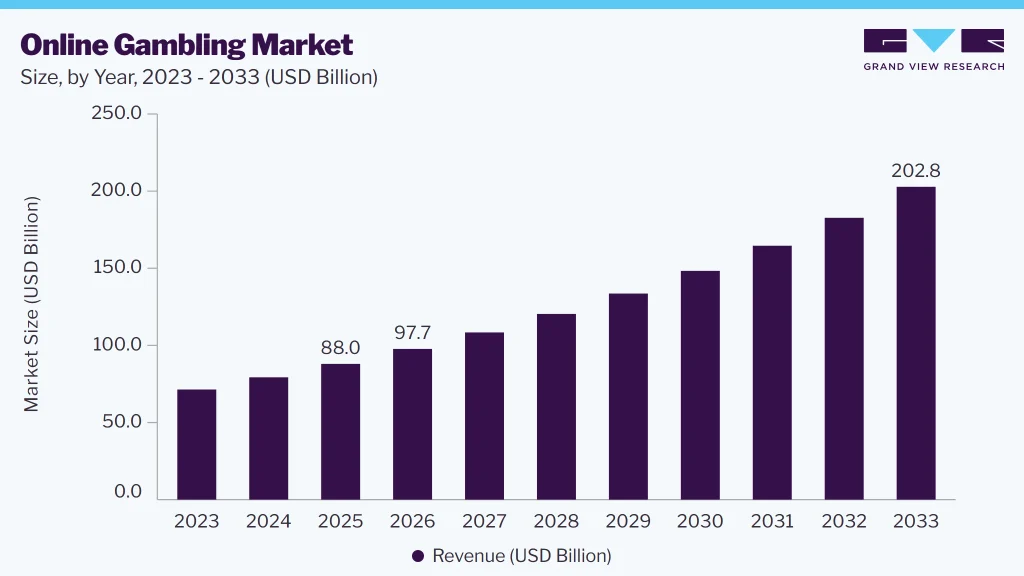
A crypto casino is an online casino that takes deposits and pays winnings in digital assets such as Bitcoin and stablecoins. Online gambling is projected to grow from $88.0 billion in 2025 to $202.8 billion by 2033, while on-chain gambling volume reached $51 billion in 2025.
Therefore, a crypto casino license now decides who can bank, scale, and survive.
1. How Big Is the Market Founders Are Entering?
First, online gambling is a large and expanding market. Grand View Research values it at $88.0 billion in 2025 and projects $202.8 billion by 2033, an 11.0% annual growth rate from 2026.
Moreover, Europe held 41% of 2025 revenue, a region with strict national licensing.
Meanwhile, the US shows how fast regulated online casinos can grow. The American Gaming Association reports iGaming revenue rose 27.6% to $10.73 billion in 2025 across seven states with lawful online casinos. Notably, online revenue passed land-based casino revenue in Pennsylvania and New Jersey for the first time.
2. Why Crypto Casinos Are Growing Faster
In addition, crypto-native platforms keep scaling. TRM Labs reports on-chain gambling volume of $51 billion in 2025, a record $15 billion in Q4 2025, and $14 billion in Q1 2026. However, that figure measures on-chain volume, not operator revenue.
For example, Stake, the largest crypto casino by reported revenue, reported about $4.7 billion in gross gaming revenue for 2024, according to Forbes Australia. Consequently, founders entering this market face established brands, so credibility and licensing matter from day one.
Crypto Casino Licenses Compared in 2026
Founders comparing a crypto casino license should shortlist Curaçao, the Isle of Man, and Malta first, because those regulators publish their fees. Meanwhile, Kahnawà:ke and Anjouan need extra verification before any commitment.
Overall, this comparison covers all five on fees, timelines, crypto rules, and limitations, so founders can rule options in or out quickly.
1. Compare Licensing Costs, Timelines, and Requirements
| Jurisdiction | Authority | Verified fees | Review timeline | Crypto rules | Main limitation |
| Curaçao | CGA | €4,592 application; €47,450 annual B2C | [verify] | [verify] | Highest verified annual fee |
| Kahnawà:ke | KGC | Unconfirmed [verify] | [verify] | [verify] | Fees conflict across sources |
| Isle of Man | GSC | £5,250 application | 10 to 16 weeks | [verify] | Isle of Man company required |
| Malta | MGA | €5,000 application; €25,000 annual B2C | [verify] | [verify] | Tier-1 compliance burden |
| Anjouan | Claimed authorities | Requires legal verification | [verify] | [verify] | Regulatory credibility concerns |
However, fees alone mislead. For example, Curaçao charges €47,450 every year, while Malta charges €25,000 every year after a €5,000 application. Moreover, the Isle of Man requires a local company, which adds setup costs beyond its £5,250 application fee.
Timelines differ as well. Specifically, the Isle of Man publishes a decision window of 10 to 16 weeks from a complete application. For the others, therefore, request written timelines before setting a launch date.
Additionally, some reports say Comorian authorities dispute the standing of Anjouan’s gaming regulators. Consequently, founders should get independent legal advice before relying on it.
2. The Cheapest License Is Not Always the Easiest
In practice, ease means more than a low fee. Therefore, judge each route on five factors:
- Cost of obtaining and maintaining authorization.
- Application requirements and approval process.
- Markets the casino can legally serve.
- Banking, payment, and game-provider acceptance.
- Regulatory obligations after approval.
Notably, banking acceptance is where cheap licenses often cost the most. For instance, a processor or game provider that rejects your license forces expensive changes after launch. Therefore, check supplier and payment acceptance before paying any application fee.
Likewise, markets matter. Specifically, offshore licenses generally do not authorize US players, so a US-based founder must geo-block American traffic or choose a different legal structure.
Ultimately, the most useful license is the one that lets a founder operate the intended business and not the one advertised at the lowest price.
The Best Jurisdictions for Crypto Casino Licensing
The best crypto casino license depends on the operator. Specifically, Curaçao suits funded startups, Kahnawà:ke suits independent operators, the Isle of Man suits established businesses, and Malta suits casinos wanting stronger oversight. However, Anjouan needs legal verification first.
Overall, each profile below covers who should consider it, current rules, estimated cost, and limitations.
1. Curaçao for Crypto Casino Startups
First, funded startups that can carry a fixed annual fee and need a widely recognized offshore license should consider Curaçao.
Under the LOK, enacted December 24, 2024, the Curaçao Gaming Authority (CGA) licenses operators directly for a €4,592 application and €47,450 annual B2C fee. However, local presence and crypto-specific requirements still need confirmation with the CGA.
2. Kahnawà:ke for Independent Casino Operators
Next, independent operators comfortable with detailed due diligence should consider Kahnawà:ke. Specifically, its Client Provider Authorization requires a Control System Submission and criminal-record consents for key people.
Moreover, the Commission announced a fee increase effective January 1, 2027, reported at $40,000 to apply and $20,000 annually [verify].
3. Isle of Man for Established Crypto Casino Businesses
Meanwhile, established, well-funded operators should consider the Isle of Man. Specifically, the Gambling Supervision Commission licenses online gambling for a £5,250 application fee and requires a genuine local presence.
Importantly, convertible virtual currencies such as Bitcoin are accepted, subject to the Commission’s AML guidance for virtual assets. Consequently, expect banking and staffing costs on the island.
4. Malta for Casinos Seeking Stronger Regulatory Oversight
Likewise, casinos wanting strong oversight and EU credibility should consider the Malta Gaming Authority (MGA).
Moreover, a B2C Gaming Service License costs €5,000 to apply for and €25,000 annually, and crypto assets need MGA approval under its DLT policy. However, a Maltese license does not replace national licenses where countries require them.
5. Anjouan and Its Low-Cost Licensing Claims
In contrast, cost-sensitive founders may notice Anjouan, which advertises roughly €17,000 and a few weeks’ approval. However, the bodies claiming licensing authority include the Anjouan Offshore Finance Authority and Anjouan Gaming, and some reports question their standing in the Comoros.
Meanwhile, sources disagree on payment acceptance, so independent legal verification is essential.
6. Other Jurisdictions Founders May Encounter
Finally, other jurisdictions fall into two groups:
- Formal gambling authorizations: Gibraltar, Alderney, and Estonia, which suit well-funded operators.
- Company registration: Costa Rica, which offers no gambling license.
Specifically, Costa Rican operators receive a data-processing permit, serve only foreign players, and face no gambling supervision. Therefore, banks and players have no regulator to rely on.
Overall, match each jurisdiction to a business case, because no single location is best for every founder.
What a Crypto Casino License Actually Allows
A crypto casino license lets an operator run a gambling business under the issuing country’s rules. However, it does not authorize play in every country where customers live. Moreover, each player’s own country sets separate gambling laws.
Therefore, operators must confirm market access country by country, and they must also confirm which activities their license actually covers.
1. Licensing Location vs Countries Where Players Can Play
First, the licensing jurisdiction supervises the operator, while each player’s country decides whether the activity is legal there. Moreover, offshore licenses commonly list excluded markets, so a license can forbid some countries outright.
Therefore, operators must verify market access separately for every country they target, including any local approval that country requires.
Specifically, check three things for each target country:
- Whether your license excludes that country.
- Whether that country requires its own approval.
- Whether payment and advertising partners accept that market.
2. Accepting Players From the US, UK, and EU
Overall, offshore-licensed casinos cannot assume access to any of these three markets. In the US, for example, no federal casino license exists, and eight states have authorized real-money online casinos through their own regulators.
By contrast, Great Britain requires a Gambling Commission license for any remote gambling offered to its consumers.
Similarly, each EU country sets its own online gambling rules, so a Maltese license does not automatically permit serving every European player. Likewise, a Curaçao license gives no automatic access to European markets.
Therefore, treat US, UK, and EU access as three separate legal questions, especially for US-based founders.
3. Operator Licenses vs Software Supplier Licenses
No, the company running a casino and its software supplier usually need different authorizations. Specifically, operators hold B2C licenses, while suppliers hold B2B licenses where jurisdictions separate the roles.
For example, Malta issues a Gaming Service License for operators and a Critical Gaming Supply License for suppliers.
Likewise, Curaçao issues separate B2C and B2B licenses, and Kahnawà:ke authorizes casino software providers separately. However, the Isle of Man makes supplier licensing elective, while Great Britain offers a remote gambling software license. Therefore, confirm each supplier’s status before commissioning a platform.
Overall, a license has a defined legal scope, so founders must understand its permitted activities and markets before commissioning a platform.
The Requirements Behind a Crypto Casino License
Regulators examine four areas before approving a crypto casino license: ownership and management, player protection, technology testing, and the operator’s ability to keep complying.
Moreover, requirements differ by jurisdiction, so this section explains scope rather than filing steps. Overall, regulators want proof that a founder is credible, funded, and ready to run a controlled operation.
1. Company Registration and Ownership Verification
First, regulators examine the company itself, including where it is incorporated and who ultimately owns and controls it. Moreover, they assess management suitability, source of funds, capital, and whether the business plan is credible.
For example, Curaçao’s key person policy covers individuals who influence governance, finances, or compliance, so founders should expect management vetting.
Consequently, unclear ownership or funding can stall a review.
2. Player Verification and Responsible Gambling Rules
Next, regulators evaluate how an operator protects players. Typically, that includes identity and age verification, AML controls, self-exclusion, deposit limits, complaint handling, and, where applicable, protection of player funds.
For example, Malta requires self-exclusion, deposit or wagering limits, and reality checks, while crypto AML expectations draw on FATF guidance.
Moreover, crypto deposits add wallet screening and transaction monitoring to ordinary identity checks [verify].
3. Game Testing, Security, and Technical Approval
Then, regulators usually want independent evidence that games and systems behave as declared. Specifically, approved laboratories test random number generators, game mathematics, and security, and operators supply technical documentation.
However, certification is not identical everywhere: some regulators incorporate GLI-19, while others approve labs such as eCOGRA or iTech Labs.
Consequently, founders should confirm accepted laboratories with their chosen regulator before building.
4. Renewals, Reporting, and Ongoing Supervision
Finally, approval starts the ongoing obligations. Typically, licensees pay recurring fees, file regulatory reports, accept audits, and notify regulators of material system changes.
For example, Malta can require system audits, system reviews, and compliance audits, plus audited financial statements within 180 days of year-end.
Likewise, material changes, such as new products or technologies, can trigger notices or fresh reviews.
Overall, licensing is an ongoing operating responsibility, not permission purchased once, so founders should budget for compliance as a recurring cost.
How Crypto Payments Affect Casino Licensing
A crypto casino license authorizes gambling, not regulated crypto services. However, accepting Bitcoin or stablecoins adds separate questions about approved assets, fund custody, and whether the business needs authorization as a crypto-asset service provider.
Moreover, wallets, custody, and game verification each add technical and regulatory questions beyond ordinary gambling compliance.
1. Using Bitcoin, Stablecoins, and Other Crypto Assets
No, a gambling license does not automatically permit every crypto asset. For example, Malta requires approval from its gaming regulator before an operator uses a DLT asset as a payment method.
Therefore, founders should choose supported assets, settlement methods, and currency-conversion rules with their regulator before building.
Meanwhile, settlement choices matter. Holding balances in a stablecoin differs from converting every deposit to fiat, and each approach changes custody, reporting, and exchange-rate exposure.
2. Crypto Wallets, Custody, and AML Requirements
First, custody determines whether crypto handling creates extra regulatory exposure. Typically, regulators examine wallet ownership and access controls, blockchain transaction monitoring, and sanctions screening of wallet addresses.
Moreover, a business that holds, exchanges, or transmits crypto for customers may need separate virtual-asset authorization, for example under the EU’s MiCA regime.
Similarly, in the US, FinCEN treats exchangers and administrators of convertible virtual currency as money transmitters, so founders should have counsel test the business model.
Consequently, a gambling license and a crypto-asset authorization answer different questions, and one never replaces the other.
3. Provably Fair Gaming and Certified Game Outcomes
No, provably fair verification does not replace regulated testing. Specifically, provably fair systems let players verify individual game results with cryptographic proofs.
In contrast, the UK Gambling Commission requires RNG outcomes to be acceptably random, shown through statistical analysis.
Meanwhile, smart contract audits are a third control. They review on-chain code for security flaws, a service we offer, but they do not certify game mathematics or replace regulator approval.
Therefore, treat the three as complementary: proofs build player trust, labs satisfy regulators, and audits protect contracts.
Overall, accepting crypto changes the platform’s financial and technical requirements, but it does not remove conventional gambling compliance obligations.
Banking and Game Providers Can Change Your Choice
Payment providers and game suppliers do not accept every crypto casino license equally. Moreover, each runs its own due diligence, and a license that regulators grant can still fail a bank’s or studio’s review.
Therefore, founders should test provider acceptance before choosing a jurisdiction, because acceptance can decide whether the platform launches or stalls.
1. Banking and Payment Provider Acceptance
A license proves regulatory permission, not banking acceptance. First, banks and payment companies run their own due diligence on owners, jurisdiction, and fund flows. Moreover, Visa classifies card-absent gambling as a top-tier high-integrity risk, so acquirers must register before onboarding such merchants.
Additionally, jurisdiction restrictions add another layer. For example, designated US payment systems require participants to maintain policies designed to block unlawful internet gambling transactions, so US-facing flows face stricter scrutiny.
Finally, banks and specialist payment companies behave differently. Banks offer lower-cost fiat settlement but screen conservatively, while specialist processors accept gambling but price in fraud and chargeback exposure [verify].
Consequently, ask providers for written eligibility before you pick a license, and compare which platform model keeps the merchant relationship with you.
2. Crypto Payment Gateway Requirements
Crypto payment gateways run their own checks, separate from your gambling regulator. First, they assess your company documents, owners, license, and target markets. Moreover, they review custody arrangements, supported assets, and settlement methods, because those decide who controls funds in transit.
Likewise, monitoring matters equally. For example, the FATF calls the Travel Rule a key AML measure, so partners may ask how your platform monitors and screens transfers.
Finally, each provider also applies its own policies, so a gateway can decline your license, assets, or market even when regulators approve them [verify].
3. Casino Game Providers and Licensing Restrictions
No, a license does not guarantee access to major game studios. Specifically, aggregators, slot studios, and live casino studios screen operators for license type, jurisdiction, and market exposure.
For example, Evolution states it supplies licensed B2C operators and aggregators, and that suppliers often need B2B licenses themselves.
Moreover, some regulators require suppliers to be licensed or recognized before working with local operators. Anjouan, for example, reportedly made a supplier license or recognition certificate mandatory from July 2025.
Consequently, founders should confirm in writing that target suppliers will contract with their license, entity, and markets before committing to a jurisdiction.
Overall, provider acceptance should influence jurisdiction selection before the founder commits to building the platform.
Building a Crypto Casino That Meets Licensing Needs
Licensing requirements shape a crypto casino’s architecture, integrations, data retention, and compliance workflows. Specifically, the platform must enforce player eligibility, account for crypto balances, support game testing, and produce records on request.
Therefore, scope the build around the obligations of your chosen crypto casino license, not around a feature list.
1. Player Accounts, KYC, and Location Controls
First, the player account should hold identity status, age, country, and account restrictions in one record. Moreover, every registration and login should check that record against the license’s excluded and permitted markets.
Consequently, geolocation and country rules must run before a player can deposit or bet. Likewise, responsible-gambling settings belong in the same record.
For example, UK Gambling Commission standards cover financial limits and responsible product design, so the platform should enforce limits, not only display them.
2. Crypto Wallets and Player Balance Management
Next, the platform must record every deposit, withdrawal, and bet against a player balance that can be audited.
Therefore, wallet design and ledger design should be scoped together, because custody choices decide who carries which obligations. For a wider view, our crypto casino platform guide covers the full build.
a. Custodial and Non-Custodial Wallet Options
Typically, in a custodial design, the operator holds player funds in wallets it controls, so it carries custody, security, and reconciliation duties.
Conversely, a non-custodial design leaves keys with players, but the operator still needs wallet screening and clear bet-settlement rules.
Consequently, regulators and payment partners will ask which model you run and who can move funds.
b. Player Ledgers and Transaction Reconciliation
First, a double-entry ledger should record each credit and debit, so player balances always equal what the platform owes. Next, reconciliation jobs should match ledger entries against blockchain confirmations and provider settlements, and flag differences for review.
Finally, keep records of transactions and the wallets used per player, because regulators may ask for them.
3. Certified Games and Fairness Verification
First, the platform should integrate games through a controlled layer that records each game version, its certificate, and the markets where it is approved.
Moreover, it should store testing evidence and RTP documentation per game, so operators can answer a regulator or supplier quickly. Therefore, treat certification as data the platform manages, not paperwork stored elsewhere.
However, accepted certification differs by regulator, and the GLI-19 standard is one reference among several.
Provably fair features can add player-verifiable proofs where relevant, but they do not replace independent testing. Moreover, our casino game development guide explains how RTP and RNG testing fit together.
4. Compliance Reporting and Operator Dashboards
Next, the operator dashboard should turn compliance duties into daily workflows. First, immutable audit logs record logins, balance changes, and admin actions. Moreover, suspicious-activity alerts and withdrawal reviews route to named reviewers with a documented decision.
Likewise, financial reports and role-based permissions matter. For example, Malta can require system audits and audited statements, so the platform should export records and grant auditors read-only access.
Similarly, the UK Gambling Commission applies security requirements to critical systems, so operators should plan for independent review.
5. Support for Future Licensing Jurisdictions
Yes, if the platform treats each jurisdiction as configuration instead of code. First, market restrictions, limits, and game availability should live in a rules engine.
Moreover, payment integrations, compliance policies, and supplier approvals should be modular, so adding a market means adding a configuration set and integrations.
However, configuration cannot replace legal review. Therefore, document every rule change, because regulators and partners may ask when and why a restriction changed.
6. Jurisdiction-to-Platform Requirements Table
The table below connects common regulatory outcomes to the engineering capabilities that support them.
Specifically, each row names an example from this guide, so confirm the exact rule with your regulator before building.
| Regulatory outcome | Example in this guide | Platform capability | Evidence to keep |
| Owner and key-person vetting | Curaçao key person policy | Role-based admin accounts and ownership records | Org chart and key-person register |
| Excluded or licensed-only markets | Great Britain requires its own license | Country rules engine and geolocation | Block logs and rule history |
| Responsible-gambling tools | Malta requires self-exclusion, limits, and reality checks | Limits and exclusions enforced at ledger level | Limit and exclusion records |
| Approved crypto assets | Malta approves DLT assets first | Asset allowlist and wallet permissions | Approved asset list and access records |
| AML and sanctions controls | FATF Travel Rule | Blockchain analytics and case management | Alert logs and case decisions |
| Independent game testing | GLI-19 and eCOGRA, accepted by some regulators | Game registry linked to certificates and RTP files | Lab reports and version records |
| Audits and financial reporting | Malta audits and audited statements | Immutable logs and read-only auditor access | Audit logs and report exports |
| Supplier and change rules | Separate B2B licenses; Kahnawà:ke material change reports | Supplier register and change management | Contract register and release log |
Overall, a well-scoped casino platform should support the obligations of the selected license and allow documented changes when rules or markets change.
White-Label, Turnkey, or Custom Casino Software
Your crypto casino license route decides which software model is realistic. First, white-label usually runs under the provider’s arrangements, so founders rent speed and accept limits. By contrast, turnkey usually requires your own license, so you gain control and carry operational duties.
Custom suits founders who already know their license, markets, and differentiators. Therefore, choose the model after the licensing route, because compliance responsibility follows the license holder, not vendors.
How the Licensing Route Changes the Development Model
| Decision | White-label | Turnkey | Custom |
| License responsibility | Usually the provider’s license, but responsibility stays with the license holder | Usually your own license, so you answer to the regulator | Your own license, because software does not replace it |
| Software ownership | Provider owns the platform; contract sets data access | Vendor owns the platform; code rights vary by contract | You own the code if the contract assigns it |
| Payment control | Often the provider’s processors and merchant accounts | Your own PSPs and merchant accounts, with vendor help | Your own PSPs, with cashier logic you design |
| Launch complexity | Lowest: mostly branding and marketing | Moderate: license and payments to set up | Highest: many months, depending on scope |
| Expansion flexibility | Limited by the provider’s license and markets | Broader, but each market needs your license and integrations | Highest: rules engine and modular integrations per market |
| Best fit | Validating demand | Operating independently | Differentiated product across several markets |
Key takeaways
- First, white-label suits market testing, but compliance responsibility stays with the license holder even when a provider runs the platform.
- Next, turnkey suits founders who hold their own license and can run compliance, payments, and support in-house.
- Finally, custom pays off when wallets, compliance workflows, or game products differentiate your business. For the full comparison of cost and ownership, read Should You Choose a Turnkey, White-Label, or Custom Casino?
Crypto Casino Licensing and Development Costs in 2026
Last Updated: October 2026. Regulator fees change, so confirm current figures before budgeting.
Published annual regulator fees include €25,000 in Malta and €47,450 in Curaçao, while an illustrative custom engineering scope runs $70,000 to $300,000. However, those are separate budgets: the engineering scope excludes licensing, setup, and full launch costs.
Therefore, founders should plan licensing, platform development, and operating costs as three distinct lines.
1. Crypto Casino License Fees by Jurisdiction
First, regulators publish many licensing fees directly, so founders can verify them. Moreover, each figure below stays in its original currency, because converting euros, pounds, and dollars without a stated date would mislead.
For example, Malta requires minimum share capital of €100,000 or €40,000 depending on game type, and Kahnawà:ke raises its application fee on January 1, 2027.
Table 1. Regulator-published fees in original currencies, October 2026
| Jurisdiction | Application fee | Annual fee | Documented capital or setup requirement | Notes |
| Curaçao (CGA), B2C | €4,592 | €47,450 | No capital figure found | Local key-person rules add cost |
| Malta (MGA), B2C | €5,000 | €25,000 (€10,000 if solely Type 4) | Share capital: €100,000 (Types 1 and 2); €40,000 (Types 3 and 4) | Monthly compliance contribution, Type 1 minimum €15,000 and maximum €375,000 a year; 5% gaming tax on revenue from players in Malta |
| Isle of Man (GSC), full license | £5,250 | £36,750 | No capital figure stated; Manx company, two local directors, resident Designated Official or Operations Manager | Network license £52,500 a year; fees effective July 6, 2023 |
| Kahnawà:ke (KGC), CPA | $35,000 now, $40,000 from January 1, 2027, each including the first-year annual fee | $20,000 | No capital figure stated | Key Person Permit: $5,000 now, $6,000 from 2027, plus $1,000 a year |
| Anjouan | No regulator-published figure verified | Not verified | Not verified | Agent quotes vary |
Figures are shown as published, with no currency conversion applied. Therefore, treat agent quotes for Anjouan as unverified until the regulator confirms them.
2. Legal Setup, Compliance, and Certification Costs
Next, the application fee is only part of first-year spending. Typically, founders also pay for company setup, legal advice, compliance staff, testing, audits, payment onboarding, and responsible-gambling operations.
Consequently, request written quotes for each line before choosing a jurisdiction.
Table 2. Costs beyond the license application
| Cost item | What drives it | Published figure | Status |
| Incorporation and local entity | Capital, local directors, key persons | Malta share capital €100,000 or €40,000; other jurisdictions quote-based | Official for Malta |
| Legal services | Jurisdiction, ownership structure, policies | No reliable public benchmark | Quote required |
| Compliance and operations staff | Key functions, support, review teams | One staffing estimate: about €7,000 a month for a six-person support team | Illustrative |
| Technical testing and certification | Game count, markets, laboratory | $20,000 to $100,000 per jurisdiction [confirm currency] | Idea Usher estimate |
| Security testing and audits | Platform scope, regulator audits | $15,000 to $30,000 a year [confirm currency] | Idea Usher estimate |
| Payment onboarding | Provider review, reserves | Rolling reserves of 5% to 10%, held 90 to 180 days | Idea Usher estimate |
| KYC and AML tools | Verification volume | $0.80 to $5.00 per check; manual reviews $3 to $15 per case | Idea Usher estimate |
3. Custom Crypto Casino Development Costs
Idea Usher’s scoped custom engineering estimate is $70,000 to $300,000, split across five phases.
However, it excludes licensing, lab certification, payment reserves, game revenue share, staff, and marketing. Therefore, read it as a build budget, not a launch budget.
Table 3. Illustrative phase ranges for a scoped custom engineering engagement (USD, provisional)
| Phase | Core deliverables | Provisional range |
| 1. Discovery and licensing-led planning | Requirements map, architecture, ownership map | $5,000 to $20,000 |
| 2. Player accounts, wallets, and core platform | PAM, wallet and ledger, front end, bonus and CRM hooks | $25,000 to $105,000 |
| 3. Payments, KYC, and game integrations | PSPs, crypto gateways, KYC vendors, aggregator API | $15,000 to $70,000 |
| 4. Compliance controls and admin systems | Back office, audit logs, reviews, limits, permissions | $15,000 to $65,000 |
| 5. Security testing and launch preparation | QA, security testing, certification prep, deployment | $10,000 to $40,000 |
| Total | $70,000 to $300,000 |
For marketing, bonus, and staffing budgets beyond this scope, read How Much Does It Cost to Start an Online Casino in 2026?
Planning a launch? Qualified founders can request a jurisdiction-informed technical scope and development estimate from Idea Usher.
Overall, budget separately for regulator fees, setup and compliance, engineering, and annual operations, and treat $70,000 to $300,000 as engineering only.
Choosing a License for Your Casino Business Model
No single crypto casino license suits every founder, so match the route to your commercial situation. Moreover, budget, product design, and target markets each point to different options.
Therefore, compare jurisdictions by valid authorization, provider acceptance, and obligations you can sustain, not by the lowest fee.
The sections below apply that test to three common founder profiles.
1. First-Time Founders With Limited Launch Budgets
First, smaller startups should prioritize a valid authorization that providers will actually accept. Cheaper routes lower fees but can raise banking and supplier friction.
Consequently, verify payment and game-provider acceptance, and confirm compliance duties you can staff, before paying any application fee.
2. Crypto-First Casinos With Custom Wallet Systems
Next, crypto-native products should start with custody. Regulators may approve specific assets, so confirm which coins and wallet models a jurisdiction accepts.
Moreover, payment partners, security reviews, and software ownership terms must fit the wallet design from day one.
3. Established Operators Planning New Markets
Finally, established operators should treat each market as its own approval. A recognized license can add credibility, but local permissions may still apply.
Therefore, weigh scalability, integrations, and long-term operating costs before committing to a regional strategy.
4. Founder Decision Table
| Business model | Main priority | Jurisdictions to evaluate | Main risks | Expected platform requirements |
| First-time founder, limited budget | Affordable, valid authorization | Curaçao; Anjouan after legal verification | Banking friction; credibility questions | Core KYC, geo-blocking, limits, certified suppliers |
| Crypto-first, custom wallets | Custody and asset approval | Curaçao; Isle of Man; Malta | Asset approvals; custody duties | Wallet controls, blockchain monitoring, audit logs |
| Established operator, new markets | Recognized licenses plus local permissions | Malta; Isle of Man; local licenses | Local permits; higher running costs | Rules engine, modular integrations, reporting |
Overall, choose the license that fits your business model, budget, and markets, and avoid declaring any one location universally best.
How Idea Usher Builds License-Ready Crypto Casinos
We are the software engineering partner beside your operator team and its legal or compliance advisers. Specifically, we turn your chosen licensing route into working software, whether a crypto casino or an immersive metaverse casino.
However, we are not a law firm, so your counsel confirms the rules, and we build to them.
- Licensing-led scope: we turn jurisdiction rules, restricted markets, and wallet requirements into your engineering brief.
- Core architecture: we connect accounts, wallets, games, and back office through one ledger.
- Wallets and payments: we build crypto deposits, withdrawals, and controls into the cashier.
- KYC, AML, and player protection: we wire verification, monitoring, and responsible-gambling tools into player accounts.
- Games and reporting: we integrate game content and keep audit logs and records for regulators.
- Testing evidence: we prepare documentation and test records that support audits and independent certification.
- Launch and expansion: we maintain the platform and use modular rules, so adding markets needs no rebuild.
- Proof: we built NeonVerse Casino, a playable browser prototype with a walkable 3D floor, four games, and a jackpot.
Ready to scope your build? Next, talk to our team at Idea Usher Casino Development Services for a jurisdiction-informed technical plan and estimate.
Conclusion
Choosing a crypto casino license is a business decision, not a search for the cheapest fee. First, match the jurisdiction to your markets, wallets, and budget. Next, confirm that banks, payment providers, and game suppliers will accept it. Moreover, plan for ongoing compliance and engineering costs, not only the application.
Finally, build the platform around the license you choose. Therefore, speak with qualified gaming counsel and an engineering partner before committing, and request a jurisdiction-informed technical scope for your launch.
FAQs
Q1 Which Country Offers the Cheapest Crypto Casino License?
A1. Among verified euro fees, Malta’s annual fee is lower than Curaçao’s: €25,000 versus €47,450 for B2C licenses. However, Anjouan is advertised as cheaper, yet we found no regulator-published fee, and credibility questions remain. Therefore, compare fees alongside banking and supplier acceptance, because a low-cost authorization can cost more later on.
Q2 How Quickly Can I Get a Crypto Casino License?
A2. Regulator review can be fast, but launch takes longer. For example, the Isle of Man targets 10 to 16 weeks after a complete application. However, preparation, testing, payment onboarding, and building the platform add time, and our focused builds take 16 to 24 weeks. Therefore, plan several months before launch.
Q3. Can I Accept US Players With an Offshore Casino License?
A3. No. An offshore license does not authorize play in the United States. Specifically, there is no federal casino license, and eight states have authorized real-money online casinos through their own regulators. Therefore, serving US players requires approval in each state, so founders typically geo-block American traffic or restructure their model.
Q4. Do Crypto Casinos Need KYC and AML Checks?
A4. Yes. Cryptocurrency does not remove player verification or financial-crime obligations. Specifically, licensed operators generally need identity, age, and AML controls, and the FATF calls the Travel Rule a key anti-money-laundering measure for crypto transfers. Therefore, plan KYC, transaction monitoring, and sanctions screening from the start, whatever the payment method used.
Q5. Is an Anjouan License a Good Alternative to Curaçao?
A5. Possibly, but only after legal verification. Anjouan is advertised as cheaper and faster, yet some reports question its regulators’ standing, and payment and supplier acceptance vary. Curaçao costs more, at €47,450 a year, but publishes its fees and licenses directly. Therefore, weigh credibility and market access carefully above price alone.
Q6. Do I Need Another License to Accept Cryptocurrency?
A6. Sometimes. A gambling license does not automatically authorize crypto services. For example, Malta requires approval before operators accept DLT assets, and the EU’s MiCA regime may require authorization for businesses that hold, exchange, or transmit crypto for customers. Therefore, ask counsel to test your wallet and custody model before launch.
Q7. Can I Change My Crypto Casino License Later?
A7. Yes, but expect a new approval process. Moving jurisdictions usually means a fresh application, new contracts, audits, and player-market controls. Moreover, the platform may need modifications. Therefore, build with configurable market rules and modular integrations from the start, so a move mostly changes configuration and paperwork, not the core software.