


Key Takeaways
- Rebet’s P2P feature lets two users set their own terms and bet directly against each other instead of against the house.
- Stakes get locked in escrow and released automatically once an oracle verifies the event’s outcome.
- A sweepstakes-style dual-currency model, Rebet Coins and Rebet Cash, lets Rebet operate in 46-plus U.S. states.
- Social mechanics like leaderboards and friend challenges drive stickier retention than flat-odds sportsbook apps.
- A comparable P2P betting app typically costs $35,000 to $100,000 and takes 12 to 16 weeks for a compliant MVP.
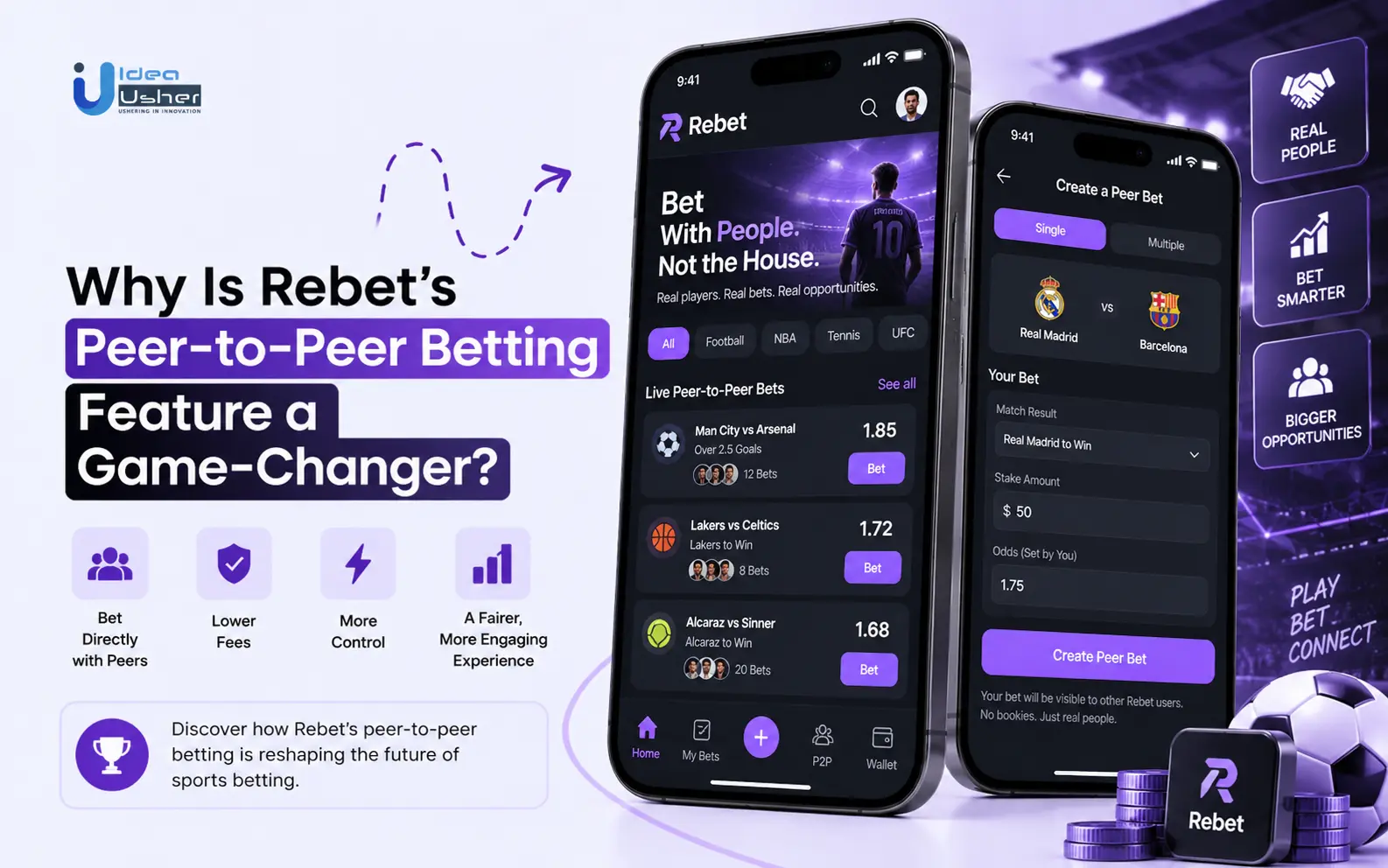
Rebet’s peer-to-peer betting feature lets two users set their own terms and bet directly against each other instead of against the house, and it is one of the clearest signals yet that social sportsbooks are moving past flat, house-set odds. Most sportsbook apps still work the same way: the operator sets a line, takes a cut on both sides, and the user never sees who is on the other end of the bet. Rebet flips that model. A user picks an outcome, sets their own terms, and a friend or another player on the platform can accept the challenge directly. Idea Usher’s app development team has been tracking this shift closely because the same mechanics power prediction markets, fantasy contests, and social betting products across Idea Usher, and founders keep asking the same question after seeing Rebet’s traction: how do you actually build something like this. This article breaks down how Rebet’s P2P feature works, why it is pulling users away from traditional sportsbooks, and what it takes technically and legally to build a comparable app.
What Is Rebet and How Does Its Sportsbook Model Work?
Rebet is a social sportsbook that runs on sweepstakes mechanics instead of real-money wagering, which is why it can operate in 46 or more U.S. states while most traditional sportsbooks are locked out of dozens of them. The app uses two virtual currencies. Rebet Coins are free-play tokens used for entertainment and prediction games with no cash value. Rebet Cash is the second currency, earned through promotions or purchased Gold Coin-style packages, and it can be redeemed for real prizes once a user meets the platform’s terms. This dual-currency structure is the same legal workaround that sweepstakes casinos like Chumba and Stake.us rely on, and it is why Rebet can offer 60-plus sports and leagues, including NFL, NBA, MLB, NHL, and NCAA markets, without holding a traditional sportsbook license in every state.
Signup requires an app download since Rebet has no web client, followed by identity verification and email confirmation, standard steps for any platform handling redeemable value. Idaho, Michigan, Louisiana, Nevada, and Montana are currently excluded, which lines up with how those states treat sweepstakes-model gaming. The core betting experience covers moneylines, spreads, props, and live in-play markets, functionally similar to any mainstream sportsbook. What sets Rebet apart is layered on top of that base: a social feed, leaderboards, a “Re-bet” mode that lets users copy a bet they see someone else make, and the peer-to-peer feature that is the real differentiator.
Rebet is not alone in exploring this territory, and it is worth understanding where it sits relative to the broader sportsbook market before evaluating whether to build something similar. Founders often benchmark a build like this against a much wider set of competitors first, which is why teardown research such as Idea Usher’s roundup of top sports betting app development companies is a useful starting point for understanding what feature set actually differentiates a new entrant from an app that just repeats what PointsBet, Coral, or ESPN Bet already offer.

U.S. sweepstakes casino Gold Coin sales grew from $3.5B in 2022 to $14.3B in 2025 before an estimated pullback in 2026
How Does Rebet’s Peer-to-Peer Betting Feature Actually Work?
Rebet’s P2P feature turns betting into a direct challenge between two users, with the platform acting as the matchmaker and escrow holder rather than the house taking the other side of the bet. Four mechanics make this work end to end: challenge creation, opponent matching, stake handling, and automated settlement.
Creating and Setting Custom Challenge Terms
A user starts a P2P challenge by picking an event and setting their own line instead of accepting whatever the sportsbook is offering. Rebet describes this as letting players “set your own lines and terms, tailoring your experience to your preferences,” which is a meaningfully different flow from a standard bet slip. Instead of clicking a price the operator already fixed, the user defines the terms of the wager itself, whether that is a point spread on a game, a head-to-head prediction against a friend, or a custom proposition neither sportsbook menu would list. This is closer to how a betting exchange or a peer-to-peer marketplace works than a traditional fixed-odds sportsbook.
Matching Opponents With Smart Algorithms
Once a challenge is live, Rebet’s matching system pairs it with another user willing to take the opposite side, using what the platform describes as smart algorithms to find compatible matchups. A challenge can also be sent directly to a specific friend, turning the feature into a literal one-on-one contest, or left open for anyone on the platform to accept. This dual mode, targeted challenges plus open matching, is what lets Rebet scale P2P betting beyond just friend groups while still keeping the social hook that a friend-versus-friend bet provides.
Escrow and Secure Stake Handling
Both users’ stakes get locked into a secure wallet or escrow account the moment a challenge is accepted, and neither side can withdraw or reuse those funds until the event resolves. This is the part of the architecture that has to be bulletproof from a compliance and trust standpoint. If escrow logic has any gap, a platform is exposed to disputes, chargebacks, and regulatory scrutiny. Rebet’s approach mirrors how betting exchanges and prediction markets like Polymarket handle collateral, a model Idea Usher has covered in detail in its guide to building a prediction market platform like Polymarket, since the underlying escrow and settlement problem is nearly identical across both categories.
Smart Contract-Based Settlement and Payouts
When the underlying event ends, an automated settlement process verifies the result and releases the escrowed funds to the winner without manual intervention. Rebet’s own materials describe this as smart contract logic that checks the outcome through a trusted oracle and then pays out directly, removing the delay and dispute risk that comes with manual grading. For a founder evaluating this space, this is the single hardest piece to get right: the oracle feed has to be accurate, the smart contract or settlement logic has to handle edge cases like postponed games or contested results, and the whole system has to be auditable if a regulator or a user disputes an outcome.

Flow diagram showing how Rebet settles a peer-to-peer wager: challenge created, opponent matched, stake escrowed, oracle verifies outcome, smart contract payout
Why Rebet’s P2P Feature Is a Game-Changer
Peer-to-peer betting is a game-changer because it solves the two biggest weaknesses of traditional sportsbook apps at once: it removes the perception that the house always wins, and it turns a solitary bet into a social event people want to share. Three specific advantages explain why this feature is driving engagement.
Social Proof and Virality Loop
A bet against a friend generates a story, a screenshot, and bragging rights in a way a bet against an anonymous sportsbook line never does. Rebet’s social feed, leaderboards, and reaction features exist specifically to surface these moments, turning every accepted challenge into visible content that other users see and want to replicate. This is the same growth loop that made fantasy sports and social trading apps sticky: the product does not just facilitate a transaction, it manufactures social content around that transaction, which lowers customer acquisition cost because users are recruiting other users.
User-Set Odds vs House-Set Odds
Letting users set their own terms removes the single biggest trust objection sportsbook operators face: the suspicion that the house always prices the line in its own favor. In a P2P match, both sides negotiate or accept terms directly, and the platform’s revenue comes from a matching or platform fee rather than from beating the customer on the spread. This is a meaningfully different unit economics model, and it is one reason peer-to-peer and exchange-style betting products have kept growing even as regulators tighten rules on traditional sweepstakes sportsbooks.
Retention Impact of Peer-to-Peer Mechanics
Products with a P2P layer tend to hold users longer than single-player betting apps because a challenge against a specific friend creates a reason to open the app that has nothing to do with a sports schedule. A traditional sportsbook loses relevance the moment there is no game on, but a pending challenge, an open leaderboard position, or a friend’s “Re-bet” invite pulls a user back regardless of what is happening on the field that day. This is the same retention mechanic behind fantasy sports leagues that run all season instead of one game at a time, and it is a big part of why social sportsbook operators are investing so heavily in P2P and social features rather than just adding more markets.
Compliance Advantage of the Sweepstakes-Style Model
Running on a dual-currency sweepstakes structure instead of real-money wagering is what lets Rebet operate across most of the U.S. instead of the roughly 38 states where traditional online sports betting is legal. That advantage is not permanent. Nine states enacted bans or restrictions on sweepstakes-style gaming by mid-2026, and California’s AB831 alone reportedly removed close to a fifth of national Gold Coin sales industry-wide, according to sweepstakes market tracking data. Any founder building in this space needs a compliance architecture flexible enough to adapt state by state, not a single fixed legal model, which is exactly the kind of build Idea Usher’s team scopes for clients through its sports betting app development guide.
What It Takes to Build a Peer-to-Peer Betting App Like Rebet
Building a P2P betting app like Rebet means combining four systems that most standard sportsbook builds do not need: a challenge and matching engine, escrow-grade wallet infrastructure, oracle-based settlement, and a compliance layer that can flex between sweepstakes and real-money models. Here is what each layer actually requires.
Core Features You Need
A functional P2P betting platform needs a bet-matching engine, multi-currency wallets, KYC verification, an admin risk dashboard, live odds or line-setting tools, and social features like feeds and leaderboards baked in from day one, not bolted on later. Idea Usher’s own build framework for this category centers on a real-time order-book style matching engine capable of pairing opposing positions in milliseconds, alongside fraud scoring and exposure limits so an operator can catch abuse before it becomes a liability. Responsible gambling tools, deposit limits, self-exclusion, and cooldown periods, are non-negotiable in most regulated markets and should be part of the initial scope rather than a post-launch patch. Teams comparing feature sets across competitors often start from a teardown like Idea Usher’s breakdown of sports betting app development like PointsBet before deciding which features actually differentiate a new product.
Escrow, Smart Contracts, and Oracle Integration
The escrow and settlement layer is where most P2P betting builds succeed or fail, because it has to lock funds instantly, verify outcomes accurately, and pay out without manual grading delays. This typically means either a smart contract on a chain like Ethereum, Polygon, or Solana for crypto-enabled products, or a traditional escrow ledger enforced at the database and payments layer for fiat-only products. Either way, the system needs a reliable outcome oracle, whether that is a licensed sports data feed or a manually verified admin override for disputed edge cases, plus full audit logging so every payout can be traced and defended if challenged.
Regulatory and Compliance Considerations
Whether an app should launch on a sweepstakes model, a real-money model, or a hybrid depends entirely on which states or countries it plans to operate in, and that decision should be made before a single feature is built, not after. A sweepstakes structure using dual currencies, similar to Rebet’s Coins and Cash system, opens the door to a broader footprint but comes with the same regulatory exposure that led to bans in states like California, Montana, and Louisiana. A real-money P2P exchange model requires proper licensing, KYC and AML compliance, and typically a narrower initial state footprint. Idea Usher’s process for scoping this, covered in its overview of sports betting app development and process, starts with a legal and market assessment for exactly this reason.
Tech Stack for a P2P Betting Platform
A production-grade P2P betting app typically runs on React or Next.js for web, Flutter, Swift, and Kotlin for native mobile, Node.js, NestJS, Go, or Java Spring Boot on the backend, and PostgreSQL, MongoDB, and Redis for data and caching. Cloud infrastructure usually runs on AWS, Azure, or Google Cloud with Docker and Kubernetes for auto-scaling during live event traffic spikes, since betting volume concentrates heavily around kickoff times and major games. Payment rails need to support both traditional gateways like Stripe, PayPal, and Razorpay and crypto rails where relevant, and any product layering in AI-driven personalization or bet recommendations, an approach covered in Idea Usher’s guide to AI sports betting app development, needs a data pipeline built for real-time inference, not batch processing.
Development Cost and Timeline Estimates
A P2P betting app with the core matching, escrow, and compliance features typically costs between $35,000 and $100,000 depending on complexity, with a phased MVP achievable in roughly 12 to 16 weeks. Basic builds with simple matching and limited market coverage sit at the lower end of that range, while advanced platforms with live in-play betting, AI-driven odds, and full regulatory automation across multiple states push toward $100,000 or higher. Team location affects this significantly too, with blended rates ranging from $20 to $50 an hour for teams based in India or Southeast Asia up to $100 to $150 an hour for North America-based teams. Most experienced teams structure the build in phases, discovery and compliance mapping, UI and UX design, core development, third-party integrations, and a testing and audit phase before launch, so that regulatory requirements get validated before the majority of the engineering budget is spent, an approach benchmarked against competitor builds like Idea Usher’s teardown of sports betting app development like Coral.
Common Pitfalls to Avoid When Building a P2P Betting App
Most failed P2P betting builds fail for the same handful of reasons: escrow logic that was not stress-tested for concurrent disputes, an oracle feed with no fallback for postponed or contested events, and a compliance model chosen after the product was already built instead of before. A matching engine that works fine at low volume can also fall apart during a high-traffic event like a championship game if it was not load-tested against realistic concurrent challenge volume, which is why competitor teardowns like Idea Usher’s breakdown of sports betting app development like Skybet are useful benchmarks for what “production-ready” actually looks like at scale, not just what a demo needs to look like. Skipping responsible gambling tooling at launch is another common mistake, since regulators in most states expect deposit limits and self-exclusion features to be present from day one rather than retrofitted after a complaint.
Why Partner With IdeaUsher to Build Your P2P Betting App
Idea Usher has spent more than a decade building compliance-heavy fintech and gaming products, which is exactly the depth a P2P betting app needs given how much of the build lives in escrow logic, KYC flows, and state-by-state legal nuance.

Idea Usher by the numbers: 10+ years in business, 250+ niche experts, 1,000+ projects delivered, 50+ countries reached, 95% client retention, Top 2026 Clutch App and Blockchain Company
Over 10 Years Building Regulated Fintech and Gaming Apps
Idea Usher has operated for more than 10 years and has grown to a team of 250-plus specialists working across AI, blockchain, fintech, and mobile development. That tenure matters specifically in gaming and betting builds, where regulatory requirements shift year to year and a team without prior exposure to KYC, AML, and sweepstakes compliance can blow both the timeline and the budget relearning lessons other teams already know.
Real-Time Matching Engine and Compliance Architecture
Idea Usher’s own P2P sports betting development practice is built around a real-time order-book matching engine, multi-currency wallet support, KYC-ready onboarding, and a risk management dashboard with fraud scoring and exposure limits, the same categories of infrastructure this article breaks down above. That means a founder is not asking a generalist team to reverse-engineer Rebet’s mechanics from scratch, they are working with a team that has already built the matching, escrow, and compliance stack for this exact category.
Phased Delivery in 12 to 16 Weeks
Idea Usher runs betting and gaming builds through a seven-phase process, discovery, planning, design, development, testing, deployment, and support, typically compressed into a 12 to 16 week MVP timeline for compliance-heavy builds. That phased structure means legal and compliance mapping happens before the bulk of development spend, reducing the risk of building features that later need to be reworked for a state or country’s specific rules.
A Track Record Backed by 1,000+ Projects and Industry Recognition
Idea Usher has delivered more than 1,000 projects across over 50 countries, maintains a 95 percent client retention rate, and has been recognized by Clutch as a top app development and top blockchain company for 2026, alongside recognition from GoodFirms and The Manifest. For a founder deciding who builds a product handling real user funds and regulated wagering activity, that track record is the difference between a team that ships a demo and a team that ships something that survives an audit.
If you are scoping a P2P betting build, talk to Idea Usher’s team about your peer-to-peer sports betting app development options, or book time directly with Nitish Garg to walk through your specific market and compliance requirements.
Conclusion
Rebet’s peer-to-peer betting feature is a genuine shift in how social sportsbooks compete, replacing house-set odds with direct, user-negotiated challenges backed by escrow and automated settlement. The mechanics behind it, matching, escrow, oracle-based payouts, and a compliance model flexible enough to survive shifting state regulations, are the same mechanics any team needs to get right before launching a comparable product. Founders who understand this early, before writing a line of code, are the ones who end up with a platform that scales instead of one that gets stuck in a compliance rewrite six months post-launch.
FAQs
What is Rebet’s peer-to-peer betting feature?
It is a mode within the Rebet app that lets two users challenge each other directly, setting their own terms for a wager instead of accepting the sportsbook’s fixed line, with funds held in escrow until the event resolves.
Is Rebet’s P2P betting feature legal in the U.S.?
Rebet operates its P2P feature under a sweepstakes-style dual-currency model, which is why it is available in 46-plus states while excluding a handful, including Idaho, Michigan, Louisiana, Nevada, and Montana, where sweepstakes gaming faces restrictions.
How is P2P betting different from a traditional sportsbook?
A traditional sportsbook sets the odds and takes the other side of every bet, while a P2P model matches two users against each other and earns revenue from a platform or matching fee instead of the spread.
How much does it cost to build a P2P betting app like Rebet?
A P2P betting app with core matching, escrow, and compliance features typically costs between $35,000 and $100,000, depending on feature complexity, target markets, and whether the team is based in a lower-cost or higher-cost region.
What tech stack powers a Rebet-style P2P betting app?
Most builds run on React or Next.js and Flutter or native mobile for the frontend, Node.js, NestJS, or Go on the backend, PostgreSQL and Redis for data, and either smart contracts or a fiat escrow ledger for stake handling, deployed on AWS, Azure, or Google Cloud.
How long does it take to build a P2P betting platform?
A phased MVP with core P2P features, compliance mapping, and testing typically takes 12 to 16 weeks, though advanced platforms with live in-play markets and multi-state compliance automation can take 8 to 12 months.
Can a P2P betting app use real money instead of sweepstakes coins?
Yes, but a real-money P2P exchange model requires proper gambling or betting exchange licensing, full KYC and AML compliance, and typically launches in a narrower set of states or countries compared to a sweepstakes-model app.


