

Key Takeaways
- Connecting to CAQH, NPDB, NPPES, and OIG lets credentialing platforms verify providers faster and cut down on manual checking.
- CAQH helps access provider credentialing and profile data.
- NPDB supports checks on practitioner history and adverse actions.
- NPPES provides NPI and basic provider identity information.
- OIG data helps platforms screen providers against federal exclusion lists.
- See how IdeaUsher helps businesses integrate essential healthcare data sources into custom credentialing platforms.
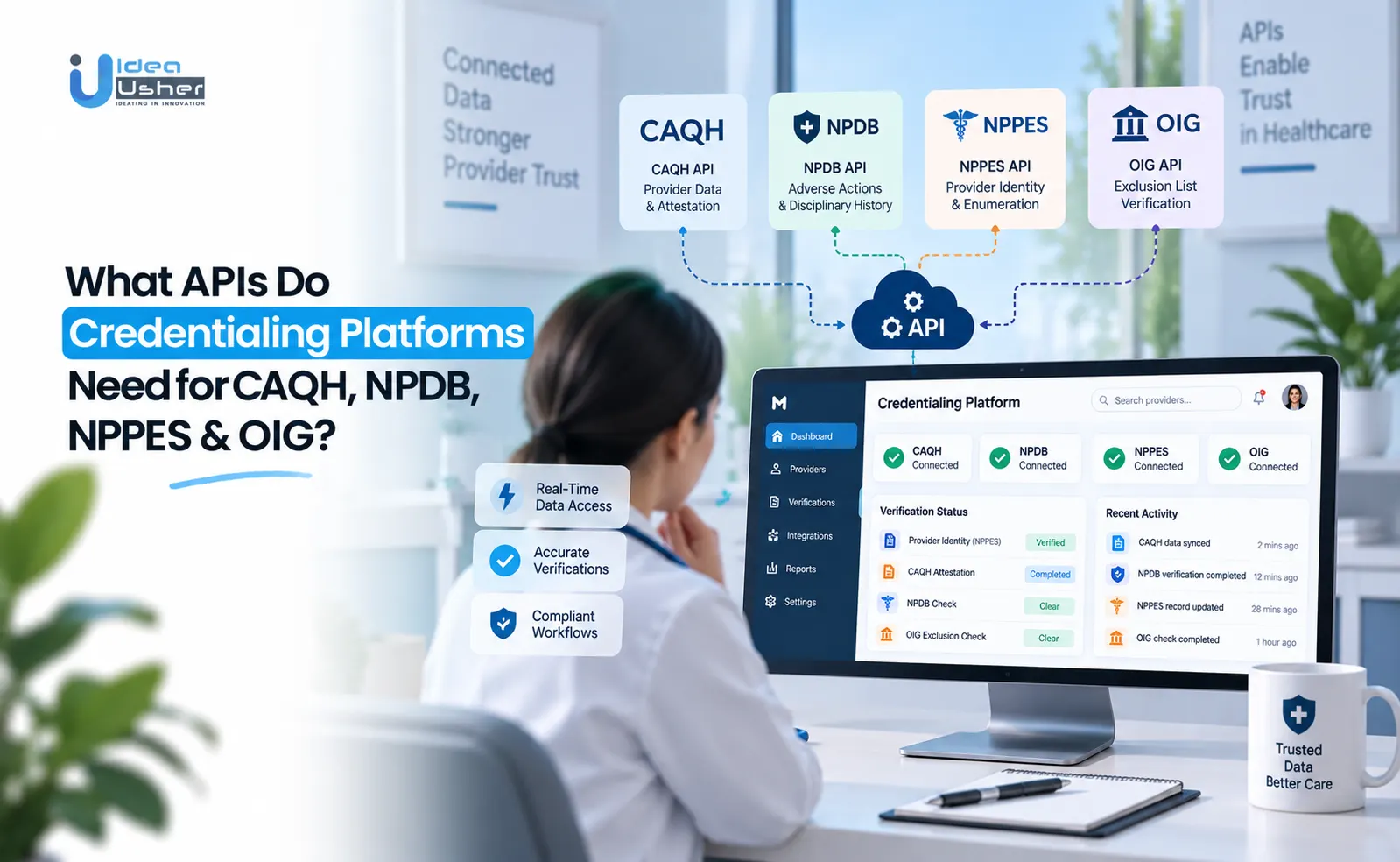
Credentialing platforms can connect with CAQH, NPDB, NPPES, and OIG through APIs and secure integrations that can help in automating provider verification, NPI searches, exclusion checks, document access, and ongoing monitoring. Founders and healthcare organizations often approach IdeaUsher to build custom credentialing platforms around these sources. They typically ask for CAQH and payer integrations, primary source verification, provider data management, automated screening with continuous monitoring, and configurable credentialing workflows with approvals and audit trails.
We have seen that many US healthcare startups are now exploring custom credentialing platforms. Checking provider credentials by hand takes time and can lead to mistakes. As the number of providers grows, these checks become even harder to manage. Many teams also want a system that fits the way they already work instead of forcing them to change their process. That is why in this blog, we’ll look at the key integrations and things to consider when building a credentialing platform.
Why Do Credentialing Platforms Need Multiple Data Sources?
Credentialing platforms need multiple data sources because no single database can verify a provider’s identity, history, and eligibility at once. Connecting CAQH, NPDB, NPPES, and OIG lets each source verify a different part of the provider record. According to Data Intelo, the global mobile credentialing platform market was valued at $4.8 billion in 2025 and is projected to grow at a CAGR of 13.2% through 2034, reaching about $14.7 billion.
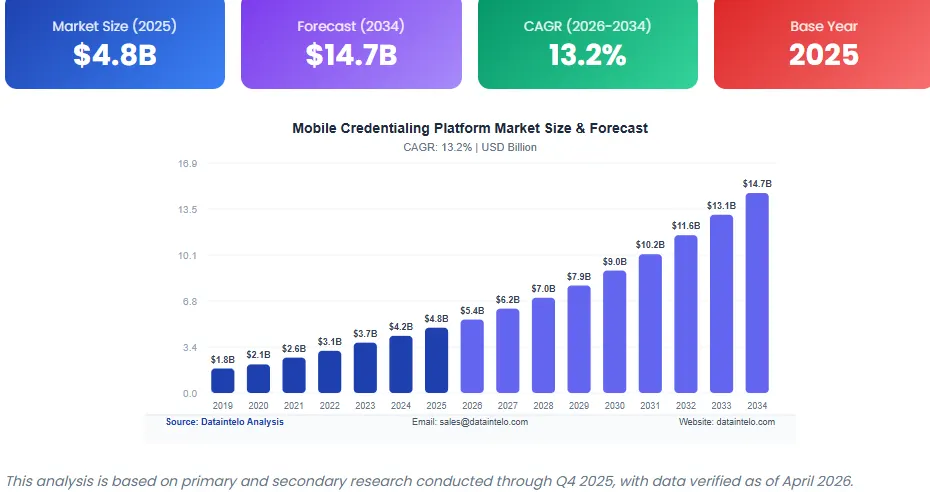
Source: Data Intelo
Each Source Verifies Different Details
Each source answers a different question. CAQH stores provider-reported information, NPDB contains malpractice and adverse-action reports, NPPES provides NPI data, and the OIG exclusion list identifies people excluded from federal health programs.
| Source | What it verifies | Why it matters |
| CAQH | Provider profile, education, licenses, work history | Providers must re-attest at least every 120 days |
| NPDB | Malpractice payments and adverse actions | Held more than 1.87 million reports and handled over 14.9 million queries in 2024 |
| NPPES | NPI, name, practice and mailing addresses | Changes should be reported within 30 days |
| OIG exclusion list | Federal health program exclusions | Updated monthly |
Verisys shows how this works in practice. Its FACIS database combines exclusions, sanctions, debarments, and disciplinary actions. Its ProviderCheck supports real-time provider verification, while CheckMedic offers credentialing and provider data management. Its monitoring also covers licenses, DEA registrations, NPI records, and Medicare opt-out data.
One Platform Keeps Data Synced
These sources follow different update schedules. CAQH requires re-attestation at least every 120 days, while one Blue Cross plan allows 180 days for providers in Illinois. NPPES expects changes within 30 days, and OIG updates its exclusion list monthly. A connected platform can track these timelines automatically.
Medallion is one example. It launched Privileging, Integration Engine, CAQH Management, and CredAlliance for sharing verified provider data. It also introduced automated primary source verification and electronic privileging workflows.
Multiple Sources Catch Data Conflicts
Provider records can differ across databases. An HHS OIG review found inaccurate data in 48% of sampled NPPES records and 58% of PECOS records. The two systems disagreed for 97% of records, mostly because of address differences. A CMS review also found 45.1% of Medicare Advantage provider directory locations were inaccurate.
A connected platform can compare these records and flag issues such as:
- A CAQH address that does not match NPPES
- A license that differs from the issuing source
- An NPDB report missing from provider disclosures
- An OIG exclusion hit despite a clean CAQH profile
- An expired attestation on an otherwise current profile
These conflicts can also create financial risks. OIG states that employing or contracting with an excluded person can result in a $10,000 civil monetary penalty for each item or service, plus up to three times the amount claimed. Multiple data sources give credentialing teams more chances to catch these issues early.
CAQH, NPDB, NPPES & OIG Solve Different Credentialing Problems
CAQH, NPDB, NPPES, and OIG each verify a different part of a provider’s record. CAQH provides provider-reported credentialing information, NPDB checks malpractice payments and adverse actions, NPPES confirms NPI and provider identity details, and OIG helps identify providers excluded from federal health programs. Connecting all four gives credentialing platforms a more complete view of a provider.
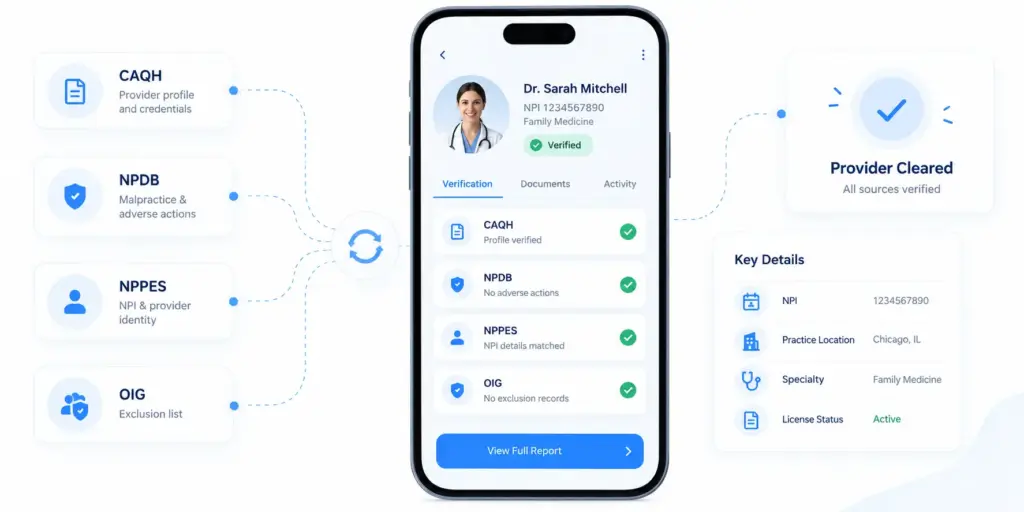
1. Each Source Verifies Different Details
Each source answers a different question. CAQH stores provider-reported information, NPDB contains malpractice and adverse-action reports, NPPES provides NPI data, and the OIG exclusion list identifies people excluded from federal health programs.
| Source | What it verifies | Why it matters |
| CAQH | Provider profile, education, licenses, work history | Re-attestation at least every 120 days |
| NPDB | Malpractice payments and adverse actions | More than 1.87 million reports and over 14.9 million queries in 2024 |
| NPPES | NPI, name, practice and mailing addresses | Changes should be reported within 30 days |
| OIG exclusion list | Federal health program exclusions | Updated monthly |
Verisys shows how multiple sources can work together. Its FACIS database combines exclusions, sanctions, debarments, and disciplinary actions. ProviderCheck supports real-time verification, while CheckMedic provides credentialing and provider data management. Its monitoring also covers licenses, DEA registrations, NPI records, and Medicare opt-out data.
2. One Platform Keeps Data Synced
These sources follow different schedules. CAQH requires re-attestation at least every 120 days, while one Blue Cross Illinois guide allows 180 days. NPPES expects changes within 30 days, and OIG updates its exclusion list monthly. A connected platform can track these timelines automatically.
3. Multiple Sources Catch Data Conflicts
Provider records can differ across databases. An HHS OIG review found inaccurate data in 48% of sampled NPPES records and 58% of PECOS records. The two systems disagreed for 97% of records, mostly because of address differences. A CMS review also found 45.1% of Medicare Advantage provider directory locations were inaccurate.
A connected platform can flag issues such as:
- A CAQH address that does not match NPPES
- A license that differs from the issuing source
- An NPDB report missing from provider disclosures
- An OIG exclusion hit despite a clean CAQH profile
- An expired attestation on an otherwise current profile
These conflicts can create financial risks. OIG states that employing or contracting with an excluded person can result in a $10,000 civil monetary penalty for each item or service, plus up to three times the amount claimed. Multiple data sources help teams catch these issues early.
What Should a Credentialing Platform Pull From Each API?
A credentialing platform should pull provider data from CAQH, practitioner history from NPDB, NPI and identity data from NPPES, and exclusion data from OIG. Each source fills a different gap in the provider record. The platform can bring these records together, compare them, and flag issues for review. These sources also use different integration methods. NPDB provides QRXS, NPPES provides an API and downloadable files, while OIG provides searchable and downloadable LEIE data.
1. CAQH Provider and Credential Data
CAQH provides provider profiles, education, licenses, certifications, work history, and malpractice information. CAQH ProView has more than 1.6 million providers and is used by more than 1,000 participating organizations, making it an important source for credentialing data.
A credentialing platform can pull CAQH data into its workflow to reduce repeated data entry. It should also track attestation status and supporting documents, since providers need to review and attest to their information. CAQH follows a 120-day attestation cycle, so platforms can use this information to trigger follow-ups when profiles need attention.
A CAQH integration can include:
- Provider profile and demographic data
- Education and training
- Licenses and certifications
- Work history and malpractice information
- Documents and attestation status
2. NPDB Practitioner History Data
NPDB provides information that may not appear in a provider’s self-reported profile. It contains medical malpractice payments and certain adverse actions, and only authorized organizations can query it. For software teams, NPDB provides QRXS, an XML-based API designed to connect NPDB with in-house credentialing systems. It also provides a test environment for validating XML files before production use.
| NPDB capability | Platform use |
| One-Time Query | Initial credentialing checks |
| Continuous Query | Ongoing practitioner monitoring |
| QRXS | Connecting NPDB with credentialing systems |
| Test Environment | Testing XML submissions |
Continuous Query costs $2.50 per enrolled practitioner per year and can send notifications within 24 hours of a new report. NPDB also says One-Time Query and Continuous Query are scheduled to merge into NPDB Query on December 4, 2026, which is important for teams planning new integrations.
3. NPPES Provider Identity Data
NPPES provides the National Provider Identifier (NPI) and public provider information. A credentialing platform can use it to confirm NPI status, provider names, practice locations, addresses, and other identity details. CMS provides access through the NPI Registry, NPPES API, and downloadable files.
The NPI Registry is updated daily, while CMS also provides monthly full files and weekly incremental files. The right option depends on whether the platform needs individual lookups or larger data updates.
One important limitation is that an NPI does not prove that a provider is licensed or credentialed. NPPES should therefore support identity and NPI checks while other sources handle actual credential verification.
4. OIG Exclusion Data
Credentialing platforms can use the OIG List of Excluded Individuals and Entities (LEIE) to screen providers against federal healthcare exclusions. OIG does not provide this as a standard public API. Instead, organizations can use its searchable database or download the complete LEIE CSV file.
OIG updates the LEIE by the 10th of every month. Platforms can use the full file or monthly supplements for recurring screening. Potential matches should still be verified through the OIG search because the downloadable file does not contain SSNs or EINs.
A practical OIG workflow is: Provider record → LEIE screening → Possible match → Identity verification → Result stored → Audit record
OIG also recommends documenting searches and additional checks used to verify potential matches. This makes search history and audit records important parts of the platform.
How to Normalize Provider Data Across Sources
The main challenge is not connecting these sources. It is making their data work as one provider record. CAQH, NPDB, NPPES, and OIG use different fields and identifiers, so the platform needs matching rules for identifying providers and handling conflicts. A practical approach is to create a master provider record and attach each source result to it. The platform can track where each value came from, when it was received, and how conflicts should be handled.
For example, NPPES can validate an NPI while CAQH supplies the broader credentialing profile.
- CertifyOS provides an example through its Provider Hub, which uses AI-driven entity resolution and survivorship rules to reconcile information from multiple sources into a single source of truth.
- Medallion takes a similar approach with its Provider Data Management platform. Its workflow can pre-fill provider profiles from NPPES, CAQH, and uploaded documents, flag conflicts for review, and connect credentialing and enrollment changes through its API and Integration Engine.
Where Do Credentialing APIs Fit in the Provider Data Stack?
Credentialing APIs connect the systems that collect provider information with the systems that use it. They bring in data from CAQH and NPPES, verify it against sources such as NPDB, OIG, and state licensing boards, and send verified records to EHR, billing, HR, and CRM systems. This replaces manual data entry with a connected provider data flow.
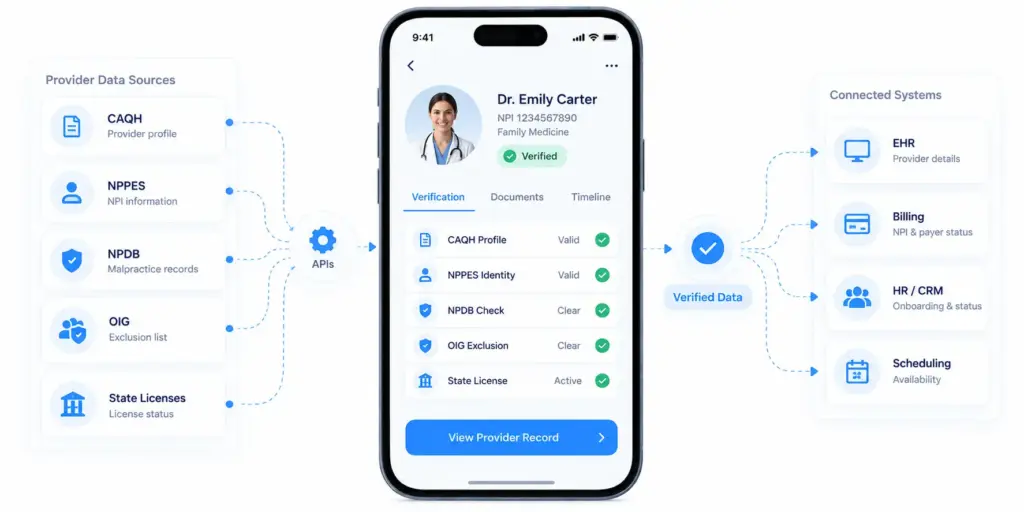
1. Provider Data Coming Into the Platform
Providers submit applications and documents, while CAQH provides much of their self-reported history and NPPES adds NPI details. CAQH recently rebranded as DataSpring, powered by CAQH, with the former CAQH ProView now called the CAQH Provider Data Portal. The organization carries forward more than 4.8 million provider-sourced records.
The main challenge is deciding which data to trust when sources disagree. A good intake layer stores the original data, normalizes names and addresses, and flags gaps before verification.
2. Verification Data From Primary Sources
Primary source verification confirms information directly with the organization that issued it. Credentialing platforms can connect to state licensing boards, NPDB, OIG, and other sources rather than relying only on provider-submitted documents. This helps return structured data and creates a clearer audit trail.
| Verification | Primary source | Cadence |
| Self-reported profile | CAQH | At least every 120 days |
| Malpractice and adverse actions | NPDB | Continuous Query alerts within 24 hours |
| Exclusions and sanctions | OIG, SAM.gov, state Medicaid lists | Monthly |
| License status | State licensing boards | Monthly tracking |
| NPI status | NPPES | Daily |
| Full re-verification | All sources | At least every 36 months |
Each verification should also store the source, method, and completion date. DataSpring’s Credentialing Suite includes DataSpring Primary Source Verification and DataSpring Sanction Monitoring, showing how verification and ongoing monitoring can operate as connected services.
3. Verified Data Flowing Out
Once a provider is verified, the information needs to reach the systems that use it. EHRs and scheduling systems need active status and practice locations, while billing systems need the NPI, payer status, and effective dates. Public directories also need updated provider information. CMS requires certain payer Provider Directory APIs to follow HL7 FHIR Release 4.0.1 and make updated information available within 30 calendar days.
Medicare adds another deadline. Providers generally revalidate enrollment every five years, or every three years for DMEPOS suppliers. Missing the deadline can lead to deactivation of billing privileges. Connecting these dates to credentialing workflows can turn a missed deadline into a scheduled task.
4. Connecting Credentialing With CRM and HRIS
Credentialing often starts with HR or recruiting and ends with contracting, scheduling, and billing. Payers can take 90 to 120 days to complete credentialing, so automated HRIS connections can reduce delays. Employment changes can also flow into credentialing automatically, helping teams stop monitoring providers who have left.
CRM integration provides visibility into provider status. Verifiable offers a native Salesforce application that connects credentialing with contracting and onboarding. Its CredAgent™ AI agent processes verifications in parallel and syncs results to the Provider Record with decision logs and primary-source evidence.
5. Building a Unified Provider Record
A unified provider record brings together NPPES identity data, CAQH profiles, verification results, NPDB and OIG monitoring, payer enrollment, and connected system IDs. Each verification should retain its source, method, and date so teams can quickly trace conflicts and prepare for audits.
The platform also needs to track different deadlines at the same time:
| Clock | Cadence |
| CAQH attestation | Every 120 days; 180 days for Illinois providers |
| NPDB Continuous Query | One year per practitioner |
| Exclusion screening | Monthly |
| Recredentialing | At least every 36 months |
| Medicare revalidation | Generally every five years |
| Directory updates | Within 30 calendar days |
A connected API layer keeps these deadlines and provider records in one place instead of leaving teams to manage separate spreadsheets and portals.
How Do APIs Work Together Inside a Credentialing Platform?
Credentialing APIs work together through a shared workflow that creates one provider record, matches data from CAQH, NPDB, NPPES, and OIG, runs source-specific checks, compares the results, and routes conflicts for review. The platform then stores verification evidence and timestamps so every credentialing decision can be traced back to its source.
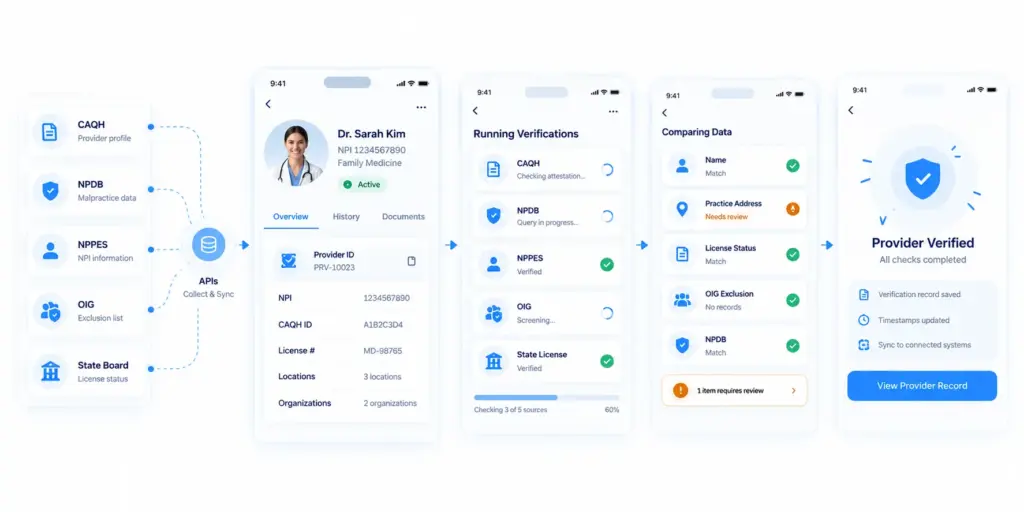
1. Create a Master Provider Record
The master record anchors every API result to one provider. It should store a stable internal ID plus NPI, CAQH ID, license numbers, and exclusion-screening details. It also needs multiple locations and organizations because 72% of providers work at multiple locations, while 50% billed under at least two organizations and 24% under three or more. A flat one-provider, one-address model will not work well.
The record must also preserve changes. 38% of providers changed office locations and 19% changed employers during the study period. NPPES requires updates within 30 days, but many providers update only when first registering. Keeping historical values lets the platform connect past verifications to the correct address and affiliation.
HealthStream’s CredentialStream follows this model by gathering and validating provider information into a single source of truth. Its Provider Portfolio offers a pre-validated credential wallet, while Network by HealthStream supports payer credentialing, compliance, network checks, directory updates, and contract management. Its OneClick Verisys service also supports outsourced CVO processing.
2. Match Providers Across Sources
Matching determines which record belongs to which provider. NPI is the first key, but it is not enough because NPIs may be used inconsistently and organizations can change names. Addresses are also unreliable. An HHS OIG review found inconsistencies between NPPES and PECOS for 89% of practice locations, 51% of mailing addresses, and 42% of license numbers. A layered matching approach is safer.
| Match tier | Identifiers used | What the platform does |
| Exact | NPI + name + license number | Link automatically and log the rule |
| Strong | Name + DOB + license state/number | Link automatically and store rationale |
| Fuzzy | Name variants + nicknames + prior addresses | Hold for reviewer |
| Exclusion confirmation | SSN or EIN through OIG tool | Confirm before adverse action |
OIG guidance explains why exclusion matches need extra confirmation. A matching name alone is not enough. Potential matches should be checked using SSN for individuals or EIN for entities. Platforms can normalize names and use exact, phonetic, or fuzzy matching before sending unconfirmed cases for manual review.
3. Run Source-Specific Checks
After matching, the platform runs the check designed for each source. These checks should run in parallel and store results separately so one slow source does not stop the workflow.
- CAQH: Pull the attested profile and confirm authorization and current attestation. Providers re-attest every 120 days, or 180 days in Illinois.
- NPDB: Run a One-Time Query or Continuous Query. Continuous Query sends email alerts within 24 hours of a new report. Queries cost $2.50 per practitioner, so duplicate checks should be avoided.
- NPPES: Check the NPI registry, which is updated daily, and review the deactivation file for retired numbers.
- OIG: Screen against the LEIE monthly supplements or full datasets, then add SAM.gov and state Medicaid exclusion lists.
- State licensing boards: Verify license status and discipline while tracking expiration monthly.
Timing matters too. NCQA’s ongoing monitoring standard calls for sanction information to be reviewed within 30 calendar days of release, with adverse event monitoring at least monthly.
4. Compare External Data
The platform then compares source results with provider-reported information. Each field needs its own matching rule because names may allow formatting differences while license numbers and exclusion status require exact checks.
| Field | Compared against | Typical rule |
| Legal name | CAQH, NPPES, license board | Normalize names and allow known aliases |
| Practice address | CAQH, NPPES, application | Flag mismatches and keep history |
| License number/status | State board, CAQH | Exact match; expired status blocks approval |
| Exclusion status | LEIE, SAM.gov, state lists | Confirmed match stops the file |
| Malpractice/adverse actions | NPDB, disclosures | Undisclosed reports go to review |
| Attestation | CAQH | Lapsed attestation pauses payer steps |
Comparison is important because about 20% of provider directory data changes each year, while health plans spend $2.1–$2.3 billion annually maintaining directories. Blue Cross Blue Shield of Michigan’s CAQH DirectAssure 2.0 pilot improved data alignment by more than 30%.
5. Route Discrepancies for Review
Not every mismatch needs human review. The platform should clear low-risk issues automatically while routing risky cases to specialists.
- Classify discrepancies by risk.
- Auto-clear low-risk differences such as capitalization.
- Queue medium-risk cases with source links and both values.
- Escalate exclusion matches or undisclosed adverse reports.
- Notify providers when information differs from the primary source.
- Record the decision, reviewer, and rationale.
symplr shows how software and human review can work together. Its symplr Provider product combines credentialing, privileging, enrollment, and recredentialing. Its NCQA-certified symplr CVO supports verification and enrollment services, while its Operations Platform connects systems through shared services and APIs.
6. Store Verification Evidence
Every verification needs supporting evidence. The platform should record what was checked, when it was checked, the source version, and who made the decision. Search logs, roster snapshots, input files, and output logs should also be retained. NPDB responses, for example, can only be downloaded or printed for 45 days, so platforms need their own copy.
| Evidence field | What to store | Why it matters |
| Source/version | System, endpoint, dataset version | Reproduce the result |
| Query inputs | NPI, name, other identifiers | Shows what was searched |
| Timestamp | Date and time | Shows verification freshness |
| Raw response | Payload, PDF, screenshot | Preserves evidence |
| Decision | Match/clear + rationale | Explains approval |
| Reviewer | User ID + approval status | Creates accountability |
Sensitive identifiers should have restricted access and encrypted storage and transmission. HIPAA’s Security Rule requires covered documentation to be kept for 6 years from creation or when it was last in effect, whichever is later. State, payer, and accreditation requirements may also apply.
What Should the API Architecture of a Credentialing Platform Look Like?
A credentialing platform should use a layered API architecture with separate layers for provider data, healthcare integrations, verification, provider matching, rules, audit trails, and monitoring. This structure connects sources like CAQH, NPDB, NPPES, and OIG while keeping verification, compliance, and ongoing monitoring organized and scalable.
1. Provider Data Layer
The provider data layer stores one profile per provider with locations, organizations, licenses, and identifiers. It should separate provider-reported data from verified data and record the source and effective date for each value. Provider data changes often. 2.4% of provider demographics change monthly, 30% of doctors change affiliations yearly, and 5% change status yearly.
The platform should keep historical values instead of overwriting them. CMS also requires certain payers to offer an HL7 FHIR R4.0.1 Provider Directory API with updates reflected within 30 calendar days.
2. Healthcare API Integration Layer
The integration layer connects outside systems through separate adapters that handle each source’s API, files, limits, and update schedule.
| Source | Interface style | What the adapter must plan for |
| NPPES | NPI Registry API + downloadable files | Updated daily; max 200 results; skip reaches 1,000; version 2.1 active |
| NPDB | Web access + XML batch tool | Up to 1,000 practitioners; $2.50 each; responses available for 45 days |
| OIG LEIE | Database, monthly files + online search | SSNs excluded from downloads; possible matches need online verification |
| CAQH | Provider Data Portal partner integration | Attestation every 120 days, or 180 days in Illinois |
The layer also needs pagination, retries, version control, secret management, and queues. NPPES has retired API versions 1.0 and 2.0, showing why source adapters should remain isolated.
3. Verification Engine
The verification engine decides which checks to run and returns normalized results. Each check should have its own status, timeout, and cost so checks can run in parallel.
- Per-source workers: Keep NPDB and OIG logic separate.
- Idempotent jobs: Prevent duplicate checks, especially $2.50 NPDB queries.
- Normalized results: Return status, evidence, timestamp, and confidence.
- Timeouts and retries: Failed sources remain pending rather than clear.
- Scheduled and event-driven runs: Support monthly exclusions and continuous-query alerts.
NCQA guidance calls for sanction review within 30 calendar days and adverse event monitoring at least monthly. Hospitals must query NPDB medical staff every two years.
4. Provider Matching and Normalization
This layer cleans source data and matches records to providers. Normalization should come first. An NPI has nine numeric digits plus a Luhn check digit and an 80840 prefix. Validating this format first can catch errors without using an API call.
- Validate identifiers before external calls.
- Standardize names, credentials, and addresses while keeping originals.
- Generate aliases for former names and nicknames.
- Match from exact identifiers to fuzzy candidates.
- Send low-confidence matches to the exception engine.
Raw and normalized values should stay together. OIG says a matching LEIE name alone is not enough; identity must be confirmed with an SSN or EIN. Missing identifiers should be recorded as gaps rather than guessed.
5. Rules and Exception Engine
Rules should be configurable because accreditation, state, and payer requirements differ. The Joint Commission allows reappointment up to three years, while California and New York still require two-year periods.
| Rule | Typical parameter | Engine action |
| Attestation freshness | CAQH every 120 days; 180 days in Illinois | Pause payer steps and notify |
| Recredentialing cycle | At least every 36 months under NCQA | Open case before deadline |
| Reappointment period | Up to three years, or shorter by state law | Schedule by state |
| Sanctions lookback | Most recent five years initially | Require full lookback |
| Exclusion screening | Monthly LEIE and other lists | Confirmed match is a hard stop; penalties reach $10,000 per item/service + up to 3× amount claimed |
The exception engine assigns severity, owner, and deadline. Possible exclusion matches go to compliance, while formatting issues use normal queues. Each case should retain conflicting values, sources, action, and decision.
6. Audit and Evidence Layer
The audit layer records checks, decisions, and changes with the source, inputs, raw response, timestamp, and decision-maker. An append-only design prevents evidence from being overwritten. NPDB responses are available for only 45 days, and confidentiality violations can carry penalties up to $27,894.
Intiva Health’s earlier Ready Doc used distributed ledger technology to timestamp credential documents and verify they had not changed. It also offered credential packaging, expiration reminders, and instant OIG status checks. Its current Incredable solution includes an AI Document Extractor.
7. Monitoring and Notification Layer
Monitoring continues after approval. New NPDB reports, monthly exclusion updates, and lapsed attestations should automatically create tasks for the right users. Each alert needs an owner, channel, and service level.
| Signal | Trigger | Who is notified | Timing reference |
| New NPDB report | Continuous Query | Compliance + credentialing lead | Within 24 hours |
| Exclusion match | Monthly LEIE refresh | Compliance | Updated monthly |
| Attestation nearing lapse | CAQH age | Provider + coordinator | Every 120 days |
| Medicare revalidation | CMS due date | Enrollment + billing | 3–4 months before due date |
| Recredentialing due | Cycle date | Credentialing specialist | 90–120 days before expiry |
| NPI deactivation | Weekly/monthly files | Credentialing + billing | Newly assigned, updated, and deactivated NPIs |
QGenda Credentialing connects with QGenda Advanced Scheduling through a standardized provider database. Its dashboard tracks credentials, privileges, and payer enrollment and can flag issues in real time. QGenda also integrates with NPDB, CMS, HRIS, and EHR systems, while its Payer Enrollment product automates applications, tracking, and roster management.
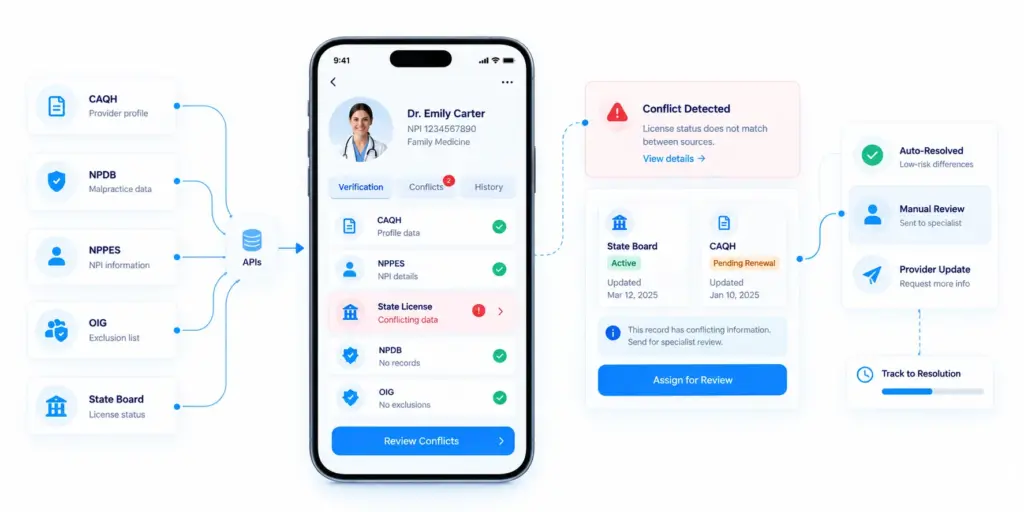
What Happens When Credentialing APIs Return Conflicting Data?
When credentialing APIs return conflicting data, the platform should flag the mismatch, determine which source has authority, and send unresolved cases to a credentialing specialist. The six scenarios below cover common conflicts across CAQH, NPDB, NPPES, and OIG, with each requiring different resolution logic.
1. Exact Provider Match
An exact match occurs when identifiers such as NPI, legal name, date of birth, and SSN in some NPDB queries align across sources. This is the ideal outcome, but real-world data makes it less common. When CMS compared provider names, addresses, and specialties in payer machine-readable files with NPPES, only 28% matched cleanly.
Platforms can improve matching by normalizing names and addresses and using NPI as the anchor field. Even small formatting differences can otherwise turn an exact match into a partial match.
2. Partial Provider Match
A partial match occurs when most fields suggest the same provider but one or more details differ. Common examples include a maiden versus married name, a missing suite number, or a different middle initial. Fuzzy matching, confidence scores, and secondary identifiers such as NPI + DOB or NPI + SSN suffix can reduce unnecessary manual reviews.
An AMA survey found 52% of physicians said patients experienced coverage issues because of inaccurate payer-directory information. CAQH research also found that the average physician practice manages 20.2 health plan contracts, each with its own directory and update cycle.
Common Partial Matches
- Name variations, including nicknames and maiden names
- Address differences, such as suite numbers or old locations
- Specialty or taxonomy discrepancies
- Multiple NPIs, including Type 1 vs. Type 2 confusion
3. Conflicting Credential Information
This happens when two sources provide different credential information, such as a state board showing an active license while CAQH shows pending renewal. A useful approach is to prioritize primary sources such as state boards, certifying bodies, and NPDB over self-reported CAQH data. When two primary sources disagree, the more recently updated source can take priority.
4. Missing Verification Data
Sometimes there is no conflict because the required information is simply missing. A source may not have returned data, a provider may have an incomplete CAQH profile, or a state board may not have digitized older records.
NCQA’s updated standards, effective in mid-2025, shortened the PSV windows:
| Program Track | Previous PSV Window | Current PSV Window |
| Credentialing Accreditation | 180 days | 120 days |
| Credentialing Certification (CVO) | 120 days | 90 days |
This gives organizations 33% less time to resolve missing information. Platforms can help by detecting incomplete CAQH profiles or unverified DEA numbers early instead of waiting for credentialing deadlines.
5. API Failure or Timeout
External sources can be slow or temporarily unavailable. State licensing boards may time out, NPDB may experience query delays, and CAQH can see load spikes during re-attestation periods. A credentialing platform should retry with backoff, use a cached last-known-good record with a staleness flag, and never treat a timeout as a successful verification.
Medallion’s acquisition of Andros reflects this approach. The combined platform runs primary-source queries against state medical boards, NPDB, OIG exclusion lists, and DEA registries in parallel. This can reduce verification cycles from weeks to days while preventing one slow source from blocking the workflow. NPDB alone processed more than 12.5 million queries in a recent year.
6. Manual Review and Exception Handling
Not every conflict should be resolved automatically. Human review provides a backstop for cases that do not meet automated rules. Exception queues should have clear workflows rather than simply flagging records in a database.
Key Exception Rules
- Set a confidence threshold for automatic approval.
- Keep an audit trail showing which source was trusted and why.
- Set an SLA for unresolved discrepancies.
- Provide a path back to the provider when more information is needed.
Medallion uses human-in-the-loop credentialing specialists alongside automated verification. Its Automated Quality Assurance layer reviews evidence behind automated PSV, while OIG or NPDB sanction hits and failed checks are routed to specialists instead of being auto-cleared.
Which Credentialing Checks Should Run Continuously?
Credentialing platforms should continuously monitor exclusion and sanctions status, license status, credential expiration, provider data changes, and NPDB reports. These checks help detect new exclusions, license changes, expiring credentials, updated provider details, and adverse actions before they create compliance or operational issues.
1. Exclusion and Sanctions Monitoring
Exclusion monitoring checks whether a provider is barred from federal healthcare programs. NCQA’s 2025 standards require monthly checks against OIG, SAM.gov, and state Medicaid lists. Employing or billing for an excluded person can result in penalties of up to $25,000 per item or service, plus treble damages.
The OIG LEIE contains roughly 84,000 active exclusion records and updates monthly, with new names typically posted around the ninth and effective around the twentieth. Verisys’ FACIS® database combines 10+ million exclusion, sanction, debarment, and disciplinary records from roughly 3,500–5,000 primary sources, covering 56 U.S. states and jurisdictions and 868 provider taxonomies.
2. License Status Monitoring
A provider’s license can become suspended, restricted, or revoked after credentialing. Monitoring is complex because authoritative data is spread across roughly 56 state and territorial licensing boards with different formats and update schedules.
| Monitoring type | Authoritative source | Typical update trigger |
| License status | State medical/nursing/allied-health boards | Discipline, suspension, revocation, reinstatement |
| DEA/CDS registration | DEA and state registries | Lapse, restriction, or surrender |
| Federal exclusion | OIG LEIE, SAM.gov | Monthly update |
| Medicare enrollment | CMS PECOS | Revocation or preclusion |
Because state boards generally do not push alerts like NPDB Continuous Query, platforms should poll license systems on a defined schedule and compare results with the previous status.
3. Credential Expiration Monitoring
Expiration monitoring covers state licenses, DEA registrations, board certifications, malpractice insurance, and CDS registrations. Modio Health’s OneView® flags credentials within 60 days of expiration, with adjustable thresholds, and pulls data from NPI registries, DEA databases, SAM, FSMB, and state boards. Modio reports that automated tracking reduces credentialing turnaround times by more than 30%, while its KLAS score has remained in the low-to-mid 90s out of 100 across recent cycles.
Each credential should have its own expiration date and alert threshold. A current license does not prevent risks from an expired malpractice policy or another credential.
4. Provider Data Change Detection
This monitoring catches changes to addresses, specialties, phone numbers, and other provider data before stale information reaches directories, claims, or payer rosters. About 1.4 million providers update or confirm information in the CAQH Provider Data Portal each month.
Platforms can sync CAQH, NPPES, and authorized CAQH feeds daily or every few days and compare updates with stored records. This helps detect changes within days rather than months later.
5. NPDB Continuous Query Workflows
NPDB offers One-Time Query and Continuous Query. One-Time Query provides a snapshot, while Continuous Query is a one-year subscription costing $2.50 per practitioner per year and sends notifications within 24 hours, often within minutes, when a new report is filed.
Under the older snapshot model, NPDB data showed roughly 500 days between receiving a report and its appearance in routine querying. More than 3.2 million practitioners were enrolled in Continuous Query by the end of one recent reporting year, while nearly 6,000 organizations received a combined 245,000 notifications in an earlier year.
6. Scheduled vs Event-Driven Monitoring
Credentialing platforms generally use both scheduled and event-driven monitoring. Scheduled checks query sources at fixed intervals, while event-driven monitoring receives updates directly when supported. Using both approaches helps reduce delays while covering sources that do not offer real-time alerts.
Scheduled Checks
Scheduled checks work best for sources without push capabilities, such as most state licensing boards and the OIG LEIE monthly file. The schedule should follow the source’s update cycle.
Event-Driven Monitoring
Event-driven monitoring works with subscriptions, webhooks, and Continuous Query. It should be preferred when available because it reduces the delay between a change and its detection.
The platform should choose the monitoring model based on source capabilities, rather than applying the same schedule to every source.
What Other Integrations Does a Credentialing Platform Need?
Beyond CAQH, NPDB, NPPES, and OIG, a complete credentialing platform also needs state boards, DEA, PECOS, SAM.gov, board certification sources, payer enrollment systems, EHR, HRIS, CRM, and billing systems. These integrations cover licensing, prescribing, Medicare enrollment, exclusions, certification, payer participation, and downstream workflows.
1. State Medical Board Integrations
CAQH and NPDB do not confirm whether a license is currently valid in a specific state. That information comes from the issuing board. There are roughly 70 medical and osteopathic boards across U.S. states and territories, each with different systems and update schedules.
The FSMB created the Federation Credentials Verification Service or FCVS to provide a primary-source-verified repository of physician credentials. Since 1996, FCVS has been used by more than 200,000 physicians and PAs. symplr’s symplrCVO and IntelliCVO services combine verification teams with integrations into multiple state boards, reducing manual portal work.
2. DEA Registration Verification
DEA verification is different because the DEA does not provide a public, free verification API and discontinued its active-registrant dataset through NTIS. Platforms generally use three approaches:
- Request the provider’s current DEA certificate.
- Validate the registration number using the DEA checksum algorithm.
- Use a licensed third-party data aggregator.
About 1.8 million practitioners hold active DEA registrations for Schedule II–V substances. Because DEA registrations are tied to specific addresses, platforms should also track address changes and renewals.
3. PECOS and Medicare Enrollment
CMS’s PECOS contains Medicare enrollment information and follows timelines separate from state licensing and commercial payer credentialing.
| PECOS process | Typical timeframe |
| Clean web application | 15 days or less |
| Clean paper application | Under 30 days |
| Standard revalidation | Every 5 years; 3 years for DMEPOS |
| Revalidation response | 60 days |
Missing the 60-day revalidation window can deactivate a provider from Medicare’s enrollment file. The provider must then submit a new enrollment application, potentially causing weeks of billing disruption.
4. SAM.gov and Exclusion Sources
SAM.gov and OIG’s LEIE are different systems, which is why NCQA requires checking both monthly. SAM.gov covers federal debarment and exclusion actions across government and updates daily, while LEIE updates monthly. There are also 42 state Medicaid exclusion lists, each with its own format. Some state exclusions may never appear on the federal LEIE, so a complete platform should combine SAM.gov, OIG, and relevant state Medicaid lists.
5. Board Certification Sources
Board certification should be verified through the certifying organization. The American Board of Medical Specialties or ABMS has 24 Member Boards covering 40 specialty and numerous subspecialty programs. Its database is updated daily and tracks 1,025,104 actively certified diplomates.
ABMS certification data is recognized by the Joint Commission, NCQA, and URAC for primary source verification, allowing platforms to complete the certification check without manual calls.
6. Payer Enrollment Systems
Credentialing does not automatically mean a provider can be paid by a commercial payer. Each payer has its own enrollment process, forms, timelines, and status tracking. Availity supports electronic provider enrollment and real-time application status tracking through Availity Essentials.
Its Provider Data Management module also combines primary-source and payer data into a single “golden record.” This connects credentialing, directory data, and payer enrollment instead of maintaining separate records.
7. EHR, HRIS, CRM, and Billing
The final integration layer connects credentialing decisions to internal systems. Without these connections, an approved provider may still appear incorrectly in scheduling, HR, or billing systems. symplr’s Cactus platform demonstrates this approach. Its Privilege Plus module covers 9,600+ clinical privileges across 250+ specialties, sourced from more than 30 organizations, including the FDA, ACGME, and AOA. It also integrates with EHR/EMR systems to connect privileges with clinical activity and FPPE/OPPE reporting.
Why Downstream Integration Matters
A credentialing database can confirm that a provider is verified. An integrated platform ensures that EHR, HRIS, CRM, scheduling, and billing systems receive that status automatically, reducing manual re-entry, claim issues, and operational delays.
Contact IdeaUsher for Credentialing Platform Development
Build a custom credentialing platform with IdeaUsher, backed by 500,000+ hours of coding experience and a team of ex-MAANG and FAANG developers. We help healthcare businesses build secure credentialing workflows that connect provider data, automate verification, and support ongoing compliance.
Custom Credentialing Platform Development
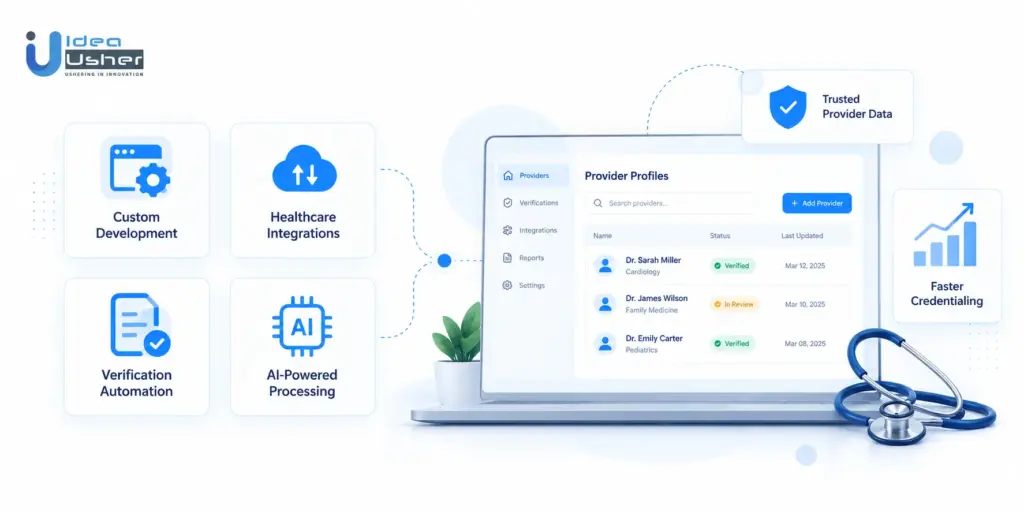
We build custom credentialing platforms around your provider workflows, approval processes, recredentialing cycles, and compliance requirements. The platform can include provider onboarding, credential tracking, approval workflows, dashboards, notifications, and audit trails. We design the system to fit your operations instead of forcing your team into a fixed workflow.
Healthcare API and Data Integrations
Integrate CAQH, NPDB, NPPES, OIG, state licensing boards, PECOS, SAM.gov, DEA, payer systems, EHRs, and HRIS to create a connected provider data environment. These integrations help bring provider information into one platform while reducing repetitive data entry and manual lookups. We can also build the integration layer to support data synchronization, error handling, monitoring, and future API connections.
Primary Source Verification Automation
Automate primary source verification across licenses, certifications, exclusions, sanctions, and other credentials while maintaining verification records, timestamps, and audit trails. The workflow can automatically identify missing or conflicting information and route exceptions to credentialing specialists. This helps teams reduce repetitive verification work while keeping a clear record of how each credential was verified.
AI-Powered Credential Processing
Use AI to extract credential data, identify discrepancies, organize provider records, and reduce manual work across credentialing workflows while keeping human review for exceptions. AI can help process documents faster, identify missing information, and support provider data matching across multiple sources. Human reviewers can remain in the loop for sensitive decisions, exceptions, and cases that require additional verification.
Conclusion
Credentialing platforms need CAQH, NPDB, NPPES, and OIG integrations to verify providers properly. Each source checks a different part of a provider’s record. When these sources work together, the platform can automate more checks and spot problems faster. This also helps healthcare teams keep provider data up to date without relying on manual work. For businesses planning to build a custom credentialing platform, choosing the right integrations early can make the system easier to scale and manage.
FAQs
A1: Credentialing platforms typically need integrations with CAQH, NPDB, NPPES, and OIG. These sources help verify different parts of a provider’s record. A platform may also connect with state licensing boards, PECOS, DEA, payer systems, and EHRs as the workflow grows.
A2: Yes. CAQH provides integration options for authorized organizations and credentialing workflows. These integrations can help platforms access provider information and keep credentialing data updated. The exact access and services available depend on the CAQH program and the organization’s authorization.
A3: A credentialing platform can connect with NPDB through its available query and integration services for authorized organizations. The platform can use NPDB to check practitioner history and adverse reports. It can also support Continuous Query to receive notifications when new reports are added.
A4: The NPPES API helps credentialing platforms look up NPI information and basic provider details. It can be used to confirm provider identity and match records across other systems. Since NPPES data is updated regularly, it can also help platforms keep provider records current.
A5: Yes. Credentialing software can automate screening against the OIG LEIE by checking provider records against exclusion data. The platform can run scheduled checks and flag potential matches for review. For stronger coverage, organizations can also include SAM.gov and relevant state Medicaid exclusion lists.
A6: Yes. These sources can work together as part of one credentialing workflow. NPPES can help identify the provider, CAQH can provide credentialing information, NPDB can support practitioner history checks, and OIG can screen for exclusions. Bringing the results into one platform gives credentialing teams a clearer view of each provider.