

Key Takeaways
- HIPAA-compliant HL7 integration needs end-to-end ePHI protection, including encryption, access controls, authentication, audit logs, monitoring and administrative safeguards.
- HL7 itself is not HIPAA-certified. Compliance depends on how patient data is handled across HL7 v2/MLLP, FHIR APIs, interface engines, storage and connected systems.
- Key security measures include TLS 1.3/IPsec VPN, AES-256, MFA, RBAC, mTLS, OAuth 2.0/SMART on FHIR, immutable audit logs and data minimization.
- A compliant HL7 setup follows 8 key steps, from mapping ePHI data flows and assessing risks to securing connections, monitoring activity, testing failures and maintaining compliance.
- Development costs depend on the approach. In-house development can cost $100K–$500K+, managed platforms may start at $499–$2,000+/month, while outsourced development can range from $50K–$250K+.
- IdeaUsher offers custom HIPAA-compliant HL7/FHIR integration with zero-trust security, EHR connectivity, automated ACK/NACK handling, clinical terminology mapping and zero vendor lock-in.
Healthcare interoperability cannot be treated as secure simply because an HL7 interface exchanges data successfully. HIPAA compliant HL7 integration requires organizations to protect ePHI throughout transmission, storage and processing while maintaining the controls needed to detect, manage and document security risks. As healthcare platforms connect more EHRs, labs, pharmacies and digital services, interoperability and privacy now have to be designed together.
Traditional integration approaches often focus on message mapping and connectivity while treating security as an additional layer. That model is no longer sufficient. Modern implementations need access controls, encryption, audit trails, secure infrastructure, monitoring and appropriate administrative safeguards built into the integration architecture.
In this blog, we will talk about how to get HIPAA compliant HL7 integration, key requirements, architecture, security controls, implementation steps, common risks and how to build a scalable healthcare integration solution that protects sensitive patient data, supports secure data exchange and meets changing compliance requirements.
What Does HIPAA-Compliant HL7 Integration Actually Mean?
“HIPAA-compliant interface” is often treated like a software feature or product badge in healthcare technology. In reality, HIPAA compliance is an operational, architectural, and administrative state, not an inherent property of HL7 or any file format.
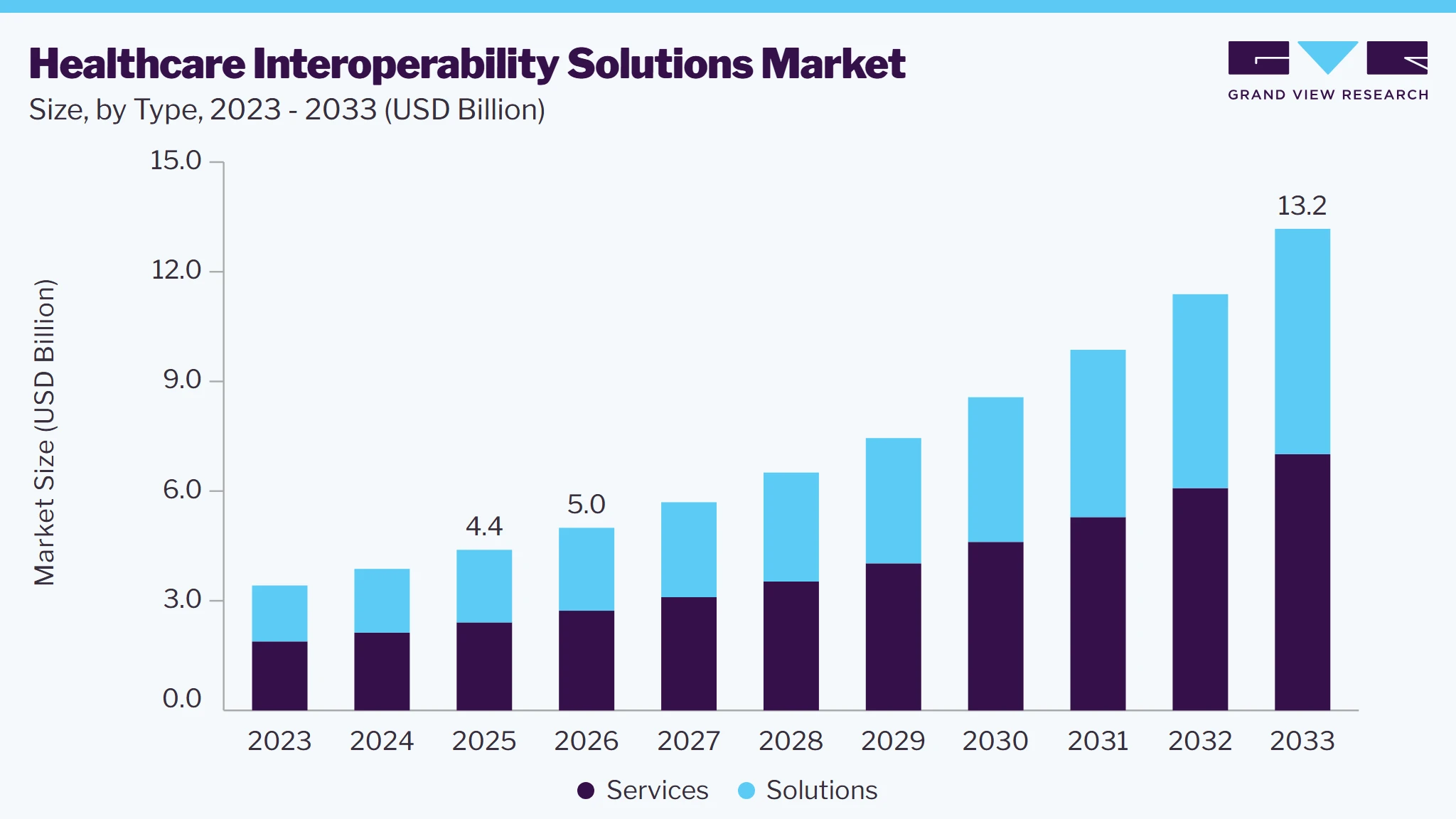
The global healthcare interoperability solutions market, valued at $4.4 billion in 2025 and is projected to grow from $5.0 billion in 2026 to $13.2 billion by 2033, growing at a 14.9 percent CAGR, according to Grand View Research, driven largely by regulatory mandates such as the CMS Interoperability Rule, ONC Cures Act requirements, and accelerating HL7 FHIR adoption.
Healthcare data breaches now average $6.64 million per incident, the highest of any industry for thirteen consecutive years, according to IBecker’s Hospital Review. An unsecured HL7 interface exposing ePHI directly carries that exact financial exposure for the organization behind it.
HL7 messages include sensitive data like diagnoses, demographics, psychiatric records, and billing details. Compliance requires an end-to-end secure environment with data protection in transit and at rest, strict access controls, auditing, and safeguards mandated by the HIPAA Security, Privacy, and Breach Notification Rules.
A. HIPAA Compliance Is Not an HL7 Certification
A common misconception among early-stage founders and IT teams is that implementing standard HL7 v2 or FHIR makes an application inherently compliant:
- Standards bodies do not grant compliance: Health Level Seven International (HL7) defines message syntax, datatypes, and RESTful resource schemas but does not test, audit, or certify software for HIPAA compliance.
- The “cleartext pipe” reality: Native HL7 v2 uses raw, unencrypted, pipe-delimited data. Sending it over bare TCP/IP MLLP across the public internet can expose ePHI and fail key HIPAA Security Rule safeguards.
- Compliance Is Comprehensive: Achieving compliance requires satisfying the triad of HIPAA mandates:
- Administrative Safeguards: Formal Business Associate Agreements (BAAs), security governance, workforce clearance, and incident response runbooks.
- Physical Safeguards: Facility access controls, device media controls, and cloud datacenter physical boundary attestations (e.g., AWS/Azure SOC 2 Type II).
- Technical Safeguards: Access controls, multi-factor authentication, transmission security (TLS), cryptographic at-rest protection, and immutable audit logs.
An interface engine can parse every HL7 segment with mathematical perfection, but if its debug log writes unmasked patient names to an unencrypted disk, the integration is non-compliant.

B. How HL7 Integration Handles ePHI
Electronic Protected Health Information (ePHI) comprises 18 specific identifiers under HIPAA such as names, dates of birth, Social Security numbers, medical record numbers (MRNs), and biometric data when linked to health conditions, clinical care, or payment data.
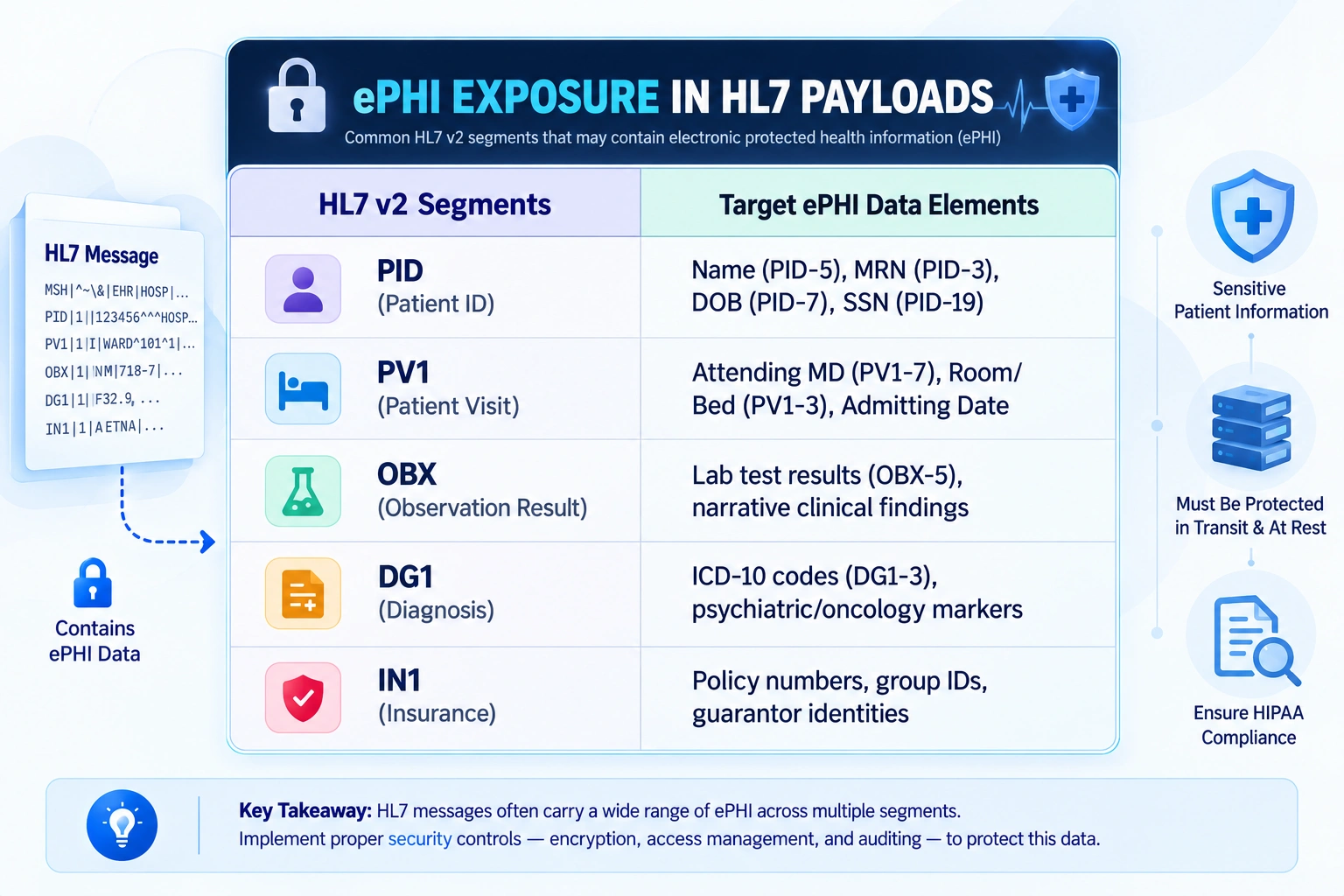
In an HL7 interface, ePHI is distributed across nearly every core segment and resource:
Handling ePHI in compliant integrations requires strictly enforcing the Minimum Necessary Rule:
- Payload truncation & stripping: For SIU^S12 appointment messages, filter non-essential clinical segments such as DG1 before routing.
- In-memory volatility: Process messages in memory where feasible to minimize persistent storage of unencrypted clinical payloads.
- Sanitized monitoring: Log only transmission metadata such as MSH-10 and error codes; redact names, MRNs, and lab values from monitoring tools and alerts.
C. HL7 v2 vs FHIR in HIPAA-Secure Integrations
Both protocols can be engineered for complete HIPAA compliance, but they place security responsibilities on different layers of your infrastructure:
| Compliance Dimension | Traditional HL7 v2 | Modern HL7 FHIR (R4) |
| Data in Transit | Encryption required: MLLP has no native encryption; use IPsec VPN, TLS-wrapped MLLP, or dedicated circuits. | HTTPS-based: Uses HTTPS with TLS 1.3 for endpoint communication. |
| Authentication & IAM | Network-level security: Relies on firewalls, IP allowlisting, and VPN keys, with limited user-identity context. | Identity-level security: Uses SMART on FHIR, OAuth 2.0, JWTs, and mTLS. |
| Access Granularity | All-or-nothing streams: ADT or ORU sockets typically deliver the full message payload. | Fine-grained scopes: API scopes can restrict access, such as patient/Observation.read or system/Patient.write. |
| At-Rest Staging | Interface-engine queues require AES-256 disk encryption and restricted permissions. | FHIR datastores can apply resource-level encryption, column-level security, and role-based partitions. |
D. Where HIPAA Controls Apply in an HL7 Workflow
HIPAA protection depends on how security responsibilities are distributed throughout an integration environment. Each stage has a distinct purpose, helping organizations create a stronger foundation for protecting healthcare information.
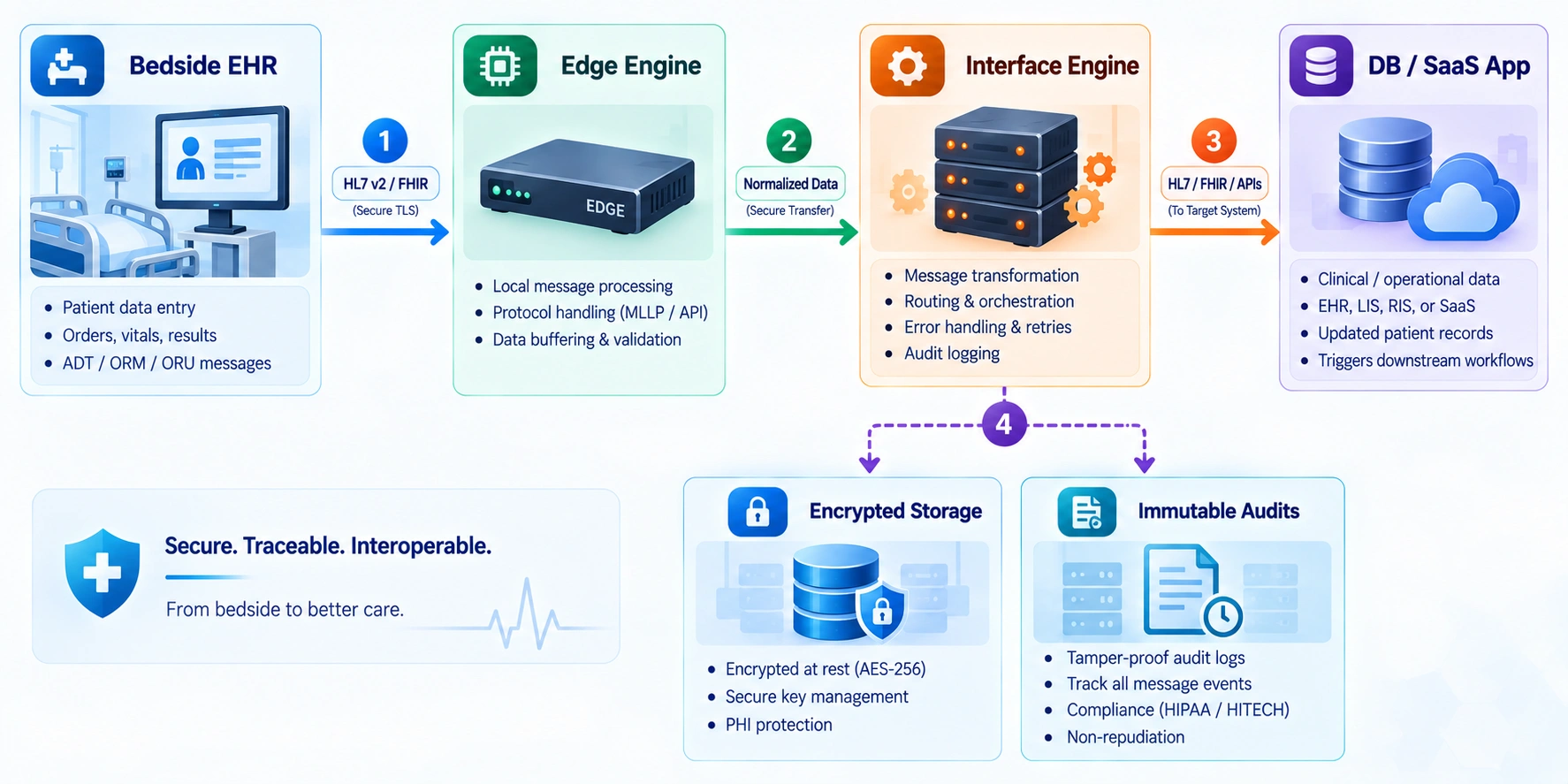
True security requires embedding HIPAA controls into every link of the transmission chain, from the bedside trigger to the downstream archive:
1. Origin Point (Data Minimization & Role-Based Access)
Strong access controls at the source help limit who can initiate data exchange and reduce unnecessary exposure of protected health information.
- Role-Based Access Controls (RBAC) ensure only authorized clinicians trigger message dispatches.
- Sending applications log the outbound trigger event linked directly to the initiating provider’s National Provider Identifier (NPI) or user credential.
2. Network Transit (Transmission Security)
Secure network connections protect HL7 messages while moving between facilities, reducing the risk of interception, unauthorized access or accidental exposure during transmission.
- Enforce TLS 1.3 or IPsec VPN tunnels with strong cipher suites (e.g., AES-GCM-256) across all inter-facility network hops.
- MLLP ports must be bound strictly to internal private IP addresses, never exposed directly to the public internet without an upstream firewall and intrusion detection system (IDS/IPS).
3. The Interface Engine (Access Control & Data Masking)
The interface engine needs controlled administrative access and protected logs so sensitive patient details do not appear unnecessarily during troubleshooting.
- Engine administrator consoles (e.g., Mirth Connect, Rhapsody) must enforce Multi-Factor Authentication (MFA) and automatic session timeouts.
- Debug logging configurations must use automated regex masking rules to obscure patient names, Social Security numbers, and clinical narratives before writing to disk.
4. Storage & Queue Persistence (At-Rest Encryption)
Encryption protects HL7 messages stored in queues and temporary locations, while proper key management helps prevent unauthorized access to stored healthcare data.
- All intermediate message queues, temporary landing tables, and dead-letter queues (DLQs) must be encrypted at rest using AES-256.
- Cryptographic keys must be managed via dedicated Key Management Services (e.g., AWS KMS, HashiCorp Vault) with automated key rotation policies.
5. Auditing & Monitoring (Accountability & Breach Prevention)
Detailed monitoring creates visibility into HL7 activity, helping teams identify unusual behavior, investigate incidents and respond quickly to potential security threats.
- Maintain an immutable, tamper-evident audit trail for every transaction, including timestamp, source/destination IPs, user identity, and Message Control ID (MSH-10).
- Forward audit telemetry to a centralized SIEM platform such as Splunk or Datadog to detect anomalous downloads and unauthorized access attempts.
What HIPAA Requires From an HL7 Integration
HIPAA-compliant HL7 integration requires more than a secure IPsec tunnel. Any pipeline that handles, transforms or routes PHI is subject to regulatory oversight.
Rather than prescribing a specific code checklist, HIPAA establishes a legal framework for protecting ePHI from unauthorized exposure, tampering and downtime throughout its transmission lifecycle.
A. Protecting ePHI Confidentiality, Integrity, and Availability
At the core of the HIPAA Security Rule (45 CFR Part 164, Subpart C) is the “CIA Triad.” It guides how healthcare systems protect ePHI throughout its lifecycle.
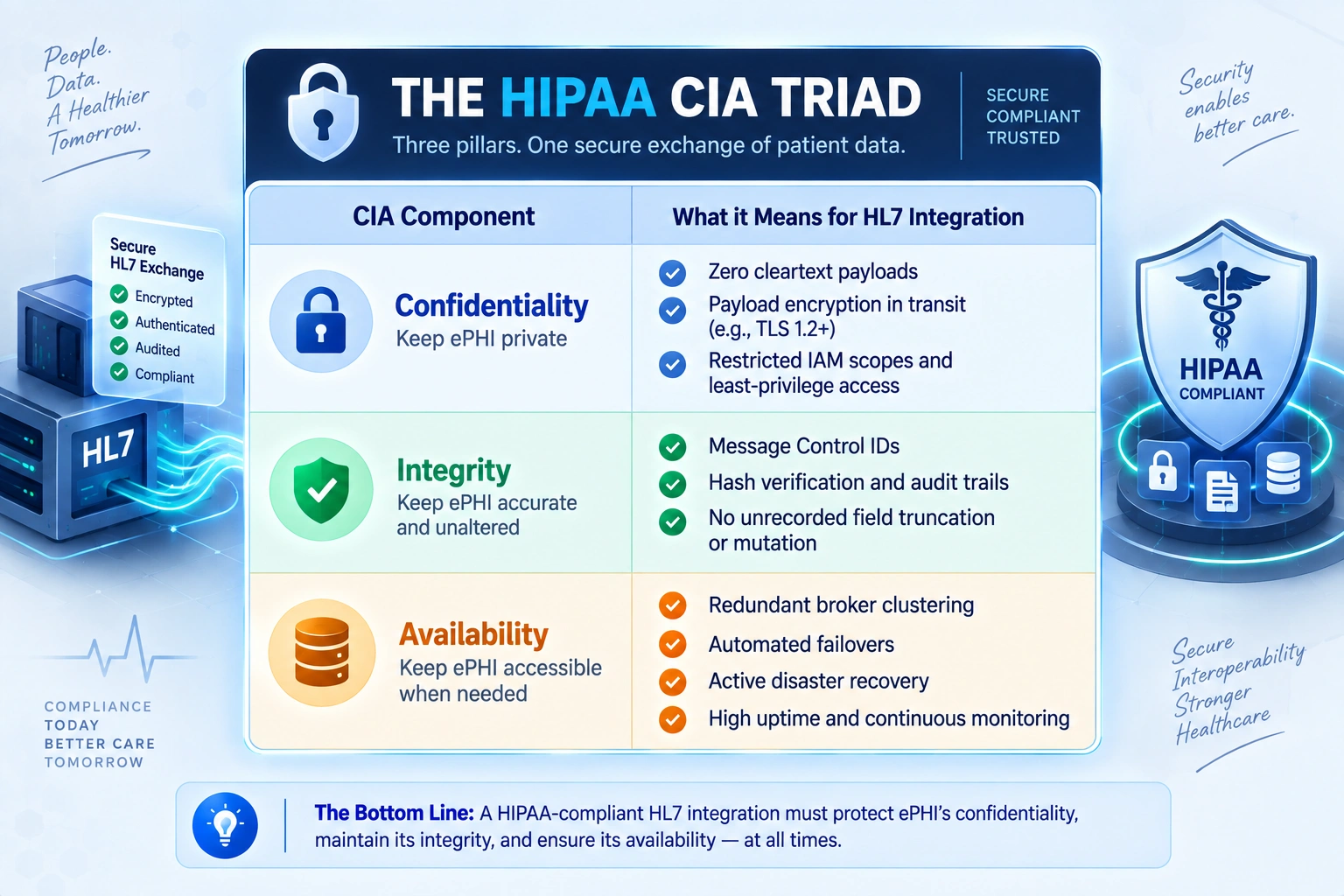
In the context of HL7 integration engineering, each principle establishes distinct technical design constraints:
- Confidentiality: Restrict ePHI to authenticated, authorized identities and prevent cleartext exposure across public networks, shared directories, or debug logs, especially for raw HL7 v2 messages containing sensitive patient data.
- Integrity: Ensure downstream data exactly matches the source EHR. Prevent encoding, delimiter, and parser errors from silently altering clinical values, diagnoses, or medication dosages.
- Availability: Keep critical ORU and ADT interfaces operational through redundant message brokers, automated failover, and durable persistent queues that prevent transaction loss during infrastructure failures.
B. Administrative, Physical, and Technical Safeguards
HIPAA requires a balanced defense strategy across three operational domains. An interface architecture can enforce high-grade cryptography, but if operational access controls or data center security are weak, the system remains legally non-compliant:
| Safeguard Domain | Core HIPAA Mandate | Practical HL7 Implementation Requirement |
| Technical Safeguards | Automate controls to secure access and protect data in transit and at rest. | Run MLLP over TLS 1.3 or IPsec VPN; use HTTPS for FHIR APIs, AES-256 for stored PHI, MFA, RBAC, and immutable audit logs for all access events. |
| Administrative Safeguards | Establish security policies, personnel controls, and risk-management workflows. | Execute BAAs with vendors handling PHI; enforce RBAC, prohibit shared admin accounts, and maintain incident-response runbooks for message drops and breach notification within required statutory windows promptly. |
| Physical Safeguards | Control physical access to systems, workstations, and data storage. | Verify cloud data-center certifications such as SOC 2 Type II and ISO 27001; enforce full-disk encryption and MDM for workstations storing clinical HL7 payloads and sample data. |
C. Risk Analysis Before Choosing Security Controls
A frequent failure point for early-stage digital health platforms is adopting a “one-size-fits-all” security configuration.
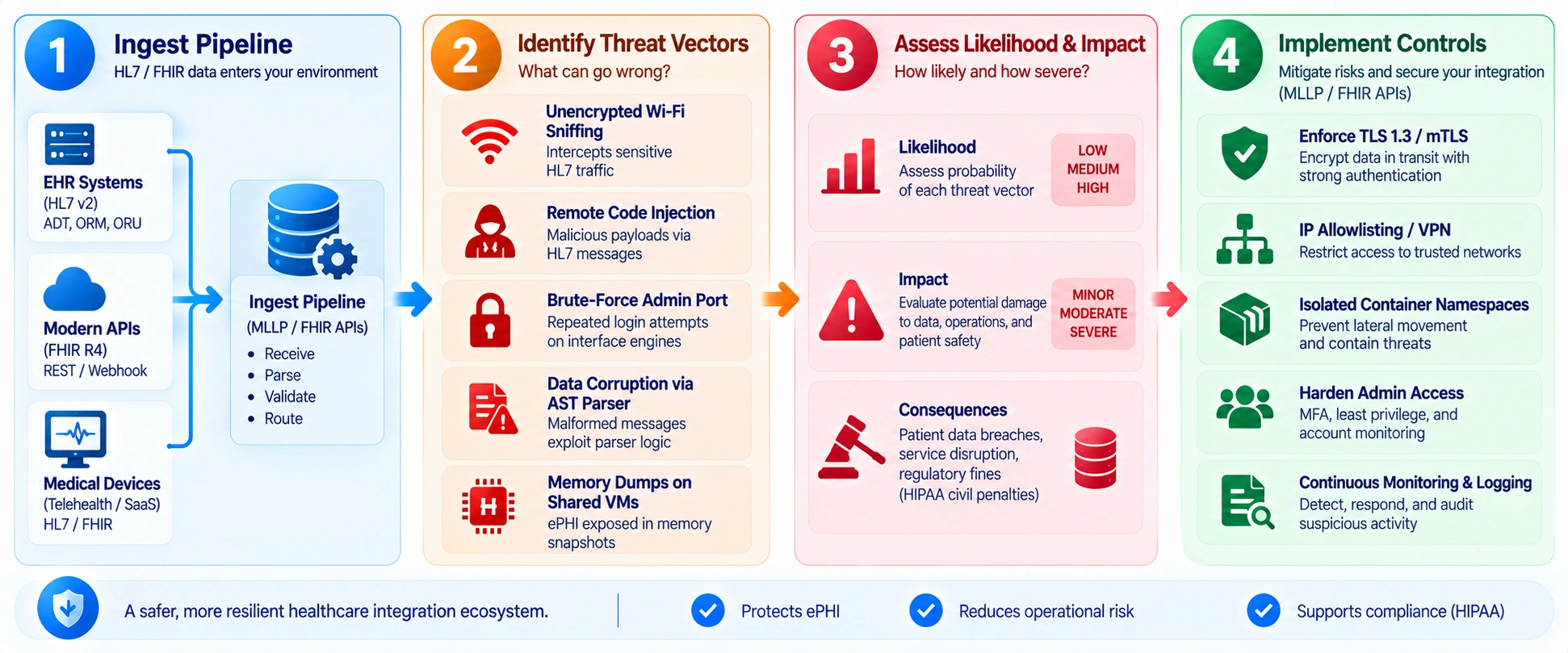
HIPAA explicitly mandates a formal Security Risk Analysis (45 CFR § 164.308(a)(1)(ii)(A)) prior to selecting technical safeguards:
- Contextual Evaluation: Match controls to the architecture, from isolated hospital LAN interfaces to multi-tenant cloud platforms handling nationwide webhook streams.
- Threat Vector Identification: Engineers must evaluate specific architectural vulnerabilities: Can an attacker intercept an unencrypted MLLP port? Does a custom parser fail open on buffer overflows? Are intermediate database backups exposed to unauthorized internal roles?
- Targeted Mitigation: Apply proportional controls, such as mTLS with automated certificate rotation for FHIR endpoints and network security groups with egress firewalls for MLLP listeners.
D. Minimum Necessary Access Across Data Flows
The Minimum Necessary Standard (45 CFR § 164.502(b)) requires covered entities and business associates to limit ePHI access and disclosure to what is needed for the intended clinical or administrative purpose.
Traditional HL7 v2 interfaces can violate this principle through “firehose” messaging. An ADT^A08 update sent to an external scheduling tool or patient engagement CRM may expose the full patient record, including psychiatric diagnostic codes (DG1), emergency contacts, Social Security numbers and primary care notes.
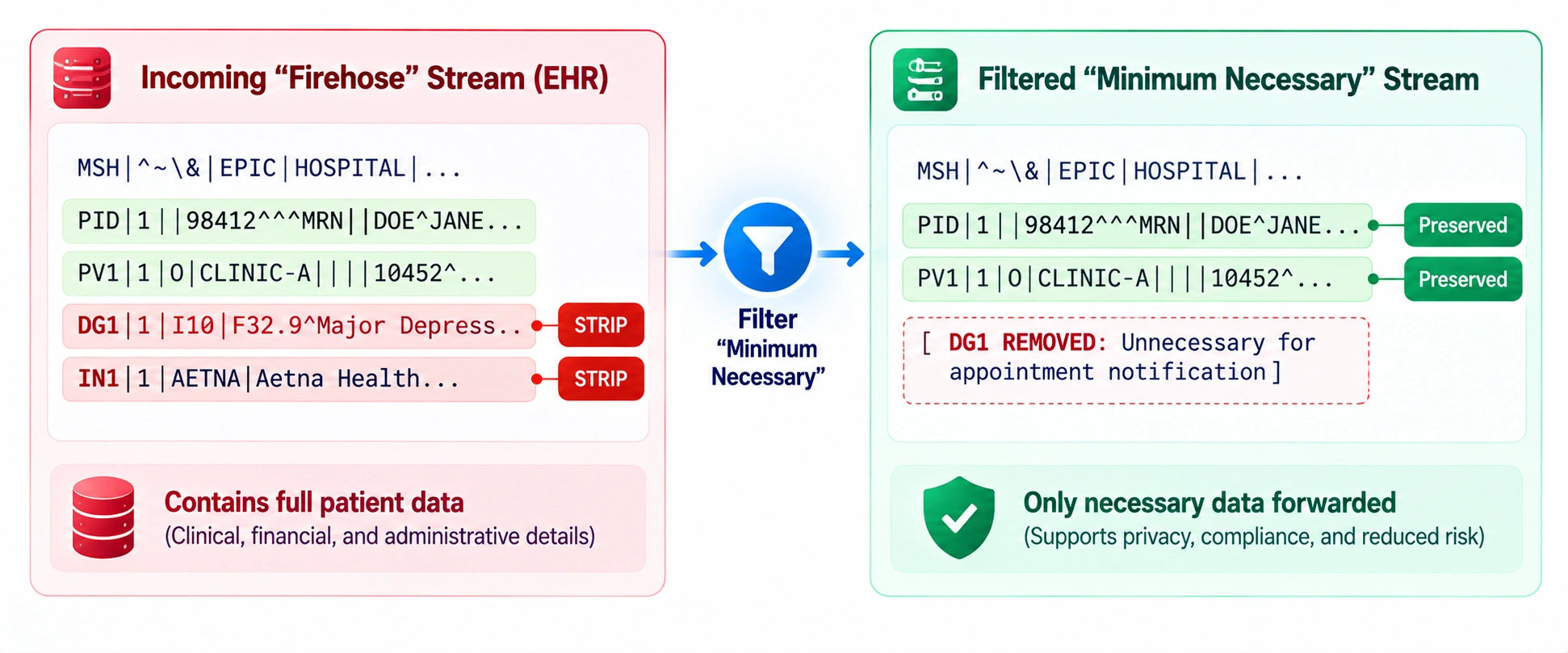
Achieving compliance requires engineering explicit data-minimization filters directly into your transformation pipelines:
- Segment and field stripping: Remove non-essential segments, such as IN1 or DG1, before routing HL7 payloads to systems that do not handle billing or diagnostics.
- Non-production payload masking: Never send live clinical feeds to test environments. Use automated de-identification to mask names, shift DOBs, and tokenize MRNs, using only synthetic or sanitized data.
- Granular FHIR API scoping: Use SMART on FHIR OAuth scopes instead of broad database access. Restrict tokens to required resources, such as Observation.read, preventing access to unrelated clinical data.
HIPAA Security Controls Your HL7 Architecture Needs
HIPAA compliance in an HL7 environment requires embedding the Technical Safeguards of the HIPAA Security Rule (45 CFR § 164.312) directly into the integration architecture. Because HL7 pipelines continuously handle, transform and store ePHI, network firewalls alone are not enough.
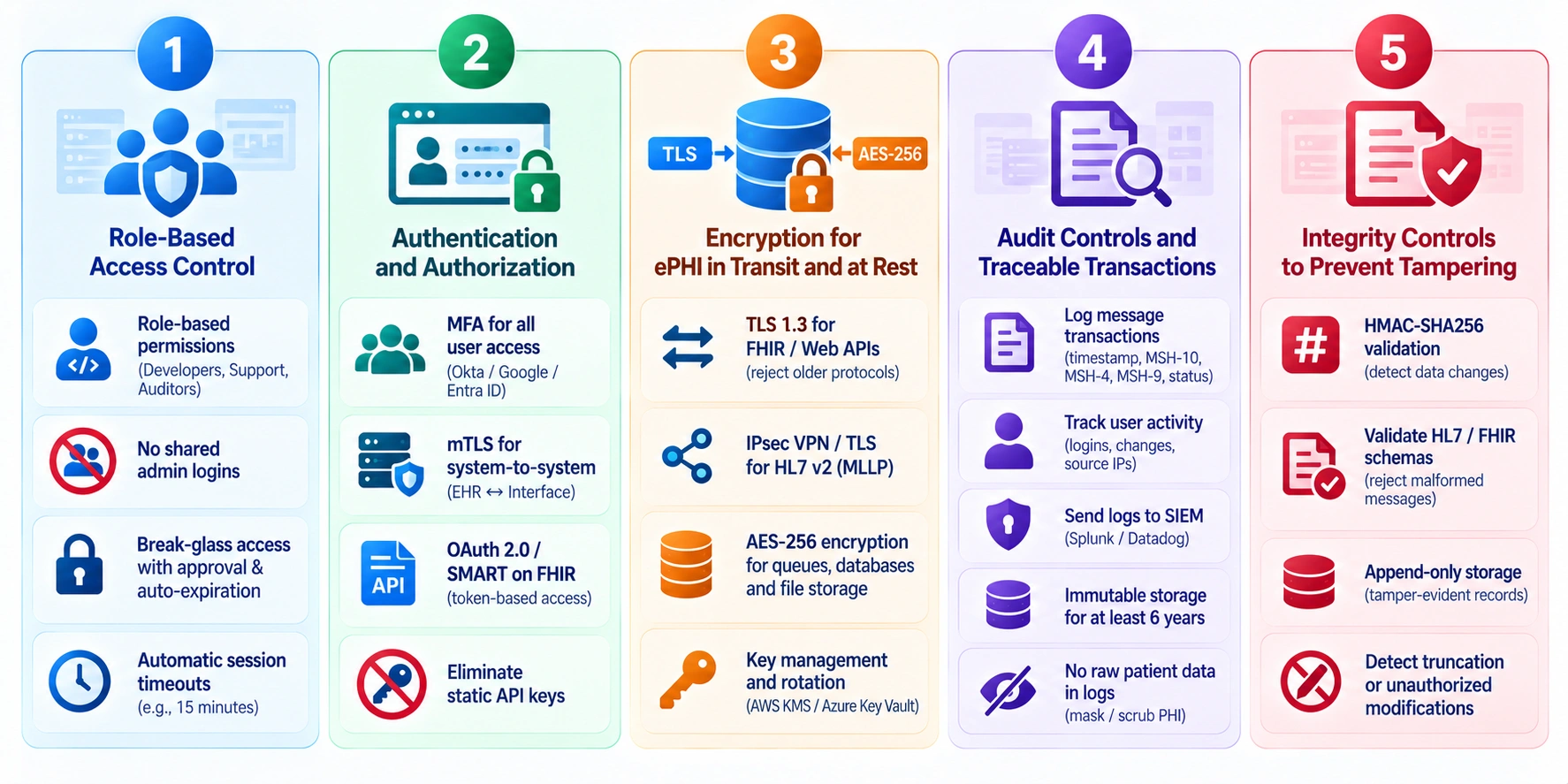
Your integration layer including interface engines, message brokers, storage queues and downstream connectors, must enforce six core technical controls to protect ePHI, reduce security vulnerabilities and meet regulatory requirements.
1. Role-Based Access Control for Integration Users
Under the HIPAA principle of least privilege, systems processing patient data must strictly limit who can view or alter clinical feeds:
- Granular Console Permissions: Interface engines (such as Mirth Connect or Rhapsody) must eliminate shared administrator logins. Access should be partitioned into defined team roles:
- Integration Developers: Can build mapping rules, test channels in staging, and edit transformation logic, but cannot view unmasked live patient records.
- Support Analysts: Can monitor queue backlogs, inspect transmission error counts, and retry failed messages, with clinical narratives and names masked by default.
- Compliance & Security Auditors: Have read-only access to audit trails, configuration version histories, and login records without permission to alter live channels.
- Emergency “Break-Glass” Access: Require approval for temporary access to unmasked PHI during critical outages, with automatic expiration and permanent audit trails.
- Automatic Session Timeouts: Automatically disconnect idle web consoles, database tools, and remote sessions after a defined window, typically 15 minutes.
2. Authentication and Authorization for System Access
Every person and software application interacting with an HL7 interface must authenticate its identity before sending or receiving patient data:
- Human Identity Verification: Eliminate shared database logins. Route admin access through enterprise identity providers like Okta, Google Workspace or Microsoft Entra ID, with MFA required for every login.
- System-to-System Authentication (mTLS): Since MLLP lacks built-in authentication, use mTLS so both the EHR and integration engine verify digital certificates before establishing connections.
- Token-Based Authorization for FHIR: Use OAuth 2.0/SMART on FHIR instead of static API keys, with short-lived, signed tokens granting access to authorized patient resources only.
3. Encryption for ePHI in Transit and at Rest
The Department of Health and Human Services (HHS) treats robust encryption as an essential baseline. Intercepted or stolen patient data that was properly encrypted is shielded by the HIPAA Breach Notification Safe Harbor, protecting organizations from severe regulatory penalties.
A. Data in Transit (Moving Data):
- FHIR & Web APIs: All RESTful endpoints must enforce modern TLS 1.3 (or strict TLS 1.2) encryption, automatically rejecting obsolete, vulnerable security protocols.
- HL7 v2 Socket Feeds: Because native MLLP sends data as raw text, connections must run through encrypted IPsec VPN tunnels or private TLS-encrypted network channels between facilities.
B. Data at Rest (Stored Data):
- Message Queues: Temporary buffers and staging queues on the interface server (e.g., Mirth storage, RabbitMQ, Kafka) must use disk-level AES-256 encryption.
- Database & File Archives: Any database table, clinical document archive, or diagnostic staging folder holding patient records must enforce storage encryption.
- Key Management: Cryptographic keys should be stored in dedicated cloud key management systems (such as AWS KMS or Azure Key Vault) with automated key rotation and restricted access policies.
4. Audit Controls and Traceable HL7 Transactions
HIPAA mandates that every system touching electronic health records must track and record user and data activity:
| Audit Category | What Gets Recorded | Storage & Compliance Rules |
| Transaction Records | Timestamp, MSH-10, sending hospital (MSH-4), event trigger (MSH-9), and processing status. | No raw or unmasked clinical data. Store in high-speed logs for real-time monitoring and SLA tracking. |
| User & Configuration Logs | User IDs, source IPs, channel configuration changes, code revisions, and channel restarts. | Export to centralized SIEM/logging platforms such as Datadog or Splunk; alert on unauthorized changes. |
| Clinical Access Histories | User identity, Patient ID/MRN, clinical data accessed, and stated clinical purpose. | Preserve in immutable, tamper-resistant storage for at least 6 years to support federal audit requirements. |
Log Sanitization Rule: To maintain compliance, system logs should never write raw patient names, Social Security numbers, or clinical diagnostic text to plain-text log files. Scrub or mask identifying clinical details before writing operational logs to disk.
5. Integrity Controls to Prevent Data Tampering
Healthcare workflows require technical verification that patient data has not been altered, truncated, or corrupted in transit:
- Data Fingerprint Validation: Generate an HMAC-SHA256 checksum on message ingestion and re-check it before database writes to detect silent data changes, such as altered medication dosages.
- Strict Format Conformance: Validate inbound payloads against defined HL7/FHIR schemas; reject malformed transactions with a NACK so senders know processing failed.
- Tamper-Evident Storage: Use append-only storage for processed clinical transactions to prevent historical records from being modified or deleted retroactively.
How to Build a HIPAA-Compliant HL7 Integration
Handling protected health information across HL7 interfaces carries real legal exposure. This eight-step framework covers exactly how a HIPAA compliant HL7 integration gets built, from mapping ePHI data flows through encryption, access control, audit logging, and the ongoing maintenance required to stay compliant.
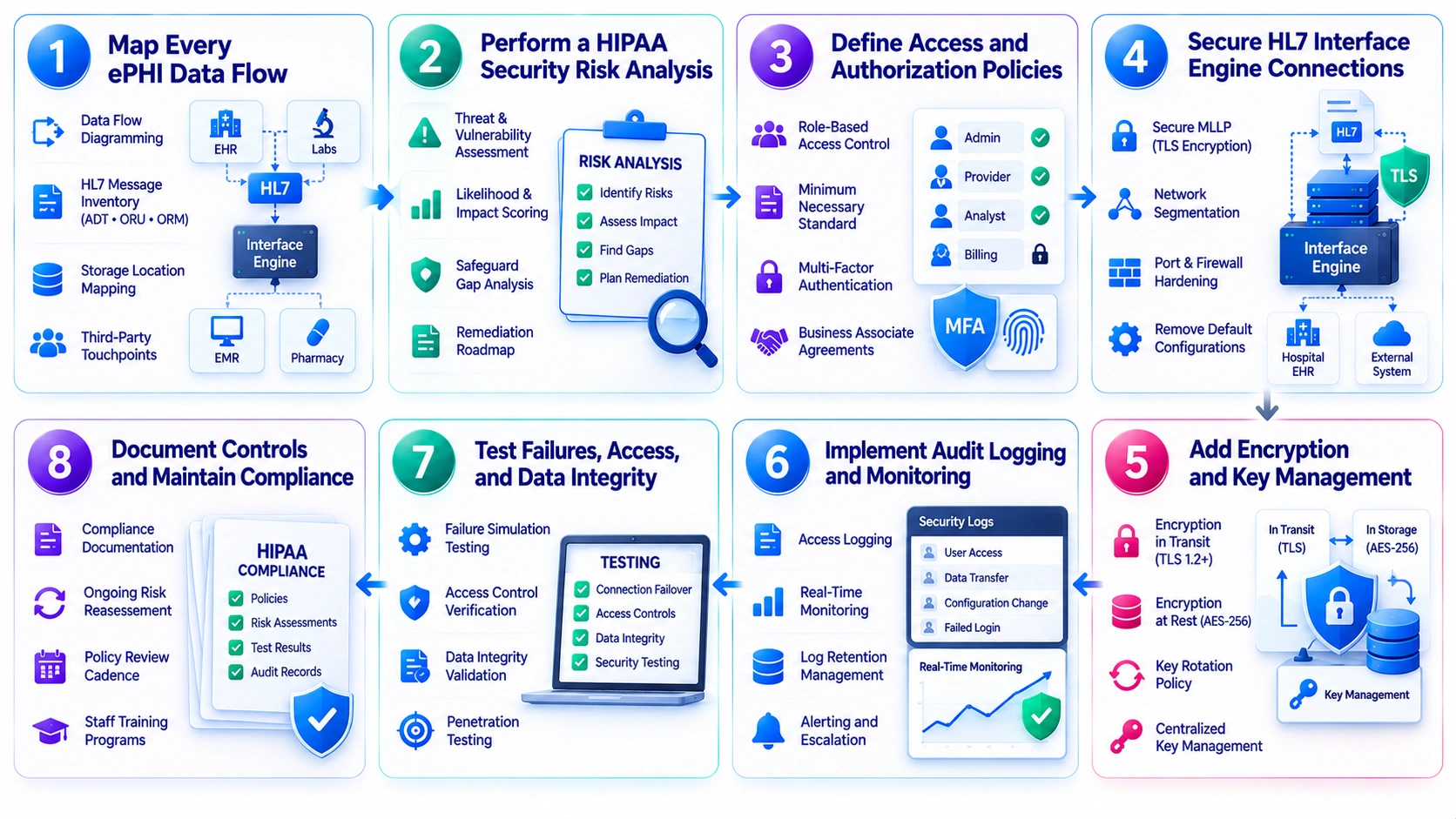
1. Map Every ePHI Data Flow
Our developers begin by tracing every point where electronic protected health information enters, moves through, or exits your systems, documenting each HL7 message type, endpoint, and storage location involved.
- Data Flow Diagramming: Maps every ePHI touchpoint across sender systems, interface engines, and receiving applications end to end.
- Message Type Inventory: Catalogs every ADT, ORU, and ORM message carrying patient data across connected systems and interfaces.
- Storage Location Mapping: Identifies every database, log file, and backup location where ePHI is stored or cached.
- Third-Party Touchpoint Review: Documents every vendor, clearinghouse, and external system that receives or transmits ePHI on your behalf.
2. Perform a HIPAA Security Risk Analysis
Our team conducts a formal HIPAA Security Risk Analysis, evaluating administrative, physical, and technical safeguards against the interface’s actual threat landscape to identify vulnerabilities before they become breaches.
- Threat and Vulnerability Assessment: Identifies potential risks to ePHI confidentiality, integrity, and availability across the integration pathway.
- Likelihood and Impact Scoring: Rates each identified risk by probability and potential severity to prioritize remediation efforts effectively.
- Safeguard Gap Analysis: Compares existing administrative, physical, and technical controls against HIPAA Security Rule requirements directly.
- Remediation Roadmap: Builds a prioritized action plan addressing every identified gap before development on the integration begins.
3. Define Access and Authorization Policies
We design role-based access controls and authorization policies that govern exactly who can view, modify, or transmit ePHI, applying the minimum necessary standard across every interface touchpoint.
- Role-Based Access Control: Assigns permissions by job function, limiting ePHI visibility to only what each role requires.
- Minimum Necessary Standard: Restricts data access and transmission to only the fields required for a given workflow.
- Authentication Policy Design: Defines multi-factor authentication and credential rules for every system and user touching ePHI.
- Business Associate Agreements: Ensures every third party handling ePHI through the interface signs a compliant BAA beforehand.
4. Secure HL7 Interface Engine Connections
Our developers harden every connection point on the interface engine, closing unused ports, enforcing secure transport protocols, and eliminating default configurations that commonly expose HL7 systems to attack.
- Secure MLLP Configuration: Enforces TLS-encrypted MLLP connections instead of plaintext transport between sending and receiving systems.
- Network Segmentation: Isolates interface engine traffic on a dedicated network segment, limiting exposure from broader system compromise.
- Port and Firewall Hardening: Closes unused ports and restricts inbound connections to explicitly allowlisted trusted endpoints only.
- Default Configuration Removal: Eliminates default credentials, sample accounts, and unnecessary services left over from initial engine setup.
5. Add Encryption and Key Management
We implement encryption for ePHI both in transit and at rest, pairing it with a formal key management process that rotates, stores, and retires cryptographic keys securely.
- Encryption in Transit: Applies TLS 1.2 or higher to every HL7 message moving between systems and networks.
- Encryption at Rest: Secures stored ePHI in databases, logs, and backups using industry standard AES-256 encryption.
- Key Rotation Policy: Establishes scheduled rotation cycles for encryption keys to limit exposure from a single compromise.
- Centralized Key Management: Stores and manages cryptographic keys through a dedicated key management system rather than manually.
6. Implement Audit Logging and Monitoring
Our team builds comprehensive audit logging across every interface touchpoint, capturing who accessed what data and when, paired with real-time monitoring that flags suspicious activity as it happens.
- Access Logging: Records every user and system interaction with ePHI, including timestamps and specific actions taken.
- Real-Time Anomaly Detection: Monitors traffic patterns continuously, flagging unusual access attempts or data transfer volumes immediately.
- Log Retention Management: Maintains audit logs for the duration required under HIPAA and organizational retention policies.
- Alerting and Escalation: Routes critical security alerts to the appropriate team immediately for rapid incident response.
7. Test Failures, Access, and Data Integrity
We stress test the integration under real failure conditions, verifying that access controls hold, data integrity survives interruptions, and message errors trigger visible alerts rather than silent failures.
- Failure Simulation Testing: Intentionally disrupts connections and services to confirm failures are detected and handled safely.
- Access Control Verification: Confirms permission boundaries actually prevent unauthorized users from viewing or modifying ePHI.
- Data Integrity Validation: Verifies messages arrive complete and unaltered across interruptions, retries, and network instability.
- Penetration Testing: Engages independent third-party testers to actively probe the integration for exploitable security weaknesses.
8. Document Controls and Maintain Compliance
Our team compiles complete documentation of every safeguard, policy, and test result, then establishes a maintenance schedule to keep the integration compliant as regulations and systems continue to evolve.
- Compliance Documentation: Compiles all risk analyses, policies, and test results into one audit-ready compliance record.
- Ongoing Risk Reassessment: Schedules periodic security risk analyses to catch new vulnerabilities as systems change.
- Policy Review Cadence: Establishes a recurring schedule to review and update access, security, and retention policies.
- Staff Training Programs: Trains employees and administrators on HIPAA obligations and proper handling of ePHI.
HL7 Integration Security: Build vs Buy vs Outsource
Securing an HL7 integration is not just an engineering decision. It is also a question of who holds responsibility when ePHI moves through the system. The right path, in-house, managed platform, or outsourced development company, depends on team capacity, compliance maturity, and how much control your organization needs over the code itself.
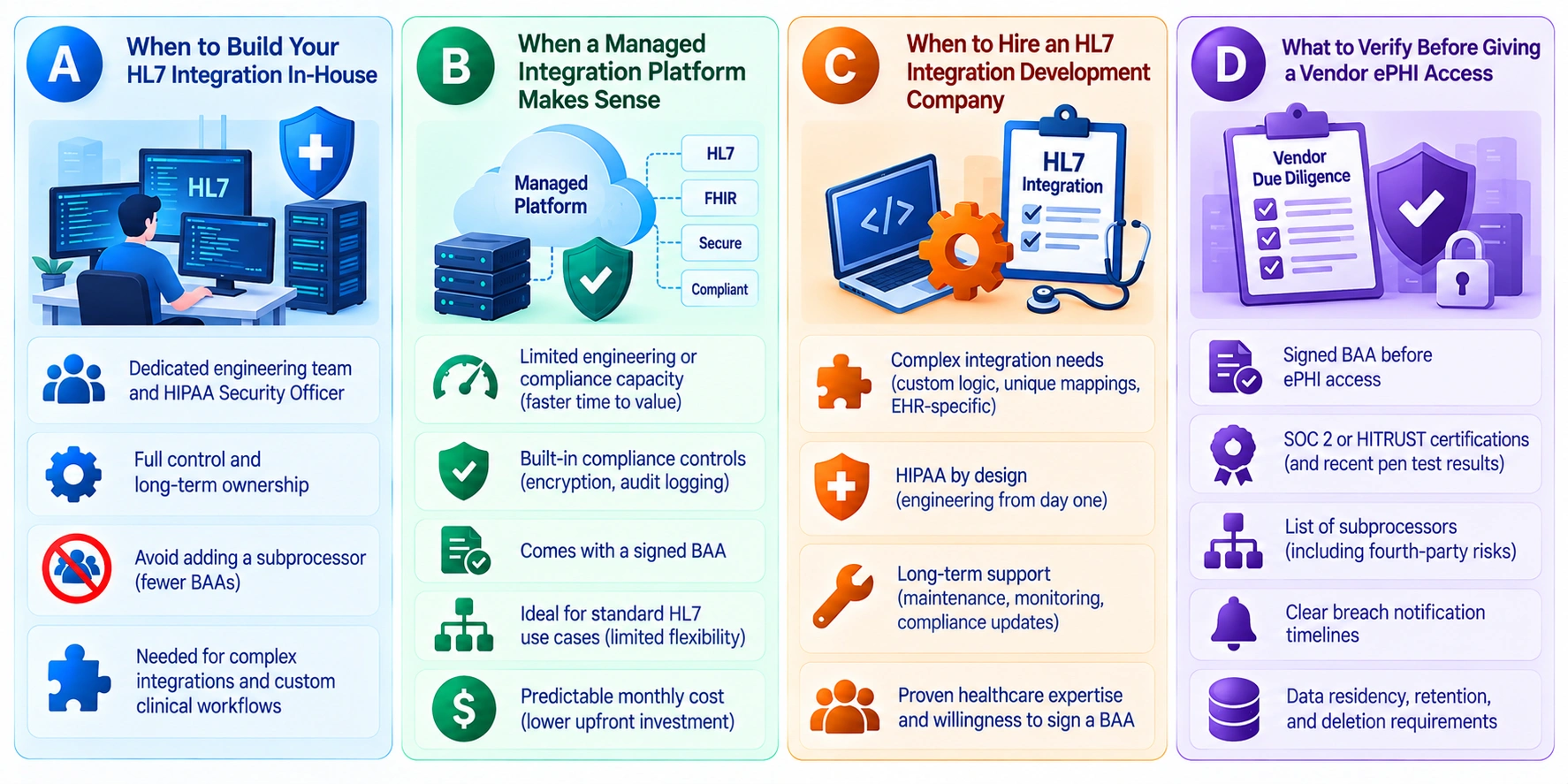
A. When to Build Your HL7 Integration In-House
Building in-house keeps every safeguard, from access controls to audit logs, under your team’s direct ownership rather than a vendor’s.
- You already have a dedicated engineering team and HIPAA Security Officer capable of managing risk analysis and compliance internally.
- Long-term ownership matters more than speed, giving your team direct control over the Security Rule safeguard stack without vendor roadmap dependencies.
- You want to avoid adding a subprocessor, since each vendor with ePHI access expands the compliance surface and requires a signed BAA.
- Interface complexity or clinical workflows exceed a managed platform’s configuration capabilities and require extensive customization.
B. When a Managed Integration Platform Makes Sense
A managed platform shifts the burden of compliance infrastructure from your team’s build backlog to the platform’s product roadmap, at a lower upfront cost.
- Your organization has limited in-house engineering or compliance capacity and needs a compliant integration faster than a custom build.
- The platform provides built-in compliance controls, including encryption at rest/in transit, audit logging, and a signed BAA.
- Your interface needs are largely standard, as managed platforms support common HL7 message types but offer limited flexibility for specialized clinical workflows.
- A predictable monthly cost is preferable to high upfront investment, especially for smaller practices or single-facility deployments.
C. When to Hire an HL7 Integration Development Company
A specialized development partner sits between the two extremes, delivering custom-built integration work with compliance engineered into the architecture from the start.
- Complex integration needs: Custom logic, unique mappings, or deep EHR-specific integrations exceed no-code and managed-platform capabilities.
- HIPAA by design: Treat HIPAA compliance as an engineering requirement from day one, avoiding costly retrofits for encryption and audit logging.
- Long-term support: Choose a development partner offering maintenance, monitoring, and compliance updates as systems and regulations evolve.
- Healthcare expertise: Verify proven healthcare integration experience, HIPAA-compliant delivery, and willingness to sign a BAA.
D. What to Verify Before Giving a Vendor ePHI Access
Before any vendor touches protected health information, a short verification checklist protects your organization from inheriting risk you cannot see or control.
- A signed BAA must be in place before any ePHI access begins, not after implementation starts.
- The vendor should provide current SOC 2 or HITRUST certifications and recent third-party penetration-test results.
- Require a complete list of subprocessors handling ePHI, including fourth-party access risks.
- Define breach notification timelines explicitly instead of relying on vague “reasonable efforts” or “prompt notice” language.
- Document data residency, retention, and deletion requirements, including storage locations and ePHI handling after engagement termination.
How Much Does HIPAA-Compliant HL7 Integration Cost?
The cost of HIPAA-compliant HL7 integration depends on interface complexity, security requirements, development approach and compliance needs. Understanding these cost factors helps healthcare organizations plan budgets accurately and avoid unexpected expenses during development, testing and ongoing compliance.
A. HL7 HIPAA Compliance Cost by Development Approach
HL7 integration costs vary based on who builds the solution, its complexity, and the level of HIPAA protection required. Comparing development approaches helps estimate investment, timelines, and compliance responsibilities, while partnering with an experienced provider like IdeaUsher can reduce the internal burden of building and securing the integration.
| Approach | Estimated Cost | Compliance Cost Included | Timeline |
| Build in-house | $100,000 to $500,000+ for the build, plus 20-30% added for HIPAA-specific compliance infrastructure | Not included; built and owned internally | 4 to 12 months, longer with limited internal compliance expertise |
| Managed integration platform | $499 to $2,000+ per month, scaling with usage and interface count | Included: BAA, encryption, audit logging bundled into subscription | Days to a few weeks |
| Outsourced development company | $50,000 to $250,000+ depending on interface count and complexity, HIPAA premium generally included in scoped quote | Typically included when quoted correctly; confirm it is itemized, not added later | 2 to 9 months depending on scope |
Note: The right approach depends on internal expertise, integration complexity and compliance requirements. Lower upfront costs may come with usage limits or less control, while custom development offers greater flexibility but requires more resources.
B. Phase-Wise Cost of Building a HIPAA-Compliant HL7 Integration
Compliance cost is not one lump sum. Building a HIPAA-compliant HL7 integration involves costs across planning, security, development, testing and ongoing compliance. Breaking the project into phases shows where the budget goes and which activities require the most resources.
| Phase | Estimated Cost | Typical Duration | Key Cost Drivers |
| 1. Map Every ePHI Data Flow | $5,000 – $30,000 | 1 to 3 weeks | Data flow diagramming, message type inventory, storage and third-party touchpoint mapping |
| 2. Perform a HIPAA Security Risk Analysis | $5,000 – $25,000 | 2 to 4 weeks | Threat and vulnerability assessment, risk scoring, safeguard gap analysis |
| 3. Define Access and Authorization Policies | $8,000 – $35,000 | 2 to 5 weeks | Role-based access design, authentication policy, legal review and BAA execution ($5,000-$20,000 of this typically legal) |
| 4. Secure HL7 Interface Engine Connections | $15,000 – $60,000 | 3 to 6 weeks | TLS/MLLP configuration, network segmentation, firewall hardening, engine configuration review |
| 5. Add Encryption and Key Management | $10,000 – $45,000 | 2 to 5 weeks | Encryption in transit and at rest, key rotation policy, centralized key management setup |
| 6. Implement Audit Logging and Monitoring | $10,000 – $40,000 | 3 to 6 weeks | Access logging infrastructure, real-time anomaly detection, alerting and escalation tooling |
| 7. Test Failures and Data Integrity | $20,000 – $55,000 | 3 to 8 weeks | Failure simulation, access control verification, third-party penetration testing ($15,000-$40,000 of this typically pen testing) |
| 8. Document Controls and Maintain Compliance | $10,000 – $50,000 one-time, plus 15-20% of total build cost annually | 2 to 4 weeks initial, ongoing after | Compliance documentation, staff training, recurring risk reassessment and policy review cadence |
Note: These phases show how compliance spending builds throughout development rather than appearing as one separate expense. Actual costs can shift based on interface count, existing infrastructure, security requirements and the complexity of connected healthcare systems.
C. HIPAA Compliance-Specific Cost Add-Ons
Certain compliance costs apply no matter which approach you choose. Risk analysis, penetration testing, audits, and legal review show up in every HIPAA-compliant HL7 project regardless of who builds it.
| Compliance Line Item | Estimated Cost (USD) | Notes |
| HIPAA Security Risk Analysis | $5,000 to $25,000 | Required baseline; often bundled into build-cost estimates but should be itemized |
| Penetration testing | $15,000 to $40,000 | Independent third-party testing; typically recurring annually or after major changes |
| Compliance audit | $10,000 to $50,000 | Formal review against 45 CFR Part 164 safeguards |
| Legal review (BAAs, policies, contracts) | $5,000 to $20,000 | Healthcare legal specialists commonly bill $300 to $600 per hour |
| Annual maintenance and compliance updates | 15-20% of build cost or $10,000 to $30,000 per year separately for compliance-specific updates | Covers regulatory changes, patching, and EHR API updates |
Note: HIPAA compliant HL7 integration cost figures reflect 2026 US market ranges drawn from published healthcare software and HIPAA compliance cost research. Actual pricing varies by vendor, interface count, and whether compliance is scoped from the start or added mid-project, so treat these as planning ranges rather than fixed quotes.
How to Make HL7 v2, MLLP, and FHIR APIs HIPAA Compliant
Converting HIPAA requirements into engineering controls requires protocol-specific safeguards. Traditional HL7 v2 over MLLP was built for local networks, whereas FHIR targets web architectures, so each presents unique security and compliance risks.
Achieving compliance across both legacy and modern data paths demands hardening the transport pipes, enforcing cryptographic identity verification, and deploying end-to-end audit observability.
1. Secure HL7 v2 and MLLP Connections
The Minimal Lower Layer Protocol (MLLP) is an encapsulation protocol that wraps HL7 v2 ASCII text with simple start and end block characters (<VT> 0x0B and <FS><CR> 0x1C0x0D). It possesses no native encryption, session handshakes, or authentication mechanisms.
- TLS 1.3 Encapsulation: Wrap MLLP socket connections in TLS 1.3; reject unencrypted TCP handshakes and allow only approved authenticated cipher suites.
- mTLS & Certificate Management: Require both endpoints to validate X.509 certificates; manage internal certificates through enterprise PKI, automated renewal, and CRLs.
- Dedicated Network Routing: All MLLP traffic must traverse private routing topologies:
- Site-to-Site IPsec VPNs: Encrypt all inter-facility point-to-point connections with AES-256 and SHA-256 hashing.
- Cloud Direct Interconnects: Route high-volume feeds through private cloud connectivity links (such as AWS Direct Connect or Azure ExpressRoute).
- Zero Public IP Exposure: Bind MLLP listener ports strictly to internal private IP addresses within isolated subnets, behind private load balancers.
2. Validate HL7 Messages and Protect Data Integrity
Preventing accidental data corruption or intentional tampering requires validating inbound structures before transactions trigger database mutations or clinical workflows:
- Strict Conformance Profile Validation: Validate inbound messages against formal HL7 v2.5.1 or custom conformance profiles; reject invalid segment order, missing PID-3/MSH-9/MSH-10, or malformed delimiters at the interface boundary.
- Cryptographic Payload Fingerprinting: Generate an HMAC-SHA256 checksum at socket ingress and link it to MSH-10; verify it after transformation and before database commits to detect altered or missing clinical data.
- Isolated Dead-Letter Queue (DLQ) Remediation: Quarantine unparseable payloads or failed clinical updates in an encrypted, durable DLQ instead of silently discarding them or blocking First-In, First-Out (FIFO) queues.
- Dispatch immediate administrative alerts to integration analysts via encrypted operational channels.
- Store the raw message alongside machine-readable rejection metadata (captured from ERR-3 and ERR-8 segments).
- Provide a secure, authenticated review dashboard where authorized engineers can remediate mapping errors and trigger a message replay.
3. Secure FHIR APIs With OAuth 2.0 Authorization
Modern FHIR implementations interact over public HTTPS channels, shifting the primary security perimeter from physical network boundaries to cryptographic identity tokens:
SMART on FHIR Backend Services Specification: For system-to-system automated integrations, eliminate shared client secrets. Enforce the OAuth 2.0 client_credentials grant with asymmetric client assertions:
- The connecting system signs a JSON Web Token (JWT) using its private key and submits it to the token authorization endpoint.
- The authorization server validates the signature against the client’s public key registered in a JSON Web Key Set (JWKS).
Fine-Grained Contextual Scopes: Issue short-lived access tokens (5 to 15-minute expirations) bounded by precise SMART on FHIR scopes. Discard generic wildcard access in favor of compartmentalized privileges:
- Read-only vital signs: patient/Observation.read?category=vital-signs
- System demographic sync: system/Patient.read
- Lab order submission: system/ServiceRequest.write
Automated Token Revocation: Maintain a distributed Redis cache or authorization server revocation list to immediately revoke active bearer tokens if an anomalous download pattern or credential leak is detected.
4. Apply Network Segmentation and Least-Privilege Access
Compartmentalizing system architecture limits the lateral spread of any security incident and enforces the HIPAA Minimum Necessary rule:
| Architecture Layer | Isolation Mechanism | Access Restriction Policy |
| Ingress DMZ | Public/perimeter subnets hosting API gateways and VPN endpoints. | Terminates TLS/mTLS, inspects traffic, and blocks direct database access. |
| Interface Processing Layer | Private VPC subnets hosting interface engines such as Mirth and Rhapsody. | Handles transformation and routing; blocks internet ingress, allowing only NAT Gateway egress. |
| Data Persistence Tier | Isolated database subnets hosting FHIR stores and persistent queues. | Allows access only through specific service-account credentials from the processing layer. |
| Service Account Governance | Uses ephemeral, short-lived IAM credentials such as AWS IRSA. | Grants single-purpose permissions, such as write-only access to observation_queue, with no cross-table access. |
5. Monitor HL7 and FHIR Activity With Audit Logs
A secure HIPAA compliant HL7 integration must maintain continuous traceability across every transaction, payload mutation, and API call:
Immutable Transaction Auditing: Log every message lifecycle event to a write-once, tamper-evident data store. Each audit event must record:
- Precise UTC timestamp (synchronized across systems via Network Time Protocol – NTP).
- System identifiers: Sending Application (MSH-3), Sending Facility (MSH-4) and Destination Endpoint.
- Message Control ID (MSH-10) or FHIR Resource ID.
- Event Trigger (MSH-9 e.g., ADT^A01 or HTTP method POST /Observation).
- Initiating User Identity, Client IP, and Granted Token Scopes.
Sanitized Log Streaming: Keep ePHI out of plaintext logs by using automated regex interceptors to mask patient names, SSNs, DOBs and clinical narratives before storage or streaming.
Real-Time SIEM Threat Detection: Stream audit events to a centralized SIEM such as Datadog, Splunk, or AWS CloudWatch:
- Anomalous Volume Alerts: Flag bulk FHIR $export requests or query volumes from one IP exceeding baseline thresholds by 300%.
- Failed Handshake Tracking: Detects repeated TLS handshake failures, invalid tokens, or MLLP socket resets as potential breach indicators.
- Six-Year Retention: Store transactional audit and authentication logs in encrypted, immutable storage such as AWS S3 Object Lock in Compliance Mode.
Common HIPAA Mistakes in HL7 Integration Projects
Building a HIPAA compliant HL7 integration involves more than encrypting messages. Developers must address real-world interoperability, security, and reliability challenges while ensuring ePHI remains protected across every connected system.
1. Inconsistent HL7 Messages and Data Mapping
Challenge: Different EHRs and healthcare systems may send inconsistent HL7 segments, fields, formats, or codes, causing mapping errors and unreliable ePHI exchange.
Solution: Our developers implement HL7 validation, configurable mapping rules, normalization, and comprehensive testing to handle system-specific variations without compromising data integrity or security.
2. Securing ePHI Across Multiple Integration Points
Challenge: ePHI can pass through interface engines, APIs, databases, and external systems, creating multiple points where unauthorized access or exposure can occur.
Solution: We apply encryption, role-based access, secure authentication, network controls, and least-privilege permissions across integration layers to minimize exposure and protect ePHI.
3. Handling Failed Messages Without Losing Data
Challenge: Network failures, malformed messages, duplicate transactions, or unavailable systems can interrupt HL7 workflows and create incomplete or inconsistent patient records.
Solution: Our developers implement acknowledgments, retries, error queues, duplicate detection, transaction tracking, and recovery workflows so failed messages can be safely identified and processed.
Build Your HIPAA-Compliant HL7 Solution with Idea Usher
IdeaUsher is a digital health product engineering partner with 11+ years of industry mastery across 50+ countries. Backed by 250+ experts, 1,000+ completed projects, and a 4.9/5 Clutch rating, we build custom, HIPAA-compliant healthcare interoperability platforms from scratch.
We skip generic templates to handcraft scalable, cloud-native architectures equipped with end-to-end ePHI encryption, bi-directional HL7 v2 and FHIR translation pipelines, automated audit logging, and certified EHR integrations to ensure your platform achieves clinical reliability and complete regulatory compliance.
Why Enterprises Partner With Us
Healthcare systems, digital health innovators, and healthtech enterprises partner with us because we transform fragmented clinical data workflows into secure, high-throughput, and fully compliant interoperability engines.
- HIPAA & HITECH Security by Design: We build zero-trust data safeguards with TLS 1.3+ in-transit encryption, AES-256 at-rest encryption, granular RBAC, and tamper-evident audit logging to protect ePHI.
- Dual HL7 v2 & FHIR (R4/R5) Interoperability: Our developers build resilient pipelines that ingest legacy ADT, ORM, and ORU feeds and transform them into standardized FHIR resources without semantic distortion or data loss.
- Certified EHR & Clinical Network Connectivity: We establish high-availability, bi-directional integrations with platforms such as Epic, Cerner/Oracle Health, Athenahealth, and MEDITECH using SMART on FHIR protocols.
- Fault-Tolerant Interface Orchestration: Our developers build scalable integration backends with automated ACK/NACK handling, intelligent dead-letter re-queuing, and socket-level MLLP reconnect handlers to prevent lost clinical transactions.
- Clinical Vocabulary Harmonization: We automate in-flight cross-mapping across LOINC, SNOMED CT, ICD-10, and RxNorm to maintain consistent clinical semantics across receiving systems.
- Zero Vendor Lock-In Asset Delivery: We provide clean, audited, well-documented source code, ensuring your organization retains full intellectual property, data sovereignty, and infrastructure ownership from day one.
Ready to deploy a secure, enterprise-grade HL7 interoperability platform built to strict HIPAA standards? Partner with Idea Usher’s principal healthtech and cloud software architects to map out your custom product build today.
Conclusion
The right approach to HL7 integration starts with understanding your data flows, security obligations, integration complexity, and long-term operational needs. A HIPAA compliant HL7 integration should protect ePHI across interfaces, APIs, systems, and workflows while supporting reliable data exchange. Organizations can choose between in-house teams, managed platforms, or specialized development partners based on their priorities. For tailored interoperability and security requirements, IdeaUsher can help plan, implement, and support an integration aligned with your healthcare environment.
FAQs
A.1. No. HIPAA compliant HL7 integration depends on appropriate safeguards, risk analysis, access controls, encryption, authentication, audit logging, transmission security, policies, and operational practices surrounding the integration.
A.2. Core controls include role-based access, strong authentication, authorization, encryption, audit trails, integrity protection, secure transmission, system hardening, monitoring, vulnerability management, and incident-response procedures.
A.3. The HIPAA compliant HL7 integration choice depends on connected systems and interoperability requirements. HL7 v2 commonly uses MLLP, while modern integrations may use FHIR APIs with secure authorization mechanisms.
A.4. A vendor handling ePHI on behalf of a covered entity may qualify as a business associate, requiring a BAA and appropriate contractual safeguards before access begins.