


Key Takeaways
- Custom LLM development makes sure that the model is better suited to an area of work. It also keeps data safe, fits into existing work processes, gives reliable results and helps a product stay unique over time.
- Enterprises have choices whether they want to buy an API, adjust an existing model or start from zero. It depends on how they need things, how much control they want, how much money they have and what their daily work needs are.
- RAG works best when the company needs to use information that changes often. Fine-tuning helps the model behave in a specific way, use the right style, use the correct terms and give consistent answers.
- Creating an LLM from the beginning is expensive and hard. It is only practical for companies that need full control, want to own the model completely or need very special performance.
- The cost of development can be as low as $20,000 for using an API. It can go up to more than $5 million for a custom model. The exact price depends on the data, equipment, security and system integrations.
Businesses are discovering that a powerful AI model may still be the wrong fit for the product because users want more than fluent answers. They want relevant context, data privacy and consistent performance, while businesses need to manage costs, integrations and model behavior. This makes custom LLM development a strategic choice that can boost product performance, save money and create a long-term advantage.
A general-purpose API may cover basic tasks, but specialized products often need private data, domain adaptation, workflow integration and predictable outputs. Building, buying or fine-tuning can each provide the right mix of control, speed and cost, depending on business needs. The real opportunity is choosing the approach that creates a real product edge.
In this blog, we will talk about custom LLM development, build vs buy vs fine-tune, key decision factors, costs, architecture choices and how to create an AI system built for long-term differentiation, designed to deliver greater control, scalable performance and a clear competitive edge as your business grows.
What Is Custom LLM Development for Business?
Custom Large Language Model (LLM) development adapts and operationalizes foundation models to meet an organization’s specific data, workflows and regulatory needs. It integrates five core layers: Infrastructure Core, Model Foundation, Adaptation Layer, Context & Retrieval and Application Layer to create secure, scalable, enterprise-ready AI systems.

Rather than training a multi-billion-parameter model from scratch, custom LLM development focuses on engineering a complete software solution around an established base model. It pairs base reasoning capabilities with proprietary enterprise data, programmatic guardrails and bidirectional software integrations, transforming generic conversational AI into a dependable, production-grade business asset.
A. How Custom LLMs Differ From General-Purpose AI
Consumer AI models (like ChatGPT, Claude or Gemini) are broad generalists trained on public web data. They lack access to internal files and database permissions, often generating generic or hallucinated answers for specialized business logic.
A custom LLM solution bridges this gap by engineering a specialized execution system around the model:
- Proprietary Data Grounding: The model is augmented with internal knowledge bases including SOPs, clinical records, engineering specifications, ERP databases and historical customer interactions, through Retrieval-Augmented Generation (RAG) and domain fine-tuning.
- Foundational Intelligence as a Baseline: Instead of spending tens of millions of dollars training a base model from zero, developers use high-performing open-weight or foundation models as the initial cognitive engine.
- System Integration vs. Standalone Chat: General AI operates inside isolated chat windows. A custom solution connects directly with enterprise tools such as CRMs, EHRs, billing platforms and ticketing engines, through APIs and function calling to read records and trigger downstream actions.
- Controlled Non-Determinism: Custom implementations enforce structured output contracts such as strict JSON schemas and programmatic guardrails to ensure generated outputs meet the technical standards required by downstream software.
- Specialized Operational Behavior: System prompts, deterministic guardrails and reinforcement techniques are engineered to reduce conversational filler, prevent hallucinations and enforce strict adherence to industry rules.
B. What Businesses Can Customize in an LLM
Enterprise customization involves configuring multiple layers of the application stack to align with specific business operations:
| Customization Layer | What Is Configured | Business Impact |
| Domain-Specific Terminology | Custom tokenizers, fine-tuned embeddings and domain dictionaries. | Reduces misinterpretation of industry jargon, CPT/ICD-10, financial acronyms and internal SKUs. |
| Response Formats & Tone | System prompts, few-shot libraries and LoRA/PEFT behavioral adapters. | Enforces brand voice, regulatory disclaimers and structured outputs such as Markdown tables or JSON. |
| Task-Specific Performance | Supervised fine-tuning (SFT) and Direct Preference Optimization (DPO) using historical data. | Improves high-value tasks like clinical appeals, invoice audits and legal contract summaries. |
| Proprietary Knowledge Access | Hybrid vector/keyword retrieval pipelines (RAG) and document-chunking logic. | Grounds responses in verified company sources and citations, reducing speculative hallucinations. |
| Private Deployment | Self-hosted open-weight models, such as Llama and Mistral, VPCs or on-premise hardware. | Keeps company prompts and customer data private from public APIs and external model training. |
| Workflow Integration | Tool-calling connectors, webhooks and asynchronous message queues. | Enables multi-step actions such as support tickets, refund processing and record updates. |
| Security & Governance | Role-Based Access Controls (RBAC), automated PII/PHI redaction and audit logging. | Enforces document-level permissions and compliance controls for HIPAA, SOC 2 and GDPR. |
C. When Does a Business Actually Need a Custom LLM?
The global large language models market size was estimated at $5.62 billion in 2024 and is projected to reach $35.43 billion by 2030, growing at a CAGR of 36.9% from 2025 to 2030, highlighting the rapid expansion of enterprise AI adoption.

Off-the-shelf AI models and consumer chatbots suit brainstorming, research and basic drafting. Customization becomes essential when standard tools face business constraints, especially as Gartner projects over 40% of enterprises will experience security, operational or compliance incidents from unmanaged public AI tools by 2030.
- Zero Hallucination Tolerance: When outputs influence financial transactions, clinical documentation, or legal compliance, responses need verified sources and traceable citations. OpenAI reports that 75% of surveyed workers experienced improved speed or quality.
- Strict Privacy & Compliance: The UK Government’s 2026 Business Data Survey found 73% of businesses were uncomfortable with their data training external AI models. This highlights the need for private deployment, access controls, encryption, data residency and clear governance policies.
- Machine-to-Machine Reliability: When AI outputs feed backend workflows, valid schemas and predictable responses become essential. OpenAI reports that weekly users of Custom GPTs and Projects increased approximately 19× year-to-date, reflecting deeper workflow integration.
- Proprietary Logic & Edge Cases: Workflows involving proprietary underwriting rules, non-standard contracts, or internal routing require specialized context. Capgemini reports that 93% of organizations are exploring or enabling generative AI capabilities, increasing the need for scalable enterprise solutions.
Custom LLM development focuses on moving past experimental chat prompts to build reliable software around foundational AI models, ensuring predictable performance, verifiable data security and clear ROI.

Build vs Buy vs Fine-Tune: What Actually Changes?
When executive teams evaluate generative AI, the strategic dilemma is frequently framed as a false binary: “Do we buy commercial software or build our own LLM?” In production engineering, the question is not whether to build an entire neural network from scratch, but which layer of the AI stack your organization should own, adapt or outsource.
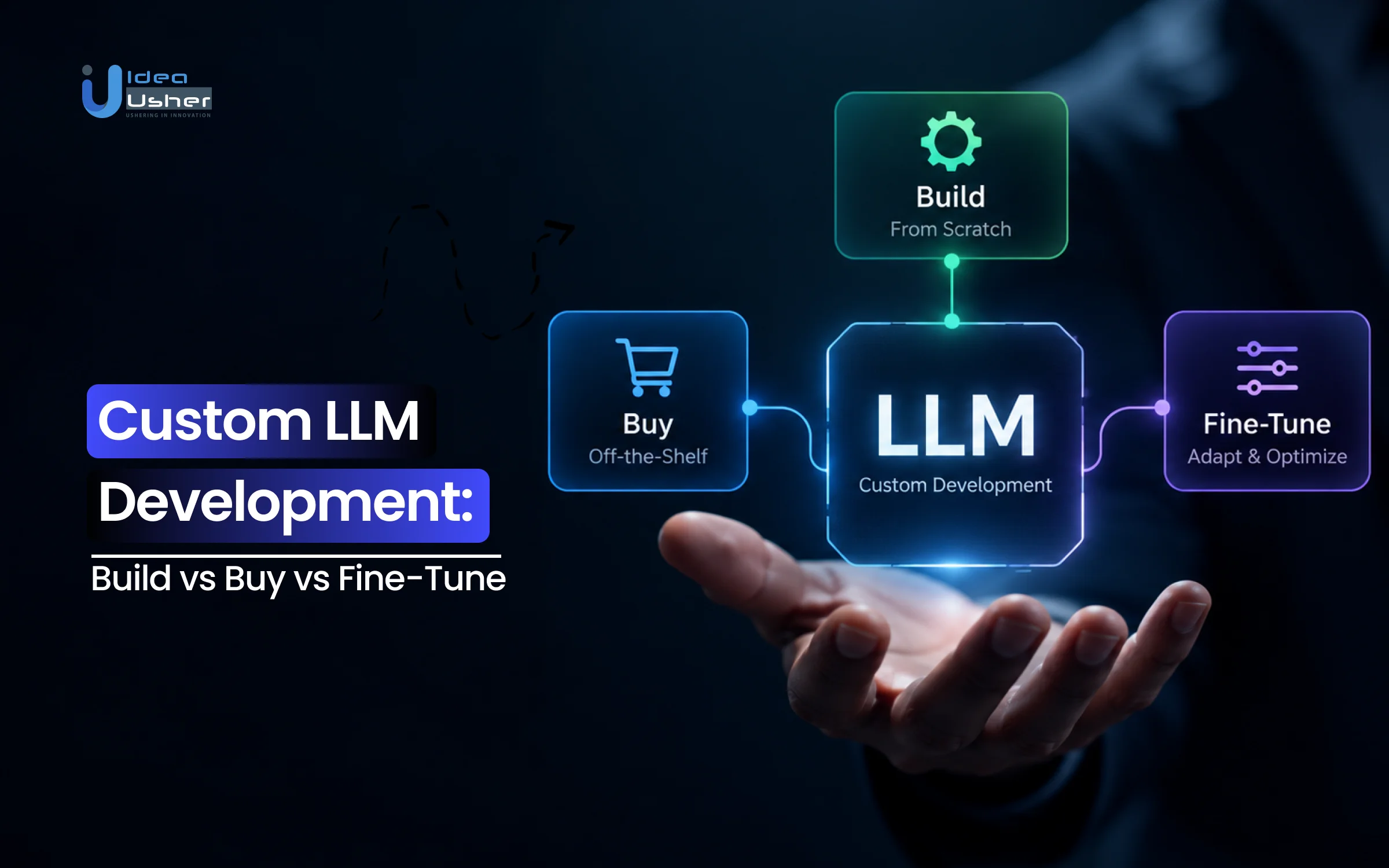
| Approach | Best Suited For | Main Advantage | Main Trade-Off |
| Buy (API / Managed) | Fast application launches, standard administrative tasks, knowledge retrieval | Speed to market and low initial capital expenditure | Dependency on vendor pricing, rate limits and zero model-level weight control |
| Fine-Tune | Specialized domain behavior, fixed JSON schemas, task-specific performance | Consistent outputs, brand tone and lower token latency/cost on small models | Requires curated, high-quality training pairs and ongoing retraining pipelines |
| Build (Custom Pre-Training) | Highly specialized or sovereign models, proprietary hardware, frontier research | Complete IP ownership, zero vendor lock-in, custom tokenizers/architectures | Highest cost ($1M–$10M+), extreme infrastructure complexity, multi-quarter timelines |
The table outlines the core trade-offs, but the real decision depends on where control, cost and differentiation matter most. The following sections examine each approach and its practical implications.
A. Buy an Existing LLM Through an API
The “Buy” approach does not mean buying a generic consumer SaaS tool; it means licensing hosted foundation intelligence via managed APIs (e.g., OpenAI, Anthropic, Google Gemini or AWS Bedrock) and engineering a proprietary application layer on top.
How It Works: The application sends prompts, structured context and instructions to an external endpoint over HTTPS. The model can be paired with Retrieval-Augmented Generation (RAG) to inject internal documentation, database records or ERP schemas into the prompt context window.
Where the IP Lives: Competitive differentiation resides not in the model weights but in the proprietary data pipelines, system orchestration, business logic and user experience.
Cost & Operational Profile: Low upfront engineering costs of $20,000–$80,000 enable rapid deployment within 4 to 10 weeks. However, recurring token costs apply to every API call while third-party availability remains a dependency and the model’s underlying parameters cannot be modified.
B. Fine-Tune an Existing Foundation Model
Fine-tuning takes a pre-trained open-weight or base model (e.g., Llama, Mistral or a closed-model fine-tuning endpoint) and runs additional training cycles on a domain-specific dataset.
How It Works: Fine-tuning adjusts model weights through Parameter-Efficient Fine-Tuning (PEFT), Low-Rank Adaptation (LoRA) or QLoRA (Quantized-LoRA) to improve behavior rather than add factual knowledge. It helps models handle domain jargon, match corporate tone and produce strict formats such as JSON or SQL.
Cost & Efficiency Payoff: A fine-tuned 7B-to-13B model can match or exceed a larger frontier model on narrow workflows. Embedding instructions in model weights reduces prompt length, inference latency and recurring compute costs.
The Engineering Investment: Fine-tuning may require under $5,000 in GPU compute, but preparing 10,000–50,000 golden prompt-response pairs can cost $50,000–$150,000+ in specialized data engineering.
C. Build a Custom LLM From Scratch
Building a custom LLM from scratch means pre-training a foundation model on raw tokenized text across billions or trillions of tokens, starting from randomly initialized weights.
Custom Application vs. Foundation Pre-Training:
- Building a Custom AI Application means assembling the full enterprise stack: UI/UX, vector databases, deterministic guardrails, API connectors and model orchestration around an existing foundation model.
- Training a Foundation Model from Scratch means architectural engineering: writing custom tokenizers, designing transformer attention layers, leasing distributed GPU clusters (hundreds of NVIDIA H100s or B200s) and managing multi-node synchronization.
The Resource Barrier: Training even a mid-scale 7B-to-70B parameter model from scratch requires $1 million to $10 million+ in dedicated compute, specialized distributed-systems PhDs and months of continuous data curation and alignment passes (RLHF/DPO).
When Building Actually Makes Sense: Pre-training makes sense only for highly specialized domains beyond general models’ capabilities. For most enterprises, the advantage lies in building a proprietary, secure AI ecosystem around foundation models with strong data governance and business logic.
Custom LLM vs RAG vs Fine-Tuning: Which Works Best?
A common misconception in enterprise AI planning is treating model fine-tuning as the default method for giving an AI system company knowledge. In practice, attempting to teach a model evolving facts by fine-tuning its weights leads to stale responses, high retraining costs and persistent hallucinations.
The fundamental architectural principle is simple: RAG supplies the facts; fine-tuning instills the behavior. Knowing which strategy to apply or how to combine them, determines whether your application achieves production reliability or becomes an expensive maintenance burden.
A. When RAG Is Better Than Fine-Tuning
Retrieval-Augmented Generation (RAG) dynamically searches enterprise data repositories (databases, document stores, wikis) at query time, injecting the most relevant context directly into the model’s active prompt window.
- Dynamic, Frequently Changing Knowledge: RAG is appropriate for clinical policies, product pricing, inventory catalogs and regulatory standards that change frequently. Updating the system only requires refreshing the vector index or database entry, without GPU retraining.
- Traceable Citations & Auditability: Fine-tuned models cannot identify the source of facts stored in their parameters. RAG provides direct references to source documents, supporting auditability in healthcare, legal and finance.
- Strict Permission Boundaries: RAG filters retrieved context according to the querying user’s Active Directory or SSO permissions, preventing unauthorized employees from accessing restricted company data.
- Faster Deployment with Lower Initial Overhead: RAG pipelines rely primarily on data engineering rather than specialized model-training workflows, reducing development complexity and time-to-market.
B. When Fine-Tuning Is Better Than RAG
Fine-tuning permanently modifies a pre-trained model’s internal weights via supervised training on thousands of curated input-output pairs. It does not act as a dynamic search engine; rather, it trains the network to think, format and execute like a domain specialist.
Fine-tuning is the superior choice when your primary objective is operational consistency:
- Strict, Consistent Output Formats: When applications must return complex, machine-readable schemas such as valid JSON, SQL queries or EDI X12 syntax, without schema drift or conversational padding.
- Specialized Jargon & Tone: When outputs must use a clinical register for physician summaries, follow legal drafting conventions or maintain a specific brand voice across customer interactions.
- High-Accuracy Classification & Extraction: When thousands of billing disputes or medical claims must be classified against standardized taxonomies, with latency and accuracy being critical.
- Instruction Following on Complex Edge Cases: When standard prompts drift or become excessively long, fine-tuning embeds behavioral constraints directly into the model’s weights.
- Distillation for Cost & Latency: Fine-tuning can help an 8B Small Language Model match a larger frontier model on a narrow task, reducing inference costs by up to 90% and enabling sub-second latency.
C. When a Custom LLM Needs Both RAG and Fine-Tuning
For advanced enterprise platforms, RAG and fine-tuning are not mutually exclusive, they function as complementary systems within a hybrid architecture:
Consider an Automated Clinical Appeal System:
The Fine-Tuned Model: A compact model has been fine-tuned on thousands of past successful healthcare appeal letters. It understands clinical medical necessity arguments, adheres to formal healthcare legal registers and consistently outputs properly structured appeal sections.
The RAG Pipeline: At the moment of execution, the RAG engine retrieves the patient’s specific operative report from the EHR, pulls the payer’s current Local Coverage Determination (LCD) policy and injects that real-time context into the fine-tuned model.
The fine-tuned model provides the domain-specific reasoning and formatting, while RAG ensures the appeal is grounded in the latest clinical records and payer guidelines.
D. A Practical Customization Path for Most Businesses
Most businesses should begin with the simplest effective customization method and advance only when measurable performance gaps justify additional engineering investment.

The most cost-effective path follows a progressive, four-stage implementation ladder:
Stage 1: Advanced Prompt Engineering & In-Context Learning
Start with prompt engineering to test whether existing frontier models can meet your business requirements before investing in more complex customization.
The Action: Prototype using commercial frontier models (GPT-4o, Claude 3.5 Sonnet). Leverage few-shot examples, system instructions and structured output constraints.
When to Stop: If standard models achieve >95% accuracy and latency/token costs remain acceptable, launch here.
Stage 2: Retrieval-Augmented Generation (RAG)
RAG extends foundation models with relevant business knowledge, making it the next step when general-purpose models lack the context needed for accurate responses.
The Action: Connect the foundation model to your internal databases, document repositories and APIs via vector embeddings and semantic search.
When to Advance: If the system retrieves the right documents but struggles with output formatting, hallucinates syntax or incurs unsustainable context-window token costs.
Stage 3: Parameter-Efficient Fine-Tuning (LoRA / QLoRA)
Fine-tuning becomes valuable when businesses need models to perform specialized tasks consistently, rather than repeatedly supplying instructions and examples at inference time.
The Action: Curate 1,000 to 5,000 verified input-output examples from your RAG pipeline. Train lightweight adapter layers on open-weights models (e.g., Llama 3 or Mistral) to enforce deterministic syntax, tone and narrow-task behavior.
The Payoff: Drastically reduced inference latency, lower token consumption and deployment freedom inside your private cloud.
Stage 4: Deeper Model Customization & Continued Pre-Training
Continued pre-training addresses specialized language gaps that lighter customization methods cannot resolve, but its complexity makes it a last-resort investment.
The Action: Execute domain-adaptive continuous pre-training on billions of specialized tokens.
When It’s Justified: Exclusively when an enterprise possesses vast, proprietary vocabularies (e.g., genomic sequencing, proprietary chip design) that baseline language models fundamentally cannot parse.
The High-Intent Verdict: Does Your Business Need Fine-Tuning?
If your problem is “The AI does not know our private or changing business facts,” you need RAG.
If your problem is “The AI knows the facts, but formats responses inconsistently, fails to follow complex instructions or costs too much to run at scale,” you need Fine-Tuning.
When Should a Business Build Its Own LLM?
Pre-training an enterprise LLMs from scratch by initializing random neural weights and training across billions or trillions of tokens requires millions of dollars in compute, specialized research talent and multi-quarter development cycles.
For the vast majority of commercial applications, pre-training is economically unviable and technically unnecessary. However, under specific operational, regulatory and architectural conditions, owning the foundational weights becomes a justifiable, high-leverage strategic asset.
A. Build When Proprietary Data Is a Competitive Advantage
A company should consider ground-up model training only when its primary commercial moat resides in a massive, proprietary dataset that public foundation models have never seen:
- Domain Exclusivity: Decades of specialized, closed-door records, such as seismic geological mappings, semiconductor lithography simulations or institutional trading tick data, create IP that generalist models cannot replicate.
- Encoding Knowledge into Neural Representations: Pre-training on private data can reveal latent relationships that RAG cannot capture when business value depends on neural representations rather than retrieved excerpts.
- Commercialization of Foundation IP: Businesses selling industry-specific foundation models to legal, pharmaceutical or defense platforms must build and own the underlying model weights.
B. Build When Model Control Matters More Than Speed
Commercial APIs and even managed open-weight models introduce operational dependencies that certain enterprise platforms cannot accept:
- Complete Model Ownership & IP Capitalization: Training a proprietary model can create a corporate IP asset, reducing exposure to external licensing changes, vendor shutdowns and API deprecations.
- Absolute Deployment & Air-Gap Control: Defense contractors, intelligence agencies and sovereign entities may require 100% air-gapped, on-premise execution with zero outbound network calls.
- Specialized Inference & Latency Engineering: Custom tokenizers optimized for DNA base pairs, machine telemetry or specialized code can reduce sequence lengths and cut inference latency by 3x to 5x.
- Custom Model Architecture: Pre-training enables specialized architectures, including Mixture-of-Experts (MoE), Mamba variants and tailored linear-attention mechanisms, designed around specific hardware constraints.
- Elimination of Third-Party Vendor Risk: Commercial LLM dependencies expose production workflows to policy changes, alignment updates and pricing revisions that can disrupt operations without warning.
C. Build When Existing Models Cannot Meet Performance Needs
Building from scratch becomes commercially justifiable when both off-the-shelf foundation models and fine-tuned open-source variants demonstrably fail key operational benchmarks:
| Operational Dimension | Commercial API Limits | Custom-Built Model Advantage |
| Inference Latency | 200ms – 1,000ms+ round-trip API network latency. | <15ms on local bare-metal or embedded edge silicon. |
| Tokenization Efficiency | High token fragmentation on specialized code, chemical notation or DNA sequences. | Custom-trained tokenizers reduce sequence lengths by 50%–70%, slashing compute. |
| Domain-Specific Logic | Hallucinations caused by generic internet pre-training bias overriding domain rules. | Weights calibrated strictly to proprietary mathematical, legal or biological constraints. |
| Edge Footprint | Massive parameter sizes requiring multi-GPU server nodes. | Compact, custom-architected 1B–3B models fit on local mobile or embedded devices. |
D. Why Most Businesses Should Not Start Here
For 98% of businesses, embarking on a from-scratch LLM pre-training program is an expensive operational distraction with limited returns compared to adapting existing foundation models to specific business needs.
The resource footprint required to build and maintain a custom foundation model extends far beyond simple software development:
- Massive Capital Requirements: Training a production-grade 7B–13B model from scratch costs $150,000–$500,000+ in raw compute, while 30B–70B models can cost $1 million–$6 million+. Data engineering, storage and validation can easily double the total.
- Distributed Systems Talent: Foundation model training requires senior engineers and research scientists skilled in Megatron-LM, DeepSpeed, FSDP, gradient synchronization and GPU cluster failure recovery.
- Experimentation Risk & Sunk Capital: Training runs can experience loss divergence, catastrophic collapse or silent data corruption weeks into a $300,000 compute run, making outcomes less predictable than conventional software development.
- Retraining & Maintenance Burden: Custom foundation models require ongoing retraining, RLHF/DPO alignment and hardware maintenance to remain accurate and operational as business data and requirements change.
The Decision: Is Building From Scratch Worth It?
If your business objective is to automate workflows, parse enterprise documents or build intelligent conversational interfaces, building from scratch is not worth the investment. You will capture higher ROI in a fraction of the time by combining open-weights models, parameter-efficient fine-tuning (LoRA) and structured Retrieval-Augmented Generation (RAG).
Reserve building from scratch for scenarios where proprietary data is your primary corporate valuation asset where external APIs represent an existential business risk and where you possess the multi-million-dollar compute capital to sustain an ongoing MLOps infrastructure.
When Is Fine-Tuning the Right Investment?
Fine-tuning balances renting commercial APIs and training base models from scratch. Instead of teaching broad knowledge, it adapts an established base network (like Llama or Mistral) by updating neural weights for specific operational tasks.
For enterprise software teams, fine-tuning is an efficiency and reliability play: it eliminates prompt bloat, locks down deterministic schemas and drastically lowers latency and token costs at production scale.
A. Fine-Tune for Specialized Behavior, Not Just More Knowledge
The most common enterprise AI mistake is using fine-tuning as a knowledge database. Neural weights are poor for storing mutable facts because policies change frequently, making constant retraining costly, inefficient and unsustainable for daily business updates.
- Behavior vs. Information: Fine-tuning teaches a model how to think, act and format, while Retrieval-Augmented Generation (RAG) tells the model what facts to consider.
- The “Style of Thought” Shift: Apply fine-tuning to adopt expert reasoning such as a senior underwriter evaluating credit risk or a medical coder applying rules to clinical encounters.
- Separation of Concerns: Store dynamic business data in databases and SQL systems, reserving fine-tuning strictly for training the engine that processes and acts on it.
B. Fine-Tune for Consistent Business Outputs
When an LLM powers automated downstream workflows, variability causes system failures. Fine-tuning bakes structural and stylistic consistency into the base weights across six operational dimensions:
| Output Requirement | Prompt Engineering Failure Mode | Fine-Tuned Model Behavior |
| Structured Responses | Markdown ticks, preambles or unescaped quotes that break JSON parsers. | Produces valid, deterministic JSON or ANSI ASC X12 without filler. |
| Brand Tone & Voice | Inconsistent phrasing, corporate boilerplate or session-to-session drift. | Reliably follows brand guidelines, legal precision or patient engagement rules. |
| Domain Terminology | Misinterprets niche abbreviations or replaces precise clinical/legal terms. | Accurately handles specialized jargon, CPT modifiers and statutory references. |
| Classification Accuracy | Inconsistent labels, hallucinated categories or edge-case confusion. | Delivers high-confidence multi-class categorization across support tickets or claim rejections. |
| Domain Summarization | Misses technical nuance or includes irrelevant details. | Extracts operationally critical data points such as margins, dates and liabilities. |
| Complex Instruction Following | Skips negative constraints when prompts become lengthy. | Follows nested constraints and multi-step decision trees consistently. |
C. Fine-Tune When Prompting Alone Is Not Enough
Most enterprise projects start with prompt engineering and they should. However, as an application scales and edge cases compound, prompt engineering hits hard operational limits:
- Prompt Bloat and Context Fatigue: Strict rules often require system prompts containing few-shot examples, negative constraints and schema definitions. These prompts can reach 2,000–4,000 tokens before the user’s question is introduced.
- Fragile “Prompt Jenga”: Large system prompts make edge-case fixes risky, as changing one instruction can disrupt several other behaviors. Fine-tuning replaces this fragile prompt chaining with structured, regression-tested datasets.
- Inference Latency & Cost Compounding: Repeating thousands of input tokens increases API costs and time-to-first-token (TTFT). Fine-tuning internalizes these instructions, reducing system prompts to a single instruction line and potentially cutting recurring token costs by 70%–80%.
D. Consider LoRA and PEFT for Resource-Efficient Training
Enterprises no longer need to update all billions of parameters in a neural network to achieve specialized domain performance without the cost and complexity of full model retraining.
| Training Strategy | Parameters Updated | Compute Requirements | Hardware Sizing | Storage / Deployment Footprint |
| Full Fine-Tuning | 100% of weights | Massive distributed clusters; multi-GPU synchronization | 4–8x NVIDIA H100 (80GB) | Full model copy per task (14GB–140GB+ per model) |
| LoRA / QLoRA (PEFT) | 0.1% to 1% of weights | Single-node cloud instances; parameter quantization | 1–2x NVIDIA L40S or A10G (24GB) | Lightweight adapter files (50MB–200MB) |
Modern enterprise fine-tuning relies almost exclusively on Parameter-Efficient Fine-Tuning (PEFT), primarily LoRA (Low-Rank Adaptation) and QLoRA (Quantized LoRA):
- How LoRA Works: LoRA freezes the original weights of the foundation model and injects small, trainable rank-decomposition matrices into the transformer layers.
- Cost & Compute Efficiency: Training under 1% of total parameters allows runs on a single GPU (such as an NVIDIA A100 or H100) in hours, lowering compute costs from thousands of dollars to below $50.
- Modular Runtime Architecture: A cloud-based base model instance can serve multiple departments by dynamically swapping compact LoRA adapters (50MB–200MB) on the fly such as for medical coding, chart summarization or patient intake.
The High-Intent Verdict: How Do You Know Fine-Tuning Is Worth the Cost?
Fine-tuning is worth the investment when you can answer yes to at least two of these operational criteria:
- You process high transaction volumes (over 10,000 queries daily) and shortening your input prompt tokens will immediately reduce your monthly API or compute bill.
- Your application requires strict structural adherence (such as machine-readable JSON or X12 EDI) and off-the-shelf prompt instructions still yield a >2% schema failure rate.
- You have access to 1,000+ clean, validated, domain-specific input-output examples that reflect the exact behavior you want the model to emulate.
- You need to host the model privately within your own HIPAA- or SOC 2-compliant cloud perimeter using an open-weights model, but need it to match the reasoning quality of frontier commercial models on your specific task.
When Buying an Existing LLM Makes More Business Sense
Not every enterprise AI initiative requires fine-tuning weights or training custom models. In many commercial use cases, attempting to build or heavily customize a model is an unnecessary engineering detour that inflates upfront capital requirements and delays product validation.
“Buying” in modern enterprise AI means licensing hosted foundation models through managed APIs (e.g., OpenAI, Anthropic, Google Gemini or AWS Bedrock). This lets teams treat language intelligence as a utility, like cloud compute or database storage, while directing capital toward business value.
A. Buy When Speed to Market Is the Priority
Buying makes sense when speed, flexibility and early validation matter more than deep model ownership. It reduces upfront complexity while helping teams launch, learn and iterate faster.
- Instant Production Readiness: Commercial APIs from OpenAI, Anthropic or Google can move from prototype to production within days. Pre-training or fine-tuning requires months of data curation, hyperparameter tuning and evaluation before launch.
- Continuous Upstream Upgrades: Managed APIs provide automatic improvements in reasoning, token efficiency and speed, without requiring teams to retrain models or manage architectural migrations.
- Immediate Commercial Validation: Buying access lets product teams test demand, refine prompts and measure willingness to pay before investing in deeper model customization.
B. Buy When the Model Is Not the Main Product Differentiator
Most successful enterprise software products do not monetize raw model intelligence; they monetize operational workflow execution:
- Proprietary Workflows & Automation: An automated invoice parser, EHR billing assistant or legal contract analyzer creates value by routing tasks, managing exceptions and integrating business logic across software ecosystems, not through a custom tokenizer.
- Proprietary Data Moats: Private data, such as patient records, ERP ledgers or customer history, can power domain-accurate outputs through RAG without the liability and cost of training model weights.
- User Experience & Frictionless Integrations: Enterprise buyers value responsive UIs, SSO, bi-directional CRM/EHR connectors and compliance certifications. Prioritizing model pre-training over integration infrastructure can weaken product-market fit.
C. Buy When Training Infrastructure Is Not Justified
Buying is often practical when specialized infrastructure, GPU costs and technical staffing would create more operational burden than the AI product can justify. Maintaining specialized machine learning infrastructure introduces persistent operational overhead:
| Infrastructure Vector | Custom-Trained / Self-Hosted Model | Managed “Bought” LLM API |
| GPU Procurement & Costs | Dedicated NVIDIA H100/A100 clusters with high fixed costs. | Zero CapEx; pay per-token or per-seat usage. |
| Specialized Talent | Requires distributed systems engineers, CUDA developers and MLOps researchers. | Requires standard full-stack and backend API engineers. |
| Capacity & Autoscaling | Complex Kubernetes autoscaling, cold starts and GPU idle-time waste. | Elastic autoscaling fully managed by the provider. |
| Uptime & Failover SLA | Internal teams manage model crashes, node failures and memory leaks. | Enterprise-grade availability SLAs backed by major cloud providers. |
For organizations whose core competency is not machine learning research, delegating infrastructure operations to managed hyperscalers frees technical teams to focus entirely on customer-facing product features.
D. What Businesses Still Need to Build Around a Purchased Model
Buying an LLM does not mean buying a finished product. The foundation model is merely the compute engine; your internal software team must build the proprietary scaffolding that transforms that engine into an enterprise solution:
- The Proprietary Application Layer: Designing intuitive interfaces, conversational state persistence, multi-tenant workspace partitioning and role-based access control (RBAC).
- Advanced RAG Ingestion Pipelines: Building production pipelines to extract, de-duplicate, chunk, embed and index enterprise documents into vector stores (e.g., Pinecone, Qdrant, pgvector) with hybrid keyword/semantic search.
- Deterministic Tool Calling & System Integrations: Engineering bi-directional API connectors that let the model safely query internal SQL databases, update CRM records or trigger ERP tasks with schema validation and retry logic.
- Enterprise Security & Compliance: Implementing data-redaction engines to scrub sensitive PII/PHI, enforcing zero-data-retention agreements and maintaining immutable audit trails.
- Observability & MLOps Infrastructure: Setting up automated evaluation frameworks (e.g., Ragas, TruLens) to monitor retrieval precision, track latency and control per-user token consumption.
Can You Build a Custom AI Product Without Training Your Own LLM?
Yes, the most valuable enterprise software companies do not invent relational databases or build proprietary cloud hardware; they engineer specialized workflows on top of established infrastructure.
By consuming managed foundation models via APIs or hosting open-weights models, enterprises avoid the multi-million-dollar cost of foundational pre-training while retaining the flexibility to switch model providers and focus engineering resources on defensibility: proprietary business logic, deep data integration and seamless user experiences.
However, relying exclusively on a third-party foundation model introduces structural trade-offs. Understanding these trade-offs clarifies why high-scale enterprises eventually outgrow commodity APIs and invest in custom fine-tuning or dedicated model ownership.
The Operational Drawbacks of Relying Solely on Third-Party LLMs:
- Scaling Unit Economics: Commercial APIs work for early prototypes, but per-token pricing raises COGS as usage scales. At millions of monthly transactions, API fees often exceed the cost of hosting a fine-tuned model on private GPUs.
- Deprecation & Upstream Volatility: Vendors may change checkpoints, safety alignments or model versions with limited notice, potentially altering reasoning, breaking regex parsers or reducing output quality.
- Privacy, Compliance & Data Sovereignty: In defense, sovereign government and regulated clinical environments, external endpoints may violate mandates or air-gapped security requirements, even with zero-data-retention agreements.
- Latency & Context Bloat: Enterprise schemas often require lengthy system prompts, constraints and few-shot examples, increasing time-to-first-token (TTFT) and network overhead.
- “Thin Wrapper” Moat Risk: Products built mainly on prompt engineering and commercial models are easy to replicate. Without proprietary data integration, competitors can reproduce core features within days.
Custom LLM Development Cost: What Changes the Budget?
Custom Large Language Model (LLM) software development typically ranges from $25,000 to over $1,000,000. The vast difference in capital outlay is driven by architecture: calling a managed foundation API costs a fraction of building custom data pipelines or fine-tuning neural weights, while training a foundation model from scratch represents a multi-million-dollar infrastructure program.
1. What Does It Cost to Buy an Existing LLM?
Typical Range: $20,000 – $60,000
Consuming a hosted foundation model (e.g., OpenAI, Anthropic, Google Gemini) shifts capital from machine learning research to full-stack application development.
- API Usage: Ongoing operational expense based on input/output token volume.
- Engineering Scope: Backend API proxy layers, UI/UX components, stateful conversational memory, prompt management, and authentication.
2. What Does It Cost to Add RAG?
Typical Range: $45,000 – $150,000+
Retrieval-Augmented Generation connects foundation intelligence to proprietary knowledge without altering underlying weights.
- Data Ingestion & Cleaning: Document parsers, OCR for legacy PDFs, and text sanitization (typically 30%–40% of the build).
- Retrieval Infrastructure: Vector databases (e.g., Pinecone, pgvector), chunking strategies, dense/sparse hybrid search, and cross-encoder re-ranking.
- Security & Permissions: Metadata filtering to enforce enterprise Role-Based Access Control (RBAC).
3. What Does It Cost to Fine-Tune an LLM?
Typical Range: $75,000 – $250,000+
Fine-tuning adapts open-weight models (like Llama or Mistral) for task-specific behaviors, fixed schemas, or sub-second latency.
- Dataset Preparation: Curating, structuring, and labeling 1,000 to 20,000+ verified prompt-completion pairs.
- Compute & Training: Parameter-efficient training runs (LoRA/QLoRA) on cloud GPU instances.
- Serving & Infrastructure: Provisioning dedicated VPC inference clusters (e.g., vLLM or TensorRT-LLM on AWS/Azure) with ongoing model drift monitoring.
4. What Does It Cost to Build an LLM From Scratch?
Typical Range: $500,000 – $5,000,000+
Pre-training a proprietary foundation model from randomly initialized weights is reserved for sovereign or frontier requirements.
- Massive Compute: Hundreds of thousands of GPU-hours on NVIDIA H100/B200 clusters.
- Large-Scale Data Engineering: Filtering and tokenizing billions of domain-specific data tokens.
- Specialized ML Engineering: Distributed-systems engineers to manage multi-node training, loss-divergence recovery, and post-training alignment (RLHF/DPO).
Why Custom LLM Development Cost Varies So Much
Right-sizing the approach ensures investment is directed toward solving the business problem rather than maintaining unnecessary AI infrastructure. Budgets reflect functional requirements rather than arbitrary vendor markups:
| Cost Dimension | Low-End Drivers | High-End Drivers |
| Model Size & Location | Hosted cloud API endpoints | Dedicated private VPC or air-gapped GPU clusters |
| Data Readiness | Clean Markdown/HTML text | Messy scanned PDFs, databases, and multi-format files |
| Compliance Overhead | Standard web security | HIPAA, SOC 2, zero-retention, and audit logging mandates |
| Operational Workflow | Read-only Q&A summaries | Multi-system transactional tool calling and agentic actions |
How to Choose the Right Custom LLM Development Approach
Selecting an custom LLM development strategy is an architectural and financial decision, not a branding exercise. The goal is to match your business requirements to the simplest, most resilient architecture that delivers verifiable ROI.
1. Evaluate the Business Problem Before the Model
Start by defining the operational job-to-be-done rather than debating foundation model parameters. Determine whether the primary objective is:
- Information Retrieval: Grounding an assistant in evolving internal documents (RAG).
- Behavioral Consistency: Forcing deterministic output schemas or brand voice (Fine-Tuning).
- Task Automation: Executing multi-step transactions across databases and APIs (Agentic Orchestration).
Designing around the workflow prevents organizations from spending $200,000 to train a model when a structured prompt pipeline or deterministic API integration would solve the operational bottleneck.
2. Evaluate Data Quality and Data Availability
Your data maturity dictates your technical boundary by determining whether retrieval, fine-tuning or a combination delivers the right balance of accuracy, freshness and control.
- Volume & Structure: RAG ingests messy, unstructured documentation (PDFs, wikis) through parsing and chunking. Fine-tuning requires 1,000 to 10,000+ rigorously cleaned, labeled and deduplicated prompt-completion pairs.
- Freshness & Governance: Dynamic, weekly-changing data should never be hard-coded into model weights. Use vector retrieval for changing information and reserve fine-tuning for stable, repeatable behaviors.
3. Evaluate Accuracy, Latency and Output Consistency
Performance requirements determine how deep in the stack you must build to meet accuracy, latency and consistency targets.
| Engineering Dimension | Hosted Frontier APIs | RAG Architectures | Fine-Tuned Open Models (SLMs) |
| Factual Accuracy | Moderate; may hallucinate ungrounded details | High; grounded in verified retrieved context | Moderate; weights remain static after training |
| Schema Consistency | Variable; requires system prompts and retries | Variable; depends on model reasoning | High; weights adapted to strict JSON/EDI formats |
| Inference Latency | 800ms–3,000ms+; network overhead varies | 1,200ms–4,000ms+; retrieval, re-ranking & generation | 100ms–500ms; distilled 8B model on local GPU |
| Source Attribution | Limited; black-box generation | Complete; direct URI links to chunk metadata | Limited; knowledge encoded in model parameters |
4. Evaluate Privacy, Compliance and Deployment Needs
Privacy and compliance requirements can determine where AI runs, how data is handled and who can access it, making deployment architecture a critical strategic decision. Highly regulated industries (healthcare, finance, defense) must evaluate deployment isolation:
- Public APIs: Suitable for general text synthesis with zero-data-retention agreements.
- Private VPC / On-Premise: Self-hosting open-weight models (e.g., Llama) ensures protected health information (PHI) and trade secrets never leave your infrastructure.
- Access Control Parity: Multi-user enterprise platforms require metadata-filtered vector search to mirror Active Directory permissions.
How IdeaUsher Can Help Build a Custom LLM Solution
IdeaUsher operates as an enterprise product engineering partner and AI innovator, leveraging 11+ years of software expertise, 250+ technical specialists and a 4.9/5 Clutch rating. We engineer custom, production-grade LLM architectures tailored to eliminate hallucinations, protect proprietary data, and solve specific business problems.
A. Start With a Business and AI Feasibility Assessment
Selecting an effective LLM architecture starts with strategic evaluation, not premature training. We assess your target operational workflows, proprietary data readiness, latency constraints, and expected compute budgets to determine the most cost-effective path, preventing costly over-engineering.
B. Build the Right Customization Strategy
We implement the optimal level of model customization based on your functional accuracy requirements:
- Foundation Model Selection: Auditing open-weights (Llama, Mistral) vs. commercial APIs (Claude, OpenAI) for speed, compliance, and cost.
- Advanced Prompt Engineering: Designing system-level context windows and structured output schemas.
- RAG Implementation: Building hybrid vector retrieval pipelines with document chunking to ground models in your internal knowledge.
- Domain Fine-Tuning: Executing Parameter-Efficient Fine-Tuning (PEFT/LoRA) on curated datasets for proprietary tasks.
- Rigorous Model Evaluation: Establishing automated benchmarking suites (BLEU, ROUGE, and LLM-as-a-judge) to measure drift and accuracy.
C. Develop the AI Application and Enterprise Integrations
We connect custom LLMs into real-world business environments by integrating enterprise systems, automating workflows and delivering intuitive, auditable AI experiences.
- Enterprise Integration: Secure REST/GraphQL connectors linking models to ERPs, CRMs, and internal databases.
- Workflow Automation: Building multi-agent task pipelines that trigger external actions autonomously.
- User-Centric Interfaces: Low-latency web and mobile dashboards that make AI outputs intuitive and auditable.
D. Add Security, Governance, and Production Readiness
We deploy models within private, zero-trust cloud environments (AWS, Azure, GCP) featuring end-to-end AES-256 encryption, RBAC, and strict PII guardrails. Continuous observability pipelines track token usage, inference latency, and hallucination rates in real time.
E. Scale the Solution as Business Requirements Grow
Our modular architectures let you launch quickly with an agile RAG-augmented foundation model, validating user adoption before scaling into deeper parameter tuning or self-hosted cluster deployment as ROI is proven.
Looking for a custom LLM development company? Start with a feasibility assessment. Connect with IdeaUsher’s principal AI software architects today to evaluate your use case, data assets, and custom model roadmap.
Conclusion
The right custom LLM strategy starts with your business requirements, not the most advanced model available. Speed to market, data privacy, output consistency, and long-term costs should guide the choice between buying, fine-tuning, or building. For businesses evaluating a custom LLM development partner, IdeaUsher offers the technical expertise to assess feasibility, select the right approach, and deliver a solution aligned with business goals. Discuss your requirements with IdeaUsher today and identify the most practical path to a production-ready AI solution.
FAQs
A.1. Custom LLM development adapts an existing model or builds a specialized one for business needs. It can improve domain relevance, output consistency, privacy, and workflow performance.
A.2. Custom LLM development costs vary by approach, data requirements, model size, infrastructure and deployment needs. Costs can start at around $20,000 for using an API and go up to more than $5 million for a custom model, depending on whether the solution uses RAG, fine-tuning or full model training from scratch.
A.3. Data requirements depend on the customization approach. RAG uses business documents and knowledge sources, while fine-tuning requires high-quality examples. Full training demands substantially larger datasets.
A.4. Custom LLM development commonly uses Python, PyTorch, Hugging Face Transformers, vector databases, embedding models, cloud infrastructure, APIs, and MLOps tools for training, deployment, and monitoring.


