


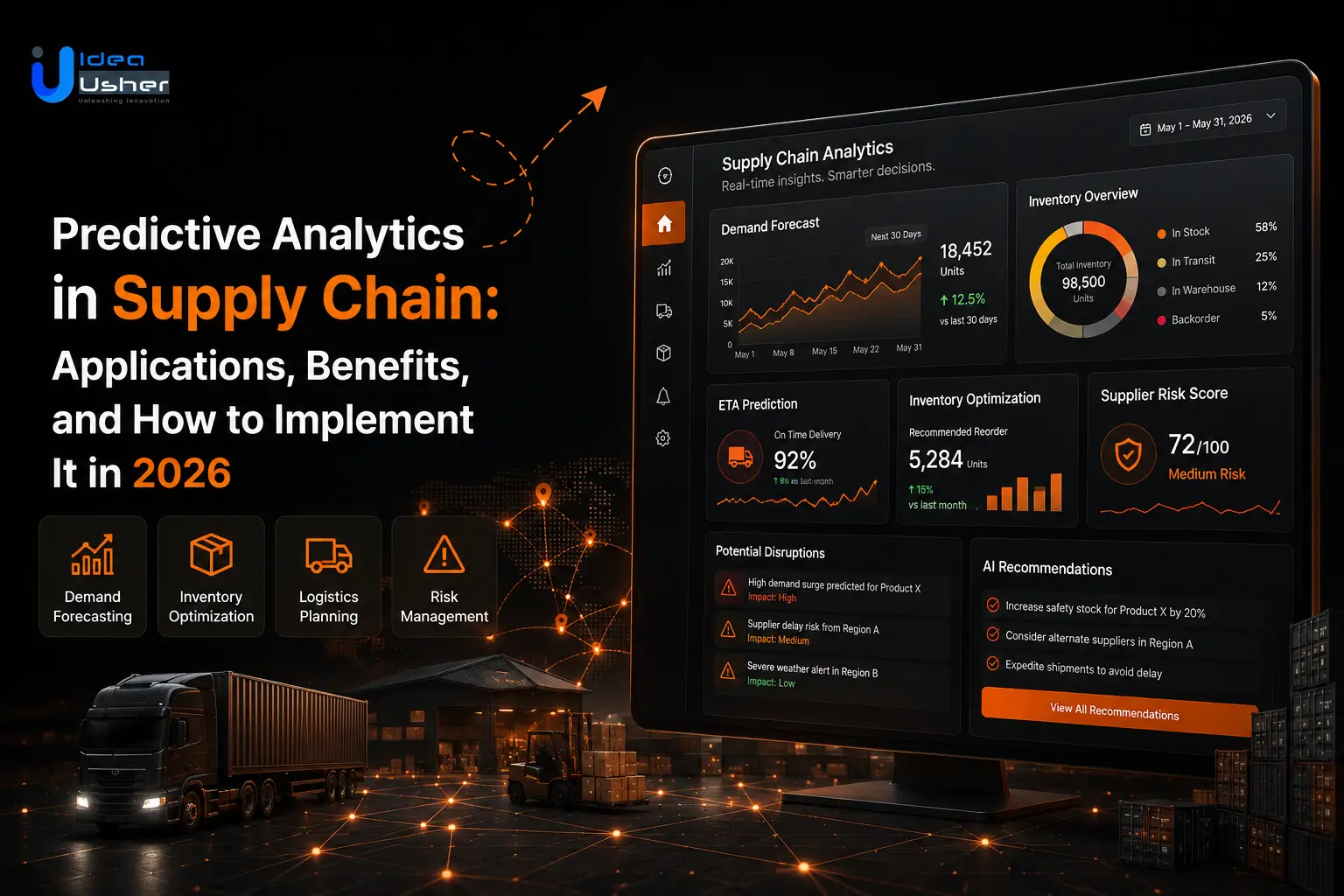
Large enterprises lose an average of $182 million a year to supply chain disruptions. 43% of organizations still have little to no visibility into how their tier-one suppliers are actually performing. Demand keeps shifting, freight costs keep swinging, and a spreadsheet updated once a week just cannot keep up with any of it.
Predictive analytics in supply chain management is how a growing number of companies are closing that gap. Instead of finding out about a stockout, a late shipment, or a supplier failure after it happens, predictive models flag the problem two to six weeks ahead of time, which gives planners something reactive forecasting never could: time to act. This piece covers what predictive analytics in supply chain actually looks like in practice, the applications worth building first, the benefits you can measure, the technical process behind a prediction, a few real case studies, the challenges teams tend to hit, and where the technology is headed next. If you’re scoping a build, IdeaUsher works with enterprises and mid-market operators on exactly this kind of AI-driven supply chain platform.
What Is Predictive Analytics in Supply Chain Management?
Predictive analytics in supply chain management uses historical data, statistical modeling, and machine learning to forecast what happens next: demand spikes, supplier delays, price swings, equipment failures, so teams can act before those events hit the bottom line. It’s a step beyond a standard business intelligence dashboard, which mostly tells you what already happened. A predictive model instead gives you a forward-looking number, something like an 85 to 90 percent confidence that a shipment lane will run late, or a demand curve for the next six weeks broken down by SKU and region.
This has moved well past the pilot-project stage at this point. The global supply chain analytics market is valued at roughly $14.18 billion in 2026, growing at a 16.61% CAGR toward close to $56 billion by 2035. The narrower predictive analytics and maintenance segment is expected to more than quadruple on its own, from $11.79 billion in 2025 to $48.34 billion by 2031, as manufacturers, retailers, and logistics operators fold predictive models directly into their ERP, WMS, and TMS stacks rather than running them as a side project.
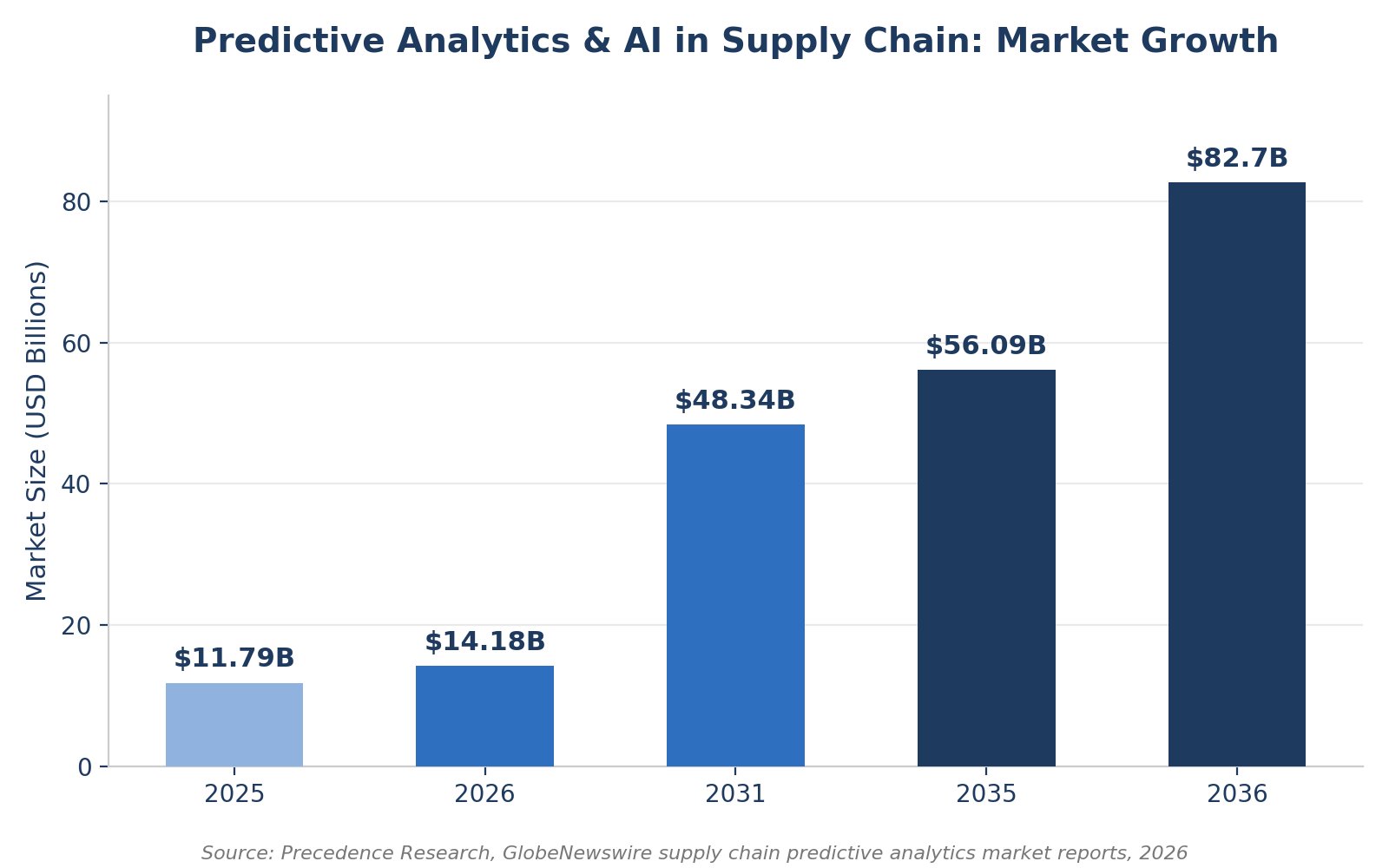
Predictive analytics and AI supply chain market growth 2026 to 2036
The Business Case for Predictive Analytics in Supply Chain
A few things are pushing predictive analytics for supply chain from a side initiative into something closer to table stakes.
For one, the cost of getting it wrong keeps climbing. Tariff volatility, extreme weather, and one-off disruptions have made single-point forecasting a lot less reliable than it used to be, and companies still planning off trailing 12-month averages are eating avoidable stockouts and markdowns as a result.
The models have also gotten a lot better. Modern supply chain AI can now predict shipment delays with 85 to 90 percent accuracy two to four weeks before the delay actually happens, which turns what used to be reactive expediting into proactive rerouting. Models trained on historical shipment, supplier, and market data can flag demand shifts and supplier failures weeks out instead of days out.
And the returns are showing up in the numbers. Figures cited from McKinsey’s supply chain research put AI-driven forecasting at 20 to 50 percent fewer forecasting errors, up to 65 percent fewer lost sales and stockouts, 5 to 10 percent lower warehousing costs, and 25 to 40 percent lower administration costs. Separately, companies adopting AI across supply chain functions have reported a 12.7% drop in logistics costs and a 20.3% reduction in inventory levels. Gartner has also found that around 30% of AI spend in supply chain organizations returns 3x, which is a big part of why boards are now asking for a predictive analytics roadmap instead of treating it as a one-off experiment.
Applications of Predictive Analytics in Supply Chain
Predictive analytics touches nearly every function in a supply chain, from the first demand signal all the way to the last mile. Below are the applications currently delivering the clearest ROI.
Demand Forecasting and Alignment with Market Needs
This is the foundational use case, and usually the first one companies build. Predictive models pull in historical sales, seasonality, weather, local events, and sometimes social sentiment to project demand at the SKU and store level instead of leaning on trailing averages. IdeaUsher has a couple of pieces that dig into the mechanics: optimizing supply chain demand planning with AI forecasting and a broader look at AI in demand forecasting. Retailers using this approach have cut perishable inventory waste by up to 30% simply by matching orders to a more accurate demand curve.
Predictive Analytics for Inventory Optimization
Predictive analytics for inventory optimization swaps out static reorder points for dynamic thresholds that adjust to real demand signals, supplier lead times, and seasonality. The payoff is fewer overstocked warehouses tying up working capital and fewer “out of stock” messages at checkout. Studies on AI adoption in supply chain point to inventory cost reductions of 15 to 25% once predictive reorder logic takes over from manual planning, a shift covered in more depth in IdeaUsher’s top applications of AI in inventory management.
Predictive Analytics in Logistics and Route Planning
Predictive analytics in the logistics industry looks at traffic patterns, weather, fuel prices, and carrier performance history to recommend the fastest and cheapest routes, and to flag which lanes are likely to run into delays before a truck even leaves the yard. Teams applying predictive routing and load consolidation report 8 to 15% in logistics cost savings. IdeaUsher’s guides on logistics app development and load planning software development go into the fleet and dispatch tooling this usually runs on top of.
Supply Chain Visibility with Predictive Analytics
Supply chain visibility predictive analytics pairs IoT sensor data and GPS tracking with predictive models to give planners a live, forward-looking view of where every shipment, pallet, and container actually is, and where it is likely to end up. The supply chain visibility software market alone is valued at roughly $3.3 billion and growing at a 13.4% CAGR as more companies push visibility all the way down to the item level. IdeaUsher’s guide to IoT data analytics breaks down how sensor data actually feeds into these models.
Supplier Risk Scoring and Relationship Management
Not every supplier carries the same risk. Predictive models score suppliers on delivery reliability, financial health signals, and geopolitical exposure, and that surfaces which relationships need a backup plan long before a single-source dependency turns into a crisis. It’s the same predictive logic showing up inside newer predictive procurement platforms, where supplier scoring and automated sourcing recommendations sit side by side.
Predictive Pricing Strategies
Commodity and freight prices move constantly, and predictive pricing models track price trends, competitor moves, and buying behavior to recommend dynamic price adjustments in near real time. That protects margins instead of leaving a business to react to a price shock only after it’s already eaten into profit.
Retail Supply Chain Predictive Analytics
Retail supply chain predictive analytics is one of the more mature applications of this technology. Retailers combine point-of-sale data, loyalty program history, and local event calendars to forecast demand at the store level, then use that to drive replenishment, markdown timing, and micro-fulfillment placement. AI-driven forecasting in retail has been shown to cut supply chain errors by 20 to 50%, which translates into roughly a 65% efficiency boost from fewer lost sales and out-of-stock products. Fashion and apparel retailers deal with a sharper version of this volatility, something IdeaUsher’s piece on technology in fashion supply chains gets into.
Predictive Analytics in Healthcare Supply Chain
Predictive analytics in healthcare supply chain management helps hospitals and health systems forecast demand for medical supplies, implants, and pharmaceuticals, cutting both waste and the risk of a critical item being unavailable mid-procedure. The stakes here are higher than in most industries; a stockout in this context isn’t just a lost sale, it can be a patient safety issue. Predictive models also need to work within HIPAA-aligned data handling requirements, which is an area IdeaUsher’s healthcare app development team builds around by default. The healthcare-focused SaaS supply chain management market alone is projected to reach $70 billion by 2034 as more health systems make this shift from reactive procurement to predictive planning.
Benefits of Supply Chain Predictive Analytics
Pulled together, the benefits of predictive analytics in supply chain management land across three areas: cost, service level, and risk.
On cost, balanced inventory replaces the guesswork of manual reordering and frees up capital that would otherwise sit in slow-moving stock, while predictive routing and load planning typically save 8 to 15% on logistics costs and another 5 to 10% on warehousing. On service level, forecast accuracy improvements of 20 to 50% are common once models take over from trailing-average planning, and a clearer, shared view of true demand also tends to reduce the bullwhip effect, where a small forecasting miss at the retail end amplifies into a much bigger swing further up the chain.
On risk, two to four weeks of advance notice on likely delays gives teams enough runway to reroute instead of paying a premium to expedite at the last minute. Supplier performance scoring surfaces which relationships need attention before a missed delivery turns into a pattern, and dynamic pricing models respond to commodity and competitor shifts in near real time rather than waiting on a quarterly pricing review to catch up.
How Predictive Analytics Improves Supply Chain Decisions: The Technical Process
Understanding how predictive analytics improves supply chain decisions means looking past the output and at the pipeline behind it. In practice, it comes down to four stages.
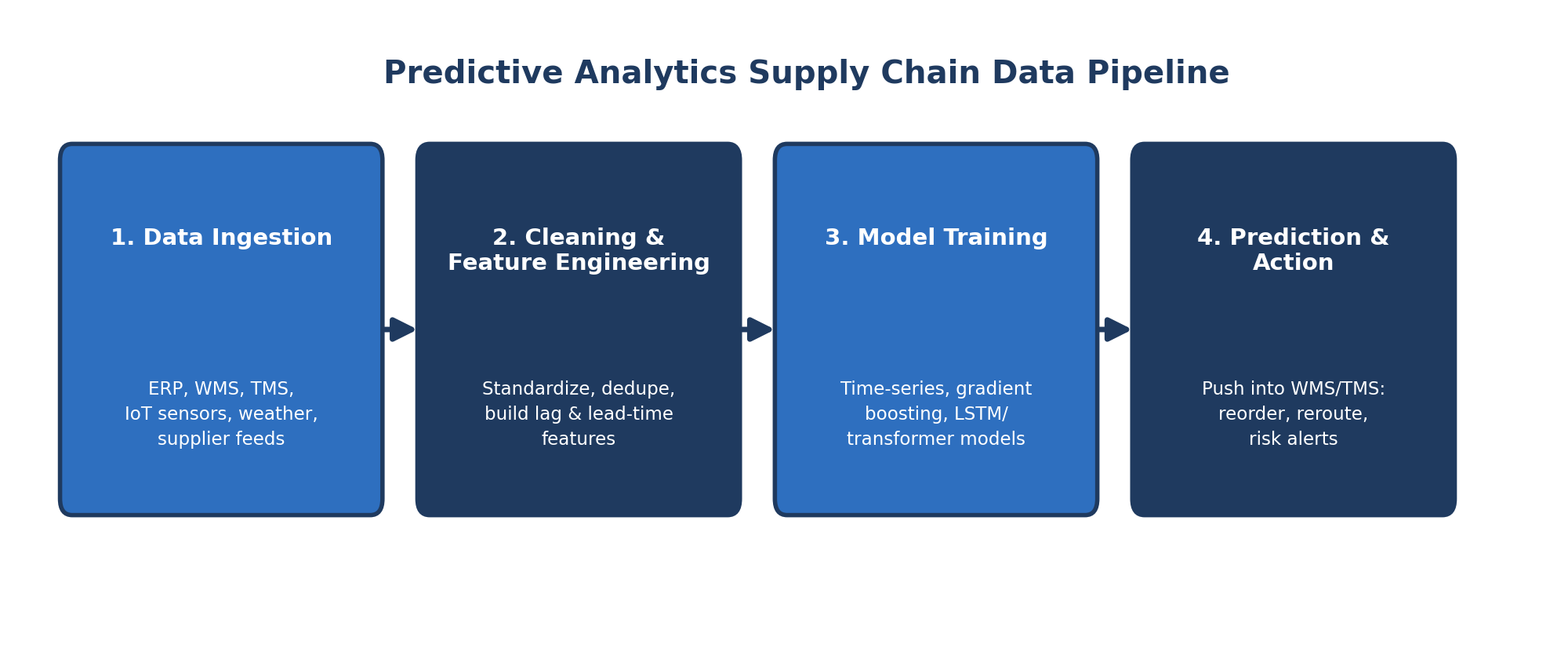
Predictive analytics supply chain data pipeline: ingestion, modeling, prediction, action
Data ingestion pulls structured data out of ERP, WMS, and TMS systems and combines it with less structured signals: weather feeds, IoT sensor streams off pallets and vehicles, supplier scorecards, and commodity or market pricing data.
Cleaning and feature engineering standardizes and deduplicates that raw data, then turns it into something a model can actually use: lag variables for seasonality, lead-time distributions per supplier, anomaly flags on suspect records. This is where most predictive analytics for supply chain management projects either succeed or quietly fail, since a model trained on fragmented, inconsistent data will still produce a confident-looking prediction that happens to be wrong.
Model training and validation is where the technique varies by use case. Time-series models like ARIMA or Prophet handle demand curves well, gradient-boosted trees tend to work for supplier risk scoring, and LSTM or transformer-based models come into play for sequence-heavy problems such as shipment delay prediction. Models get validated against holdout periods and retrained on a rolling basis as new data comes in, because a static model degrades fast in a market this volatile. IdeaUsher’s overview of machine learning in app development goes deeper into how this lifecycle typically gets engineered and maintained once it’s in production.
The last stage, prediction and action, is where a lot of projects fall short even after the modeling is solid. A prediction only matters once it lands back inside the tools planners already use: a reorder recommendation inside the WMS, a rerouting alert inside the TMS, a risk flag inside the supplier portal. That integration step is really what separates a predictive analytics dashboard nobody opens from one that actually changes how a team plans its week.
Real-World Case Studies: Supply Chain Predictive Analytics in Action
A supply chain predictive analytics case study is usually the fastest way to see what this technology delivers once it’s out of the pilot stage.
Walmart
Walmart analyzes purchase history, seasonal patterns, and local events across millions of transactions to forecast demand at the individual store level. That granularity lets the company carry less safety stock system-wide while still avoiding the stockouts that erode customer trust, and it’s one of the most-cited retail supply chain predictive analytics examples at scale for a reason.
DHL
DHL runs predictive models to forecast demand, fine-tune delivery routes, and schedule fleet maintenance before a breakdown happens instead of after. Pairing route prediction with maintenance prediction has helped the company hold service levels steady even as freight volumes and fuel costs have swung.
Western Digital
During the COVID-19 pandemic, Western Digital leaned on a Predictive Risk Engine to catch supplier and logistics disruptions before they cascaded through its electronics supply chain. The company has credited the tool with saving millions in avoided downtime and expedited freight.
UPS
UPS uses predictive analytics to forecast package volume by region and route delivery vehicles around live traffic, weather, and historical delay data. That approach is now central to how large parcel networks handle peak-season surges without blowing out delivery windows.
Common Challenges in Supply Chain Predictive Analytics
Predictive analytics for supply chain delivers real value, but the path to get there has a few genuine friction points.
Data Quality and Fragmentation
Predictive models are only as good as the data behind them. Fragmented systems, inconsistent formats, and missing fields lead straight to faulty predictions, wrong reorder quantities, and misrouted shipments. Fixing this starts with a data governance framework built before any modeling work begins: standardized formats across ERP, WMS, and supplier feeds, automated cleansing where it’s feasible, and regular audits so drift gets caught early instead of after a bad forecast has already shipped.
Legacy System Integration
A lot of supply chain organizations run on ERP and WMS platforms that were never designed to expose real-time data to an outside model, and that alone can turn integration into the longest phase of the whole project. The more workable path is an API-first architecture with middleware that streams data out of legacy systems incrementally, rather than betting everything on a single high-risk rip-and-replace migration.
High Costs and ROI Uncertainty
These projects require real investment in data infrastructure, skilled talent, and modeling tools, and the payback period isn’t always obvious upfront, which makes budget approval genuinely hard for mid-sized operators. The teams that get past this define measurable KPIs tied to one high-impact area first, inventory carrying cost or on-time delivery rate are common starting points, prove the model’s accuracy there, and expand once the win is on the board.
Security, Privacy, and Compliance
Predictive analytics depends on sharing data across systems and, often, across partner organizations, and that raises the stakes on data protection considerably, especially in regulated sectors like healthcare and finance. Encrypting data in transit and at rest, enforcing strict access controls, and building to the relevant regulatory standard from day one, HIPAA for healthcare supply chains, GDPR or CCPA wherever consumer data is involved, is a lot cheaper than retrofitting compliance after the fact.
Emerging Trends Shaping the Future of Predictive Analytics in Supply Chain
Predictive analytics for supply chain is still moving fast, and a handful of trends are shaping where it goes over the next few years.
Agentic AI is starting to resolve predicted disruptions on its own rather than just flagging them, automatically rerouting a shipment or triggering a reorder without waiting on a human to act on the alert first. IoT sensor density is climbing too: low-cost, disposable sensors on individual pallets and cartons are pushing visibility well past container-level GPS, feeding models a much more granular data stream than they had even a couple of years ago.
Blockchain-backed traceability is gaining traction as a way to strengthen data integrity across multi-party supply chains, since the underlying transaction history becomes effectively tamper-resistant once it’s on a ledger. Digital twins are being used for scenario planning, letting teams stress-test a predicted disruption, a port closure or a supplier failure, before committing to a response in the real world. And sustainability-aligned forecasting is showing up more often, with models increasingly optimized for carbon footprint and waste reduction alongside cost, as regulatory pressure and customer expectations around sourcing keep building.
Why Partner With IdeaUsher to Build Your Predictive Supply Chain Analytics Platform
Building a predictive analytics platform for supply chain is as much a data engineering problem as it is a machine learning one, and getting the architecture wrong early is expensive to unwind later. Here’s what IdeaUsher brings to that kind of build.
Deep AI/ML Engineering Bench
IdeaUsher’s AI and ML development team covers the full stack a predictive supply chain platform needs, data engineering, model development, and MLOps for retraining models as market conditions shift, working across Python, TensorFlow, PyTorch, and cloud platforms spanning AWS, GCP, and Azure.
Compliance-Ready Builds for Regulated Industries
For healthcare and pharma supply chains especially, compliance can’t be bolted on at the end. IdeaUsher builds to HIPAA and equivalent regional standards starting from the first sprint, the same rigor its healthcare app development team applies across the board.
Phased Delivery That De-Risks Investment
Instead of one high-risk rollout, IdeaUsher typically scopes a compliant MVP inside a 12 to 16 week window, proves the model against a defined KPI, and expands scope from there. It’s the same start-small-prove-it-scale-it approach that takes a lot of the ROI uncertainty out of these projects.
A Track Record Across 50+ Countries
Over 11+ years, IdeaUsher has delivered 1,000+ projects for clients in 50+ countries, backed by a 250-plus person team and a 4.9 out of 5 average rating on Clutch.
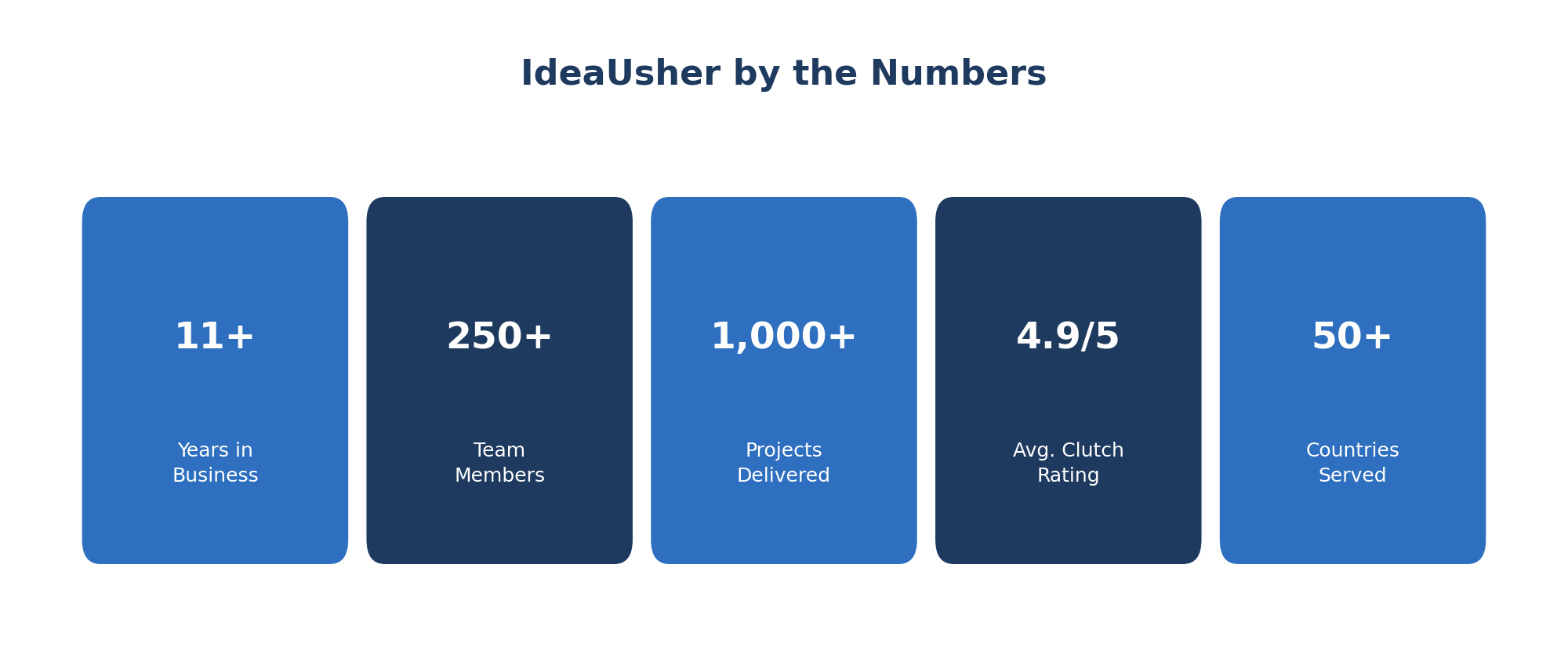
IdeaUsher by the numbers: 11+ years, 250+ team members, 1000+ projects, 4.9/5 Clutch rating, 50+ countries served
If you’re scoping a predictive analytics build for your supply chain, talk to IdeaUsher’s AI and ML team about the data architecture, model selection, and integration path that fits your systems.
Conclusion
Predictive analytics in supply chain isn’t a competitive edge anymore so much as a baseline expectation for any company that doesn’t want to get caught flat-footed by the next disruption, price swing, or demand surge. The companies getting the most out of it usually aren’t the ones trying to do everything at once. They picked one high-impact use case, got the underlying data right, proved it worked, and built out from there. That starting point might be demand forecasting, inventory optimization, or supplier risk scoring, but the fundamentals above should give you enough to evaluate a build and pick the right team to run it with.
FAQs
What is predictive analytics in supply chain management?
Predictive analytics in supply chain management uses historical and real-time data, statistical models, and machine learning to forecast future events, demand changes, shipment delays, supplier failures, so businesses can act before those events turn into a disruption instead of reacting after the fact.
What are the benefits of predictive analytics in supply chain?
The core benefits are more accurate demand forecasting, fewer stockouts and less overstock, lower logistics and warehousing costs, two to four weeks of early warning on disruptions, stronger supplier relationships through performance scoring, and margin protection through dynamic, predictive pricing.
How does predictive analytics improve supply chain decisions?
It replaces gut-feel and trailing-average planning with a data pipeline that ingests ERP, WMS, IoT, and market data, runs it through trained forecasting and risk models, and feeds the resulting predictions back into the systems planners already use, turning a probability into a concrete reorder, reroute, or risk alert.
What are common supply chain predictive analytics use cases?
The most widely adopted use cases are demand forecasting, inventory optimization, logistics and route planning, supplier risk scoring, supply chain visibility through IoT and predictive models, and dynamic pricing, with retail and healthcare supply chains among the most mature adopters.
How is predictive analytics applied in retail supply chains?
Retail supply chain predictive analytics combines point-of-sale data, loyalty history, and local event or seasonal signals to forecast demand at the store and SKU level, and that forecast then drives replenishment timing, markdown decisions, and micro-fulfillment placement.
How does predictive analytics help healthcare supply chains?
In healthcare, predictive analytics forecasts demand for medical supplies, implants, and pharmaceuticals so hospitals avoid both waste and the patient-safety risk of a critical item being unavailable, all while keeping data handling aligned with HIPAA and other regulatory requirements.
How much does it cost to build a predictive analytics platform for supply chain?
Cost depends heavily on data complexity and integration scope. Small-scope MVPs focused on one use case like demand forecasting can start in the tens of thousands of dollars, while enterprise-wide platforms integrating ERP, WMS, TMS, and IoT data typically run into six figures. IdeaUsher’s breakdown of logistics app development costs is a useful reference point for scoping a related build.