


Key Takeaways
- Lenders are adopting end-to-end AI lending platforms to automate the entire lending lifecycle, from borrower onboarding to repayment management.
- Modern platforms combine AI underwriting, intelligent document processing, fraud detection, Open Banking, and automated loan servicing.
- Building a successful solution requires AI models, secure infrastructure, banking integrations, regulatory compliance, and scalable cloud architecture.
- These platforms improve loan approvals, portfolio performance, operational efficiency, and borrower experience, creating strong opportunities for fintech growth.
For years, digital lending was judged by how quickly a lender could approve a loan. Today, that expectation has evolved. Borrowers still want fast approvals, but lenders also need stronger risk management, lower operating costs, and a better customer experience. That’s why AI lending platforms are becoming the preferred choice. Instead of simply automating approvals, they improve decisions across the entire lending process, reduce manual work, and help lenders build smarter systems that become more effective over time.
Our experience building AI-powered lending software has shown us that successful platforms require much more than fast loan approvals. They need the right balance of automation, risk management, compliance, and scalability. In this blog, we’ll explore what it takes to build an end-to-end AI lending platform.
Market Potential of AI Lending Platforms
According to MarkeUS, the global AI in lending market is projected to grow from USD 7.0 billion in 2023 to USD 58.1 billion by 2033, expanding at a CAGR of 23.5%. This rapid growth reflects how lenders are replacing traditional loan processing with AI-driven decision-making that speeds up approvals, reduces operating costs, and improves risk assessment. As adoption continues to rise, AI lending platforms are becoming one of the strongest growth opportunities in the fintech market.
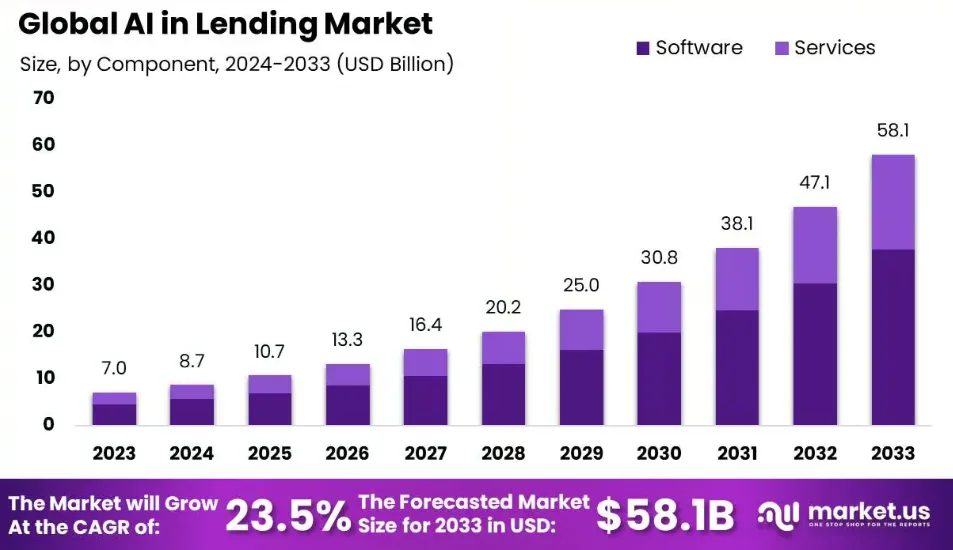
Source: MarkeUS
What’s Driving Enterprise AI Lending Adoption?
Traditional credit scoring models miss millions of creditworthy borrowers simply because standard bureaus rely on narrow historical data. Enterprise lenders face steep competition from agile fintech startups, making old manual processes a liability. Take a look at how companies like Zest AI are taking advantage of this gap.
Zest AI pulls in thousands of alternative variables to give credit unions and regional banks superior risk accuracy, allowing them to safely approve more applicants without taking on bad debt. Their platform business model consistently pushes past estimated revenues of $80+ million annually by providing this exact infrastructure.
- Alternative Credit Scoring: Analyzing utility payments, rental history, cash-flow behavior, and employment trajectory expands the total addressable borrower pool safely.
- Instant Loan Approvals: Borrowers expect real-time decisions. Intelligent systems automate document verification and income checks instantly, reducing drop-off rates during application.
- Advanced Fraud Detection: Machine learning models spot anomalous patterns, synthetic identities, and application tampering long before funds leave the vault.
- Regulatory Compliance & Auditability: Modern explainable machine learning models give compliance officers a clean line of sight into every automated approval or denial, simplifying reporting.
Why Now Is the Right Time to Invest
The gap between technology adopters and traditional lenders is widening fast. Banks, non-banking financial companies, and digital lenders are actively searching for white-label or custom intelligent software stacks to replace legacy back-office software. Building a platform that solves these operational bottlenecks positions you directly in front of enterprise clients willing to pay top dollar for infrastructure software.
Companies like Blend Labs highlight the massive market demand for digitized originations. Blend generated over $120 million in revenue by supplying cloud banking software that connects borrowers directly to automated financial workflows.

How an AI Lending Platform Works from Application to Loan Repayment?
Building an enterprise AI lending platform requires a deep understanding of how automated decisioning, risk modeling, and seamless operations connect into a unified workflow. From the moment a user submits an application to final loan recovery, modern lending architectures replace high-friction manual processing with high-speed, data-driven execution.
1. Borrower Onboarding and Loan Origination
Modern lending begins with a friction-free digital application. Instead of filling out paper forms or visiting a branch, the borrower enters basic information on a web portal or mobile app. The onboarding process runs several automated background checks simultaneously:
- KYC & Identity Check: Verifies facial recognition, government IDs, and selfie matches to prevent synthetic identity theft.
- OCR Document Processing: Optical character recognition extracts income details directly from bank statements, tax returns, and pay stubs.
- Real-time Eligibility: System verifies age, residency, and baseline income criteria within seconds.
By pulling data directly from bank APIs and payroll systems, the platform eliminates manual data entry errors. This reduces the application drop-off rate and sets the stage for instant underwriting.
2. AI Underwriting and Loan Disbursement
Once the data is ingested, the machine learning engine evaluates the borrower’s risk profile using traditional bureau data combined with alternative signals like utility payments, rental history, and cash flow stability.
- Fraud Screening: Anomaly detection algorithms check for suspicious device signatures, altered documents, or inconsistent application entries.
- Credit Scoring & Pricing: Risk models assign a custom credit score, determining the exact interest rate and maximum loan amount.
- Automated Decisioning: Low-risk applications get instant approval. High-risk or complex applications get routed to human underwriters for secondary review.
- E-Signature & Funding: The platform generates a legal agreement for digital signature, triggering an automated ACH or instant payout to the borrower’s bank account.
3. Repayment and Portfolio Monitoring
The lending lifecycle continues well after funds are disbursed. Automated servicing systems handle the daily management of active loans while continuously evaluating portfolio health. AI models continuously re-evaluate repayment behaviors across the entire platform. If economic conditions shift or specific borrower cohorts start showing signs of strain, the risk engine automatically updates its approval parameters for future applicants.
| Servicing Layer | Platform Function | Key Benefit |
| Payment Scheduling | Sets up auto-debits via direct debit or card rails | Reduces missed payment rates |
| Delinquency Detection | Identifies early warning signals in bank cash flow | Allows proactive outreach |
| Automated Collections | Triggers targeted SMS, email, or WhatsApp reminders | Lowers recovery costs |
| Portfolio Analytics | Monitors aggregate default risk and loan health | Refines future underwriting models |
Key Features of an End-to-End AI Lending Platform
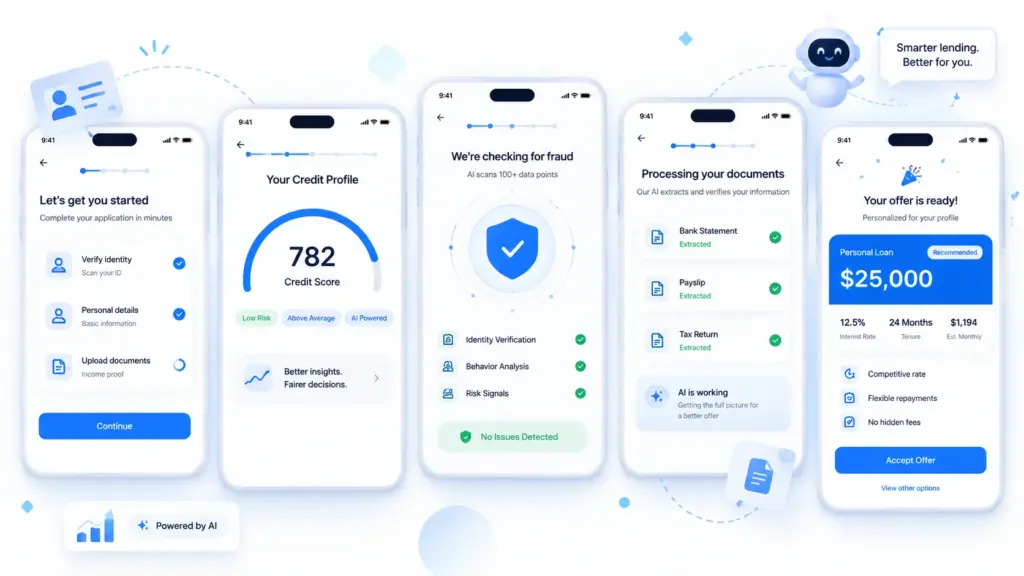
Building an enterprise AI lending platform involves bringing together multiple capabilities into one connected system. From borrower onboarding and loan applications to underwriting, disbursement, and portfolio management, every module helps automate the lending process, speed up decisions, and reduce operational effort while improving risk management.
1. AI Borrower Onboarding and KYC
Allow borrowers to complete applications digitally with automated identity verification, OCR-based document capture, and real-time KYC checks to reduce onboarding time and improve compliance. Blend streamlines digital onboarding with guided application flows, identity verification, and document collection for banks and lenders. In addition to Blend, Informed.IQ focuses specifically on automating applicant data checks.
2. Intelligent Credit Scoring and Underwriting
Use machine learning to evaluate traditional credit data alongside alternative financial signals, enabling faster and more accurate lending decisions than rule-based underwriting. Upstart uses AI models that analyze thousands of variables beyond conventional credit scores to automate credit decisioning and expand access to qualified borrowers.
3. AI Fraud Detection and Risk Monitoring
Detect identity fraud, synthetic identities, suspicious application behavior, and transaction anomalies before loan approval while continuously monitoring portfolio risk after disbursement. Pagaya applies AI-driven credit risk analysis and multiple verification layers to improve lending quality while managing portfolio risk.
4. Intelligent Document Processing
Automatically extract, classify, validate, and verify information from bank statements, payslips, tax returns, and other financial documents using AI and OCR, eliminating manual review. Ocrolus specializes in extracting unstructured financial data for lenders. Its platform parses bank statements and tax returns with high accuracy, driving over $50 million in annual revenue by replacing manual audit queues.
5. Personalized Loan Recommendations
Generate loan products, repayment terms, and interest rates tailored to each applicant’s financial profile, improving conversion rates and customer satisfaction. Zest AI helps lenders build custom risk models that offer personalized terms without increasing default rates. Operating across hundreds of credit unions and banks, Zest AI generates roughly $80 million in annual revenue by optimizing loan structures for individual risk profiles.
Key levers for personalization include:
- Dynamic interest rates aligned with real-time cash flow stability.
- Repayment schedules synced directly to borrower payday cycles.
- Pre-screened loan offers generated without hard credit pulls.
6. Automated Loan Servicing and Collections
Manage repayments, payment reminders, delinquency detection, restructuring, and collections using AI-driven automation to reduce servicing costs and improve recovery rates. Prodigy Finance automates loan servicing and international repayment tracking. By streamlining border-crossing payments and automated borrower communication, Prodigy Finance manages massive loan books while securing over $100 million in annual revenue.
7. Analytics and Portfolio Intelligence
Provide lenders with dashboards for loan performance, portfolio health, borrower behavior, default predictions, and operational KPIs to support proactive decision-making. C3 AI provides enterprise-grade AI analytics for large financial institutions. Its predictive dashboards monitor portfolio exposure, systemic risk, and default forecasts across multi-billion-dollar loan books, generating over $300 million in annual revenue.
| Monitoring Dimension | Business Impact |
| Early Warning Indicators | Spots shifting cash flows before a payment is missed |
| Macro Stress Testing | Models rate changes across active borrower cohorts |
| Capital Allocation | Shifts lending volume toward high-performing segments |
How to Build an End-to-End AI Lending Platform?
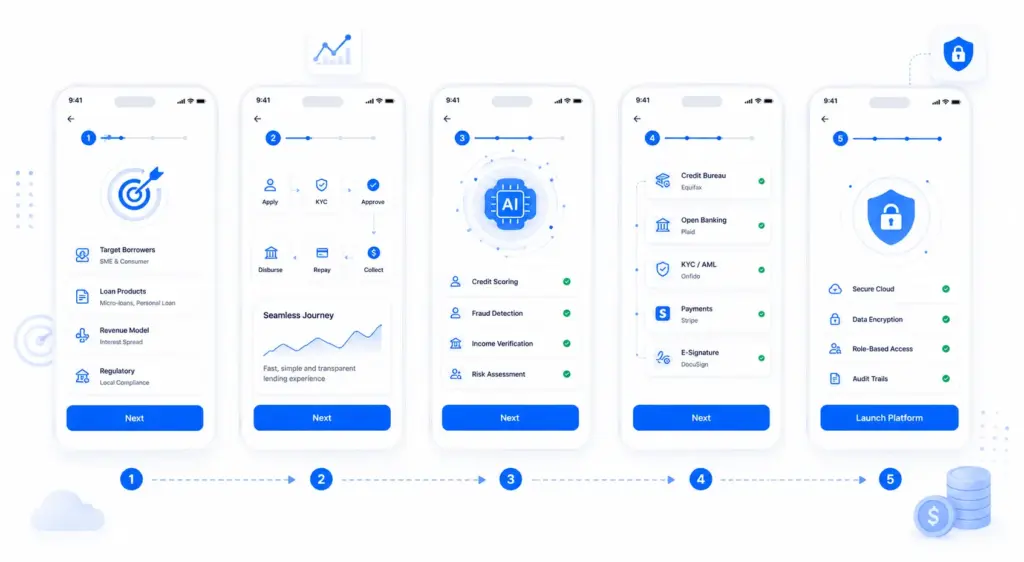
Building a custom AI lending platform is about combining advanced technology with reliable risk management. A well-planned development process helps you create a platform that automates loan decisions, improves operational efficiency, and gives lenders the flexibility to scale without compromising compliance or portfolio quality.
1. Define Lending Model and Goals
Start by identifying your target borrowers, loan products, revenue model, regulatory requirements, and key business objectives. This foundation shapes every technical and operational decision that follows. Outline your core lending parameter matrix early:
- Target Asset Class: Consumer micro-loans, commercial SME credit, or auto financing.
- Monetization Strategy: Origination fees, interest spreads, or software licensing fees.
- Regulatory Jurisdiction: Local banking licenses vs. balance-sheet partner models.
2. Design Lending Workflow
Map the complete borrower journey, from application and KYC to underwriting, loan approval, disbursement, repayment, and collections, to ensure a seamless experience for both borrowers and lending teams. Keep the front-end intake form light. Collect basic details first, then let APIs pull financial histories automatically to prevent high application drop-off rates.
3. Build Credit & Risk AI
Develop AI models for credit scoring, fraud detection, income verification, alternative data analysis, and predictive risk assessment. Ensure the models remain transparent, explainable, and continuously monitored for performance. Combine traditional credit bureau data with bank statement cash flows and payroll APIs. Use explainable machine learning frameworks so compliance teams can easily audit why the engine approved or rejected specific applicants.
4. Integrate Banking and Payment Services
Connect the platform with credit bureaus, Open Banking APIs, KYC/AML providers, payment gateways, e-signature tools, and core banking systems to automate the lending lifecycle.
| System Layer | Recommended Integration Purpose |
| Data Aggregation | Plaid or Yodlee for real-time bank account verification |
| Identity & AML | Persona or Onfido for automated ID verification |
| Payment Rails | Stripe or ACH networks for direct debit repayments |
5. Secure Infrastructure
Build a cloud-native architecture with strong security, encryption, role-based access, audit trails, and regulatory compliance to support large-scale lending operations and protect sensitive financial data. Encrypt all sensitive borrower data both in transit and at rest. Implement strict role-based access controls so internal teams only view data necessary for their specific operational duties.
6. Test, Launch & Optimize
Validate lending workflows, AI accuracy, security, integrations, and user experience before deployment. Launch an MVP, gather user feedback, and improve the platform through continuous iterations. Run full end-to-end simulations across edge cases like failed identity verification or payment gateway timeouts. Launching a pilot with a small capital pool helps prove model accuracy before opening up high-volume lending.
7. Monitor & Refine Models
After launch, track portfolio health, repayment behavior, fraud patterns, model drift, and operational KPIs. Retrain AI models regularly and refine workflows to improve lending decisions over time.
- Track Default Indicators: Monitor early payment defaults to adjust risk thresholds quickly.
- Audit Model Drift: Update training datasets regularly as macroeconomic conditions shift.
- Refine Intake Rules: Remove unnecessary application steps that slow down verified borrowers.
Cost to Build an End-to-End AI Lending Platform
Building an end-to-end AI lending platform is a capital-intensive project, with overall investment directly tied to model sophistication, data integrations, and regulatory coverage. Understanding the budget distribution helps you allocate capital efficiently without compromising security or decision accuracy.
Development Cost by Platform Complexity
The cost of building an AI lending platform depends on how advanced you want the solution to be. An MVP focuses on the core lending workflow, while larger platforms include AI-driven underwriting, fraud detection, and enterprise integrations. The breakdown below shows what you can expect at each development stage.
| Platform Tier | Estimated Cost Range | Key Capabilities Included | Target Deployment |
| Minimum Viable Product (MVP) | $60,000 – $120,000 | Basic borrower onboarding, AI-assisted credit scoring, KYC/AML, payment gateway, admin dashboard | Pilot launches, niche lenders, startup validation |
| Mid-Scale Platform | $120,000 – $280,000 | Advanced AI scoring, bureau integrations, OCR, dynamic pricing, automated disbursement and repayments | Growing fintechs, NBFCs, mid-sized lenders |
| Enterprise AI Engine | $280,000 – $500,000+ | Proprietary AI models, fraud detection, multi-currency support, risk analytics, white-label platform | Banks, enterprise fintechs, large lenders |
Key Factors That Influence Development Cost
Discuss the major cost drivers, such as AI model development, third-party integrations (credit bureaus, KYC/AML, payment gateways), cloud infrastructure, security, compliance, scalability, and custom feature development.
- Proprietary AI & ML Model Development ($30,000 – $100,000+): Custom credit scoring engines and fraud detection algorithms require extensive data engineering, model training, and continuous validation to prevent algorithmic bias.
- API & Core System Integrations ($15,000 – $45,000): Connecting to third-party services like Plaid, Experian, Persona, and core banking APIs incurs initial setup costs along with ongoing usage-based vendor fees.
- Security, Compliance & Audit Trails ($20,000 – $60,000): Enterprise-grade encryption, SOC 2 compliance readiness, GDPR/CCPA alignment, and role-based access frameworks demand dedicated security architecture setup.
- Cloud Infrastructure & Data Storage ($3,000 – $12,000/month): Real-time data processing and high-availability hosting across platforms like AWS or Google Cloud scale dynamically with loan application volume.
How to Reduce Development Costs?
Explain practical strategies like building an MVP first, prioritizing high-impact AI features, leveraging cloud-native services, reusing proven AI models where appropriate, and adopting a phased development approach to optimize budget and time-to-market.
- Launch a Focused MVP First: Build core loan application, KYC, and baseline automated underwriting flows first. This validates market demand before committing heavy capital to custom neural networks.
- Leverage Pre-Trained Machine Learning APIs: Use established third-party services for document OCR and identity verification during initial stages rather than building computer vision models from scratch.
- Adopt Modular Microservices: Construct the platform using decoupled services. This lets you add advanced features like real-time portfolio stress testing down the line without rebuilding core infrastructure.
Who Should Invest in an End-to-End AI Lending Platform?
An AI lending platform creates value beyond faster loan approvals. It helps lenders reduce operational costs, improve risk management, and scale lending operations more efficiently. It also enables financial institutions to deliver better borrower experiences while making lending decisions with greater confidence. The way these benefits are realized depends on the type of financial institution and its lending goals.
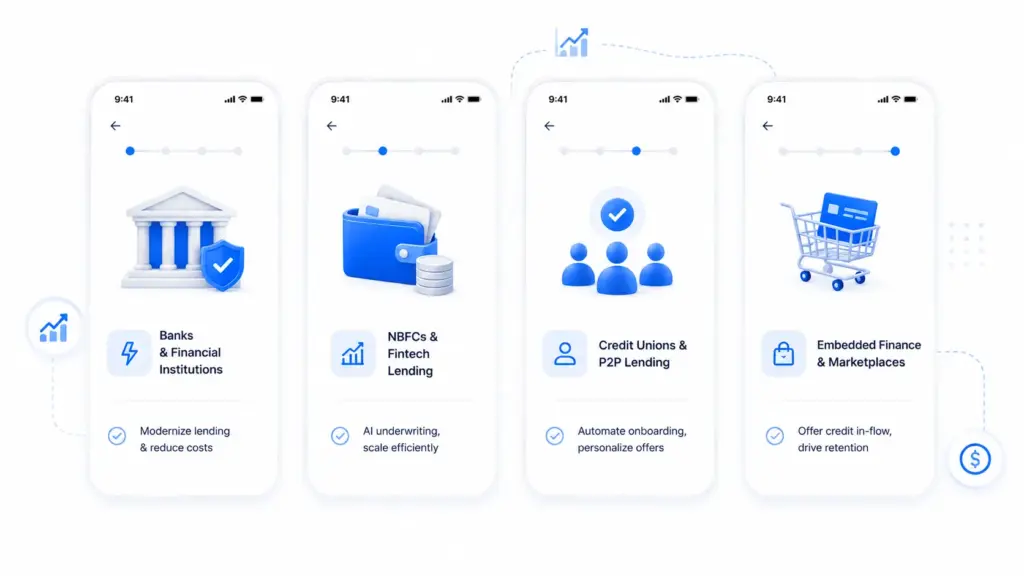
1. Banks and Financial Institutions
Traditional banks are investing in AI lending platforms to modernize legacy loan origination systems, accelerate approvals, strengthen fraud prevention, and deliver a seamless digital borrowing experience across retail and commercial lending. Automated pipelines allow institutions to reduce manual loan review costs by up to 70%.
By instantly connecting core banking systems to automated verification tools, banks capture tech-savvy borrowers who would otherwise shift to agile fintech alternatives.
2. NBFCs and Fintech Lending Companies
NBFCs and digital lenders benefit from AI-driven underwriting, alternative credit scoring, automated risk assessment, and operational efficiency, enabling them to scale lending while serving underserved borrowers more effectively. Take a look at platforms like OakNorth Bank. OakNorth uses custom data algorithms to assess commercial loans for medium-sized businesses, delivering tailored debt structures that traditional banks miss.
This focus on intelligent debt profiling has helped OakNorth generate revenues exceeding $380 million annually (approx. £300+ million).
Primary Efficiency Gains for NBFCs:
- Risk Accuracy: Cash-flow analysis catches creditworthiness beyond flat bureau scores.
- Speed to Capital: Instant decision engines keep borrower conversion rates high.
- Portfolio Growth: Automated systems process higher loan counts without linear headcount expansion.
3. Credit Unions and P2P Lending Platforms
Credit unions and peer-to-peer lending platforms can leverage AI to automate borrower onboarding, improve loan eligibility assessments, personalize lending offers, and enhance member or investor experiences without significantly increasing operational costs. Replacing manual credit committees with transparent machine learning models helps smaller institutions keep overhead low. Peer-to-peer portals gain clear risk tiering, giving retail and institutional investors immediate confidence in the underlying asset quality.
4. Embedded Finance and Marketplace Platforms
E-commerce platforms, B2B marketplaces, SaaS providers, payment companies, and other embedded finance businesses can integrate AI-powered lending to offer contextual credit, merchant financing, BNPL, and working capital solutions directly within their ecosystems, creating new revenue opportunities and improving customer retention.
A prime example of embedded credit at scale is Affirm. By embedding real-time point-of-sale financing into checkout flows for hundreds of thousands of merchants, Affirm generates over $3.2 billion in annual revenue. Their machine learning engine prices risk in seconds at the exact moment of purchase, unlocking massive transaction volumes without traditional bank branch friction.
| Ecosystem Type | Embedded Credit Use Case | Primary Financial Metric |
| B2B Marketplaces | Instant invoice factoring & supplier payables | Higher average order value (AOV) |
| E-Commerce Portals | Point-of-sale split payments (BNPL) | Reduced cart abandonment |
| SaaS Platforms | Revenue-based financing against recurring subscriptions | New fintech software yield |
Real-World Success Stories of AI Lending Platforms
Investment in AI lending platforms continues to grow as financial institutions adopt smarter lending technologies. Leading platforms show how AI is helping lenders automate loan origination, improve credit decisions, and expand into new lending markets while operating more efficiently. Understanding how these platforms are built can help you identify the features and technologies needed to develop a competitive AI lending solution.
1. Casca AI: Transforming SMB Lending
Casca AI is building an AI-native lending platform that helps banks automate the entire small business lending process. Its AI agents handle tasks like document review, financial analysis, underwriting, and loan origination, allowing lenders to process significantly more applications with far less manual effort. The company recently secured funding through Y Combinator and is already working with major U.S. banks, highlighting strong investor confidence in AI-first lending infrastructure.
Key operational highlights:
- Automates high-friction document analysis for commercial balance sheets.
- Backed by Y Combinator to deploy autonomous agents across regional banks.
2. Upstart: Scaling AI Credit
Upstart continues to be one of the biggest success stories in AI lending. Its machine learning models help lenders approve more qualified borrowers while managing risk more effectively than traditional credit scoring. The company reported strong revenue growth, renewed funding commitments from its private credit partners, and expanded into new lending categories such as auto and home loans, demonstrating the scalability of its AI-powered lending model.
| Scaling Vector | Market Performance |
| Asset Expansion | Personal loans, auto refinancing, and home equity |
| Model Efficiency | Approves up to 173% more borrowers at equal loss rates |
| Institutional Capital | Strong multi-billion dollar private credit commitments |
3. Arva AI: Modernizing Compliance
Arva AI focuses on automating business verification, KYC, and AML checks using artificial intelligence. While it is a RegTech platform, its technology plays a critical role in digital lending by helping banks and fintech companies onboard borrowers faster and reduce compliance risks. The company raised $3 million in seed funding led by Gradient Ventures, Google’s AI investment fund, reflecting growing demand for AI-powered compliance solutions in financial services.
- Streamlines Know Your Business (KYB) checks for corporate loan applicants.
- Reduces onboarding manual review times down to minutes.
- Supported directly by Google’s specialized AI venture fund.
Top 5 AI Lending Platforms in the USA
We researched several leading AI lending platforms in the U.S. to understand what sets them apart. Each platform offers a unique approach to credit assessment, underwriting, and loan automation, giving valuable insights into the features and capabilities that are shaping the future of digital lending. Studying these platforms can help you identify the capabilities worth including when building your own AI lending solution.
1. Upstart
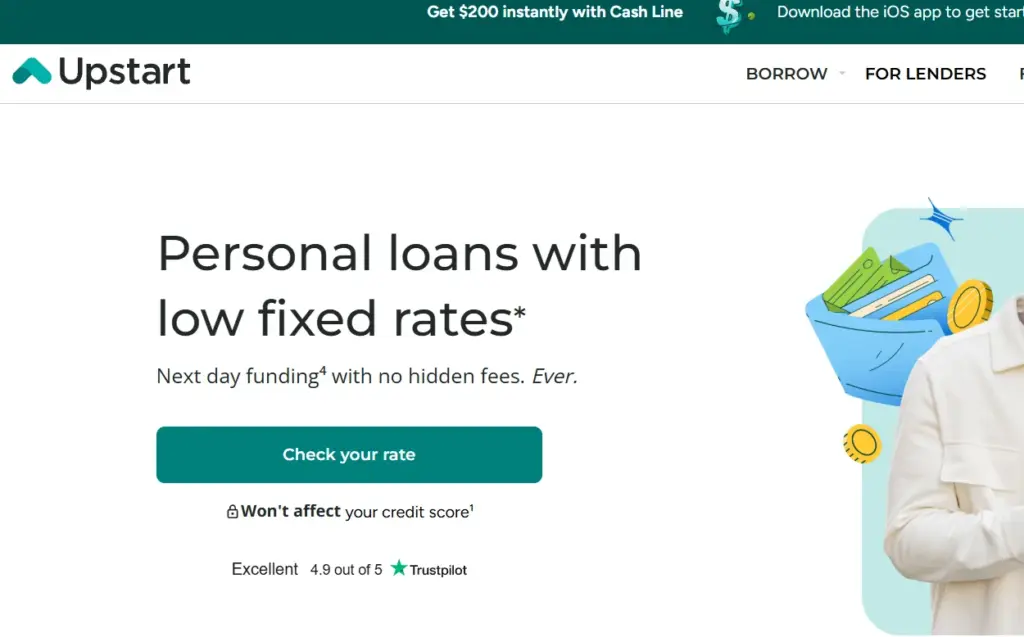
Upstart has become one of the best-known names in AI lending by helping banks and credit unions make faster and smarter lending decisions. Instead of relying only on traditional credit scores, its AI models analyze a broader set of financial data to assess risk. This allows lenders to approve more qualified borrowers while keeping default rates under control, making the lending process quicker and more accessible.
2. Zest AI
Zest AI focuses on helping banks and credit unions improve their underwriting process with explainable AI. Its platform enables lenders to build more accurate credit models while meeting regulatory requirements for fairness and transparency. This makes it a popular choice for institutions looking to modernize lending without replacing their existing systems.
3. Blend
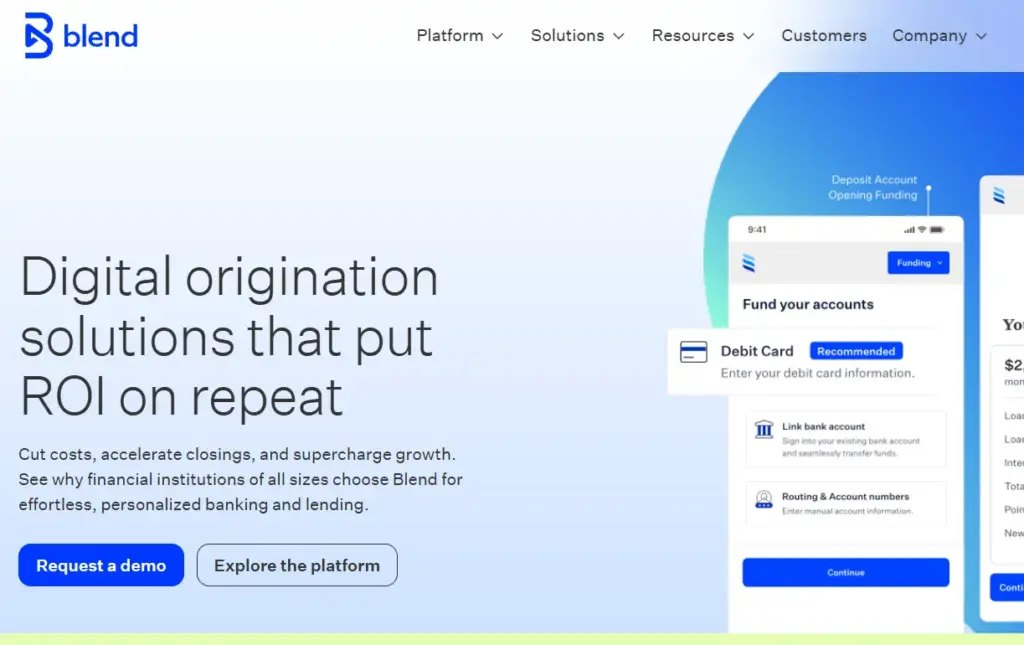
Blend is designed to simplify the entire loan origination journey. Borrowers can complete applications online, upload documents, and receive updates through one digital experience, while lenders benefit from automated workflows that reduce manual effort. The platform is widely used by banks and mortgage lenders to deliver faster approvals and a smoother customer experience.
4. Pagaya
Pagaya helps financial institutions expand lending without taking on unnecessary risk. Its AI platform analyzes large volumes of borrower data to identify creditworthy applicants who may be overlooked by traditional underwriting models. This gives lenders the confidence to approve more loans while maintaining strong portfolio performance.
5. Ocrolus
Unlike traditional lenders, Ocrolus provides the AI infrastructure that powers lending decisions. Its platform automatically extracts and verifies data from bank statements, tax returns, and other financial documents, helping lenders make faster underwriting decisions with greater accuracy. Many banks, fintech companies, and mortgage providers use Ocrolus to automate document review and reduce manual processing.
Build an AI Lending Platform with IdeaUsher
Building an AI lending platform requires expertise in both technology and financial regulations. At IdeaUsher, we develop secure and scalable AI lending solutions that automate decision-making, support compliance, and are designed to grow with your business. From product strategy and AI model development to deployment and ongoing support, we help turn complex lending ideas into production-ready platforms.
Custom Lending Architecture
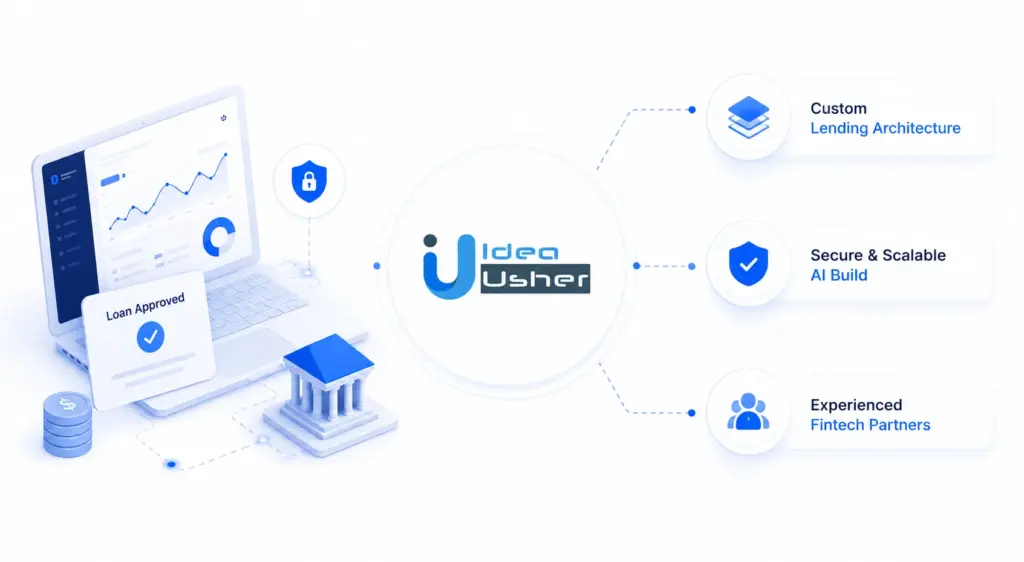
Every lending business operates differently, so your platform should too. At IdeaUsher, we build AI lending solutions around your business model instead of using generic software. Whether you’re serving consumers, businesses, or BNPL customers, we tailor the platform to match your lending workflows, compliance needs, and long-term growth plans.
Secure & Scalable AI Build
An AI lending platform needs more than intelligent automation. It must also be secure, compliant, and capable of handling growing transaction volumes. Our team develops cloud-native platforms with AI-powered decision engines, banking API integrations, KYC and AML workflows, and enterprise-grade security, ensuring your platform is ready for both regulatory requirements and long-term scale.
Key technical foundations we integrate:
- Explainable Risk Engines: Audit-ready machine learning models that comply with lending regulations.
- Direct API Rails: Seamless integration with credit bureaus, Open Banking APIs, and payment networks.
- Bank-Grade Security: Encrypted data pipelines with SOC 2 readiness and strict role-based access.
Experienced Fintech Partners
IdeaUsher has helped startups and enterprises build AI-powered digital products across regulated industries. With 250+ niche experts, 1,000+ successful projects, and experience in AI, fintech, cloud engineering, and enterprise software, we guide clients through every stage of development, from product strategy and MVP development to deployment, optimization, and ongoing support.
With over 500,000 hours of coding experience, our team of ex-MAANG/FAANG developers brings top-tier engineering practices to every build.
| Engineering Capability | Client Value Delivered |
| Ex-MAANG Expertise | High-throughput architectures built for low-latency scoring |
| 500,000+ Coding Hours | Reduced development risks and faster time-to-market |
| Full Lifecycle Support | From initial architectural design to post-launch optimization |
Conclusion
A successful AI lending platform combines automation, data intelligence, and risk management into one unified solution. It involves creating a connected system that automates the entire lending lifecycle while meeting security, compliance, and scalability requirements. With the right development approach, you can build a platform that delivers faster decisions, improves borrower experience, and supports long-term business growth.
Things to Know About AI Lending Platforms
A1: No. AI is built to make underwriters more efficient, not replace them. It handles repetitive work like reviewing documents, checking borrower information, and assessing risk in seconds. Human experts still play an important role when applications are complex or require judgment. This combination of AI and human oversight helps lenders process loans faster while maintaining accuracy and compliance.
A2: AI lending models can make more informed credit decisions because they look beyond traditional credit scores. They analyze a wider range of financial information to build a better picture of each borrower. As these models learn from new lending data over time, they continue to improve, helping lenders approve more qualified applicants while reducing defaults.
A3: AI lending platforms are flexible enough to support almost every type of lending business. They can be used for personal loans, home loans, auto financing, business loans, SME lending, BNPL services, and commercial credit. The workflows and underwriting rules can be customized to match different lending products, making the platform suitable for banks, NBFCs, fintechs, and credit unions.
A4: Yes, when it is built with the right security measures. Modern platforms use encrypted data storage, secure user authentication, and detailed audit logs to protect sensitive financial information. They also support explainable AI and compliance features, giving lenders greater confidence in every lending decision while meeting regulatory expectations.