


Key Takeaways
- Healthcare financing platforms help patients afford high-cost treatments through soft credit checks, long-term installment loans and instant approvals.
- Core features of healthcare fintech platform include automated underwriting, provider funding, fixed-rate loans and digital financing workflows.
- Healthcare fintech platform success depends on secure lending infrastructure, banking integrations and healthcare compliance.
- Providers benefit from higher treatment acceptance, faster funding and reduced collection risk through embedded financing.
- How Idea Usher can help you build a healthcare financing platform with AI underwriting, lending automation and healthcare-compliant architecture.
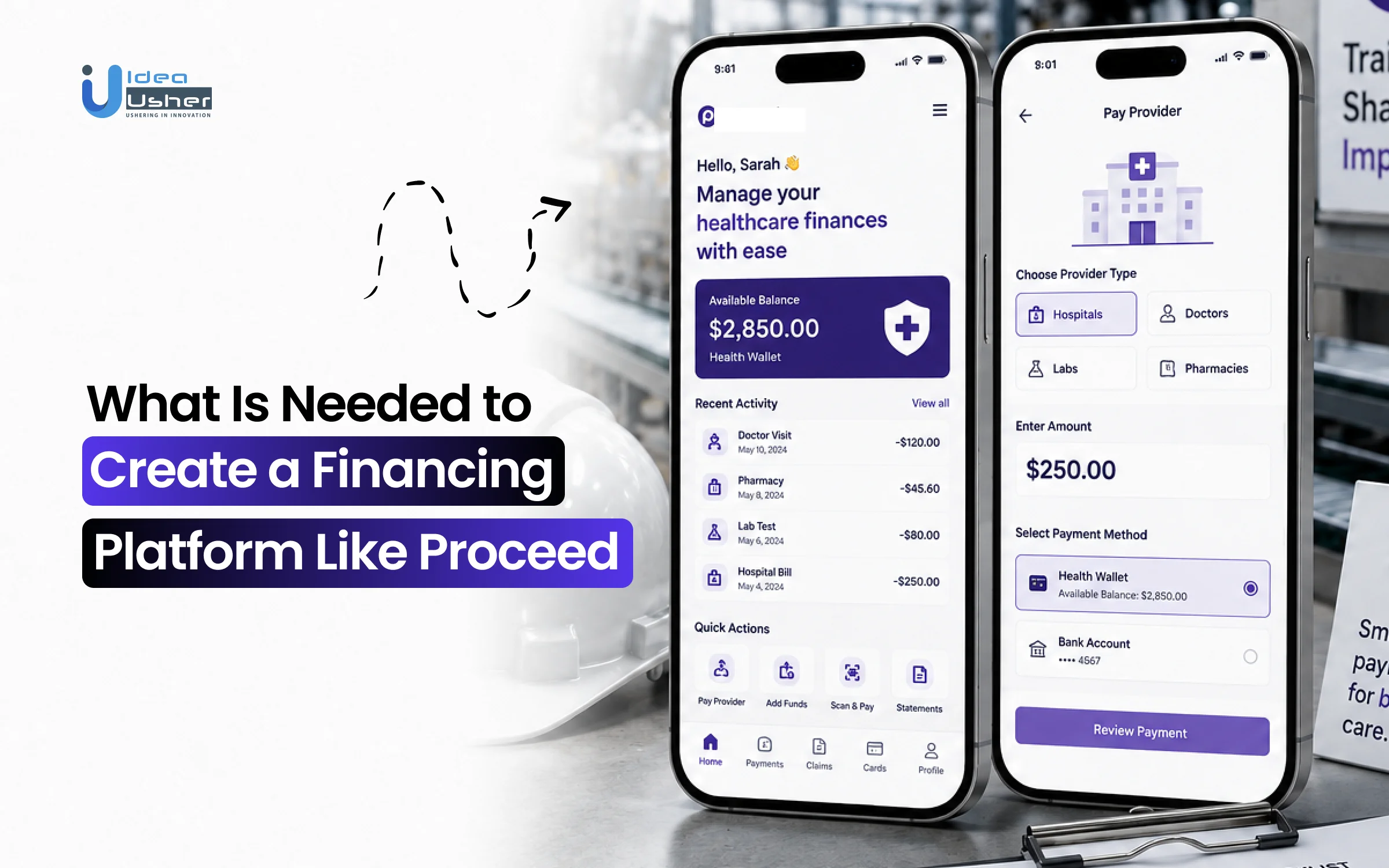
High treatment costs are increasingly becoming a financing challenge rather than a healthcare one. This shift is accelerating Proceed Finance platform development as healthcare providers seek financing solutions that help patients move forward with high-cost treatments instead of postponing care because of upfront expenses.
Traditional healthcare financing relied on short repayment terms, complex approvals, and limited support for high-cost procedures. Modern providers need soft credit pre-qualification, instant financing decisions, long-term installment loans, provider-direct funding, and digital financing workflows. Beyond payment options, these platforms improve affordability, increase case acceptance, and give patients predictable, accessible financing for essential care.
In this blog, we will talk about what is needed to create a financing platform like Proceed, including core features, financing workflows, technology architecture, compliance requirements, development costs and how Idea Usher can help you build scalable healthcare financing solutions that drive adoption and long-term success in healthcare financing ecosystems..
Why Large-Case Healthcare Financing Is Growing Fast
High-ticket medical and elective specialties including orthopedic surgeries, advanced dental reconstructions, fertility treatments (IVF), and plastic surgery deal with ticket sizes typically ranging from $5,000 to over $50,000.
The global healthcare patient financing platform market is valued at $7.94 billion and is projected to scale to $28.15 billion by 2035, accelerating at a compound annual growth rate (CAGR) of 13.8%. Within this landscape, large-case financing has evolved from a premium luxury option into a structural necessity for maintaining clinical volume.

As high-value treatments remain largely decoupled from standard commercial insurance models, automated financing networks are stepping in to bridge the gap between necessary clinical recommendations and personal household liquidity.
A. Why Patients Delay High-Cost Treatments
The primary barrier to large-case clinical care is not a lack of patient intent, but a stark deficit in immediate consumer liquidity.

Several financial and systemic challenges combine to discourage patients from moving forward with expensive treatments, even when medically necessary.
- The Insurance Exclusion Gap: Many high-ticket elective procedures are partially covered or excluded by insurers, forcing patients to bear significant upfront out-of-pocket costs as healthcare expenses continue to rise 3.7% annually.
- The “Missing Middle” Liquidity Crisis: Millions of consumers have stable incomes but lack the immediate liquidity for large medical deposits. For example, IVF treatments cost $5,000–$15,000 per cycle, often exceeding household cash reserves.
- Massive Checkout Abandonment: Nearly 60% of patients leave without treatment due to financing delays and cost anxiety, while 52% of specialty clinics lose over 1 in 5 patients because transparent financing options are unavailable at the point of care.
B. How Financing Improves Treatment Acceptance
Deploying point-of-sale (POS) financial infrastructure actively preserves patient momentum by eliminating price shock before the patient leaves the clinic.
- The 30-Second Momentum Lock: Modern embedded financing platforms run instant soft-credit eligibility checks in under 30 seconds, allowing patients to view financing options while the treatment plan is presented and maintaining purchase momentum.
- Slashing Case Drop-Offs: Integrating multi-lender POS financing into the clinical workflow reduces treatment abandonment by 30% and accelerates patient decision-making by 51% by offering transparent financing at checkout.
- Increasing Average Case Value: Flexible monthly installment plans let patients choose comprehensive treatment instead of reducing care to fit their budget, helping providers increase average treatment value by 19%–40%.
C. Why Providers Are Adopting Financing Platforms
Medical practices, surgical networks, and dental groups are rapidly integrating third-party financing software to protect their operational margins against severe macroeconomic headwinds.
- Managing Operational Inflation: Healthcare providers face historic margin compression as hospital expenses rose 5.1%, with supply costs up 9.9% and pharmaceutical costs up 13.6%. Maximizing collections and accelerating payments has become essential to maintaining profitability.
- Reducing Collections Overhead: Managing payment plans in-house increases administrative overhead and collection costs. As providers shift collections earlier in the care journey, 14.5% of private insurance revenue and 24.1% of specialized care revenue are now collected before treatment, reducing financial exposure.
- Transferring Credit Risk: Dedicated payment infrastructure transfers non-payment risk to financing partners while providers receive full case payments within 24–48 hours through ACH settlements. This improves cash flow, reduces accounts receivable, and lets clinical teams focus on patient care instead of financial underwriting.

What Is Proceed Finance?
Proceed Finance is a specialized financial technology company that provides large-case, fixed-rate installment loans tailored explicitly for high-ticket medical and dental procedures. Unlike retail Buy Now, Pay Later (BNPL) platforms or traditional revolving medical credit cards, this platform acts as a dedicated point-of-sale (POS) lending network, connecting patients needing high-cost treatments with partner banks (such as Optum Bank, Customers Bank, and Security First Bank) to finance complex, elective care plans.

The platform specializes exclusively in unsecured personal loans ranging from $2,500 to $75,000, providing long-term capital deployment specifically built for significant clinical investments like full-arch dental implants, advanced prosthodontics, fertility treatments, and major orthopedic procedures.
Why It Is Popular
Proceed Finance has experienced massive adoption among specialty surgical networks and dental groups due to its unique structural approach to high-ticket underwriting and revenue management.
- Higher Loan Limits: Unlike traditional medical financing capped around $25,000, Proceed Finance offers unsecured loans up to $75,000, making high-cost procedures like All-on-4 dental implants more accessible.
- 12-Year Repayment Terms: Patients can finance treatments over 144 months (12 years), significantly lowering monthly payments and making expensive care plans more affordable.
- Transparent Fixed-Rate Financing: Unlike deferred-interest financing that can charge up to 29.99% APR, Proceed Finance offers fixed-rate loans (3.99%–17.99% APR) with no hidden fees, prepayment penalties, or retroactive interest.
- Broader Credit Approvals: The underwriting model supports full-amount approvals for borrowers with FICO scores as low as 640, expanding financing access beyond traditional bank lending.
How a Financing Platform Like Proceed Actually Works
The financing process follows a streamlined, technology-driven workflow that guides patients from eligibility verification to repayment while ensuring providers receive timely payments and minimal administrative burden throughout the process.

1. Case Presentation and Digital Pre-Qualification
The workflow begins when the provider presents a treatment estimate and sends a pre-qualification link via SMS or email. Patients enter basic details to complete an instant soft credit check that provides financing eligibility without impacting their credit score.
2. Automated Underwriting and Plan Matching
The platform processes applicant data through automated underwriting APIs, evaluates debt-to-income (DTI) metrics, and matches applicants with partner lenders. Within 60 seconds, patients receive an approval decision and personalized fixed-rate repayment options without paperwork.
3. Plan Selection and Digital Agreement
Patients select a repayment term between 24 and 144 months based on their budget. The platform generates a transparent fixed-rate loan agreement, which is reviewed and signed securely using electronic signatures.
4. Upfront Provider Settlement
After loan approval and e-signature verification, the platform initiates an ACH transfer, depositing funds into the provider’s account within 1–2 business days. Providers receive 100% of the approved treatment amount (less applicable fees), improving cash flow and enabling immediate care delivery.
5. Loan Servicing and Repayment
Loan servicing transfers to the financing partner, where patients repay through a secure payment portal or automatic bank withdrawals. AutoPay reduces APR by 0.25%, while providers remain insulated from collections, payment defaults, and long-term credit risk.
Core Features of Financing Platform like Proceed
Building a healthcare financing platform similar to Proceed requires more than traditional lending capabilities. The platform should simplify patient financing, automate provider workflows, ensure regulatory compliance, and deliver transparent lending experiences with proper user-friendly core features that improve treatment accessibility while helping healthcare organizations accelerate approvals, funding, and revenue collection.

1. Soft Credit Pre-Qualification
Soft credit pre-qualification allows patients to check financing eligibility without affecting their credit score. This risk-free eligibility check removes hesitation, encourages more applications, delivers instant financing estimates, and integrates with credit bureaus to provide quick, reliable eligibility assessments before submitting a complete loan application.
- Soft Credit Inquiry: Performs eligibility checks without impacting patients’ credit scores, encouraging more users to explore financing confidently.
- Instant Pre-Qualification: Displays financing eligibility within minutes, reducing waiting times and improving the overall patient experience.
- Credit Bureau Integration: Connects with trusted credit bureaus to retrieve financial information for fast and accurate eligibility evaluations.
- Higher Patient Confidence: Allows patients to understand financing options before committing, increasing trust and treatment acceptance rates.
2. Instant Financing Decision Engine
An instant financing decision engine evaluates loan applications using predefined lending rules, real-time credit data, and eligibility criteria. This automated underwriting system reduces manual reviews, accelerates approvals, and enables patients to receive financing decisions within seconds for faster treatment planning.
- Automated Underwriting: Evaluates applications using configurable lending policies, reducing manual intervention and approval processing time significantly.
- Real-Time Decisioning: Generates financing decisions within seconds, helping patients move quickly toward treatment approval and scheduling.
- Eligibility Rule Engine: Applies customizable approval criteria based on credit profiles, financing limits, and lender requirements automatically.
- Scalable Decision Workflow: Supports thousands of simultaneous financing requests while maintaining consistent approval accuracy and platform performance.
3. Large-Case Treatment Financing
Large-case treatment financing enables patients to finance expensive healthcare procedures that often exceed personal budgets. This high-value financing capability supports flexible loan amounts, multiple specialties, and simplifies approvals for larger medical expenses.
- High Financing Limits: Supports expensive treatment plans without restricting patients to low-value financing options or short-term loans.
- Multi-Specialty Support: Enables financing for dental, cosmetic, fertility, bariatric, orthopedic, and various specialized healthcare procedures.
- Treatment Cost Estimation: Allows providers to generate financing offers directly from personalized treatment plans and estimated expenses.
- Large Loan Management: Handles higher financing amounts efficiently while maintaining transparent approval and repayment processes.
4. Long-Term Repayment Plans
Long-term repayment plans make costly treatments more affordable by offering flexible repayment durations and customizable installment structures. These plans help patients choose repayment schedules matching their financial capacity while improving financing accessibility and treatment acceptance.
- Flexible Loan Terms: Offers multiple repayment durations based on treatment costs and patient affordability preferences.
- Predictable Monthly Payments: Calculates consistent installment amounts that simplify long-term financial planning for borrowers.
- Custom Financing Options: Enables lenders to configure repayment structures according to business policies and financing programs.
- Improved Treatment Access: Reduces financial barriers by making expensive procedures affordable through manageable monthly installments.
5. Fixed-Rate Installment Loans
Fixed-rate installment loans provide predictable monthly payments and transparent financing terms throughout the repayment period. Stable interest rates eliminate uncertainty, improve financial planning, and strengthen patient trust by avoiding fluctuating repayment amounts or unexpected loan costs.
- Fixed Interest Rates: Maintains consistent borrowing costs throughout the loan lifecycle without unexpected payment fluctuations.
- Transparent Repayment Schedule: Clearly outlines monthly installments, total repayment amounts, and loan duration before financing approval.
- No Prepayment Penalties: Allows borrowers to repay loans early without additional charges or hidden financial penalties.
- Higher Financial Confidence: Builds patient trust through predictable repayment obligations and transparent financing terms.
6. Digital Patient Financing Application
A digital patient financing application streamlines the borrowing process through secure online forms, digital document submission, identity verification, and electronic signatures. This paperless application workflow reduces paperwork, accelerates approvals, and creates a seamless financing experience for patients across all devices.
- Online Application Forms: Enables patients to complete financing requests digitally without visiting healthcare facilities repeatedly.
- Secure Document Uploads: Supports encrypted submission of financial records, identification documents, and supporting paperwork safely.
- Identity Verification: Confirms applicant identity using digital verification services before financing approval begins.
- Electronic Signatures: Allows legally compliant loan agreements to be signed digitally, eliminating manual paperwork delays.
7. Healthcare Provider Portal
A healthcare provider portal gives organizations complete visibility into patient financing activities through a centralized management dashboard. Clinics can manage treatment plans, monitor financing requests, review approvals, track funding progress, and access business reports efficiently.
- Patient Financing Dashboard: Displays financing requests, approval status, treatment plans, and funding progress from one centralized interface.
- Treatment Management: Links financing requests directly with patient treatment plans for improved operational efficiency.
- Business Reporting: Generates financing performance reports, approval metrics, and revenue insights for healthcare providers.
- Practice Administration: Simplifies account management, provider settings, and financing workflow administration through one secure platform.
8. Provider-Direct Funding Automation
Provider-direct funding automation transfers approved loan amounts directly to healthcare practices through automated disbursement workflows after financing approval. This reduces administrative delays, improves cash flow, and ensures providers receive payments quickly.
- Automated Loan Disbursement: Transfers approved financing directly to providers without manual payment coordination or processing delays.
- Faster Provider Payments: Improves clinic cash flow by accelerating funding after successful financing approval.
- Settlement Tracking: Monitors payment status from approval through successful provider fund transfers automatically.
- Reduced Administrative Work: Eliminates repetitive payment processing tasks through automated financing and payout workflows.
Advanced Features of Healthcare Financing Platforms
Modern healthcare financing platforms leverage advanced technologies like AI, automation, and analytics to streamline lending processes, enhance patient experiences, and improve provider outcomes. These features of Proceed Finance platform development enable smarter decision-making, increased approvals, better risk management, and seamless communication across the entire financing lifecycle.
| Advanced Feature | What It Does | Business Impact |
| AI-Powered Financing Recommendations | Uses AI/ML to generate personalized financing recommendations based on treatment costs, credit eligibility, and repayment capacity. | Improves financing acceptance, personalization, and operational efficiency. |
| Multi-Lender Financing Marketplace | Matches applicants with the most suitable lender through a unified financing marketplace. | Expands financing access, increases approvals, and reduces lender dependency. |
| Dynamic Loan Offers | Generates real-time loan offers, interest rates, and repayment terms using borrower and treatment data. | Increases conversions, enables risk-based pricing, and improves borrower experience. |
| Provider Performance Analytics | Tracks financing approvals, treatment acceptance, revenue, funding, and conversion metrics through real-time dashboards. | Optimizes financing programs and supports data-driven decisions. |
| Automated Underwriting Rules | Automates credit evaluation, risk scoring, and underwriting using configurable lending policies. | Reduces processing time, lowers costs, and improves approval consistency. |
| Patient Communication Automation | Automates financing notifications, reminders, document requests, and follow-ups across multiple channels. | Improves engagement, increases application completion, and reduces support effort. |
| Fraud Detection & Identity Verification | Secures applications with identity verification, document authentication, biometrics, and fraud detection. | Prevents fraud, strengthens compliance, and protects patient and financial data. |
How to Build a Financing Platform Like Proceed
Developing a healthcare financing platform requires strategic planning, regulatory expertise, and robust technical execution. Our Proceed Finance platform development roadmap focuses on building a secure, scalable, and compliant solution that streamlines patient financing, automates provider workflows, and supports long-term business growth.

1. Product Discovery & Compliance Planning
Our team begins with business model clarity, financing strategy alignment, and regulatory mapping to define product requirements, validate feasibility, and create a structured roadmap that ensures compliant and scalable platform development from day one.
- Business Model Definition: Establish revenue streams, financing structures, pricing strategies, and long-term growth objectives aligned with your target market.
- Target Healthcare Segmentation: Identify high-demand specialties like dental, cosmetic, or elective care to align financing offerings with real patient demand.
- User Role & Workflow Planning: Define patients, providers, lenders, and admin roles to structure platform access, workflows, and interactions.
- Regulatory Compliance Planning: Map HIPAA, PCI DSS, and KYC/AML requirements early to ensure secure and legally compliant platform architecture.
- Scope & Feature Finalization: Define core features, timelines, and technical scope to ensure focused development and controlled execution.
2. UX/UI Design & Financing Workflow Mapping
We focus on intuitive user journeys, financing workflow clarity, and conversion-driven design to create seamless experiences for patients, providers, and lenders, ensuring every interaction supports faster approvals and better user engagement.
- User Journey Design: Create seamless flows for patients, providers, and lenders to simplify financing applications and approvals.
- Wireframing & Prototyping: Build interactive prototypes to visualize workflows and validate usability before development begins.
- Financing Workflow Mapping: Structure loan application, approval, and disbursement processes for smooth and efficient operations.
- Dashboard Interface Design: Design intuitive dashboards for tracking loans, payments, approvals, and financial performance.
- Responsive & Conversion-Focused Design: Ensure mobile compatibility, clear navigation, and strong CTAs to improve engagement and conversions.
3. Core Platform Development & API Integrations
Our developers build scalable core modules, automated underwriting systems, and secure API integrations to connect payment gateways, credit bureaus, and banking services, creating a fully functional and interconnected financing ecosystem.
- Patient & Provider Module Development: Build onboarding, loan application systems, and provider dashboards for managing treatments and financing.
- Underwriting & Approval Engine: Develop automated risk assessment and approval workflows to streamline financing decisions.
- Payment & Billing Integration: Integrate secure payment gateways and recurring billing systems for seamless transactions and repayments.
- Credit & Identity Verification APIs: Connect with credit bureaus and KYC services to validate users and assess creditworthiness.
- Notification & Communication System: Enable real-time alerts via email, SMS, and in-app notifications to keep users informed.
4. Financial Risk Management & Lending Optimization
We implement advanced risk modeling, credit scoring enhancements, and portfolio monitoring tools to help you minimize defaults, optimize approval rates, and maintain a healthy lending ecosystem that supports sustainable business growth.
- Custom Credit Scoring Models: Develop tailored scoring systems based on healthcare financing behavior and borrower profiles.
- Risk Segmentation & Decision Logic: Categorize applicants into risk tiers to automate smarter approval and rejection decisions.
- Fraud Detection Mechanisms: Integrate AI-driven fraud detection to identify suspicious activities and prevent financial losses.
- Portfolio Performance Tracking: Monitor loan performance, repayment trends, and default rates to optimize lending strategies.
- Dynamic Interest & Offer Optimization: Adjust financing terms based on risk profiles to maximize conversions while controlling exposure.
5. Security, Compliance & Quality Assurance
We implement enterprise-grade security, regulatory compliance validation, and rigorous testing processes to ensure every data transaction, workflow, and integration meets industry standards for safety, reliability, and performance.
- Data Encryption & Protection: Implement strong encryption protocols to secure sensitive patient and financial data.
- Role-Based Access Control: Ensure secure platform usage with controlled access across different user roles.
- Security Testing & Risk Assessment: Conduct penetration testing and vulnerability scans to eliminate potential threats.
- Regulatory Compliance Validation: Ensure adherence to HIPAA, PCI DSS, and KYC/AML standards across all workflows.
- Performance & Load Testing: Validate platform stability, scalability, and performance under high user traffic.
6. Deployment, Monitoring & Continuous Optimization
After launch, we focus on scalable cloud deployment, real-time performance monitoring, and continuous optimization to enhance user experience, maintain compliance, and support long-term growth of Proceed Finance platform development through ongoing updates and improvements.
- Cloud Deployment & Infrastructure Setup: Launch on scalable platforms like AWS or Azure for reliability and performance.
- Performance Monitoring & Alerts: Implement real-time monitoring tools to track uptime, system health, and detect issues early.
- User Analytics & Insights: Analyze user behavior to identify friction points and improve financing workflows.
- Continuous Feature Enhancements: Release updates and new features to improve functionality and stay competitive.
- Ongoing Compliance & Security Updates: Maintain regulatory compliance and platform security through continuous monitoring and updates.
Cost to Build a Financing Platform Like Proceed
The cost of building a healthcare financing platform depends on features, compliance, integrations, security, and scalability. Clear business goals help optimize Proceed Finance platform development. Multiple phases contribute to functionality and compliance, while overall investment varies based on scope, complexity, and customization requirements.
| Development Phase | Estimated Cost (MVP → Enterprise) | What the Phase Covers |
| Product Discovery & Planning | $8,000 – $25,000 | Business analysis, market research, compliance planning, feature prioritization, technical architecture, roadmap creation, and project estimation. |
| UI/UX Design & Prototyping | $10,000 – $35,000 | User research, wireframes, interactive prototypes, dashboard design, financing workflows, responsive interfaces, and usability validation. |
| Backend & Frontend Development | $35,000 – $180,000 | Patient portal, provider dashboard, lending engine, admin panel, APIs, databases, authentication, and business logic implementation. |
| Third-Party API Integrations | $10,000 – $50,000 | Payment gateways, banking APIs, credit bureaus, KYC verification, e-signatures, SMS, email, and notification services. |
| Security, Compliance & QA | $12,000 – $70,000 | HIPAA, PCI DSS, KYC/AML implementation, penetration testing, encryption, audit logs, quality assurance, and performance testing. |
| Deployment & Post-Launch Support | $10,000 – $40,000 | Cloud deployment, DevOps, monitoring, bug fixes, maintenance, analytics, feature optimization, and ongoing platform support. |
| Total Estimated Cost | $75,000 – $450,000+ | Combined cost across all development phases aligned with platform maturity. |
Note: These estimates represent typical custom software development costs. Final Proceed Finance platform development pricing depends on business requirements, regulatory scope, integrations, AI capabilities, platform complexity, and the experience of your development partner.
Development Cost by Platform Level
The earlier estimates may appear similar to other platforms because many fintech and healthcare solutions share overlapping foundational components. However, a healthcare financing platform like Proceed typically requires deeper compliance layers, lending logic, and integrations, which can slightly increase costs compared to generic platforms.
To provide more clarity and differentiation, here is a refined and more realistic cost breakdown based on platform maturity and complexity:
| Platform Level | Estimated Cost | Features Includes |
| MVP | $75,000 – $130,000 | Patient onboarding, soft credit checks, loan application flow, provider portal, basic financing dashboard, payment gateway integration, admin panel, and essential compliance setup. |
| Mid-Level | $140,000 – $220,000 | Automated underwriting logic, credit scoring integrations, CRM integration, notification automation, identity verification (KYC), reporting dashboards, and audit logs. |
| Enterprise | $250,000 – $450,000+ | Multi-lender marketplace, AI-driven financing recommendations, fraud detection systems, advanced analytics, custom workflows, enterprise integrations, scalable cloud architecture, and full regulatory compliance. |
Why These Costs Differ from Other Payment Platforms:
- Healthcare financing platforms require strict compliance (HIPAA + financial regulations), which increases development effort.
- Integration with credit bureaus, lenders, and banking systems adds complexity.
- Building a secure lending engine and underwriting logic is more resource-intensive than standard app features.
- Enterprise platforms often include AI, fraud detection, and multi-party ecosystems, significantly raising costs.
Note: Starting with an MVP helps validate your business model while reducing initial investment. Additional features, AI capabilities, enterprise integrations, and advanced compliance modules can be introduced incrementally as your platform grows.
Factors That Influence Development Budget
Several business and technical factors directly impact the overall Proceed Finance platform development budget. Understanding these variables helps define a realistic investment plan while balancing product quality, compliance, scalability, and long-term business objectives.
- User Roles & Workflows: Supporting multiple roles, such as patients, providers, lenders, and administrators, increases workflow complexity and development effort, typically adding $5,000–$20,000.
- Regulatory Compliance: Meeting healthcare and financial regulations, including security, privacy, and compliance requirements, can add $10,000–$40,000 to development and legal costs.
- Third-Party Integrations: Integrating payment gateways, credit bureaus, identity verification, and banking APIs increases integration, testing, and maintenance costs by $8,000–$25,000.
- Platform Scalability: Supporting higher user volumes, transaction loads, and cloud infrastructure typically requires an additional $3,000–$15,000 in initial setup costs.
- Automation & AI: Implementing automated underwriting, loan processing, and AI-driven risk assessment increases backend complexity, adding $15,000–$50,000 depending on sophistication.
How a Proceed like Fintech Platform Makes Money
A healthcare financing platform generates revenue through multiple lending models and service-based revenue streams. Combining financing income, provider fees, and value-added services creates predictable recurring revenue streams while helping healthcare providers improve treatment acceptance rates and enhance patient affordability.
Quick Revenue Overview
Understanding revenue streams helps evaluate platform sustainability and scalability. The following table outlines key monetization models used by healthcare fintech platforms, highlighting how each stream contributes to consistent income generation and growth.
| Revenue Stream | How It Works | Key Benefit |
| Merchant Discount Rate (MDR) | 3%–8% fee deducted from provider payouts | Immediate revenue per transaction |
| Interest Spread | 3.99%–17.99% APR margin between funding cost and patient rate | Long-term recurring income |
| Loan Origination Fees | 1%–5% fee applied during loan processing and approval | Covers operational and compliance costs |
| Subscription & SaaS Fees | $99–$499 monthly fees for platform access and tools | Stable and predictable revenue |
Each revenue stream plays a distinct role in strengthening financial stability after Proceed Finance platform development, allowing platforms to balance short term gains with long term income while supporting scalable growth across healthcare providers.
1. Merchant Discount Rates (Provider Fees)
The largest source of revenue for healthcare fintech platforms is the transaction fee charged directly to healthcare and dental clinics. When a patient is approved for a loan (e.g., $25,000 for full-arch dental implants), the platform does not pay the clinic the full amount. Instead, it takes a percentage-based cut known as a Merchant Discount Rate (MDR).
- How it works: If a clinic’s fee tier is 5% MDR, the platform retains $1,250 and deposits the remaining $23,750 into the clinic’s bank account within 24–48 hours, ensuring fast provider payouts.
- Why Providers Pay: The fee increases case acceptance by making high-cost treatments more affordable. A single-digit merchant fee is often justified if it converts procedures that would otherwise be lost due to affordability barriers.
2. Interest Spread (Net Interest Margin)
Healthcare fintech platforms operating on structured installment loan models generate revenue from the interest accrued over time throughout the loan lifecycle.
- The Spread: Platforms partner with regulated financial institutions to fund loans and earn a share of the interest spread, the difference between the lender’s cost of capital and the patient’s APR (3.99%–17.99%), based on creditworthiness.
- Long-Term Interest Revenue: Extended repayment terms of up to 12 years (144 months) generate steady interest income, creating a scalable, long-term revenue stream through loan duration and volume.
3. Loan Origination & Platform Fees
When a patient moves from a soft-credit pre-qualification to a fully approved hard-credit loan agreement, administrative, compliance, and processing costs are incurred.
- Origination Fees: Platforms may include loan origination fees within the total financed amount to cover underwriting, identity verification, risk assessment, and loan processing expenses.
- SaaS / Subscription Access: Some healthcare fintech platforms also charge providers implementation fees, onboarding costs, or recurring subscription fees for access to financing dashboards, analytics tools, reporting systems, and integrations with clinic billing and practice management systems.
Integrations That Power a Financing Ecosystem
A healthcare financing platform depends on seamless third-party integrations to automate lending, accelerate approvals, protect sensitive data, and improve provider operations. These integrations connect financial institutions, healthcare systems, and digital services into a secure, efficient financing ecosystem.
| Integration | Purpose | Business Value |
| EHR & Practice Management Software | Synchronizes patient, treatment, and billing data with financing workflows. | Reduces manual work and improves operational efficiency. |
| Credit Bureau APIs | Retrieves credit data for soft credit checks and automated underwriting. | Accelerates approvals and improves lending accuracy. |
| Banking & ACH Gateways | Automates loan disbursements, ACH payments, and reconciliation. | Streamlines payment processing and improves cash flow. |
| Identity Verification Services | Performs KYC, document verification, and fraud detection. | Prevents fraud and strengthens regulatory compliance. |
| Digital Signature Platforms | Enables electronic signatures for loan agreements and consent forms. | Speeds up approvals and eliminates paperwork. |
| CRM & Patient Communication Tools | Automates financing updates and patient communication across email, SMS, and in-app messaging. | Improves engagement and application completion rates. |
Note: Choosing the right integrations during Proceed Finance platform development ensures seamless data flow, faster approvals, enhanced security, and improved user experience, ultimately helping healthcare financing platforms scale efficiently and deliver reliable financial services.
Compliance Requirements for Healthcare Fintech Platform
Healthcare financing platforms process medical, financial, and personal data, making compliance essential. A compliance-first architecture protects sensitive information, reduces legal risks, and builds trust among patients, providers, and lending partners.
| Compliance Requirement | What It Covers | Business Importance |
| HIPAA Compliance | Protects ePHI through encryption, access controls, audit logs, and healthcare privacy safeguards. | Ensures patient privacy, reduces compliance risks, and enables secure data sharing. |
| PCI DSS Compliance | Secures payment card data with encrypted transactions, secure authentication, and continuous monitoring. | Protects payment data, reduces fraud, and strengthens transaction security. |
| Consumer Lending Regulations | Ensures compliant loan disclosures, interest rates, repayment terms, and fair lending practices. | Reduces legal risk and promotes transparent lending. |
| KYC & AML Verification | Performs identity verification, document validation, sanctions screening, and fraud monitoring. | Prevents fraud, supports compliance, and protects lenders from financial crime. |
| Data Encryption & Audit Trails | Encrypts sensitive data and maintains audit logs, user activity, and transaction records. | Strengthens security, supports audits, and improves accountability. |
Note: Compliance should be incorporated from the initial planning stage rather than added after Proceed Finance platform development. A compliance-first architecture reduces future remediation costs, accelerates certifications, and builds greater confidence among healthcare providers, lenders, and patients.
Challenges to Build a Healthcare Fintech Platform
Developing a healthcare financing platform involves much more than building lending features. Developers must balance regulatory compliance, financial security, healthcare integrations, and real-time lending workflows in Proceed Finance platform development while delivering a seamless experience for patients, providers, and financial institutions.
1. Integration of Multiple Financial & Healthcare Systems
Challenge: Integrating banking APIs, credit bureaus, payment gateways, EHR systems, and identity verification services without disrupting data consistency or transaction reliability.
Solution: Our developers build a modular API architecture with standardized data mapping, secure middleware, and continuous integration testing to ensure reliable communication between financial institutions, healthcare providers, and third-party services.
2. Compliance with Healthcare & Financial Regulations
Challenge: Creating a platform that satisfies healthcare privacy laws, payment security standards, and financial lending regulations across every user workflow.
Solution: We implement a compliance-first architecture by embedding HIPAA, PCI DSS, KYC/AML, encryption, audit logging, and role-based access controls throughout development instead of treating compliance as a post-launch requirement.
3. Reliable Underwriting & Loan Decision Engine
Challenge: Delivering instant financing decisions while accurately evaluating borrower eligibility, lending policies, risk profiles, and credit information at scale.
Solution: Our engineers develop configurable underwriting engines with automated decision rules, real-time credit bureau integrations, and scalable processing pipelines that accelerate approvals while maintaining lending accuracy.
4. Protection of Sensitive Healthcare & Financial Data
Challenge: Safeguarding medical records, financial information, payment transactions, and personally identifiable information from cyber threats, unauthorized access, and data breaches.
Solution: We implement enterprise-grade encryption, secure authentication, continuous security monitoring, penetration testing, and zero-trust access controls to protect sensitive data and maintain long-term platform security.
Why Choose Idea Usher for Your Healthcare Financing Platform
IdeaUsher operates as an elite product engineering powerhouse and digital transformation catalyst, leveraging 11+ years of hyper-focused industry mastery to launch disruptive, compliant software ecosystems across 50+ countries. Fueled by an intellectual brain trust of 250+ niche developers, a portfolio of 1,000+ deployed assets, and a top-tier 4.9/5 Clutch credential, we build high-yielding medical financing architecture from scratch.
Avoid generic templates with our handcrafted lending ecosystems, we optimize your platform using predictive large-ticket risk profiling, multi-tier amortization matrices, and native practice management hooks to expand your loan book and capture market share.
Why Enterprises Partner With Us
Global medical networks and fintech innovators choose us to outpace legacy payment barriers because we turn rigid compliance frameworks into automated point-of-sale checkout advantages.
- High-Ticket Risk Underwriting: We develop ML-powered credit decisioning engines that evaluate complex risk factors and deliver instant financing approvals for high-value treatments.
- PMS Data Synchronization: We build secure API integrations with Practice Management Systems (PMS) for real-time settlement tracking and duplicate-free data synchronization.
- Security & Compliance: Our developers implement HIPAA- and PCI-DSS-compliant infrastructure with encryption, access controls, and secure payment processing.
- Automated Clearing & Remittance: We develop ACH-integrated payment pipelines that automate recurring collections, payment reconciliation, and provider settlements.
Ready to launch a high-performance, compliant point-of-sale financing utility that scales your medical lending operations? Partner with IdeaUsher’s principal healthcare fintech architects to map your product roadmap today.
Conclusion
Healthcare financing is becoming an essential part of improving patient access to care while helping providers increase treatment acceptance and streamline revenue collection. Success in this space depends on combining secure lending workflows, regulatory compliance, intelligent automation, and seamless integrations into one scalable platform. At IdeaUsher, our fintech and healthcare experts specialize in creating tailored financing solutions that align with your business goals, ensuring your Proceed Finance platform development is secure, compliant, scalable, and ready to compete in the evolving healthcare finance market.
FAQs
A.1. A healthcare financing platform should include soft credit pre qualification, automated underwriting, provider funding, flexible repayment plans, compliance management, secure payment processing, and seamless integrations with banking, healthcare, and identity verification services.
A.2. Most healthcare financing platforms earn revenue through merchant discount rates, interest spreads on installment loans, loan origination fees, subscription plans for providers, and premium value added financial services.
A.3. A healthcare financing platform should comply with HIPAA, PCI DSS, KYC, AML, and applicable consumer lending regulations to protect sensitive healthcare and financial information while meeting legal and security requirements.
A.4. The Proceed Finance platform development cost depends on platform complexity, integrations, compliance requirements, and feature set. A basic MVP may cost between $75,000 to $130,000, while advanced enterprise platforms with full capabilities can range from $250,000 to $450,000 or more.


