


Key Takeaways
- AccessOne-like platforms simplify healthcare payments through flexible payment plans, digital billing and self-service financial tools.
- Core features include unified medical billing, automated payments, patient portals and healthcare system integrations.
- AI-powered payment recommendations and financial engagement improve collections while making healthcare more affordable for patients.
- Success depends on secure payment infrastructure, compliance and seamless EHR, billing and payment integrations.
- How IdeaUsher can help your build healthcare payment platform with AI automation, digital payment workflows and healthcare-compliant architecture.
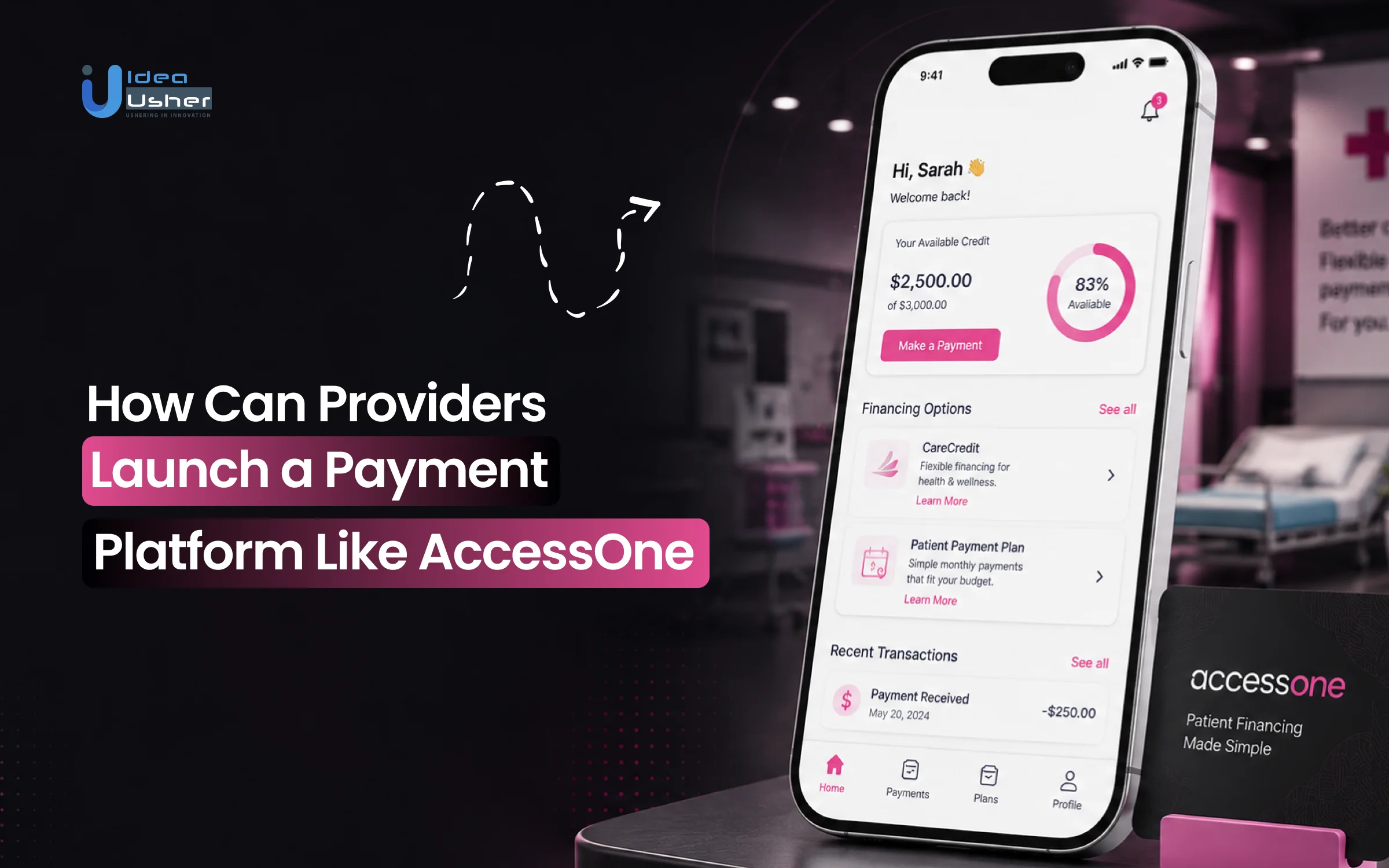
Patients rarely compare hospitals based only on clinical care anymore and financial experience is becoming part of the healthcare product itself. This shift is driving AccessOne platform development as providers invest in payment platforms that combine affordability, transparency and digital financial engagement into a single patient experience.
Traditional healthcare payment systems focused on collections, standardized billing, and limited financing options. Today, providers require personalized payment plans, digital billing, self-service payment portals, automated payment workflows, financial assistance programs, and revenue cycle optimization. The focus has shifted beyond payment collection to improving patient affordability, financial engagement, long-term payment compliance, and provider revenue.
In this blog, we explore how to build a payment platform like AccessOne, covering core features, payment workflows, technology architecture, compliance requirements, development costs, and how Idea Usher helps create scalable healthcare financing affordability platforms that strengthen patient trust while supporting sustainable provider revenue.
Why Providers Are Investing in Patient Payment Platforms
The financial mechanics of patient care collection have reached a critical transition point. The global market for AI-driven financial platforms in the medical space is undergoing an unprecedented expansion, tracking from $148.85 billion in 2025 , calculated at $160.49 billion in 2026 and is expected to reach around $314.38 billion by 2035, expanding at a CAGR of 7.76% from 2025 to 2034.

As the administrative costs of pursuing uncollateralized consumer balances outpace the recovery yields, medical practices are aggressively replacing backward-looking billing cycles with forward-looking, real-time digital payment rails.
A. The Care Affordability & Revenue Index
The matrix below highlights the core economic indicators and systemic market pressures accelerating the deployment of specialized healthcare financing networks.
| Revenue Risk Metric | Current Ecosystem Industry Benchmark | Systemic Impact on Health Systems |
| National Debt Mass | 100 million Americans holding $220 billion in medical debt. | Creates a massive credit freeze, driving steep care abandonment rates. |
| Hospital Bad Debt | Bad debt and charity care write-offs spiked 8% year-over-year. | Erodes thin operational margins and reduces physical capital reserves. |
| Billing Document Error | 80% of U.S. medical bills contain documented errors. | Generates massive post-care payment disputes and delays processing. |
| Claim Denial Core | Industry-wide claim denial rates hover between 10% and 15%. | Forces immediate administrative rework overhead averaging $25 per claim. |
| Billing Revenue Leakage | U.S. practices lose 4% to 5% of gross revenue to leakage. | Restricts liquid cash flows required to manage persistent labor inflation. |
B. Rising Out-of-Pocket Costs Are Reshaping Healthcare Payments
The financial burden of modern medical treatments has fundamentally broken through the cash savings cushions of the average household, introducing extreme volatility into everyday medical billing.
- The Growing Medical Debt Burden: According to the Consumer Financial Protection Bureau (CFPB), nearly 100 million Americans carry $220 billion in medical debt, creating a major affordability barrier and causing many patients to delay necessary care.
- Billing Errors & Insurance Denials: Industry audits show 4 in 5 medical bills contain errors, while incorrect medical coding contributes to 32% of first-submission insurance denials, leading to payment disputes, delayed collections, and lower patient trust.
- Mounting Financial Pressure on Providers: Healthcare organizations are absorbing a 5% increase in operating expenses and a 7% rise in drug costs. With already thin operating margins, providers can no longer afford to carry large volumes of unpaid self-pay balances.
C. Why Traditional Medical Financing Models Fall Short
Legacy collection methodologies and rules-based financing tools are structurally unequipped to handle the modern self-pay landscape. Relying on paper billing cycles or standard credit lines creates immense friction at checkout.

These shortcomings create financial inefficiencies for providers while making it harder for patients to access affordable payment options.
- The High Cost of Billing Rework: Inefficient billing practices cost healthcare providers an estimated $125 billion annually, while each denied claim adds roughly $25 in administrative rework to correct documentation and coding errors.
- The Limitations of Post-Care Billing: Traditional billing statements are often issued weeks after treatment, reducing patients’ willingness to pay and increasing aging receivables and uncompensated care.
- The Credit Approval Gap: Traditional healthcare financing relies on rigid FICO-based underwriting, excluding many non-prime borrowers and limiting financing options at the point of care, which reduces treatment acceptance and creates friction for front-desk teams.
D. The Shift Toward Patient Financial Engagement
To stop revenue leakage before it starts, forward-thinking medical organizations are aggressively shifting toward automated, upfront patient financial engagement layers embedded directly within their existing workflows.
- Real-Time Pre-Service Cost Estimates: Modern platforms integrate with insurance systems to verify coverage, automate eligibility checks, and generate accurate out-of-pocket estimates before treatment, reducing surprise medical bills.
- Intelligent Payment Orchestration: Automated payment workflows, growing at 25% annually in healthcare, enable recurring digital payments and flexible repayment schedules aligned with each patient’s financial capacity.
- Accelerated Revenue Collection: Digital financing platforms help providers secure upfront payments, often within 48 hours, by transferring repayment management to financing partners, reducing administrative burden and improving revenue cycle predictability.

What Is an AccessOne-Like Healthcare Payment Platform?
AccessOne is a patient payment and healthcare affordability solution that helps hospitals and healthcare providers improve patient affordability through flexible, personalized payment plans. Unlike traditional financing models that rely on credit approvals and interest-bearing loans, it delivers patient-friendly payment experiences that simplify medical bills while improving collections and patient satisfaction.
The platform operates as a patient financial engagement ecosystem, combining customized payment plans, digital billing, self-service payment tools, and financial assistance programs within a unified experience. Solutions such as Patient Simple® and CarePay+® offer tailored payment options that reduce financial stress and improve access to care.
A. The Inclusive Financing Architecture
The matrix below highlights how the patient-centric financing principles that drive AccessOne platform development eliminate many of the exclusions associated with traditional retail medical credit cards.
| Core Performance Attribute | Traditional Medical Credit Cards | AccessOne-Like Financing Architecture |
| Eligibility Criteria | Hard FICO credit check; limits access based on score. | 100% Inclusivity; universal qualification for all patients. |
| Credit Bureau Reporting | Reports missed payments, potentially damaging credit. | Zero Credit Reporting; fully insulated financial health. |
| Account Consolidations | Separate applications per encounter or department. | Guarantor-Level Pooling; combines family-wide medical bills. |
| Baseline Net Repayment | Volatile; highly dependent on fluctuating credit tiers. | Achieves an optimized 96% repayment rate on 0% plans. |
| Platform Financial Yield | Diluted by high-volume point-of-sale rejections. | Delivers a consistent 85% net yield on payment plans. |
B. How the Platform Works for Patients
The digital patient journey replaces confusing, fragmented statements with intuitive mobile channels, removing payment friction from the post-discharge experience.

The result is a simplified payment experience that gives patients greater flexibility, transparency, and control over medical expenses.
- Frictionless Digital Delivery: Following a clinical encounter, the platform bypasses paper billing delay by delivering a secure, mobile-optimized link via text or email. The patient views their itemized liability instantly without requiring logins, passwords, or app downloads.
- Guarantor-Level Consolidation: If a family has multiple active balances across different departments (e.g., emergency department, radiology, and outpatient specialty clinics), the system automatically aggregates them into a single unified statement under one guarantor profile.
- Self-Service Selection: The patient interacts with a secure customer portal to choose their preferred path: instant one-click guest checkout via mobile wallet (Apple Pay/Google Wallet) or self-directed enrollment into an extended repayment tier.
- Continuous Engagement Loop: Once enrolled, the user manages their account through a centralized dashboard. They can configure automated text reminders, adapt payment dates to matching salary cycles, and add subsequent medical bills to the existing plan smoothly.
C. How Signature Programs Improve Payment Flexibility
Flexible payment plans are a defining feature of modern healthcare payment platforms. Instead of offering a one-size-fits-all repayment model, they enable providers to personalize payment options based on each patient’s financial situation, improving affordability and payment completion. AccessOne demonstrates this approach through its Patient Simple® and CarePay+® programs, which deliver simplified, personalized payment experiences without the complexity of traditional healthcare financing.
1. Patient Simple®: Digital Self-Service Orchestration
This program serves as the front-end digital interaction engine, empowers patients to independently discover, simulate, and establish self-service payment plans directly within their patient portal.
Key Capability to Replicate: Built-in calculation widgets that let users adjust their monthly payment size in real time to see the resulting timeline extension. This self-directed flexibility drives up to a 60% self-service enrollment rate, completely offloading payment arrangement tasks from front-desk staff.
2. CarePay+®: High-Capacity Long-Term Financing
For major surgeries, oncology regimens, or complex multi-stage procedures that leave families with intimidating out-of-pocket deductibles, this track offers extended repayment runways.
Key Capability to Replicate: The ability to offer extended structural payment timelines ranging from 12 to 100 months. These plans feature ultra-low or 0% interest rates and low minimum monthly payments, converting a catastrophic lump-sum invoice into a highly manageable financial asset.
While Patient Simple® and CarePay+® are proprietary programs unique to AccessOne, the broader principle is what matters when building a similar platform. Providers should focus on delivering configurable payment plans, patient-friendly financing workflows, and transparent digital payment experiences that achieve the same goals of improving affordability and payment compliance.
D. How Providers Benefit Operationally
Implementing an inclusive, technology-driven financing framework yields substantial financial returns across the hospital enterprise.
- Significant Reduction in Bad Debt: Shifting self-pay risks to an automated framework leads to an immediate 10% to 20% drop in uncompensated bad-debt write-offs, securing revenue that would otherwise be lost.
- Compression of Days in A/R: Providing accessible payment solutions at discharge prevents bills from stalling out past the 90-day mark, accelerating cash flow velocity toward healthy accounts receivable targets.
- Enhanced Administrative Efficiency: Automating payment plan setups improves billing staff efficiency by 25%. Front-office specialists spend less time chasing outstanding statements and more time focused on front-end accuracy and care delivery.
- Substantial Cost Mitigation: Shifting consumers to electronic statements and automated text reminders triggers up to an 81% reduction in print and mailing operational overhead.
E. Where Payment Automation Fits Into Revenue Cycle Management
Automated patient financing is most effective when embedded directly into the revenue cycle. By prioritizing interoperability, AccessOne platform development enables seamless payment automation, synchronized financial records, and compliance-driven workflows.

To operate smoothly at an enterprise scale, automated patient financing must embed directly into the health system’s existing technology stack.
1. Native HIS/EMR Integration
The platform integrates with major EMR and Hospital Information Systems (HIS) such as Epic, Oracle Cerner, and MEDITECH through secure, real-time APIs. Payments and plan updates automatically sync with core system ledgers, eliminating manual reconciliation.
2. Automated Payment Orchestration
A secure payment engine stores tokenized debit, credit, and HSA/FSA payment methods, automating recurring payments based on user-defined schedules while maintaining PCI DSS compliance.
3. Proactive Omnichannel Communication
The platform runs automated communication routines that replace manual outreach entirely. Intelligent notification triggers send text alerts, email updates, and interactive voice response (IVR) calls before statements are due, prompting self-service updates if a card is about to expire.
4. Compliance-First Governance
The system includes a dynamic rules engine that adapts to evolving state and federal regulations, including the No Surprises Act, Regulation F, and IRS 501(r) compliance. This architecture protects all financial communications and payment terms from violations, shielding health systems from legal risk.
AI Features Every AccessOne-Like Platform Should Include
Artificial intelligence is rapidly reshaping patient financing, making it a critical consideration in modern AccessOne platform development. AI-driven payment planning, communication, and risk analysis help providers improve collections while delivering more personalized financial experiences.
| AI Feature | What It Does | Business Value |
| AI-Powered Payment Plan Recommendations | Analyzes balances, payment history, affordability, and repayment preferences to recommend personalized payment plans. | Improves payment completion by matching repayment plans to patient affordability. |
| Predictive Payment Risk Analysis | Predicts patients likely to delay or miss payments using historical payment data. | Reduces bad debt and enables proactive collection strategies. |
| Intelligent Billing Communication | Automates personalized payment reminders, due-date alerts, follow-ups across multiple channels. | Increases patient engagement while reducing manual collection efforts. |
| Conversational AI Support | Provides 24/7 AI assistance for billing questions, payment plans and guidance. | Improves patient experience while reducing call center workload. |
| AI-Driven Payment Forecasting | Forecasts collections, payment trends, and outstanding balances using financial data. | Improves cash flow planning and financial decision-making. |
| Smart Patient Segmentation | Segments patients by payment behavior, affordability, and engagement. | Enables targeted financial outreach and higher repayment rates. |
| Automated Financial Assistance Screening | Identifies eligibility for financial assistance and personalized payment programs. | Speeds assistance approvals and improves access to suitable payment options. |
| Revenue Cycle Intelligence Dashboard | Combines AI insights, payment analytics, and revenue KPIs into a unified dashboard. | Optimizes revenue cycle performance through actionable financial insights. |
Note: AI should augment, not replace, the patient financial experience. Successful healthcare payment platforms use AI to personalize repayment options, automate tasks, provide insights, and maintain transparency, compliance, and human oversight.
Must-Have Features of an AccessOne-Like Payment Platform
A successful healthcare payment platform should do more than process medical bills. It should simplify patient payments, improve financial transparency, automate revenue workflows, and increase collection rates without compromising affordability. The following capabilities form the foundation of an enterprise-grade AccessOne platform development with patient-first payment model.
1. Flexible Patient Payment Plans
One of the defining capabilities of an AccessOne-like platform is offering flexible, interest-free payment plans that reduce financial barriers to care. Instead of relying on traditional lending models, providers can offer personalized repayment options that improve affordability, increase payment compliance, and strengthen long-term patient relationships.
- Configurable Payment Plans: Allows providers to create personalized installment schedules based on patient balances, repayment preferences, and organizational policies.
- Universal Patient Eligibility: Ensures every patient can access flexible payment plans without traditional credit approval requirements or exclusions.
- Flexible Installment Options: Supports weekly or monthly repayment schedules that accommodate different financial situations and payment capacities.
- Interest-Free Financing: Eliminates additional borrowing costs, making healthcare expenses easier for patients to manage over time.
- Payment Plan Management: Enables patients to modify schedules, monitor balances, and track repayment progress through digital tools.
2. Unified Medical Bill Management
Healthcare payments often become confusing when patients receive separate bills from multiple departments or provider locations. Consolidating these balances into one unified payment experience simplifies account management, improves financial transparency, and encourages faster payments while reducing administrative complexity for providers.
- Consolidated Medical Bills: Combines balances from multiple facilities and departments into a single patient payment account.
- Unified Billing Experience: Presents all outstanding medical charges within one organized dashboard for easier financial management.
- Simplified Account Management: Reduces billing confusion by eliminating multiple payment portals and disconnected billing statements.
- Cross-Facility Payment Tracking: Keeps payment records synchronized across hospitals, clinics, and specialty care providers.
- Transparent Outstanding Balances: Provides patients with a complete financial overview before selecting repayment options.
3. Patient Self-Service Payment Portal
Patients increasingly expect digital self-service experiences that allow them to manage healthcare payments independently. A self-service portal reduces support requests while giving patients complete visibility into their accounts, payment plans, billing history, and future payment schedules.
- Secure Patient Accounts: Allows users to register, authenticate, and securely access their payment information anytime.
- Digital Bill Management: Displays outstanding balances, invoices, payment history, and downloadable billing statements in one place.
- Payment Scheduling: Enables patients to schedule one-time or recurring payments based on preferred repayment dates.
- Guest Payment Access: Allows family members or caregivers to make payments without creating permanent accounts.
- Profile and Preference Management: Lets patients update contact information, notification preferences, and saved payment methods.
4. MobilePay and Text-to-Pay Experiences
Mobile-first payment experiences reduce payment friction by enabling instant, on-the-go transactions directly from smartphones. SMS payment links, digital wallets, and responsive payment pages improve convenience, increase engagement, and encourage faster payment completion.
- SMS Payment Links: Sends secure payment links through text messages for immediate bill settlement.
- Mobile-Optimized Checkout: Delivers responsive payment experiences across smartphones and tablets without requiring additional downloads.
- Digital Wallet Support: Supports modern payment methods such as Apple Pay, Google Pay, and other digital wallets.
- QR Code Payments: Enables patients to instantly access payment pages by scanning secure QR codes.
- Automated Payment Reminders: Sends timely mobile notifications before upcoming due dates to reduce missed payments.
5. Automated Payments and Flexible AutoPay
Automation minimizes manual collection efforts while ensuring patients never miss scheduled payments. Intelligent payment workflows improve operational efficiency, reduce overdue balances, and provide a predictable repayment experience for both patients and providers.
- Recurring Payment Collection: Automatically processes scheduled installment payments according to approved repayment plans.
- Custom Payment Scheduling: Allows patients to choose payment dates aligned with their income or billing preferences.
- Automatic Payment Reminders: Delivers reminders before due dates through SMS, email, or push notifications.
- Failed Payment Recovery: Retries unsuccessful transactions using configurable payment recovery workflows.
- AutoPay Enrollment: Allows patients to securely enable automatic recurring payments with minimal setup effort.
6. Direct EHR, PM, and Revenue Cycle Integrations
A healthcare payment platform delivers maximum value when it connects seamlessly with existing clinical and financial systems. Real-time system integrations eliminate duplicate work, improve billing accuracy, and ensure payment information remains synchronized across the healthcare ecosystem.
- EHR and EMR Integration: Synchronizes patient demographics, balances, and billing information with electronic health record systems.
- Practice Management Connectivity: Exchanges payment and appointment information directly with provider management platforms.
- Revenue Cycle Synchronization: Updates outstanding balances and payment statuses across revenue cycle management systems automatically.
- Secure Payment Gateway Integration: Connects with trusted payment processors for secure transaction handling and settlement.
7. Revenue Cycle Performance and Payment Insights
Healthcare organizations need real-time visibility into payment performance to improve financial outcomes. Advanced reporting helps providers identify collection trends, monitor patient repayment behavior, and optimize revenue strategies through data-driven decision-making.
- Payment Collection Dashboards: Provides real-time visibility into collection performance across facilities and departments.
- Repayment Trend Analysis: Identifies patient payment patterns to improve financing strategies and collection planning.
- Outstanding Balance Monitoring: Tracks unpaid balances and overdue accounts through centralized reporting tools.
- Financial Performance Metrics: Measures payment completion rates, bad debt reduction, and overall revenue improvements.
8. Compliance-First Payment Infrastructure
Healthcare payment platforms manage highly sensitive financial and patient information, making security and compliance essential. Building these safeguards into AccessOne platform development helps protect data, meet regulatory requirements, and strengthen trust among healthcare organizations and their patients.
- HIPAA-Compliant Data Protection: Secures protected health information throughout storage, processing, and payment workflows.
- PCI DSS Payment Security: Protects cardholder data using industry-standard payment security controls and encryption.
- Role-Based Access Controls: Restricts system access according to user responsibilities and organizational permissions.
- Encrypted Financial Data: Protects sensitive payment information using encryption during transmission and long-term storage.
How to Develop and Launch an AccessOne-Like Payment Platform
Engineering a high-performance patient financial engagement platform requires combining inclusive lending logic with deep hospital network data integrations. Successful AccessOne platform development transforms medical billing operations into a low-risk, high-yield system that unifies cross-departmental invoices and automates long-term patient collections.

1. Define Your Payment Model and Business Goals
Our product managers establish your application’s core economic frameworks long before writing code. We define inclusive zero-exclusion credit limits, structure tiered interest-bearing timelines for long-term balances, isolate target hospital systems, and align platform monetization pathways with regional lending guidelines.
- Zero-Exclusion Framework Rules: Outlining specialized underwriting thresholds that approve 100% of patients for installment plans without requiring traditional credit score queries.
- Tiered Revenue Engineering: Designing flexible interest allocation matrices that cleanly transition early zero-interest introductory balances into stable, long-term revolving revenue channels.
- Provider Subsidy Architecture: Crafting customizable merchant discount fees and provider risk-sharing rules to ensure steady platform margins from healthcare clients.
2. Design Patient and Provider Experiences
UX design division wireframes simple, accessibility-focused interfaces tailored to alleviate financial anxiety for patients. We map out lightning-fast self-service mobile enrollment workflows, create clean hospital administrator intake views, and layout consolidated balance tracking dashboards for centralized medical billing departments.
- Frictionless Patient Portals: Designing a ultra-lean, mobile-responsive dashboard where individuals can easily view, select, and activate custom repayment timelines via SMS text notifications.
- One-Click Staff Ingestion: Crafting minimalist point-of-service enrollment flows that empower clinic front-desk receptionists to easily put patients onto payment structures within seconds.
- Transparent Amortization Layouts: Wireframing highly clear installment schedules that display upcoming recurring totals, remaining obligations, and statement dates to reduce customer service queries.
3. Build Core Payment and Billing Features
Our frontend and backend engineers code an advanced, multi-facility transaction engine to manage ongoing user balances. We build secure statement-merging microservices, develop automated direct-debit subscription networks, and construct personalized member communication portals to maximize steady payment collection rates.
- Multi-Facility Statement Consolidation: Programming complex data-matching logic that automatically groups a patient’s separate hospital, lab, and clinic invoices into one monthly bill.
- Flexible Installment Calculations: Coding financial math routines that instantly recalculate monthly payment sizes when a user appends a new medical invoice to their active line.
- Automated Direct-Debit Pulls: Structuring automated pull networks that safely collect scheduled installments from linked bank checking profiles or debit cards on payday.
4. Integrate Healthcare and Payment Systems
The system integration teams build robust, bi-directional API bridges connecting your platform to heavy healthcare database architectures. We write secure data wrappers into Electronic Health Record (EHR) networks, synchronize practice management ledgers, and embed encrypted payment gateway connections.
- Deep EHR and Epic Connections: Coding highly secure data pipes that link straight with legacy systems like Epic and Cerner to read inbound patient statement files automatically.
- Real-Time Revenue Cycle Syncing: Mapping automated webhooks that immediately update the hospital’s internal accounting registers the exact millisecond a patient installment clears.
- Instant Identity Verification Tools: Integrating fast, secure verification APIs to validate patient names, addresses, and tax records instantly during portal registration.
5. Implement Security, Compliance and AI
We embed strict regulatory protection filters and predictive machine learning models deep into the application core. End-to-end encryption, role-based access controls, and predictive patient communication models serve as critical components of secure and scalable AccessOne platform development.
- Rigid Regulatory Safeguards: Hardcoding infrastructure layers to ensure absolute alignment with HIPAA medical privacy laws, 501® hospital guidelines, and PCI-DSS financial card rules.
- Predictive Propensity Scoring: Deploying machine learning models that analyze early interaction signs to flag accounts likely to miss milestones, suggesting adjusted terms early.
- Immutable Compliance Log Trails: Building unalterable database ledgers that record every payment plan change, balance write-off, and user data view to streamline banking audits.
6. Test, Launch and Optimize the Platform
Our DevSecOps engineers subject your finished ecosystem to rigorous pre-production stress tests to guarantee absolute server stability. Extensive security reviews, simulated billing surges, cloud auto-scaling, and backend optimization are essential for ensuring AccessOne platform development delivers reliable performance at scale.
- High-Volume Load Stressing: Bombarding your integration endpoints with massive simulated healthcare files to ensure the system processes thousands of invoices smoothly during high-volume periods.
- Underwriting Performance Validation: Auditing automated balance consolidations and installment updates across test medical cases to secure 100% processing precision.
- Token Cost Optimization: Refining data sync routines and automated text triggers to minimize third-party API transaction processing overheads and protect your operating margins.
Cost to Build a Payment Platform Like AccessOne
Building an AccessOne-like payment platform depends on complexity, integrations, security, AI, and compliance. MVPs focus on core payments, while enterprise solutions require advanced automation, analytics, and extensive healthcare system integrations for scalability and efficiency.
A healthcare payment platform is typically developed in multiple phases, with each stage contributing to the overall project scope and budget. The following estimates provide an investment range for each AccessOne platform development phase.
| Development Phase | Estimated Cost (MVP → Enterprise) | What the Phase Covers |
| Discovery & Product Strategy | $5,000 – $10,000 | Business analysis, requirements, workflow mapping, feature planning, technical architecture, project roadmap |
| UI/UX Design | $6,000 – $15,000 | User research, wireframes, prototypes, patient journeys, provider dashboards, responsive UI |
| Frontend & Backend Development | $25,000 – $80,000 | Patient portal, provider dashboard, payment engine, billing workflows, APIs, databases, core business logic |
| Healthcare & Payment Integrations | $10,000 – $35,000 | EHR/EMR integration, payment gateways, RCM systems, identity verification, third-party APIs |
| AI Feature Development | $8,000 – $30,000 | Payment recommendations, predictive analytics, AI automation, conversational support |
| Security, Compliance & Testing | $8,000 – $25,000 | HIPAA, PCI DSS, penetration testing, QA, performance testing, compliance validation |
| Deployment & Post-Launch Support | $5,000 – $20,000 | Cloud deployment, monitoring, maintenance, staff training, production support |
| Total Estimated Cost | $70,000 – $450,000+ | End-to-end development, integrations, compliance, testing, deployment, and ongoing support |
Note: The estimated AccessOne platform development cost spans MVP to enterprise development levels. Final investment varies based on features, complexity, integrations, compliance needs, AI capabilities, and ongoing maintenance and post-launch improvements.
Development Cost by Platform Level
The overall AccessOne platform development investment varies depending on the scale of the platform being developed. Organizations often begin with an MVP to validate workflows before expanding into enterprise-grade solutions with advanced integrations, AI, analytics, and compliance capabilities.
Cost estimates vary widely depending on vendor pricing, location, project complexity, and integration depth, though typical ranges provide a general directional understanding for healthcare fintech development projects.
| Platform Level | Estimated Cost | Features Included |
| MVP | $70,000 – $120,000 | Flexible payment plans, patient portal, digital billing, payment gateway integration, AutoPay, responsive web platform, and admin dashboard. |
| Mid-Level Platform | $120,000 – $220,000 | Everything in MVP plus mobile apps, healthcare integrations, revenue analytics, text-to-pay, AI-powered recommendations, and workflow automation. |
| Enterprise Platform | $220,000 – $450,000+ | Complete patient financial engagement platform with enterprise integrations, predictive AI, advanced reporting, multi-organization support |
Note: These ranges reflect real-world healthcare fintech costs, where compliance, integrations, and scalability raise expenses. Providers typically launch MVPs first, then expand platforms based on feedback, needs, and growth.
Factors That Influence Development Budget
Several technical and business decisions directly impact the cost of developing an AccessOne-like platform. Understanding these factors helps organizations prioritize investments, optimize AccessOne platform development scope, and create a scalable solution that aligns with long-term operational goals.
- Platform Scope & Complexity: Supporting multiple features, user roles, and complex payment workflows can add $15,000–$60,000 to development costs.
- Healthcare & Payment Integrations: Integrating EHR/EMR systems, payment gateways, and revenue cycle management (RCM) tools can increase costs by $10,000–$35,000.
- AI & Automation Features: Implementing predictive analytics, smart payment recommendations, and automated patient communications may contribute $8,000–$30,000.
- Security & Compliance: Building HIPAA and PCI DSS compliance, encryption, and data protection measures can add $8,000–$25,000.
- Scalability & Cloud Infrastructure: Developing a scalable cloud architecture with load balancing, high availability, and disaster recovery can increase costs by $5,000–$20,000.
- Mobile & Cross-Platform Development: Building and maintaining web, iOS, and Android applications can contribute $10,000–$40,000 to the project budget.
Essential Integrations for Healthcare Payment Platform
A healthcare payment platform cannot operate in isolation. Seamless interoperability is a core requirement of AccessOne platform development, ensuring clinical, billing, payment, and communication systems remain synchronized to support efficient financial operations and patient experiences.
| Integration | What It Integrates With | Business Value |
| Electronic Health Record (EHR) & EMR Systems | Epic, Cerner, athenahealth, patient demographics, encounters, billing data | Eliminates duplicate entry, improves billing accuracy, and synchronizes patient financial data. |
| Revenue Cycle Management (RCM) Software | Payment status, balances, invoices, collections, reimbursement data | Streamlines payment workflows, improves collections, and reduces manual reconciliation. |
| Payment Gateways & Banking APIs | Payment gateways, ACH, card processors, digital wallets, banking APIs | Enables secure payments, recurring billing, refunds, and faster settlements. |
| Identity Verification & Authentication | Identity verification, MFA, SSO, fraud detection services | Strengthens security, reduces fraud, and supports regulatory compliance. |
| Insurance Eligibility & Claims Systems | Payer networks, eligibility verification, coverage, deductibles, claims | Improves billing transparency and verifies patient financial responsibility. |
| CRM & Patient Communication Platforms | CRM systems, email, SMS gateways, patient engagement platforms | Automates payment reminders, outreach, and patient engagement. |
| Accounting & ERP Systems | NetSuite, Microsoft Dynamics, SAP, accounting platforms | Simplifies reconciliation, reporting, auditing, and financial management. |
Note: The most effective healthcare payment platforms use secure, real-time API integrations to connect clinical, financial, and payment systems, reducing manual work, improving operational efficiency, and delivering a seamless patient payment experience.
Challenges During Healthcare Payment Platform Development
Building a healthcare payment platform involves far more than developing payment workflows. Providers must overcome complex integration, security, compliance, and scalability challenges during AccessOne platform development while delivering a seamless patient payment experience that aligns with evolving healthcare regulations and operational requirements.
1. Legacy Healthcare System Integration
Challenge: Most hospitals rely on multiple legacy EHR, EMR, billing, and revenue cycle systems that often lack standardized APIs, making real-time data synchronization difficult.
Solution: Our developers build API-first integration layers, middleware services, and secure data synchronization pipelines that connect modern payment platforms with existing healthcare ecosystems without disrupting clinical or financial operations.
2. Healthcare Security and Compliance Requirements
Challenge: Handling protected health information (PHI) and financial transactions requires strict compliance with HIPAA, PCI DSS, and other healthcare regulations throughout the platform.
Solution: We implement compliance-first architectures with end-to-end encryption, role-based access controls, audit logging, secure authentication, and continuous security testing to protect sensitive healthcare and payment data.
3. Patient Payment Experience Complexity
Challenge: Complicated payment journeys, fragmented billing, and limited repayment options discourage patients from completing payments and increase provider collection challenges.
Solution: Our team designs intuitive patient experiences featuring unified billing, self-service portals, flexible payment plans, mobile payments, and automated reminders that simplify repayment while improving patient engagement and payment completion.
4. Platform Scalability and Performance
Challenge: As healthcare organizations expand, payment platforms must support increasing patient volumes, additional facilities, new integrations, and growing transaction loads without performance issues.
Solution: We develop cloud-native, microservices-based architectures with scalable infrastructure, automated monitoring, load balancing, and modular components that enable healthcare organizations to grow without rebuilding their platform.
Partner With Idea Usher for Healthcare Payment Platform Development
IdeaUsher is a premier global technology solutions and product engineering firm with 11+ years of industry experience launching cutting-edge mobile and web architectures across 50+ countries. Backed by 250+ niche experts, over 1,000+ completed projects, and a flawless 4.9/5 Clutch rating, we specialize in building highly secure, compliant fintech and healthcare payment systems.
Integrating mobile checkout frontends with deep EHR/Epic connectors, multi-facility consolidation, and automated zero-exclusion tools, we deliver robust medical billing platforms optimized to reduce bad debt, maximize self-pay collections, and accelerate enterprise growth.
- Universal Zero-Exclusion Architecture: Our engineers structure robust alternative data evaluation portals that instantly activate 0% interest payment plans for all incoming patients without demanding hard credit checks or reporting to bureaus.
- Deep EHR Revenue-Cycle Integration: We design secure, low-latency API wrappers that connect seamlessly into core enterprise software like Epic, automating patient enrollment workflows and freeing administrative staff from manual data entries.
- Multi-Facility Account Consolidation: We build high-capacity data matching frameworks that dynamically consolidate a single patient’s fragmented invoices across different hospital clinics and departments into one unified monthly statement.
- Rigid Regulatory Compliance Safeguards: Our development teams hardcode core platform infrastructures to fully satisfy strict medical financial laws, including HIPAA, 501r compliance rules, and PCI-DSS data transmission protocols without leakage.
Ready to launch an inclusive, automated patient financing platform that drastically lowers bad hospital debt? Partner with IdeaUsher’s principal healthcare fintech architects to engineer your product roadmap today.
Conclusion
As healthcare payments continue to evolve, providers need solutions that simplify medical bill management while strengthening financial performance. Successful AccessOne platform development depends on flexible payment workflows, secure integrations, AI-driven automation, and regulatory compliance. With the right development partner, healthcare organizations can build scalable patient financial engagement platforms that improve collections, enhance patient trust, and support long-term growth. At IdeaUsher, we help transform that vision into a secure, enterprise-ready solution.
FAQs
A.1. A successful platform should include flexible payment plans, unified medical billing, patient self-service portals, payment automation, healthcare integrations, AI-powered financial engagement, and strong security to improve patient affordability and provider revenue.
A.2. The AccessOne platform development costs typically range from $70,000 for an MVP to over $450,000 for an enterprise platform, depending on feature complexity, healthcare integrations, AI capabilities, security requirements, and regulatory compliance.
A.3. AI improves payment platforms by recommending personalized payment plans, predicting payment behavior, automating billing communications, and providing intelligent patient support, helping providers increase collections while enhancing patient engagement.
A.4. Healthcare payment platforms process sensitive patient and financial information. HIPAA compliance protects this data through secure storage, encrypted communication, controlled access, and regulatory safeguards that build provider and patient trust.


