

Key Takeaways
- Healthcare payment platforms simplify patient financing with no-credit-check payment plans, automated billing and flexible repayment options.
- Core capabilities include intelligent checkout, recurring payments, provider dashboards and healthcare system integrations.
- Healthcare fintech platform success depends on payment automation, secure infrastructure and seamless practice management integration.
- Providers benefit from higher treatment acceptance, faster collections and stronger cash flow through embedded payment infrastructure.
- How Idea Usher can help you build a healthcare payment platform with AI automation, payment workflows and healthcare-compliant architecture.
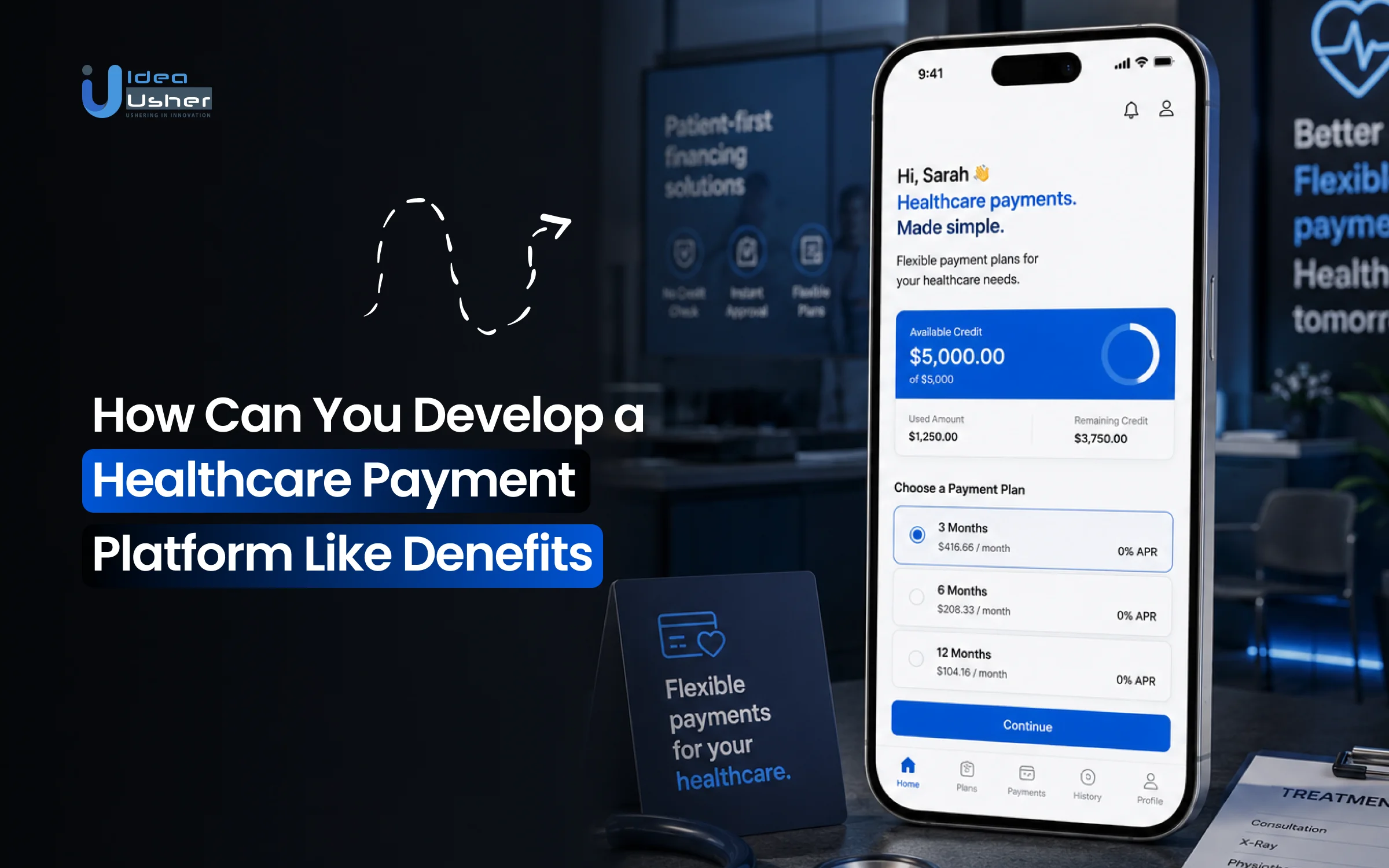
Healthcare payment innovation is increasingly shifting away from lending and toward payment infrastructure. This transition is driving Denefits platform development as healthcare providers seek flexible payment ecosystems that remove financial friction without depending on traditional credit approvals or disrupting existing clinical workflows.
Traditional patient financing relied on credit-based lending, rigid repayment plans, and disconnected billing systems. Modern healthcare providers need no-credit-check financing, automated billing, flexible repayment schedules, embedded payment infrastructure, and seamless practice management integrations. Beyond financing treatment, these platforms improve affordability, increase treatment acceptance, streamline collections, and strengthen provider cash flow within a unified payment ecosystem.
In this blog, we explore how to build a healthcare payment platform like Denefits, covering core features, payment workflows, technology architecture, compliance requirements, development costs, and how IdeaUsher can help you develop a scalable healthcare fintech platform that integrates financing directly into the patient care journey.
Why Healthcare Payment Infrastructure Is Replacing Traditional Financing
Traditional healthcare lending is failing because it treats an integrated medical experience like a retail commodity or a luxury purchase. Commercial healthcare cost trends are rising 9%, driving commercial medical expenses to their highest level in 17 years.
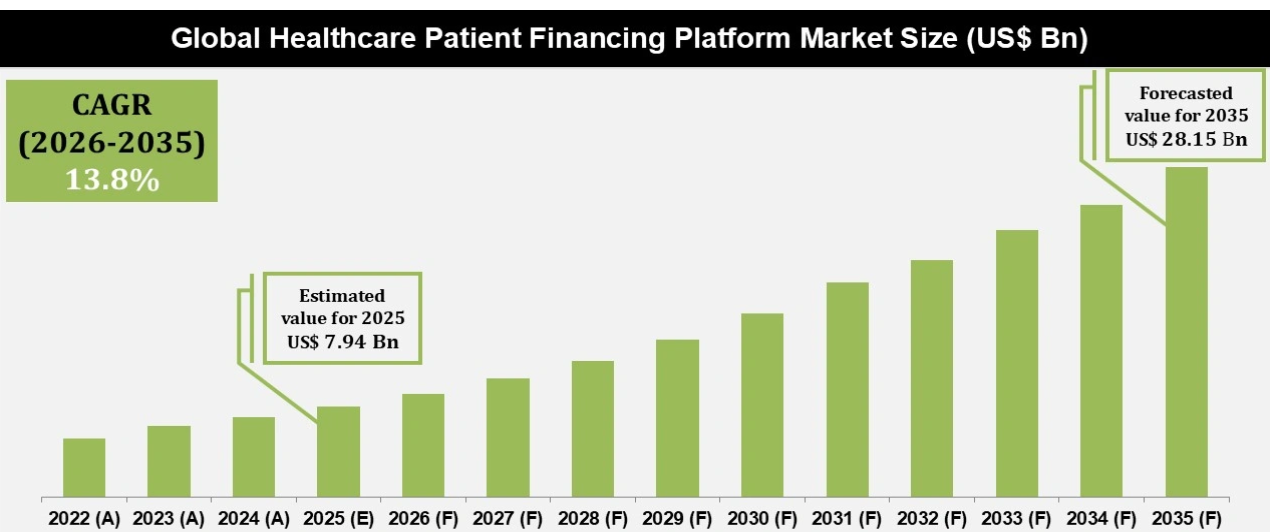
This macro-environmental shift is fueling explosive expansion within the digital alternative; the global healthcare patient financing platform market is valued at $7.94 billion and is projected to surge to $28.15 billion by 2035, growing at a steep compound annual growth rate (CAGR) of 13.8%. This rapid market evolution is rendering legacy, credit-card-style patient financing completely obsolete.
Instead of deploying third-party loan products that add layers of friction, health systems are shifting toward unified payment infrastructures. These modern networks weave underwriting, digital wallets, and custom payment installment pathways directly into the clinical timeline.
A. Rising Patient Out-of-Pocket Healthcare Costs
The primary catalyst for this infrastructural evolution is the direct shifting of financial liability from insurance payers onto household budgets.
- The Deductible Spike: Following the expiration of enhanced premium tax credits, the average Affordable Care Act (ACA) Marketplace deductible increased 37% to a record $3,786, the largest annual increase on record.
- The Flight to Bronze Plans: To offset a 58% increase in average monthly premiums ($113 to $178), more individuals are shifting to lower-premium, higher-deductible Bronze plans. Bronze plan selections reached 40% of total enrollments, with an average individual deductible of $7,476.
- The Liquidity Disconnect: With hospital and related services inflation at 7.59%, providers are increasing upfront procedure costs while out-of-pocket liabilities continue rising 3.7% annually, leaving many patients unable to pay their balance in full at the point of service.
B. Why Credit-Based Financing Creates Treatment Delays
Legacy financing models like medical credit cards and personal bank loans were built to secure upfront payments for providers, but their design actively drives down treatment adoption rates.
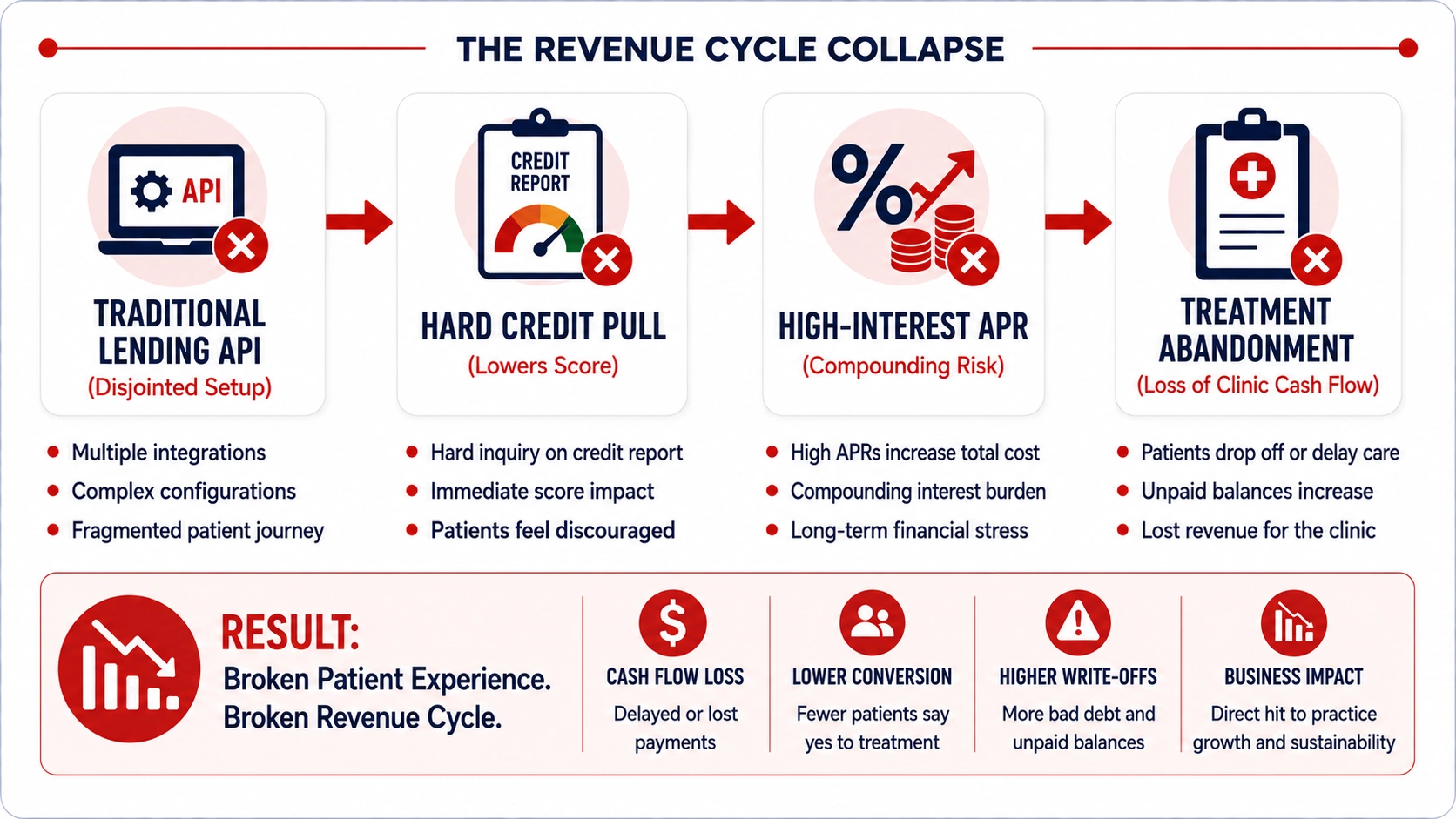
Understanding these limitations reveals why traditional financing often discourages timely treatment and creates financial barriers for both patients and healthcare providers.
- Hard Inquiries and Drop-offs: Traditional applications require hard credit pulls that negatively impact credit profiles. For non-elective or time-sensitive treatments, this friction results in a 45% to 55% patient drop-off at registration.
- The Compounding Debt Trap: Traditional financing uses deferred-interest structures that can retroactively apply interest rates of up to 29.99% to the entire principal balance if the promotional period expires.
- Clinical Delays: Restrictive financing terms and fear of long-term debt cause 36% of adults to delay elective procedures. Among them, 30% reported their physical health deteriorated because of delayed care.
C. The Move Toward Embedded Healthcare Payments
To fix the friction points of legacy loans, health systems are replacing third-party credit products with embedded financial infrastructure. This framework converts financial checks into a seamless, automated step within the standard intake workflow.
- Algorithmic Underwriting: Modern infrastructure networks use APIs, alternative financial data, real-time banking data, verified household income, and soft credit inquiries instead of a single credit score, maintaining 85%+ patient approval rates.
- Immediate Financial Conversion: Embedded billing with integrated software replaces disconnected loan applications, presenting instant installment options that reduce appointment cancellations by up to 51% and increase practice volume by 15% to 40%.
What Is Denefits and Why Is Its Payment Model Different?
Denefits is an automated, point-of-sale (POS) healthcare payment infrastructure platform that functions as a SaaS layer rather than a third-party lender. By removing traditional banking from the process, it allows medical providers to offer customized, in-house installment plans to virtually any patient without credit checks. The platform manages billing, automation, and debt protection, enabling practices to protect their revenue cycles while making care more affordable.
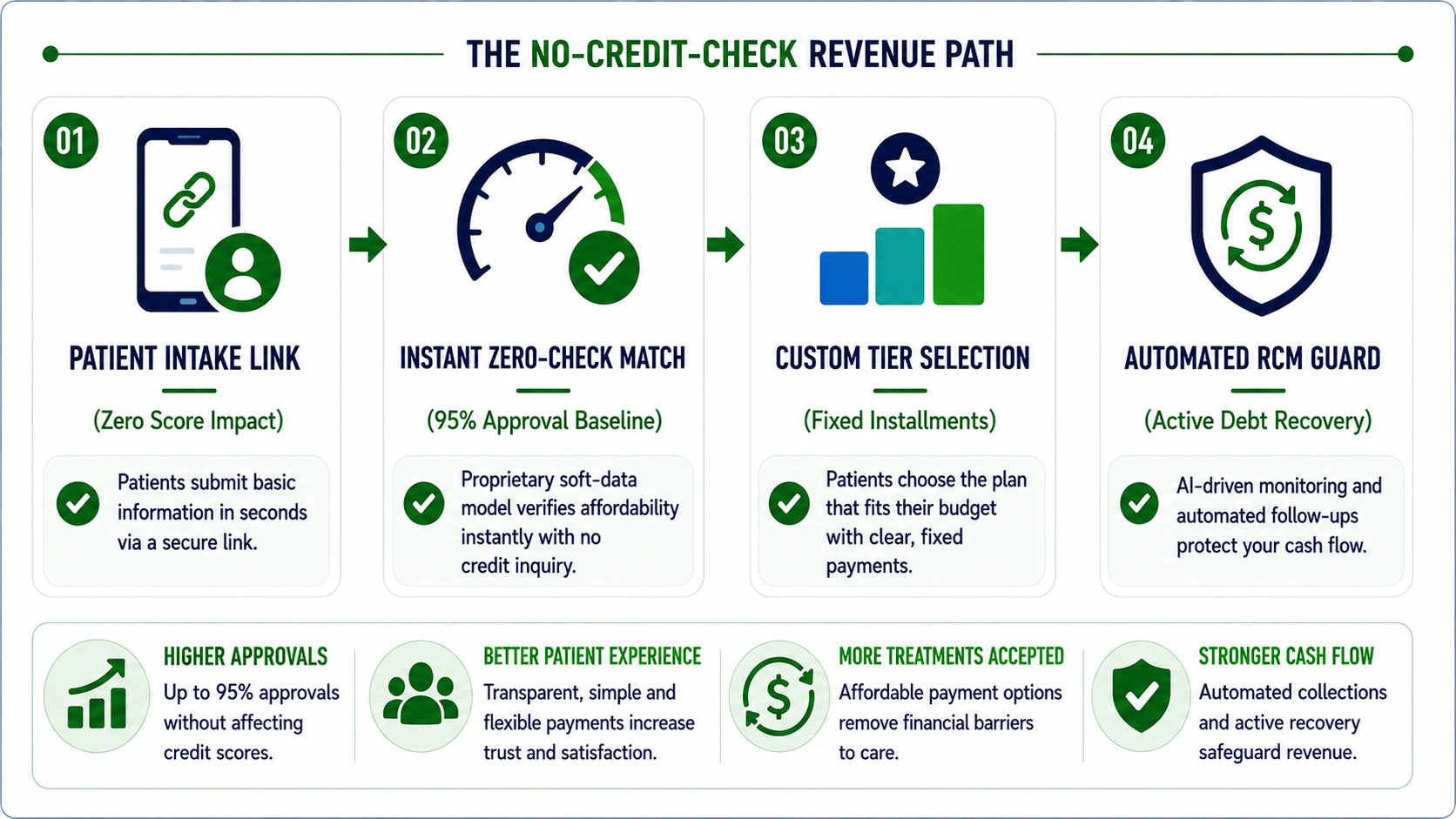
Operating as a “healthcare payment infrastructure ecosystem,” the platform enables providers to design custom payment plans, embed smart checkout, automate billing, and sync workflows with existing systems. Denefits distinguishes itself through a no-credit-check model featuring ~95% approval rates, instant decisions, and flexible schedules, ensuring patients access treatment without financial obstacles.
A. Healthcare Payment Infrastructure vs. Patient Lending
Traditional medical lending options rely completely on third-party financial institutions to approve credit lines. If a patient does not meet strict banking credit tiers, the loan is denied, and the patient frequently abandons treatment. Denefits bypasses this limitation by replacing traditional lending with a dedicated payment infrastructure software layer.
- The Structural Pivot: Instead of acting as a bank, Denefits enables medical practices to run their own financing programs. The financial agreement remains between the patient and practice, while Denefits manages financing operations, customer portals, and recurring multi-currency payment collection.
- Decoupled Capital Risk: Traditional financing charges providers 5% to 15% merchant fees to fund loans upfront. Denefits offers customizable options, including its No-Fee Payment Plan, shifting administrative and processing costs away from the clinic’s operating margins.
B. How the No-Credit-Check Payment Workflow Operates
Because Denefits is a software layer rather than an institutional credit lender, it eliminates the requirement for standard credit screening entirely. This design allows the platform to achieve a 95% baseline patient approval rate.
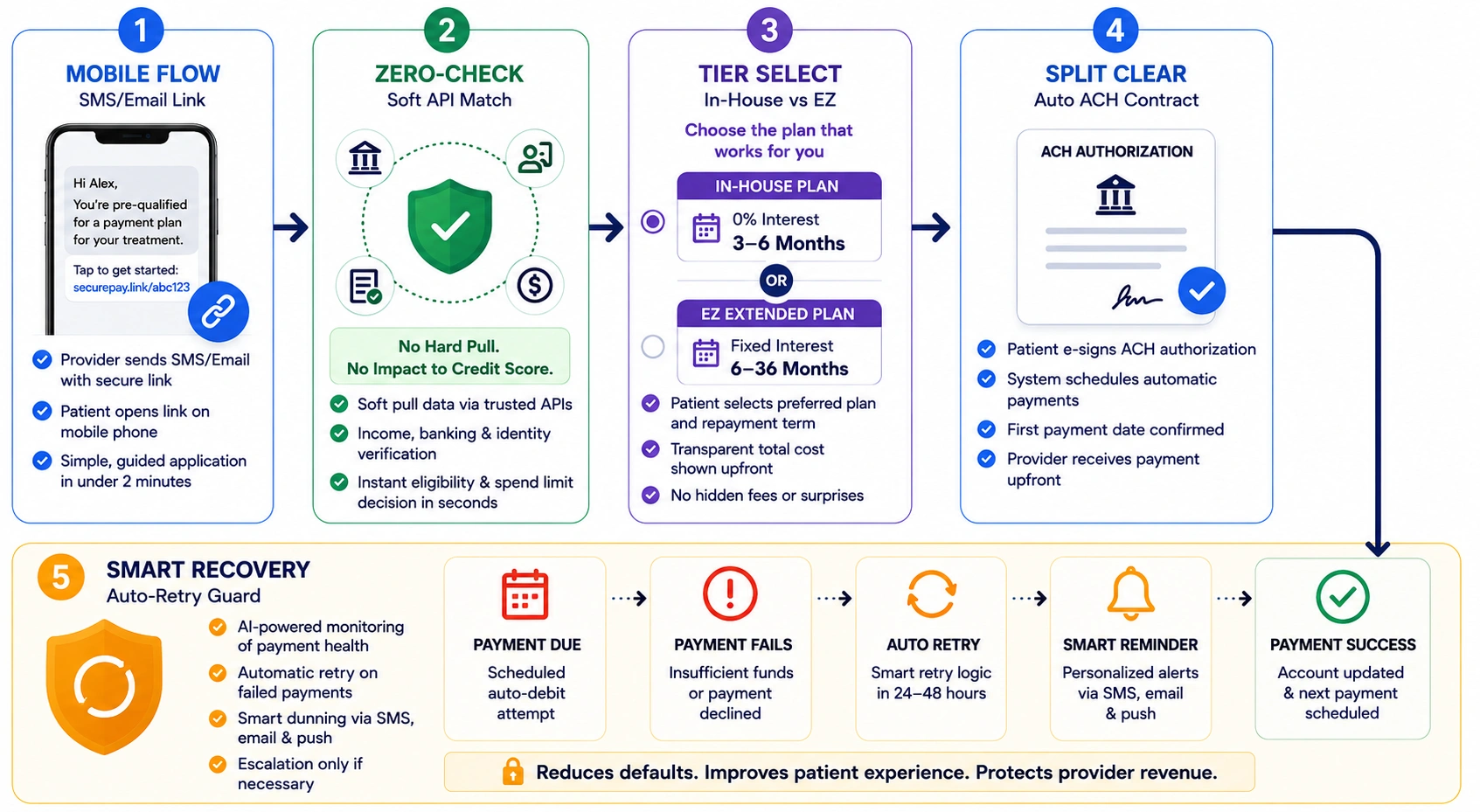
1. The 35-Second Mobile Flow
Care coordinators send a secure, personalized checkout link from the practice dashboard via SMS or email. Patients complete identity and contact verification on their mobile device, bypassing traditional multi-page financial application forms.
2. Zero-Check Onboarding
The AI underwriting engine bypasses major credit bureaus, using proprietary risk algorithms, alternative transaction history, and open banking data. With no hard or soft credit inquiries, the process leaves no credit footprint or score impact.
3. Custom Tier Selection
The platform instantly generates customized monthly payment options based on provider settings, including EZ Payment Plans with Deferred Interest for prime clients or In-House Payment Plans where the practice sets the specific interest rate, installment duration, and down payment caps required to start care.
4. Automated Split-Payment Clearing
After plan selection and e-signature, the payment structure is finalized. The platform collects the down payment and automatically creates an ACH recurring payment profile linked to the patient’s debit card, credit card, or bank account.
5. The Smart Recovery Loop
Denefits automates the accounts receivable lifecycle with multi-channel payment reminders, automated retries, and payment recovery workflows for failed transactions, protecting clinic revenue while preserving the provider-patient relationship.
C. Why Providers Achieve Higher Treatment Acceptance
Moving away from rigid credit scoring systems directly improves the clinic’s primary revenue cycle management (RCM) metrics.
- Capturing the Subprime Market: Traditional medical credit cards reject 40% to 50% of applicants due to low credit scores or thin credit histories. Denefits expands access to these patients, helping practices capture previously unserved demand.
- Automated Debt Recovery Protection: Denefits automates account recovery with SMS notifications, payment reminders, and payment protection protocols, reducing administrative burden and increasing checkout conversion rates by 38%.
- Eliminating Treatment Room Friction: Automated contract generation, e-signatures, and recurring payments eliminate manual collections, allowing clinical staff to focus on patient care instead of payment collection.
Core Features of Healthcare Payment Platform Like Denefits
A healthcare payment platform like Denefits simplifies patient financing while improving provider cash flow and operational efficiency. The Denefits platform development with right combination of payment automation, flexible financing, seamless integrations and other core features creates a frictionless experience that benefits both patients and healthcare businesses.
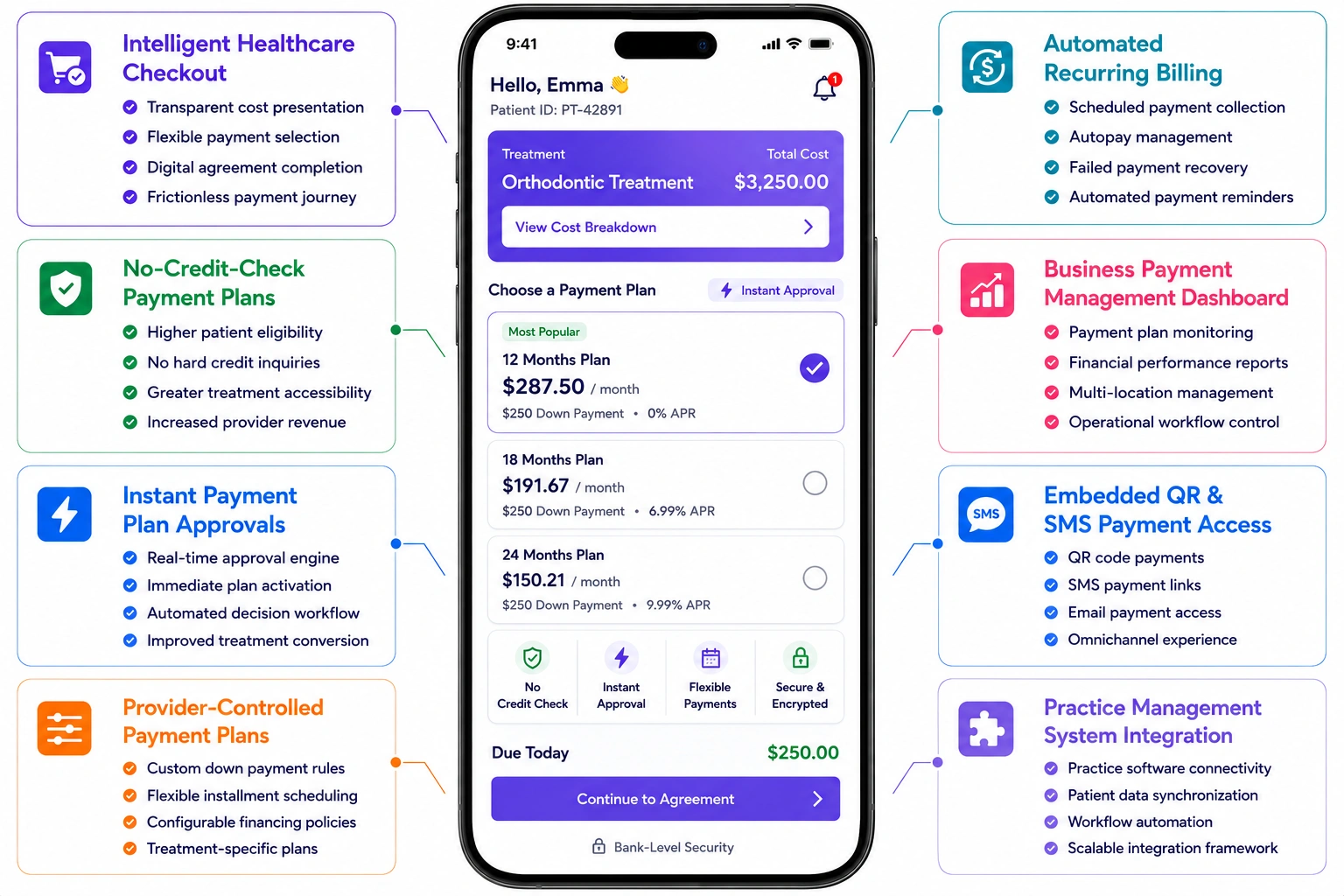
1. Intelligent Healthcare Checkout
An intelligent healthcare checkout streamlines the payment journey, presenting treatment costs, payment plans, and digital agreements within a single workflow. It minimizes payment friction, increases treatment acceptance, and helps patients confidently complete healthcare purchases without lengthy administrative processes.
- Transparent Cost Presentation: Displays treatment estimates, payment breakdowns, and financing options before patients commit to care decisions.
- Flexible Payment Selection: Enables patients to compare installment plans and choose repayment options matching their financial preferences.
- Digital Agreement Completion: Supports secure electronic signatures for financing agreements without requiring additional paperwork or office visits.
- Frictionless Payment Journey: Reduces checkout complexity through a guided payment experience that improves treatment conversion rates.
2. No-Credit-Check Payment Plans
No-credit-check payment plans remove traditional lending barriers, allowing more patients to qualify for financing without hard credit inquiries. This feature expands treatment accessibility, improves approval rates, and enables providers to serve a broader patient population.
- Higher Patient Eligibility: Approves significantly more patients by removing dependency on conventional credit score requirements.
- Hard Credit Check Elimination: Prevents credit score impacts while simplifying access to healthcare financing solutions.
- Greater Treatment Accessibility: Helps patients begin recommended treatments despite limited or unfavorable credit histories.
- Provider Revenue Growth: Increases treatment acceptance by reducing financial barriers during patient decision-making.
3. Instant Payment Plan Approvals
Instant payment plan approvals automate financing decisions in real time, allowing patients to receive immediate payment options during checkout. Faster approvals reduce treatment delays and help healthcare providers convert consultations into confirmed procedures more efficiently.
- Real-Time Approval Engine: Processes patient eligibility instantly to eliminate lengthy financing approval waiting periods.
- Immediate Plan Activation: Allows patients to start treatment immediately after selecting an approved payment option.
- Automated Decision Workflow: Reduces administrative review by automating payment plan qualification and approval processes.
- Improved Treatment Conversion: Minimizes patient drop-offs caused by delayed financing decisions or manual approvals.
4. Provider-Controlled Payment Plans
Provider-controlled payment plans enable healthcare organizations to design custom financing options that match their services, pricing models, and patient needs. This flexibility helps businesses maintain financial control while offering affordable repayment choices to patients.
- Custom Down Payment Rules: Lets providers define upfront payment amounts based on treatment type or service value.
- Flexible Installment Scheduling: Supports customized repayment frequencies, durations, and payment intervals for different patients.
- Configurable Financing Policies: Enables providers to create payment rules that align with internal financial strategies.
- Treatment-Specific Plans: Allows personalized financing structures for various procedures, specialties, and healthcare services.
5. Automated Recurring Billing
Automated recurring billing ensures scheduled payment collection without manual intervention, delivering consistent revenue flow throughout the repayment period. It reduces administrative workload, minimizes missed payments, and improves long-term payment compliance across healthcare practices.
- Scheduled Payment Collection: Automatically processes installment payments according to predefined repayment schedules.
- Autopay Management: Supports secure recurring payment authorization for uninterrupted monthly payment collection.
- Failed Payment Recovery: Initiates retries and recovery workflows when scheduled payments cannot be successfully processed.
- Automated Payment Notifications: Sends reminders before due dates and alerts patients about completed or missed payments.
6. Business Payment Management Dashboard
A business payment management dashboard provides complete visibility into patient financing operations, simplifying payment monitoring, financial reporting, and operational management. It enhances revenue tracking across one or multiple practice locations.
- Payment Plan Monitoring: Tracks active financing plans, outstanding balances, and completed payment schedules from one dashboard.
- Financial Performance Reporting: Generates actionable insights into collections, revenue trends, and payment completion metrics.
- Multi-Location Management: Centralizes payment operations across multiple clinics, departments, or provider locations efficiently.
- Operational Workflow Control: Helps staff manage customer accounts, payment activities, and financing performance from one interface.
7. Embedded QR and SMS Payment Access
Embedded QR and SMS payment access enables providers to deliver secure payment requests through digital channels patients already use. Convenient payment links improve response rates, accelerate collections, and eliminate unnecessary checkout friction.
- QR Code Payments: Enables patients to access secure payment pages instantly by scanning provider-generated QR codes.
- SMS Payment Links: Sends personalized payment requests directly through text messages for faster payment completion.
- Email Payment Access: Delivers secure payment links through email for convenient remote healthcare payments.
- Omnichannel Payment Experience: Gives patients multiple digital payment options based on their preferred communication channels.
8. Practice Management System Integration
Practice management system integration connects payment workflows with existing healthcare software, eliminating duplicate processes and improving operational efficiency. Seamless integrations ensure patient records, appointments, billing, and payment information remain synchronized across the organization.
- Practice Software Connectivity: Integrates payment workflows directly with existing practice management platforms and healthcare systems.
- Patient Data Synchronization: Automatically updates patient records, billing information, and payment statuses across connected applications.
- Workflow Automation: Eliminates repetitive administrative tasks through synchronized payment and operational processes.
- Scalable Integration Framework: Supports future integrations with EHRs, CRMs, accounting software, and payment gateways.
How to Develop a Healthcare Payment Platform like Denefits
Building a healthcare payment platform requires more than software development. The Denefits platform development involves designing secure payment workflows, meeting healthcare regulations, integrating existing systems, and creating a scalable infrastructure that improves patient affordability while helping providers automate collections and increase revenue.
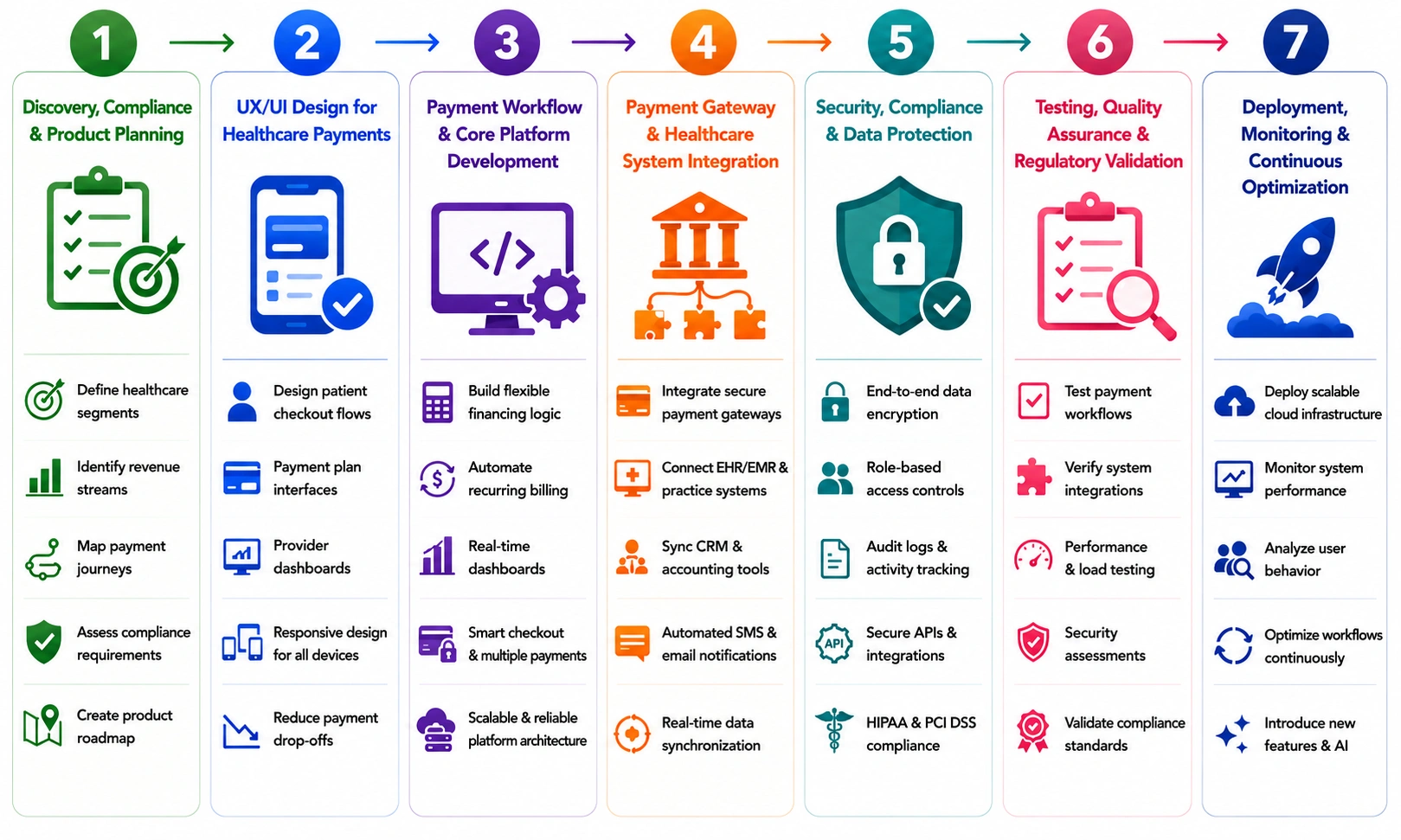
1. Discovery, Compliance, and Product Planning
Our product management team begins by understanding your business model, target healthcare providers, payment workflows, and growth goals. We define product requirements, identify compliance obligations, validate technical feasibility, and create a development roadmap that aligns with your long-term vision.
- Define Target Healthcare Segments: Identify specific healthcare niches like dental, cosmetic, or specialty clinics to tailor payment workflows and maximize platform adoption.
- Identify Revenue Streams: Analyze monetization strategies including transaction fees, subscription models, and financing commissions to ensure sustainable and scalable business growth.
- Map Payment Journeys: Design detailed patient payment journeys and provider workflows to ensure seamless interactions and efficient financial operations across the platform.
- Assess Compliance Requirements: Evaluate HIPAA, PCI DSS, and regional regulations to ensure the platform meets all legal and data protection standards.
- Create Product Roadmap: Develop a structured roadmap with milestones, feature priorities, and scalability plans aligned with long-term business objectives.
2. UX/UI Design for Healthcare Payments
Next, our designers create intuitive user experiences, seamless checkout journeys, payment plan selection flows, and provider dashboards. We ensure responsive interfaces that simplify financing while reducing payment friction across every touchpoint.
- Design Patient Checkout Flows: Create simple, guided checkout experiences that reduce confusion, improve conversions, and make healthcare payments easy for patients.
- Payment Plan Interfaces: Design clear and transparent payment plan selection screens that help patients understand financing options and make confident decisions.
- Provider Dashboards: Create intuitive dashboards for providers to track payments, manage plans, and monitor financial performance in real time.
- Responsive Design: Optimize interfaces for mobile, tablet, and desktop devices to deliver consistent user experiences across all platforms.
- Reduce Payment Drop-offs: Focus on minimizing friction during onboarding and payment processes to improve completion rates and overall user satisfaction.
3. Payment Workflow and Core Platform Development
Our developers build core platform functionality, including intelligent checkout, customizable payment plans, recurring billing systems, and provider payment automation modules. Every workflow is optimized for scalability, reliability, and a seamless user experience during Denefits platform development.
- Financing Logic: Build flexible payment plan structures with customizable terms, interest models, and approval workflows tailored to healthcare services.
- Recurring Billing: Implement automated recurring billing systems to ensure timely collections and reduce manual intervention for providers.
- Create Real-Time Dashboards: Develop dashboards that provide real-time insights into transactions, payment statuses, and financial performance metrics.
- Implement Smart Checkout: Build intelligent checkout systems supporting multiple payment methods, ensuring convenience and higher conversion rates for patients.
- Platform Scalability: Design backend architecture capable of handling increasing transaction volumes without compromising performance or reliability.
4. Payment Gateway and Healthcare System Integration
We integrate secure payment gateways, EHR/EMR systems, practice management software, and CRM and accounting tools. These integrations create synchronized workflows, eliminate manual processes, and ensure accurate financial and patient data.
- Integrate Payment Gateways: Connect secure gateways supporting card, ACH, and digital payments to enable seamless and reliable transaction processing.
- Connect Healthcare Systems: Integrate with EHR/EMR and practice management systems to synchronize patient data and streamline operational workflows.
- Sync CRM and Accounting: Ensure seamless data synchronization with CRM and accounting platforms for accurate financial tracking and reporting.
- Enable Automated Notifications: Implement SMS and email notifications for payment reminders, confirmations, and updates to improve communication efficiency.
- Data Synchronization: Maintain consistent and real-time data flow across all integrated systems to eliminate errors and manual reconciliation efforts.
5. Security, Compliance, and Data Protection
Security is embedded throughout Denefits platform development with HIPAA-ready architecture, PCI DSS compliance, data encryption, and role-based access controls. We ensure secure APIs, audit logs, and authentication mechanisms to protect sensitive healthcare and payment information.
- Implement Data Encryption: Apply end-to-end encryption to protect sensitive patient and payment data during storage and transmission processes.
- Apply Access Controls: Use role-based access control systems to restrict data access based on user roles and responsibilities.
- Maintain Audit Logs: Track all system activities through audit logs to support compliance monitoring and detect unauthorized actions.
- APIs and Integrations: Protect APIs and third-party integrations against vulnerabilities using authentication, validation, and security best practices.
- Regulatory Compliance: Align platform architecture with HIPAA and PCI DSS standards to safeguard healthcare and financial data.
6. Testing, Quality Assurance, and Regulatory Validation
Before launch, our QA engineers validate payment workflows, system integrations, and security layers through functional, performance, and compliance testing of Denefits platform development. This ensures reliable performance while meeting healthcare and payment industry standards.
- Test Payment Workflows: Validate all payment processes to ensure accuracy, reliability, and seamless user experiences across different scenarios.
- Verify System Integrations: Test integrations with external systems and APIs to ensure smooth data exchange and operational consistency.
- Conduct Performance Testing: Simulate high transaction loads to evaluate system stability, speed, and scalability under real-world conditions.
- Perform Security Assessments: Identify vulnerabilities through security testing and ensure robust protection against potential threats and breaches.
- Validate Compliance Standards: Ensure the platform meets healthcare and payment regulations before launch to avoid legal and operational risks.
7. Deployment, Monitoring, and Continuous Optimization
After successful testing, we deploy using scalable cloud infrastructure, monitor system performance, track payment success rates, and analyze user behavior. Continuous updates and AI-driven optimizations keep the platform competitive as your business grows.
- Deploy Scalable Infrastructure: Launch the platform on cloud infrastructure designed for high availability, reliability, and future scalability needs.
- Monitor System Performance: Track payment success rates, uptime, and system health to ensure consistent and efficient platform operations.
- Analyze User Behavior: Use analytics to understand user interactions, identify bottlenecks, and improve conversion and retention rates.
- Optimize Workflows Continuously: Refine payment processes and user journeys based on real-time data insights and performance metrics.
- Introduce New Features: Continuously enhance the platform with automation, AI capabilities, and new functionalities to stay competitive.
Cost to Build a Healthcare Payment Platform Like Denefits
The cost of developing a healthcare payment platform like Denefits depends on the product scope, payment infrastructure, compliance requirements, integrations, and AI capabilities. A well-planned investment ensures long-term scalability, secure payment processing, and seamless healthcare workflow automation.
A. Development Cost Breakdown by Phase
Developing a healthcare payment platform involves multiple specialized phases, each contributing to security, functionality, scalability, and compliance. The table below provides an estimated investment range for every major Denefits platform development stage.
| Development Phase | Estimated Cost (MVP → Enterprise) | What the Phase Covers |
| Planning & Discovery | $5,000 – $12,000 | Business analysis, requirement gathering, compliance assessment, healthcare workflow planning, technical architecture, and product roadmap definition. |
| UI/UX Design | $6,000 – $15,000 | Patient checkout design, provider dashboards, payment journeys, wireframes, responsive interfaces, and user experience optimization. |
| Payment Workflow Development | $25,000 – $90,000 | Intelligent checkout, payment plans, recurring billing, dashboards, automation, APIs, and backend platform development. |
| Payment Gateway and Healthcare System Integration | $10,000 – $35,000 | Payment gateways, EHR/EMR integration, practice management systems, CRM, accounting software, notifications, and third-party APIs. |
| Security & Compliance | $8,000 – $25,000 | HIPAA-ready architecture, PCI DSS implementation, encryption, authentication, audit logs, access controls, and API security. |
| Testing & QA | $6,000 – $18,000 | Functional testing, payment validation, integration testing, performance optimization, security testing, and compliance verification. |
| Deployment & Maintenance | $5,000 – $20,000 | Cloud deployment, DevOps setup, monitoring, infrastructure optimization, performance improvements, maintenance, and post-launch enhancements. |
| Total Estimated Cost | $70,000 – $400,000+ | Combined cost of all Denefits platform development phases based on platform level. |
Note: The estimated Denefits platform development costs above may vary depending on your feature requirements, technology stack, third-party integrations, compliance needs, development approach, and the overall scope and complexity of the platform.
B. Development Cost by Platform Level
Every healthcare payment platform has different business goals and technical requirements. The table below outlines the estimated investment based on Denefits platform development maturity, feature depth, scalability, and enterprise readiness.
| Platform Level | Estimated Cost | What Features Are Included |
| MVP Platform | $70,000 – $120,000 | Intelligent checkout, payment plans, recurring billing, provider dashboard, payment gateway integration, basic reporting, and essential security features. |
| Mid-Level Platform | $120,000 – $220,000 | Everything in MVP plus EHR/EMR integrations, advanced automation, AI-powered recommendations, analytics dashboards, QR/SMS payments, and multi-clinic support. |
| Enterprise Platform | $220,000 – $400,000+ | Complete healthcare payment infrastructure with advanced AI, custom integrations, enterprise security, compliance automation, multi-region deployment, white-label capabilities, and scalable cloud architecture. |
Note: The Denefits platform development cost ranges are estimates, not exact figures. Actual expenses vary based on compliance, integrations, AI complexity, and infrastructure. Highly regulated healthcare fintech platforms typically require higher budgets.
C. Factors That Influence Development Budget
Several technical and business factors directly affect the overall Denefits platform development budget. Understanding these variables helps entrepreneurs anticipate real-world expenses and avoid unexpected cost overruns during development.
- Integration Complexity with Legacy Systems: Integrating with legacy EHR/EMR systems often requires custom middleware, additional testing, and extended development, adding $5,000 to $20,000 to integration costs.
- Payment Processing Fees and Setup Costs: Payment gateways, merchant accounts, and financing partners may charge $500 to $3,000 in setup fees, plus 2% to 3.5% transaction fees.
- Data Migration and System Transition: Migrating patient records, billing data, and financial histories requires specialized tools, data validation, and manual effort, costing $3,000 to $15,000.
- Infrastructure and Cloud Usage Costs: Cloud hosting, storage, bandwidth, and scaling on platforms like AWS or Azure typically cost $500 to $5,000 per month.
- Security Audits and Compliance Certifications: HIPAA and PCI DSS audits, penetration testing, and compliance certifications add $5,000 to $25,000 in costs.
- AI Model Development and Maintenance: Developing and maintaining AI models for predictive analytics, fraud detection, payment recommendations, and automation costs $10,000 to $50,000+ initially, with ongoing maintenance expenses.
How a Healthcare Payment Platform Like Denefits Make Money?
Healthcare payment platforms generate revenue by aligning monetization strategies with provider needs, transaction activity, and platform usage. The business models focus on delivering financial efficiency, improving cash flow, and creating sustainable income streams through scalable and value-driven services.
Note: Relying on multiple revenue models such as subscriptions, transaction fees, and enterprise services helps diversify income, reduce risk, and improve profitability while supporting sustainable long term growth.
Key Revenue Streams and Pricing Overview
The table below outlines key revenue streams, explaining how healthcare payment platforms generate income through subscriptions, transaction fees, integrations, and licensing, along with typical pricing structures and earning potential across different service models.
| Revenue Stream | How It Works | Typical Pricing / Earnings |
| Subscription Plans | Monthly or annual access to platform features for providers | $49–$299 (individual), $500–$1,500 (clinics), $2,000–$5,000+ (enterprise) |
| Transaction Fees | Percentage or fixed fee per payment processed | 2.5%–3.5% per transaction, $0.20–$0.30 per payment, ACH 0.8%–1.5% |
| Integration Services | One-time setup and system integration with healthcare tools | $2,000–$15,000+, complex setups up to $50,000 |
| White-Label Licensing | Licensing platform under client branding with revenue sharing | $1,000–$10,000+ monthly or $15,000–$50,000+ annually + 5%–15% revenue share |
These revenue streams form the foundation of a sustainable business model after Denefits platform development, with each contributing to predictable income while supporting platform scalability and long-term growth potential.
1. Subscription Plans for Healthcare Providers
Offer tiered monthly or annual subscription plans providing access to payment plan management, recurring billing, analytics, and dashboards. Pricing ranges from $49–$299 per provider, $500–$1,500 for clinics, and $2,000–$5,000+ for enterprise healthcare groups based on scale and features.
2. Payment Processing and Transaction Fees
Generate revenue by charging 2.5%–3.5% per transaction or $0.20–$0.30 per payment, with ACH fees around 0.8%–1.5%. Platforms processing $1M+ monthly volume earn significant recurring income as transaction-based revenue scales with usage.
3. Enterprise Integration and Implementation Services
Charge $2,000–$15,000+ per integration for connecting EHR/EMR systems, accounting tools, and workflows. Complex deployments can exceed $25,000–$50,000, with ongoing support contracts adding $500–$2,000 monthly, making enterprise onboarding a high-value revenue stream.
4. White-Label Platform Licensing
License the platform under client branding, generating $1,000–$10,000+ monthly or $15,000–$50,000+ annually. Additional revenue comes from 5%–15% transaction revenue sharing, enabling scalable enterprise growth without increasing operational complexity.
How AI Makes Healthcare Payment Platforms More Intelligent
Artificial intelligence is transforming healthcare payment platforms by making financing decisions faster, improving patient engagement, and optimizing provider revenue. Instead of replacing payment workflows, AI enhances every stage of the payment lifecycle through predictive analytics, intelligent automation, and data-driven decision-making.
| AI Capability | How It Enhances a Healthcare Payment Platform |
| AI-Driven Payment Plan Recommendations | AI analyzes treatment costs, patient affordability, payment history, and behavioral patterns to recommend personalized payment plans that improve treatment acceptance and repayment success. |
| Intelligent Patient Eligibility Assessment | AI evaluates financial and behavioral indicators beyond traditional credit scores to determine suitable payment options while expanding financing accessibility for more patients. |
| AI-Powered Patient Communication | AI chatbots and virtual assistants answer payment-related questions, recommend financing options, send personalized reminders, and provide multilingual assistance across SMS, email, and web channels. |
| Predictive Revenue Forecasting | AI analyzes historical payment trends, recurring billing performance, seasonal demand, and collection rates to forecast future revenue and support proactive financial planning. |
| Intelligent Payment Recovery | AI predicts payment failures, automates reminder schedules, prioritizes overdue accounts, and recommends personalized recovery strategies to improve collection rates. |
| AI-Powered Provider Insights | AI continuously monitors payment operations, identifies collection bottlenecks, measures treatment acceptance trends, and provides actionable recommendations to improve financial performance and operational efficiency. |
Technology Architecture Behind a Platform Like Denefits
A scalable healthcare payment platform requires a robust technology architecture that securely connects patients, providers, payment systems, and healthcare software. Each architectural layer plays a critical role during Denefits platform development in enabling seamless payment workflows, regulatory compliance, and real-time financial operations.
| Architecture Layer | Recommended Technologies | Role in the Platform Architecture |
| Patient Applications | React, Angular, Flutter, Swift, Kotlin | Patient portal for treatment cost estimates, payment plans, digital agreements, installment management, and payment history. |
| Provider Management Portal | React.js, Vue.js, Next.js, Tailwind CSS | Provider dashboard for payment plan creation, patient account management, collections monitoring, reporting, and financial operations. |
| Payment Orchestration Layer | Node.js, Java Spring Boot, Python (Django/FastAPI), Microservices Architecture | Orchestrates payment workflows, financing approvals, transaction routing, payment scheduling, and gateway integrations. |
| Billing Automation Engine | Python, Node.js, Apache Kafka, RabbitMQ | Automates recurring billing, installment scheduling, payment reminders, retry logic, and collections workflows. |
| Payment Gateway Integration | Stripe, PayPal, Square, Plaid, Adyen APIs | Enables payment processing, recurring payments, refunds, ACH transfers, digital wallets, and real-time transactions. |
| Practice Management Integrations | HL7/FHIR APIs, Redox, MuleSoft, Zapier | Synchronizes patient, appointment, billing, treatment, and payment data across EHR/EMR, CRM, and accounting systems. |
| Security and Compliance Layer | OAuth 2.0, JWT, AWS KMS, Azure Security Center, Okta | Enforces encryption, authentication, RBAC, audit logging, secure APIs, and HIPAA/PCI DSS compliance. |
Note: A modular architecture allows healthcare payment platforms to scale efficiently, simplify future integrations, strengthen security, and support advanced capabilities such as AI-powered automation, predictive analytics, and enterprise-grade payment infrastructure.
Challenges to Build a Healthcare Payment Platform
Developing a healthcare payment platform involves balancing payment technology, healthcare regulations, data security, and system integrations. Addressing these challenges during Denefits platform development create a reliable, scalable, and compliant platform that delivers seamless payment experiences for both healthcare providers and patients.
1. Legacy Healthcare System Integration
Challenge: Integrating diverse EHR/EMR systems, practice management software, and legacy healthcare platforms often creates compatibility issues, inconsistent data formats, and synchronization challenges.
Solution: Our developers build API-first integration layers using HL7/FHIR standards, middleware, and secure connectors to synchronize patient, billing, and payment data while minimizing disruptions to existing healthcare workflows.
2. Healthcare Data Security and Regulatory Compliance
Challenge: Protecting sensitive healthcare and financial data while meeting HIPAA, PCI DSS, and regional data privacy regulations requires robust security architecture and continuous compliance management.
Solution: We implement encryption, role-based access control, secure APIs, audit logging, multi-factor authentication, and compliance-ready infrastructure, ensuring patient data remains protected throughout every payment transaction.
3. Reliable Payment Automation Workflows
Challenge: Managing recurring billing, failed payments, payment retries, installment schedules, and real-time transaction processing without disrupting provider cash flow can become technically complex.
Solution: Our engineers develop resilient payment orchestration and billing automation engines with intelligent retry mechanisms, automated reminders, transaction monitoring, and scalable workflows to maximize successful payment collections.
4. Platform Scalability for High Transaction Volumes
Challenge: As healthcare providers, patients, and payment transactions increase, maintaining fast performance, high availability, and reliable payment processing becomes increasingly difficult.
Solution: We design cloud-native, microservices-based architectures with auto-scaling infrastructure, load balancing, distributed databases, and continuous performance monitoring to ensure the platform scales securely without compromising user experience.
Why Partner With Idea Usher for Healthcare Payment Platform
IdeaUsher acts as a premier product engineering and digital transformation catalyst, leveraging 11+ years of hyper-focused industry mastery to launch disruptive, compliant software ecosystems across 50+ countries. Driven by an elite brain trust of 250+ niche developers, over 1,000+ deployed assets, and a top-tier 4.9/5 Clutch credential, we excel at building sophisticated, secure healthcare fintech engines.
We replace generic templates with custom, high-performance platforms featuring instant no-credit-check underwriting, multi-tier repayment calculators, and native medical ledger integrations. These solutions expand care access, protect lending capital, and establish market leadership.
Why Enterprises Partner With Us
Global healthcare networks and fintech visionaries choose us to outpace legacy payment barriers because we turn rigid compliance mandates into automated point-of-care checkout advantages.
- Frictionless No-Credit-Check Underwriting: We develop ML-based automated decisioning modules that evaluate alternative customer data to deliver instant financing decisions without hard credit bureau inquiries.
- Deep Practice Ledger Integrations: We build secure, low-latency API integrations with EHR and Practice Management Systems for real-time, duplicate-free statement synchronization.
- Rigid Financial and Privacy Safeguards: Our developers implement encryption, secure infrastructure, HIPAA-compliant data protection, and PCI-DSS payment security.
- Automated Direct-Debit Collection Frameworks: We develop ACH-integrated payment pipelines for automated recurring collections and real-time accounting reconciliation.
Ready to launch an inclusive, automated patient financing platform that completely redefines healthcare affordability? Partner with IdeaUsher’s principal healthcare fintech architects to build your product roadmap today.
Conclusion
Success in healthcare payments depends on creating a platform that removes financial barriers for patients while giving providers greater control over collections, cash flow, and operational efficiency. From intelligent payment workflows and AI-powered automation to secure integrations and regulatory compliance, every component contributes to long-term business success. If you’re planning to launch a healthcare payment platform, partnering with IdeaUsher can help you transform your Denefits platform development vision into a secure, scalable, and future-ready solution.
FAQs
A.1. A healthcare payment platform should include intelligent checkout, no-credit-check payment plans, recurring billing, payment automation, provider dashboards, secure payment gateway integration, patient payment management, and reporting capabilities.
A.2. The Denefits platform development cost typically ranges from $70,000 to $400,000+, depending on platform complexity, integrations, compliance requirements, AI capabilities, and the number of custom features included in the product.
A.3. AI improves healthcare payment platforms by recommending suitable payment plans, predicting payment outcomes, automating patient communication, optimizing collections, and providing financial insights that enhance provider efficiency and patient payment experiences.
A.4. Healthcare payment platforms generate revenue through provider subscriptions, payment processing fees, enterprise integrations, implementation services, premium automation features, and white label licensing, creating multiple recurring income streams for long term business growth.