

Key Takeaways
- Scaling enterprise AI requires more than models; it depends on strong data foundations, governance and operational execution.
- AI consulting firms accelerate enterprise adoption through strategy, MLOps, infrastructure modernization and cross-functional delivery teams.
- Common challenges include data silos, talent shortages, compliance requirements and integrating AI into existing workflows.
- Successful AI programs rely on elastic engineering teams, scalable architectures and continuous governance frameworks.
- How IdeaUsher can help you with enterprise AI projects with dedicated AI engineers, consulting services and end-to-end enterprise AI delivery.
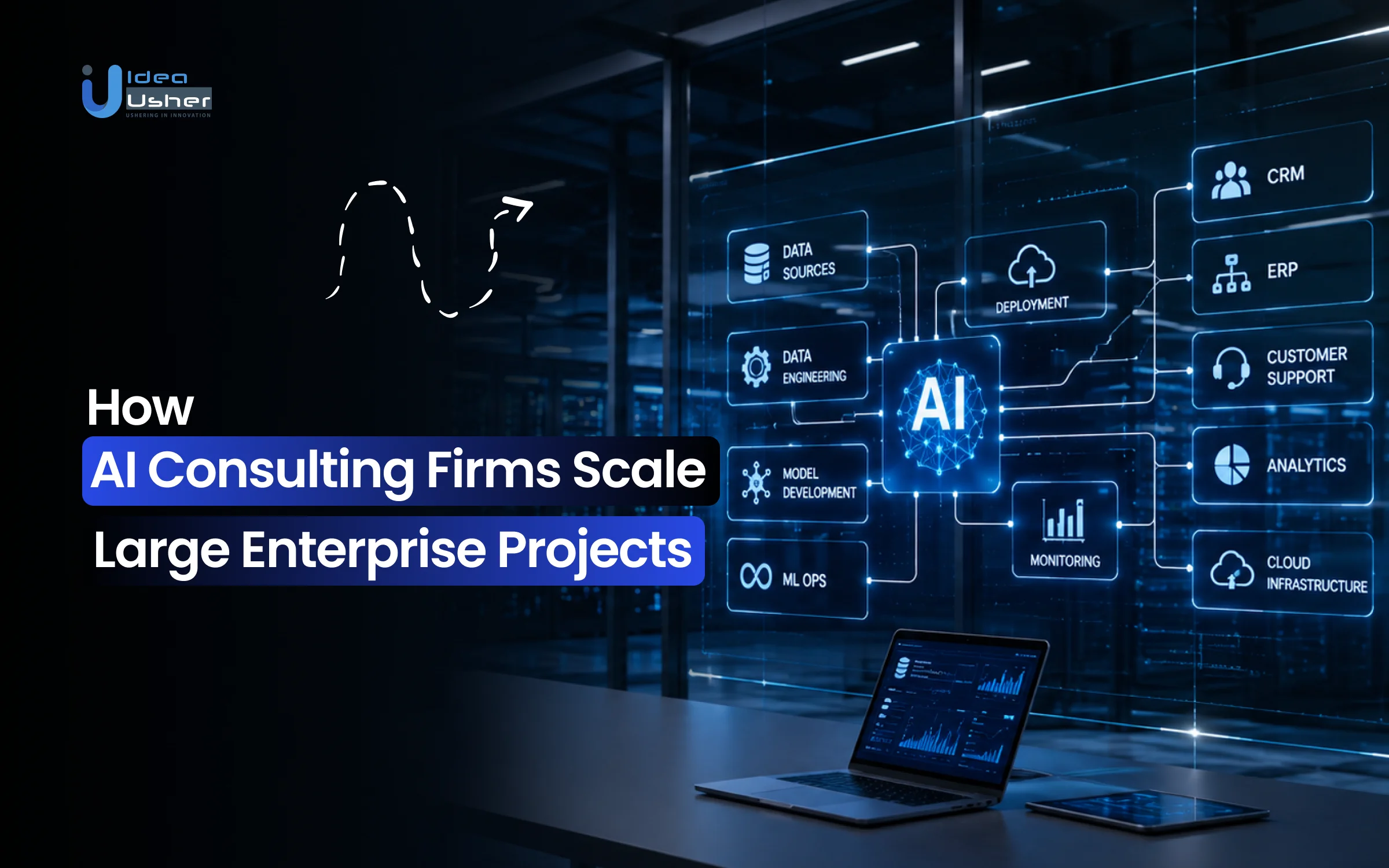
The hardest part of enterprise AI is rarely building the first prototype. The real challenge begins when organizations attempt to scale that success across departments, data systems, regulatory requirements and millions of operational decisions. This reality is driving interest in AI consulting firm scaling strategies that help enterprises move from isolated pilots to organization-wide AI adoption.
Traditional consulting models were designed around fixed-scope implementations and predictable delivery cycles. Enterprise AI projects require data engineering, MLOps, AI governance, cloud infrastructure, model deployment and cross-functional execution at scale. The value is no longer just delivering an AI solution. It is creating the operational framework needed to sustain, govern and expand AI initiatives across the enterprise.
In this blog, we will talk about how AI consulting firms scale large enterprise projects, the delivery models they use, key operational challenges, team structures, execution strategies and how IdeaUsher helps organizations build, deploy and scale enterprise AI initiatives effectively.
Why Scaling Enterprise AI Projects Is More Challenging Than Building AI Models
The corporate landscape is facing a critical reality check as training or fine-tuning an AI model is just the baseline but scaling that model according to real business value from it is far more difficult. As organizations struggle to scale AI into production and achieve measurable P&L impact that’s why AI consulting service demand is surging, driving the market from USD 22.27 billion in 2025 to USD 349.80 billion by 2034 at a CAGR of 35.8%.

According to global research from organizations like the RAND Corporation and MIT’s Project NANDA, 80% to 95% of enterprise AI projects fail to deliver a measurable financial return. The bottleneck is rarely the mathematical design of the model itself; it is the chaotic, unoptimized data foundations and fragmented legacy operational environments into which these models are forced.
A. The Shift From AI Experiments to Enterprise-Wide Deployments
The era of the frictionless AI pilot is officially over. In recent years, organizations rushed to launch rapid Proof of Concepts (POCs) to demonstrate technical capability to boardrooms. However, moving from an isolated developer sandbox to an automated production lifecycle requires an entirely different technical substrate.
The scope of this deployment friction is visible in global market metrics:
- The Pilot Purgatory Trap: S&P Global Market Intelligence reports that the average enterprise scraps 46% of its AI proofs-of-concept before they ever reach production.
- The Investment Value Gap: Despite global enterprise AI spending scaling past $250 billion, McKinsey data reveals that only 6% of organizations qualify as “high performers” capable of attributing 5% or more of their corporate EBIT directly to AI automation. The remaining vast majority are trapped in expensive experimentation loops.
B. Common Scaling Challenges Enterprises Face
As enterprises expand AI initiatives beyond pilot programs, they encounter several operational, technical, and organizational barriers. These challenges often slow deployment, increase costs, and limit business outcomes.

The table below outlines the most common AI scaling bottlenecks, supporting market data, and the operational impact these challenges create for enterprises.
| Scaling Bottleneck | Defining Market Statistic | Operational Reality & Impact |
| Fragmented Data Ecosystems | 85% of AI models fail due to poor data quality; 60% without AI-ready data are abandoned. | Siloed legacy systems, inconsistent definitions, and the lack of a unified semantic layer often undermine production AI deployments. |
| Infrastructure Constraints | 48% of tech leaders cite insufficient data infrastructure as their primary scaling barrier. | Generative AI models processing enterprise datasets frequently encounter compute bottlenecks on legacy or poorly optimized infrastructure. |
| Talent Shortages | 38% of executives face operational constraints due to a critical 3.2 to 1 demand-to-supply talent deficit. | Integrating live enterprise data with AI systems requires PySpark, Flink, data engineering, and MLOps expertise. |
| Governance & Compliance | 88% of firms use AI, but only 8% maintain an active, comprehensive AI governance framework. | Missing data lineage tracking and governance controls increases GDPR and HIPAA risks. Incidents average $4.88 million. |
| Model Reliability Concerns | 84% of developers use AI tools, but only 29% actually trust the raw output. | Autonomous AI agents require validation guardrails to prevent hallucinations from impacting business-critical systems and decisions. |
C. Why Internal Teams Often Struggle to Scale AI Initiatives
Many organizations struggle to scale initiatives due to operational inefficiencies, talent shortages, and slow hiring cycles despite strong AI ambitions. The table below highlights common challenges and how staff augmentation helps overcome them.
| Operational Friction Area | Internal Team Failure Mode | Staff Augmentation Solution |
| Workflow Redesign Gap | 70% of companies deploy AI models directly on top of broken, manual workflows without changing the underlying business logic. | Professional engineers re-architect data pipelines top-down, aligning the model directly to targeted business KPIs. |
| The Skills Deficit | Existing IT personnel are often trained in static database management rather than continuous MLOps or real-time streaming data orchestration. | Immediate injection of pre-vetted specialists who understand advanced infrastructure tools like PySpark and Apache Flink. |
| Hiring Speed Restrictions | Internal HR recruitment loops take 4 to 7 months to fill a single senior technical role, stalling project momentum. | Compresses deployment timelines down to 7 to 10 days, keeping active transformation sprints fully staffed. |

The Role of AI Consulting Firms in Enterprise AI Transformation
Enterprise AI spending has reached $252 billion, with 88% of organizations actively using AI. However, 73% of enterprises still struggle with data quality and fragmented infrastructure, increasing demand for AI consulting firms that can bridge the gap between AI adoption and scalable business outcomes.

Enterprise AI Consulting Core Impact Framework
The framework below illustrates how AI consulting firm scaling enables organizations to overcome enterprise AI challenges by replacing fragmented internal efforts with structured execution models built for sustainable growth.
| Architectural Transformation Pillar | Traditional Internal Sourcing Approach | Managed Consulting Firm Paradigm |
| Strategy & Alignment | Bottom-up, ad-hoc pilot projects; high redundancy and duplicate tool spend. | Top-down strategic mapping targeting high-leverage P&L workflows. |
| Data Foundations | Models forced onto unoptimized, siloed databases; 73% face data quality failures. | Designing Universal Semantic Layers and real-time retrieval networks. |
| Operational Scale | Sandbox scripts that lack live writeback access or system integration. | Developing reliable, multi-agent workflows with production guardrails. |
| Talent Mobilization | Traditional HR hiring loops taking an average of 4 to 7 months per specialist. | Deploying fully functional, cross-functional engineering pods in 7 to 10 days. |
Understanding AI consulting firm scaling requires examining how consulting teams execute each transformation pillar, turning strategic plans into scalable, secure, and production-ready AI systems.
A. Driving Business Outcomes Through Enterprise AI Strategy
Many AI initiatives underperform because organizations confuse AI experimentation with enterprise transformation, deploying isolated tools, copilots, and assistants that rarely improve core business metrics.
AI consulting firms use an outcome-driven delivery framework. Instead of asking what data exists, consultants start with the business outcome: “Where can automated reasoning, predictive modeling, or autonomous agents generate the largest financial or operational return?”
By targeting high-impact areas like supply chain automation and clinical trial harmonization, this strategy ensures AI investments drive measurable ROI and align with core business value.
B. Aligning Enterprise AI Initiatives With Business Goals
To bridge the gap between technical capability and business execution, consulting partners leverage comprehensive maturity diagnostics to evaluate an organization across seven core pillars such as strategy, data, talent, governance, operations and culture & ROI.

This structured assessment permanently eliminates the “Pilot Purgatory” trap where 46% of proofs-of-concept are scrapped before reaching production. By mapping out a clear matrix that weighs operational feasibility against targeted corporate value, consultancies align IT developers, data engineers, and line-of-business executives under a single unified roadmap.
C. Creating a Scalable Enterprise AI Implementation Roadmap
Moving a machine learning model or an Agentic AI workflow safely into production requires a step-by-step modernization plan. Consultancies guide enterprises through a strict, four-stage scaling roadmap:
- Diagnostic Assessment: Audit existing legacy IT infrastructure, map data silo locations across ERP/CRM systems, and evaluate current security profiles and talent readiness scores.
- Data Foundation Construction: Clean historic data layers and build an AI-ready foundation. Engineers deploy real-time ingestion streams and establish a Universal Semantic Layer to provide models with clear business context.
- Agentic Deployment: Embed predictive algorithms and multi-agent systems directly into day-to-day operations, establishing strict human-in-the-loop review steps and cross-model performance validation.
- Continuous Governance: Configure automated lineage tracking, set up data drift alerts, and launch centralized monitoring dashboards to track real-time P&L impact and compliance.
D. Designing Enterprise AI Architectures for Long-Term Growth
AI models are inherently fragile without robust data engineering underneath them. When an autonomous agent is granted direct writeback privileges to a company’s production systems, it requires highly specialized infrastructure to prevent system corruption.
Consultants construct advanced Data Fabric and Data Mesh architectures that integrate siloed data across cloud, on-premise, and SaaS environments without costly duplication. This framework enables AI agents to quickly identify verified data, utilize vector indexing for contextual understanding, and function securely within established governance limits.
E. Building Cross-Functional Teams for Enterprise AI Success
Because enterprise AI transformation collapses the traditional boundaries between database administration, cloud orchestration, and front-end application design, it demands a multidisciplinary engineering squad that standard HR teams struggle to source.

AI consultancies resolve resource bottlenecks by deploying cross-functional Delivery Pods. These teams integrate architects, PySpark/Flink engineers, MLOps specialists, and governance experts under a unified framework to ensure scalable, secure delivery.
These elastic engineering teams integrate directly into your active development cycles within 7 to 10 days, consultancies provide the immediate technical capacity needed to build secure, auditable, and highly scalable AI assets that drive permanent competitive advantage.
How AI Consulting Firms Scale Large Enterprise Projects
Scaling enterprise AI from a proof-of-concept to production requires precise coordination across technical layers. Failure to optimize any link in the data or infrastructure chain can lead to excessive compute costs or governance violations.
To bridge this operational execution gap, elite AI consulting firms deploy multidisciplinary teams that manage the transformation across six core technical areas.
The Enterprise AI Production Architecture
AI consulting firm scaling depends on coordinating multiple technical disciplines across the enterprise. The framework below highlights the operational layers consulting teams optimize to transform AI initiatives into production-ready systems.
| Operational Layer | Core Technical Focus | Primary Toolsets & Architectures | Mission-Critical Production Deliverable |
| 1. Strategy & Assessment | Top-Down Value Mapping | Prioritized Use Case Matrix, Value Trackers | Identifying high-leverage workflows to eliminate pilot redundancies and maximize P&L return. |
| 2. Data Modernization | AI-Ready Foundations | PySpark, Apache Flink, dbt, Vector Indexes | Constructing a Universal Semantic Layer to provide models with accurate real-time enterprise context. |
| 3. Model Optimization | Execution & Token Tuning | Quantization, Fine-Tuning, LoRA, RAG | Reducing model latency and compute overhead while eliminating hallucination vectors. |
| 4. MLOps & Deployment | Lifecycle Automation | MLflow, Kubeflow, Docker, CI/CD Engines | Building automated, version-controlled pipelines for seamless continuous integration and deployment. |
| 5. Governance & Risk | Compliance & Isolation | Guardrails, RBAC, Automated Lineage Logs | Enforcing strict zero-trust parameters to meet GDPR, HIPAA, and EU AI Act compliance standards. |
| 6. Workflow Integration | Autonomous Execution | Agentic Frameworks, Multi-System Writebacks | Connecting models directly to core ERP/CRM environments to automate daily transactions safely. |
The architecture framework provides a high-level view of AI consulting firm scaling. The following areas explain how consultants execute each layer successfully.

1. Enterprise AI Strategy and Opportunity Assessment
Consultants replace fragmented AI pilots with an outcome-driven strategy, conducting discovery audits across business units to identify high-impact friction points and align AI initiatives with corporate KPIs, ensuring measurable business value and ROI.
2. Data Infrastructure and Modernization
Consultants modernize data foundations through real-time data ingestion, automated data cleaning, and semantic metadata layers. This transforms complex data environments into reliable, business-ready datasets that support LLMs, analytics, and predictive models.
3. AI Model Development and Optimization
Consulting teams improve enterprise AI performance using Retrieval-Augmented Generation (RAG), LoRA fine-tuning, and model quantization. These techniques reduce compute requirements, lower token costs, improve response times, and optimize cloud infrastructure spending.
4. MLOps and Continuous Model Deployment
Consultants implement MLOps frameworks that automate model versioning, testing, deployment, and monitoring. Automated CI/CD pipelines detect data drift and performance degradation, enabling validated fallback models to maintain reliability and system availability.
5. AI Governance, Compliance, and Risk Management
Consultants establish AI governance through prompt-injection protection, PII redaction, Role-Based Access Control (RBAC), and end-to-end audit trails. These controls support compliance with regulations such as GDPR, HIPAA, and the EU AI Act.
6. Enterprise Integration and Workflow Automation
Consultants integrate AI systems with ERP, CRM, and legacy platforms through secure, bi-directional APIs. This enables AI agents to move beyond recommendations and execute validated actions, delivering end-to-end workflow automation and decision intelligence.
The AI Experts Required to Scale Enterprise Projects Successfully
Successful AI consulting firm scaling depends on multidisciplinary expertise beyond data science. Enterprise AI deployments require specialists in data engineering, MLOps, infrastructure, security, and software development to build, deploy, and maintain production-ready systems.
To transition AI projects successfully from experimental sandbox code to reliable, production-grade engines, organizations must deploy six distinct engineering profiles.
| Technical Specialization | Core Platform Layer | Primary Toolsets & Frameworks | Mission-Critical Production Deliverable |
| AI Solution Architect | Strategy & System Topography | Unified Modeling Language (UML), AWS/Azure/GCP AI Blueprints | Designing end-to-end operational systems and evaluating multi-tenant security structures. |
| Machine Learning Engineer | Mathematical Logic & Compute | PyTorch, TensorFlow, Scikit-Learn, Hugging Face | Training, fine-tuning, and quantizing predictive algorithms to run at maximum compute efficiency. |
| Data Engineer | Ingestion & Core Pipelines | PySpark, Apache Flink, Kafka, dbt, Apache Iceberg | Structuring high-velocity, automated data streams to feed models clean, context-rich data. |
| MLOps Engineer | Lifecycle & Infrastructure CI/CD | MLflow, Kubeflow, Docker, Kubernetes, GitHub Actions | Orchestrating automated testing, versioning registries, and real-time model drift monitoring. |
| Generative AI Engineer | Language Models & Reasoning | LangChain, LlamaIndex, Pinecone, Weaviate, vLLM | Engineering advanced RAG architectures and autonomous, multi-agent transactional workflows. |
| AI Product Manager | Business Logic & Alignment | Jira, Miro, Product Value Calculators, KPI Trackers | Translating abstract company goals into explicit technical features and managing execution roadmaps. |
Why Access to Specialized AI Talent Determines Project Success
The competitive advantage in AI now depends less on model availability and more on specialized talent. As demand outpaces supply, AI consulting firm scaling has become essential for enterprise transformation.
Research from RAND and McKinsey shows that over 80% of enterprise AI projects fail to reach production, nearly double the failure rate of traditional software projects. In most cases, the challenge is not AI models but the lack of specialized infrastructure and implementation expertise.

A. The Growing Demand for Enterprise AI Engineers
The market for specialized intelligence infrastructure is experiencing a severe supply crisis. The rapid emergence of multi-agent orchestration, complex Retrieval-Augmented Generation (RAG) frameworks, and low-latency vector databases has fundamentally transformed the required corporate engineering profile.
- Rising Demand for AI Talent: Market data from firms such as Gartner shows a sharp increase in demand for professionals with expertise in both AI and machine learning infrastructure, with sectors like supply chain and logistics reporting a 387% increase in AI-related job postings.
- MLOps and Infrastructure Talent Shortage: Enterprise AI relies on scalable infrastructure and specialized skills. Demand for engineers experienced in PySpark, Apache Flink, vector databases/indexing, and CI/CD automation has created a critical 3.2:1 global demand-to-supply gap for AI and data infrastructure talent.
B. Challenges of Hiring AI Talent Internally
Relying exclusively on standard corporate human resource pipelines to build out an internal artificial intelligence department presents severe operational hurdles.
- Long Hiring Cycles: Recruiting, technically vetting, and onboarding a senior machine learning or data infrastructure engineer typically takes 4-7 months. In rapidly evolving technology environments, these delays can slow or disrupt digital transformation initiatives.
- Low Offer Acceptance Rates: According to Gartner HR analytics, economic volatility has pushed tech experts toward job stability, dropping offer acceptance rates for vital roles to 48% and complicating recruitment.
- High Cost of Full-Time Hiring: Building internal teams requires significant investment, including recruitment fees averaging 20% of annual salary, cloud tooling costs, employee benefits, and payroll taxes. Combined with rising compensation, the first-year cost of a senior pipeline architect often exceeds $250,000, reducing overall project ROI.
C. Why Staff Augmentation Has Become a Preferred Enterprise Model
To bypass the friction of permanent headcount acquisitions while maintaining absolute control over system architecture, over 55% of global technology leaders have shifted to staff augmentation as their primary scaling strategy.

AI consulting firm scaling integrates specialized engineers directly into internal squads, avoiding the silos of traditional Business Process Outsourcing (BPO) models. Developers work within your secure cloud tenant and report to your tech leads, using native workflows like GitLab and Jira. This approach blends the speed of external networks with the oversight and security of an in-house team.
D. Benefits of On-Demand AI Engineering Teams
For large-scale enterprise deployments, successful AI consulting firm scaling relies on agile talent models that provide on-demand engineering capacity, enabling organizations to realize five distinct structural advantages:
| Strategic Advantage | Core Operational Impact | Defining Milestone Metric |
| Faster Deployment | Bypasses traditional hiring friction to inject project-ready talent directly into active development sprints. | Compresses standard 4-to-7-month recruitment loops down to just 7-to-10 days. |
| Lower Hiring Risks | Reduces hiring risk through engineering partners that continuously vet, technically screen, and evaluate developers. | Zero technical vetting drag for internal human resource teams. |
| Flexible Scaling | Enables rapid scaling of engineering teams during development and seamless downsizing after deployment. | 0% severance exposure or cultural headcount friction during scaling pivots. |
| Access to Niche Expertise | Provides immediate access to specialized technical skills without lengthy internal upskilling initiatives. | Immediate onboarding of experts in LoRA fine-tuning, RAG optimization, and guardrail layers. |
| Reduced Project Delays | Allows senior architects to focus on business logic and data quality instead of day-to-day execution bottlenecks. | Eliminates the “Pilot Purgatory” trap that claims 46% of raw proofs-of-concept. |
How AI Consulting Firms Build Elastic Engineering Teams for Enterprise Projects
The traditional model of enterprise technical staffing is broken. AI consulting firm scaling requires a more flexible talent strategy, yet many organizations still rely on permanent teams of full-time data scientists and software developers when launching large-scale AI initiatives.
AI lifecycles are cyclical, requiring an initial surge in engineering for data structuring, followed by specialized talent for model training, MLOps, and deployment.
Using a rigid headcount strategy for fluid AI projects causes organizational friction, leading to either skill gaps or excessive salary overhead. Elite AI consulting firms avoid these bottlenecks by deploying Elastic AI Engineering Teams.
A. Sourcing Models: Fixed Headcount vs. Elastic Teams
The matrix below compares traditional sourcing approaches with the flexibility enabled by AI consulting firm scaling, highlighting the operational and financial advantages of elastic engineering teams.
| Operational Capability | Traditional Internal Sourcing | Elastic Consulting Teams |
| Average Onboarding Velocity | 4 to 7 Months | 7 to 10 Days |
| Skill Mix Agility | Fixed (Locked to individual developer backgrounds) | Dynamic (Fluid specialization swaps mid-project) |
| Resource Scalability | Low (Severe headcount friction & layout liabilities) | High (Instant capacity scaling based on active sprint needs) |
| Long-Term Financial Overhead | High (Permanent fixed salaries, benefits, payroll taxes) | Low (Variable OpEx tied strictly to delivery milestones) |
B. What Is an Elastic AI Engineering Team?
An Elastic AI Engineering Team is a modular, high-scale workforce model where the overall size, technical composition, and domain specialization of your development squad expand and contract dynamically to match the changing demands of your project lifecycle.
This framework treats talent as an on-demand resource rather than permanent assets. Engineers integrate into internal teams, reporting to your technical leads and following your coding standards.
Team composition adjusts automatically as milestones are hit. It transitions from data ingestion specialists to model fine-tuners, bypassing slow and costly HR recruitment or offboarding processes.
Scaling Teams Based on Project Requirements
Every stage of an enterprise artificial intelligence deployment introduces highly distinct workloads and technical friction points. An elastic staffing framework structures resources to mirror these shifting demand curves smoothly:
- Architecture and Ingestion Phase: During the first 30-60 days of an enterprise AI rollout, organizations often need a rapid increase in solution architects and PySpark/Flink data engineers to design data architecture, deploy integration agents, and consolidate fragmented data sources.
- Optimization and Model Deployment Phase: Once core data foundations are established, staffing needs shift from data engineering to machine learning and Generative AI engineers focused on Retrieval-Augmented Generation (RAG), LoRA fine-tuning, model quantization, and AI model optimization.
- Continuous Monitoring Phase: After production deployment, teams move to a lean operating model led by MLOps specialists. Their focus includes data drift monitoring, model registry management, CI/CD automation, and ongoing model performance and reliability management.
C. Activating Specialized Expertise at Different Project Stages
The table below illustrates how AI consulting firm scaling aligns specialized engineering talent with each phase of the enterprise AI production pipeline.
| Project Deployment Phase | Active Specialization Injected | Primary Platform Focus Area |
| 1. Strategy & Discovery | AI Solution Architect / Product Manager | Mapping top-down business KPIs to system topography and selecting core model platforms. |
| 2. Pipeline Foundation | Data Engineer / Governance Specialist | Building automated ETL streams, setting up Kafka, and enforcing zero-trust RBAC frameworks. |
| 3. Model Refinement | Machine Learning / Generative AI Engineer | Executing parameter-efficient fine-tuning (PEFT), model compression, and custom vector indexing. |
| 4. Lifecycle Automation | MLOps Engineer | Implementing continuous deployment CI/CD pipelines, automated testing, and drift tracking. |
D. Balancing Cost Efficiency and Technical Excellence
Sustaining an internal AI department causes high financial overhead. Full-time experts require salary premiums and hidden costs like benefits, recruitment fees, and cloud allowances.
Elastic teams convert these rigid, permanent fixed expenses into predictable, variable OpEx. Enterprises drive a documented 40% to 60% total project cost savings by paying exclusively for the exact engineering capacity required to hit immediate delivery milestones, accessing elite niche talent without long-term financial liabilities.
E. Accelerating Delivery Without Increasing Internal Headcount
Internal HR recruitment for senior data specialists averages 4 to 7 months, stalling transformation roadmaps. Talent shortages have also dropped global tech offer acceptance rates to 48%.
Elastic models remove hiring friction by using pre-vetted talent to deploy engineering squads within 7 to 10 days. This rapid mobilization meets aggressive deadlines without increasing permanent headcount, allowing in-house architects to remain focused on high-leverage data strategy.
Enterprise AI Projects Delivery Models Offered by Idea Usher
Selecting the right engagement framework is as vital as the technical stack. AI consulting firm scaling requires delivery models that adapt to changing project demands without creating talent shortages or excessive costs.
Idea Usher eliminates this operational hurdle by providing four flexible, enterprise-grade engagement models tailored to your specific project velocity, internal capabilities, and strategic milestones.
Choosing the Right Engagement Model for Your AI Project
The structured table below to quickly match your internal technical capabilities and immediate project requirements with the optimal Idea Usher sourcing model.
| Engagement Model | Best For | Core Operational Advantage | Management Overhead |
| AI Staff Augmentation | Resolving immediate skill gaps and accelerating active sprint delivery. | Plugs directly into your existing in-house development team and workflows within 7–10 days. | Managed by Your Tech Leads |
| Dedicated AI Engineers | Executing long-term, continuous AI initiatives and platform scaling. | Combines extreme engineering specialization with complete code and infrastructure continuity. | Managed Jointly |
| AI Development Teams | Launching full, end-to-end product development from concept to launch. | Delivers a completely self-managed, cross-functional engineering pod focused on execution. | Managed by Idea Usher PMs |
| AI Consulting Services | Top-down technology strategy, risk analysis, and transformation planning. | Validates data readiness, designs blueprints, and establishes strict compliance guardrails first. | Managed by Executive Advisors |
A. AI Staff Augmentation for Rapid Team Scaling
This model acts as an immediate injection of pure execution power, designed for companies that already possess internal technical leadership but need to scale throughput instantly.
- Pre-Vetted AI Engineers: Access a curated bench of 250+ developers whose advanced machine learning, streaming, and architecture profiles have passed strict technical screening loops.
- Filling Critical Skill Gaps: Instantly infuse specialized, hard-to-source technical capabilities such as LoRA fine-tuning, vector indexing, or custom RAG optimization without forcing extensive internal training delays.
- Faster Onboarding Velocity: Compress standard 4-to-7-month recruitment loops down to just 7 to 10 days, avoiding human resource administrative drag and preserving development momentum.
- Direct Internal Integration: Augmented developers report straight to your in-house technical leads, adapt to your native GitLab/Jira workflows, and write code directly within your secure cloud tenant.
B. Dedicated AI Engineers for Long-Term Initiatives
For multi-quarter digital transformations that demand continuous infrastructure maintenance, system iteration, and long-term knowledge retention.
- Full-Time Dedicated Resources: Secure an exclusive, ring-fenced engineering layer that focuses 100% on your corporate codebases, preventing context-switching inefficiencies.
- AI Architects & ML Engineers: Deploy structural masterminds to manage multi-tenant security topographies alongside mathematical specialists focused on inference efficiency.
- Data & MLOps Specialists: Embed pipeline builders to manage high-velocity data ingestion networks while automation experts handle versioned registries and real-time model drift monitoring.
- Complete IP & Knowledge Retention: By maintaining a consistent team fabric over time, your organization prevents disruptive losses of system knowledge and builds highly stable operational assets.
C. Cross-Functional AI Development Teams
A fully managed, autonomous delivery unit engineered to take an abstract corporate concept and build it out into a production-grade application from scratch.
- End-to-End Delivery Ownership: Idea Usher assumes full accountability for the design, verification, and deployment of the target asset against pre-determined business KPIs.
- Strategic Product Managers: We provide dedicated product leaders who translate complex business logic into explicit development backlogs, coordinates sprints, and updates stakeholders.
- Integrated Engineering & Ops Pods: Our teams combine backend data engineers, generative specialists, and DevOps/MLOps experts who operate under a single, unified development methodology.
D. AI Consulting and Strategic Advisory Services
A top-down advisory framework designed for executive leadership teams looking to map out high-leverage investments before committing significant engineering capital.
- AI Readiness Assessments: We execute comprehensive maturity diagnostics to evaluate your current data quality, infrastructure bottlenecks, and compliance vulnerabilities.
- Enterprise AI Roadmaps: Our strategists isolate high-leverage operational workflows and build step-by-step modernization plans that balance technical feasibility against targeted P&L impact.
- Architecture Planning: We design multi-cloud structural blueprints, map complex relationship diagrams, and establish decoupled data mesh patterns to permanently prevent vendor lock-in.
- Governance Frameworks: We configure granular security parameters, prompt-injection filters, and metadata logging structures to ensure absolute alignment with strict regulatory standards like GDPR or HIPAA.
How Idea Usher Scales Large Enterprise AI Projects
Scaling AI in billion-dollar enterprises requires moving beyond isolated IT experiments. Without structured end-to-end management, initiatives often fail due to unoptimized compute costs, data mismatches, or security breaches.
Idea Usher serves as the elastic engineering layer, operating as a unified, outcome-driven partner; we apply a strict, top-down execution framework that turns fragmented legacy databases into highly secure, production-grade AI assets.
1. Starting With Business and Technical Discovery
We begin by rejecting the traditional bottom-up approach of launching scattered, disjointed AI pilots. Idea Usher initiates every enterprise engagement top-down:
- Current Infrastructure Assessment: We audit your existing on-premise, cloud, and legacy server footprints to evaluate processing bottlenecks.
- Data Readiness Evaluation: Our teams analyze the cleanliness, volume, and formatting of your core databases to ensure they can support advanced models.
- AI Opportunity Mapping: We isolate your highest-leverage business friction points and map them to targeted corporate KPIs.
- Risk Analysis: We identify potential data privacy liabilities, model hallucination vectors, and system constraints before a single line of code is written.
2. Designing a Scalable Enterprise AI Architecture
Moving past simple chatbot interfaces requires highly sophisticated engineering to support long-term corporate growth:
- Cloud Infrastructure: We design highly available, auto-scaling multi-cloud environments tailored to minimize token latency and processing spikes.
- Data Architecture: Our architects build advanced Data Fabric and Data Mesh environments that connect disconnected databases without forcing expensive data duplication.
- Security Frameworks: We decouple the model layer from your underlying storage, enforcing strict zero-trust parameters directly at the data level.
- Integration Planning: We construct robust blueprints for bidirectional APIs, ensuring models can eventually interact seamlessly with core ERP and CRM networks.
3. Providing Dedicated AI Engineers and Specialists
We eliminate the technical hiring bottleneck by deploying project-ready, platform-certified professionals directly into your active development lines:
- AI Architects: Structural masterminds who design end-to-end system topographies and manage multi-tenant security perimeters.
- ML Engineers: Algorithmic specialists who fine-tune open-weight models, manage quantization, and optimize inference efficiency.
- Data Engineers: Pipeline builders who deploy Apache Flink/Spark streams to feed models clean, context-rich, and validated data.
- MLOps Engineers: Lifecycle automation experts who configure versioned registries, automated testing, and CI/CD deployment loops.
- AI Consultants: Strategic business translators who align daily developer sprints with high-level executive expectations and P&L goals.
4. Building Cross-Functional AI Delivery Teams
Our engineering pods do not operate inside an isolated third-party silo. We build tightly integrated, communicative delivery units:
- Agile Delivery: Augmented engineers report directly to your in-house technical leads and write code straight within your secure cloud repositories.
- Sprint-Based Execution: We break complex machine learning roadmaps into transparent, two-week sprint cycles focused on delivering functional software.
- Continuous Stakeholder Communication: We eliminate development handoff risks by establishing routine governance check-ins and live progress dashboards.
5. Implementing MLOps and Governance Frameworks
To guarantee that your autonomous intelligence assets remain safe, reliable, and compliant, we implement strict automated guardrails:
- Monitoring: We layer real-time analytics to continuously audit live model inferences, tracking performance metrics and compute footprints.
- Model Retraining: If a model’s prediction accuracy slips past a designated safety boundary, our automated pipelines trigger targeted retraining sequences.
- Security Controls: We implement advanced prompt-injection filters, PII-redaction gates, and granular Role-Based Access Controls (RBAC).
- Compliance Management: Every transaction creates immutable cryptographic lineage logs, ensuring absolute readiness for GDPR, HIPAA, and EU AI Act audits.
6. Scaling From Pilot to Enterprise-Wide Deployment
The final tier of our process ensures the model transitions smoothly from a successful localized test case into a primary corporate backbone:
- Multi-Department Rollout: We systematically expand model access across regional business units, configuring adaptive prompt layers for differing departmental tasks.
- Infrastructure Scaling: Our DevOps engineers transition applications onto multi-region Kubernetes nodes to handle massive concurrent user volumes cleanly.
- Adoption Management: We provide clear technical documentation and model feedback loops to ensure non-technical staff trust and utilize the software.
- Performance Optimization: We continuously refine vector indexing, adjust cache configurations, and optimize token windows, driving down annual cloud compute bills while maintaining maximum decision intelligence.
Conclusion
Scaling large enterprise AI projects requires more than advanced models. Success depends on the right strategy, data infrastructure, governance frameworks, deployment processes, and specialized talent. As AI consulting firm scaling becomes essential for enterprise transformation, organizations increasingly rely on experienced partners to bridge execution gaps and accelerate adoption. At Idea Usher, we provide dedicated AI engineers, consultants, and cross-functional teams that help enterprises scale AI initiatives efficiently, reduce delivery risks, and build long-term competitive advantage.
Things to Know
Q.1. How do AI consulting firms scale large enterprise AI projects?
A.1. AI consulting firms scale enterprise projects by assembling multidisciplinary teams, standardizing delivery processes, implementing governance frameworks, and building scalable data infrastructure that supports deployment across multiple business functions.
Q.2. What tech experts are needed to scale enterprise AI projects?
A.2. Large AI projects require data engineers, AI engineers, MLOps specialists, cloud architects, software developers, and governance experts working together to develop, deploy, secure, and maintain AI systems.
Q.3. Why do enterprise AI projects fail to scale?
A.3. Most enterprise AI projects struggle because of poor data quality, fragmented infrastructure, governance gaps, and shortages of specialized talent required to move solutions from pilot stages into production.
Q.4. What delivery models AI consulting firms use for enterprise projects?
A.4. AI consulting firms typically use staff augmentation, dedicated engineering teams, and project-based delivery models to provide specialized expertise, accelerate implementation, and support changing enterprise project requirements.