


Key Takeaways
- Knowunity combines AI tutoring, homework help and community learning to create a personalized study ecosystem for students.
- Core features include AI tutors, homework solvers, flashcard generation, study plans and exam preparation tools.
- The platform improves learning through adaptive recommendations, AI-generated resources and peer-shared study materials.
- Long-term success depends on personalization, content quality, community engagement and scalable AI infrastructure.
- How IdeaUsher can help you build AI learning platforms like Knowunity with tutoring engines, recommendation systems and community-driven learning features.
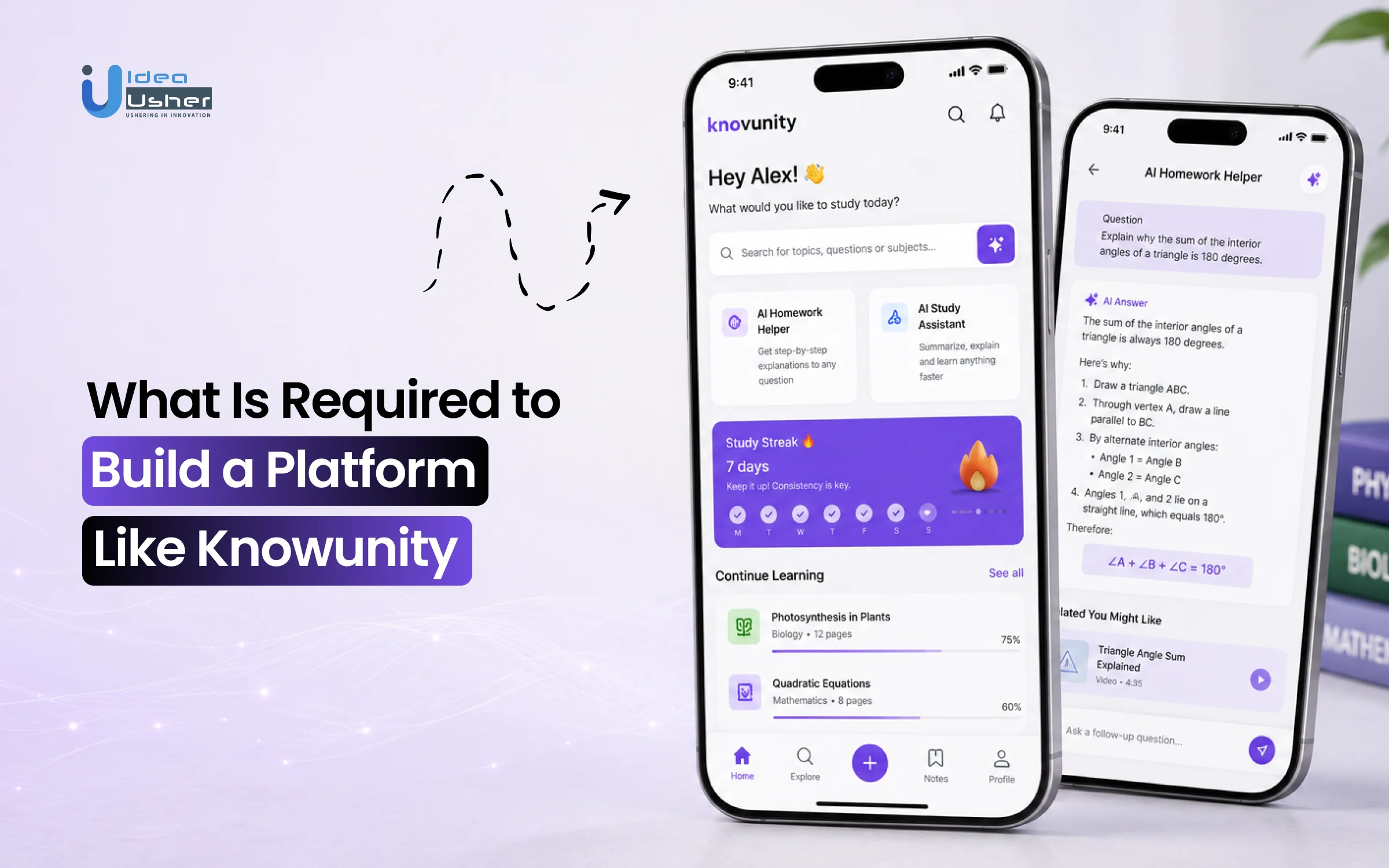
The future of learning may depend less on delivering content and more on helping students navigate information overload. This shift is driving interest in Knowunity app development, where AI-powered learning support, community-generated knowledge and personalized study experiences work together to make education more engaging, accessible and effective.
Traditional learning platforms relied on static resources, predefined courses and one-way content delivery. Modern students increasingly expect AI tutoring, homework assistance, personalized study plans, flashcard generation, exam preparation tools and peer-driven learning communities that adapt in real time. The value is no longer just delivering educational content. It is helping learners understand, retain and apply knowledge through personalized learning experiences.
In this blog, we will talk about core features, AI capabilities, architecture, development costs and how IdeaUsher can help with Knowunity app development, reflecting a broader evolution toward AI-powered study ecosystems where community contributions and intelligent learning tools coexist within a single environment
Why AI-Powered Study Platforms Are Growing Fast
The global education technology (EdTech) landscape is undergoing an unprecedented structural acceleration. Driven heavily by the rapid integration of machine learning and large language models, the global AI EdTech industry is projected to reach from USD 8.3 billion in 2025 to more than USD 57 billion by 2033, expanding at a robust compound annual growth rate (CAGR) of 25.9%.

This massive growth is fueled by dramatic economic and efficiency shifts. Between 2024 and 2025 alone, the infrastructure costs to process and query advanced reasoning models plummeted by an astounding 82%.
This massive drop in inference costs has allowed edtech platforms to deploy sophisticated, real-time AI tools at scale, making personalized learning affordable and accessible to millions of students worldwide.
A. The Shift From Static Learning Apps to AI Companions
Traditional study apps acted as digital filing cabinets, static repositories of flashcards, PDFs, and rigid pre-recorded quizzes. AI study platforms have shifted the paradigm by functioning as dynamic cognitive scaffolds that adjust to a student’s unique learning pace.
Data demonstrates that this shift from static software to adaptive AI companions significantly impacts student comprehension and performance:
- Academic Impact: Empirical regression analyses show an exceptionally strong correlation between personalized AI tool usage and heightened student engagement (β = 0.72, p < 0.001) and active classroom participation (β = 0.70, p < 0.001).
- User Satisfaction: Large-scale student surveys indicate that 70% of modern students now integrate AI into their study routines on a weekly basis, with 42% utilizing these tools daily.
- Core Use Cases: Rather than using it just to find answers, students primarily leverage AI companions for 68% use it to break down and explain complex technical concepts, 61% for custom assignment planning, and 55% for building tailored exam preparation materials.

B. How Gen Z Students Prefer Learning Today
Generation Z represents the first true generation of “digital natives” who explicitly reject conventional, passive educational methods. Instead, Gen Z heavily favors immersive, visual, and highly interactive learning ecosystems that offer real-time feedback.
- Active Feedback Loops: Instead of absorbing static lectures, Zoomers favor visual, highly interactive learning interfaces that provide instantaneous, real-time diagnostic guidance.
- Algorithmic Integration: Early exposure to algorithmic platforms cultivates comfort with software-driven workflows. Since only 11.1% trust human-curated social feeds, they lean heavily on objective, data-driven AI systems.
- Autonomous Tutoring: About 56% of young adults aged 18 to 29 utilize generative AI multiple times weekly. Zoomers view the non-judgmental iteration of AI tutors as essential for self-directed academic autonomy.
C. Why AI and Social Learning Work Better Together
While individual AI usage provides targeted cognitive assistance, combining AI with collaborative social spaces directly counters the psychological risks of screen isolation.
- Bridging Efficiency and Connection: Integrating social features like peer networks and collaborative workspaces effectively bridges the gap between technical study efficiency and healthy socio-emotional development.
- Collaborative AI Analytics: Modern frameworks highlight that utilizing AI to analyze group dynamics provides real-time feedback on communication, teamwork, and collaboration skills during group work.
- The Blended Advantage: This delivers the best of both worlds: 82%cheaper, tailored conceptual mastery powered by machine learning, paired with the peer accountability, motivation, and empathy of social learning.
What is Knowunity?
Knowunity is an AI-powered social learning platform that combines personalized tutoring, study resources, exam preparation tools, and community-driven learning into a single mobile-first experience. Designed for Gen Z students, the platform serves as a daily AI study companion, helping learners understand concepts, complete homework, and prepare for exams through interactive and personalized learning experiences. It has grown into one of Europe’s largest AI learning communities, serving more than 30 million students, exceeding 200,000 new user registrations per week.
Operating as an “AI-powered study ecosystem,” across more than 20 countries, the platform provides tutoring, homework help, study plans, and millions of peer-shared materials. Knowunity uniquely merges community educational content with AI support, allowing students to learn effectively from both digital tools and their peers.

A. What Makes Knowunity Different From Traditional EdTech Apps?
Knowunity uses a high-engagement hybrid model instead of legacy static content or costly human tutoring networks. Consequently, 94% of active users report direct improvements in their marks and comprehension.
The platform’s key differentiator is its partnership with European AI pioneer Mistral AI. Moving beyond generic APIs, the platform uses a hyper-personalized, multi-layered LLM architecture designed specifically for Gen Z students:
- Peer-to-Peer Learning Assistant: A custom fine-tuned Mistral Small model delivers conversational, student-friendly responses using a proprietary training dataset, enabling a more engaging peer-learning experience.
- Socratic Learning Engine: Mistral Large 2 powers interactive, question-driven tutoring that uses Socratic dialogue to guide students through reasoning processes rather than simply providing answers, improving conceptual understanding and long-term retention.
B. SchoolGPT and Personalized AI Tutoring
Knowunity’s flagship AI feature, SchoolGPT, functions as a specialized, 24/7 personal tutor for students ranging from Year 5 to A-Levels/Advanced Placement (AP) curricula. Working inside a highly intuitive chat interface, SchoolGPT is engineered to understand the contextual demands of standard school assignments.
- Cognitive Scaffolding: Automatically parses the student’s designated grade level and target syllabus to customize technical explanations, dynamic reading levels, and vocabulary depth.
- Adaptive Pacing: Mimics the patience and behavior of a private tutor by continually analyzing user conversational cues and slowing down or speeding up instruction as needed.
- Context-Aware Assistance: Understands the structural demands of standard school curriculum assessments across multiple subjects, from complex algebraic proofs to advanced literary analysis.
C. Community-Generated Study Resources
At the core of Knowunity’s organic network effects is its massive decentralized peer-to-peer content engine, housing over 1.6 million user-uploaded materials curated and verified by the community itself.

This decentralized system allows student “creators” to build profiles, gain followers, and share high-quality, localized notes, cheat sheets, presentations, and flashcard decks. By crowd-sourcing content directly from high-achieving pupils, the platform effectively maps local and national educational curricula without the costly content-acquisition lag typical of older EdTech entities.
D. AI-Powered Homework Assistance
When students get stuck on after-school assignments, Knowunity provides an instantaneous safety net through its multimodal AI Scanner and AI Helper tools. The entire workflow operates on a streamlined, real-time sequence:
Student Snapshot → OCR & AI Parse → Step-by-Step Breakdown→ Socratic Follow-ups
- Multimodal Scanner: Translates smartphone-captured snapshots of handwritten mathematical equations, complex biology diagrams, or foreign-language passages into digital assets.
- High-Accuracy OCR Engine: Leverages advanced character recognition to translate visual homework prompts, generating step-by-step solutions with a $90\%$ real-time accuracy and conceptual relevance rating.
- Guided Socratic Follow-Ups: Instead of offering flat answers, the engine prompts students with scaffolded questions to build independent critical thinking and conceptual mastery.
E. Personalized Revision and Exam Preparation
Knowunity automates the diagnostic cycle to prepare students for examinations. Rather than forcing students to read hundreds of pages of textbook chapters repeatedly, the app generates custom, course-relevant mock exams and practice tests.
- Syllabus-Aligned Practice: Generates dynamic mock exams built around official specifications, including College Board AP parameters and UK GCSE syllabus guidelines.
- Diagnostic Analytics: Tracks diagnostic assessment scores over time to log weak points, missed concepts, and active learning gaps.
- Spaced Repetition Integration: Leverages mathematical memory retention algorithms to surface targeted flashcards and diagnostic review prompts right before retention curves drop.
F. Content-to-Learning Material Automation
Knowunity converts complex inputs into interactive learning structures. By transforming study assets like textbook PDFs, slides, images, or YouTube links into clear study guides, the system reduces cognitive fatigue for the user. In a matter of seconds, the backend AI parses the input content and automatically generates:
- Scannable, highly-structured topic summaries.
- Customized, digital flashcard decks.
- Interactive, multiple-choice quizzes complete with detailed answer rationales.
- Guided study itineraries tailored to the student’s exam date.
This automation shifts the student’s daily cognitive load away from administrative preparation and note organization, focusing 100% of their energy directly on active recall and conceptual understanding.
How the AI Engine Behind a Knowunity-Like Platform Works
The success of a platform like Knowunity relies on a powerful AI engine that processes educational content, delivers personalized learning experiences, generates study resources, and provides intelligent academic support through interconnected systems for content understanding, recommendations, and adaptive learning.
The table below outlines the six interconnected layers that power an AI social learning platform. In the context of Knowunity app development, each layer plays a distinct role in transforming educational content into personalized, engaging learning experiences.
| AI Layer | Primary Function | Student Benefit |
| Content Ingestion Layer | Collects and converts educational content into machine-readable formats | Enables uploads from PDFs, notes, images, videos, and lectures |
| AI Knowledge Processing Pipeline | Structures, categorizes, and analyzes educational content | Generates summaries, flashcards, quizzes, and revision materials |
| Retrieval-Augmented Learning System | Combines AI responses with verified educational resources | Delivers accurate, curriculum-aligned explanations and tutoring |
| Personalized Recommendation Engine | Analyzes learning behavior and study patterns | Recommends relevant content and personalized learning paths |
| Adaptive Learning Intelligence | Continuously adjusts learning experiences based on performance | Helps students focus on weak areas and improve outcomes |
| Multi-Modal AI Processing | Understands text, images, audio, videos, and documents | Converts any learning material into interactive study resources |
Together, these interconnected AI layers enable an AI social learning platform to transform raw educational content into personalized learning experiences at scale. This architecture forms a critical foundation of modern Knowunity app development, supporting intelligent content delivery and adaptive learning journeys.
1. Content Ingestion Layer
The content ingestion layer acts as the foundation of the AI ecosystem, collecting educational materials from multiple sources and converting them into structured, machine-readable data that can be analyzed effectively.
What it does:
- Accepts multiple content formats: Allows students to upload PDFs, notes, presentations, images, videos, and lecture recordings from different learning sources.
- Extracts text using OCR: Converts printed or scanned documents into editable text that AI systems can understand and process.
- Converts audio into text: Uses speech-to-text technology to transcribe lectures, recordings, and educational videos automatically.
- Processes handwritten notes: Recognizes handwritten content and transforms it into searchable digital information.
- Standardizes content formats: Organizes uploaded materials into a consistent structure for easier analysis and retrieval.
Why it’s important: A Knowunity-like platform relies heavily on user-generated and uploaded learning materials. Without a robust ingestion layer, the AI cannot effectively analyze, organize, or transform educational content into revision resources.
Key technologies involved:
- OCR engines: Extract text from scanned documents, images, and handwritten notes.
- Speech recognition APIs: Convert spoken content into accurate text transcripts.
- Document parsers: Analyze files and extract structured information from different formats.
- File processing pipelines: Manage content uploads, conversions, and data preparation workflows.
- Cloud storage systems: Securely store and manage large volumes of educational content.
Business impact: The more content formats your platform supports, the more valuable and engaging it becomes for students seeking flexible learning experiences.
Outcome: A centralized and structured content repository that enables the AI system to process educational materials efficiently and generate meaningful learning resources at scale.
2. AI Knowledge Processing Pipeline
Once educational content is collected, it passes through an AI processing pipeline that organizes information, identifies key concepts, and transforms raw materials into structured learning assets.
What happens in this stage:
- Topic extraction: Identifies the main subjects and themes discussed within the content.
- Concept identification: Detects important ideas, theories, and learning concepts for deeper understanding.
- Formula recognition: Recognizes mathematical equations, scientific formulas, and technical expressions.
- Keyword tagging: Assigns relevant keywords to improve searchability and content discovery.
- Curriculum mapping: Aligns content with educational standards, subjects, and learning objectives.
- Content categorization: Organizes materials into structured categories for easier navigation.
Core outputs generated:
- Study summaries: Condenses lengthy materials into concise and easy-to-review notes.
- Flashcards: Creates question-and-answer cards for active recall learning.
- Revision notes: Generates focused study materials for exam preparation.
- Practice questions: Produces quizzes and assessments based on uploaded content.
- Learning recommendations: Suggests relevant resources based on content analysis.
Why this layer matters: This pipeline converts raw educational content into searchable and reusable learning assets, enabling the platform to generate personalized study materials automatically.
Outcome: A well-organized educational knowledge base that powers automated content generation, intelligent search, and personalized learning experiences.
3. Retrieval-Augmented Learning System
A Retrieval-Augmented Learning System combines AI models with educational knowledge repositories, enabling students to receive accurate, context-aware answers based on relevant study materials and curriculum-specific resources.
How it works:
- Student submits a question: The learner asks a question through the AI tutor or homework assistant.
- Relevant content is searched: The system scans study notes, uploaded materials, and educational resources.
- Best information is retrieved: The most relevant content is selected based on the query context.
- AI generates the response: The language model creates an answer using the retrieved educational information.
Benefits of RAG in education:
- More accurate responses: Answers are based on verified learning materials rather than generic AI knowledge.
- Reduced AI hallucinations: Minimizes incorrect or fabricated information in educational explanations.
- Curriculum-aligned explanations: Keeps responses relevant to specific subjects and academic standards.
- Subject-specific tutoring: Delivers more contextual support across different disciplines.
- Better homework assistance: Provides detailed explanations grounded in actual study resources.
Why Knowunity-like platforms need it: Students require answers based on actual educational resources rather than generic internet knowledge. RAG ensures explanations remain relevant to the learner’s syllabus and study materials.
Outcome: Students receive highly accurate, context-aware answers that improve trust in the platform and enhance overall learning effectiveness.
4. Personalized Recommendation Engine
The recommendation engine analyzes student behavior and learning patterns to deliver tailored study resources, helping learners discover relevant content and maintain consistent academic progress.
Data analyzed by the engine:
- Study habits: Tracks when, how often, and how long students engage with learning materials.
- Subject preferences: Identifies subjects and topics that users interact with most frequently.
- Learning speed: Measures how quickly students complete lessons and assessments.
- Quiz performance: Evaluates strengths and weaknesses based on assessment results.
- Revision history: Reviews previously studied topics and learning activities.
- Engagement patterns: Monitors content interactions, searches, and resource usage.
Recommendations generated:
- Relevant study notes: Suggests materials related to current learning goals.
- Flashcards: Recommends revision cards for topics requiring reinforcement.
- Practice tests: Provides assessments tailored to student performance levels.
- Revision schedules: Creates study timelines based on upcoming exams and priorities.
- Learning pathways: Guides students through structured learning journeys.
Key benefits:
- Improves student retention: Keeps learners engaged with personalized content.
- Increases engagement: Encourages more frequent platform usage through relevant recommendations.
- Reduces learning friction: Helps students quickly find useful resources.
- Targets weak areas: Focuses attention on concepts that need improvement.
Business value: Personalized recommendations significantly increase session duration and platform stickiness, making them a critical feature for long-term growth.
Outcome: A tailored learning journey that keeps students engaged, improves academic performance, and increases long-term platform retention.
5. Adaptive Learning Intelligence
Adaptive learning intelligence continuously evaluates student performance and dynamically adjusts educational experiences, ensuring learners receive personalized support based on their strengths, weaknesses, and goals.
How adaptive learning works:
- Tracks performance continuously: Monitors learning activities and assessment results in real time.
- Identifies knowledge gaps: Detects topics where students struggle or need additional support.
- Measures concept mastery: Evaluates how well learners understand specific subjects.
- Adjusts difficulty levels: Modifies content complexity based on student progress.
- Updates study plans automatically: Refines learning schedules as performance changes.
Examples of adaptive behavior:
- Additional practice recommendations: Suggests extra exercises for weaker topics.
- Difficulty progression: Introduces more challenging questions after strong performance.
- Exam-focused prioritization: Highlights subjects that require immediate attention.
- Smart revision reminders: Encourages review sessions based on retention patterns.
Why it matters: Students learn at different speeds. Adaptive learning ensures every learner receives a customized educational experience rather than a one-size-fits-all curriculum.
Outcome: A continuously optimized learning experience that adapts to individual needs, helping students achieve better outcomes with less effort.
6. Multi-Modal AI for PDFs, Images, and Videos
Multi-modal AI enables the platform to understand and process diverse educational formats, allowing students to transform various learning materials into interactive study resources instantly.
Supported content formats:
- PDFs: Textbooks, notes, worksheets, and academic documents.
- Images: Photos of study materials, diagrams, and classroom content.
- Screenshots: Captured questions, explanations, and educational references.
- Handwritten notes: Personal study notes and classroom annotations.
- Infographics: Visual learning materials containing structured information.
- Lecture recordings: Audio or video recordings from classes and tutorials.
- Educational videos: Online learning content from various sources.
- Presentation slides: Classroom presentations and study decks.
What the AI can generate from uploaded content:
- Flashcards: Converts key concepts into revision cards for active recall.
- Summaries: Creates concise overviews of lengthy materials.
- Practice quizzes: Generates assessment questions based on content.
- Revision guides: Produces structured study resources for exam preparation.
- Topic explanations: Simplifies complex concepts into understandable explanations.
- Exam preparation materials: Builds targeted resources for upcoming assessments.
Why multi-modal AI is a competitive advantage: Students no longer need to manually create study resources. The platform automatically converts learning materials into interactive revision assets within seconds.
Key technologies powering this feature:
- Computer vision models: Analyze images, diagrams, and visual content.
- Large Language Models (LLMs): Generate explanations, summaries, and learning materials.
- Speech-to-text systems: Convert spoken content into searchable text.
- Video understanding models: Extract insights and information from educational videos.
- Multi-modal AI frameworks: Combine text, image, audio, and video processing capabilities.
Outcome: Students can instantly convert any learning material into actionable study resources, significantly improving study efficiency and content accessibility.
Core Features Needed to Build a Platform Like Knowunity
AI social learning like Knowunity app development requires combining collaborative learning, AI-powered personalization, and user-generated educational content into a seamless experience. By transforming shared study materials into interactive learning resources, the platform empowers students with instant academic support, peer insights, and tailored study assistance.
1. AI Tutor and Conversational Learning Assistant
To bridge the gap between static reading and actual comprehension, the platform embeds an active, conversational AI study partner like SchoolGPT AI tutor. This module acts as a localized digital tutor, processing complex text queries and break-down requests in real time to resolve academic confusion immediately.
- Natural Language Academic Conversations: Allows students to ask open-ended questions and receive clear, conversational explanations that mirror a human tutoring session.
- Contextual Question Answering: Remembers previous turns in a study conversation, enabling students to ask follow-up questions and dig deeper into complex topics without restarting.
- Subject-Specific Tutoring Adjustments: Fine-tunes the AI’s explanation style automatically based on whether the student is untangling a calculus derivation or analyzing a history theme.
- Continuous 24/7 Study Support: Guarantees that students have access to patient, deep academic breakdowns at any time of night, completely removing the wait times of traditional tutoring.
2. AI Homework Solver With Smart Scanning
Students frequently hit friction points when trying to type complex math equations or chemical formulas into a text box. This module uses advanced visual recognition models to turn a smartphone camera into an instant, step-by-step problem solver.
- Image-Based Question Recognition: Ingests camera snapshots instantly, isolating text lines and handwriting from messy notebooks or textbook layouts.
- Step-by-Step Solution Breakdown: Avoids just dropping a flat answer; instead, it outputs structured, logical sequences detailing how to solve the problem stage by stage.
- Mathematical Reasoning Engines: Processes complex algebra, calculus geometric proofs, and scientific formulas with extreme logical accuracy.
- Frictionless Scanning Workflows: Guides the student through a rapid “point, shoot, and learn” layout that matches the speed of modern mobile camera tools.
3. Personalized AI Study Plans and Exam Roadmaps
To eliminate the anxiety of cramming, the platform includes an intelligent planning framework that translates massive exam syllabi into bite-sized daily milestones. This tracking module acts as a proactive guide, adapting to a user’s day-to-day performance automatically.
- Goal-Based Learning Pathways: Setting clear academic targets and tracking official exam countdown dates to establish transparent, motivating milestones for the student.
- AI-Driven Study Planning: Building an adaptive, personalized revision schedule that automatically calculates daily study tasks based on remaining time and syllabus density.
- Dynamic Subject Reprioritization: Analyzing day-to-day quiz performance trends to automatically move struggling subjects higher up in the study queue the very next morning.
- Performance-Based Recommendations: Delivering tailored study suggestions and content reviews in real time, allowing students to balance workloads and patch up weak areas before test day.
4. AI-Generated Flashcards From Any Content
Active recall is a proven mechanism for long-term data retention, but manually creating study cards takes up hours of productive time. This automated engine converts raw uploaded study materials into custom study decks in seconds.
- Instant Multi-Source Generation: Reviews user-uploaded files, textbook chapters, and handwritten notes to instantly isolate key terms and concepts.
- Active Recall Structuring: Formulates crisp, high-impact question-and-answer pairings optimized for mental retention and rapid review sessions.
- Seamless Visual Extraction: Pulls diagrams and core definitions straight out of lecture slides and embeds them cleanly onto the digital flashcards.
- Memory Retention Optimization: Interfaces directly with the application’s review schedules to ensure cards are surfaced at ideal cognitive testing intervals.
5. Mock Exams and Adaptive Practice Tests
True test confidence comes from simulating the real testing environment long before exam day arrives. This engine acts as a dynamic testing gate, generating custom practice assignments that adjust in difficulty based on the user’s growing competence.
- Automated Quiz Synthesis: Examines a student’s current reading modules to instantly build matching multiple-choice questions and short-answer prompts.
- Adaptive Difficulty Scaling: Measures live accuracy rates, automatically serving harder questions as a student masters a topic, or scaling back to reinforce core concepts.
- Granular Knowledge-Gap Isolation: Pins down exact sub-topics or formulas where a student consistently drops points, highlighting them for immediate review.
- Real-Time Readiness Assessments: Outputs a clear preparation score indicating a student’s likelihood of clearing target benchmarks based on their cumulative practice history.
6. AI Note Summaries and Revision Materials
When preparing for finals, students are often overwhelmed by hundreds of pages of unorganized lecture documents. This text-simplification engine strips away the fluff, turning complex literature or sprawling study logs into highly structured, readable revision summaries.
- Automated Note Summarization: Condenses dense textbook chapters and multi-page lecture notes down into clear, high-impact bulleted study sheets.
- Key Concept Extraction: Pulls out formulas, dates, critical historical figures, and definitions, placing them in an accessible study index.
- Bite-Sized Study Capsules: Transforms complex, multi-layered paragraphs into simple, high-retention text blocks optimized for rapid reading.
- Custom Simplification Toggles: Allows students to request simpler phrasing or analogies for confusing theories with a single tap.
7. Multi-Format Content Upload and Processing
A truly central study hub must handle the messy, fragmented ways students collect information across different classes. This ingestion layer serves as a universal document translator, processing everything from clean PDFs to scratchy audio notes flawlessly.
- Comprehensive Document Ingestion: Supports effortless file uploads across diverse formats, including PDFs, handwritten images, presentations, and documents.
- Lecture Recording Ingestion: Ingests classroom audio and video files, converting speech into organized, timestamped study transcripts automatically.
- Intelligent Content Indexing: Tags and files all incoming multi-format assets across precise subjects and academic chapters for easy searching later.
- Dynamic Transformation Workflows: Converts unstructured visual data into searchable text documents, allowing students to copy or highlight text straight from images.
8. Community-Powered Study Resource Library
The network value of a Knowunity-style application comes from its expansive, crowd-sourced archive of learning materials. This architecture creates an organized digital library that connects students looking for specific study aids with peer-verified content instantly.
- Crowd-Sourced Academic Archives: Constructing a massive, student-generated database where users index millions of self-written notes, custom flashcards, and textbook summaries daily.
- Searchable Content Repositories: Deploying robust search filters that let students locate matching study materials instantly by entering specific topics, keywords, or authors.
- Curriculum-Aligned Filter Networks: Organizing the global media library using precise school metadata, enabling users to isolate resources matching their exact grade, school, or teacher.
- Community-Validated Quality Controls: Leveraging student ratings, peer downloads, and accuracy upvotes to automatically surface the highest-quality, most comprehensive notes at the top of the search feed.
9. Study Groups and Social Learning Spaces
Studying alone in front of a screen can easily lead to isolation and a drop in motivation. This framework builds collaborative, digital workspaces that turn exam preparation into a team effort, driving high community interaction and app retention.
- Collaborative Study Rooms: Allows students to build private or public digital spaces where they can share notes, review flashcard decks, and tackle problems together.
- Asynchronous Discussion Threads: Enables nested comment sections and forum tracks directly beneath individual study documents to resolve peer questions.
- Frictionless Content Sharing Bridges: Helps users text specific study materials, flashcard packs, and exam roadmaps to external classmates with a single tap.
- Community Knowledge Exchange: Encourages global peer-to-peer interactions, letting advanced students explain complex problems to struggling users across different schools.
10. Student Creator and Content Sharing System
To sustain a continuous stream of fresh, accurate study materials without massive internal content costs, the application must incentivize top students to share their work. This workspace functions as a creator economy built specifically for the academic environment.
- Professional Student Creator Profiles: Allows high-achieving student contributors to build public portfolios highlighting their uploaded notes, follower counts, and helpfulness ratings.
- Streamlined Content Publishing Tools: Offers an intuitive mobile upload panel that makes scanning, tagging, and publishing physical study notes a seamless task.
- Community Contributor Reward Programs: Tracks user downloads and note views, rewarding creators with digital platform badges, XP points, and tangible incentives.
- Automated Content Moderation Guardrails: Screens user-submitted files through safety filters and peer-review systems to eliminate inaccurate information or copyrighted material before it hits the public library.
How to Develop an AI Study Platform like Knowunity
Building an AI social learning platform requires combining large-scale content management with intelligent personalization. Through Knowunity app development, educational content can be transformed into adaptive learning experiences that improve engagement, knowledge retention, and long-term user growth.

1. Define Your Learning Niche and Student Audience
Our principal product consultants align your business vision with target user needs. We pinpoint exact student demographics, outline multi-state or national testing curriculum databases, map subject-specific coverage requirements, and establish high-yield hybrid monetization frameworks before building.
- Curriculum Framework Isolation: Structuring primary database schemas to strictly index material under specific regional exam boards, grade divisions, and textbook chapters.
- Competitor Market Auditing: Identifying localized feature gaps and unserved academic verticals within target geographic markets to capture early market share.
- Monetization Blueprint Setup: Integrating flexible billing models combining automated micro-subscriptions, premium exam prep access, and programmatic ad mediation platforms.
2. Design an AI-First Learning Experience
Our UX design division layouts high-retention wireframes that prioritize immediate, intelligent interaction. We map out single-tap camera scanning paths, structure seamless AI tutor chat workspaces, and wireframe continuous gamification loops that transform textbook reading into engaging study habits.
- Frictionless Ingestion Wireframing: Placing direct-access camera triggers on the home tab so students can capture and solve homework problems within seconds of opening.
- Cognitive Load Optimization: Structuring chat interfaces to cleanly display multi-layered text, mathematical formulas, and visual diagrams without causing information overload.
- Gamified Behavior Mapping: Designing highly visible daily study streak calendars, unlockable achievement badges, and interactive weekly leaderboards to drive user retention.
3. Build the AI Tutoring and Homework Engine
Our software developers construct your platform’s core conversational artificial intelligence capabilities. We code robust, multi-modal vision processors for smartphone camera problem decoding, configure context-aware large language models, and deploy step-by-step mathematical reasoning engines.
- Image-Based Problem Parsing: Integrating advanced optical character recognition (OCR) systems to effortlessly extract text, math expressions, and drawings from blurry notebook pictures.
- Context-Aware Explanatory Pipelines: Programming conversation memory matrices that allow the AI assistant to remember preceding chat history for seamless follow-up question management.
- Algorithmic Hint Orchestration: Adjusting backend logic to deliver guided, prompt-based conceptual hints rather than direct final answers, encouraging actual long-term academic comprehension.
4. Develop Content Generation and Revision Tools
Our engineering teams build automated asset-synthesis microservices that turn raw files into interactive learning materials. We write proprietary data pipelines for instant text summaries, compile dynamic quiz generation scripts, and construct adaptive flashcard creation blocks.
- Automated Flashcard Extraction: Coding automated extraction algorithms that scan uploaded lecture files to isolate core terms and definitions into active-recall study decks instantly.
- Multi-Format Note Summarization: Programming document parsing engines to condense sprawling textbook PDFs into scannable study capsules, key concept lists, and revision guides.
- Dynamic Evaluation Engineering: Structuring randomized multiple-choice question (MCQ) engines that evaluate a student’s instant retention scores immediately following content ingestion sessions.
5. Create the Community Learning Ecosystem
Our backend architects build secure, high-throughput social networking databases to manage crowd-sourced study resource libraries. We establish frictionless peer-to-peer sharing nodes, develop custom student creator profiles, and integrate proactive, multi-tier content moderation filters.
- High-Throughput File Indexing: Engineering cloud storage infrastructure to sort, search, and serve millions of student-uploaded notes and flashcard decks with sub-second response times.
- Plagiarism and Safety Guardrails: Hardcoding intelligent language filters and duplication checks to flag misinformation, copyright breaches, and harmful content before uploads go public.
- Community Validation Vectors: Implementing upvote tracking loops and download analytics dashboards that automatically surface peer-verified, premium study materials to the top of search matrices.
6. Implement Personalization and Recommendation Systems
Our machine learning engineers develop the intelligence layer that powers personalized learning experiences. In Knowunity app development, we implement behavioral analytics, spaced repetition systems, adaptive learning paths, and content-ranking algorithms to maximize engagement and knowledge retention.
- Spaced Repetition Scheduling: Programming modified memory modeling algorithms that track individual forgetting curves to surface past review materials at optimal cognitive testing windows.
- Behavioral Recommendation Terminals: Building data-driven content ranking matrices that analyze micro-second watch loops and interaction rates to continuously personalize user discovery feeds.
- Dynamic Difficulty Adjustments: Engineering item-response matrix logic that analyzes quiz histories to adjust incoming assessment granularities and subject priorities in real time.
7. Test, Launch, and Scale the Platform
Our DevSecOps specialists ensure the AI social learning platform remains secure, reliable, and scalable before launch. During Knowunity app development, we perform load testing, monitor AI performance, configure cloud scaling, and manage controlled production deployments across environments.
- High-Concurrency Traffic Stressing: Pounding global database layers with massive simulated user queries to ensure the infrastructure handles viral social media spikes without slowdowns.
- AI Hallucination Verification: Running strict automated verification scripts over generative text outputs to guarantee 100% academic factual accuracy before public launch.
- Live Performance Telemetry: Configuring advanced cloud diagnostics to monitor server health, optimize API latency, and scale server resources dynamically based on active user surges.
Cost to Develop an AI Learning Platform Like Knowunity
The cost of developing an app like Knowunity depends on several factors, including AI capabilities, content processing infrastructure, community features, personalization engines, and platform scalability. Development costs can vary significantly based on feature complexity, technology choices, and the target scale of deployment.
A phase-wise Knowunity app development cost breakdown provides a clearer understanding of where the development budget is allocated and how each stage contributes to building a fully functional AI-powered learning platform.
| Development Phase | Estimated Cost | What the Phase Covers |
| Discovery & Product Strategy | $2,000 – $20,000 | Market research, feature planning, user journeys, technical architecture, and product requirement documentation. |
| UI/UX Design | $4,000 – $40,000 | Wireframes, user flows, mobile interfaces, design systems, prototypes, and usability optimization. |
| AI Tutor & Homework Engine Development | $10,000 – $120,000 | Conversational AI, homework solving, OCR integration, prompt engineering, and tutoring workflows. |
| Content Generation Features | $6,000 – $70,000 | Flashcards, quizzes, summaries, revision tools, and AI-powered learning material generation systems. |
| Community & Content Sharing Modules | $4,000 – $60,000 | Study resource uploads, creator tools, social interactions, moderation, and engagement mechanisms. |
| Backend & Cloud Infrastructure | $6,000 – $80,000 | APIs, databases, authentication, storage, content processing, and cloud deployment architecture. |
| Personalization & Recommendation Engine | $3,000 – $60,000 | Learning recommendations, adaptive study plans, content ranking, and behavioral analytics systems. |
| Testing, Security & Deployment | $5,000 – $50,000 | Quality assurance, performance testing, security audits, bug fixing, and production deployment. |
| Total Estimated Cost | $40,000 – $500,000+ | Complete development cost across all phases for an AI-powered learning platform like Knowunity. |
Note: The MVP-side Knowunity app development estimates reflect the minimum investment required to launch a functional AI learning platform, while the enterprise-side estimates account for advanced AI capabilities, large-scale infrastructure, and community-driven ecosystems.
A. Development Cost by Platform Level
The overall budget largely depends on the platform’s maturity level. Businesses often begin with an MVP to validate demand before investing in advanced AI capabilities and large-scale community ecosystems.
| Platform Level | Estimated Cost | Features Included |
| MVP | $40,000 – $80,000 | AI tutor, homework solver, flashcards, content uploads, basic study plans, and user management. |
| Mid-Level Platform | $80,000 – $180,000 | Advanced AI features, quizzes, recommendations, community content sharing, analytics, and improved scalability. |
| Enterprise Platform | $180,000 – $500,000+ | Full AI ecosystem, creator economy, advanced personalization, multi-region deployment, and large-scale infrastructure. |
Note: Enterprise-grade Knowunity app development cost require significant investment in AI infrastructure, content moderation systems, recommendation engines, security, and cloud scalability to support millions of users and learning resources.
B. Factors That Influence Development Budget
Several technical and business decisions can significantly impact the final AI social learning like Knowunity app development cost. Understanding these factors helps founders allocate resources more effectively and avoid unexpected expenses.
- AI Model Complexity: The sophistication of tutoring, homework-solving, content generation, and personalization features significantly impacts both development and ongoing infrastructure costs.
- Number of Learning Features: Including flashcards, quizzes, study plans, revision tools, exam preparation modules, and other learning functionalities increases project scope and timelines.
- Content Processing Requirements: Supporting PDFs, notes, images, videos, and other educational content formats requires advanced processing pipelines, storage systems, and AI workflows.
- Community and Social Features: Study groups, content sharing, creator ecosystems, moderation tools, and social engagement features add considerable development complexity.
- Platform Scalability Goals: Platforms designed to support large user bases require robust backend architecture, cloud infrastructure, and performance optimization.
- Security and Compliance Requirements: User privacy, data protection, secure authentication, and regulatory compliance measures require additional development and maintenance efforts.
The AI Social Learning Community Layer That Drives Retention
While AI-powered tutoring attracts students, long-term retention depends on building an active learning community. Platforms like Knowunity combine personalized AI assistance with collaborative content sharing, peer engagement, and social learning experiences, creating network effects that strengthen user engagement and platform value over time.
1. Student-Generated Learning Content
Student-generated content is the foundation of a community-powered learning ecosystem. Platforms like Knowunity enable students to share notes, summaries, flashcards, revision guides, and study resources that help peers learn more effectively.
As user-generated content grows, the platform becomes more valuable by offering diverse resources across subjects, grade levels, and curricula without relying entirely on platform-created content. Key capabilities typically include:
- Note and document uploads: Allow students to upload class notes, assignments, and study materials for others to access and learn from.
- Flashcard and quiz sharing: Enable users to create and distribute interactive learning resources that support revision and self-assessment.
- Revision guide publishing: Let students publish structured study guides that simplify complex topics and exam preparation.
- Subject-specific resource categorization: Organize content by subject, grade, or curriculum to improve discoverability and relevance.
- Search and content discovery systems: Help learners quickly find useful resources through keywords, filters, and recommendations.
- Content engagement tracking: Measure views, saves, downloads, and interactions to identify high-performing educational content.
By leveraging student contributions, businesses can build a continuously expanding educational content library while encouraging active participation within the learning community.
2. Creator Incentives and Gamification
A successful learning community relies on motivating students to consistently share valuable educational content. Creator incentives and gamification encourage participation by rewarding contributions and platform engagement.
Common incentives include points, badges, leaderboards, achievement milestones, contributor rankings, and recognition programs. Some platforms also offer exclusive rewards or monetization opportunities for top creators. Common gamification features include:
- Learning streaks: Reward students for maintaining consistent daily or weekly learning habits.
- Achievement badges: Recognize milestones such as content creation, study completion, or community participation.
- Contributor levels: Unlock higher status levels as users contribute more valuable educational resources.
- Reputation scores: Reflect a creator’s credibility based on content quality and community feedback.
- Leaderboards: Showcase top contributors and active learners to encourage healthy competition.
- Content performance metrics: Display views, likes, saves, and shares to motivate creators.
- Community recognition systems: Highlight outstanding contributors through featured profiles or special rewards.
Gamification not only drives content creation but also improves user retention by making learning more interactive, rewarding, and engaging.
3. Social Learning Feeds
Social learning feeds make studying more engaging by helping students discover study materials, trending resources, and peer-generated content through personalized content streams.
Instead of manually searching for resources, students receive recommendations based on their subjects, interests, and learning behavior, improving content discovery and encouraging regular platform engagement. Features commonly found in social learning feeds include:
- Personalized content recommendations: Suggest relevant study materials based on user preferences and learning activity.
- Trending study materials: Highlight popular notes, flashcards, and resources gaining attention within the community.
- Subject-based content feeds: Deliver content tailored to specific subjects, courses, or academic interests.
- Resource sharing: Allow students to easily distribute useful learning materials with peers.
- Likes, saves, and bookmarks: Enable users to engage with and revisit valuable content later.
- Content interaction metrics: Show engagement data such as views, comments, and shares to indicate popularity.
- AI-powered content discovery: Use machine learning to surface the most relevant resources for each learner.
A well-designed feed helps students uncover valuable learning resources while creating the familiar engagement patterns seen in successful consumer applications.
4. Community Moderation Systems
As educational communities grow, moderation systems become essential for maintaining content quality, accuracy, and user safety. They help ensure that shared learning resources align with platform standards and educational objectives.
Most platforms combine AI-powered moderation with human oversight. AI can automatically detect spam, inappropriate content, duplicates, and policy violations, while human moderators review complex cases that require contextual judgment. Effective moderation frameworks typically include:
- Automated content screening: Scan uploaded content for inappropriate material before it becomes publicly available.
- Spam detection systems: Identify and remove low-quality, repetitive, or promotional content.
- Content reporting mechanisms: Allow users to flag inaccurate, harmful, or policy-violating resources.
- Human moderation workflows: Enable moderators to review flagged content and make final decisions.
- Community guidelines enforcement: Ensure users follow platform rules and educational standards.
- User reputation monitoring: Track user behavior to identify trusted contributors and problematic accounts.
- Educational content review processes: Verify that learning materials remain relevant, accurate, and useful.
Strong moderation protects the integrity of the learning ecosystem while fostering a safe and trustworthy environment for students.
5. Trust, Quality, and Content Verification
Trust is essential for any educational platform and that is why students need confidence that the study materials they access are accurate, reliable, and relevant. Without proper quality controls, user-generated content can become inconsistent and undermine platform credibility.
Content verification systems maintain educational standards by assessing submissions for accuracy, relevance, and quality. AI-powered review tools can also detect factual errors, duplicate resources, and outdated information before content is widely distributed. Common quality-control mechanisms include:
- Content review workflows: Evaluate newly submitted resources before they are recommended to users.
- AI-powered quality checks: Automatically identify inaccuracies, incomplete information, or low-quality content.
- Community rating systems: Allow learners to rate resources based on usefulness and accuracy.
- Expert validation processes: Involve educators or subject specialists in reviewing important content.
- Duplicate content detection: Prevent multiple copies of the same resource from cluttering the platform.
- Contributor credibility scoring: Assess creator reliability based on past content performance and quality.
- Curriculum alignment verification: Ensure resources match educational standards and syllabus requirements.
By establishing strong trust and verification frameworks, businesses can create a reliable learning ecosystem where students confidently engage with both AI-generated and community-created educational resources.
Key Challenges in Building an AI Learning Ecosystem
Building an AI social learning app involves far more than adding a chatbot or content generator. Successful Knowunity app development requires addressing challenges around AI accuracy, personalization, large-scale content management, and scalability to deliver engaging and reliable learning experiences.
1. Maintaining AI Accuracy and Reducing Hallucinations
Challenge: AI models can generate inaccurate explanations, incorrect answers, or misleading educational content that negatively impacts student trust and learning outcomes.
Solution: Our developers implement Retrieval-Augmented Generation (RAG), verified knowledge bases, prompt optimization, and human review workflows to ensure AI responses remain accurate, curriculum-aligned, and contextually relevant.
2. Processing Diverse Educational Content at Scale
Challenge: Handling PDFs, handwritten notes, images, videos, presentations, and lecture recordings requires complex content extraction and processing pipelines.
Solution: We build multi-modal AI architectures using OCR, speech-to-text, document parsing, and content indexing systems that efficiently process diverse educational formats and transform them into usable learning resources.
3. Delivering Personalized Learning Experiences
Challenge: Every student learns differently, making it difficult to provide relevant study materials, recommendations, and adaptive learning paths at scale.
Solution: Our team develops recommendation engines, behavioral analytics systems, and adaptive learning algorithms that continuously analyze student interactions and deliver personalized content, study plans, and learning experiences.
4. Scaling Infrastructure for Growing User Communities
Challenge: Supporting thousands or millions of students simultaneously can create performance bottlenecks across AI services, databases, and content delivery systems.
Solution: We leverage cloud-native architectures, microservices, scalable databases, caching mechanisms, and load-balancing strategies to ensure consistent performance, reliability, and seamless user experiences during rapid growth.
Partner With IdeaUsher to Build a Platform Like Knowunity
IdeaUsher is an elite global technology solutions company with 11+ years of industry experience launching disruptive web and mobile software architectures across 50+ countries. Driven by a dedicated team of 250+ niche experts, over 1,000+ completed projects, and a stellar 4.9/5 Clutch rating, we excel at engineering massive social learning hubs.
By blending crowd-sourced data ecosystems with multimodal AI parsing pipelines, real-time recommendation feeds, and high-capacity content repositories, we deliver robust, scalable EdTech networks optimized to capture high user retention and fuel market growth.
Why Enterprises Partner With Us
Enterprise leaders choose IdeaUsher because we transform highly complex community interaction loops and crowd-sourced content portfolios into a safe, deeply personalized learning ecosystem.
- High-Throughput Crowd Ingestion: We engineer advanced, cloud-native storage frameworks capable of indexing, searching, and sorting millions of user-submitted notes, PDFs, and flashcards with sub-second response times.
- Flawless Multimodal Data Processing: Our developers design sophisticated machine learning pipelines that effortlessly extract text and structural context from handwritten images, presentations, and digital textbooks.
- Proactive Automated Community Safeguards: We eliminate copyright and safety liabilities by hardcoding intelligent AI filtering algorithms that automatically check for plagiarism, misinformation, and harmful content before uploads go live.
- Hyper-Targeted Personalization Engines: Our teams excel at building data-driven recommendation terminals and adaptive learning matrices that dynamically align community study resources with a student’s precise national curriculum.
Ready to build a disruptive, AI-driven social learning hub that commands the attention of modern students worldwide? Partner with IdeaUsher’s principal EdTech software architects to map your technical build strategy today.
Conclusion
Building a platform like Knowunity requires much more than integrating AI into a learning app. Success depends on combining intelligent tutoring, content generation, personalized learning paths, community-driven knowledge sharing, and scalable infrastructure into a unified ecosystem. From AI-powered homework assistance and adaptive learning engines to creator communities and social learning features, every component plays a critical role in engagement and retention. With the right development strategy and technology stack, businesses can create a next-generation AI learning platform capable of serving millions of students worldwide.
Things to Know
Q.1. What features are essential in a Knowunity-like platform?
A.1. A Knowunity-like platform requires AI tutoring, homework assistance, flashcard generation, personalized study plans, content uploads, community learning features, and recommendation systems. These features work together to create an engaging and scalable learning ecosystem.
Q.2. How much does it cost to build a platform like Knowunity?
A.2. Development costs typically range from $40,000 for an MVP to over $500,000 for an enterprise-grade platform. Costs depend on AI complexity, content processing capabilities, personalization features, scalability requirements, and community functionality.
Q.3. How does AI personalization improve learning outcomes?
A.3. AI personalization analyzes learning behavior, performance, and study preferences to recommend relevant content, revision plans, and assessments. This helps students focus on weak areas and learn more efficiently.
Q.4. Why is community learning important for platform growth?
A.4. Community learning increases user engagement by encouraging content sharing, collaboration, and peer-to-peer learning. User-generated resources continuously expand the content library, improve retention, and create strong network effects that support long-term growth.


