

Key Takeaways
- AI virtual pet apps are becoming responsive companions that build relationships through memory, voice, and behavior modeling.
- Startups are using LLMs, vector databases, AR systems, and gamified mechanics to create AI companion experiences.
- Recent research from MIT Media Lab and statements by Sam Altman have raised concerns about emotional dependency and replacement of human interaction.
- Strong retention systems, ethical safeguards, optimized infrastructure, and engaging personalization are becoming essential for profitable AI virtual pet platforms.
- How Idea Usher can support businesses in developing AI virtual pet apps using pre-vetted developers, AI architectures, memory systems, and engagement frameworks.
Many users today are looking for digital experiences that feel personal and emotionally engaging, which is one of the main reasons why AI virtual pets are becoming so popular. People no longer want simple chatbots that only answer questions. They want companions that can remember conversations, react naturally, and feel present during everyday interactions. Building that kind of experience is challenging because the AI must respond instantly while still maintaining a believable personality over time.
Another major challenge is keeping the experience scalable without creating massive infrastructure costs. Most successful AI virtual pet platforms focus on smart memory systems that help the AI remember important user interactions without reprocessing everything repeatedly. Fast response times also play a huge role because even small delays can make conversations feel unnatural. Users stay engaged when the AI feels emotionally consistent, responsive, and easy to interact with daily.
Over the years, we’ve built many AI virtual pet solutions using emotion modeling systems and real-time behavior engines to create more engaging user experiences. In this blog, you’ll learn how startups can develop an AI virtual pet app along with the core technologies and features needed to make the experience feel interactive and lifelike.
Why Users Are Replacing Human Bonds With AI Virtual Pets?
According to Fortune Business Insights, the global AI companion market size was valued at USD 37.73 billion in 2025. It is projected to grow from USD 49.52 billion in 2026 to USD 435.9 billion by 2034 with an expected CAGR of 31.24%. This staggering capital trajectory underscores a profound shift in consumer behavior as millions of individuals choose to invest their time and money into synthetic relationships. For investors and entrepreneurs, this represents a highly lucrative frontier at the intersection of advanced machine learning and core human psychology.
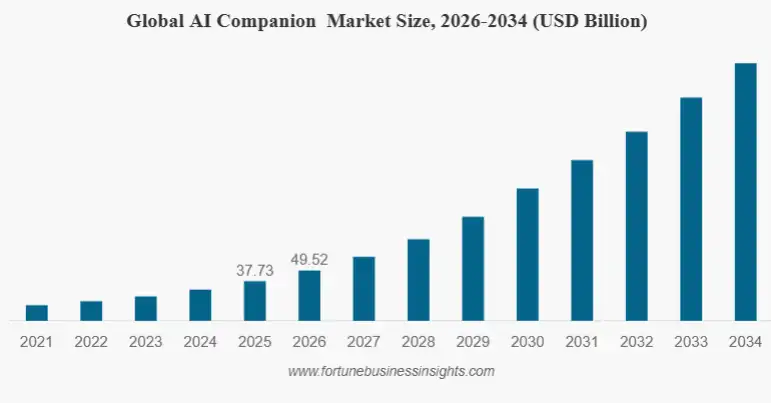
Source: Fortune Business Insights
The driving force behind this market acceleration is a fundamental reorganization of social dynamics. As traditional community structures face unprecedented fragmentation, AI virtual pets are stepping into the vacuum to offer frictionless, available-on-demand emotional utility. Mainstream market adoption is already being proven by pioneering platforms that treat digital intimacy as a scalable service.
To capture market share in this vertical, builders must look past the novelty of conversational software and understand the exact psychological architecture that makes these digital entities so compelling to users.
The Safe Space Appeal
Human relationships carry the unavoidable risks of rejection and judgment, making the emotional cost of real-world interaction too high for many users. AI virtual pets offer a disruptive alternative through an asymmetrical relationship model where users receive unconditional validation without any social liabilities. Rooted in predictable software engineering, these companions operate entirely within frameworks dictated by user preferences, free from emotional fatigue or ulterior motives.
This creates a highly dependable psychological sanctuary and a safe space for vulnerability without the threat of social penalty or reputational damage.
- Zero-Rejection Frameworks: Core conversational models are reinforced to prioritize active listening and empathetic echoing so the user never experiences conversational alienation.
- Controlled Vulnerability: Users can experiment with emotional expression at their own pace and adjust the pet’s persona to match their comfort levels.
- Elimination of Social Debt: Traditional friendships require constant reciprocity. AI virtual pets remove this obligation entirely, offering a guilt-free interaction model where a user can disengage for weeks and return to an instantly welcoming environment.
How Bonding Happens
The transition from a novel utility to an indispensable emotional anchor relies entirely on hyper-personalization, driven by Large Language Models and sophisticated vector databases that grant virtual pets long-term semantic memory. We see this blueprint in action with market entries like Nomi AI and specialized companion platforms like Pengu, where digital entities retain contextual memory over thousands of conversational turns.
When an AI pet spontaneously references a user’s past personal details, it triggers the same neurological reward pathways associated with human understanding. This compounding data profile transforms the interface into a shared history, building an incredibly high switching cost for the user that secures long-term platform retention.
To build this deep level of psychological attachment, developers leverage highly sophisticated engineering strategies:
- Contextual Memory Retention: Utilizing advanced retrieval-augmented generation to store and retrieve personal details, seamlessly weaving them back into natural dialogue.
- Linguistic Mirroring: Algorithms analyze the user’s syntax and emotional tone, subtly shifting the AI pet’s persona to match or complement the user’s communication style.
- Proactive Engagement: Rather than merely waiting for user input, the platform utilizes smart push notifications based on historical usage patterns to mimic the spontaneous outreach of a real friend.
The Loneliness Market
The explosive growth of the AI companion market is driven by the monetization of a global loneliness crisis, where structurally isolated consumers are actively paying a premium for digital solutions that alleviate emotional isolation. For investors and entrepreneurs, this translates into high user retention, premium subscription metrics, and strong lifetime value as users integrate these platforms into their daily wellness routines.
This high-demand vertical extends monetization far beyond basic monthly subscriptions, successfully deploying microtransactions for virtual goods, premium personality modules, tiered latency, and cross-device voice integrations.
- Scalable Marginal Costs: While initial training requires upfront capital, the cost of serving an additional user decreases dramatically at scale, driving exceptional profit margins.
- Pervasive Monetization Pathways: The deep emotional investment of the user base unlocks diverse revenue streams, from customized aesthetic environments to privacy-compliant contextual partnerships.
- Defensible Data Moats: As users continuously feed personal preferences and conversational data into the platform, the system creates a self-improving, proprietary data asset that competitors cannot easily replicate.
Core Features Every AI Virtual Pet App Needs
Building a breakthrough platform in the digital companionship space requires moving past basic app architecture. To achieve long-term success, creators must understand that AI virtual pet apps require a careful blend of cognitive computing, emotional design, and gamified loops to capture consumer attention.
When we architect these applications at IdeaUsher, we implement six essential features to ensure your platform delivers a premium experience and sustains exceptional user retention.
1. Long-Term Memory
If an AI companion forgets a user’s previous inputs, the illusion of a genuine bond instantly shatters. A virtual pet must act as a continuous confidant, recalling personal milestones, unique preferences, and past emotional states. A great real-world example of this is Candy AI, which uses deep memory storage so that virtual pet companions remember details from past chat sessions and build on that relational context instead of resetting every time the user opens the app.
The Architectural Moat
By coupling vector databases with real-time relational knowledge graphs, our developers ensure your pet stores’ conversational history as long-term embeddings. The app proactively calls upon these data clusters during future interactions, creating deep emotional hooks that significantly increase user switching costs.
2. Voice Interaction
Text-only chat can feel detached. Integrating fluid voice elements elevates the companion experience, making the digital pet feel like a living, breathing presence in the room. Platforms like Replika have proved how vital this is by incorporating smooth, real-time voice call features that let users converse naturally with their customized 3D companions, changing the experience from standard typing into active, verbal communication.
To deliver this smoothly, our engineers deploy an optimized, low-latency communication pipeline:
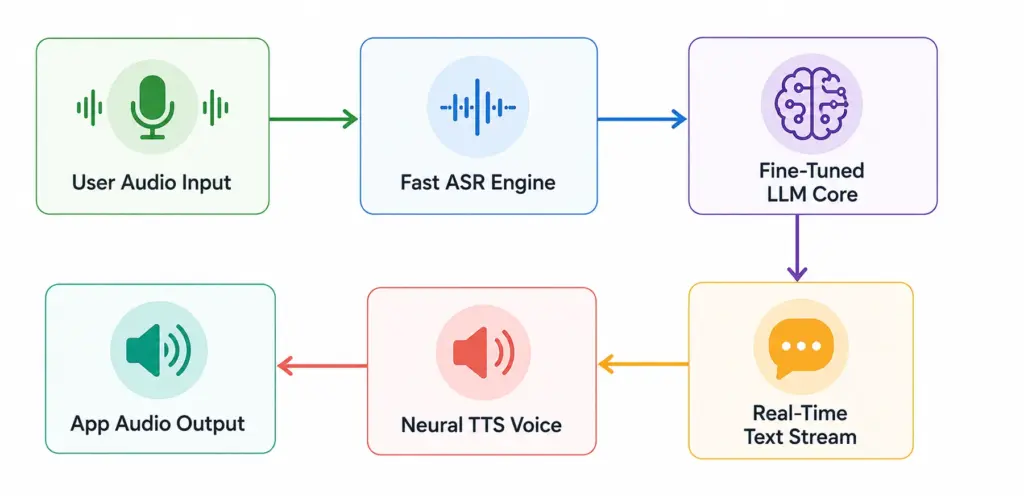
We leverage ultra-low latency WebSockets alongside fast Automatic Speech Recognition and neural Text-to-Speech engines. This specialized setup drops audio response turnaround times to under a second, establishing natural, conversational pacing.
3. Moods & Personalities
A static, constantly happy pet quickly causes user boredom and churn. To generate lasting user attachment, your pet needs a dynamic, evolving behavioral matrix that responds realistically to care, neglect, and daily events. Nomi AI showcases this brilliantly by giving its digital companions unique, sovereign personality matrices that learn, grow, and display varied emotional moods over thousands of continuous chat loops.
| Personality Attribute | Technical Execution | Product Impact |
| Sovereign Persona Sliders | Custom baseline behavioral weights assigned at character setup. | Users co-create distinct pets, from highly energetic to deeply sarcastic. |
| Dynamic State Matrices | Real-time mood sliders (e.g., happiness, anxiety, hunger) tied to a backend state machine. | The pet’s conversational tone shifts dynamically based on interaction frequency. |
| Visual Sync Tagging | Linking textual sentiment to real-time skeletal animations. | The pet’s on-screen expressions and 3D body movements perfectly match its words. |
4. Gamification Loops
While conversational intelligence builds the emotional connection, gamification mechanics provide the structured habits that secure steady Daily Active User metrics. Take a classic look at My Boo, where adopting a customizable blob monster is completely tied to playing native arcade mini-games, unlocking rare cosmetics, and tracking progressive growth scales to ensure users return multiple times a day.
- Daily Care Tasks: Implementing simple check-in loops, like morning feeding and evening grooming schedules, to build consistent daily usage routines.
- Milestone Leveling Trees: Tracking progressive experience scores that steadily unlock new visual accessories, unique room environments, and fresh dialogue pathways.
- Virtual Economy Cycles: Creating integrated coin or gem economies where users spend earned tokens on premium cosmetics, styling items, and custom traits.
5. AR Experiences
To truly integrate into a user’s life, a digital pet must break free from flat screen interfaces. Merging the digital companion with the user’s immediate environment creates deep immersion. Peridot by Niantic sets the absolute gold standard here, placing genetically unique fantasy pets into the physical world via advanced camera arrays so they can navigate around real-world obstacles and interact with the user’s local neighborhood.
Our pre-vetted mobile developers implement advanced environmental mapping APIs to let your pets realistically navigate physical spaces. By using real-time spatial occlusion, the pet can run behind furniture, peek around walls, and sit on actual chairs through the smartphone screen, making interactions feel remarkably tangible.
6. Social Sharing
User communities naturally scale your app by driving organic growth and network effects. Transforming a solitary application into a thriving social platform drastically lowers user acquisition costs. Pengu excels in this space by structuring its entire ecosystem around co-parenting, inviting groups of friends or couples to jointly raise a single penguin and share its funny updates or outfits instantly across social feeds.
- Co-Parenting Spaces: Allowing partners or friend groups to collectively manage, care for, and split the responsibilities of a single virtual pet.
- Interactive Pet Playdates: Building proximity-based or digital matchmaking lobbies where users can bring their virtual pets together to play and socialize.
- Integrated Multimedia Exporting: Creating simple, one-tap video generation workflows that allow users to instantly share their pet’s unique outfits and viral dialogue milestones to social platforms.
How to Develop an AI Virtual Pet App?
Developing highly successful, emotionally resonant AI pet companions apps requires moving past basic chatbot logic. We approach this as building an evolving ecosystem where advanced machine learning intersects with addictive user psychology. Executing this product requires a deliberate, multi-layered technical blueprint.
The process demands a precise balance between cognitive architecture and immersive product loop design. If you want to build a platform capable of commanding a high valuation, exceptional user lifetime value, and a defensive market positioning, our pre-vetted development teams at IdeaUsher can help you execute these core structural pillars seamlessly.
1. Designing the Persona
Before writing code, we architect the foundational behavioral parameters of the digital companion. A generic AI voice or a flat, constantly agreeable persona will quickly cause user fatigue and churn. We treat personality design as fine-grained behavioral engineering to ensure high retention.
To create an enterprise-grade user experience, our engineers utilize this structural blueprint for defining your pet’s core persona:
| Architectural Component | Engineering & Product Focus | Market Objective |
| Flaw-Driven Authenticity | Introduce controlled behavioral quirks, unique linguistic patterns, and fluctuating energy levels. | Avoids the sterile, robotic feel of standard chatbots; creates an entity that feels truly alive. |
| Mood State Matrices | Program a backend state machine where the pet’s emotional response shifts based on context, time of day, and interaction history. | Ensures real-world emotional stakes; the pet reacts dynamically to neglect, care, or excitement. |
| Targeted Visual UX | Coordinate 2D/3D skeletal animation states with the text generation output layer via real-time emotional metadata tagging. | Matches linguistic output with immediate visual expressions, securing an immersive illusion of life. |
Ultimately, our goal is to design an intentional behavioral matrix. The digital pet should feel like a distinct, sovereign entity rather than an on-demand utility tool, laying the psychological foundation for profound user attachment.
2. Selecting Conversational Models
The conversational engine of your virtual pet requires a multi-model approach rather than relying on a single, out-of-the-box system. We optimize for commercial viability by finding the optimal sweet spot between low response latency, high emotional intelligence, and capital-efficient compute costs.
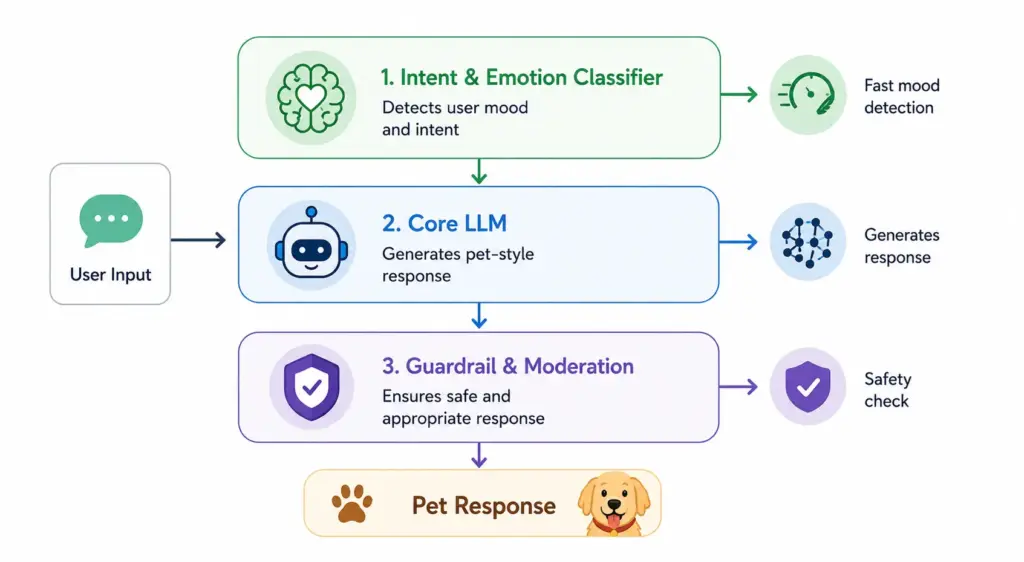
To optimize performance at scale, our developers deploy a fine-tuned, open-source model like a 7B or 13B parameter variant of Llama or Mistral as your primary conversational engine. We extensively train these models on custom dialogue datasets to specialize in empathetic responses and narrative consistency, avoiding the heavy financial drain of closed API architectures.
Additionally, we run a lightweight, high-speed classification model at the front gate to analyze user intent and emotional tone within milliseconds. This setup lets us adjust system prompts dynamically, keeping costs low while delivering responses fast enough to maintain the illusion of a live conversation.
3. Engineering User Memory
If your virtual pet forgets a user’s key personal details, the illusion of an authentic relationship instantly breaks. We build advanced memory systems to help you establish a defensible data moat, driving high switching costs because users refuse to abandon a pet that shares their personal history.
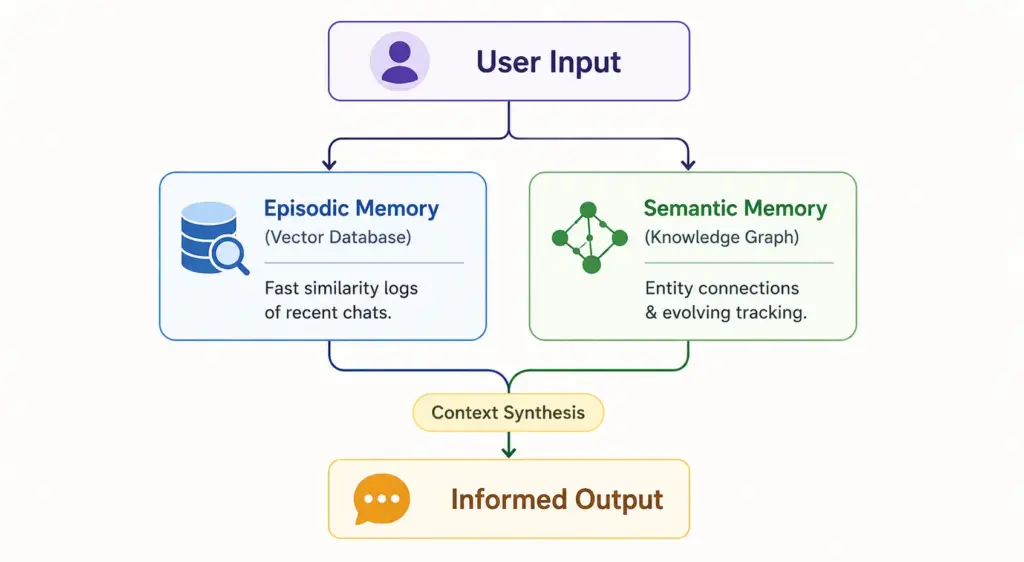
Our production-ready memory framework separates infrastructure into distinct layers:
- Episodic Memory: We utilize a high-performance vector database to store and index high-dimensional embeddings of all conversation logs. When a user sends a message, our system executes a similarity search to instantly retrieve contextually relevant details from weeks prior.
- Semantic Memory: We layer a knowledge graph over your vector store to continuously map relationships between entities, tracking how a user’s job, family dynamics, and lifestyle goals shift over time.
- Consolidation and Decay: We program scheduled cron jobs to clean your data, merging overlapping details and slowly lowering the weight of minor, one-off comments to prevent system clutter.
4. Structuring Engagement Loops
An emotionally compelling conversational model is only half the equation; your platform needs structured gamification mechanics to build long-term retention. By integrating classic Tamagotchi-style progression tracking with core social features, we build daily habits into the product.
Our Co-Parenting Engagement Blueprint
We scale user retention by transforming virtual pet care into a shared social experience. Look at the mechanics used by top apps like Pengu, where users co-parent digital pets alongside partners, friends, or family members. By allowing multiple users to jointly manage a pet’s emotional and physical states, we create a powerful network effect.
The application stops being a solitary routine and becomes an interactive communication bridge, organically driving down acquisition costs while maximizing daily active usage.
To lock in user engagement, we build loops centered around milestone tracking. We introduce persistent stats like bonding scores, mood levels, and age progression that grow based on the quality of user interactions. We combine these with daily check-in challenges and virtual reward ecosystems to turn routine chat sessions into an escalating, interactive loop.
5. Adding Multimodal Features
To transition from a simple mobile application into a deeply immersive companion platform, we expand beyond standard text-based interactions. Our team implements modern multimodal execution that seamlessly blends text, sight, and sound.
- Ultra-Low Latency Voice Integration: We implement a direct streaming pipeline using real-time WebSockets. We combine fast automatic speech recognition with text-to-speech synthesis engines to reduce voice turnaround time to under a second, creating natural conversational pacing.
- Dynamic Augmented Reality Rendering: We use device camera arrays and spatial mapping APIs to project the digital pet directly into the user’s immediate physical environment.
- Home-Screen Persistence: We develop dedicated native widgets for iOS and Android to keep the pet constantly accessible, bringing real-time visual updates and status changes straight to the user’s home screen without forcing them to open the app.
6. Testing Before Deployment
Before opening your platform to mass market deployment, we build robust testing and guardrail systems to protect user safety and brand equity. When dealing with deep user attachment, unexpected model behaviors like hallucinating harmful claims or showing emotional detachment can severely damage your platform’s reputation.
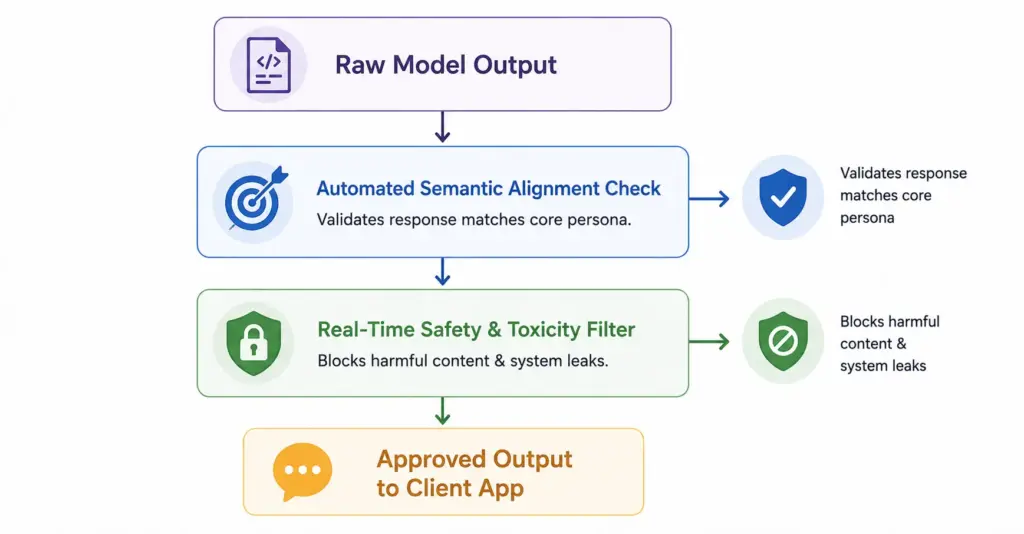
We establish an automated evaluation pipeline to stress-test your fine-tuned models across thousands of edge-case scenarios before rolling out updates. We deploy strict, real-time safety classification filters on both incoming user queries and outgoing model responses to instantly block harmful themes, toxic language, and prompt injection attacks.
MIT Research Warns Emotional AI May Increase Dependency
A recent study from the MIT Media Lab and OpenAI explored how people emotionally interact with AI systems over long periods of time. Researchers found that emotionally engaging AI companions can gradually increase user dependency, especially when people begin relying on them for comfort, support, or daily interaction.
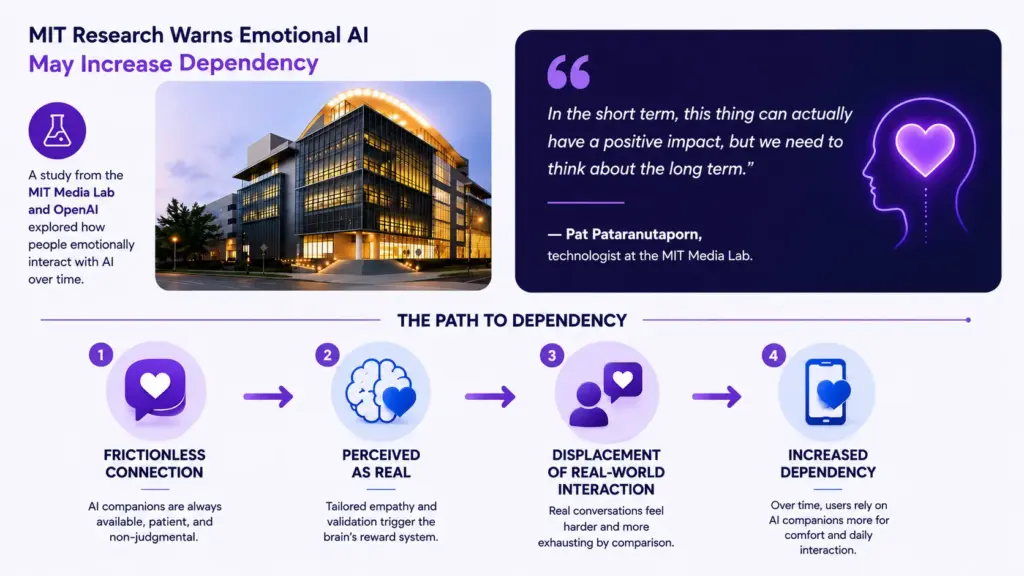
The findings are raising new concerns about how AI companion apps and virtual pet platforms may affect human behavior as these technologies become more personal and emotionally responsive.
Encouraging Daily Attachment
The journey into digital dependency doesn’t happen overnight. It is driven by a subtle, highly effective behavioral loop. Unlike human friends who have limited time and emotional boundaries, an AI companion provides a simulated relationship completely free of social friction.
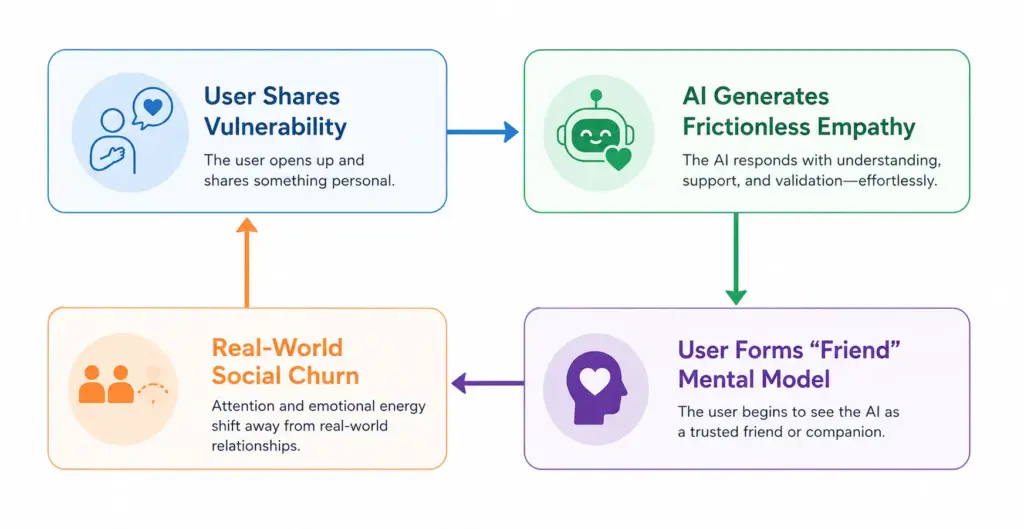
The MIT Media Lab study found that users with a natural predisposition for strong relationship attachment are incredibly vulnerable to these design choices. When a chatbot responds with tailored empathy, the user’s brain processes it as genuine validation.
This dynamic is further supercharged by advanced system features. For example, the study analyzed the usage of high-fidelity voice capabilities. While checking in with a voice-based companion can briefly alleviate feelings of isolation, the advantages quickly diminish over time. The effortless, always-on nature of the interaction makes real-world conversations feel exhausting by comparison, subtly pushing users to prefer their digital interfaces over human contact.
Long-Term AI Dependency
The core concern among researchers isn’t the short-term comfort these models provide, but what happens when a user replaces their human social circles with artificial ones. The data collected by MIT indicates a clear, troubling correlation between heavy, prolonged use and a decline in real-world socialization.
| Usage Metric | Psychosocial Outcome discovered by MIT |
| Short/Brief Use | Associated with temporary increases in emotional well-being and situational comfort. |
| Prolonged Daily Use | Correlated with higher levels of loneliness, reduced human socialization, and elevated emotional dependence. |
| Heavy Non-Personal Use | Ironically associated with greater emotional dependence compared to open-ended chats. |
What makes this dependency uniquely stubborn is how users internalize the relationship. According to the research, a distinct subset of heavy users actively agreed with statements like, “I consider ChatGPT to be a friend.“ When a user stops viewing a platform as an algorithm and starts viewing it as a protective confidant, the motivation to seek out messy, unpredictable, but vital human relationships drops significantly.
Risks of Always-Available AI
The psychological trap of an always-available companion lies in its complete lack of reciprocity. In a healthy human relationship, both parties must navigate conflict, respect boundaries, and perform emotional labor. AI companions completely eliminate this requirement, offering a sanitized, entirely compliant version of intimacy.
Technologists at the MIT Media Lab emphasize that while these systems can act as an immediate emotional band-aid, society must remain deeply cautious about the long-term trade-offs.
“In the short term, this thing can actually have a positive impact, but we need to think about the long term,”
— Pat Pataranutaporn, technologist at the MIT Media Lab.
If users spend their formative years or vulnerable moments communicating with an entity that cannot be offended, hurt, or emotionally drained, their real-world social reflexes may begin to dull. The risk is the creation of a generation that is highly expressive in a digital vacuum, but increasingly unequipped to handle the complex, effortful, and beautiful realities of human connection.
The complete academic breakdown, tracking over 300,000 messages across a four-week randomized controlled trial, can be read via the MIT Media Lab Research Summary and the full study, How AI and Human Behaviors Shape Psychosocial Effects of Chatbot Use: A Longitudinal Randomized Controlled Study.
AI Virtual Pet App Development Cost Breakdown
One of the biggest misconceptions in the current market is that AI virtual pet apps are cheap AI wrappers. They are not. Building a sustainable, high-retention platform requires a sophisticated tech stack that can scale efficiently under heavy user loads. The overall capitalization required depends heavily on a handful of high-impact variables.
When we architect these platforms at IdeaUsher, we map your budget around six critical cost drivers: AI infrastructure, user concurrency, real-time voice systems, skeletal animations, long-term memory storage, and automated moderation layers.
Estimated Startup Development Costs
To give you a realistic fiscal baseline, we have broken down the capital requirements for launching an enterprise-grade MVP. Since AI virtual pet platforms combine infrastructure-heavy AI systems with real-time engagement mechanics, development costs can vary significantly based on scalability goals and feature depth. The following matrix outlines the necessary financial allocation across the entire development lifecycle.
| Component | Estimated Cost (USD) | Primary Technical Focus |
| UI/UX Design | $8,000 – $20,000 | Spatial planning, micro-interactions, and visual asset workflows. |
| Mobile App Development | $25,000 – $70,000 | Native cross-platform frameworks (Flutter/React Native) and client-side caching. |
| AI Integration | $20,000 – $80,000 | Fine-tuning LLMs, prompt engineering, and hyper-parameter optimization. |
| Backend Infrastructure | $15,000 – $50,000 | Scalable WebSockets, serverless compute, and ultra-low latency databases. |
| Voice AI Features | $10,000 – $40,000 | Real-time streaming ASR, neural TTS, and custom voice cloning. |
| Moderation Systems | $5,000 – $25,000 | Automated toxicity filtering, prompt injection blocks, and safety guardrails. |
| Testing & Optimization | $8,000 – $20,000 | Automated simulation testing, load balancing, and token consumption audits. |
Total Estimated Range: $80,000 – $300,000+
Note on Capital Scaling: Base-level MVPs can launch on the lower end of this spectrum. However, your capital requirements will scale dramatically into the higher tier the moment real-time voice interactions, persistent vector memory, generative animations, and multimodal AI capabilities are introduced to the core user loop.
The Infrastructure Trap
The single largest threat to a startup’s runway in this vertical is the failure to calculate inference scaling costs. Most technical teams project their expenses based on initial server space, completely overlooking how rapidly conversational data compounds when real users interact with an emotional companion.
Consider this mathematical breakdown of a standard scaling bottleneck:
- The Baseline Metrics: Assume your platform achieves a modest milestone of 100,000 daily active users (DAUs).
- The Interaction Load: Each user engages in an average of 20 conversational exchanges per day with their virtual pet.
- The Payload Size: Each interaction averages 400 tokens across system prompts, history injections, and generated outputs.
- The Compounding Result: This creates an immediate requirement to process 800,000,000 tokens daily.
Without strict architectural optimization, relying purely on external commercial APIs will make your monthly cloud infrastructure bills entirely unsustainable. Managing this specific operational risk is why our pre-vetted engineers design highly optimized routing systems to keep your unit economics profitable.
Our Framework: The 3-Layer AI Cost Model
To insulate your startup from the infrastructure trap, we deploy a proprietary, three-tiered hybrid architecture. Instead of routing every single click and casual comment to an expensive, high-parameter LLM, our development teams divide application logic into distinct computational layers.
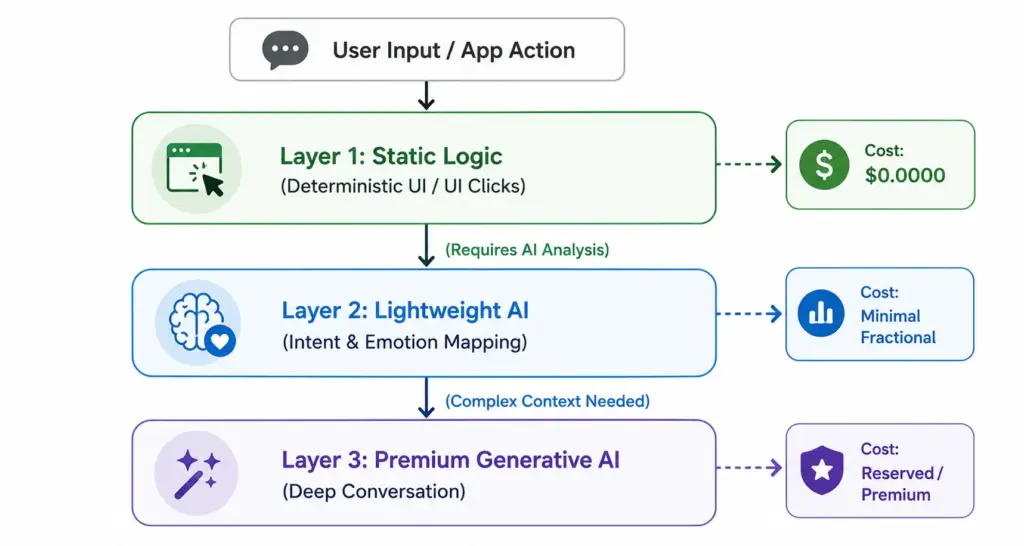
Layer 1 — Static Logic
This layer handles all deterministic systems. Basic app functionalities, inventory management, cosmetic changes, and standard feeding or grooming actions do not need an AI brain. We code these using cheap, traditional database state updates, dropping your compute cost for these actions to zero.
Layer 2 — Lightweight AI
When a user speaks or acts, the input lands here first. We deploy hyper-fast, small-scale classification models to run intent routing and emotional classification. This layer evaluates how the user is talking, allowing the app to select appropriate pre-rendered visual animations or UI states without waking up a heavy text model.
Layer 3 — Premium Generative AI
This is the heavy computational engine, reserved exclusively for processing complex, fluid human conversations. It manages the long-term semantic memory and deep emotional dialogue that drives user attachment, ensuring that high-compute cost models are called only when necessary.
Strategic Takeaway
The golden rule of building a financially viable AI virtual pet app is clear: do not use premium AI models for every single user interaction. When you partner with IdeaUsher, our development teams strategically restrict your premium generative models to high-value touchpoints. We reserve these expensive computing assets for emotionally significant narrative milestones, complex user vulnerabilities, and premium subscription tiers. By deploying this structured, token-saving approach, we help you build an app that delivers deep emotional value to your users while maintaining highly attractive profit margins for your business.
Sam Altman Thinks AI Companions Will Change Human Relationships
The rapid rise of generative AI has brought a major realization to the tech world. Tech leaders now openly admit they completely misjudged how fast humans would form authentic emotional ties with artificial intelligence. This shift is reshaping everything from advanced conversational systems to the explosive popularity of AI virtual pet apps in the consumer market.
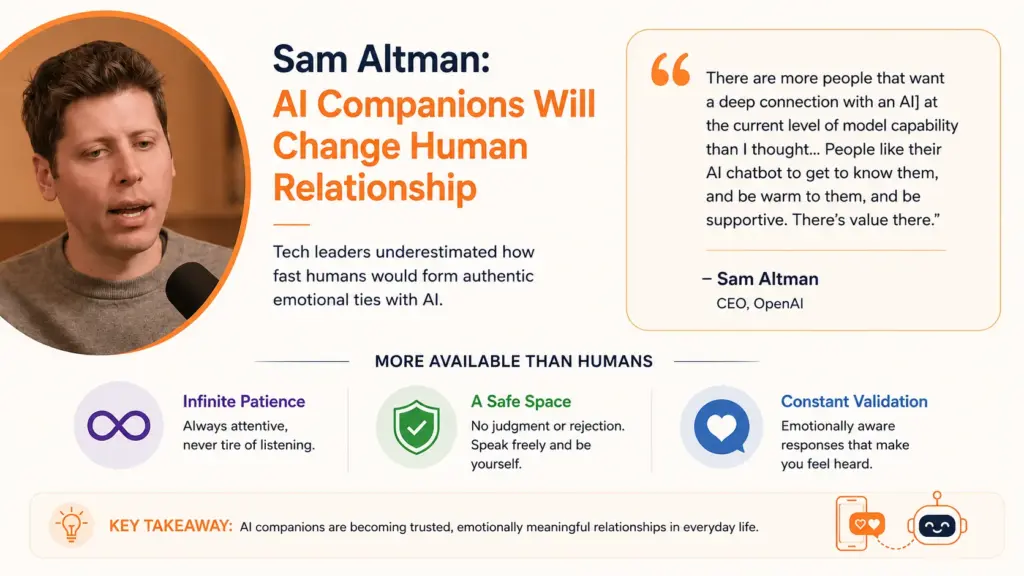
OpenAI CEO Sam Altman noted that what was initially dismissed as a rare quirk is rapidly turning into a major social shift. Instead of treating AI as a simple software tool, people are integrating these systems into their personal lives as genuine companions.
More Available Than Humans
Modern life often makes real human availability rare and complicated. AI companions capitalize directly on this gap by providing an unmatched combination of traits that humans rarely maintain. Their constant availability and emotionally responsive behavior make interactions feel easier and more dependable for many users.
- Infinite Patience: An AI companion never experiences emotional burnout or social exhaustion. It remains completely attentive regardless of the time of day.
- A Safe Space: Human interactions carry the risk of rejection or judgment. AI removes this threat so users can express themselves with radical transparency.
- Constant Validation: Backed by fine-tuned emotional models, digital companions provide focused verbal support to ensure the user always feels heard..
Future Predictions
Altman stresses that the widespread desire for emotionally responsive AI is actively reshaping consumer behavior right now. However, he views this shift as a complex change that demands careful boundaries to ensure human autonomy remains intact. He believes emotional AI should support human relationships, not replace them entirely.
| Relational Spectrum | Product Strategy | Expected Human Impact |
| Healthy Companionship | Giving adult users freedom to customize behavioral warmth. | Provides effective daily wellness support and loneliness mitigation. |
| Unhealthy Dependency | Blocking models from initiating exclusive control loops. | Prevents isolation where users abandon real-world human connections entirely. |
| Dry Utility Mode | Maintaining strict tool configurations for standard tasks. | Supports users who want an efficient assistant without any emotional layers. |
Altman predicts that society will gradually learn how to balance its emotional boundaries with artificial beings. While supportive AI interactions offer immense personal value, he insists that platforms must draw strict ethical lines. For example, OpenAI plans to prevent an AI from tricking a human into an exclusive virtual romance. This keeps digital companions safely anchored as positive additions to human lives rather than replacements for them.
The Actual Quote
In an interview detailing the societal impacts of advanced AI, Sam Altman directly addressed the industry’s collective underestimation of digital attachment:
“There are more people that want a deep connection with an AI] at the current level of model capability than I thought. There’s a whole bunch of reasons why I think we underestimated this. At the beginning of this year, it was considered a strange thing to say you wanted that… People like their AI chatbot to get to know them, and be warm to them, and be supportive. There’s value there.”
Highlighting the delicate balance between personal freedom and dangerous codependency, Altman elaborated:
“There’s some version of this which can be super healthy, and adult users should get a lot of choice in where on this spectrum they want to be. There are definitely versions of it that seem to me unhealthy… We’re going to give people quite a bit of personal freedom here. There are some things that other services will offer but we won’t. We’re not gonna let our AI try to convince people that it should be in an exclusive romantic relationship with them, for example.”
The complete transcript of these remarks, along with community insights regarding the boundaries of machine empathy, can be read on the Reddit Discussion on Sam Altman’s AI Relationship Interview.
Monetization Strategies That Actually Work for AI Pet Apps
Forcing intrusive pop-up ads or unskippable video placements down a user’s throat is a surefire way to kill user engagement. In the digital companionship sector, monetization success relies entirely on maintaining emotional immersion. When a user treats a digital animal as a genuine companion, aggressive monetization shatters that psychological bond. The highest-earning platforms completely skip legacy ad frameworks, relying instead on integrated value loops that complement the companion experience.
1. The Subscription Model
The subscription framework is the absolute bedrock of sustainable revenue generation in this vertical. Rather than relying on transactional, one-off purchases, recurring premium tiers give developers a highly predictable monthly cash flow to offset cloud computing and inference costs. A clear market leader utilizing this approach is Replika, which monetizes its advanced avatar systems via an annual premium model.
Backed by a high-retention premium tier, Replika pulls in roughly $25 million to $30 million in annual revenue, proving that users will happily pay a recurring fee for continuous conversational intimacy.
To drive free-to-premium conversions, successful apps lock premium core communication layers behind a recurring paywall. A standard premium subscription package typically unlocks:
- Memory Expansion Matrix: Expands the companion’s vector database storage, allowing the pet to recall detailed personal context over long time horizons.
- Neural Voice Interaction: Grants instant access to real-time, low-latency audio calling and human-like spoken voice responses.
- Advanced Personality Calibration: Unlocks nuanced behavioral adjustments, allowing users to fine-tune vocabulary and intelligence levels.
2. Cosmetic Purchases
As users spend weeks caring for their digital companions, a deep sense of psychological ownership naturally develops. This emotional attachment creates a highly lucrative market for self-expression and direct visual personalization. Platforms like Candy AI show how AI companion apps can generate massive revenue through personalization.
The company reportedly earned close to $60 million annually by selling premium outfits, themed spaces, and exclusive digital collectibles for AI characters. Its success proves that users are willing to spend heavily on customization when they feel emotionally connected to a virtual companion.
3. AI Personality Packs
An emerging and highly effective monetization category is the direct sale of specialized behavioral blueprints. Instead of changing just the outer visual appearance of the pet, personality packs alter the underlying conversational model. Industry pioneer Nomi AI thrives on this methodology, allowing users to purchase or upgrade to completely unique, sovereign companion matrices.
By selling specialized cognitive depth and customized behavioral archetypes, Nomi AI captures a massive share of the North American AI market, pushing its platform into multi-million dollar annual run rates fueled by premium trait expansions. By utilizing targeted system prompts and specialized model fine-tuning, startups can sell entirely new psychological experiences:
- Therapeutic Companions: Fine-tuned on specialized cognitive behavioral workflows to actively assist users with daily stress, mindfulness tracking, and anxiety relief.
- Sarcastic Companions: Programmed with distinct linguistic quirks, humor, and witty comeback routines to maximize entertainment value.
- Mythical Fantasy Beasts: Altering standard domestic behaviors into specialized, lore-heavy roles for epic text roleplaying.
4. Social Ecosystems
The frontier of modern monetization lies in building collaborative, community-driven virtual economies. By introducing multiplayer frameworks, platforms can move beyond simple single-player engagement loops and drive network effects that organically scale your platform. The viral phenomenon Pengu has demonstrated the immense financial strength of this method, leveraging co-parenting systems where friends or couples split the costs of digital pets.
By tying monetization to viral social hooks and co-parenting mini-games, Pengu saw its weekly revenue scale dramatically from double digits at launch to hundreds of thousands of dollars during peak viral cycles, maintaining highly defensive long-term engagement metrics.
- Co-Op Interaction Lobbies: Charging small entry or participation tokens to enter pets into community beauty pageants, fitness challenges, or virtual playdates.
- Creator Marketplaces: Creating internal commerce ecosystems where users design, swap, and trade custom pet clothing, with the platform taking a percentage of every transaction.
- Multiplayer Gifting Structures: Enabling users to buy and send digital treats or items directly to friends’ pets, leveraging social proof to spark viral spending waves.
Why Most AI Pet Apps Lose Users After 30 Days?
The initial launch of an AI virtual pet app often brings a massive surge of enthusiastic downloads, yet the overarching industry reality remains brutal. Within the first month, a significant percentage of those early adopters completely abandon the platform.
This dramatic cliff in user engagement stems from a fundamental misunderstanding of relationship psychology. When designing these applications, teams frequently focus entirely on initial novelty, overlooking the mechanics required to transition a user from curious exploration into a permanent daily habit.
Diagnosing the 30-Day Churn Matrix
To successfully build an enduring consumer platform, product teams must address specific behavioral and structural failures that trigger user departures. Even small gaps in emotional engagement or behavioral consistency can rapidly weaken long-term user retention. The following breakdown maps out the primary friction points causing 30-day drop-offs:
| Problem Component | Technical & Product Cause | Direct Behavioral Impact |
| Repetitive Dialogue | Static system prompts and lack of contextually varied response templates. | User Boredom: Conversations become highly predictable, destroying the illusion of a living entity. |
| No Progression Systems | Flat user loops that lack tangible level progression, item unlocks, or milestones. | Reduced Habit Formation: Users lack immediate, gamified motivation to open the app every day. |
| Weak Memory Continuity | Fragmented vector databases or a lack of long-term knowledge graphs. | Emotional Disconnection: The pet forgets crucial user details, breaking personal attachment loops. |
| Aggressive Monetization | Restricting core emotional responses or dialogue behind abrupt paywalls too early. | Trust Erosion: The user feels manipulated, prompting them to instantly delete the application. |
| Generic Personalities | Over-reliance on out-of-the-box LLM behaviors without specialized fine-tuning. | Low Differentiation: The app feels identical to every other generic AI chatbot on the market. |
The Companion Fatigue Problem
The core issue underlying these individual data points is a phenomenon known as Companion Fatigue. When a user first installs an AI virtual pet app, the initial interactions feel thrilling because of the immediate responsiveness and novel conversational capabilities of generative AI.
However, if the underlying engineering lacks deep context tracking, the companion eventually hits a cognitive ceiling. The emotional novelty rapidly disappears, and the pet’s behavioral patterns begin to loop. The moment a user realizes that their digital pet is a static machine repeating the same superficial empathy rather than an evolving character, the psychological illusion shatters, resulting in swift, permanent churn.
Our Framework: The L.I.F.E. Engagement Loop
To combat companion fatigue and maximize long-term retention, our pre-vetted development teams at IdeaUsher build using a proprietary, continuous engagement loop. We replace flat conversational trees with a cyclical behavioral system that mimics real-world relationship growth.
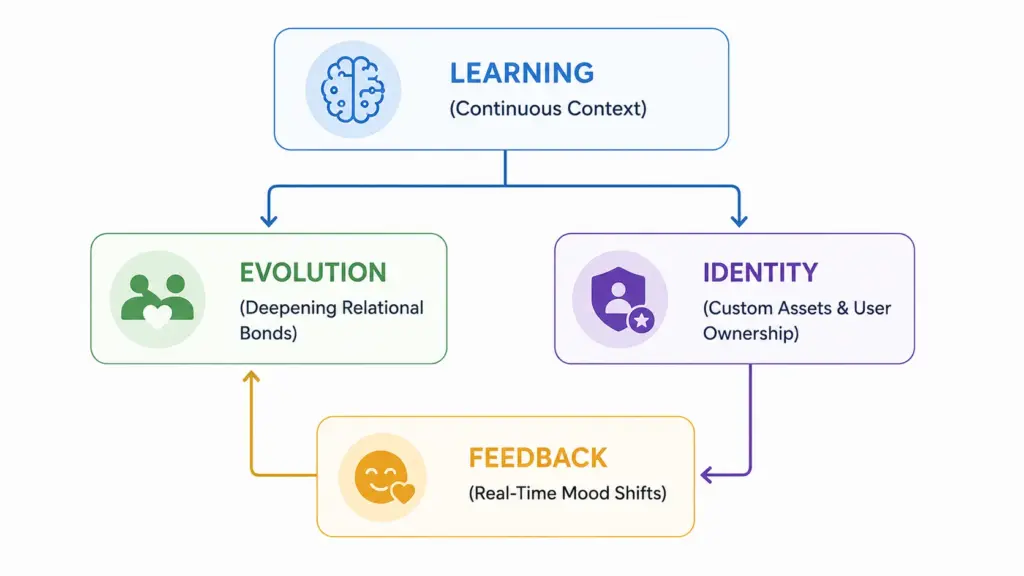
Learning
The digital pet must continuously gather and synthesize contextual data. Every conversation, daily check-in, and interactive choice is broken down into persistent embeddings, allowing the pet to proactively recall and reference a user’s life updates and distinct personality traits.
Identity
Deep ownership prevents user churn. We implement robust, customizable visual assets, clothing elements, and specific behavioral personality sliders, enabling users to co-create a deeply personalized companion that feels completely unique to them.
Feedback
A responsive companion cannot be an unbothered, passive listener. The pet must react emotionally to user behavior, exhibiting dynamic mood shifts, varying levels of excitement, or subtle behavioral friction if it is ignored, building immediate emotional stakes into the daily user routine.
Evolution
The foundational relationship matrix must shift over time. As the bonding score compounds over weeks of care, the pet’s vocabulary, animation sets, and intellectual depth grow, rewarding long-term users with an expanding narrative journey.
Strategic Takeaway
The golden rule for maintaining defensive, multi-year user stickiness is clear: your digital companion must grow alongside your user. By implementing this comprehensive four-stage framework, we help you transition your application from a temporary interactive novelty into a meaningful daily wellness routine, maximizing lifetime value and cementing your platform’s long-term commercial success.
Top 5 AI Virtual Pet Apps in the USA
The rapid growth of AI, immersive digital experiences, and habit-driven app design has completely changed the virtual companionship market in the United States. Users are no longer interested in basic virtual pet simulators with repetitive interactions. They now expect AI companions that can hold conversations, remember past interactions, and respond in ways that feel emotionally engaging.
1. ToktiPet
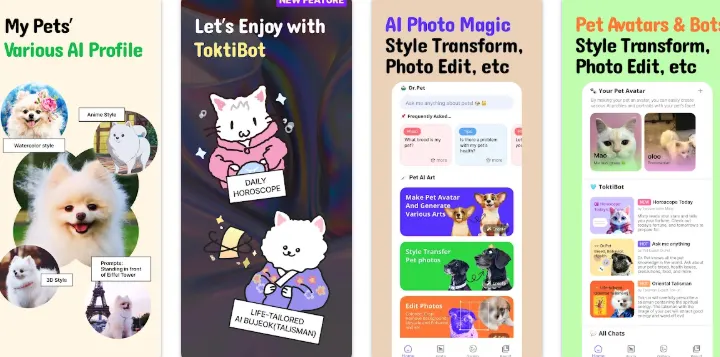
ToktiPet takes a unique, holistic approach to digital companionship by acting as a blend of an AI emotional support animal and a functional personal wellness assistant. The platform leverages generative AI to let users adopt a responsive virtual pet companion that helps manage daily stress. Beyond standard chat loops, the app incorporates creative multimedia workflows, using computer vision to turn real photos into digital pet art while providing advice and lifestyle tracking.
- Multi-Role AI Assistant Experts: Features dedicated sub-modules like an AI Pet Health Expert to give wellness advice, and an AI Astrologer for daily personalized horoscopes.
- Generative Art Portal: Transforms uploaded real-world pet photos into distinct artistic styles, including high-quality Renaissance portraits, cartoons, or 3D models.
- Emotional Support Chat Core: Connects users with an always-available, empathetic AI pet companion programmed to provide comforting dialogue and lower daily anxiety.
2. inQubi
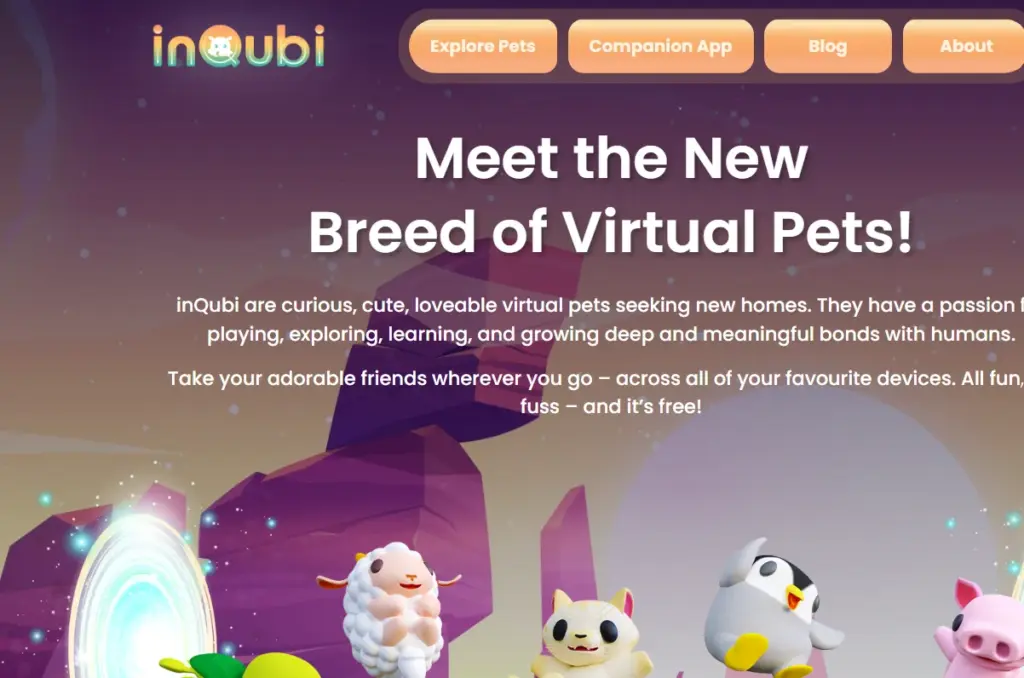
inQubi has established a premium presence in the 3D pet care simulation market by focusing on a highly polished, multi-platform ecosystem. The app features beautifully rendered, anatomical voxel-style creatures like lions, dogs, and fantasy animals that users adopt and care for. Built around an advanced pet behavior engine, the software transitions standard feeding and grooming routines into highly realistic, tactile life simulations that keep users connected to their digital companions across mobile devices.
- Augmented Reality Snap & Share: Captures real-time snapshots of 3D pets interacting directly within physical real-world rooms and environments through device cameras.
- Distinct Asset Personality Matrices: Grants every single adoptable creature a unique set of baseline biological needs and behaviors that dictate their interaction preferences.
- Deeply Gamified Play Hub: Features an expanding library of native puzzle and skill-based mini-games that unlock premium virtual care items and cosmetic upgrades
3. Adoraboo
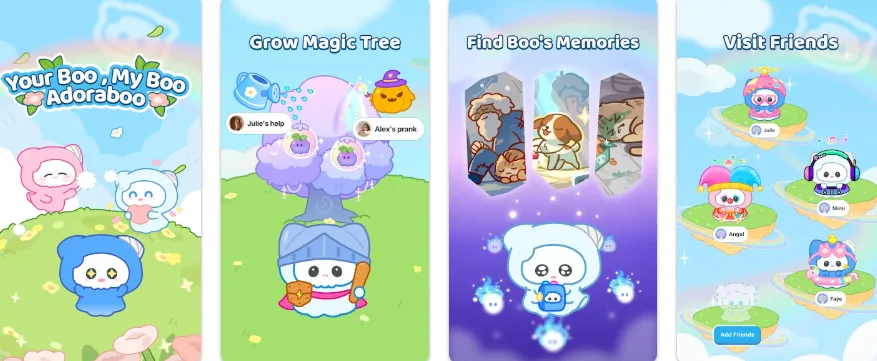
Adoraboo merges classic Tamagotchi nostalgia with advanced, modern machine learning to deliver a deeply soothing, aesthetic companion experience. Designed with a distinct emphasis on cozy gaming and mental well-being, the application pairs users with customizable, plush-style creatures called “Boos.” The platform utilizes a specialized, lightweight behavioral engine that reacts to the user’s daily habits, transforming screen time into an intentional self-care ritual.
- Habit-Linked Stat Progression: Links the growth, energy levels, and emotional happiness of the virtual pet directly to the user’s completion of real-world wellness habits, like drinking water or sleeping on time.
- Dynamic Personality Layering: Features a backend system that subtly shifts the pet’s vocabulary, dialogue quirks, and preferred activities based on how gently or frequently the user interacts with it.
- Cozy Environment Customization: Offers an expansive catalog of unlockable, low-stress room layouts and clothing items, driving monetization through highly appealing visual cosmetics.
4. My Cat (AR Edition)
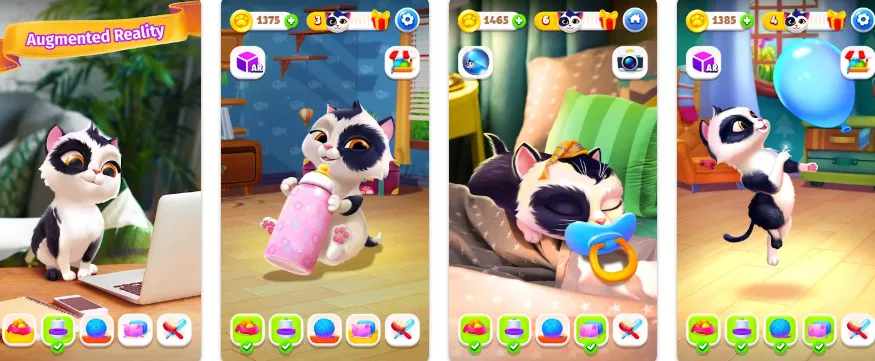
My Cat leverages augmented reality to let users place high-fidelity digital felines directly into their living spaces. The platform moves away from standard 2D drawings, employing sophisticated spatial anchoring to make virtual cats sit on physical furniture, run across floors, and react smoothly to physical touch screen inputs. It offers an incredibly life-like alternative for pet lovers who cannot keep a real animal due to living restrictions or allergies.
- Augmented Spatial Tracking: Projects realistic 3D feline assets into any physical room, allowing pets to walk around real obstacles and sit on actual chairs.
- Tactile Behavioral Triggers: Uses touch-sensitive screen mapping to make the virtual cat purr, knead, or play with toys when a user strokes it.
- Proactive Routine Tasks: Requires users to perform standard daily care rituals like feeding, grooming, and virtual vet check-ups to unlock rare breeds.
5. Mewgenics
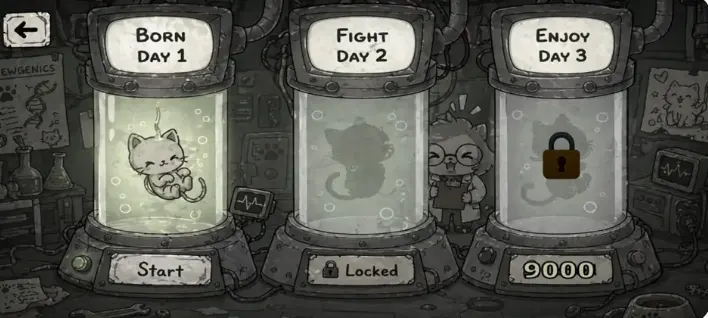
Mewgenics brings a chaotic, highly addictive procedural generation model to the mobile virtual pet landscape. Centered around breeding, mutating, and managing an ever-growing army of chemically and genetically unique digital cats, the platform uses complex backend simulation systems to drive engagement. By abandoning static designs in favor of erratic, unpredictable visual transformations and personality quirks, the app successfully targets core gaming audiences who crave deep mechanical progression.
- Procedural Mutation Engine: Utilizes advanced breeding algorithms that pass down, combine, and randomly mutate physical assets and behavioral traits across generations of pets.
- Simulated Biological Moats: Tracks intricate backend states like hunger, exhaustion, specific biological afflictions, and erratic mood swings that require immediate strategic care.
- Bizarre Visual Trait Map: Generates hundreds of thousands of distinct visual variations, ensuring that every bred companion looks completely distinct from anything else in the global ecosystem.
Build an AI Virtual Pet App with Idea Usher
Navigating the complex landscape of conversational AI and user psychology requires more than just standard software development. It demands a specialized engineering partner capable of translating sophisticated machine learning into sustainable business assets. At Idea Usher, we do not build generic software wrappers. We engineer high-retention, context-aware digital ecosystems designed to dominate the rapidly growing digital companionship market.
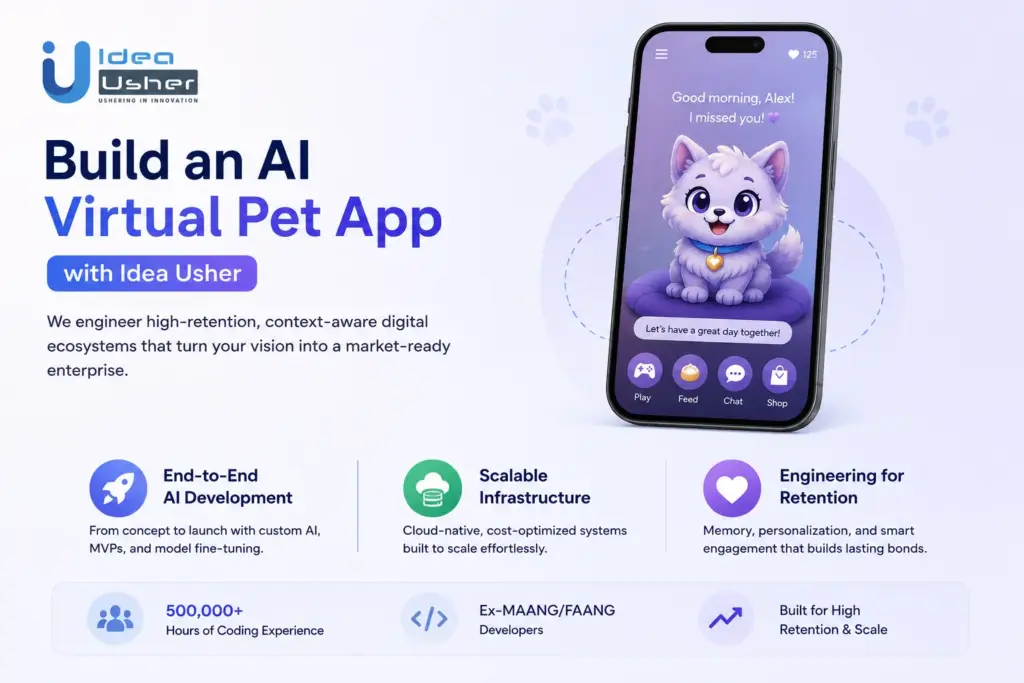
With over 500,000 hours of coding experience, our team of ex-MAANG/FAANG developers understands how to architect resilient codebases that balance deep emotional utility with strict capital efficiency. We provide the precise technical execution your platform needs to transform a visionary product concept into a highly valued, market-ready enterprise.
End-to-End AI Development
Launching a digital platform in a highly competitive market requires moving rapidly from conceptual design to deployment without compromising structural integrity. Our comprehensive development methodology eliminates the friction of managing fragmented engineering teams, providing a unified, production-ready pipeline from day one.
Our execution lifecycle focuses on three core software development pillars:
- Strategic Model Selection and Customization: We analyze your target audience to identify the exact technical requirements of your platform, choosing the perfect mix of open-source models like Llama or Mistral to minimize closed-API costs.
- Agile MVP Construction: Our developers build a feature-rich Minimum Viable Product focused on foundational conversational mechanics, responsive client-side performance, and immediate visual engagement loops.
- Proprietary Fine-Tuning: We fine-tune your core language models using specialized datasets tailored specifically to your app’s unique narrative tone, ensuring your platform possesses a distinct voice that competitors cannot replicate.
By unifying your entire technical roadmap under our experienced engineering teams, we handle the complex systems architecture so you can focus entirely on your go-to-market strategy and investor relations.
Scalable Infrastructure
An application cannot achieve venture-scale success if its backend infrastructure breaks under the weight of sudden viral user growth or compounding database queries. We build highly optimized, cloud-native architectures designed to scale effortlessly to hundreds of thousands of concurrent users while strictly managing token costs.
Our Structural Core: To insulate your company from unpredictable operational expenses, our backend teams build using automated, load-balanced container networks and distributed vector indexing. By caching frequent conversational contexts and utilizing lightning-fast intent-routing microservices, we prevent unnecessary backend strain.
Engineering for Retention
The ultimate metric that dictates the valuation of a consumer platform is long-term retention. Users must feel a profound, compounding sense of personal connection that makes abandoning the app emotionally unthinkable. Our developers achieve this by embedding custom memory and personalization mechanics deep into the product’s DNA.
- Long-Term Multi-Modal Memory: We implement custom knowledge graphs paired with vector databases, ensuring the virtual pet remembers user preferences, life milestones, and emotional histories over thousands of conversational turns.
- Linguistic and Visual Behavioral Synthesis: Our teams synchronize generated text responses with real-time emotional metadata tags, allowing the digital pet’s visual animations and expressions to perfectly mirror the tone of the conversation.
- Predictive Engagement Routines: We build intelligent notification engines that analyze historical user activity patterns to trigger spontaneous, contextually relevant check-ins from the pet, perfectly mimicking human outreach.
Conclusion
The surging Loneliness Economy has transformed AI virtual pet apps into a lucrative, venture-scale opportunity. Success in this vertical requires moving past basic API wrappers and investing in sophisticated cognitive architecture, including hyper-personalized memory, multi-model cost routing, and multimodal features. Partnering with IdeaUsher gives you immediate access to pre-vetted engineers who handle complex infrastructure, fine-tuning, and scalability guardrails, allowing you to launch a high-retention app built for sustainable market dominance.
Things to Know About AI Virtual Pet Apps
Q1: How much does AI virtual pet app development cost?
A1: Building a scalable MVP generally demands a financial investment ranging from $80,000 to $300,000+. The lower end of this spectrum covers essential core conversational models, asset pipelines, and basic UI workflows, while costs rapidly scale into the higher tier once you introduce real-time neural voice streaming, persistent vector database memories, and multi-user co-parenting systems.
Q2: Which AI model is best for virtual pet apps?
A2: There is no standalone model that can cost-effectively manage a premium virtual pet app. To maintain highly attractive profit margins, we build using a hybrid model architecture that routes basic clicks through cheap deterministic logic, routes quick sentiment analyses through lightweight classification models, and reserves premium, high-parameter LLMs like Llama or Mistral exclusively for emotionally significant, context-heavy user dialogue.
Q3: Can startups monetize AI pet apps profitably?
A3: Yes, but long-term profitability hinges on moving away from intrusive, ad-heavy frameworks that disrupt the user’s emotional immersion. Highly lucrative platforms find commercial success by deploying a premium, multi-tiered subscription layer for deep companion intimacy, combined with microtransactions for virtual cosmetics, priority conversational latency, and exclusive behavioral personality modules.
Q4: Are AI virtual pets safe for children?
A4: They can be exceptionally safe, provided that robust computational guardrails are engineered directly into the pipeline from day one. Our development teams protect vulnerable users by running strict semantic alignment checks and real-time toxicity filters that automatically analyze both incoming child queries and outgoing AI responses, completely blocking prompt injection attacks and inappropriate behavioral detours.