

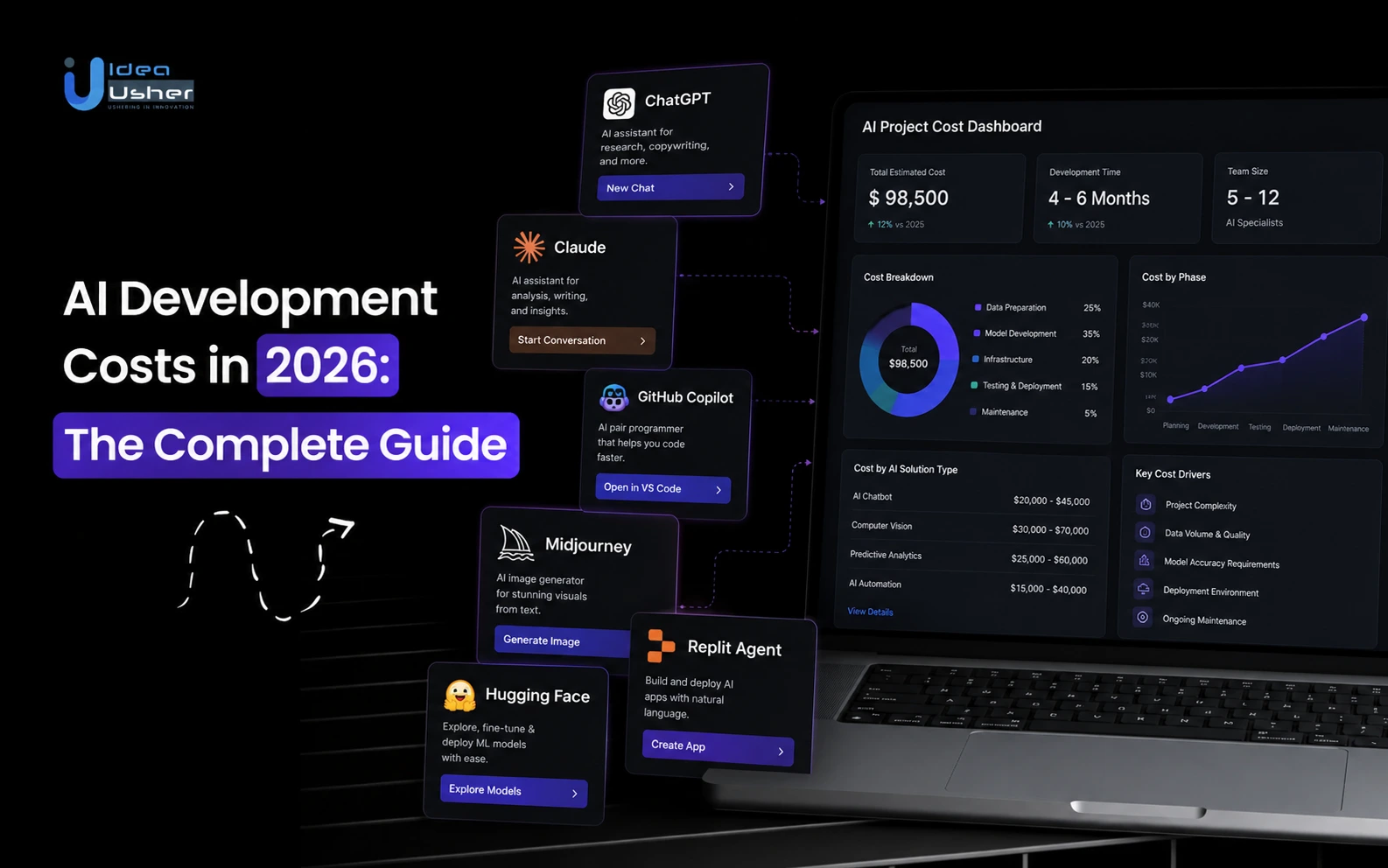
The uncomfortable truth about AI development costs is that 60% of enterprise projects exceed their initial budgets by 30-50%. This isn’t because teams are incompetent. It’s because the gap between what companies budget for and what they actually need to spend reveals a fundamental misunderstanding of where AI development money actually goes.
When most organizations think about building an AI solution, they mentally budget for “model development” and “deployment.” These are visible, tangible concepts. But they represent only 20-30% of actual project costs. The real money 35-60% of your budget disappears into data preparation. Another 20-35% goes to systems integration. Security, compliance, infrastructure, and ongoing maintenance consume the remainder.
This guide analyzes real project data from 200+ completed AI initiatives across healthcare, financial services, manufacturing, and retail. Rather than offering generic cost ranges, we’ve identified the structural factors that drive expenses and provide practical frameworks for accurate budgeting.
The Three Tiers of AI Development: Understanding Cost Drivers
AI projects don’t fit into one cost category. A chatbot powered by OpenAI’s API operates under completely different economics than a custom computer vision system for manufacturing. Understanding which tier your project falls into is the first step toward accurate budgeting.
Tier 1: API-Based Solutions ($5,000 – $50,000)
What qualifies: Implementations built on pre-trained models accessed through vendor APIs chatbots, sentiment analysis tools, document classification systems, recommendation engines.
Cost structure: You’re not training models. Your expenses cover integration work, knowledge base development, testing, and business logic implementation.
Real example: A retail company implemented a customer service chatbot. Their breakdown looked like this:
| Cost Category | Amount | % of Budget |
|---|---|---|
| API Setup & Integration | $4,500 | 27% |
| Knowledge Base Creation | $3,200 | 19% |
| Testing & Deployment | $6,800 | 41% |
| Prompt Optimization | $2,100 | 13% |
| Total | $16,600 | 100% |
The hidden costs nobody anticipates:
Once live, they discovered inference costs they hadn’t budgeted for. At 200 daily inquiries, their monthly API bill ran $300-400. That’s $3,600-4,800 annually. They also needed to refine responses based on actual customer interaction data an additional $2,000-3,000 in optimization work. Security implementation for customer data handling added another $4,000.
The real lesson: API-based projects feel cheap on launch day but develop ongoing expense surprises that weren’t part of the initial budget.
Tier 2: Custom-Tuned Systems ($50,000 – $300,000)
What qualifies: Projects requiring fine-tuning pre-trained models with your own data, custom integration with backend systems, or combinations of multiple AI components.
Cost structure: Data preparation becomes the dominant expense. You need labeled training data, which requires human annotation. Integration complexity increases significantly.
Real example: A financial services company built a document intelligence system for mortgage applications. Here’s what actually happened:
| Cost Category | Amount | % of Budget |
|---|---|---|
| Data Labeling (8,000 documents @ $18 each) | $144,000 | 52% |
| Data Infrastructure & Security | $35,000 | 13% |
| Model Development & Fine-Tuning | $38,000 | 14% |
| Legacy System Integration | $28,000 | 10% |
| Testing, Security & Compliance | $32,000 | 11% |
| Total | $277,000 | 100% |
Their initial budget estimate? $120,000. They were off by 130%.
Why? They budgeted for “model development.” They didn’t budget for the systematic reality that 52% of this project involved data work, 23% involved integration and compliance, and only 14% involved actual model development.
Tier 3: Enterprise AI Systems ($300,000 – $2,000,000+)
What qualifies: Custom-built systems requiring legacy infrastructure integration, strict compliance adherence, real-time processing, or custom foundation model development.
Cost structure: Data, integration, compliance, and infrastructure dominate. Model development becomes proportionally smaller.
Real example: A manufacturing company implemented AI-powered quality control using computer vision. The system had to integrate with factory floor equipment, process video streams in real-time, maintain sub-second response times, comply with industry safety standards, and scale across five manufacturing facilities.
| Cost Category | Amount | % of Budget |
|---|---|---|
| Data Collection & Labeling | $180,000 | 24% |
| Image Processing Pipeline & Infrastructure | $145,000 | 19% |
| Equipment Integration | $125,000 | 17% |
| Real-Time Processing Infrastructure | $95,000 | 13% |
| Compliance & Safety Validation | $85,000 | 11% |
| Model Development & Optimization | $72,000 | 10% |
| Deployment & Monitoring | $48,000 | 6% |
| Total | $750,000 | 100% |
This project’s initial estimate was $400,000. The overrun occurred because they underestimated infrastructure complexity and didn’t account for the specific demands of real-time manufacturing environments.
Visual Guide: Where Your AI Budget Actually Goes
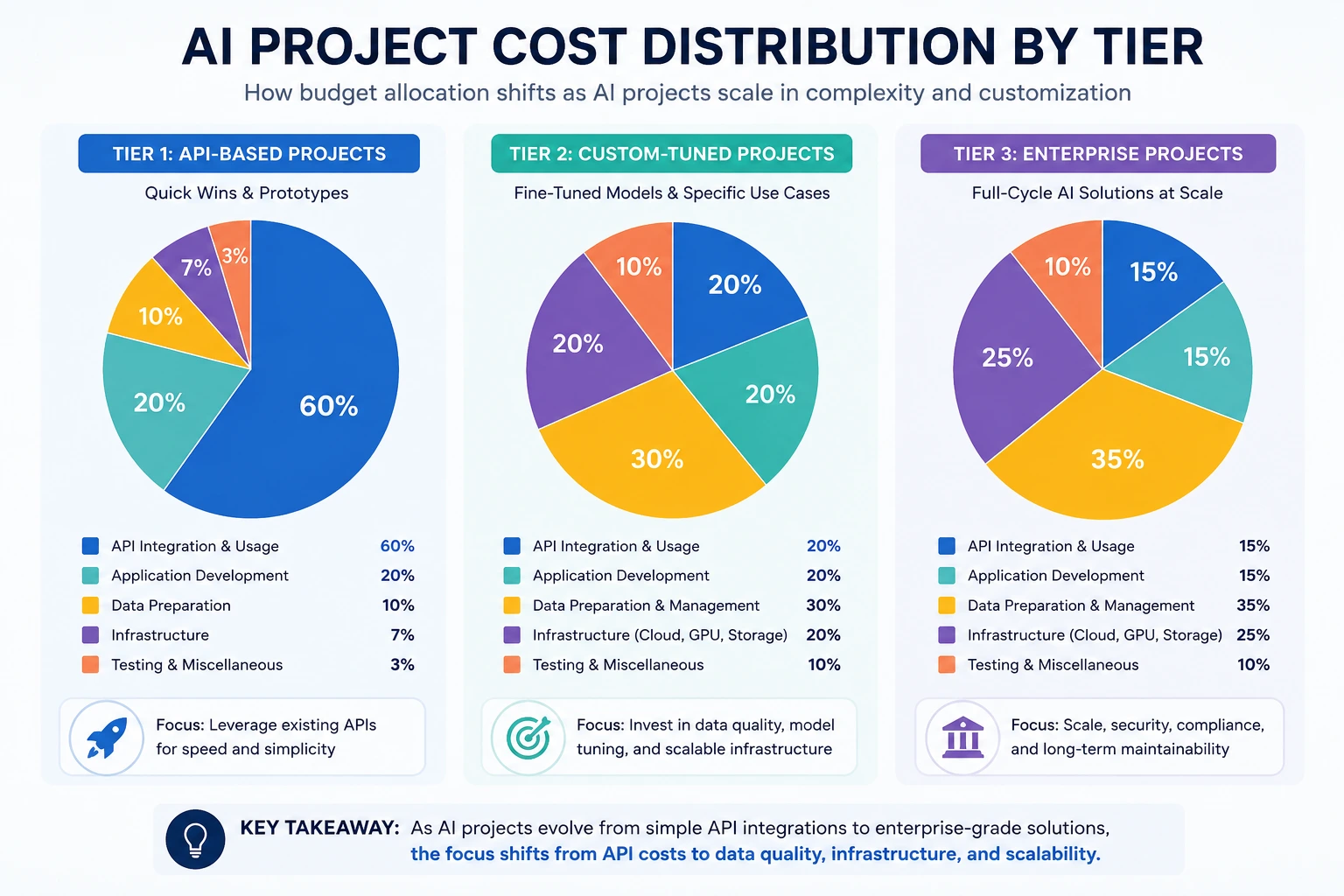
The Real Cost Breakdown: Where Your Money Actually Goes
Understanding percentage breakdowns helps more than raw cost ranges. Here’s where the money actually goes across typical projects:
Data Preparation (30-60% of budget)
This dominates project costs, yet receives the least attention during budgeting. It includes data collection, cleaning, labeling, quality assurance, and compliance preparation. A healthcare AI project requires HIPAA-compliant data handling infrastructure. A financial services project needs SOX compliance. These aren’t incidental costs—they’re structural requirements that add 20-40% to data work.
Why is data so expensive? Because quality data is fundamentally expensive. You can’t get around it. A model trained on garbage data produces garbage results. No amount of engineering skill compensates for poor training data.
Data Cost Breakdown Example:
| Activity | Typical Cost |
|---|---|
| Data Collection & Organization | $5,000-15,000 |
| Data Cleaning & Preprocessing | $8,000-20,000 |
| Expert Labeling (per 1,000 items @ $10-30 each) | $10,000-30,000 |
| Quality Assurance & Validation | $5,000-15,000 |
| Compliance Infrastructure (GDPR, HIPAA, etc.) | $10,000-25,000 |
| Version Control & Management | $3,000-8,000 |
| Total for 5,000 items | $41,000-113,000 |
Model Development (15-30% of budget)
Actual model selection, fine-tuning, and optimization. This is what most organizations think of as “AI development,” but it’s typically only 15-30% of real costs. The reason: good pre-trained models already exist. You’re not building from scratch. You’re selecting the right model for your use case, fine-tuning it on your data, and optimizing it for your specific requirements.
Integration (20-35% of budget)
Connecting the AI system to existing business systems. This is where many projects face unexpected costs. A chatbot needs to connect to your ticketing system, CRM, knowledge base, and customer database. A document processing system needs to integrate with your workflow management system, database, and compliance logging infrastructure. Each integration point adds complexity and cost.
Testing, Security, and Compliance (10-20% of budget)
Testing that the system works correctly, implementing security to protect sensitive data, and documenting compliance with relevant regulations. This often exceeds initial estimates because edge cases emerge during testing that weren’t anticipated.
Deployment and Infrastructure (5-15% of budget)
Setting up production environments, implementing monitoring and alerting, creating disaster recovery procedures. This varies dramatically based on reliability requirements.
The Hidden Cost Killer: Data Preparation Explained
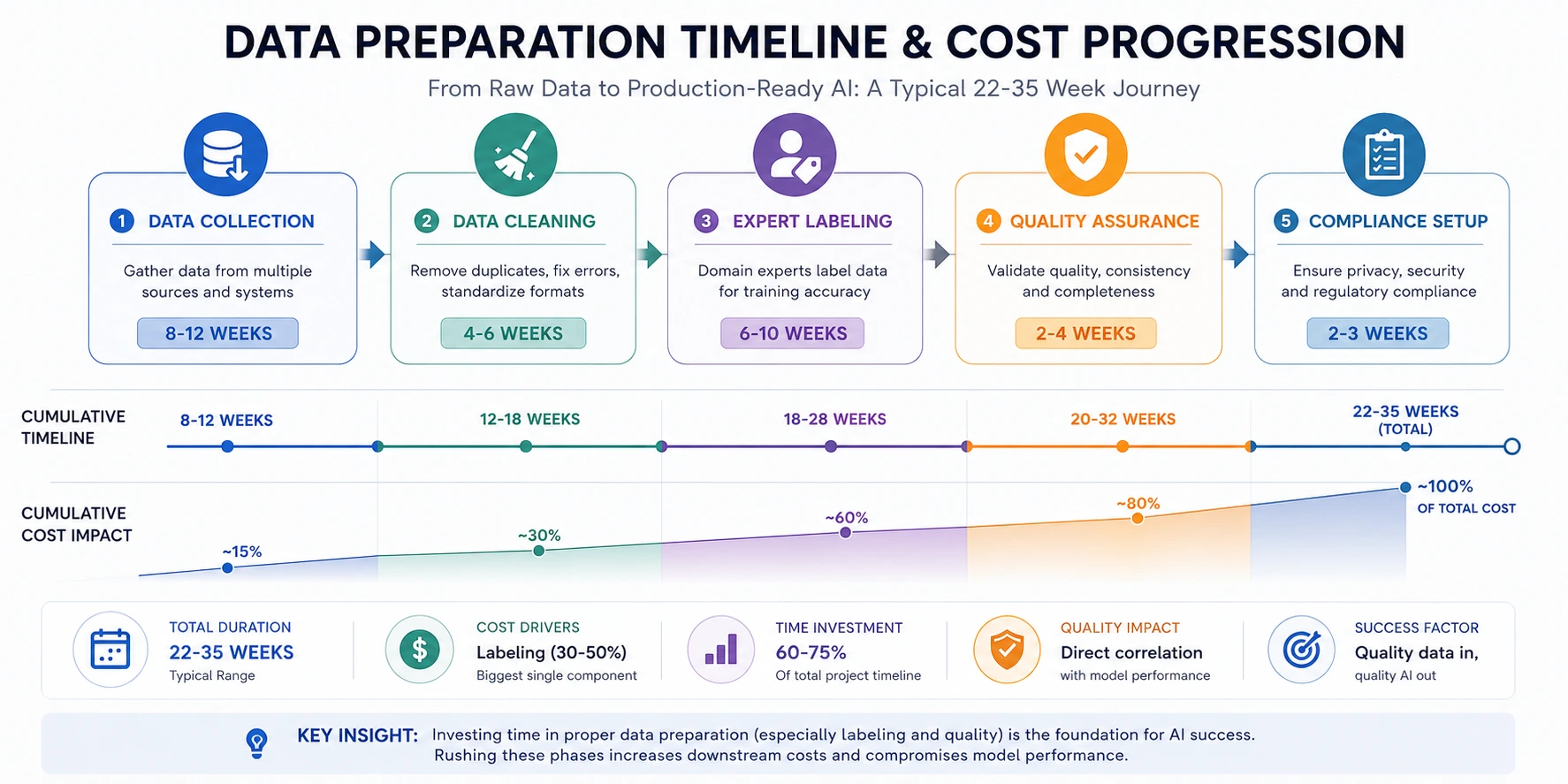
Data preparation deserves specific attention because it’s where most budget overruns originate.
A typical project needs labeled training data. “Labeled” means humans have marked it up identifying what’s in each image, transcribing what’s in each audio clip, marking sentiment in text samples, or extracting key information from documents.
A moderate-sized project needs 5,000-10,000 labeled examples. At $10-30 per labeled example (depending on complexity), you’re looking at $50,000-300,000 in labeling costs. Add data cleaning, quality assurance, infrastructure for secure storage, and compliance implementation (GDPR, HIPAA, etc.), and data costs frequently exceed $100,000 even for modest projects.
Why organizations underestimate this:
Most people think of “data collection” as something that happens automatically. Your company already has transaction data, customer information, historical records. You just need to use it, right? Wrong. Historical data is rarely in the format needed for AI training.
Companies often discover mid-project that their existing data is biased or incomplete. A retail company’s historical sales data is biased toward their best-performing stores. Implementing an AI recommendation system on this data produces recommendations that ignore slower-moving products. Fixing this requires supplementing with additional data collection and labeling unexpected costs that weren’t budgeted.
Integration Complexity: The Silent Budget Killer
The second-largest source of budget surprises is integration. Most organizations underestimate how complex connecting AI systems to existing infrastructure actually is.
A document processing system needs to:
- Receive documents from your customer portal
- Route them to the AI system
- Handle the AI response
- Log results in your document management system
- Update your CRM
- Create alerts in your workflow system
- Maintain audit logs for compliance
Each of these integration points is a potential source of complexity. If your organization uses legacy systems (common in enterprise environments), integration becomes significantly more complex.
Integration Cost Multipliers:
| System Type | Base Cost Multiplier |
|---|---|
| Modern SaaS Applications (Salesforce, HubSpot, etc.) | 1.0x |
| Cloud-Native Systems (AWS, Google Cloud) | 1.2x |
| Older Cloud Systems | 1.5x |
| Legacy On-Premise Systems | 2.5x |
| Mainframe Systems | 3.0x+ |
A financial services company we worked with budgeted $25,000 for system integration. The actual cost was $85,000. Why? Because connecting to their legacy core banking system required custom development. The system had limited modern APIs, so engineers had to work directly with data files. Documentation was sparse, requiring reverse engineering of the data format.
How to estimate integration costs accurately:
For each system the AI needs to connect with, add $15,000-30,000. For legacy systems, double that estimate. For systems requiring real-time bidirectional communication, add another 50%. This framework accounts for development, testing, documentation, and the inevitable edge cases that emerge during integration.
Ongoing Costs: The Surprise Expenses Nobody Budgets For
Many organizations budget for the development phase, then get surprised by ongoing expenses. These fall into three categories:
Annual Ongoing Cost Projections
| Cost Type | Low Volume | Medium Volume | High Volume |
|---|---|---|---|
| Inference Costs | $600-2,400/year | $18,000-60,000/year | $180,000-600,000/year |
| Model Maintenance | $8,000-15,000/year | $20,000-40,000/year | $50,000-100,000/year |
| Infrastructure & Monitoring | $12,000-24,000/year | $24,000-60,000/year | $100,000-300,000/year |
| Support & Updates | $5,000-10,000/year | $10,000-25,000/year | $30,000-75,000/year |
| Total Ongoing | $25,600-51,400/year | $72,000-185,000/year | $360,000-1,075,000/year |
Inference costs: Running your AI model costs money. If you’re using a commercial API (OpenAI, Anthropic, Google), you pay per API call. A chatbot handling 500 customer inquiries daily might cost $150-300/month. At scale (50,000 daily inquiries), costs climb to $2,000-5,000/month.
Model maintenance: AI models degrade over time. Your model needs retraining to remain accurate, typically quarterly, costing $10,000-30,000 per cycle.
Infrastructure and monitoring: Keeping your system running requires infrastructure and monitoring systems. Small implementations cost $1,000-2,000/month. Large-scale systems cost $5,000-20,000/month.
The companies that succeed budget for these costs from the beginning. Those that don’t discover mid-year they’ve exhausted their budget.
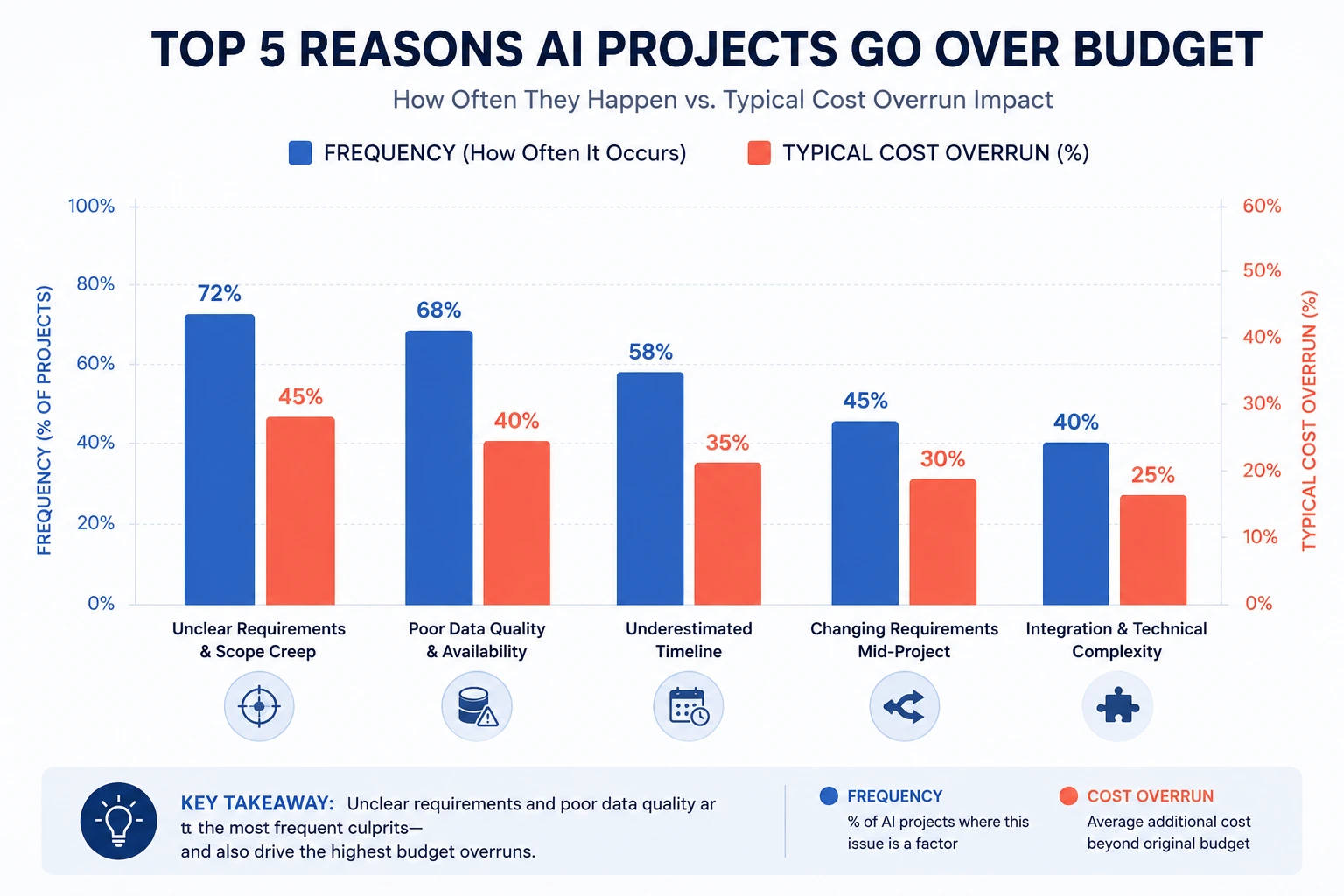
The Overrun Reality: Why 60% of Projects Exceed Budget
Our analysis identified specific reasons why projects systematically exceed budgets:
Project Overrun Statistics
| Reason | Frequency | Typical Overrun |
|---|---|---|
| Data quality issues discovered mid-project | 45% | +35% |
| Scope creep & feature additions | 38% | +40% |
| Infrastructure complexity underestimated | 32% | +45% |
| Legacy system integration challenges | 28% | +50% |
| Model performance doesn’t meet targets | 25% | +30% |
How to prevent overruns:
- Front-load data assessment ($5,000-10,000): Spend a few weeks understanding your existing data quality before committing to full development.
- Build contingency budget: Add 30-40% to initial estimates to account for uncertainties.
- Define success metrics clearly: Specify minimum acceptable accuracy, performance, and other requirements upfront.
- Phase the project: Build MVP first, then hardening, then optimization. This validates assumptions with partial implementation.
2026 Cost Trends: What’s Actually Changing
Model costs declining: Inference costs are dropping 40-60% year-over-year. Open-source models are reducing dependence on expensive commercial APIs.
Data costs rising: As regulatory requirements tighten, data preparation consumes larger percentages of budgets.
Integration complexity growing: More legacy systems, stricter security requirements, and expanding compliance rules make integration more expensive.
Infrastructure costs stabilizing: Cloud providers are competing on infrastructure pricing. GPUs and specialized AI hardware are becoming commodities.
ROI Framework: Justifying Your AI Investment
AI projects should generate measurable returns.
Annual Value = (Cost Savings) + (Revenue Increase) – (Annual Maintenance)
ROI = (Annual Value / Initial Investment) × 100%
ROI Examples & Timelines
Example 1: Customer Service Chatbot
| Metric | Value |
|---|---|
| Initial Investment | $25,000 |
| Handles % of Inquiries | 30% |
| Annual Support Cost Savings | $90,000 |
| Annual Inference Costs | $3,600 |
| Annual Maintenance | $2,000 |
| Net Annual Value | $84,400 |
| Year 1 ROI | 338% |
| Payback Period | 3.6 months |
Example 2: Predictive Maintenance System
| Metric | Value |
|---|---|
| Initial Investment | $250,000 |
| Reduces Downtime % | 25% |
| Annual Production Loss Prevention | $300,000 |
| Annual Infrastructure Costs | $40,000 |
| Annual Maintenance & Retraining | $30,000 |
| Net Annual Value | $230,000 |
| Year 1 ROI | 92% |
| Payback Period | 13 months |
ROI Timeline by Project Type:
| Project Type | Payback Period | 2-Year ROI |
|---|---|---|
| Cost Reduction (chatbots, automation) | 4-8 months | 400-600% |
| Revenue Generation (recommendations, personalization) | 12-18 months | 150-300% |
| Strategic Initiatives (competitive advantage) | 18-24 months | 100-250% |
Phased Budgeting Approach: How Successful Companies Do It
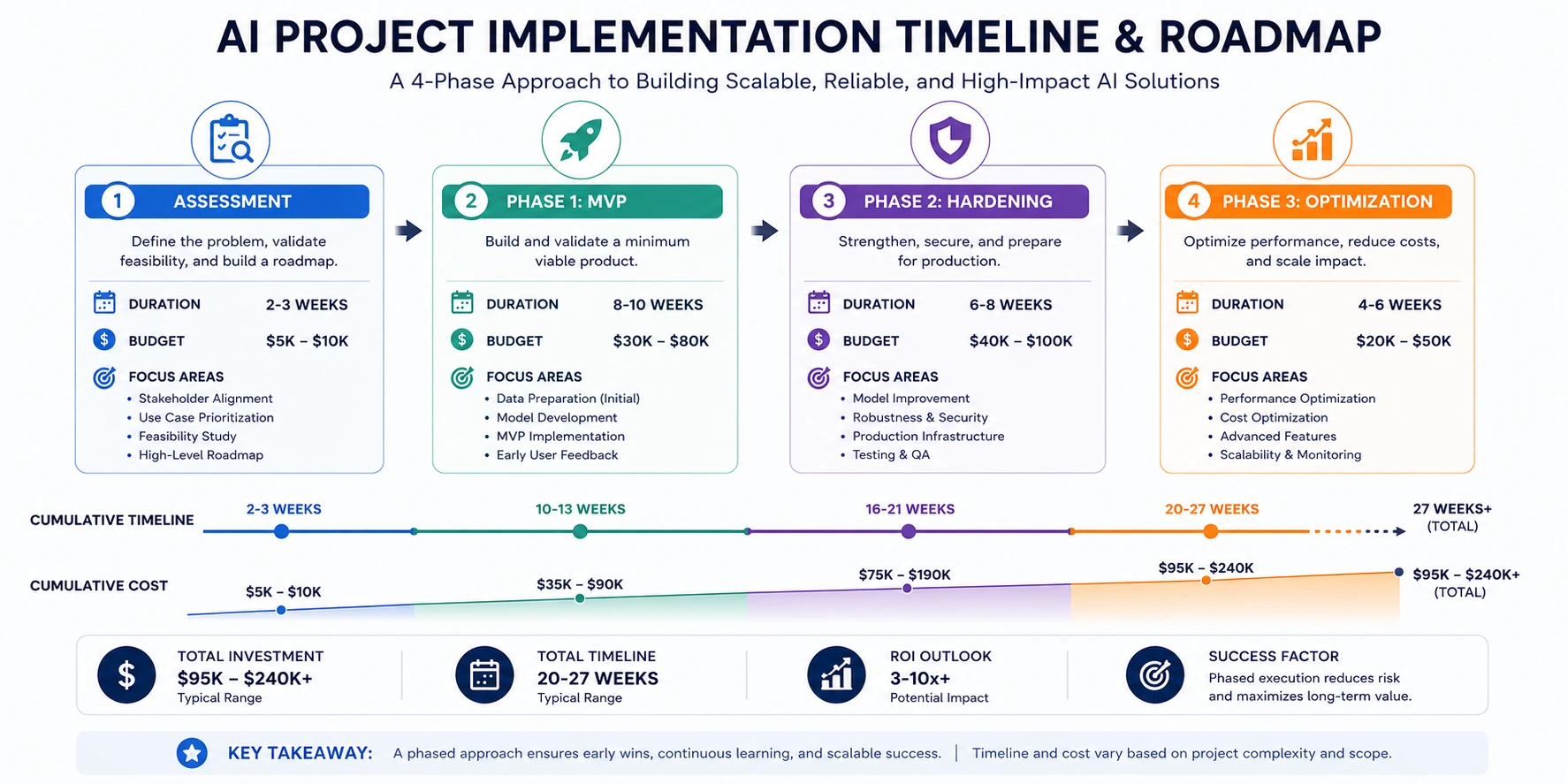
| Phase | Duration | Budget | Focus |
|---|---|---|---|
| Assessment | 2-3 weeks | $5-10K | Data audit, feasibility, requirements |
| MVP | 8-10 weeks | $30-80K | Proof of concept, basic functionality |
| Hardening | 6-8 weeks | $40-100K | Security, compliance, scalability |
| Optimization | 4-6 weeks | $20-50K | Performance tuning, cost reduction |
| Total | 20-27 weeks | $95-240K | Production-ready system |
This approach reduces risk because you validate assumptions before full commitment. If the MVP doesn’t deliver expected value, you stop. If it does, you proceed with full confidence.
Budget Estimation Framework
To estimate your specific project:
Step 1: Identify tier (API-based, custom-tuned, or enterprise)
Step 2: Calculate data costs
Records needed × Cost per record + Infrastructure = Data cost
Example: 8,000 records × $18/record + $35,000 infrastructure = $179,000
Step 3: Add development
Base cost from tier + (integrations × $20,000) + (compliance multiplier × 1.3) = Development cost
Step 4: Add ongoing
Monthly inference + monthly maintenance + monitoring = Annual ongoing cost
Step 5: Apply contingency
(Data + Development) × 1.35 = Realistic budget
Final Insights: Building AI That Actually Works
The organizations succeeding with AI in 2026 share common characteristics:
They understand the real cost structure. Building the model is 10-20% of the work. Data preparation, integration, and infrastructure are 80-90%.
They budget realistically. Success requires allocating 35-45% of budget to data, accounting for integration complexity, and building in contingency.
They phase implementation. MVP first validates assumptions before committing full budget.
They track ongoing costs. Inference, maintenance, and infrastructure aren’t one-time expenses—they’re permanent parts of operations.
They invest in quality. The cheapest approach to data labeling produces the most expensive outcomes through poor model performance and failed projects.
About Ideausher: Your AI Development Partner
Building AI is complex. Budget overruns are common. Projects fail because of misaligned expectations, underestimated data requirements, and integration challenges that weren’t anticipated.
Ideausher specializes in helping organizations avoid these pitfalls.
With over 50+ completed AI projects across healthcare, finance, retail, and manufacturing, we’ve developed systematic processes that ensure projects stay on budget, meet timelines, and deliver expected value.
What We Do Differently
Transparent Budgeting: We provide detailed cost breakdowns upfront. You know exactly where your money goes before development begins. No surprises mid-project.
Data-First Approach: We understand that data quality determines model quality. We invest properly in data preparation rather than cutting corners that lead to poor results.
Phased Implementation: We structure projects as Assessment → MVP → Hardening → Optimization. This allows validating assumptions early and reducing risk.
Integration Expertise: We’ve successfully integrated AI systems with legacy banking platforms, manufacturing equipment, healthcare systems, and enterprise software. We understand integration complexity and plan accordingly.
Ongoing Support: We don’t disappear after launch. We monitor model performance, handle retraining, optimize inference costs, and ensure your system continues delivering value.
Our Track Record
- Average project completion: On time and on budget (vs. 60% industry overrun rate)
- Average ROI: 250% in Year 1 for cost-reduction projects
- System uptime: 99.5%+ across production deployments
- Client retention: 85% of clients expand AI usage after initial implementation
Why Organizations Choose Ideausher
- You get predictable costs – Our detailed assessment prevents budget surprises
- You get faster deployment – Our phased approach gets you to value quickly
- You get lasting systems – We build for long-term operation, not quick launches
- You get expert guidance – We’ve made every mistake so you don’t have to
Get Your Free AI Project Assessment
Stop guessing about your AI development costs. Get a detailed, transparent estimate.
Our free assessment includes:
- ✓ Data Quality Audit – Understanding what data you actually have and its readiness for AI
- ✓ Integration Mapping – Identifying all systems that need to connect and complexity level
- ✓ Timeline Estimate – How long your project actually takes
- ✓ Detailed Budget Breakdown – Exact costs by category, with contingency planning
- ✓ ROI Projection – Expected returns and payback timeline
- ✓ Risk Assessment – Identifying potential overrun sources for your specific project
- ✓ Implementation Roadmap – Phased approach customized to your requirements
No Obligation. No Sales Pressure.
We assess your project using the same frameworks in this guide. You’ll have a realistic understanding of what your AI system will actually cost and what value it will deliver.
Get Your Free AI Cost Assessment Today
THINGS TO KNOW – FAQ
Why do AI projects cost so much more than expected?
AI projects typically overrun budgets by 45-60% because data preparation (cleaning, labeling, validation) costs far more than anticipated. Most teams estimate 10-15% for data work but it actually consumes 30-60% of total budgets. Integration complexity also multiplies costs connecting AI to legacy systems adds layers of testing and customization that weren’t in initial estimates.
How long does it take to see ROI from an AI project?
ROI timelines vary by use case. Simple chatbots return value in 3-6 months. Predictive analytics systems typically show ROI in 6-12 months. Enterprise-scale AI implementations may take 12-18 months. The key factor is data quality—poor data extends timelines by 40-60%. Well-prepared data with clear KPIs can accelerate ROI realization by 6+ months.
Should we use an off-the-shelf solution or build custom?
Off-the-shelf solutions cost $5K-$50K and launch in weeks but offer limited customization. Custom-built AI costs $50K-$300K+, takes 3-6 months, but is tailored to your exact workflows. Choose off-the-shelf if your needs fit standard use cases (customer service chatbots, basic forecasting). Choose custom if you need proprietary algorithms, unique data integration, or competitive advantage through specialized AI.
What percentage of our budget should go to data preparation?
Industry standard: 30-60% of total AI budget goes to data work. This includes data collection, cleaning, labeling, validation, and quality assurance. Underestimating this is the #1 reason projects overrun. If your estimated budget is $100K, expect $30K-$60K just for data infrastructure and preparation not model development.
Can we phase our AI implementation to reduce upfront costs?
Yes. A phased approach reduces initial investment by 40-50%. Phase 1 (MVP): $15K-$50K, 1-2 months. Phase 2 (Enhancement): $30K-$100K, 2-4 months. Phase 3 (Scale): $50K-$200K+, ongoing. This approach also reduces risk because you validate assumptions before major investment. Most successful AI projects use phased rollouts, not big-bang implementations.