



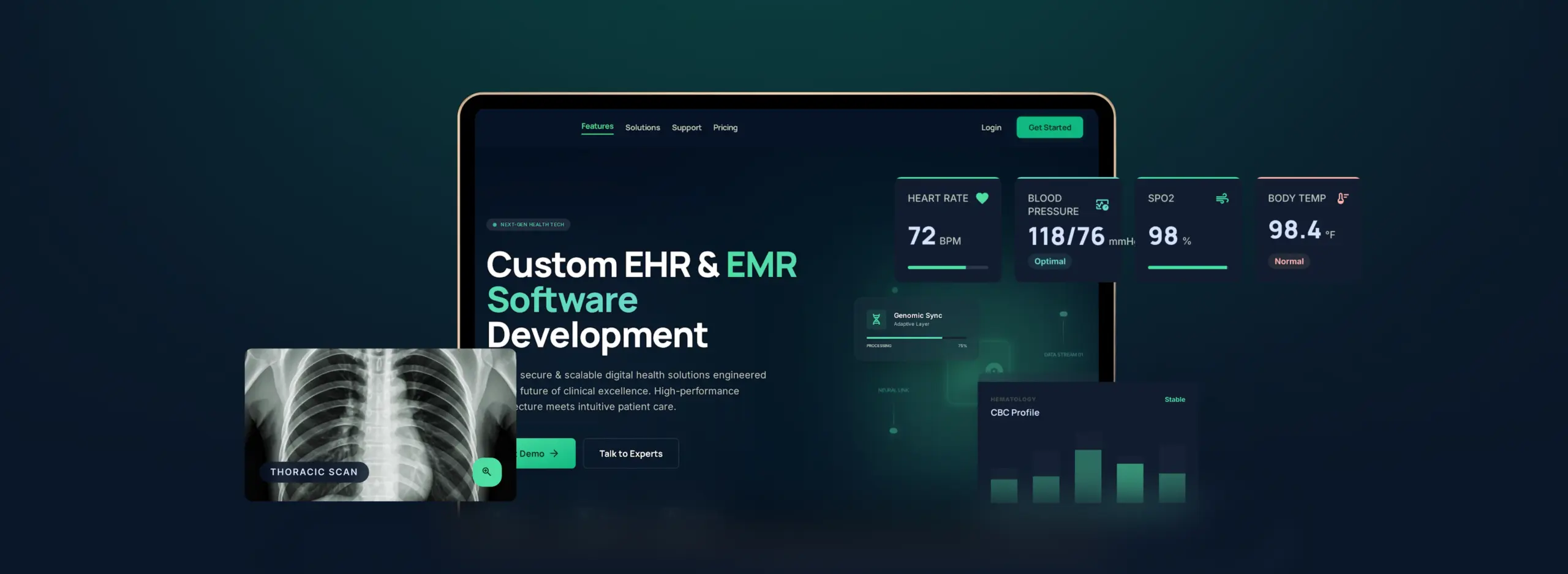


Idea Usher engineered a fully compliant, scalable Electronic Health & Medical Records platform that eliminated paperwork and reduced clinical errors by 60%.
Fewer Clinical Errors
Faster Documentation
Cost Savings
Fully Compliant
A multi-specialty healthcare group operating across 6 clinics needed to replace their outdated legacy system with a modern, interoperable EHR and EMR platform built specifically for their workflows.
Our client, a fast-growing healthcare provider, was dealing with siloed paper records, disconnected billing systems, and compliance risks. Physicians spent more time on data entry than with patients. Referrals were lost. Audit trails remained incomplete.
They needed more than software; they required a digital backbone for their entire care delivery model. Off-the-shelf EHR solutions like Epic or Cerner were too rigid, too expensive, and too complex for their team to adopt efficiently.
Idea Usher stepped in to build a fully custom EHR and EMR software solution. It was designed from the ground up around real clinical workflows, integrated with their existing lab and billing tools, and deployed across all six locations.

Custom EHR Software
EMR Development
HIPAA Compliant
HL7 / FHIR
Multi-Clinic
Healthcare IT


Before building, we deeply mapped every pain point through discovery workshops with clinicians, admins, and IT leads.
Patient data lived in 4 disconnected systems. Physicians had no unified view, leading to duplicate tests and dangerous information gaps during emergencies.
Doctors spent 2–3 hours per day on manual data entry. Clinical notes, prescriptions, and referrals were paper-based or scattered across spreadsheets.
Lab results, radiology reports, and pharmacy data didn’t flow automatically into patient charts. Everything required manual import and cross-checking.
The legacy system lacked audit trails, role-based access controls, and encrypted data storage, creating serious regulatory exposure and liability.
Disconnected billing meant frequent claim denials, missed charges, and delayed reimbursements, costing the group an estimated $400K+ annually.
The old interface required 12–15 clicks for basic tasks. Staff turnover was partly attributed to frustration with the clunky, unintuitive system.
Our team specializes in custom EHR and EMR software development for clinics, hospitals, and health networks. Let’s map your requirements — free of charge.
No commitment.
No pitch decks.
Just a real conversation.


EMR and EHR are distinct systems built for different scopes of care. We develop both with the right architecture for each use case.
We built a highly interoperable, AI-supported EMR system with integrated practice management and health information exchange capabilities. This included a custom mental health EMR module with eRx functionality, structured data tracking, and secure communication between patients and providers.
Modules Included:
We developed an interoperable EHR platform to manage operational workflows, electronic records, and clinical data across all six clinics. The system included customizable chart templates, real-time dashboards, appointment scheduling, patient profiles, prescription tracking, and distributed access control.
Patient Data Access Includes:
Every feature was designed based on clinical workflow interviews. This is what “custom” truly means.
A single, longitudinal patient record aggregates clinical history, vitals, allergies, medications, and visit notes across all clinics in real time.
AI-assisted scheduling with automated reminders, waitlist management, and multi-provider calendar sync across all clinic locations.
Digital prescription workflows with drug-interaction alerts, dosage validation, and direct integration with pharmacy networks.
FHIR R4-compliant connections pull lab results and imaging reports directly into patient charts, eliminating manual data entry entirely.

End-to-end encryption, role-based access control (RBAC), full audit trails, and automatic session management to meet all HIPAA requirements.
Automated coding, claim submission, denial tracking, and real-time financial dashboards that cut billing errors and accelerate reimbursements.

Built-in secure video consultations with automatic note capture, consent forms, and post-visit documentation linked to the patient chart.
Native iOS and Android apps let physicians access and update patient records, approve orders, and communicate with care teams from anywhere.
Patients can view records, book appointments, request refills, and securely message their care team through a branded self-service portal.


We integrate leading third-party healthcare platforms, billing systems, and EHR APIs to help providers overcome administrative and technical challenges across the healthcare industry.
Enables interoperability, unifies dashboards and reports, and connects BI tools within a governed data catalog.

Supports RCM, care coordination, population health, patient engagement, and EMR workflows.
Delivers enterprise-level interoperability for hospitals and physician practices.


Enables cloud-based EHR, practice management, and medical billing solutions.
Enables cloud-based billing and seamless practice management for EMR and EHR systems.
Provides cloud-based clinical decision support and business management for independent practices.
Offers EHR, patient portal, practice management, and RCM in one system for smaller practices.

Allows full use of its open-source EHR and practice management capabilities.


Generic solutions force your clinical team to adapt to software. Custom-built EHR adapts to your team.
Every interface, field, and alert matched the client’s real clinical processes, reducing friction across all six clinics.
The client eliminated ongoing per-user licensing fees tied to large enterprise platforms, reducing long-term software costs.
The platform connected directly with existing billing, lab, pharmacy, and insurance systems without middleware or manual data handling.
The system supported expansion across multiple clinics without requiring contract changes or platform limitations.
The client gained complete visibility into audit trails, access control, and data security without relying on third-party compliance structures.
Because the system aligned with daily clinical workflows, training time decreased and staff adoption improved across departments.
Every project is unique. Share your requirements and our healthcare tech experts will send you a detailed scope and estimate — usually within 48 hours.
For this project, we selected each component based on security, scalability, and long-term system stability.

Frontend Web App
iOS & Android Mobile
API & Backend Services
Primary Database
Cloud Infrastructure
Healthcare Interoperability
Frontend Web App
Data Security
Caching & Real-time
Telehealth Video
Container Orchestration
Billing & Claims
The development process was structured to reduce operational risk, meet compliance requirements, and ensure adoption by clinical staff.
We conducted detailed workshops with physicians, nurses, administrators, and IT stakeholders to map workflows, identify inefficiencies, and define compliance requirements before development began.
We conducted detailed workshops with physicians, nurses, administrators, and IT stakeholders to map workflows, identify inefficiencies, and define compliance requirements before development began.
The platform was developed in iterative cycles, with working features delivered every two weeks. Continuous feedback from the client ensured alignment with real clinical workflows.
User acceptance testing was performed with actual clinical staff before each release. Independent security audits and penetration testing were conducted at key milestones.
Deployment was carried out clinic by clinic, supported by hands-on training and on-site assistance during go-live to avoid disruption in patient care.
Because the system aligned with daily clinical workflows, training time decreased and staff adoption improved across departments.

Measured outcomes across all six clinic locations, 12 months post-deployment.
Reduction in clinical documentation errors
Faster patient check-in and record retrieval
Annual revenue recovered through cleaner billing
Drop in patient no-show rates via smart reminders
HIPAA audit pass rate — zero violations
Average staff satisfaction score with the new system
Whether you’re a clinic, hospital network, telehealth startup, or health-tech company, Idea Usher has the healthcare tech expertise to bring your vision to life, on time and in compliance.
Trusted by healthcare organizations across the US, UK, Canada, and the Middle East.


Timelines depend on scope and complexity. A core EHR with key modules typically takes 6–12 months for a full production deployment. We use phased rollouts so you’re seeing value in as little as 3 months, while the broader system continues development.
Projects typically range from $80,000 to $400,000+ depending on the number of modules, integrations, compliance requirements, and platforms (web, mobile). We provide a detailed estimate after a free discovery call with no surprises.
Timelines depend on scope and complexity. A core EHR with key modules typically takes 6–12 months for a full production deployment. We use phased rollouts so you’re seeing value in as little as 3 months, while the broader system continues development.
Absolutely. We build with HL7 and FHIR R4 standards, enabling seamless interoperability with labs, pharmacies, imaging systems, billing platforms, insurance clearinghouses, and wearable devices. If an API exists, we can connect it.
Yes. We offer flexible post-launch support plans including proactive monitoring, regulatory update management, performance optimization, and a structured process for evolving your system with new features as your organization grows.
We combine deep healthcare domain expertise with product-grade engineering. We don’t just deliver code — we embed ourselves in your clinical workflows, conduct real-world usability testing, and take ownership of compliance. Our track record in healthcare IT spans clinics, hospitals, and health-tech platforms globally.
Share your requirements with our healthcare tech team. We’ll respond with a tailored approach, timeline estimate, and team structure within 48 hours.
Idea Usher
Healthcare Software Development
HIPAA-Compliant Engineering
 | Transform Your Idea into Something Extraordinary Contact us for a free consultation call |

Congratulations on taking the first step towards taking your business to new heights!
We are ready to take you there.
We will soon contact you for more details.
Hi 👋 Can I help you?