


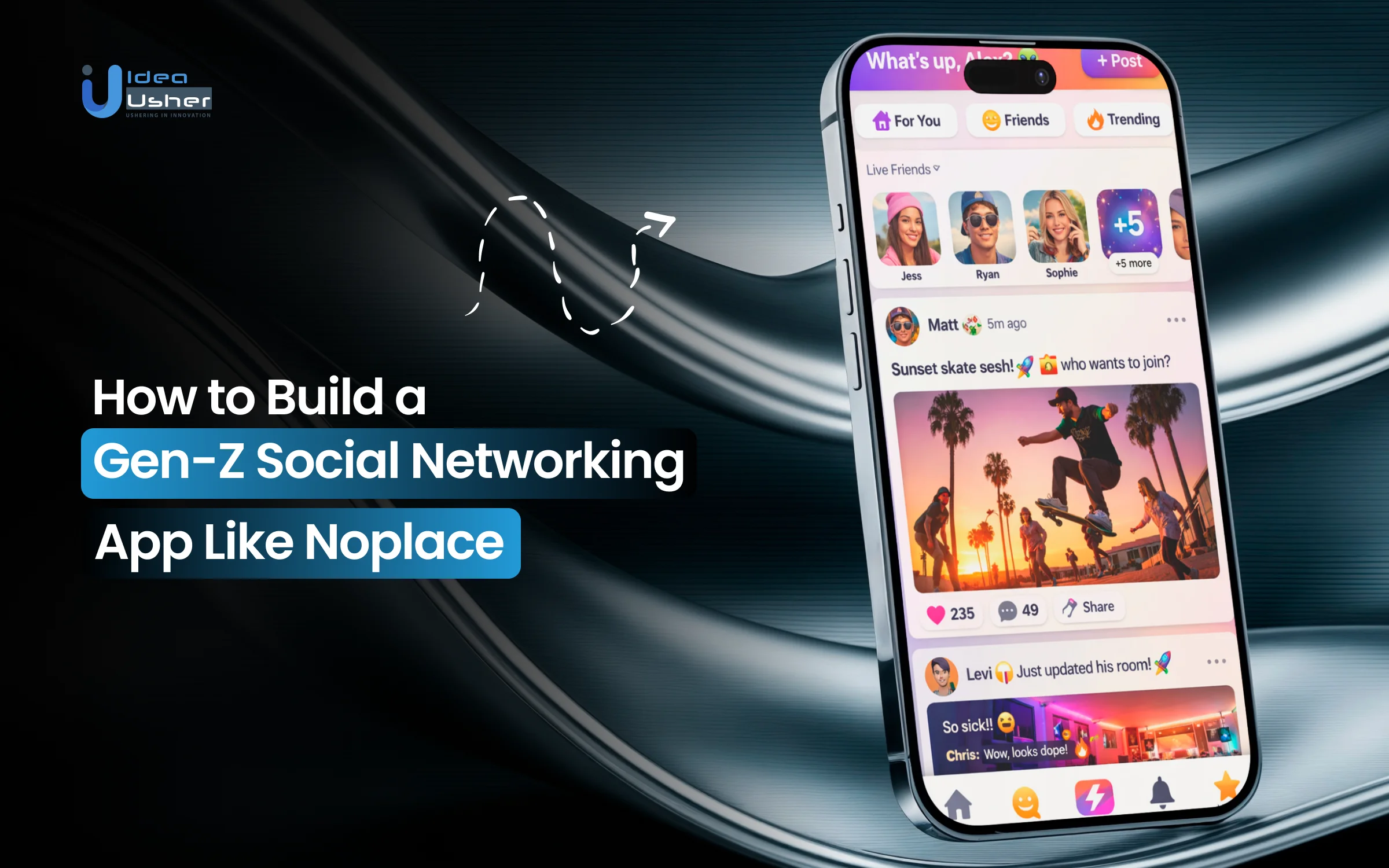
Social networking habits among Gen Z are shifting away from highly curated feeds toward more expressive, fast and community-driven interactions. Users are increasingly drawn to platforms that feel personal, less algorithm-driven, and centered on real-time communication and identity expression, driving interest in Noplace like Gen Z social networking app development where design, interactions, and community features reflect how younger audiences genuinely connect online.
Meeting Gen Z’s expectations goes beyond replicating old social media features such as intuitive profile customization, real-time updates, lightweight interactions, notifications, and community dynamics must create a seamless, engaging experience. The best platforms enable authenticity, speed, and discovery without overwhelming users or repeating the patterns Gen Z wants to leave behind.
In this blog, we explain how to build a Gen Z social networking app like Noplace by examining core features, architectural considerations, and practical steps involved in creating a scalable and engaging social platform for modern users.

What is a Gen Z Social Networking App, Noplace?
Noplace (originally named Nospace) is a text-based social networking app designed specifically for Gen Z that emphasizes personal connection over algorithm-driven content. It facilitates real-time social interaction, personal self-expression, and community formation based on shared interests, through highly customizable user profiles and chronological content feeds. Launched out of invite-only mode in July 2024, it quickly reached the top of the Apple App Store charts by offering a “nostalgic” experience reminiscent of early internet platforms like MySpace and Twitter.
Core Philosophy and Design
The app was founded by Tiffany Zhong, who aimed to bring the “social” back to social media.
- Anti-Algorithm: Unlike TikTok or Instagram, Noplace uses a reverse-chronological feed, meaning you see updates as they happen rather than what an algorithm thinks you want to see.
- Self-Expression: It focuses on users sharing what they are currently doing (e.g., eating, watching, listening to) in real-time rather than posting curated “highlight reels”.
- Retro Vibes: The app features highly customizable, colorful profiles and a “Top 10 Friends” list, directly inspired by MySpace.
Difference Between Noplace & Other Social Networking Apps
Noplace stands out from other social networking apps by prioritizing text-based interaction, customizable profiles, and authentic, real-time communication without heavy algorithmic influence or visual content focus. The table below highlights the key differences between Noplace and traditional social networking platforms.
| Feature Category | Traditional Social Apps | The Noplace Approach | Strategic Business Advantage |
| Feed Architecture | Algorithmic; driven by AI-predicted engagement to keep users scrolling. | Chronological and Global; focus on what is happening now across the whole network. | Eliminates “echo chambers” and allows new users to gain visibility without needing a pre-existing following. |
| Content Priority | Short-form video and high-production visual aesthetics. | Text-based updates and “status” sharing reminiscent of MySpace. | Lower barrier to entry for content creation and significantly reduced hosting/bandwidth costs. |
| User Identity | Curated, “perfect” lifestyles intended for a broad, public audience. | High-customization profiles (colors, interests, “top friends”) for self-expression. | Drives deeper emotional “stickiness” and user loyalty through a sense of digital ownership. |
| Discovery Logic | Interest-based silos that isolate users into specific niches. | Commonality-based discovery; finding people with shared “stars” (interests). | Facilitates genuine community building rather than isolated consumption, increasing long-term retention. |
| Monetization Potential | Heavy reliance on intrusive, interruptive video advertising. | Potential for “Profile Skins,” digital collectibles, and premium customization. | Offers a cleaner UX that users are often willing to pay for, creating a higher-quality “Prosumer” revenue model. |
Why are Gen Z Social Networking Apps Growing Rapidly?
The social networking app market was valued at USD 49.09 billion in 2022, grew to USD 98.67 billion in 2025, and is projected to reach USD 310.37 billion by 2030, with a CAGR of 26.2% from 2023 to 2030. This rapid growth is driven by Gen Z users seeking authentic, interactive, personalized digital experiences, creating high demand for Noplace like Gen Z social networking app.

Why Gen Z Is Leaving Traditional Social Media
- Platform Deletion: According to a 2025 Deloitte consumer trends survey, nearly one-third of Gen Zers deleted at least one social media app in the previous 12 months.
- The “Silent” Shift: While 94% of Gen Z remain active on social media, 40% have stopped engaging publicly (liking or commenting) from their main accounts to avoid judgment or “performance pressure”.
- Digital Exhaustion: A staggering 73% of Gen Z report feeling “digitally exhausted,” even as they spend an average of 7.2 hours daily looking at online content.
The Algorithm Fatigue and the Search for Control
- Declining Time Spent: Globally, time spent on social platforms has dropped by nearly 10% since 2022, as users push back against addictive, “mindless” scrolling.
- The Search Pivot: 46% of Gen Z now prefer using social media as a search engine over Google, showing they value peer-to-peer discovery over centralized, algorithmic results.
Privacy and the Decline of the “Permanent Record”
- The Loneliness Paradox: Despite being the most connected generation, 80% of Gen Z reported feeling lonely at some point in the last year, a figure nearly double that of Baby Boomers (45%).
- Private Engagement: 61% of young users now prefer private engagement (saving or sharing via DMs) rather than public liking, as they seek “digital autonomy” away from the spotlight.
- Detox Culture: Awareness of “brain rot” is at an all-time high, with 63% of Gen Z planning or completing a social media detox to protect their mental health.
How AI Enhances Gen Z Social App Experiences?
Noplace like social media app is a text-based “mashup of Twitter and MySpace” popular with Gen Z. AI serves as a replacement for traditional, ad-driven engagement algorithms, acts as a facilitator for personal connection, focusing instead on curation and summarization to foster authentic connection.
Rather than prioritizing content that maximizes scrolling time, noplace utilizes AI for the following roles:

- Content Summarization: The AI provides curated summaries of what users have missed while they were away from the app.
- AI-Driven Curation (vs. Algorithms): Instead of using traditional, rigid algorithms to edit the feed, noplace uses AI to drive suggestions for content and pages that align with a user’s specific interests (or “stars”).
- Enhancing “Vibes”: The AI helps curate the global feed to highlight the current “vibe,” what people are thinking, listening to, or doing in real-time, rather than just showing high-engagement highlights.
- Facilitating Connection: AI suggests connections based on shared interests rather than just friend networks, helping users find communities around niche topics.
Key Distinctions in AI Usage
- No “Algos”: Noplace like social media app ignores traditional “algos and ads,” using AI to make the app feel “social again” rather than just a media consumption tool.
- Unfiltered Feed: The main feed operates in reverse chronological order, allowing for more organic, less performative interaction compared to Instagram or TikTok.
Core Features of a Noplace Like Gen Z Social Networking App
To capture the Gen Z market, founders must prioritize “digital proximity” over passive scrolling. This architecture balances retro-expression with high-utility engineering to drive daily active usage through real-time social validation.

1. Customizable Retro-Inspired User Profiles
Modern users view their profiles as “digital bedrooms.” Moving away from sterile, standardized layouts is a strategic move to increase user “stickiness” and personal investment in the platform.
- Visual Agency & Customization: Implement modular “drag-and-drop” widgets allowing users to modify background hex codes, cursor styles, and “bling” elements. This mimics the high-agency experience of early web personalization.
- Identity Signaling: Integrate “Status Badges” and custom CSS-lite themes. This encourages social competition and long-term platform loyalty by allowing users to signal their niche subcultures visually.
- The “Sunk Cost” Advantage: When a user spends 45 minutes “theming” their page to match a specific aesthetic (e.g., “Y2K Core”), the platform stops being an app and becomes a personal asset they are unwilling to abandon.
- Business Depth: High profile-creation time leads to significantly lower churn rates. For investors, this translates to a higher Lifetime Value (LTV) per user and a moat against competitors with generic UIs.
2. Real-Time Reverse-Chronological Feed
Algorithms often feel like gatekeepers that suppress content. A reverse-chronological feed transforms the app into a “live event,” where the most recent voice is always the loudest.
- Democratic Distribution: Every post gets its moment at the top, regardless of follower count. This removes the “performativity” barrier that keeps users from posting.
- Engineering Depth: Requires a robust, low-latency Pub/Sub architecture (like Redis or Apache Kafka) to ensure “real-time” means sub-second delivery across global clusters.
- Strategic Insight: For an entrepreneur, this reduces “content fatigue.” Users check the app more frequently because the content is constantly refreshing in a predictable, fair way.
3. Interest-Based Tagging with “Stars” System
Discovery should be rooted in shared passions rather than existing social graphs. This system solves the “Cold Start” problem for new users by providing immediate community access.
- The “Star” Mechanism: Users tag themselves with specific interests (e.g., #MechanicalKeyboards, #SolanaEcosystem). The UI then highlights “Stars” or top contributors in those niches.
- Business Depth: This creates high-intent data clusters. Instead of broad demographics, you are building a database of specific psychological interests, which is invaluable for future native advertising or partnerships.
- Practical Example: A new user joins and immediately sees a feed of people discussing their specific niche, leading to an instant “First Strike” of value within 30 seconds of onboarding.
4. Text-Centric Status Updates and Notes
There is a massive shift away from high-production video toward low-stakes text. Short-form updates foster a “stream of consciousness” environment that encourages high-frequency interaction.
- The Logic: Lowering the barrier to entry increases the volume of data. If it’s easy to post, users post more often.
- Tactical Execution: Implement “Notes” that appear at the top of the feed a short, 140-character bursts that expire or update frequently.
- Strategic Thinking: This positions the app as a “communication tool” rather than a “media consumption tool,” differentiating it from TikTok or Instagram.
5. Public Top Friends Ranking System
Social hierarchies drive intense engagement. A “Top Friends” list creates a gamified layer of social loyalty and public identity that Gen Z finds nostalgic yet compelling.
- Gamification of Loyalty: Users must interact to stay on a friend’s “Top 10.” This drives “maintenance” sessions, quick check-ins to ensure social standing.
- Investor Insight: While seemingly simple, this feature is a massive driver of Peer-to-Peer (P2P) notification triggers, which are the most effective form of organic retention.
6. Age-Based Safety and Moderation Layers
The greatest risk in social networking is brand safety and legal compliance. Implementing strict age-bifurcation is a non-negotiable requirement for modern scalability and risk mitigation.
- The “Tunnel” Architecture: Use AI-driven age estimation and ID verification (such as Yoti) at the onboarding stage. This creates two entirely separate databases and interaction layers: one for minors and one for adults.
- Zero-Contact Protocols: In the “Under-18 Tunnel,” direct messaging from unverified or over-age accounts is technically impossible at the kernel level.
- Business Depth: This “Safe-by-Design” approach significantly lowers insurance premiums and simplifies global expansion, as it pre-emptively meets strict EU (GDPR-K) and US (COPPA) regulations.
- Technical Edge: Implement automated “shadow-banning” and real-time sentiment analysis using LLMs to detect predatory behavior patterns before they escalate into human-to-human interaction.
7. AI-Powered Missed Connection Summaries
To combat “scroll fatigue” and FOMO, the platform uses AI to summarize what happened while the user was away. This turns overwhelming data into actionable social intelligence.
- The Tech: Utilizing a lightweight LLM to scan missed group chats or feed updates and generate a 3-bullet summary: “What you missed.”
- Strategic Value: This increases “re-entry” success. Instead of feeling lost after being offline for 6 hours, the user is immediately caught up and ready to engage.
- Practical Example: “Your top friends are debating the new Drake album, and there’s a live room starting about #Streetwear.”
8. Synchronous Group Chat and Global Rooms
The “Global” room concept creates a digital town square. Unlike private DMs, live rooms allow for spontaneous mass interaction, making the app feel “populated” at all hours.
- Real-Time “Pulse”:
- High Concurrency: Utilize WebSocket technology and horizontal scaling to support 50,000+ users in a single chat room with sub-100ms latency.
- Ephemeral Interaction: Chat history is not stored permanently, which reduces “post-anxiety” and encourages users to speak freely.
- Entrepreneurial Edge: This creates a “24/7 party” atmosphere. Users stay on the app longer because there is always a conversation happening, regardless of their personal social circle’s activity.
- Practical Example: During a major cultural event (e.g., a music festival or product launch), the platform hosts a “Global” room where users can react in real-time, creating a shared “stadium” experience.
9. Ephemeral Vibe Check Interactive Polls
Interactivity should be baked into the core UI. “Vibe Checks” allow users to take the pulse of the community in real-time.
- Micro-Engagement: Low-friction polls (e.g., “Rate this outfit”) provide instant feedback loops.
- Strategic Data: These polls generate proprietary trend data. For an investor, this means owning a “real-time trend engine” that can be used to predict consumer shifts before they hit the mainstream.
- Technical Depth: Poll data can be fed into the discovery algorithm to recommend users to one another based on “vibe similarity,” moving beyond basic interest tags.
10. Music and Personality-Based Identity Layers
Integration with streaming services allows a user’s “sonic identity” to be part of their profile. Adding personality types (MBTI/Enneagram) further deepens the profile’s data density.
- The Insight: Music is a primary identifier for Gen Z. Displaying “Currently Listening” status creates immediate conversation starters.
- Business Depth: API integrations with Spotify or Apple Music can lead to affiliate revenue models or exclusive “listening party” events within the app.
- Strategic Value: Music is the primary identifier for Gen Z. By making it central to the UI, you tap into “community through sound,” allowing for “listening parties” that drive app session length.
11. Advanced Privacy Toggles and Inner Circle
While the app encourages discovery, it must also offer sanctuary. Users need the ability to flip between “Global” mode and “Inner Circle” mode seamlessly.
- Granular Privacy Controls:
- The “Invisibility” Toggle: Allow users to browse the global feed while appearing offline or anonymous to those outside their “Top Friends.”
- Layered Permissions: “Notes” and status updates can be restricted to specific circles (e.g., “Close Friends,” “Music Nerds,” or “Public”).
- Strategic Advantage: This hybrid approach captures two markets: the “discovery seekers” and the “private group” users, making the app a versatile tool for all social needs.
Noplace like Gen Z Social Networking App Development Process
Noplace redefines Gen Z social networking with expressive, customizable digital identities and real-time interaction. The development process blends trend-driven design, scalable tech, and community-first features to deliver engaging user experiences.

1. Consult and Product Validation
Consult Idea Usher’s experience developers and execute deep-dive ethnography into Gen Z’s “algorithm fatigue” to validate the need for text-focused, high-authenticity environments. Use low-fidelity prototypes to test features like “Top Friends” or “Vibe” updates, ensuring the product solves the specific friction of performative social media.
2. Defining Social Graph and Network Structure
Architect a “Mutual Interest” social graph rather than a traditional follower-based model. By prioritizing bidirectional connections and shared interests facilitated by “Stars” or tags to ensure the network remains high-signal, rewarding meaningful interaction over the accumulation of passive audience numbers.
3. Wireframing Identity-Driven User Journeys
Design UX flows that emphasize profile customization as a core mechanic of identity construction. Wireframes must prioritize high-visibility fields for music, relationship status, and current “Vibes,” allowing users to curate a digital persona that feels dynamic, experimental, and personally sovereign.
4. Designing Feed and Engagement Logic
Implement a dual-feed system: a “Global” chronological view for serendipitous discovery and an “Inner Circle” feed for high-density friend updates. Engagement logic should shift from “Likes” to “Conversational Momentum,” rewarding active yapping and real-time responses over passive content consumption.
5. Building Interest-Based Discovery Engine
Develop an AI-driven discovery engine that utilizes semantic analysis of user tags to connect “familiar strangers.” Instead of black-box algorithms, this engine surfaces “Star Communities” based on shared niche hobbies, creating a self-organizing neighborhood of like-minded individuals.
6. Backend and Moderation Systems Setup
Deploy a serverless backend with high-concurrency capabilities to handle global “town square” chat dynamics. Integrate AI-powered moderation that understands Gen Z slang and sentiment, ensuring real-time brand safety without stifling the informal, high-energy tone essential to the platform.
7. User Profiles and Performance Optimization
Engineer a data schema that supports highly customizable, asset-heavy profiles without compromising load speeds. Use edge caching and optimized database queries to ensure that real-time “happening now” indicators and profile transitions remain fluid across a global user base.
8. Onboarding and User Analytics Setup
Create a friction-free onboarding flow that prompts users to select their “Stars” immediately, driving day-one activation. Set up behavioral analytics to track “Community Depth”, measuring how often users join new interest groups, rather than just tracking simple session duration.
9. Testing, Launch, and Iteration
Execute a multi-phase beta using “Founding Creator” cohorts to seed the community culture before public release. Post-launch, iterate based on real-time sentiment analysis of global feeds, rapidly deploying bug fixes or feature requests that align with evolving Gen Z trends.
Noplace like Gen Z Social Networking Development Cost
Building a Gen Z-focused platform like Noplace requires shifting investment from traditional content-delivery networks toward real-time, high-concurrency “digital town square” infrastructure. In 2026, costs are heavily influenced by the need for ultra-fast profile rendering and specialized AI moderation.
| Development Phase | MVP (Entry Level) | Enterprise (Pro Level) | Key Deliverables |
| Market Research & UX Design | $6,000 – $10,000 | $25,000 – $50,000 | Ethnographic research, custom profile UI kits, and “Vibe” animation systems. |
| Real-Time Core Engine | $25,000 – $45,000 | $120,000 – $220,000 | WebSocket-driven global feeds, “Mutual Interest” social graph, and chat APIs. |
| Interest-Based Discovery | $8,000 – $15,000 | $50,000 – $95,000 | Semantic tag-matching engine, “Star” community logic, and trend aggregators. |
| Scalable Profiles & CMS | $7,000 – $12,000 | $35,000 – $70,000 | High-customization profile schema, asset hosting, and real-time status updates. |
| AI Safety & Slang Moderation | $5,000 – $10,000 | $40,000 – $80,000 | Gen Z-specific sentiment analysis, auto-flagging, and reporting dashboards. |
| Infrastructure & DevOps | $6,000 – $12,000 | $30,000 – $65,000 | Serverless backend (Lambda/Cloud Run), edge caching, and auto-scaling. |
| Analytics & Launch | $3,000 – $6,000 | $15,000 – $30,000 | Behavioral tracking setup, “Community Depth” metrics, and app store SEO. |
| Total Estimated Cost | $60,000 – $110,000 | $135,000 – $270,000+ | A high-engagement, “analog-vibe” digital social space. |
Critical Cost Drivers in 2026
When developing for the Gen Z market in 2026, the budget is dictated by the demand for immediate responsiveness and high-intensity social interaction.
- High Concurrency WebSocket Management: Maintaining a “Global Feed” with thousands of persistent connections requires scalable real time infrastructure. Expect $1,000 to $4,000 monthly costs using Pusher, PubNub, or self-hosted Redis to avoid message lag.
- Specialized AI Sentiment Analysis: Standard moderation tools struggle with Gen Z slang, “brainrot” culture, and nuanced irony. Custom AI models cost $0.05 to $0.15 per active user monthly but remain essential to prevent community churn.
- Dynamic Profile Customization Assets: Rich profile customization with heavy media and custom layouts increases storage I/O and CDN egress. During viral growth, media delivery costs can reach $0.03 to $0.09 per GB, requiring strong image optimization.
- Behavioral Discovery and Graph Processing: Interest-based “Star” clusters rely on advanced graph databases like Neo4j or AWS Neptune, which typically cost 20% to 30% more than standard relational databases.
- Real Time “Vibe” and Status Syncing: The “HAPPENING NOW” feature demands a high-performance caching layer to handle rapid updates. Optimizing read-write cycles often requires senior backend engineering expertise to prevent database bottlenecks.
Core Social Systems That Drive Engagement
Successful social platforms succeed or fail based on the efficiency of their “connection engine.” The goal is to build systems that reduce the time it takes for a new user to find their “cohort,” thereby accelerating the path to long-term retention.

1. Interest Graph and Community Discovery System
Prioritize “Interest Graphs” over social graphs to connect users via shared passions. Use “Multidimensional Tagging” for high-affinity clusters and “Strategic Cold Start Resolution” to suggest peers instantly, driving “Intent-Based Monetization” and 3x higher conversion rates.
2. Chronological Feed and Engagement Architecture
Restore user agency with a “Live Pulse” chronological feed powered by WebSockets. Implement “Hybrid Logic” to surface high-engagement content from the last 12 hours and use “Optimistic UI” to eliminate interaction friction for seamless, real-time engagement.
3. User-Controlled Personalization Systems
Navigate the “Privacy Paradox” with “Layered Access” and “Contextual Privacy Filters.” Enabling “Shadow Personas” allows users to separate professional and creative identities, reducing “Platform Anxiety” and significantly increasing long-term LTV through superior data and visibility control.
4. AI-Assisted Content Moderation & Safety
Scale safely using “Proactive Sentiment Analysis” to detect toxic “Escalation Patterns.” Combine “Safety Layer” APIs with AI “Deep Filters” to interpret nuanced intent, allowing AI to handle 95% of moderation while keeping OPEX lean and professional.
5. Transparency & Community Governance Models
Build “Trust” by publishing “Open-Source Moderation Logic” to eliminate “Censorship Anxiety.” Deploy a “Community Jury” for high-accuracy oversight and use “Cryptographic Humanity Checks” with Zero-Knowledge Proofs to verify users without the legal liability of storing sensitive IDs.
Monetization Model of Noplace like Gen Z Social Networking App
Gen Z’s “algorithm fatigue” has made traditional, intrusive advertising a significant driver of user churn. For platforms like Noplace, monetization must be secondary to the user experience, focusing on community utility and creative expression rather than data harvesting.

1. Premium Customization and Profile Aesthetics
Gen Z views digital profiles as high-value personal real estate. Monetize by offering exclusive “Design Packs” including custom background animations, rare profile fonts, and unique music-integration widgets allowing users to signal status through creative curation rather than just follower counts.
2. Digital Collectibles and “Vibe” Badges
Integrate a micro-transaction economy for “limited-edition” digital assets. Users can purchase or earn tradable badges that represent niche interests or early-adopter status, creating a secondary “social currency” that incentivizes long-term platform loyalty and community engagement.
3. Branded Interest-Based Star Communities
Instead of interruptive ads, partner with brands to host “Sponsored Stars” or niche interest groups. Brands act as community members like sharing tips, hosting AMAs, or providing exclusive text-based content ensuring commercial presence feels like a value-add rather than a broadcast.
4. “Infinite Loop” Social Commerce
Leverage Gen Z’s preference for in-feed discovery by allowing micro-influencers to link directly to products within their “Vibe” updates. By taking a small transaction fee on frictionless, native checkouts, the platform monetizes organic peer recommendations without relying on tracking-based ad placements.
5. Subscription-Based “Inner Circle” Features
Deploy a low-cost “Pro” tier that unlocks enhanced social tools like advanced “Top Friends” logic or the ability to host private, high-concurrency group chats. This MRR-driven model prioritizes power-users who seek deeper community utility over the standard, ad-supported experience.
Comparison of Gen Z-Centric Monetization Approaches
| Feature | Aesthetic Micro-transactions | Sponsored Communities | “Inner Circle” Subscription |
| User Reception | High (enhances self-expression) | Medium (must be authentic) | High (perceived as premium utility) |
| Revenue Type | Transactional / One-time | B2B Sponsorship | Recurring (MRR) |
| Impact on UX | Zero (completely optional) | Low (native to the feed) | Low (adds features, doesn’t gate) |
Conclusion
Building a Noplace like Gen Z social networking app requires a deep understanding of youth culture, creativity, and fast evolving digital trends. Focus on personalization, real time interaction, and expressive features that let users showcase identity and connect authentically. Prioritize mobile first design, engaging visuals, and strong moderation tools to ensure a safe environment. By combining innovation with community driven growth strategies, you can create a platform that resonates with Gen Z and sustains long term engagement in a competitive social media landscape while adapting quickly to changing user expectations.
Why Choose IdeaUsher for Gen Z Social Networking App Development?
Building a platform like Noplace requires understanding how Gen Z craves identity expression, niche community discovery, and playful digital spaces far removed from traditional social media paradigms.
We build blockchain-driven products across industries, specializing in performance systems, model integration, and scalable infrastructure. Our expertise helps us create Gen Z social apps that balance expression, real-time engagement, and viral growth potential.
Our ex-FAANG and MAANG engineers bring over 500,000+ hours of hands-on blockchain development experience, allowing us to architect next-gen social platforms aligned with youth culture, discovery algorithms, and community-driven engagement metrics.
Why Hire Us:
- Social & Discovery Expertise: We build high-traffic social ecosystems, deploy robust interest graph algorithms and real-time activity feeds, and ensure smooth profile customization during viral user acquisition spikes.
- Custom Engagement Features: We develop unique friend discovery, interest-based matching, and fun UI features that increase daily engagement. These make platforms more sticky and give a competitive edge over legacy social networks.
- Full-Cycle Ownership: We handle infrastructure selection, real-time WebSocket architecture, youth privacy compliance (like COPPA), and scalable solutions to make your Gen Z social app ready from launch.


FAQs
A.1. A robust real time feed requires a backend built with Node.js or Go to handle high concurrency. Use WebSockets for instant updates and a high performance database like Redis for caching active status updates to ensure sub second latency.
A.2. Focus on an “Interest Graph” rather than social connections. Develop a tagging system that groups users into high affinity clusters based on shared hobbies. This enables a “Global Feed” experience where users find relevant communities without needing a large follower count.
A.3. Building a profile engine requires a flexible JSON schema in your database to store custom colors, fonts, and “Top Friends” lists. This allows users to personalize their digital space without the rigid, homogenized templates found on legacy platforms.
A.4. A “Live Pulse” architecture uses real time event streams to show what users are doing right now. This is critical for Gen Z engagement as it replaces the curated, static feed with an active, spontaneous environment that feels authentic.


