


There was a time when social platforms felt open, but control slowly shifted away from users. Interactions started to be filtered, tracked, and monetized in ways people could notice. Users did not leave instantly, but trust gradually weakened as ownership remained limited. The popularity of decentralized social platforms has been increasing as people seek more control over their data and identity.
Growing concerns around censorship, opaque algorithms, and constant tracking have pushed this shift further. Businesses are moving toward distributed network models where platforms like Diaspora may allow independently hosted pods to operate while staying connected. This approach can give users stronger control over identity data and interaction layers.
Over the years, we’ve developed numerous decentralized social platforms powered by distributed ledger infrastructure and decentralized identity frameworks. As we have this expertise, we’re sharing this blog to discuss the steps to develop a decentralized social platform like Diaspora.
Why Founders Are Moving Beyond Centralized Social Platforms?
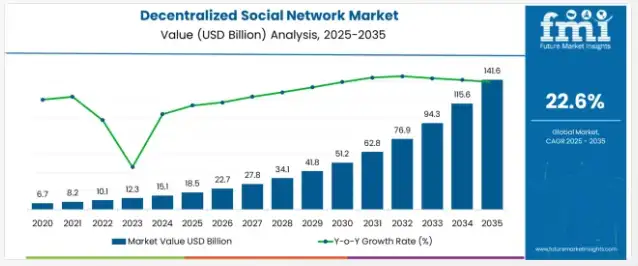
Source: Future Market Insights
Founders are increasingly rejecting the walled garden model of traditional social media. Building on centralized platforms is now recognized as a high-risk strategy, in which a single algorithmic shift can instantly decouple a business from its audience. This platform risk has turned legacy giants into unstable foundations for capital investment.
Strategic investors are pivoting toward protocols such as Lens Protocol and Farcaster to reclaim sovereignty. These decentralized infrastructures, such as Lens Protocol, allow founders to own the underlying social graph and the direct relationship with the user. This shift is about moving from rented audiences to owned digital assets that remain accessible regardless of any single app policy changes.
Hidden Costs Of Ad-Driven Platforms
The free scale offered by ad-driven platforms carries heavy structural liabilities. When a roadmap is dictated by advertiser KPIs rather than user utility, the product suffers from engagement hacking and content dilution. This creates a misalignment between the platform owner and the community.
Key financial and operational risks include:
- Algorithmic Tax: Platforms often throttle organic reach, forcing founders to pay to access their own acquired audiences.
- Asset Fragility: Sudden de-platforming represents a catastrophic risk to brand equity and revenue streams.
- Low-Quality Context: Premium content is often sandwiched between intrusive ads, thereby degrading the brand’s perceived value.
Data Ownership As A Competitive Advantage
In the decentralized era, data sovereignty is a primary moat. Traditional models harvest and commoditize user information, stripping the creator of the ability to build unique, long-term value. Decentralized architectures allow founders to offer users true ownership, a powerful retention tool.
Treating data as a shared utility builds institutional trust. For the entrepreneur, this enables tokenized incentives. Unlike legacy systems, the value generated stays within the ecosystem, ensuring that the platform, not an external data broker, captures the upside of network effects.
Demand For Privacy-First Communities
We are seeing a massive shift toward digital campfires, which are smaller, secure, and private environments. High-net-worth individuals and professionals are fleeing the public square in search of a protected connection. This demand creates a lucrative niche for platforms that prioritize encryption and decentralized identity.
Strategic investment in privacy-first tech is no longer optional; it is a response to a clear market mandate.
Platforms like Mastodon have already demonstrated that users are increasingly seeking environments free from corporate surveillance and centralized censorship. By moving toward subscription or micro-transaction-based revenue, founders can build more resilient, high-margin businesses.
What Makes Diaspora’s Model Worth Replicating?
The Diaspora model serves as a foundational blueprint for modern decentralized social architecture. Unlike traditional platforms that consolidate all data on central servers, Diaspora distributes its network across independent nodes. For an investor, this represents a shift from a single-point-of-failure business risk to a resilient, distributed asset that is virtually impossible to censor.
Replicating this model allows founders to create a federation of interconnected communities. This structure minimizes the overhead costs of massive data centers while maximizing niche autonomy. By studying Diaspora, entrepreneurs can find a scalable pathway to building high-integrity platforms that do not rely on invasive data harvesting.
How The Pod-Based Architecture Works
The core of Diaspora is the Pod, an independently run server that connects to the broader network. Users choose a specific pod or host their own, yet communicate across the network via standardized protocols. Within this structure, users organize social circles using Aspects, a feature providing granular control over content visibility.
Strategic advantages of this architecture include:
- Distributed Hosting: The financial burden of hosting is shared, reducing the primary owner’s operational burn rate.
- Interoperability: Open standards prevent vendor lock-in, attracting high-value, technically savvy users.
- Local Governance: Pod owners set their own moderation rules, allowing for tailored community standards without compromising the entire network.
Why Decentralization Improves User Trust
In centralized systems, trust is a liability. Decentralization makes transparency a structural requirement. In a pod-based system, users choose who handles their data, which provides the ultimate form of consumer leverage.
The use of Hashtags allows for organic discovery without the need for an opaque, centralized recommendation engine. When users know they can move their data or switch providers without losing social connections, platform loyalty increases. This transparency eliminates the fear of secret algorithm changes or shadowbanning, creating a more engaged user base.
Lessons Founders Can Apply To New Platforms
The primary lesson from Diaspora is that community ownership is a more sustainable growth engine than data mining.
Features like Reshares and Mentions function within a framework of user-led distribution rather than algorithmic force-feeding. Founders should focus on building the protocol, not just the application.
Another critical takeaway is the importance of sovereign identity. New platforms must ensure the social graph is portable. If an entrepreneur builds a platform where users truly own their digital presence, they solve the hardest challenge in social media: retention. This approach creates an ethical path to profitability through freemium or pro models for specialized pod features.
Core Features Users Expect in Decentralized Social Platforms
For businesses, the value of decentralized social platforms lies in their ability to address the switching-cost problem. Users are wary of ecosystems that trap their data and social equity. To capture this market, platforms must prioritize user sovereignty while maintaining a seamless modern UX.
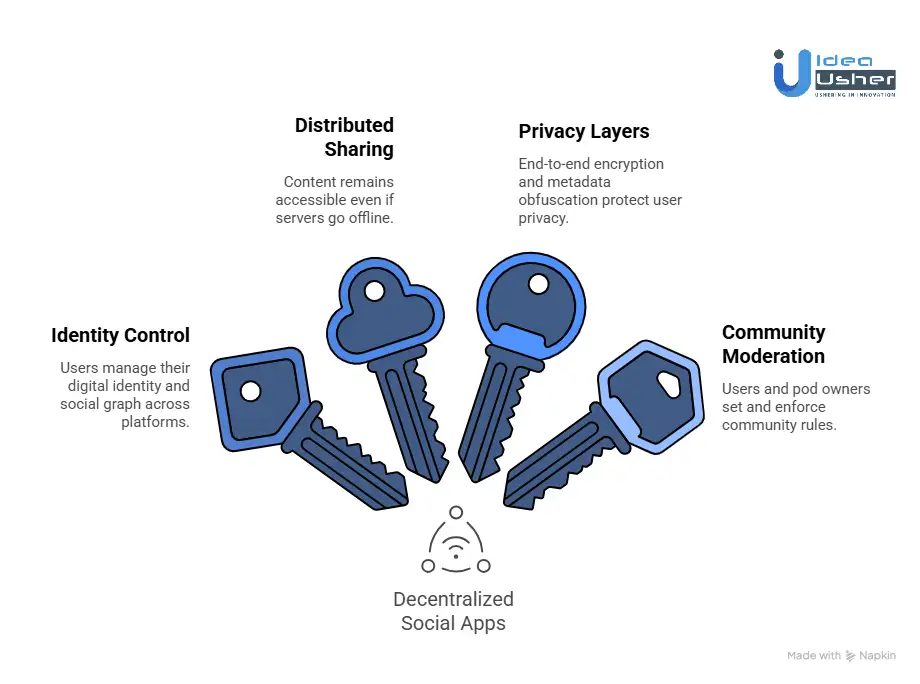
Successful apps provide a toolkit for users to manage their digital lives without a central gatekeeper. This shift from simple connectivity to comprehensive agency is what defines the next generation of social investment.
1. Identity Control And Portable Profiles
In a decentralized ecosystem, the user profile is an independent asset rather than a database entry. Using Decentralized Identifiers, users can move their entire social graph and reputation between applications. Platforms like BrightID exemplify this by allowing users to prove their unique identity without a central login.
Key requirements include:
- Self-Sovereign Identity: Cryptographic keys replace platform-controlled credentials.
- Reputation Portability: Social credit remains verifiable across any pod or app within the protocol.
- Alias Flexibility: Users can maintain non-linked personas to protect professional boundaries.
2. Distributed Sharing Without Lock-In
The goal is to decouple content from the hosting service. Users expect that once they post a Reshare, the content remains accessible even if a specific server goes offline. Bluesky, via the AT Protocol, demonstrates this by letting users move accounts and post histories between servers without losing followers.
By eliminating lock-in, founders build institutional trust. Users invest more intellectual capital when they know their contributions cannot be held hostage by a single company’s changing Terms of Service.
3. Privacy Layers And Encryption
Privacy is now the core product. Users expect end-to-end encryption (E2EE) for direct messages and private Aspects. The Session messenger highlights this trend by using decentralized onion routing to protect user metadata, ensuring the network itself cannot see who is communicating.
Strategic privacy features include:
- Metadata Obfuscation: Protecting the “who and when” of interactions.
- Hybrid Storage: Keeping sensitive data off public ledgers while using the blockchain for verification.
- Granular Visibility: Precise control over which social circles can view specific media.
4. Community-Driven Moderation
Centralized moderation cannot scale to global nuances. Decentralized apps move power to the community level, where each administrator sets their own rules. Mastodon is the gold standard here, allowing individual instances to set policies that align with specific community values.
This approach protects founders from the content liability trap. By empowering users to filter their own feeds and letting pod owners set standards, the platform remains a neutral protocol. This fosters a self-regulating ecosystem that scales without the massive overhead of centralized monitoring.
Choosing the Right Decentralized Architecture for Social Platforms
Selecting the technical foundation of a decentralized social platform is the most consequential decision an investor makes. Unlike centralized builds, where you simply scale a database, decentralized architectures dictate your long-term censorship resistance, user autonomy, and cost structure. A mismatch here can lead to a platform that is either too expensive to run or too centralized to attract the “sovereignty-seeking” demographic.
The “right” choice depends on whether you are prioritizing rapid social interactions or high-security financial integration. Founders must look past the hype of specific technologies and evaluate the structural durability of the underlying network logic.
Pod-Based vs Blockchain vs Federated Networks
Each of these three pillars offers a distinct risk-to-reward profile for the modern entrepreneur:
Federated Networks: Think of this as the “Email Model.” Platforms like Mastodon enable independent servers to communicate with each other.
- The Upside: Familiar user experience and lower latency.
- The Trade-off: You still rely on server admins, creating potential “mini-gatekeepers.”
Blockchain-Based: Networks like Lens Protocol or Deso record social actions on a ledger.
- The Upside: Absolute data permanence and built-in monetization (NFTs/Tokens).
- The Trade-off: High “gas” costs for every post and slower transaction speeds.
Pod-Based (P2P): Popularized by Diaspora, this model gives users a personal “data vault.”
- The Upside: Total privacy; the user is the only one who truly holds the key.
- The Trade-off: If a user loses their key or their pod goes offline without a backup, the data is gone forever.
When To Use ActivityPub Or Nostr
Choosing a protocol is about choosing your ecosystem. ActivityPub is the industry veteran, powering the “Fediverse.” It is ideal for founders who want a “batteries-included” approach with a massive existing user base. If your goal is to build a decentralized YouTube (PeerTube) or Instagram (Pixelfed), this is your standard.
Nostr (Notes and Other Stuff Transmitted by Relays) is the insurgent choice. It is not a blockchain or a server-to-server protocol; it is a simple messaging format.
Strategic Insight: Use Nostr if your primary goal is “unstoppable” speech. Because it relies on simple relays that don’t need to store state, it is the lightest and most censorship-resistant option available today, favored by those who want to avoid the “complexity bloat” of the Fediverse.
Trade-offs Between Scalability And Control
The “Scalability Trilemma” is the invisible hand of decentralized development. You can rarely have high decentralization, high security, and high scalability all at once.
| Architecture | Scalability | Control | Resilience |
| Federated | High | Medium | Medium |
| Blockchain | Low/Medium | Low | Extreme |
| Nostr/Relay | Extreme | Low | High |
For a founder, “Control” is a double-edged sword. Centralized control allows for rapid product updates and effective “one-click” moderation.
However, in the decentralized market, “Low Control” is actually your selling point. Investors should look for a “Pareto-efficient” configuration: a system that is “decentralized enough” to protect user assets, but “scalable enough” to handle a million concurrent video streams.
Often, the winning move is a Hybrid Approach, using a blockchain for identity (Slow/Secure) and a federated relay for the social feed (Fast/Scalable).
How to Build a Decentralized Social Platform Like Diaspora?
To build a decentralized social platform like Diaspora, independent nodes should manage user data and sync through federated protocols. Identity and privacy layers must be designed carefully so the network can stay secure and open.
We have built numerous decentralized social platforms like Diaspora, and here is how the process works.
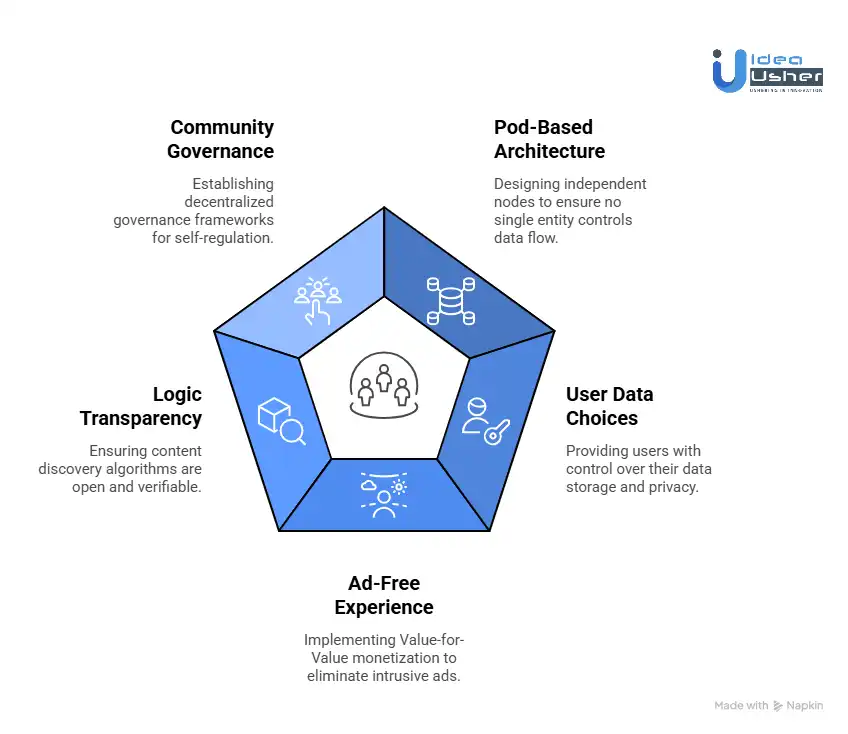
1. Designing Pod-Based Architecture
We architect your platform as a network of independent Pods to ensure no single entity controls the entire data flow. By using robust backend languages such as Go or Rust, we build nodes that communicate via the ActivityPub protocol, enabling a seamless global experience. This distributed design significantly reduces your operational overhead and mitigates the risk of a single point of failure.
2. Enabling User Data Choices
Our builds provide clients with a multi-tier storage strategy, allowing users to host data on private servers or enterprise-grade community pods. By integrating decentralized storage solutions like IPFS, we decouple the application layer from the data layer. This ensures that users retain their social assets even if they migrate between different interfaces within your ecosystem.
3. Creating An Ad-Free Experience
We eliminate the need for predatory data harvesting by integrating Value-for-Value monetization directly into the protocol. For our clients, we implement micro-payment gateways using the Lightning Network or stablecoins to enable pod-level subscriptions and peer-to-peer tipping. This aligns your revenue model with user satisfaction rather than intrusive tracking.
4. Implementing Logic Transparency
To build institutional-grade trust, we implement Open Logic ranking systems. Unlike the black-box algorithms of legacy social media, our platforms feature transparent and verifiable code for content discovery. We provide users with the ability to toggle their own feed parameters, ensuring your platform remains a neutral and manipulation-free utility for high-value communities.
5. Supporting Community Governance
The final phase of our delivery involves implementing a decentralized governance framework, often via a DAO or a federated council system. This allows the stakeholders (the pod owners and power users) to vote on protocol upgrades and moderation standards. By transitioning to this model, we essentially, via a DAO or a federated council, make the platform self-regulating and immune to the volatility of centralized corporate decision-making.
Cost Breakdown to Build a Decentralized Social Platform
Investing in decentralized social platforms involves high upfront engineering but lower long-term hosting liabilities. Unlike centralized giants that maintain expensive data silos, decentralized platforms distribute these burdens across the network. For a client, the budget prioritizes security audits and protocol integrity over server capacity.
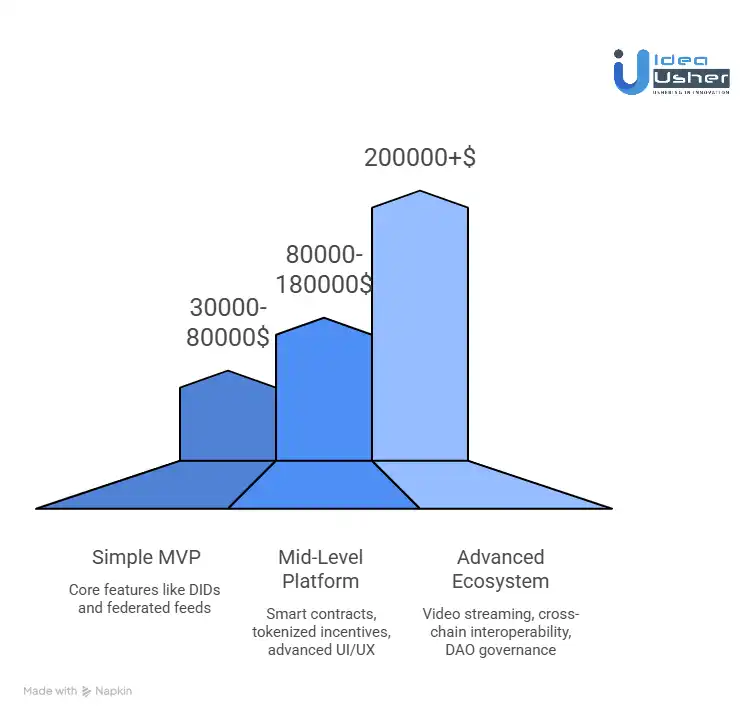
Development Cost By Feature Scope
Budgets are driven by architectural complexity. Typical development ranges for a client project include:
- Simple MVP ($30,000 – $80,000): Core features like decentralized identity (DIDs), federated feeds, and basic encryption.
- Mid-Level Platform ($80,000 – $180,000): Smart contract logic, tokenized incentives, and advanced UI/UX.
- Advanced Ecosystem ($200,000+): Video streaming, cross-chain interoperability, and DAO governance.
Infrastructure And Maintenance Expenses
Infrastructure costs stay low because the community often provides the hardware.
| Category | Typical Cost | Strategic Note |
| Storage (IPFS) | $2 – $5 per TB | Significantly cheaper than AWS or Google Cloud. |
| Node Maintenance | $500 – $2,000/mo | Supports seed nodes and protocol health. |
| Security Audits | $10,000 – $40,000 | Essential for verifying decentralized logic. |
Cost Comparison With Centralized Platforms
Centralized platforms face an efficiency trap where growth leads to exponential data security costs. Decentralized models benefit from network effects that stabilize costs as the community grows.
Client Insight: While centralized apps are cheaper to launch using off-the-shelf tools, the long-term operational burn of a decentralized app is much lower. Shifting data liability to pods or the blockchain allows a global network to operate with minimal headcount.
How to Build a Pod-Based Network Like Diaspora?
For businesses launching decentralized social platforms, architecture is the most critical asset. Unlike monolithic apps, a pod-based network functions as a galaxy of interconnected nodes. This shifts the growth burden from the central brand to the community, allowing the infrastructure to scale naturally as participants host their own servers.
Our process treats each “pod” as a sovereign unit. This ensures that while the network is global, data remains local, making it ideal for founders who want a platform that is structurally impossible to shut down.
Scaling Through Pods
In traditional models, doubling the number of users doubles server costs. In a pod-based architecture, scalability is horizontal and community-funded.
- Workload Shift: Every new pod brings its own CPU, RAM, and storage to the network.
- Regional Performance: Users connect to pods physically closer to them, reducing latency.
- Cost Efficiency: Your Master Pod only handles protocol updates, not the entire world’s media traffic.
Setting Up Node Infrastructure
We build nodes using a standardized blueprint to ensure seamless communication. We typically recommend a stack using Ruby on Rails or Go for logic and PostgreSQL for data.
- The Container Model: We use Docker to make pod software a “one-click” install for your clients.
- The Protocol Gate: Each node uses ActivityPub as a “translator” so users on different pods can interact.
- Security Hardening: Every node is firewalled and uses its own SSL certificates to prevent cross-pod breaches.
Syncing Distributed Data
The magic happens during Federation. When a user posts an update, your server “gossips” that data to every other pod where followers live.
Technical Insight: We implement an Asynchronous Sidekiq Queue to manage this. If a receiving pod is offline, your server retries the sync until delivered. Every data packet is cryptographically signed, ensuring that information remains untampered with as it travels across the open web.
How Data Ownership Drives User Acquisition?
The growth of decentralized social platforms stems from a shift in user psychology: moving from being the product to being the owner. In legacy models, user data fuels ad engines. In decentralized ecosystems, ownership is the primary driver of migration. By handing keys to the user, the fear of being de-platformed or exploited is eliminated.
Building digital estates rather than just social networks is the priority. When users own their social capital, acquisition becomes a natural byproduct of personal security.
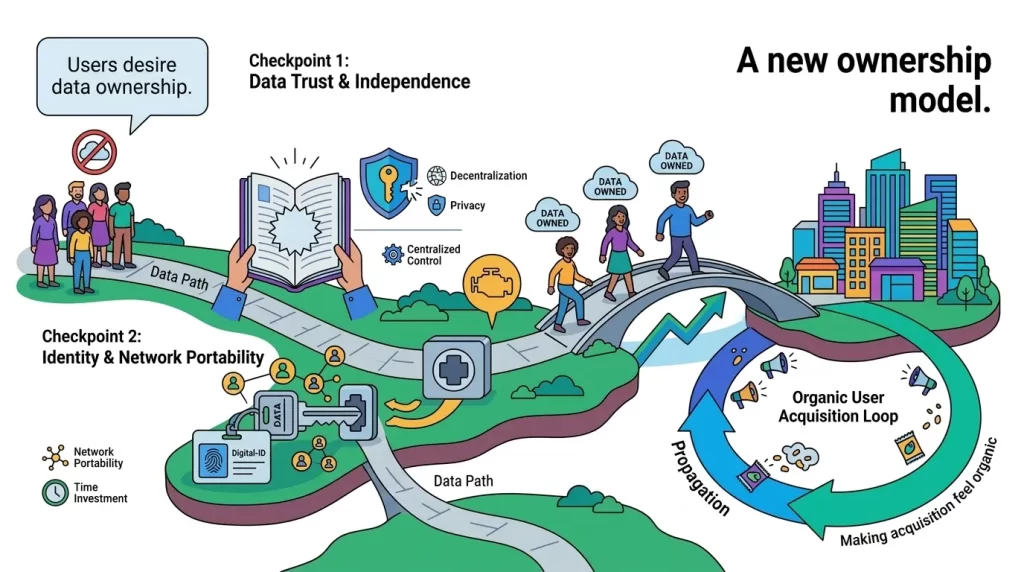
Why Users Switch
The migration from centralized giants is a response to systemic friction:
- Censorship: Opaque community standards that change without notice frustrate users.
- Algorithms: Centralized feeds prioritize engagement over truth, causing fatigue.
- Security: Repeated corporate breaches prove that centralized databases are massive targets.
Privacy As A Product
Privacy functions as a high-end feature rather than a legal disclaimer. This is communicated through Proof of Sovereignty tools.
Strategy: Visual Privacy Dashboards allow users to see exactly where data lives, whether on a private pod or a community server. This transparency builds trust that centralized apps cannot match.
End-to-end encryption serves as a core promise. Every interaction is a private exchange instead of a data point for a shadow profile.
Ownership As Growth
The Portability Loop turns data ownership into a recruitment tool.
| Feature | Growth Result |
| Portable Profiles | Users invite friends knowing they cannot be locked in. |
| Tokenized Equity | High-value contributors earn a stake in the network. |
| Interoperability | The app connects to others, expanding reach instantly. |
When users join, they mint a digital asset. Because profiles are portable, they feel safer investing time and content. This creates a viral effect where users bring their entire social graph because they hold the power to take it with them.
What Investors Look for in Decentralized Social Platform Startups?
Investing in decentralized social platforms requires a departure from legacy metrics. While traditional platforms prioritize ad inventory, decentralized startups are judged on protocol health and digital ownership. Success is measured by social equity captured without coercive lock-in tactics.
The goal is to identify platforms where the protocol is the product. A robust network creates value that is difficult to extract but easy to compound.
1. Metrics Beyond User Growth
User counts are easily spoofed; real value lies in network depth.
- Social Graph Density: Meaningful connections between nodes. Lens Protocol tracks this by treating follows as on-chain assets.
- Protocol Interoperability: Third-party apps building on the data layer. Farcaster exemplifies this with multiple clients like Warpcast and Supercast sharing one back-end.
- Developer Activity: Active SDK integrations indicate a thriving ecosystem. Mastodon leads here with thousands of independent contributors.
- Retention Through Portability: Users who stay despite the ability to leave. Bluesky proves value by retaining users who can technically migrate their data at any time.
2. Revenue Potential Without Ads
Monetization focuses on utility rather than attention harvesting.
Market Insight: Success involves serving the user rather than selling to them. Revenue models include fees for premium namespace registration, commissions on peer-to-peer tips, and subscription access to high-performance nodes.
Integrating stablecoins or the Lightning Network enables micro-transactions. Damus, built on Nostr, uses Bitcoin zaps to facilitate direct creator support. This creates revenue streams immune to advertising market volatility.
3. Scalability And Defensibility
Defensibility is built on trust and network effects rather than closed code.
| Factor | Centralized Model | Decentralized Model | Example Platform |
| Defensibility | Data Silos | Reputation/Trust | Steemit (Community curation) |
| Scalability | Vertical Upgrades | Horizontal Expansion | Pleroma (Lightweight nodes) |
| Maintenance | High Internal Costs | Shared Network Costs | Matrix (Community hosting) |
A platform becomes defensible when the cost of leaving established communities is too high. Scalability is achieved by letting the community manage the infrastructure. This creates a lean startup profile that scales globally with minimal headcount.
Why Choose IdeaUsher for a Decentralized Social Platform?
IdeaUsher can help you navigate decentralized social platforms with technical excellence. With over 500,000 hours of coding experience, our team of ex-MAANG/FAANG developers builds secure, censorship-resistant architectures. This expertise ensures a foundation optimized for the seamless user experience modern audiences expect.
500,000+ Engineering Hours
Our background enables high-velocity development without sacrificing quality. Having spent half a million hours refining code, the team identifies architectural bottlenecks early. This ensures your platform handles high concurrency while maintaining distributed integrity.
Next-Gen Protocol Expertise
Navigating ActivityPub, Nostr, or Lens requires specialized knowledge beyond standard web development. We integrate cross-platform interoperability and sovereign identity from day one. This deep understanding keeps your project compatible with the evolving ecosystem of independent relays.
End-To-End Support
Support covers the entire lifecycle from ideation to post-launch optimization. We provide UI/UX design, security audits, and decentralized hosting strategies under one roof. This holistic approach aligns technical decentralization with your specific commercial goals and acquisition targets.
Conclusion
Building a decentralized platform like Diaspora requires a strategic blend of pod-based architecture and protocol-first engineering. By shifting from silos to a federated network of independent nodes, a platform achieves scalability while fostering trust. Leveraging IdeaUsher’s extensive engineering expertise ensures the project meets the technical demands of decentralized social platforms while creating a future-proof ecosystem where users truly own their digital lives.
FAQs
A1: A decentralized social platform operates across a distributed network of independent nodes rather than a single central server. This architecture effectively empowers users to maintain absolute control over their personal data and digital identities. You will likely notice that these systems rely on open protocols to ensure that no single entity can unilaterally censor content or manipulate user feeds.
A2: You should start by selecting a robust federated protocol, such as ActivityPub, to handle your backend communication. Our team of experts will then develop a secure server infrastructure that allows your users to host their own data pods. You must prioritize end-to-end encryption to ensure the network remains private and technically resilient against external threats.
A3: A primary feature is the use of self-sovereign identity, which allows users to migrate their profiles between different applications seamlessly. You will also find that these platforms often incorporate blockchain-based tipping or peer-to-peer payments for direct monetization. These technical tools effectively eliminate the need for intrusive advertising and data harvesting.
A4: The five types include political decentralization, which redistributes power, and administrative decentralization, which manages specific public functions. You might also study fiscal decentralization for financial autonomy and market decentralization for privatized services. Finally, you have structural decentralization, which essentially organizes technical systems into distributed nodes to prevent any single point of failure.