


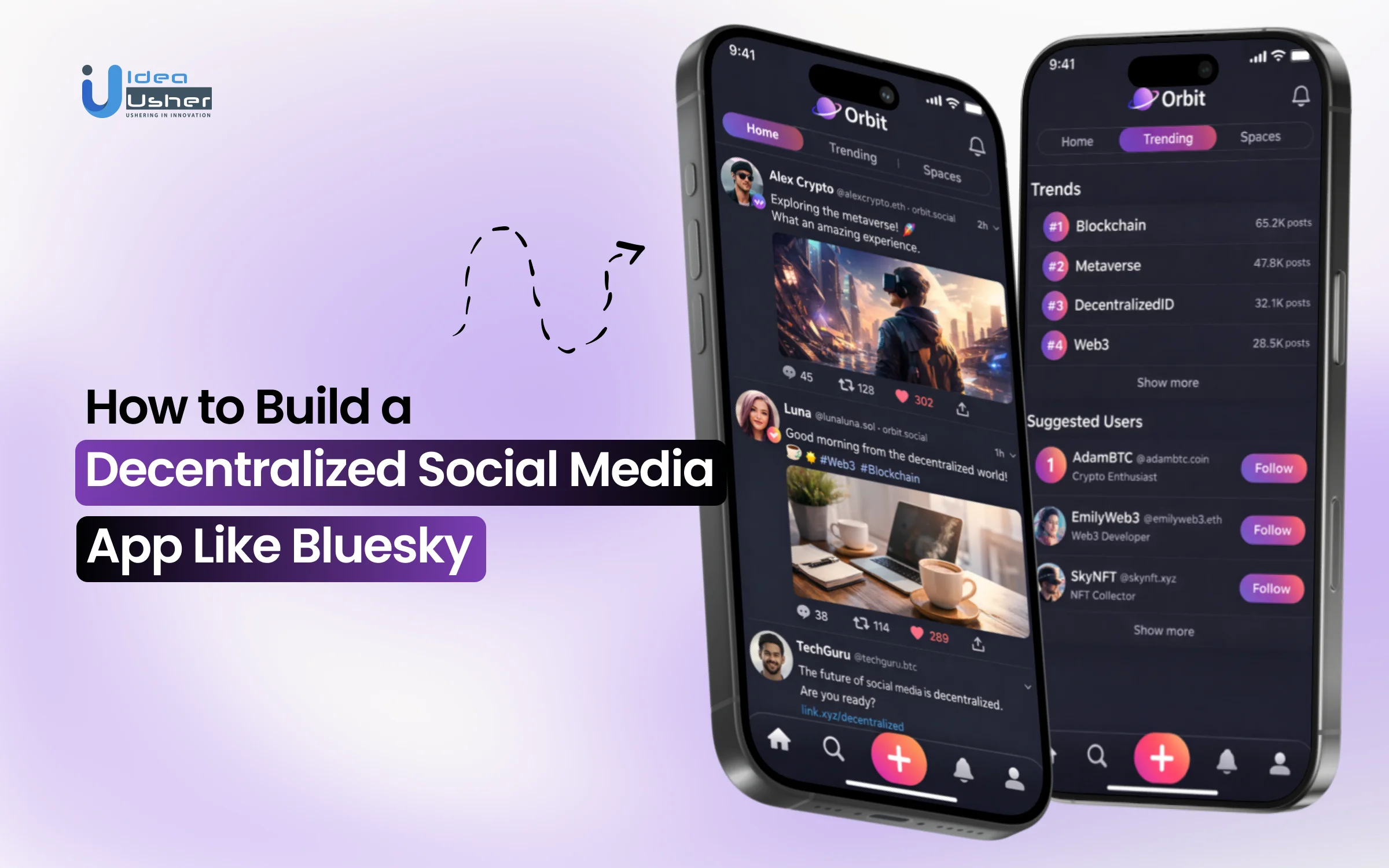
Decentralized social media platforms are gaining attention as users and developers look for alternatives to centralized networks that control data, algorithms, and moderation policies. Decentralized models allow communities and developers to build interoperable networks, encouraging businesses and developers to explore Bluesky-like decentralized social media app development where users have main control instead of relying on a single operator.
These platforms coordinate multiple system layers instead of relying on a single monolithic application. Identity frameworks, content distribution, moderation controls, and protocol interoperability must work together so users can interact across independent servers and apps. Platform effectiveness depends on how well these parts support decentralized communication while maintaining scalability, reliability, and a consistent experience.
In this blog, we explain how to build a decentralized social media app like Bluesky by examining core features, architectural considerations, and practical steps involved in developing scalable and interoperable decentralized social platforms.

What is a Decentralized Social Media App, Bluesky?
Bluesky is a decentralized microblogging social media platform designed to enable users to communicate, share content, and build online communities without relying on a single centralized company or server to control the entire network. Instead, it operates on an open protocol called the AT Protocol (Authenticated Transfer Protocol) that enables users to control their data, choose their own content moderation and algorithms, and interact across a network of independently operated servers within the same social network.
Core Concepts of Bluesky
- Decentralization: Bluesky distributes data and moderation across multiple providers, preventing platform lock-in. Users can move accounts, followers, and posts to another provider without loss.
- Algorithmic Choice: Bluesky does not force a single company-run algorithm. Users select from over 45,000 community-created custom feeds that curate content by interests like “Science” or “Popular With Friends.”
- Self-Verification: Users can use a personal domain name (e.g., @yourname.com) as a handle, providing built-in verification for individuals and organizations.
- Composable Moderation: Users can subscribe to independent “labeling services” or moderation lists that automatically filter out unwanted content, allowing for a personalized safety experience rather than a one-size-fits-all set of rules.
Business & Revenue Models of Bluesky
Bluesky operates as a Public Benefit Corporation (PBC), focusing on a “protocol-first” business model. Unlike traditional social media platforms, it prioritizes decentralized infrastructure over immediate profit maximization and has publicly committed to remaining ad-free.
Its revenue model shifts away from “surveillance capitalism” (selling user data for ads) toward direct user and developer payments:
Bluesky+ Subscription (Primary): A premium tier priced at approximately $8 per month.
- Features: Includes higher-quality video uploads, advanced profile customization (custom icons and frames), and detailed account analytics.
- No “Pay-to-Win”: Subscriptions do not provide algorithmic boosts or special verification badges, maintaining a level playing field for all users.
Custom Domain Services: Users can buy and manage custom domains (e.g., @yourname.com) to use as their handle. Bluesky earns revenue through domain registration partnerships (like Namecheap) and DNS management tools.
Infrastructure & Developer Tools:
- Paid API Tiers: Fees for developers requiring high-volume access to the AT Protocol.
- Enterprise Hosting: Custom solutions for organizations wanting to run their own independent servers within the network.
- Professional Support: Paid technical consulting and support for developers building on the protocol.
How does a Decentralized Social Media App Function?
Building a decentralized social media platform requires moving away from a central database to a modular, protocol-based architecture. Here is the technical working process of how these layers interact to create a user-owned social experience.

1. Identity Layer for Portable Accounts
Instead of a username and password stored on a company server, identity is anchored by Decentralized Identifiers (DIDs) and cryptographic key pairs.
- The Process: When a user signs up, they generate a private key (stored locally) and a public key. This identity is often registered on a blockchain or a distributed ledger.
- Portability: Because the “account” exists on a global ledger rather than a specific app’s database, the user can plug their identity into any compatible interface without losing their followers or post history.
2. Data Layer for Distributed Content Storage
Content isn’t stored in a silo; it is distributed across peer-to-peer networks.
- The Process: Media and long-form text are often hosted on protocols like IPFS (InterPlanetary File System) or Arweave.
- Content Addressing: Instead of a URL pointing to a server location (which can be deleted), files are assigned a unique hash based on their content. If the content exists anywhere on the network, the platform can retrieve it.
3. Feed Generation and Algorithm Layer
In decentralized systems, the “black box” algorithm is replaced by client-side or open-source discovery.
- The Process: Since data is public and structured (using standards like ActivityPub), different “Indexers” crawl the network to organize posts.
- User Choice: Users can choose between different algorithm providers. One might prioritize “Latest News,” while another uses a “Friends Only” logic, allowing the user to control their own attention.
4. Moderation and Trust Infrastructure
Without a central “God-mod,” moderation happens through reputation scores and community-driven schemas.
- The Process: Moderation is handled via “Attestations.” If a community flags a post as spam, that metadata is attached to the content hash.
- Subjective Filtering: Individual servers or users subscribe to specific “Moderation Lists.” You choose which filters to apply to your view, effectively outsourcing moderation to entities you trust.
5. Interoperability Between Independent Servers
This is the “Federation” model (like email), where different servers talk to each other using common languages.
- The Process: Protocols like ActivityPub or Nostr allow a user on Server A to follow and interact with a user on Server B.
- Relays: Servers act as relays that pass messages back and forth. Even if one server goes offline, the user’s data (stored in the Data Layer) and identity (Identity Layer) remain intact, allowing them to migrate to a new server instantly.
How the AT Protocol Powers Bluesky-like Social Media App?
The Authenticated Transfer (AT) Protocol powers Bluesky-like decentralized social media app by separating identity, data storage, and application layers. Unlike traditional platforms where a single company controls your identity and data, the AT Protocol separates the network into interoperable layers, allowing for true account portability and user choice.

A. What the AT Protocol Is and How It Works
At its core, the AT Protocol (or atproto) is a federated standard for large-scale social applications. It uses a “self-authenticating” data model, meaning every post or interaction is cryptographically signed by the user. This ensures that even if data is moved across different servers, its authenticity can always be verified without relying on a central authority.
Identity, Data Storage, and Relays
The protocol utilizes three critical components to manage user experience at scale:
- Identity (DIDs & Handles): Users are identified by Decentralized Identifiers (DIDs) which serve as stable, permanent IDs. These are mapped to human-readable Handles (domain names like @user.com), ensuring each member owns their identity independently of any host.
- Personal Data Servers (PDS): Each PDS serves as a member’s “home” in the cloud, hosting the data repository, managing signing keys, and handling requests to the network.
- Relays (The Firehose): To achieve “big world” scale, Relays crawl the network of PDS hosts and aggregate activity into a unified “firehose” of events. This allows developers to build search engines and global feeds without needing to query thousands of individual servers.
B. How Servers Interoperate in the Network
Interoperability is achieved through Lexicons, a schema-driven language that defines exactly how data (like a post, a like, or a follow) should be formatted.
- Schema-Driven Interaction: Because every server speaks the same “Lexicon,” a client app can read data from any PDS and display it seamlessly.
- The AppView Layer: While a PDS stores member data, AppViews provide the “view” of the network (e.g., global like counts or follower lists). This separation ensures that if one AppView becomes biased or fails, members can switch to another while keeping their data and social graph intact.
C. Advantages of Protocol-Based Social Media
Moving from a centralized platform to a protocol-based one offers several strategic business and user advantages:
- Algorithmic Choice: Members are not locked into a single “black box” algorithm. Each member can choose from multiple third-party feed generators to curate a personalized discovery experience.
- Account Portability: If a member is unhappy with a hosting provider (PDS), the entire account including posts, follows, and followers can be moved to a new provider without losing digital identity.
- Censorship Resistance: Because there is no single point of failure or central gatekeeper, it is significantly harder for any single entity to delete a user’s presence or suppress their content across the entire “Atmosphere.”
Global Market Growth of Decentralized Social Media Apps
The Global Decentralized Social Network Market is expected to grow from USD 9.4 billion in 2024 to USD 61.8 billion by 2034, with a CAGR of 20.6% from 2025 to 2034. This rapid growth prompts businesses and startups to explore building decentralized social media apps like Bluesky, allowing users more control over their data, identity, and interactions.

This shift is not merely theoretical; there is clear evidence of changing social media consumption patterns. Traditional platforms are losing users, who are moving to decentralized ecosystems in significant numbers.
- Explosive User Adoption: Bluesky grew from 25.9M to 41.4M users in 2025, a 60% annual increase. At peak moments, it added 1M users in 24 hours, proving the massive and immediate “appetite for exit” from centralized platforms.
- Deep Content Engagement: In 2025, Bluesky users generated 1.41B posts, which equals 61% of all content ever created on the platform. This interaction velocity shows decentralized users act as “power users” who create higher per-capita value than traditional networks.
- High “Stickiness” and Retention: Bluesky users spend over 10 minutes per session and view about 8.23 pages per visit. This engagement rivals X (Twitter) and confirms decentralized architecture as a sustainable model.
- The “Verified” Advantage: Over 309,000 accounts use custom domain handles. This behavior shows strong adoption of self-verification and portable identity and signals a clear revenue opportunity for decentralized apps.
The Opportunity for Founders
For a business looking to launch a Bluesky-like app today, the timing is perfect. Despite the rapid growth, decentralized social media still only represents a fraction of the total global social media population.
This “gap” creates a massive blue ocean opportunity. Open protocols like the AT Protocol let startups “bridge” into existing networks instead of building a user base from zero, which significantly lowers Customer Acquisition Costs (CAC). By building now, you secure a stake in the projected $61 billion future of the sovereign internet.
Core Features of Bluesky-like Decentralized Social Media App
Building a Bluesky-like decentralized social media app requires shifting from “platform as owner” to “protocol as infrastructure.” For investors, the value lies in creating a sovereign, portable ecosystem that eliminates traditional platform lock-in.

1. Decentralized User Identity and Profiles
A decentralized identity ensures that the user not the platform, owns their digital footprint. By using Decentralized Identifiers (DIDs), the profile remains intact even if the hosting provider changes.
- The “Handle” Strategy: Instead of @username, users map their identity to domains (e.g., @name.com). This turns a social handle into a professional asset.
- Cryptographic Verification: Every profile action is signed. This eliminates “impersonation” risks, a massive selling point for high-net-worth individuals and brands.
- Business Impact: This architecture reduces platform liability. The platform does not hold identity; it indexes identity, significantly lowering data-compliance friction.
2. Posts, Replies, and Threaded Conversations
Engagement must be fast, but data must be open. In a Bluesky-like model, every interaction is a “record” stored in a Personal Data Server (PDS) and broadcast to a relay.
- Cryptographic Content Integrity: Each post and reply uses a signed JSON object to prevent tampering by hosting providers and establish a “Source of Truth” for every conversation.
- Cross-Server Threading: Threads use URI links across servers, letting users on “Server A” reply to posts on “Server B” with zero latency or data fragmentation.
- The Firehose Advantage: Broadcasting public interactions to a real-time “Firehose” lets third-party developers build specialized search engines or analytics tools, exponentially increasing platform data utility.
- Metadata Facets: The platform stores links and mentions as byte-range metadata, preventing “link-jacking” and ensuring rich media always points to the correct, verified destination.
3. Follow Graph and Social Connections
The social graph is the most valuable “moat” in Web2, but in Web3, it is public and portable. This creates a more resilient network where the “value” stays with the user.
- Mutual Portability: If a user leaves the specific server, they take their 10,000 followers with them. This “anti-hostage” UX builds immense brand trust.
- Strategic Growth: Because the graph is open, third-party developers can build “Discovery Apps” on the protocol, driving free user acquisition to the ecosystem.
- Real-World Example: Imagine a professional transitioning from a “Corporate Server” to a “Private Server” without losing a single professional connection.
4. Custom Feed Algorithms
The “Black Box” algorithm is a major point of user frustration. By decoupling the feed from the platform, offer “Choice as a Service,” allowing users to pick their own discovery logic.
- Feed Marketplaces: Users subscribe to specific “Feed Generators” (e.g., “AI News Only” or “Positive Vibes”).
- The Business Play: User can monetize by hosting “Premium Feeds” or allowing brands to build transparent, opt-in promotional feeds that don’t feel like “spam.”
- Tech Depth: Feeds are hosted as independent services that query the “Firehose,” meaning the main app doesn’t bear the computational cost of every user’s custom logic.
5. Server Portability and Account Migration
True decentralization means “Exit Rights.” Users can migrate their data and followers between servers (PDS) seamlessly, ensuring no single entity can censor or “trap” a user.
- Trustless Hosting: Users can start on the “Starter Server” and, as they grow, move to their own self-hosted infrastructure without a minute of downtime.
- Infrastructure Moat: As an investor, the goal is to provide the best hosting experience (lowest latency, best UI), so users choose to stay, rather than being forced to stay.
6. Private Data Vaults (Encrypted DMs)
Standard DMs are a privacy nightmare for serious professionals. A “Private Vault” approach uses End-to-End Encryption (E2EE) where only the sender and receiver hold the keys.
- Security Architecture: Messages are stored as encrypted blobs. Even if the server is breached, the data is unreadable.
- Compliance: This “Zero-Knowledge” architecture protects against government data requests and privacy lawsuits, as platforms cannot hand over the plain text.
7. Community Moderation Tools
Decentralized moderation replaces a “Central Censor” with “Stackable Labels.” Users or organizations can run “Labeling Services” that flag content based on specific community standards.
- Independent Labeling Services: The platform supports third-party organizations that provide specialized moderation feeds, not just a single “Global Moderator.” Users can subscribe to a “Fact-Checker” labeler for news or an “Anti-Spam” labeler for a cleaner experience.
- User-Centric Filtering Controls: Investors should prioritize “Agency-Based Moderation.” Users choose which labelers to trust, creating a personalized safety net that avoids corporate censorship.
- The Reputation Engine: Cryptographically signed moderation reports help the system build a “Trust Score” for users across the network. This prevents “Ban Evasion” since reputation follows the DID (Decentralized Identifier) instead of just an email address.
- Strategic Cost Reduction: This model dramatically reduces internal moderation overhead. The platform provides infrastructure for communities to govern themselves, shifting human review costs to specialized third-party entities.
8. Developer-Friendly Open APIs
Being the “Standard” requires being the easiest to build on. Open APIs allow for a “Headless” ecosystem where anyone can build a new interface or tool on the protocol.
- SDK-First Approach: Providing robust TypeScript/Python SDKs ensures that the “next big feature” is built by the community at zero cost.
- The “Protocol Win”: When 50 different apps use the protocol, it becomes the “TCP/IP” of social media. The investment isn’t just an app; it’s the foundation of the new internet.
Bluesky-like Social Media App Development Process
Developing a Bluesky-like decentralized social media app involves creating a decentralized platform that prioritizes user control, open protocols, and transparent moderation. The process includes designing scalable architecture, integrating federated networking, and building engaging user features.

1. Consult & Define Decentralization Scope
Consult our experienced developers of Idea Usher to decide whether the platform needs full protocol-level decentralization or a federated model to support long-term member autonomy. Clarify whether openness serves as a fundamental feature or primarily as a marketing strategy for the target audience.
2. Choose the Protocol and Network Architecture
Choosing between AT Protocol and ActivityPub determines the technical direction and interoperability. A modular architecture that separates indexing from data storage enables independent server hosting and supports high-concurrency performance.
3. Design Identity and Data Portability System
Design a decentralized identity system using DIDs so members control their social graph. Enable portable data repositories to allow members to transfer their history between providers, strengthening platform trust and setting the business apart.
4. Build Core Social Networking Features
Develop a high-performance event stream for real-time interactions such as “skeets” or reposts. A microservices framework manages media and social metadata, keeping the frontend responsive during periods of high traffic.
5. Develop Custom Feed and Recommendation Engine
Implement “Algorithmic Choice” so members can subscribe to third-party feed generators instead of relying solely on chronological feeds. This flexibility enables the community to curate their own experiences and reduces platform moderation and curation responsibilities.
6. Implement Moderation and Governance Tools
Deploy a “Composable Moderation” stack that lets members select their own labeling services and blocklists. This decentralized model shifts governance to the community, supports brand safety, and upholds free expression.
7. Launch With Early Community Access
Execute a high-signal beta by inviting developers to build on the API before public launch. This protocol-first approach fosters a strong third-party ecosystem, ensuring the platform offers robust utility and tools at launch.
Decentralized Social Media App Development Cost
Building a Bluesky-like decentralized social media app involves unique infrastructure costs, specifically around protocol development and decentralized data storage, which differ from traditional centralized platforms.
| Development Phase | MVP (Entry Level) | Enterprise (Pro Level) | Key Deliverables |
| Protocol & Architecture | $8,000 – $15,000 | $40,000 – $90,000 | Selection of AT Protocol/ActivityPub, PDS setup, and relay architecture. |
| Decentralized ID (DID) | $5,000 – $10,000 | $25,000 – $55,000 | Identity management system, domain-handle mapping, and data portability tools. |
| Core Social Engine | $25,000 – $45,000 | $130,000 – $250,000 | High-concurrency event stream, media blob storage, and social graph indexing. |
| Algorithmic Feed Logic | $7,000 – $12,000 | $45,000 – $90,000 | Custom feed generators, user-selectable algorithms, and discovery engines. |
| Trust & Safety Stack | $6,000 – $12,000 | $50,000 – $110,000 | Labeling services, composable moderation tools, and automated filter APIs. |
| Infrastructure & DevOps | $5,000 – $10,000 | $35,000 – $75,000 | Personal Data Server (PDS) hosting, relay nodes, and global load balancing. |
| Launch & Ecosystem | $3,000 – $7,000 | $15,000 – $40,000 | App Store deployment, open API documentation, and developer portal. |
| Total Estimated Cost | $59,000 – $111,000 | $340,000 – $450,000+ | A sovereign, protocol-based social networking ecosystem. |
Critical Cost Drivers in 2026
The economics of Bluesky-like decentralized social media apps are heavily influenced by the “Big Three” of 2026: data sovereignty, protocol maintenance, and AI-driven safety.
- Relay and Indexer Resource Demands: Decentralized networks use powerful “Relays” to crawl the network. Running a high-scale indexer costs $3,000 to $10,000 monthly in cloud compute to keep global content searchable and synced in real time.
- Personal Data Server (PDS) Scalability: “User Repositories,” where members own their data, require high-concurrency database architecture. Storage costs stay low, but I/O throughput for thousands moving data between servers can add 15% to 25% to infrastructure costs over standard apps.
- Composable Moderation APIs: Decentralized environments pay for external “Labeling Services” to filter content. Third-party trust layers cost $0.80 to $2.00 per 1,000 active members to maintain a clean, advertiser-friendly environment without a large internal team.
- Protocol Governance and Security: Maintaining a custom protocol fork or integrating complex DID (Decentralized Identifier) systems requires senior blockchain and cryptography engineers. These specialists often command salaries 30% higher than standard full-stack developers, impacting the R&D budget.
- Storage and Media Blobs: Hosting decentralized images and video (blobs) across nodes requires a robust Content Delivery Network (CDN) strategy. In 2026, media egress fees range from $0.03 to $0.09 per GB and scale aggressively during viral growth.
Challenges in Building a Decentralized Social App
Building a Bluesky-like decentralized social media app presents challenges such as federation complexity, data moderation, scalability, and security. Our developers address these issues using robust architecture, efficient protocols, strong moderation tools, and scalable infrastructure solutions.

1. Network Latency and Real-Time Syncing
Challenge: Synchronizing data across thousands of independent servers creates significant “lag,” threatening the instantaneous “real-time” feel users expect from social media.
Solution: Our developers utilize High-Performance Relays that aggregate the “Firehose” of data into optimized caches. This architecture ensures sub-second global content delivery while maintaining the decentralized integrity of the underlying protocol.
2. Decentralized Search Indexing
Challenge: Querying “mentions” or “hashtags” requires more computing power when data fragments across a heterogeneous network instead of a single SQL cluster.
Solution: We architect AppView Aggregators that consume the network “Firehose.” These services index distributed records into a searchable Elasticsearch layer, providing users with high-speed discovery while the raw data remains decentralized.
3. Protocol Evolution and Versioning
Challenge: Implementing “breaking” feature updates across an open protocol becomes difficult without the ability to require independent server owners to upgrade their software.
Solution: We utilize Extensible Lexicons (schema-based definitions). This allows our developers to roll out new features like video or polls via forward-compatible schemas, ensuring the network stays unified even if some nodes lag behind.
4. Sybil Resistance and Bot Mitigation
Challenge: Lacking centralized KYC or phone verification, decentralized networks become highly vulnerable to automated bot swarms that degrade the Firehose.
Solution: Our team integrates Proof-of-Stake Identity or “Web of Trust” filters. By analyzing the social graph’s cryptographic signatures, our developers programmatically deprioritize traffic from unverified or “isolated” nodes to maintain high-signal environments.
Conclusion
Building a Bluesky-like decentralized social media app is a complex but rewarding endeavor that puts power back into the hands of users. By leveraging the AT Protocol, developers can create scalable, interoperable platforms that prioritize transparency and data ownership. While the technical challenges are significant, the demand for alternatives to traditional walled gardens continues to grow. Ultimately, building for the fediverse isn’t just about coding a new app; it is about contributing to a more open, user-centric digital future where online communities truly belong to their members.
Why Choose IdeaUsher for Decentralized Social Media Development?
Building a platform like Bluesky requires reimagining social media through the lens of decentralized protocols, portable identity, and user-controlled algorithms, moving beyond traditional walled gardens.
We build blockchain-powered products across industries, specializing in performance systems, model integration, and scalable infrastructure. Our expertise helps us create decentralized social apps that balance protocol compliance, user sovereignty, and platform sustainability.
Our ex-FAANG and MAANG engineers bring over 500,000+ hours of hands-on blockchain development experience, allowing us to architect federated social platforms aligned with open protocols, algorithmic transparency, and community governance models.
Why Hire Us:
- Protocol & Blockchain Expertise: We engineer decentralized ecosystems, deploy AT Protocol or ActivityPub, and maintain seamless identity portability as users move between instances with their complete social graph.
- Custom Algorithmic Choice: We build proprietary recommendation engines that users can customize or replace, offering platforms with superior transparency and a proprietary edge over black-box algorithms.
- Full-Cycle Ownership: We handle infrastructure selection, protocol compliance, data portability standards, and scalable architecture to make your decentralized social app technologically advanced and commercially ready from launch.


FAQs
A.1. The Authenticated Transfer (AT) Protocol acts as the backbone of the “Federated Social” model. It enables account portability and algorithmic choice. Developers who build on the AT Protocol ensure that users own their identity and move their data between servers without losing their social graph.
A.2. Decentralized systems use “Relays” and “App Views” to aggregate content from independent personal data servers. This architecture separates data storage from the user interface. Developers can build custom feeds while keeping the underlying content open and accessible across the network.
A.3. A Personal Data Server (PDS) works as the user’s private digital vault that hosts posts and media independently from the main app interface. This model reduces platform level responsibility for data ownership and gives users full control over their content.
A.4. Developers maintain performance through “Big Graphs” or aggregators that index distributed data in real time. A high speed indexing layer allows apps to deliver fast scrolling and feed updates similar to centralized platforms like X (Twitter) while the data remains decentralized across the network.


