


Admissions and enrollment teams face constant pressure to respond quickly, guide applicants, and support students across various touchpoints. As inquiries increase and admissions processes become complex, manual workflows struggle to keep up, leading to delays and inconsistency and driving interest in AI admissions automation systems that deliver faster responses, better guidance, and more reliable engagement.
AI agents in this context act less like chatbots and more like workflow coordinators. They can handle repetitive inquiries, route cases intelligently, surface relevant information, and assist staff with decision support across admissions, enrollment, and ongoing student services. The effectiveness of these agents depends on how well they integrate with CRMs, SIS platforms, and institutional policies while maintaining accuracy, transparency, and human oversight.
In this blog, we explain how AI agents work for admissions, enrollment, and student support systems by breaking down their core capabilities, system architecture, and practical considerations involved in deploying AI responsibly within education workflows.
What Is an AI Agent in Higher Education Systems?
An AI Agent is an intelligent software system designed to autonomously perform tasks, make decisions, and orchestrate complex workflows across campus systems. Unlike traditional chatbots that merely react to user prompts with scripted information, AI agents are proactive digital teammates.
They use Large Language Models (LLMs) to reason through problems, maintain context across interactions, and use external tools like Student Information Systems (SIS) or Learning Management Systems (LMS) to take real actions on behalf of students and staff.
- Autonomy: They can work toward goals such as “convert inquiries to applicants”, with minimal human intervention.
- Proactivity: Instead of waiting for a query, they can monitor student data to identify at-risk learners and reach out with resources proactively.
- Tool Use: Agents can securely read and write data in official institutional platforms like Salesforce Education Cloud, Canvas, or Workday Student.
- Contextual Reasoning: They adjust their guidance based on a student’s specific role, degree plan, or academic history rather than offering generic FAQs.
Why Universities Are Moving Beyond Rule-Based Chatbots?
Universities are moving beyond rule-based chatbots to provide smarter, context-aware support. AI admissions automation systems now enable personalized learning, scalable advising, and stronger student engagement across campus.

1. From “If-Then” Logic to Fluid Reasoning
Traditional chatbots use fixed decision trees and fail when a student’s question does not match a predefined keyword. Modern AI agents leverage Large Language Models (LLMs) to interpret intent, nuance, and slang, enabling more natural conversations and reducing unhelpful responses.
2. Scaling Beyond Simple FAQs
Rule-based bots are limited to simple questions such as “Where is the library?” In contrast, AI agents can manage complex, multi-step workflows, such as cross-referencing a student’s transcript with degree requirements to recommend a specific course schedule. These tasks are too variable for static rules.
3. The Shift from Reactive to Proactive Support
Traditional bots respond only when prompted by the user. AI agents integrate with real-time institutional data and can proactively contact students who have missed deadlines or show signs of academic difficulty. This shifts support from on-demand information to active intervention.
4. Reducing the Administrative Burden
Updating a rule-based bot requires manual edits to numerous dialogue flows whenever a policy changes. AI agents can reference updated policy documents or handbooks, automatically adjusting their logic and responses without ongoing manual reprogramming by IT staff.
5. Autonomous Action Across Campus Systems
Traditional chatbots are limited to the chat window. AI agents serve as digital teammates with the ability to access systems such as the Student Information System (SIS) or Learning Management System (LMS) to perform tasks, including registering a student for a lab or updating a financial aid record, rather than only providing links to forms.
Why are AI-Powered University Systems Growing Massively?
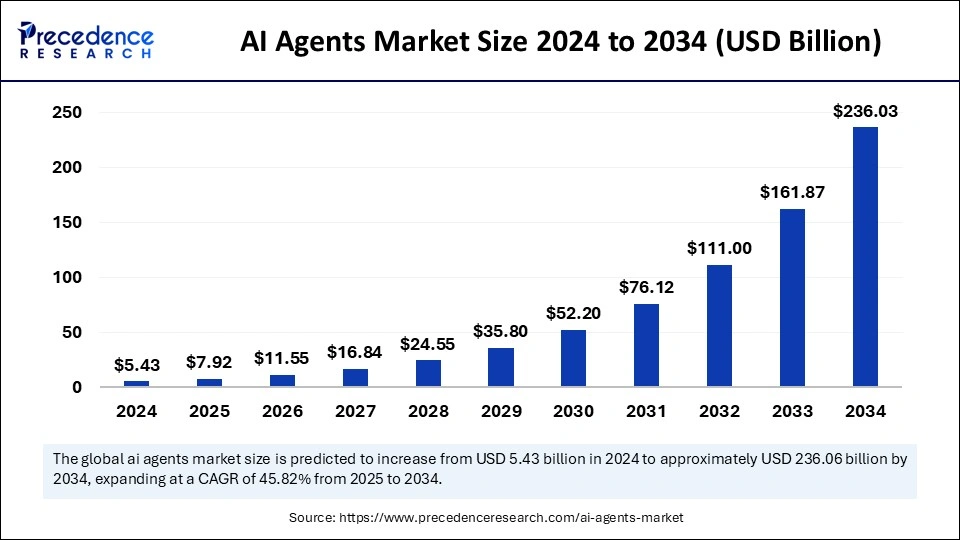
The global AI agents market size accounted for USD 5.43 billion in 2024 and is predicted to increase from USD 7.92 billion in 2025 to approximately USD 236.03 billion by 2034, expanding at a CAGR of 45.82% from 2025 to 2034. This explosive growth reflects universities’ increasing reliance on AI agents to automate complex workflows, personalize student services, and scale operations without proportional increases in staff or cost.
A majority of students are receptive to AI-driven support, with 77% willing to use AI agents for school processes and 60% likely to engage if responses are timely and accurate.
AI support is especially valued during admissions, where 62% of students say they would benefit from better AI-powered assistance and 52% would be more likely to apply if information were easier to access through digital channels.
Personalization also influences application decisions, with 46% of students saying they would be more likely to apply if the admissions process were more personalized and wait times were shorter.
63% of students wish they had access to 24/7 support, while 56% currently lack access to round-the-clock answers to common questions, a gap AI agents are directly addressing.
More than 80% of graduate students will enroll at the institution that responds with an admissions offer first, and 25% of prospective graduate students expect a personal response within minutes of submitting an inquiry, a pace only AI agents can consistently sustain at scale.
How AI Agents Are Different from Chatbots Used by Universities?
AI admissions automation systems go beyond traditional university chatbots by acting autonomously across systems. They understand context, make decisions, and execute tasks end-to-end, rather than simply responding to predefined questions.
| Comparison Area | Traditional University Chatbots | AI Agents in University Automation Systems |
| Core Function | Primarily designed to answer FAQs or route users to links based on predefined scripts. | Designed to reason, decide, and act across admissions, enrollment, and student support workflows using live institutional data. |
| Intelligence Model | Relies on static decision trees and keyword matching, breaking when queries fall outside expected patterns. | Uses intent detection, contextual reasoning, and policy evaluation to handle non-linear, multi-step student journeys. |
| System Integration Depth | Usually disconnected from core university systems or limited to surface-level lookups. | Deeply integrated with SIS, CRM, LMS, ERP, and finance systems to read, update, and validate student records in real time. |
| State and Memory | Treats each conversation as isolated, with no awareness of prior interactions or progress. | Maintains persistent state across sessions, remembering application status, resolved holds, payments, and prior interventions. |
| Proactivity | Operates reactively, responding only when a student initiates a query. | Monitors system events and behavioral signals to proactively intervene when deadlines are missed, holds appear, or engagement drops. |
| Operational Capability | Stops at information delivery, requiring students or staff to complete actions manually. | Executes actions such as checking holds, triggering workflows, initiating payments, scheduling meetings, and escalating issues. |
| Policy Handling | Requires manual updates whenever rules, deadlines, or requirements change. | Grounded in institutional policies and documents, allowing logic and responses to adapt automatically as rules evolve. |
| Governance and Trust | Limited visibility into decisions or responses once delivered. | Provides full audit trails of data access, decisions, actions, and outcomes to support compliance and accountability. |
End-to-End Architecture of an AI Agent for University Operations
An end-to-end AI admissions automation system enables universities to automate operations intelligently. It integrates data, reasoning, and action layers to streamline admissions, academics, student services, and administrative decision-making at scale.
1. User Interaction Layer (The Interface)
This is the “front door” where students and staff engage. Unlike static bots, agents here maintain omnichannel persistence, meaning a conversation started on a WhatsApp nudge can continue seamlessly on the university portal.
- Channels: Web widgets, mobile apps (Canvas/Workday), SMS/WhatsApp, and voice-enabled IVR.
- Input Processing: Natural Language Understanding (NLU) to parse intent, sentiment, and urgency (e.g., distinguishing a casual FAQ from a financial crisis).
Example
Interaction: Student types on WhatsApp: “Do I have any holds on my account that stop me from registering?”
2. Intelligence Layer (The Brain)
The intelligence layer, the core of the AI admissions automation system, is where reasoning happens. It doesn’t just “match keywords”; it solves problems.
- LLM Core: Hosted model (GPT, LLaMA, or fine-tuned open-source model) responsible for Natural Language Understanding (NLU) and Generation (NLG).
- Retrieval-Augmented Generation (RAG) Pipeline:
- Vector Database: Stores embeddings of the University Handbook, Course Catalogs, and Policy Documents.
- Semantic Search: Retrieves relevant context chunks to ground the LLM and prevent hallucinations.
- Policy & Guardrails: A layer of “logic gates” that ensures the agent follows FERPA (e.g., “FERPA rules: Do not share GPA with a third party”) regulations and ethical guidelines before responding.
Example:
Orchestrator: Authenticates student via phone number. Detects intent (Account Hold Check). Appends role (Student) and Semester (Fall 2024) to context.
Intelligence:
- RAG retrieves policy: “Students with balances over $500 cannot register.”
- LLM formulates an internal query: check_hold_status(student_id=123).
Action: Calls the Integration Layer -> SIS (Banner) API to fetch financial holds.
3. Integration Layer (The Memory & Context)
This layer connects the AI admissions automation system to the “Source of Truth.” Without this, the agent has no identity.
- SIS (Student Information System): Accesses transcripts, enrollment status, and GPA (e.g., Oracle, Ellucian, Workday).
- LMS (Learning Management System): Checks assignment completion or course engagement (e.g., Canvas, Moodle).
- CRM/ERP: Tracks recruitment history or employee payroll data (e.g., Salesforce, SAP).
Example:
Integration: SIS returns: Hold: Outstanding Library Fine ($50).
Intelligence: LLM interprets the result. $50 is less than $500, so the student can register, but they have a minor hold.
Action: Triggers a notification task: “Pay fine via Payment Portal.”
4. Action & Orchestration Layer (The Hands)
This is what makes it an Agent rather than a Chatbot. It executes multi-step workflows across the systems mentioned above.
- Task Execution: Using “Tool Calling” or APIs to actually do things like booking an advising appointment or processing a transcript request.
- Human-in-the-Loop (HITL) Escalation: If the agent identifies a high-risk situation (e.g., mental health flags or complex legal queries), it automatically pauses and hands the full context over to a human staff member.
- Autonomous Loops: The agent follows up on its own actions (e.g., “I noticed you haven’t signed the form I sent yesterday, would you like me to resend it?”)
Example:
Interaction: Agent responds via WhatsApp: “You have a library fine of $50, but it will not block your registration. You can pay it here [Link] to clear the hold.”
5. Data & Observability Layer (The “Spine”)
This layer underpins every other component of the AI admissions automation system and ensures the system remains reliable, auditable, and continuously improving as usage scales across the university.
Data Warehouse: All conversations, decisions, system actions, and human escalations are logged centrally. This creates a complete audit trail required for institutional accountability and compliance.
Analytics:
- Operational: “How many tuition queries were handled without human intervention?”
- Academic: “What are the most common questions about Course XYZ?”
LLM Ops: Prompt performance, response accuracy, latency, and token usage are continuously monitored in the AI admissions automation system to control costs and maintain response quality at scale.
Example:
- Follow-up Interaction: Student attempts course registration at a later time.
- Observability Check: Agent reviews prior interaction logs and payment status.
- State Validation: Confirms the previously flagged $50 library fine has been paid.
- Policy Re-evaluation: No active holds exceed the $500 registration threshold.
- Decision Outcome: Registration is permitted.
- Audit Record: Payment verification, decision logic, and timestamp are logged for compliance and future checks.
How AI Agents Work Across the Admissions Lifecycle?
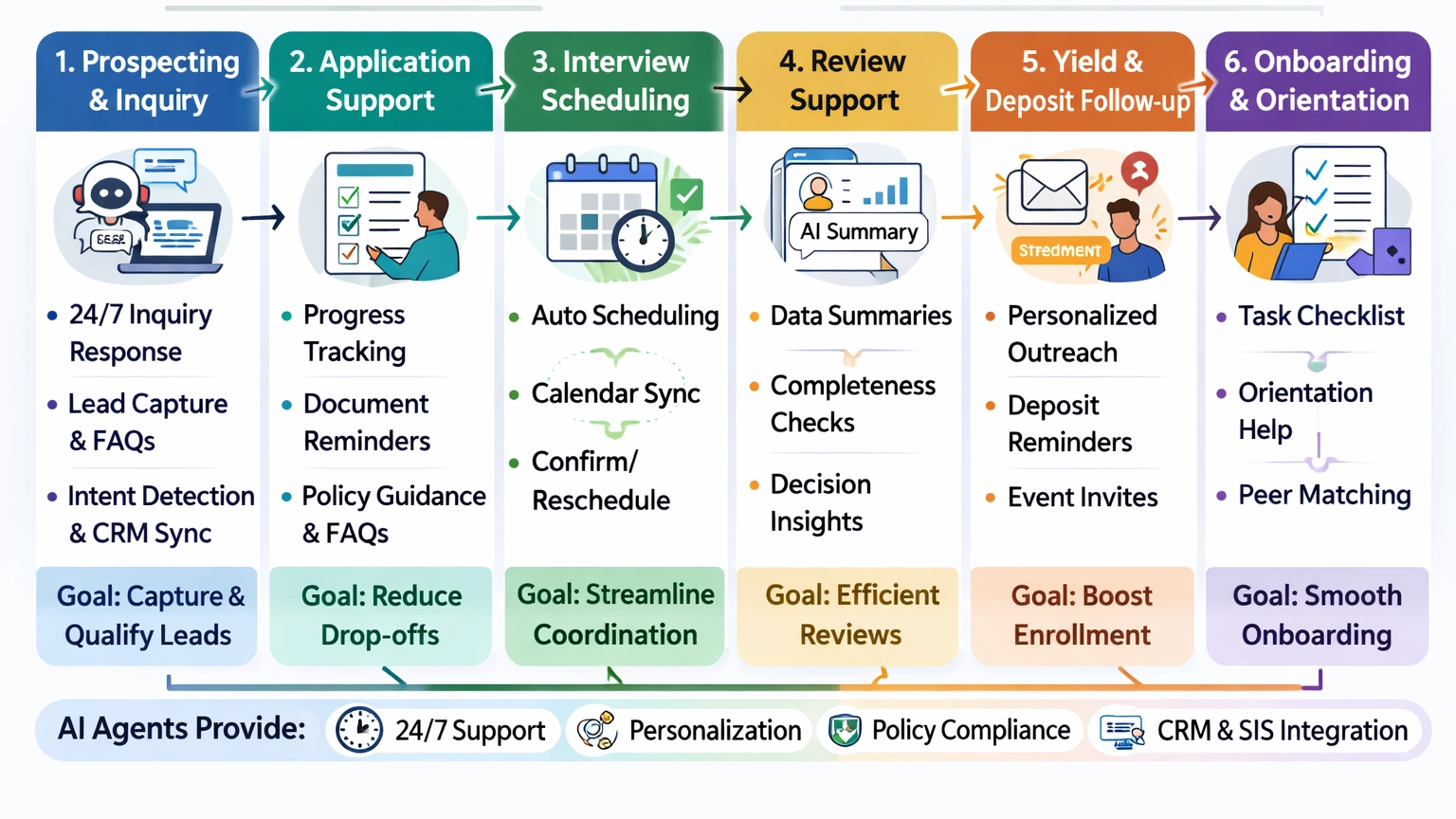
AI agents support admissions by orchestrating intent detection, policy evaluation, and system actions across the AI admissions automation system at every stage of the applicant journey, from first inquiry through onboarding and enrollment readiness.
1. Prospecting & Inquiry Management
At the top of the funnel, AI agents normalize inbound inquiries, detect intent, and create structured prospect context, ensuring early interactions translate into qualified leads rather than isolated conversations.
Goal: Capture interest, provide instant information, and qualify leads with contextual understanding.
- 24/7 Availability: They engage visitors immediately, answering questions about programs, application requirements, deadlines, and campus life, regardless of time zone.
- Lead Capture: If a prospective student asks a question, the agent prompts them to leave an email address or phone number to receive a full brochure or application guide, converting anonymous visitors into known leads.
- Intent Recognition: Advanced agents can detect high-intent behavior. For example, if a user asks, “Does this program require the GRE?” the agent flags this prospect as “academically focused” and tags them in the CRM for future follow-up.
2. Application Support & Guidance
During application stages, AI agents monitor progress, identify missing requirements, and provide policy-aligned assistance, reducing drop-offs by proactively guiding applicants through complex, multi-step processes.
Goal: Reduce application drop-offs and ensure submission completeness.
- Document Reminders: AI agents monitor application progress. If a student starts an application but hasn’t uploaded their transcript, the agent sends a proactive SMS or email reminder with direct links to complete the step.
- FAQ Automation: They handle thousands of repetitive questions simultaneously (e.g., “How do I report my AP scores?” or “What is the FAFSA code?”), preventing bottlenecks in the admissions office.
- Essay & Portfolio Tips: While agents don’t write essays, they can provide general guidance on prompts, suggest resources, and answer technical questions about portfolio upload formats.
3. Interview Scheduling & Coordination
AI agents streamline coordination by integrating with calendars and applicant records, automating scheduling, confirmations, and rescheduling while maintaining a consistent view of interview status across systems.
Goal: Eliminate scheduling friction between applicants and admissions staff.
Automatic Scheduling:
AI agents integrated with calendar systems (like Google Calendar or Outlook) allow prospective students to self-schedule interviews, campus tours, or alumni meetings.
The agent handles time-zone conversions, sends confirmation emails, and provides automatic rescheduling options, eliminating the endless email chains typically associated with coordination.
4. Application Review Support
For admissions teams, AI agents act as decision support systems, summarizing applicant data, validating completeness in the AI admissions automation system, and reducing manual effort without replacing human judgment in final admission decisions.
Goal: Help admissions teams manage large application volumes efficiently.
- Data Summarization: Before a human admissions counselor opens a file, an AI agent can summarize the key data points: GPA trends, extracurricular highlights, and any flagged issues (e.g., missing documents).
- Initial Screening (Routine Checks): Agents can verify that applications are complete, ensuring that no file goes to committee without the necessary letters of recommendation or transcripts.
Note: High-stakes decisions regarding acceptance are nearly always kept with human reviewers to ensure holistic, equitable judgment.
5. Yield Activities & Deposit Follow-Up
After admission, AI agents track enrollment signals, segment admitted students, and initiate timely, policy-aware outreach to improve conversion from acceptance to confirmed enrollment.
Goal: Convert admitted applicants into enrolled students by sending personalized nudges:
- Event Invitations: AI agents segment admitted students based on their stated interests (e.g., engineering vs. liberal arts) and send personalized invites to specific webinars or “meet the dean” events.
- Deposit Deadline Reminders: As deadlines approach, agents send gentle, automated reminders. They can also handle the influx of last-minute questions about financial aid or housing that typically flood the office right before deposit deadlines.
6. Onboarding & Orientation
As students transition into enrollment, AI agents coordinate onboarding tasks, track completion status, and deliver contextual guidance, ensuring readiness without overwhelming students or administrative teams.
Goal: Ensure a smooth transition from admitted student to registered student.
Task Management: New students often have a long checklist (health forms, placement tests, ID photos). AI agents act as a “concierge” service, guiding students through these tasks. They can answer questions like, “Where do I upload my immunization records?” or “When does orientation start for international students?”
Community Building: Some institutions use AI agents to connect incoming students with similar majors or interests, facilitating peer-to-peer interaction before they arrive on campus.
How AI Agents Drive Enrollment & Fee Conversion?
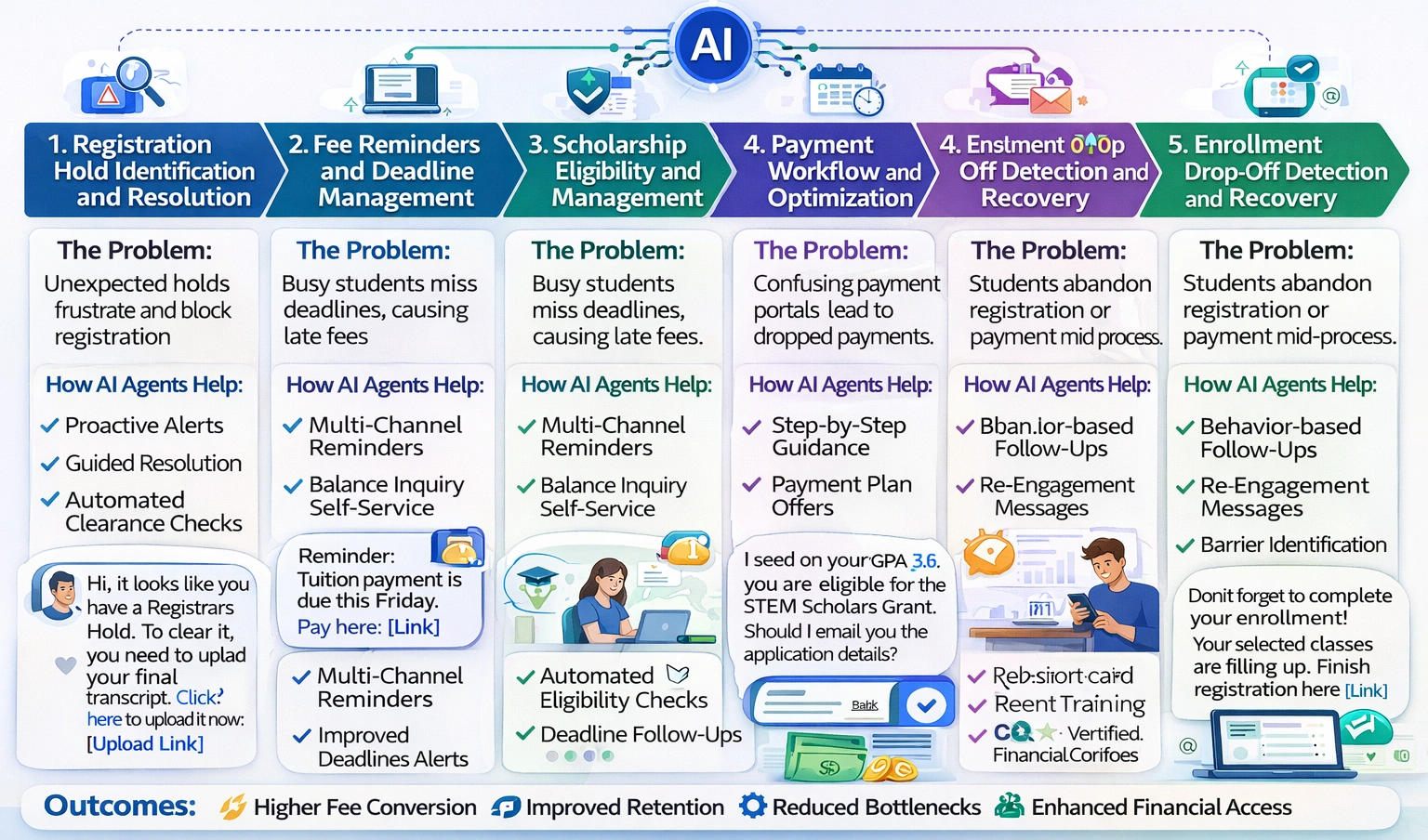
AI agents remove friction between student intent and enrollment completion by identifying blockers, guiding resolution steps, and orchestrating payments, holds, and follow-ups across registration and finance systems.
1. Registration Hold Identification and Resolution
The Problem: Students often register for classes only to hit a wall—a hold they didn’t know existed (e.g., missing health form, unpaid parking ticket, advising requirement). They often give up or forget to resolve it.
How AI Agents Help:
- Proactive Notification: The moment a student logs into the portal or starts the registration process, an AI agent can pop up and say, “I see you have a Registrar Hold. It’s because we’re missing your final transcript. Here’s the link to upload it right now.”
- Guided Resolution: Instead of just telling the student they have a hold, the agent acts as a concierge. It explains exactly which office to contact, provides a direct email, or even opens a ticket on the student’s behalf to the bursar’s or health services office.
- Automated Clearance Checks: The agent continuously monitors the student information system. As soon as the hold is resolved (e.g., the health form is uploaded), the agent sends a text: “Great news! Your hold has been cleared. You can now register for classes here: [Link].”
2. Fee Reminders and Deadline Management
The Problem: Students (and parents) are busy. Deadlines sneak up, leading to late fees or dropped courses.
How AI Agents Help:
- Multi-Channel Sequencing: AI agents don’t just send one email. They orchestrate a sequence:
- 2 Weeks Out: Email reminder: “Your tuition payment is due on [Date].”
- 1 Week Out: SMS reminder: “Heads up! Fees due in 7 days. Pay here: [Link].”
- 24 Hours Out: Push notification via the school app: “Deadline TOMORROW. Avoid late fees.”
- Balance Inquiry Self-Service: Students can ask the agent via chat or text, “How much do I owe?” and the agent pulls the real-time balance from the ERP system, providing instant transparency without a staff member needing to look it up.
3. Scholarship Eligibility and Management
The Problem: Students often don’t apply for scholarships because the process is confusing, or they assume they aren’t eligible. Institutions struggle to ensure institutional aid is fully utilized.
How AI Agents Help:
- Eligibility Triage: A student can tell the agent, “I’m a biology major from Texas with a 3.5 GPA.” The agent scans the scholarship database and replies, “Based on your profile, you are eligible for the ‘Future Scientists Grant’ and the ‘Texas Excellence Scholarship.’ Would you like me to email you the application requirements?”
- Deadline-Driven Engagement: The agent tracks upcoming scholarship deadlines. If a student has been marked as “high potential” for a specific scholarship but hasn’t applied, the agent sends a personal nudge: “Don’t forget: The [Scholarship Name] application closes on Friday. You are a strong candidate for this. Click here to start your essay.”
- Auto-Renewal Checks: For continuing students, agents can verify GPA and credit hour requirements to ensure they maintain their merit scholarships, alerting them if they are in danger of falling below the threshold before grades are final.
4. Payment Workflow and Optimization
The Problem: Complicated payment portals, forgotten login credentials, or confusion about payment plan options cause students to abandon the payment process.
How AI Agents Help:
- “Concierge” Mode: When a student clicks “Pay Now,” the agent can guide them step-by-step. “Click the ‘Make a Payment’ tab. Select the term ‘Fall 2025’. Enter the amount shown.”
- Payment Plan Opt-In: If a student hesitates or asks about the total due, the agent can immediately present the installment plan option: “I see the balance is $5,000. Would you prefer to set up a 4-month payment plan for $1,250/month instead? I can enroll you right now.”
- International Payment Support: For international students, the agent can explain currency conversion, international wire instructions (like Flywire), and expected processing times, reducing anxiety and support tickets to the international office.
5. Enrollment Drop-Off Detection and Recovery
The Problem: Students start the enrollment process they register for classes, or start the payment but then close the browser. This is the enrollment equivalent of “abandoned cart” in e-commerce.
How AI Agents Help:
- Behavioral Tracking & Triggers:
- Scenario A (Registration Drop-off): A student adds classes to their cart but doesn’t hit “Submit.” The agent waits 2 hours, then sends a text: “Hi [Name], I noticed you left your schedule unfinished. Your selected classes still have seats, but they are filling up. Click here to complete your registration: [Link].”
- Scenario B (Payment Drop-off): A student clicks into the payment portal but logs out without paying. The next day, the agent asks via SMS: “Was there an issue with your payment yesterday? If you need help with the portal or want to explore a payment plan, I’m here to help.”
- Barrier Identification: When the agent re-engages the student, it can ask, “What stopped you from finishing?” If the student says, “I couldn’t remember my parents’ login,” the agent can provide the direct link for parent PIN recovery or guest access setup.
How AI Agents Power Student Support & Retention?
AI agents support students beyond enrollment by resolving academic and administrative issues, monitoring engagement signals, and enabling proactive interventions that improve satisfaction, persistence, and long-term student retention across the university lifecycle.
1. The 24/7 Academic Assistant
The Problem: Students often have simple academic questions that arise at night or on weekends. Waiting 24 hours for an advisor to respond can lead to missed deadlines or unnecessary anxiety.
How AI Agents Help:
- Instant Answers: Agents handle high-volume, repetitive questions instantly.
- “When is the drop/add deadline?”
- “What are the prerequisites for Organic Chemistry II?”
- “How many credits do I need to be a junior?”
- Degree Audit Self-Service: Integrated with the student information system, an AI agent can allow a student to ask, “What requirements am I still missing for my major?” The agent translates the complex, coded language of a degree audit into plain English: “You still need one more upper-level history elective and a lab science. Here are three courses that fit that bill next semester.”
- Tutoring & Resource Connection: If a student asks about a difficult topic, the agent can instantly book them into the tutoring center or share links to relevant academic resources (like writing center guides or Khan Academy videos).
2. IT and Admin Support
The Problem: IT and administrative hurdles (e.g., “I forgot my password,” “How do I update my address?”) are major sources of student frustration. If these aren’t resolved quickly, they impede the student’s ability to learn.
How AI Agents Help:
- Password Reset Automation: This is the most common IT ticket. AI agents can guide students through multi-factor authentication and password resets step-by-step, resolving 80% of these tickets without any human involvement.
- Portal Navigation: Students often get lost in the labyrinth of university portals. An agent can provide direct deep links: “To update your address, go to the ‘Student Self-Service’ tab, click ‘Personal Information,’ then ‘Update Address.’ Click here to jump there now: [Deep Link].”
- Document Requests: Agents handle requests for official transcripts, enrollment verifications, or tax forms (1098-T) by providing the correct link and explaining any associated fees or processing times.
3. Proactive Alerts
The Problem: Students often don’t know what they don’t know. They may be unaware of an upcoming advising hold, a library fine, or a career fair happening next week.
How AI Agents Help:
- Personalized Campaigns: AI agents don’t just blast generic messages. They send targeted, behavior-based alerts.
- Registration Window: “Your registration time ticket opens tomorrow at 9 AM. Meet with your advisor today to get your PIN.”
- Library Books: “Your library book is due in 3 days. You can renew it here: [Link].”
- Campus Events: “I see you’re a marketing major. The Marketing Club is hosting a networking night with local agencies this Thursday. Interested?”
- Wellness Checks: Some institutions use agents to check in on student wellness. A simple, non-intrusive SMS: “How are you feeling about your coursework this week? (Reply: Good / Okay / Stressed).” If a student replies “Stressed,” the agent can immediately share links to counseling services or wellness resources.
4. The Early Retention Risk Detection
The Problem: By the time a student fails a class or withdraws, it is often too late to intervene. Institutions need to identify at-risk students before they fall off a cliff.
How AI Agents Help:
- Behavioral Pattern Analysis: AI agents monitor digital engagement signals that correlate with dropout risk:
- LMS Inactivity: A student hasn’t logged into the Learning Management System (Canvas/Blackboard) for 10 days.
- Missed Assignments: A student has failed to submit two major assignments in a row.
- Low Attendance: A student’s ID card swipes show they haven’t attended in-person classes for two weeks.
- Automated Outreach Triage: When these signals are detected, the AI agent initiates a “soft touch” intervention automatically:
“Hi [Name], I noticed you haven’t logged into your History 101 class in a while. Your professor has office hours tomorrow at 2 PM. Can I help you schedule a time to meet?”
- Success Center Referral: If the student expresses confusion or frustration, the agent can instantly create a ticket or appointment with the academic success center, ensuring a human advisor follows up.
5. The “Co-Pilot” Model
The Problem: AI agents are powerful, but they cannot (and should not) handle complex emotional crises, sensitive advising conversations, or nuanced appeals.
How AI Agents Help:
- Sentiment Analysis & Handoff: AI agents are trained to detect keywords and sentiment that indicate a human is needed.
- If a student types, “I’m thinking about dropping out,” or “I’m really struggling with depression,” the agent stops trying to solve the problem.
- Immediate Action: The agent responds with empathy: “I’m sorry to hear you’re going through this. You’re not alone. I’m connecting you with a live advisor right now who can provide the support you need.”
- The agent simultaneously creates a high-priority alert in the CRM and routes the chat to a live person in the advising or counseling office.
- Context-Rich Transfer: When the student is transferred to a human, the agent provides a summary: “Student X was asking about withdrawal but mentioned feeling depressed. They have a 2.1 GPA and haven’t logged into classes in 2 weeks.” This allows the human to step in already informed, rather than starting from scratch.
How AI Agents Prevent Hallucinations When Answering Questions?
AI agents prevent hallucinations by grounding responses in verified institutional data, validating answers against live systems, and enforcing policy guardrails that block speculative outputs before they reach students or staff.
1. Retrieval-Augmented Generation
AI agents use retrieval-augmented generation to answer questions only after pulling verified context from official sources such as policy handbooks, course catalogs, and financial aid rules, preventing responses based on assumptions or model memory.
2. Real-Time Validation
Instead of relying on inferred knowledge, AI agents validate eligibility and status by querying live systems like SIS and ERP platforms, ensuring answers reflect the student’s actual records rather than generalized policy interpretations.
3. Policy Guardrails and Enforcement
Before responding, AI agents evaluate outputs against predefined policy constraints and eligibility rules, blocking responses that violate institutional guidelines or compliance requirements such as FERPA-related data access restrictions.
4. Role-Based Access
AI agents restrict responses based on user role, identity, and authorization scope, ensuring students, parents, and staff only receive information they are permitted to access, reducing the risk of speculative or overexposed answers.
5. Confidence & Escalation
When confidence in an answer falls below defined thresholds or policies conflict, AI agents pause automated responses and escalate the query to human staff, preventing uncertain or fabricated guidance from being delivered.
Conclusion
Universities face growing pressure to respond faster, support students better, and manage admissions at scale. This is where AI agents show real value. By connecting data, decisions, and actions, they reduce delays and remove manual bottlenecks across admissions, enrollment, and student support. An AI admissions automation system does more than answer questions. It evaluates applications, triggers workflows, and supports staff with timely insights. For institutions, this means consistency and transparency. For students, it feels responsive, clear, and reliable. That balance strengthens trust and improves outcomes across the entire academic journey.
Build Intelligent AI Agents for Universitive Automation Systems!
We create AI agents that automate decisions and actions across the student lifecycle. These systems help institutions respond faster, operate consistently, and support students more effectively.
Why Work With Us?
- AI-Driven Decision Automation: Our agents handle tasks such as application screening, follow-ups, and workflow routing using context-aware logic.
- Context-Aware Integrations: AI agents connect across SIS, CRM, document management, and communication systems to act seamlessly across platforms.
- Human-Centered Design: Solutions are designed to assist staff, not replace them, improving efficiency while maintaining transparency and control.
- Enterprise-Ready AI Architecture: We build secure, scalable AI systems that align with governance standards and long-term institutional strategy.
Explore our portfolio to see how we design, build, and scale digital platforms engineered for performance, flexibility, and real-world impact.
Contact us for a free consultation and let’s build your AI admissions automation system into reliable, secure, production-ready solutions.


FAQs
A.1. AI agents can analyze context, make decisions, and act across systems, while traditional tools follow fixed rules without adaptive reasoning or end-to-end execution.
A.2. AI agents support application review, document validation, follow-ups, decision routing, and communication, reducing manual delays and improving response times.
A.3. Yes, AI admissions automation systems are designed to connect with SIS, CRM, LMS, and financial systems, enabling coordinated actions across admissions, enrollment, and student support.
A.4. AI agents deliver faster responses, offer consistent guidance, and provide proactive support. They reduce uncertainty and make the student journey smoother and more transparent.