


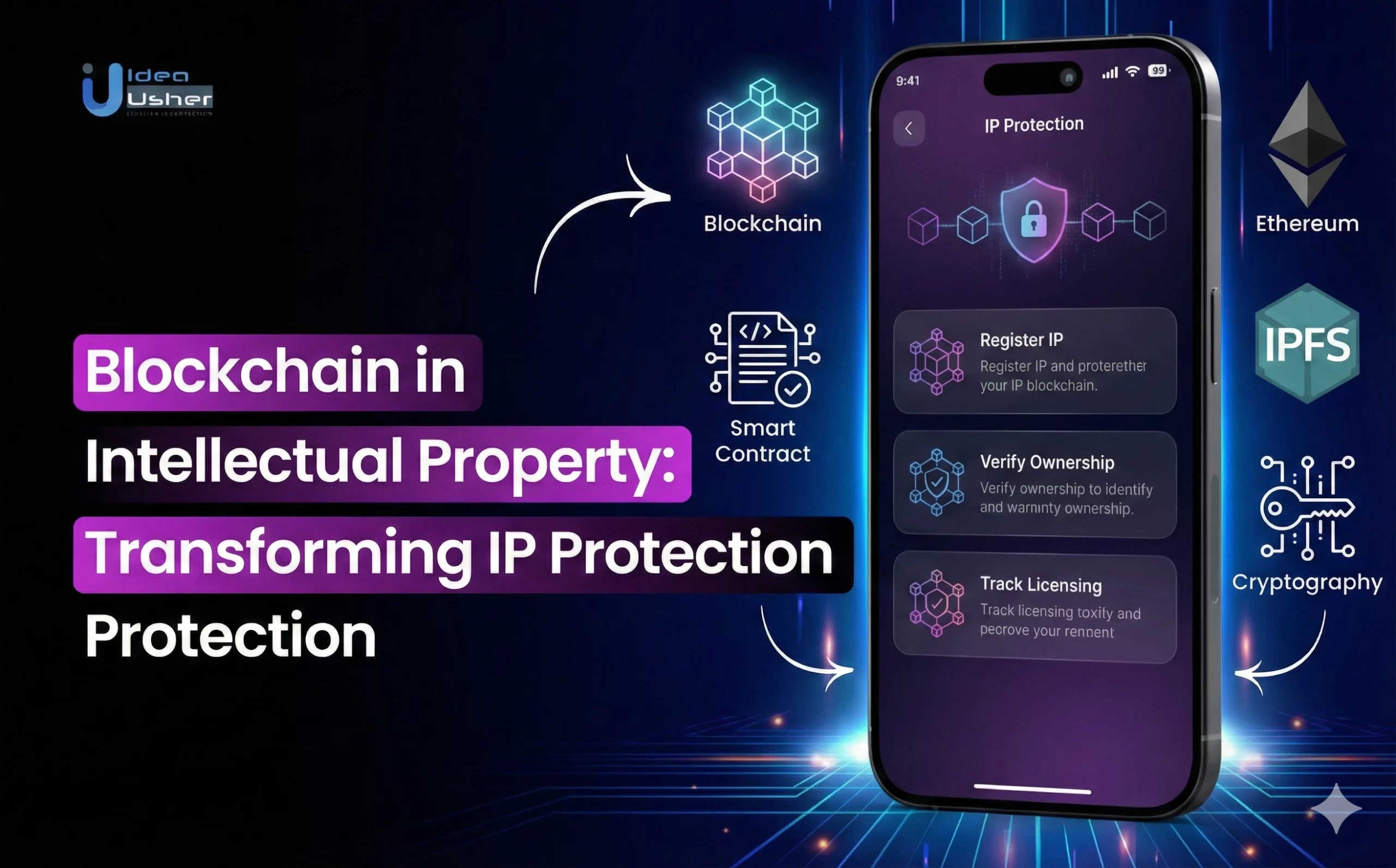
The current legal framework for Intellectual Property (IP) is losing the race against digital innovation. While creators are moving at the speed of the internet, the systems designed to protect them are still mired in 20th-century bureaucracy, manual filing, and jurisdictional silos. This gap between creation and protection has turned IP theft into a global crisis, costing the economy hundreds of billions annually.
Blockchain in Intellectual Property (IP) offers a structural shift, moving away from reactive legal battles toward a proactive, technical standard for ownership. By utilizing a decentralized, immutable ledger, creators can establish a “digital fingerprint” a timestamped, tamper-proof record of any patent, copyright, or trademark. This creates a single source of truth that allows Idea Usher to help innovators prove “prior art” instantly and automate royalty distribution through smart contracts, ensuring original work is secured from the moment of inception.
Why IP Protection is Broken Today
Traditional IP systems are fragmented. They rely on centralized databases that don’t communicate across borders, creating massive “blind spots” for creators. The process of registering a patent or trademark is often so slow and expensive that by the time protection is granted, the technology itself may already be obsolete. In a world of rapid-fire digital deployment, “waiting for approval” is a luxury most startups can’t afford.
Global IP Theft Statistics
IP infringement isn’t just a legal nuisance; it’s a systemic drain on enterprise value. Global IP theft and counterfeiting now account for hundreds of billions of dollars in lost revenue every year. In high-growth sectors like software and digital media, unauthorized distribution is the primary driver of market displacement, often neutralizing a company’s competitive advantage before they even scale.
Challenges with Patents, Copyrights, and Trademarks
- Patents: High filing costs and strict jurisdictional limits mean a patent in one territory offers zero protection in another without massive legal overhead.
- Copyrights: Proving the exact “moment of creation” is the most common failure point in legal disputes, especially for collaborative or iterative digital projects.
- Trademarks: Monitoring global markets remains a purely reactive process—infringement is usually only detected after brand equity has been diluted or stolen.
Why Digital Assets Increased IP Complexity
The explosion of AI-generated content, NFTs, and decentralized software has blurred the lines of authorship. When an asset can be duplicated with a click or “remixed” by an algorithm, traditional legal frameworks fail to provide a clear audit trail. The velocity of digital distribution has simply outrun the speed of the courtroom.
Blockchain as a Structural Solution
Blockchain replaces the need for a “trusted middleman” with a cryptographic proof of ownership. By registering IP on a decentralized ledger, the record becomes permanent and globally accessible.
When an asset is uploaded, it is encrypted and timestamped, creating court-admissible evidence of original ownership. Beyond just recording data, the integration of smart contracts allows for automated licensing and royalty payments ensuring that creators are compensated the micro-second their work is accessed, without the need for manual invoicing or third-party oversight.

Why Blockchain is Suitable for IP Protection
Blockchain properties solve the specific technical failures of the current IP system by creating a direct link between technology and legal necessity:
- Solving the “Proof of Origin” Problem: Through cryptographic hashing and timestamping, blockchain provides irrefutable evidence of the exact moment an idea was conceived. This eliminates the “he-said, she-said” nature of copyright disputes.
- Global Enforcement in a Borderless Market: Because the ledger is distributed and decentralized, it bypasses jurisdictional silos. A digital asset registered on the blockchain is visible and verifiable worldwide, rather than being trapped in a single country’s database.
- Automated Monetization: Traditional IP requires expensive legal teams to monitor and collect royalties. Smart contracts turn IP into a “living” asset that collects its own revenue, ensuring creators are compensated for every micro-transaction or use of their work.
- Eliminating Database Tampering: Centralized IP registries are vulnerable to hacking or administrative errors. The immutability of blockchain ensures that once an ownership claim is verified, it cannot be deleted or modified by any unauthorized party.
Key Challenges in Traditional Intellectual Property Systems
The current IP infrastructure is fundamentally unequipped for the speed of the 2026 digital economy. As companies shift toward “AI-first” engineering and intangible assets become the primary driver of corporate value, the friction points in traditional systems have graduated from administrative hurdles to systemic business risks.
At Idea Usher, we see these challenges as the primary catalyst for the industry-wide migration toward blockchain-based IP governance.
Proof of Ownership Issues
In the digital space, the “first to invent” is often overshadowed by the “first to claim.” Proving the exact moment of creation is the most common failure point in IP litigation. Without a tamper-proof timestamp, creators are forced to rely on internal logs, emails, or physical drafts—all of which can be challenged as fabricated. For collaborative projects involving global teams, establishing a clear “chain of custody” for an idea becomes nearly impossible under traditional documentation standards.
Lengthy Registration Processes
The time-to-protection lag is currently measured in years, while the innovation cycle is measured in months. In 2026, the average turnaround for a patent grant in major jurisdictions like Europe still ranges from 4 to 6 years. For a software startup or a high-tech manufacturer, this means their core competitive advantage is technically “unprotected” during its most valuable market window. By the time the certificate arrives, the technology is often already entering its legacy phase.
Cross-Border Enforcement Problems
Intellectual property is jurisdictional, but the internet is not. Currently, 73% of IP experts cite cross-border enforcement as their most pressing challenge. A patent or trademark registered in the US offers no automatic protection against infringement in emerging markets. Pursuing a bad actor across borders requires navigating conflicting legal systems, language barriers, and exorbitant international legal fees, which often exceed the value of the IP itself.
Royalty Tracking & Revenue Leakage
The financial plumbing of the creative industries is leaking. Recent data from the CISAC 2025 Global Collections Report highlights that while digital royalties are at record highs, unlicensed generative AI could divert up to 25% of creator royalties equivalent to approximately €8.5 billion annually if left unregulated. Traditional royalty tracking relies on fragmented “black box” databases and manual reporting, leading to significant delays and “missing” payments where the creator is never identified.
IP Infringement Detection
In a “right-click save” culture, monitoring the entire web for unauthorized use of a brand, image, or code snippet is a losing battle for human teams. Global trade in counterfeit and pirated goods is now estimated at $467 billion annually, representing over 2% of total global imports. Most companies only discover infringement after significant revenue has already been diverted. Current detection is reactive, manual, and localized, making it an ineffective shield against the scale of modern digital piracy.
How Blockchain is Transforming Intellectual Property Management
Blockchain is not merely a tool for recording data; it is a structural redesign of how value is verified and exchanged. For a high-impact agency like Idea Usher, integrating blockchain into IP management represents a shift from “legal-first” to “tech-first” protection. By moving the burden of proof from human testimony to cryptographic certainty, we can eliminate the systemic bottlenecks that have historically plagued innovators.
Blockchain for Proof of Creation & Timestamping
In traditional IP law, “prior art” and “first to invent” are often decided by who has the most persuasive lawyers or the most organized paper trail. Blockchain replaces this subjective verification with a cryptographic timestamp. When a creator uploads a file be it a software codebase, a design blueprint, or a musical composition—the system generates a unique hash (a digital fingerprint) and records it on the distributed ledger.
Because the ledger is immutable, this record serves as irrefutable, court-admissible evidence that the specific data existed in that exact form at a specific point in time. In 2026, services like WIPO PROOF have already begun bridging the gap between digital fingerprints and legal standards. For Idea Usher clients, this means that even before a formal patent is filed, their innovation is secured with a “technological birth certificate” that cannot be backdated, altered, or disputed. This proactive approach effectively neutralizes the “he-said, she-said” nature of copyright litigation, reducing the time spent in discovery and lowering legal costs by providing a single, unalterable source of truth.
Decentralized IP Registries
The centralized nature of traditional patent and trademark offices creates a “single point of failure” and a massive administrative bottleneck. A decentralized IP registry, however, operates across a global network of nodes, making it accessible 24/7 without the need for manual processing. Recent empirical studies indicate that blockchain-based registries can reduce average registration times by over 60% and lower administrative overhead by approximately 35%.
By utilizing a decentralized registry, companies can bypass jurisdictional silos. Instead of filing separate applications in dozens of countries each with its own fees and timelines a creator can register their asset on a global ledger that is recognized across borders. This democratization of access is particularly vital for startups and independent developers who previously found the cost of global IP protection prohibitive. Decentralization also ensures that the registry is resilient against hacking or administrative corruption; since the record is distributed across thousands of computers, it is nearly impossible for an unauthorized party to delete or modify a registered claim.
Smart Contracts for Licensing Automation
One of the most significant friction points in IP management is the negotiation and enforcement of licensing agreements. Traditional contracts are “passive” documents that require human intervention to execute. Smart contracts transform these agreements into “active” code. These self-executing programs live on the blockchain and automatically trigger actions when predefined conditions are met.
For example, a software developer can embed a smart contract into their API. If a third-party company wants to use that API, the smart contract handles the transaction: the moment the license fee is paid in a crypto-equivalent or stablecoin, the contract automatically releases the access keys. There is no need for manual invoicing, “net-30” payment terms, or legal departments to verify compliance. This “If-This-Then-That” logic allows Idea Usher to build platforms where licensing is as instantaneous as a credit card swipe, enabling creators to scale their distribution globally without increasing their administrative burden.
Blockchain for Royalty Distribution
Revenue leakage is a systemic crisis in the creative industries. With the rise of AI-generated content, it is estimated that unlicensed usage could divert up to 25% of creator royalties by the end of 2026. Traditional royalty chains are famously opaque, often involving multiple intermediaries labels, publishers, and collection societies that take a cut and delay payments by months or even years.
Blockchain-based royalty distribution introduces a “real-time split” model. When a digital asset (like a song or a patent-protected algorithm) is used, the smart contract identifies all stakeholders and distributes payments instantly to their digital wallets. If a song has five songwriters and two producers, the blockchain ensures that every cent of revenue is split accurately the micro-second it is earned. This transparency eliminates “black box” royalties money that is collected but never reaches the creator due to poor metadata or administrative errors. By providing a transparent, audit-ready ledger of every transaction, blockchain restores financial agency to the creators.
Tokenization of Intellectual Property Assets
Tokenization is the process of converting the rights to an IP asset into digital tokens on a blockchain. This allows for fractional ownership, turning intellectual property into a liquid asset class. Previously, if an inventor wanted to raise capital, they had to sell their entire patent or take on restrictive venture debt. Now, they can tokenize a percentage of the future royalties generated by that patent.
Investors can buy these tokens, providing the creator with immediate liquidity while the investors gain a share of the asset’s long-term success. This model is already transforming RWA (Real World Asset) management. For Idea Usher clients, tokenization opens up new avenues for “crowd-funding” innovation. A biotech startup could tokenize a portion of a new drug patent to fund clinical trials, allowing early supporters to benefit financially if the drug reaches the market. This shift democratizes investment in innovation, allowing anyone to own a “piece” of the next big idea.
NFT-Based Copyright Protection
While the initial hype around NFTs focused on digital art, their true utility in 2026 lies in copyright and trademark enforcement. An NFT (Non-Fungible Token) is a unique digital certificate that links a specific asset to a specific owner. For trademarks, this is a game-changer. Brands can now mint “on-chain trademarks” such as the specific sound of a startup’s notification or a unique brand color ensuring it is recognizable across both physical and virtual marketplaces.
NFTs can also be integrated with advanced digital watermarking (such as DCT/DWT techniques). If an image or video is “right-click saved” and reposted, the embedded NFT metadata allows automated crawlers to identify the original source and verify the license status in milliseconds. This provides a multi-level monitoring and traceability mechanism that traditional copyright cannot match. By turning intellectual property into a “living” digital entity, NFTs allow Idea Usher to help brands maintain identity and consistency in fragmented, decentralized ecosystems like the metaverse or AI-driven content platforms.
Blockchain Applications to Protect Intellectual Property
Below is a comprehensive and uniquely structured overview of how blockchain can be applied to protect intellectual property, how patent-focused platforms operate, and how different jurisdictions are experimenting with the technology.
1. Immutable Digital Proof of Creation
One of the most powerful use cases of blockchain in IP protection is the creation of a verifiable timestamp. When a creator uploads a digital fingerprint (hash) of their work to a blockchain, it generates a permanent and tamper-proof record of existence at a specific point in time.
This does not replace formal registration in all jurisdictions, but it significantly strengthens claims of authorship in disputes. For example:
- Writers can hash manuscripts before submitting them to publishers.
- Designers can timestamp logo drafts before sharing with clients.
- Software developers can record source code versions before product launch.
Because blockchain records cannot be altered retroactively, this timestamp acts as strong supporting evidence in legal conflicts.
2. Decentralized IP Marketplaces
Blockchain enables the creation of peer-to-peer intellectual property marketplaces where creators can directly license or sell their work without relying on traditional intermediaries.
In such marketplaces:
- Smart contracts automate royalty distribution.
- Licensing terms are embedded into programmable agreements.
- Payments can be executed instantly upon usage.
For example, photographers could list digital assets with predefined licensing terms. When a buyer purchases usage rights, the smart contract automatically transfers the license and records the transaction permanently.
This reduces disputes over payment delays, under-reporting of usage, and unauthorized distribution.
3. Transparent Usage Tracking and Royalty Auditing
A major challenge in IP monetization is tracking how content is used after distribution. Blockchain-based systems can record every authorized transaction, creating a transparent ledger of usage activity.
This is particularly useful in industries such as:
- Music streaming
- Digital publishing
- Film distribution
- Software licensing
Instead of relying solely on centralized reporting systems, rights holders can access a shared ledger that reflects when and how licenses were granted. This improves trust between creators, distributors, and platforms.
4. Secure Version History for Digital Assets
Creative works often go through multiple iterations. Blockchain can store cryptographic hashes of each version, ensuring a verifiable evolution trail of an asset.
This is highly relevant for:
- Patent drafts
- Product design blueprints
- Research documentation
- Game development assets
If a dispute arises regarding originality or modification timelines, the blockchain ledger provides a chronological record of changes without revealing sensitive underlying data.
5. Protection for Unregistered and Early-Stage IP
Many creators operate without formally registering copyrights or patents due to cost or procedural complexity. Blockchain provides a lightweight alternative for early-stage documentation.
For startups and independent creators:
- Early concept documents can be timestamped.
- Prototype designs can be recorded.
- Whitepapers can be hashed prior to investor discussions.
This reduces the risk of idea theft during fundraising, collaboration, or partnership negotiations.
How a Blockchain-Based Patent Platform Operates
A blockchain-powered patent management platform follows a structured process to ensure secure participation by creators, consumers, and regulatory entities.
Phase 1: Creator Onboarding and Identity Verification
Inventors and IP owners register on the platform. Identity verification is conducted using digital KYC procedures to ensure accountability and prevent fraudulent claims.
Once verified, creators receive a digital identity linked to their blockchain wallet.
Phase 2: Submission and Tokenization of Intellectual Assets
The inventor uploads documentation such as patent drafts, diagrams, technical descriptions, or supporting files. Instead of storing sensitive documents directly on-chain, the platform stores cryptographic hashes while securing full documents off-chain.
The system may tokenize the patent or invention as a digital asset, representing ownership and licensing rights.
Phase 3: Licensing Requests from Interested Parties
Businesses or individuals seeking to use the patented innovation submit licensing requests via the platform.
Smart contracts define:
- Licensing duration
- Territory restrictions
- Royalty structure
- Usage limits
Upon approval, the smart contract executes automatically, recording the agreement permanently.
Phase 4: Oversight by Legal and Patent Authorities
Patent attorneys, regulatory bodies, or recognized IP administrators may join the network as validating participants. Their role is to:
- Review submissions
- Verify compliance with legal frameworks
- Certify authenticity of claims
This hybrid model combines decentralization with institutional oversight, making it suitable for real-world legal integration.
Global Adoption Trends: Blockchain in Copyright and Patent Systems
Different countries are experimenting with blockchain for IP management in varied ways.
- Some European innovation agencies are testing blockchain for digital copyright registries.
- Asian technology hubs are piloting smart-contract-based licensing systems for research institutions.
- North American startups are building private blockchain networks for enterprise patent management.
In many cases, blockchain is not replacing national IP offices but complementing them with faster documentation and improved transparency.
Use Cases of Blockchain in Intellectual Property
Theoretical benefits are only valuable if they solve real-world industry pain points. As Idea Usher moves deeper into the Web3 and Enterprise AI sectors, we are seeing blockchain evolve from a niche experiment into a critical infrastructure for managing high-value intangible assets. Below are the primary sectors where blockchain is moving the needle for IP management in 2026.
Blockchain in Patent Management
The lifecycle of a patent is notoriously expensive and inefficient. Blockchain addresses this by creating a secure, cross-border infrastructure for the “first to invent” principle. By utilizing a Distributed Ledger Technology (DLT), pharmaceutical and tech companies can record every stage of the R&D process from initial lab notes to final prototypes creating a “defensive publication” on-chain.
This prevents “patent trolls” from claiming an idea after it has already been developed by another party. Furthermore, blockchain-based patent pools allow for easier technology sharing. Companies can license their patents to one another through automated smart contracts, ensuring that use is tracked and royalties are paid without the need for manual audits. In 2026, this is becoming the standard for open-source hardware and green energy initiatives, where rapid collaborative innovation is essential.
Blockchain for Copyright Protection (Music, Art, Media)
The “value gap” in the creative industry remains a multi-billion dollar problem. Blockchain bridges this gap by embedding ownership directly into the media file. For music and video, Smart Copyrights ensure that metadata—such as the artist’s name, the publisher, and the licensing terms stays permanently attached to the asset regardless of where it is shared.
When a track is streamed on a decentralized platform, the smart contract triggers a micro-transaction that pays the artist in real-time. This eliminates the “black box” of missing royalties, where millions of dollars go unclaimed because the metadata was stripped or incorrectly entered. For visual artists, blockchain provides a “provenance” record, documenting the entire history of an artwork’s sales and ensuring that the original creator receives a percentage of every resale (resale rights), a feature that was nearly impossible to enforce in the traditional art world.
Trademark Authentication Systems
In an era of sophisticated counterfeiting, brand protection is a constant battle. Blockchain transforms trademarks into interactive authentication tools. By linking a physical product to a unique digital twin (stored as an NFT on the blockchain), brands can provide customers with a “Certificate of Authenticity” that is impossible to forge.
For luxury goods, pharmaceuticals, and electronics, a customer can simply scan a QR code or NFC tag to verify that the item is a genuine trademarked product. This creates a transparent supply chain where every hand-off from factory to distributor to retailer is recorded on the ledger. If a counterfeit item enters the market, the lack of a corresponding blockchain record makes it immediately identifiable, protecting the brand’s equity and the consumer’s safety.
Trade Secret Protection
Unlike patents, trade secrets such as the Coca-Cola formula or Google’s search algorithm rely on absolute confidentiality. However, in legal disputes, a company must still prove that they took “reasonable steps” to keep the secret and that they owned the information at a specific time.
Blockchain offers a unique solution through Zero-Knowledge Proofs (ZKPs). This allows a company to timestamp a “hash” of their trade secret on the blockchain without actually revealing the secret itself. In the event of an industrial espionage case or a departing employee dispute, the company can present the hash to a court as evidence that the secret existed in their possession on a specific date, all while the underlying data remains encrypted and private.
Digital Content Ownership Verification
As generative AI floods the internet with content, the ability to distinguish between original human creation and synthetic “remixes” is becoming a legal necessity. Blockchain provides a verification layer for digital content by creating a permanent link between the creator and the asset.
At Idea Usher, we advocate for “Origin-Based Verification” where digital assets are minted with a cryptographic signature at the moment of creation. This allows social media platforms and news organizations to verify the authenticity of an image or article instantly. If a piece of content is modified or taken out of context, the blockchain record will show the discrepancy, serving as a powerful tool against deepfakes and digital plagiarism.
IP Rights in Metaverse & Web3
The shift toward the Metaverse has created a new frontier for IP: Virtual Assets. In these decentralized environments, users own digital clothing, virtual real estate, and 3D avatars. Blockchain is the only technology capable of enforcing IP rights across these interoperable worlds.
If a user buys a trademarked virtual sneaker in one Metaverse platform, they should be able to wear it in another. Blockchain ensures that the IP stays with the user’s wallet, not the platform’s central server. This prevents “platform lock-in” and ensures that brands can sell digital merchandise with the same legal certainty they have in the physical world. For Idea Usher, building these Web3 IP frameworks is the key to creating a truly open and commercially viable digital economy.
Industry-Wise Applications
Blockchain is not a one-size-fits-all solution; its implementation varies significantly based on the specific regulatory and commercial needs of each sector. In 2026, we are seeing specialized platforms emerge that cater to the unique IP requirements of different industries.
Media & Entertainment
The media industry faces rampant piracy and opaque royalty structures. Blockchain platforms are being used to “tokenize” content, ensuring that every stream or download is recorded and paid for instantly.
- Real-World Example: Audius is a decentralized music streaming protocol that allows artists to distribute their music directly to fans, bypassing traditional labels and ensuring they receive 90% of the revenue. Verasity uses “Proof of View” technology on the blockchain to verify that video advertisements are seen by real humans, preventing ad fraud and protecting the IP of advertisers.
Pharmaceuticals & Biotech
For pharma companies, the “patent cliff” and counterfeit drugs are multi-billion dollar threats. Blockchain provides end-to-end traceability for drug formulas and clinical trial data.
- Real-World Example: MediLedger is a leading blockchain network for the pharmaceutical supply chain. It allows companies like Genentech and Pfizer to verify the authenticity of returned drugs, preventing counterfeits from re-entering the market. Pharmaledger is another EU-based project that uses blockchain to secure clinical trial data and provide digital leaflets for patients, ensuring data integrity across the R&D lifecycle.
Software & SaaS Companies
Software companies often struggle with unlicensed redistribution and “key sharing.” Blockchain-based licensing turns software seats into unique digital tokens that can be verified in real-time.
- Real-World Example: CodeChain allows developers to issue software licenses as digital assets on a ledger, making it impossible to “crack” or duplicate a license key. Spydra offers asset tokenization for enterprise software, allowing companies to manage and transfer complex SaaS licenses across departments with a clear audit trail.
Fashion & Luxury Brands
Luxury brands lose an estimated $30 billion annually to high-quality “super-fakes.” Blockchain creates a “Digital Twin” for physical items, allowing customers to verify authenticity with a simple scan.
- Real-World Example: The Aura Blockchain Consortium (founded by LVMH, Prada, and Cartier) provides a global standard for luxury. Every product is assigned a unique digital passport that tracks its origins from the leather tannery to the boutique, proving authenticity on the secondary market. Arianee is another platform used by brands like Breitling to issue digital certificates of ownership that remain with the watch for its entire lifespan.
Research & Universities
Academic IP is often siloed or misappropriated. Universities are now using blockchain to timestamp research papers and lab results before they are published, securing “prior art” in a competitive global landscape.
- Real-World Example: Bloxberg is a global blockchain consortium for science led by the Max Planck Society. it provides researchers with a secure way to timestamp their data and prove authorship without needing to wait for the lengthy journal peer-review process. ARTiS is a decentralized platform that allows scientists to share data securely and receive micro-grants or citations automatically via smart contracts
Real-World Companies Using Blockchain for Intellectual Property Protection
Below are mid-sized and startup-focused platforms (similar in scale to Blockai, Mediachain Lab, and Ujo Music) that have applied blockchain to solve real intellectual property challenges — without being massive enterprise brands.
1. Ascribe
Focus Area: Digital art ownership and attribution
Ascribe was an early blockchain startup focused on helping artists register, track, and transfer digital artwork ownership. The platform allowed creators to upload their work, generate a cryptographic certificate of authenticity, and manage licensing rights directly.
Instead of storing artwork on-chain, Ascribe recorded ownership metadata on the Bitcoin blockchain. Artists could monitor transfers and prove authorship without relying on centralized art registries.
Why It Matters:
- Early proof-of-ownership solution for digital creators
- Built licensing tools for peer-to-peer transfers
- Reduced dependency on galleries and intermediaries
2. Po.et
Focus Area: Publishing and written content
Po.et was developed as a decentralized protocol for media and publishing professionals. Writers and journalists could timestamp their work on the blockchain to create verifiable records of authorship.
The platform enabled creators to attach licensing terms and metadata to digital content, helping publishers verify originality before distribution.
Why It Matters:
- Protected writers from plagiarism disputes
- Enabled transparent content licensing
- Provided immutable timestamps for journalism
3. Binded
Focus Area: Photography and visual content
Binded allowed photographers to register images on the blockchain to create proof of copyright ownership. It simplified the process of documenting authorship without immediately filing formal registration with government offices.
Photographers could upload images, generate blockchain certificates, and use those records as supporting evidence in infringement cases.
Why It Matters:
- Affordable protection for independent creators
- Streamlined copyright documentation
- Reduced friction in early-stage IP disputes
4. Verisart
Focus Area: Art authentication and provenance
Verisart provides blockchain-based certification for artworks and collectibles. Artists, galleries, and collectors can create tamper-proof records verifying authenticity and ownership history.
The platform records provenance data and links it to digital certificates stored on blockchain networks.
Why It Matters:
- Strengthens trust in art transactions
- Prevents forgery and ownership fraud
- Enhances resale transparency
5. IPwe
Focus Area: Patent management and licensing
IPwe uses blockchain infrastructure to streamline patent registration, due diligence, and licensing. It aims to create a global patent marketplace where innovators can license technologies more efficiently.
By combining blockchain records with analytics, IPwe reduces friction in cross-border patent transactions.
Why It Matters:
- Digitizes patent portfolios
- Enables global IP trading
- Increases transparency in patent valuation
Benefits of Blockchain in Intellectual Property
For enterprises and individual creators alike, the integration of blockchain into IP management is not just a technological upgrade it is a strategic pivot. By replacing manual oversight with cryptographic certainty, organizations can move from a defensive legal posture to an offensive, value-driven strategy.
At Idea Usher, we focus on these six core benefits that provide a quantifiable return on investment (ROI) for modern IP portfolios.
Enhanced Transparency
Traditional IP registries are often “black boxes” where data is siloed and difficult to verify without specialized legal access. Blockchain provides a shared, transparent ledger where every transaction, licensing agreement, and ownership transfer is visible to authorized stakeholders in real-time. This radical transparency ensures that all parties creators, licensees, and distributors—are operating from the same dataset, eliminating the “information asymmetry” that often leads to friction in business partnerships.
Immutable Ownership Records
The most powerful feature of blockchain is its immutability. Once an IP asset is registered on the ledger, the record cannot be altered, deleted, or backdated. This creates a permanent, tamper-proof chain of custody. For enterprises, this provides a “golden record” of innovation that is court-admissible. In 2026, companies using immutable ledgers report a 90% reduction in internal auditing time for their IP portfolios, as every asset’s history is instantly verifiable.
Reduced Legal Disputes
Legal disputes over “prior art” and ownership rights are a massive drain on corporate resources. By providing a timestamped digital fingerprint of an idea at the moment of inception, blockchain serves as an irrefutable evidence locker. This preemptive proof often prevents litigation before it begins; when the “moment of creation” is mathematically proven on-chain, there is little room for the “he-said, she-said” arguments that typically fuel multi-year legal battles.
Automated Royalty Payments
Revenue leakage in the creative and tech industries is often caused by administrative complexity. By using smart contracts, royalty distributions are automated and instantaneous. Instead of waiting for quarterly reports and manual wire transfers, creators receive payments the micro-second their work is used.
- Quantifiable Benefit: Enterprises utilizing smart contracts for licensing see an average 20-30% increase in captured revenue by eliminating the human errors and “missing” payments associated with traditional accounting.
Global Accessibility
Intellectual property is naturally borderless, yet traditional legal systems are strictly jurisdictional. Blockchain provides a decentralized, global infrastructure that ignores geographic boundaries. A creator in India can license their software to a firm in Germany via a smart contract, with the entire transaction verified on a global ledger. This democratization allows small-to-medium enterprises (SMEs) to compete on a global scale without needing a physical legal presence in every market they enter.
Lower Administrative Costs
The cost of maintaining a global IP portfolio is staggering when you factor in filing fees, legal retainers, and monitoring services. Blockchain-based management platforms drastically reduce these “middleman” costs. By automating the verification and registration processes, organizations can reduce their IP administrative overhead by up to 40%. This allows companies to reallocate those funds into R&D and further innovation, rather than sinking them into bureaucratic maintenance.
Limitations & Challenges of Using Blockchain in IP
While blockchain offers a robust technical solution for IP management, its implementation is not without significant hurdles. For a comprehensive and balanced perspective—essential for establishing E-E-A-T (Experience, Expertise, Authoritativeness, and Trustworthiness)—it is critical to address the friction points that currently prevent universal adoption. At Idea Usher, we help clients navigate these complexities to ensure their blockchain strategies are both technically sound and legally resilient.
Legal Recognition Issues
The primary challenge is the gap between “cryptographic proof” and “legal evidence.” While blockchain provides a mathematically certain timestamp, many national court systems have yet to formally recognize blockchain records as primary evidence of ownership. In many jurisdictions, a blockchain entry is still viewed as “secondary evidence” that must be supported by traditional documentation. Until there is a harmonized international legal standard similar to how the Hague Convention handles public documents—the utility of blockchain in a courtroom remains dependent on local judicial precedents.
Regulatory Uncertainty
IP law is inherently jurisdictional, but blockchain is inherently global. This creates a massive regulatory conflict. Different regions are moving at different speeds; for instance, while the European Union’s MiCA (Markets in Crypto-Assets) and the AI Act provide some framework for digital assets, other major markets remain in a state of flux. This lack of a unified regulatory “playbook” makes it difficult for multinational enterprises to deploy a single blockchain IP strategy without risking non-compliance in certain territories.
Scalability
Managing a global database of billions of micro-assets (like every single image or code snippet produced daily) requires immense throughput. While Layer 2 solutions and Proof of Stake (PoS) mechanisms have drastically improved scalability, the “gas fees” or transaction costs on public blockchains can still fluctuate wildly. For an enterprise managing tens of thousands of IP transactions a day, these costs must be predictable. If the cost of registering an asset exceeds the micro-value of the asset itself, the economic model for blockchain IP breaks down.
Privacy Concerns
Blockchain is designed for transparency, but IP management often requires extreme confidentiality. If a company registers a hash of a trade secret or a pending patent on a public ledger, they must ensure that no metadata such as the identity of the researchers or the timing of the discovery leaks competitive intelligence. Balancing the immutability of a public ledger with the privacy requirements of corporate R&D is a delicate technical challenge. Solutions like Zero-Knowledge Proofs (ZKPs) are promising, but they add a layer of computational complexity that can be difficult to manage at scale.
Integration with Existing IP Databases
The world currently relies on legacy databases maintained by the USPTO, EUIPO, and WIPO. Transitioning to a blockchain-based system is not a “flip of a switch” process; it requires these massive, siloed organizations to adopt interoperable standards. Currently, most blockchain IP initiatives exist as “islands” of data that do not communicate with official government registries. For blockchain to reach its full potential, we need a “hybrid” era where decentralized ledgers and centralized government databases can exchange data via secure APIs without compromising the integrity of either system.
Blockchain vs Traditional IP Systems
To truly understand the shift in Intellectual Property management, we must look at the structural differences between legacy bureaucracy and decentralized technology. Below is a direct comparison of how these two systems handle the most critical factors of IP governance.
The Structural Shift: A Comparative Analysis
| Factor | Traditional IP Systems | Blockchain-Based IP |
| Verification Speed | Slow. Can take months or years for official registration and verification. | Instant. Cryptographic timestamping provides proof of creation in seconds. |
| Authority Model | Centralized. Reliant on government bodies (USPTO, WIPO) and third-party intermediaries. | Decentralized. Based on a distributed ledger with no single point of failure. |
| Data Integrity | Vulnerable. Centralized databases are susceptible to hacking, human error, or administrative tampering. | Immutable. Once recorded, data cannot be altered, deleted, or backdated. |
| Cost Structure | High. Involves heavy legal fees, filing costs, and administrative overhead. | Low. Minimal transaction fees; eliminates the need for many intermediaries. |
| Royalty Distribution | Manual & Delayed. Payments often take months to process through collection societies. | Automated. Smart contracts trigger micro-payments to creators in real-time. |
| Global Enforcement | Jurisdictional. Limited to the country or region where the IP is registered. | Borderless. Accessible and verifiable globally via a decentralized network. |
| Evidence Admissibility | Standardized. Long-standing legal precedents exist in almost every courtroom. | Emerging. Admissibility is growing but depends on local digital evidence laws. |
| Monitoring | Reactive. Brand owners must manually monitor markets for infringement. | Proactive. Digital watermarking and NFT-based tracking allow for automated detection. |
Why This Comparison Matters for Enterprise Strategy
For an organization like Idea Usher, this comparison highlights more than just a technological preference it represents a move toward operational efficiency. While traditional systems are still necessary for formal legal recognition in 2026, blockchain acts as the “execution layer.”
By combining the two using traditional filing for legal “teeth” and blockchain for real-time management and evidence gathering enterprises can capture more revenue, reduce legal risk, and scale their innovations across borders with significantly less friction.
How to Build a Blockchain-Based Intellectual Property Platform
Building a robust IP platform requires more than just a ledger; it necessitates an ecosystem that balances security, legal compliance, and user accessibility. At Idea Usher, we specialize in bridging the gap between decentralized technology and enterprise requirements. Here is the blueprint for developing a high-performance, blockchain-driven IP solution.
Architecture Overview
A successful IP platform follows a multi-tier architecture designed for high throughput and data integrity.
- The Storage Layer: High-resolution digital assets (blueprints, source code, media) are typically stored off-chain using decentralized protocols like IPFS (InterPlanetary File System) or Arweave to ensure they are tamper-proof but don’t bloat the blockchain.
- The Execution Layer: This is the blockchain itself, where the “hashes” (unique digital fingerprints) of the assets and ownership records are stored.
- The Application Layer: A front-end dashboard that allows creators to upload work, manage licenses, and view royalty distributions through an intuitive interface.
Choosing the Right Blockchain (Public vs. Private)
The choice of blockchain depends on the platform’s specific goals:
- Public Blockchains (e.g., Ethereum, Polygon, Solana): Best for broad accessibility and maximum transparency. They provide the highest level of security and are ideal for consumer-facing NFT or copyright platforms.
- Private/Consortium Blockchains (e.g., Hyperledger Fabric, Quorum): Preferred for enterprise-grade patent management or trade secrets. These offer high privacy, controlled access, and lower transaction costs, which are essential when handling sensitive R&D data.
Smart Contract Development
The “engine” of your IP platform is the smart contract. Our development team focuses on creating standardized licensing templates (similar to ERC-721 or ERC-1155) that can be customized for specific IP needs. These contracts handle the logic for:
- Automatic royalty splits between multiple co-authors.
- Time-bound licensing (e.g., granting use rights for exactly one year).
- Conditional access (e.g., unlocking source code only after a successful escrow payment).
Integration with Government IP Databases
For a platform to have real-world utility, it cannot exist in a vacuum. We design systems that use Oracles (like Chainlink) to pull data from official government registries such as the USPTO or EUIPO. This ensures that the blockchain record is constantly synchronized with formal legal filings, providing a “hybrid” model that combines technological speed with legal authority.
Compliance & Legal Layer
Building for IP means building for the law. Your platform must adhere to:
- WIPO Standards: Ensuring that digital timestamps align with international copyright treaties.
- Data Protection: Compliance with GDPR and CCPA, especially regarding the “Right to be Forgotten,” which can be challenging to implement on an immutable ledger.
- KYC/AML: Verifying the identity of creators and buyers to prevent the platform from being used for money laundering or the sale of stolen IP.
Security Considerations
When you are managing a company’s entire IP portfolio, security is non-negotiable. We implement Multi-Signature (Multi-Sig) Wallets, where transfers of high-value patents require approval from multiple stakeholders. Additionally, we conduct rigorous Smart Contract Audits to ensure there are no vulnerabilities that could allow an attacker to “mint” unauthorized ownership claims.
Cost Estimation
The cost of building a blockchain IP platform varies based on complexity:
- MVP (Minimum Viable Product): A basic timestamping and registry system typically ranges from $40,000 to $70,000.
- Enterprise Ecosystem: A full-scale platform with automated licensing, government database integration, and a custom marketplace can range from $150,000 to $500,000+. While the initial investment is significant, the long-term ROI is driven by the reduction in legal fees, the elimination of manual audits, and the capture of previously “leaked” royalty revenue.
Cost to Develop a Blockchain-Based Intellectual Property Platform
The cost of developing a blockchain-based IP platform depends on the complexity of the underlying smart contracts and the level of integration required with existing legal registries. In 2026, building a production-ready system generally falls into three budget tiers.
Development Tiers & Pricing
| Project Scope | Estimated Cost (USD) | Timeline | Key Features |
| Basic MVP / PoC | $30,000 – $60,000 | 3–4 Months | Simple timestamping, basic wallet integration, single-chain registry. |
| Mid-Tier Platform | $80,000 – $200,000 | 6–9 Months | Automated licensing, royalty split logic, advanced UI/UX, multi-chain support. |
| Enterprise Solution | $250,000 – $1M+ | 12+ Months | Full integration with government databases, custom consensus, cross-border compliance layers. |
Cost Drivers in 2026
The total investment is divided across several technical and operational phases:
1. Smart Contract Architecture (25-30% of Budget)
Developing secure, bug-free smart contracts is the most critical expense. For IP, contracts must handle complex logic such as fractional ownership, time-gated licenses, and automated royalty triggers. Because a vulnerability here could lead to the loss of entire IP portfolios, high-quality engineering and security are non-negotiable.
2. Security Audits & Compliance (15-20% of Budget)
Standard software testing is insufficient for blockchain. A comprehensive smart contract audit by a third-party security firm is a mandatory cost, typically ranging from $10,000 to $50,000 depending on code complexity. Additionally, ensuring the platform meets GDPR and WIPO digital evidence standards adds to the legal engineering costs.
3. Infrastructure & Network Selection
- Public Networks (Ethereum, Polygon, Solana): Lower upfront infrastructure costs, but ongoing “Gas fees” for every IP registration or transaction.
- Private/Consortium Networks (Hyperledger, Quorum): Higher initial setup and server costs (approx. $15,000 – $30,000), but zero transaction fees and superior data privacy for trade secrets.
4. UI/UX & Frontend Development (10-15% of Budget)
Blockchain applications often suffer from high friction. Investing in an intuitive dashboard where non-technical users can upload work, track usage, and manage payments is essential for adoption. This includes building custom explorers and notification systems for license expirations.
5. Ongoing Maintenance & Support
A blockchain platform requires continuous monitoring. Maintenance usually accounts for 15-20% of the initial development cost annually (e.g., $20,000/year for a $100,000 build). This covers node hosting, security patches, and updates to the latest blockchain protocols.+2
How Idea Usher Optimizes the Budget
We emphasize a modular development approach to minimize waste. By launching with a high-utility, enterprise-grade platform, we enable organizations to secure their core assets first. As the user base expands, they can then scale into automated licensing and global marketplaces. This strategy reduces initial capital expenditure while ensuring that the platform is future-proof and ready for integration with enterprise systems.
Future of Blockchain in Intellectual Property
The convergence of decentralized ledgers and automated intelligence is moving toward a self-executing IP economy. As we look toward the end of the decade, the friction between creation and monetization will continue to dissolve, replaced by “living” assets that manage their own rights and revenue.
AI + Blockchain for Automated IP Enforcement
The most significant shift in IP management is the move from reactive to autonomous enforcement. By combining AI with blockchain, we can create automated “crawler” systems that scan global digital platforms for unauthorized use of trademarked or copyrighted material.
When a violation is detected, the AI doesn’t just flag it; it cross-references the asset’s “digital fingerprint” on the blockchain. If no valid license is found, a smart contract can automatically issue a cease-and-desist or trigger a “pay-per-use” invoice to the platform owner. This shifts the burden of enforcement from human legal teams to code, making IP protection scalable for the first time in history.
On-Chain Licensing Marketplaces
We are moving away from the era of protracted, manual licensing negotiations. Future IP marketplaces will function more like decentralized exchanges (DEXs). A software developer or designer can list their asset with pre-set licensing terms such as “Standard Personal Use,” “Commercial Redistribution,” or “Exclusive Ownership.”
Potential buyers can “swap” currency for these rights instantly. The blockchain serves as the escrow agent, transferring the license and the funds simultaneously. This “frictionless licensing” allows for the monetization of micro-assets (like individual icons or code snippets) that were previously too expensive to license through traditional legal channels.
Global Decentralized IP Registries
The long-term goal is the “Unified Ledger of Innovation.” Instead of navigating the jurisdictional silos of individual national patent offices, we are heading toward a Global Decentralized IP Registry recognized by international treaties.
By leveraging decentralized identifiers (DIDs), a creator’s identity and their body of work become portable across borders. This eliminates the “race to file” across multiple countries and creates a single, transparent audit trail that is accessible to customs officials and patent examiners worldwide, drastically reducing the window for IP theft in international trade.
DAO-Managed IP Portfolios
Decentralized Autonomous Organizations (DAOs) are transforming how intellectual property is owned and funded. In this model, a group of researchers or creators can form a DAO to collectively own a portfolio of patents or copyrights.
Decisions on how to license the IP or whether to sell certain rights are made through on-chain governance (token-based voting). This allows for “Collective Intelligence” models where the community that builds the technology also shares in its governance and financial success, removing the need for traditional corporate structures.
Tokenized Research Patents
The “Death Valley” of innovation the gap between laboratory research and commercial application—is being bridged by tokenization. By turning a research patent into a tradable digital asset, universities and startups can fractionalize ownership.
This allows individual investors to buy “shares” in a promising biotech patent or a green energy breakthrough. It provides researchers with immediate liquidity to fund further development while giving investors a direct stake in future royalties. Tokenization turns IP from a static legal document into a liquid, productive asset that can be used as collateral or traded on global RWA (Real World Asset) platforms.
Why Businesses Should Adopt Blockchain for IP Protection Now
The window for “wait and see” regarding blockchain technology has closed. In 2026, the transition from physical to digital value is nearly complete, and businesses that continue to rely on manual, centralized IP management are leaving their most valuable assets exposed. The following drivers make the adoption of blockchain-based IP protection a matter of strategic urgency.
The AI-Generated Content Ownership Crisis
The explosion of generative AI has created a legal “gray zone” that traditional IP systems are struggling to navigate. With millions of AI-generated images, code snippets, and articles flooding the market daily, the ability to prove human authorship and originality is becoming a critical business requirement.
Without a blockchain-based timestamp and a clear cryptographic audit trail of the creative process, companies risk losing their copyright claims or being unable to distinguish their proprietary work from synthetic remixes. Adopting blockchain now allows Idea Usher’s clients to “anchor” their human-led innovations, ensuring they remain protected as AI continues to disrupt authorship standards.
Rising Digital Piracy and “Super-Fakes”
Digital piracy is no longer limited to media; it has expanded into “super-fake” software, counterfeit luxury digital assets, and stolen industrial blueprints. In a 2026 market, where a “right-click save” or an AI-cloned API can displace a startup’s entire revenue stream in days, reactive legal strategies are too slow.
Blockchain provides a proactive defense. By embedding ownership directly into the asset’s metadata, businesses can implement automated verification that makes it nearly impossible for bad actors to pass off stolen IP as legitimate. Waiting for a lawsuit to resolve an infringement is a cost; blocking infringement at the source with technology is an investment.
The Complexity of Cross-Border Licensing
As businesses scale globally, the friction of managing licenses across different jurisdictions is becoming a massive administrative bottleneck. The traditional model of country-by-country filing is incompatible with a borderless digital economy.
Enterprises that adopt blockchain now gain a “Single Source of Truth” that operates above local bureaucracies. By utilizing smart contracts for international licensing, companies can automate compliance, tax calculations, and royalty splits, allowing them to enter new markets in weeks rather than months.
The Shift Toward Web3 Commerce
We are moving into a Web3-centric economy where users expect to “own” their digital experiences. Whether it’s virtual goods in the metaverse, tokenized real-world assets (RWA), or decentralized software, the underlying infrastructure of commerce is becoming the blockchain.
If your IP is not “on-chain” ready, you cannot participate in these emerging marketplaces. Adopting blockchain for IP protection now isn’t just about security it’s about interoperability. It ensures that your brand and your innovations are ready to be licensed, traded, and monetized in the decentralized ecosystems where the next generation of consumers is already spending.
How Our Blockchain Development Company Can Help
At Idea Usher, we don’t just build software; we build the infrastructure of trust. As the digital landscape shifts toward decentralization, our mission is to ensure that your intellectual property remains a secure and scalable asset. We combine deep technical expertise with a strategic understanding of IP law to deliver blockchain solutions that protect your competitive advantage.
Here is how we help enterprises and innovators transition to a tech-first IP strategy:
Custom IP Registry Development
We design and deploy decentralized registries tailored to your organization’s needs. Whether you require a private consortium for sensitive trade secrets or a public ledger for global brand transparency, we build the architecture that serves as your “Single Source of Truth.” Our registries are designed for high throughput, ensuring that thousands of assets can be timestamped and secured in real-time.
Smart Contract Licensing Systems
Move beyond static PDFs and manual invoicing. Our developers create self-executing smart contracts that automate the entire licensing lifecycle. From “pay-per-use” micro-licenses to complex, multi-stakeholder royalty splits, we build logic into the ledger that ensures you are paid the micro-second your work is accessed. This eliminates administrative friction and minimizes revenue leakage.
NFT-Based Copyright Platforms
For creators in the media, art, and gaming sectors, we develop NFT-driven ecosystems that anchor ownership to digital assets. We integrate advanced metadata standards and digital watermarking to ensure that your copyrights are verifiable across any platform. Our solutions allow for “programmable rights,” where resale royalties are automatically routed back to the original creator in the secondary market.
Patent Tokenization Platforms
Unlock the liquidity in your patent portfolio. Idea Usher develops platforms that allow enterprises to tokenize intellectual property, enabling fractional ownership and new R&D funding models. By turning a static patent into a tradable digital asset, we help you tap into global capital markets and simplify the process of cross-border technology transfers.
Enterprise Blockchain Integration
Transitioning to blockchain shouldn’t mean scrapping your existing systems. We specialize in “hybrid” integrations, connecting your current IP databases (like ERPs or legacy patent logs) to a blockchain execution layer via secure APIs and Oracles. This allows your team to maintain familiar workflows while gaining the immutability and transparency of the ledger.
Take the Next Step in IP Evolution
The future of intellectual property is decentralized, automated, and borderless. Don’t wait for a legal dispute to realize your protection is outdated. Partner with a development team that understands how to anchor innovation to the blockchain.
Book a consultation to explore blockchain-powered IP protection.
Frequently Asked Questions (FAQ)
To help you navigate the intersection of decentralized technology and legal frameworks, we’ve addressed the most common queries regarding blockchain’s role in the IP sector.
How does blockchain protect intellectual property?
Blockchain protects IP by creating a decentralized, immutable record of an asset’s existence and ownership. When a piece of intellectual property is registered, it is assigned a unique cryptographic hash and a permanent timestamp. This “digital fingerprint” proves who owned the work at a specific point in time, making it virtually impossible for third parties to backdate claims or tamper with ownership records.
Is blockchain legally valid for patents?
While a blockchain entry does not replace a formal patent grant from a government body like the USPTO or EUIPO, it is increasingly recognized as powerful secondary evidence. It is particularly effective for proving “prior art” or the exact date of invention during legal disputes. In many jurisdictions, including parts of the US, China, and the EU, digital records on a blockchain are becoming admissible in court as timestamped evidence of original creation.
Can NFTs protect copyrights?
Yes. NFTs (Non-Fungible Tokens) act as a digital layer of protection by linking a unique cryptographic token to a specific piece of content. This allows for clear provenance and traceability. While the NFT itself is the certificate of ownership, the underlying smart contract can be programmed to enforce licensing terms, automate royalty payments, and ensure the creator receives credit every time the work is resold or used.
What is blockchain timestamping?
Blockchain timestamping is the process of securely recording the exact time and date a piece of data was added to the ledger. Unlike traditional server logs, which can be edited or manipulated, a blockchain timestamp is verified by a global network of computers. This creates a permanent, tamper-proof audit trail that is essential for establishing a “first-to-file” or “first-to-invent” status in IP law.
How secure is blockchain for IP management?
Blockchain is significantly more secure than traditional centralized databases. Because the data is distributed across a network of nodes, there is no “single point of failure” for hackers to exploit. Furthermore, the use of advanced cryptography ensures that data cannot be altered once it is written. For highly sensitive assets like trade secrets, Idea Usher utilizes private or “permissioned” blockchains to ensure that only authorized stakeholders can access the data.
What is the cost of building a blockchain IP platform?
The investment for a blockchain IP platform typically starts at $40,000 to $70,000 for a Minimum Viable Product (MVP) focused on timestamping and basic registration. For an enterprise-grade solution featuring automated licensing, smart contract-driven royalties, and integration with legacy government databases, costs generally range from $150,000 to over $500,000, depending on the complexity of the architecture and compliance requirements.
Can blockchain help with cross-border IP enforcement?
Absolutely. One of the greatest advantages of blockchain is its borderless nature. Traditional IP is jurisdictional, but a decentralized ledger is globally accessible. This allows brand owners to track assets and verify licenses across different countries in real-time, providing a unified “Single Source of Truth” that simplifies enforcement and reduces the need for local legal intermediaries in every market.
Does blockchain work for trade secrets?
Yes, primarily through a method called “Zero-Knowledge Proofs” (ZKPs). This allows a company to prove they possess a specific secret and established it on a certain date without actually revealing the contents of the secret on the public ledger. This provides a secure way to establish a “chain of custody” for sensitive R&D data while maintaining total confidentiality.


