


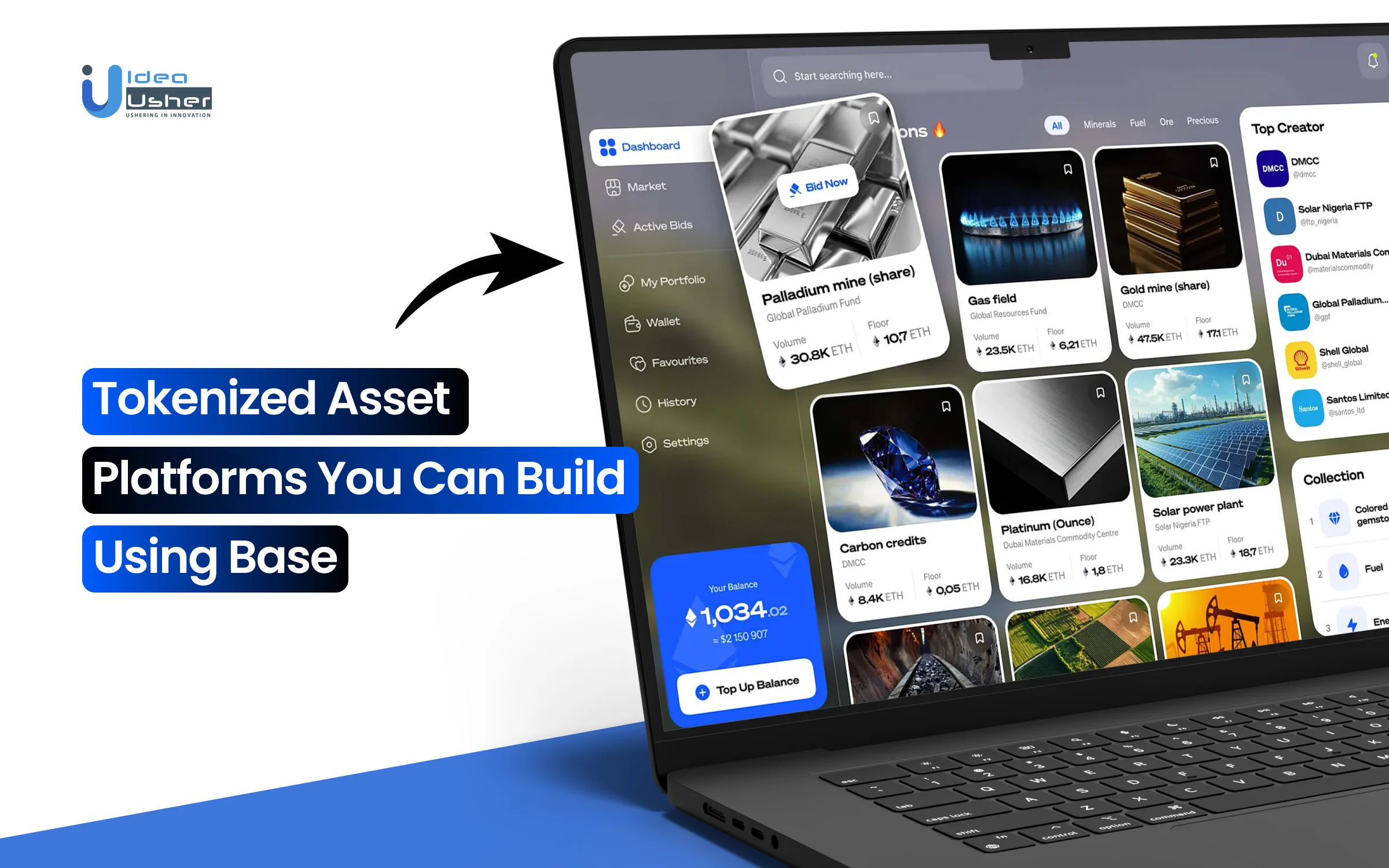
Tokenization has moved beyond experiments into practical infrastructure for representing real and digital assets on-chain. From financial instruments and commodities to access rights and digital ownership, more asset types are becoming programmable and transferable through smart contracts. This shift opens up opportunities to design an asset tokenization platform on Base that supports multiple asset classes while keeping transactions efficient and user-friendly.
The real complexity of tokenized asset platforms lies in the infrastructure surrounding the tokens. Issuance workflows, ownership tracking, compliance logic, secondary trading, and integrations with off-chain services all influence how usable and trustworthy an asset becomes. Base provides Ethereum compatibility and lower transaction costs, but long term success still depends on how well these supporting systems are designed to scale across different asset models.
In this blog, we explore the types of tokenized asset platforms you can build using Base by examining common use cases, system components, and design considerations involved in launching scalable and adaptable on-chain asset solutions.

What is a Tokenized Asset Platform?
A tokenized asset platform is a digital infrastructure that converts real-world or financial assets into blockchain-based tokens, enabling ownership rights to be recorded, transferred, and traded on a distributed ledger. These digital tokens represent claims on tangible or intangible assets and carry the same economic or legal attributes as the underlying asset.
These platforms use blockchain technology and smart contracts to enable fractional ownership, continuous trading, faster settlement, and greater liquidity. This reduces reliance on traditional intermediaries and broadens investor access.
Why Base Is Ideal for Building Tokenized Asset Platforms?
Base is ideal for building tokenized asset platforms thanks to Ethereum-grade security, low transaction fees, fast scalability, and seamless EVM compatibility. It also supports compliant, real-world finance use cases at scale. A practical choice for modern tokenization.
1. Native Ethereum Security & Scalability
Base anchors tokenized assets in Ethereum’s robust security while its Layer 2 architecture delivers the high throughput essential for scaling financial platforms.
- Powered by OP Stack: Built on Ethereum’s Layer 2 (Optimism), Base inherits Ethereum’s robust security while providing faster, cheaper transactions.
- High Throughput: Processes thousands of transactions per second, essential for handling tokenized assets like real estate, equities, or commodities.
2. Low Transaction Costs
Fractional ownership requires minimal fees. Base drastically reduces transaction costs, making the minting and trading of tokenized assets economically viable for a global user base.
- Fractional Ethereum fees: Drastically reduce costs for minting, trading, and managing tokenized assets.
- Accessibility: Enables micro-transactions and fractional ownership, broadening investor participation.
3. Seamless Ethereum Integration
Base’s full EVM equivalence ensures immediate compatibility with Ethereum’s entire developer toolkit, smart contract standards, and established ecosystem.
- EVM Compatibility: Works seamlessly with Ethereum tools (MetaMask, Solidity, Hardhat) and existing ERC-20/ERC-721 standards.
- Easy Interoperability: Assets can move between Base, Ethereum, and other L2s via secure bridges.
4. Developer-Friendly Ecosystem
Base offers powerful tooling and a direct path to users because backed by Coinbase, accelerating platform development and deployment.
- Coinbase-Backed: Built by Coinbase, with access to its ecosystem, compliance infrastructure, and potential regulatory clarity.
- Growing dApp Network: Already hosts leading DeFi protocols, enhancing liquidity and integration options for asset platforms.
5. Regulatory & Compliance Advantages
Institutional adoption demands compliance and Base’s architecture and backing facilitate the integration of on-chain KYC/AML and permissioned controls required for regulated assets.
- On-Chain Compliance Tools: Supports integration with KYC/AML providers and permissioned asset pools.
- Institutional Trust: Coinbase’s reputation adds credibility for traditional institutions entering tokenization.
6. Strong Liquidity & Network Effects
Base provides native access to deep USDC liquidity and a mature DeFi ecosystem, ensuring assets are functional and tradable from launch.
- Native USDC Integration: USDC is the native gas token, streamlining stablecoin payments and settlements.
- DeFi Ecosystem: Access to liquidity pools, lending markets, and decentralized exchanges (e.g., Aerodrome, Uniswap).
Tokenized Asset Platforms You Can Build On Base
Base combines Ethereum-level security, ultra-low fees, and seamless compliance to power real-world asset tokenization. Its scalable infrastructure enables builders to create platforms ready for global adoption and transform traditional finance. Below are key, actionable platforms you can develop to transform traditional finance.

1. Real Estate Tokenization Platform
Transform property ownership by enabling fractional investment. Tokenize commercial or residential real estate to lower entry barriers and enhance liquidity for traditionally illiquid assets.
What You Can Build:
- Fractional Ownership DApps: Mint property-backed tokens (ERC-3643 or ERC-20) to represent shares in a building or development project.
- Automated Compliance Layer: Integrate on-chain KYC/AML verification to ensure only accredited investors participate in specific offerings.
- Rental Yield Distributions: Deploy smart contracts that automatically distribute rental income to token holders in real-time.
- Secondary Marketplace: Build a dedicated exchange where users can trade property tokens peer-to-peer, with built-in transfer restrictions.
- Asset Vaulting & Proof-of-Reserve: Connect to oracles and legal frameworks to provide verifiable proof of underlying asset backing.
Why Base Excels: Low minting and trading fees make micro-investments viable, while its security ensures trustworthy custody of high-value asset records.
2. Private Equity & Venture Fund Tokens
Democratize access to high-growth private markets. Issue digital shares of funds, automating cap table management and providing investors with transparent, transferable stakes.
What You Can Build:
- Digital Fund Shares: Tokenize ownership in a VC fund or private equity deal using permissioned tokens (e.g., ERC-1400/ERC-3643).
- Automated Governance & Voting: Implement token-weighted voting for fund decisions or portfolio company choices.
- Transparency Dashboards: Give investors real-time, on-chain insights into fund performance, NAV, and portfolio composition.
- Streamlined Secondary Sales: Facilitate regulated peer-to-peer transfers of fund tokens on a permissioned marketplace.
- Cross-Border Distribution: Use smart contracts to handle multi-jurisdictional investor onboarding and currency settlements via USDC.
Why Base Excels: Native USDC integration simplifies fund subscriptions and distributions, and Base’s regulatory alignment appeals to fund managers.
3. Commodities & Luxury Goods Platform
Tangible assets like gold, fine art, or collectibles on-chain and each token represents verifiable ownership, enabling secure trading and fractional ownership of physical assets.
What You Can Build:
- Asset-Backed NFT Vaults: Issue ERC-721 or ERC-1155 tokens representing ownership of a specific, audited physical asset (e.g., a gold bar, painting, watch).
- Fractionalization Protocols: Allow a high-value NFT to be split into fungible ERC-20 tokens for partial ownership.
- Custody Integration APIs: Connect to licensed custodians and oracles for real-world audit reports and proof-of-reserve.
- Leasing & Staking Mechanisms: Enable token holders to earn yield by “staking” their asset token to a rental marketplace.
- Authenticity & Provenance Tracking: Record an immutable history of ownership, appraisals, and condition reports on-chain.
Why Base Excels: High throughput and low gas fees support vibrant secondary trading for physical assets, and its ecosystem supports robust oracle networks.
4. Carbon Credit & ESG Asset Marketplace
Tokenize environmental credits to create a transparent, liquid global marketplace. Streamline the verification, sale, and retirement of carbon offsets and other ESG instruments.
What You Can Build:
- Credit Tokenization Engine: Convert certified carbon offsets (e.g., Verra, Gold Standard) into trackable on-chain tokens (ERC-20).
- Retirement Verification Portal: Build smart contracts that permanently burn tokens upon use, providing an immutable audit trail.
- Aggregated Liquidity Pool: Create an AMM pool (e.g., on Aerodrome) for carbon credits paired with USDC to improve price discovery.
- Corporate ESG Dashboard: Offer companies tools to track, trade, and report on their tokenized environmental portfolio.
- MRV (Measurement, Reporting, Verification) Oracle Integration: Connect to IoT and data oracles to verify real-world impact automatically.
Why Base Excels: The low-cost, permanent ledger is ideal for transparent retirement tracking, and its green initiatives align with ESG goals.
5. Debt & Fixed-Income Instrument Platform
Digitize private credit, bonds, and invoices can automate coupon payments and maturity events, opening new liquidity pools for institutional and retail debt investors.
What You Can Build:
- Smart Bond Issuance: Launch tokenized bonds with programmable coupons—payments automatically distributed to holders via USDC.
- Private Credit Pools: Create permissioned lending pools where institutions can borrow against tokenized real-world collateral.
- Invoice Financing Marketplace: Allow SMEs to tokenize outstanding invoices and sell them to on-chain investors for instant liquidity.
- Secondary Trading ATS: Build an Alternative Trading System for debt instruments with built-in compliance for accredited investors.
- Default & Recovery Mechanisms: Implement on-chain triggers and collateral liquidation processes governed by smart contracts.
Why Base Excels: Predictable, low transaction fees enable frequent micro-coupon payments, and its security underpins trust in long-term debt contracts.
6. Intellectual Property & Royalty Tokenization
Valueable IP like patents, music, or digital content, tokenize as future royalty streams, allowing creators to raise capital and investors to share in revenue.
What You Can Build:
- Royalty Splitting Contracts: Deploy smart contracts that automatically split and distribute streaming or licensing revenue to token holders.
- IP Investment DAOs: Launch a decentralized entity that pools funds to acquire IP rights, governed by token-based voting.
- Future Earnings Financing: Enable creators to mint tokens representing a share of their next project’s royalties for upfront funding.
- Licensing Management Portal: Automate IP licensing agreements with programmable terms and on-chain payment routing.
- Provenance & Attribution Registry: Maintain an immutable record of creation, ownership transfers, and derivative works.
Why Base Excels: High scalability handles micro-royalty distributions efficiently, and its creator-friendly ecosystem supports media and entertainment dApps.
7. Treasury Management & Corporate Asset Platform
Businesses can tokenize their balance sheets and manage on-chain treasuries, issue digital commercial paper, and improve capital efficiency with programmable corporate assets.
What You Can Build:
- On-Chain Treasury Dashboard: A platform for companies to manage tokenized cash (USDC), bonds, and other assets with real-time analytics.
- Corporate Bill & Commercial Paper Issuance: Issue short-term, tokenized debt instruments to on-chain liquidity pools for working capital.
- Automated Cash Management: Deploy yield-generating strategies by interacting securely with DeFi protocols from the corporate treasury.
- Intercompany Settlement Network: Enable instant, low-cost cross-border settlements between subsidiaries using tokenized balances.
- Regulatory Reporting Module: Automate the generation of audit trails and financial reports from on-chain treasury activity.
Why Base Excels: Backed by Coinbase, Base provides institutional trust, and native USDC is the perfect settlement layer for corporate finance.
Key Market Takeaways of Tokenized Asset Platforms
The asset tokenization market size was valued at USD 2.06 trillion in 2024 and is expected to reach USD 41.94 trillion by 2032, growing at a CAGR of 45.83% over 2025-2032. Growth is supported by increasing institutional participation, demand for fractional ownership, and blockchain-based settlement models improving liquidity and transaction transparency.

Base NFTs reached $122 million in trading volume with 6.7 million sales in 2025, including a 336% month-over-month increase in June, signaling strong creator and user activity. This engagement indicates Base offers a scalable environment where creator economy platforms can enter with meaningful opportunities for adoption and growth.
Base Is Accelerating Adoption of Tokenized Real-World Assets
Tokenized asset platforms are moving from experimentation to real-world deployment, and Base is emerging as a preferred network for launching these platforms at scale. Till now, platforms like MoveUp, Bright Moments, Blackbird has been launched in Base and thriving in the market.
- Lower transaction costs enable fractional ownership: Base’s low gas fees make it practical to tokenize assets like real estate, commodities, and funds into smaller units, opening participation to a broader investor base.
- Ethereum security with improved scalability: By inheriting Ethereum’s security while offering higher throughput, Base provides a reliable foundation for asset-backed tokens that require trust and consistency.
- Growing ecosystem support for RWA use cases: The expanding Base ecosystem includes wallets, DeFi protocols, and compliance-friendly tooling, making it easier for tokenized asset platforms to integrate and scale.
Core Components of a Tokenized Asset Platform on Base
A tokenized asset platform on Base requires smart contracts, secure custody flows, identity compliance, and seamless settlement rails to support real-world assets. These core components ensure scalability, usability, and regulatory readiness.
| Component | What It Does | How Base Helps |
| Smart Contracts for Asset Issuance & Ownership | Handles token minting, fractionalization, transfers, and ownership rules through on-chain logic. | Base enables low-cost, high-throughput contract execution while inheriting Ethereum’s security guarantees. |
| Compliance and Permissioning Layer | Applies KYC, AML, and jurisdiction-based access controls to asset issuance and transfers. | Base supports flexible smart contract logic that enforces compliance without slowing transaction finality. |
| Asset Custody and Proof-of-Backing | Links real-world asset custody with on-chain tokens to ensure verifiable backing. | Base integrates seamlessly with oracles and off-chain services for transparent asset verification. |
| Wallet-Based Authentication | Enables users to access platforms using Web3 wallets instead of traditional logins. | Base’s ecosystem compatibility improves wallet support and simplifies onboarding for non-crypto users. |
| Primary Issuance and Secondary Marketplace | Supports asset issuance, fundraising, and peer-to-peer trading. | Base’s low gas fees make frequent trading and fractional transactions economically viable. |
| Indexing & Reporting Infrastructure | Tracks ownership, transactions, and asset performance in real time. | Base’s fast block confirmations improve data indexing speed and reporting accuracy. |
How We Build tokenized asset platform on Base ?
Building a tokenized asset platform on Base requires more than deploying smart contracts. Our approach focuses on regulatory alignment, scalable architecture, and long-term operability. We design and deliver production-ready platforms that are secure, compliant, and built for real-world adoption.

1. Discovery and Asset Structuring
We start by understanding the asset type, ownership model, and regulatory scope. Our team defines how assets will be tokenized, fractionalized, and transferred, ensuring the token design aligns with business objectives and Base’s on-chain execution model.
2. Architecture and Smart Contract Design
Our architects design modular smart contracts that handle issuance, ownership, compliance rules, and upgradeability. This phase ensures gas efficiency, scalability, and security while leveraging Base’s low-cost, high-throughput transaction environment.
3. Compliance Implementation
We embed KYC, AML, and jurisdiction-based access controls directly into smart contracts and platform logic. This ensures only eligible participants can interact with assets, making the platform ready for regulated and enterprise use cases.
4. Smart Contract Development
Smart contracts are developed following industry best practices and undergo rigorous testing and security reviews. This minimizes vulnerabilities and ensures asset logic behaves predictably under real-world transaction volumes on Base.
5. Wallet and Marketplace Integration
We build intuitive user interfaces with seamless wallet authentication, asset dashboards, and marketplace flows. The focus is on simplifying complex on-chain interactions for non-technical users while maintaining full on-chain transparency.
6. Testing and Deployment
Before mainnet deployment, we test transaction flows, compliance enforcement, and load scenarios. Platforms are then deployed on Base with monitoring and scalability planning to support future growth and increased asset activity.
Cost of Building Tokenized Asset Platform on Base
The cost of building a tokenized asset platform on Base depends on asset complexity, compliance scope, and platform scale. By building on Base, businesses gain predictable infrastructure costs and avoid the high transaction and scaling overhead common on Layer-1 networks.
| Platform Component | What’s Included | Estimated Cost |
| Discovery & Asset Modeling | Asset structure definition, ownership logic, fractionalization model, and compliance scoping. | $5,000 – $10,000 |
| Architecture & Smart Contract Design | System architecture, contract modeling, permissioning logic, and upgrade strategy. | $10,000 – $20,000 |
| Smart Contract Development & Testing | Asset issuance contracts, transfer rules, distributions, testing, and gas optimization. | $25,000 – $45,000 |
| Compliance & Permissioning Layer | KYC/AML logic, jurisdiction restrictions, role-based access controls. | $10,000 – $25,000 |
| Marketplace & Liquidity Modules | Primary issuance, secondary trading, pricing logic, and settlement flows. | $15,000 – $30,000 |
| Frontend & Wallet Integration | User dashboards, wallet login, asset views, admin panels. | $15,000 – $30,000 |
| Security Review & Audit Support | Internal reviews, audit prep, remediation, and deployment hardening. | $10,000 – $20,000 |
Estimated Total Investment: $90,000 – $180,000+, depending on asset type, regulatory scope, and feature depth.
Note: Costs may increase for multi-asset platforms, cross-jurisdiction compliance, or advanced liquidity mechanisms.
Key Challenges and How Our Developers Solve Them
tokenized asset platform on Base introduce unique technical, regulatory, and operational challenges. Below, each challenge is clearly defined, followed by our solution and how Base strengthens execution at scale.

1. Regulatory and Compliance Uncertainty
Challenge: Navigating varying regulations across regions while maintaining on-chain asset transfers, investor access control, and legal compliance without slowing platform performance.
Solution: We design compliance-first token architectures with built-in KYC, AML, and jurisdiction-based transfer restrictions, ensuring assets remain programmable while aligning with regulatory and legal frameworks.
How Base Strengthens the Solution: Base enables compliance logic to run directly within smart contracts at low cost, maintaining fast execution without compromising regulatory enforcement.
2. Smart Contract Security and Asset Safety
Challenge: Vulnerabilities in asset issuance or transfer logic can expose platforms to exploits, financial loss, and irreversible ownership manipulation.
Solution: Our developers follow audit-ready development practices, including extensive testing, formal reviews, upgrade-safe patterns, and security-focused contract design from day one.
How Base Strengthens the Solution: Base inherits Ethereum’s security guarantees while allowing frequent testing and contract iterations without prohibitive gas costs.
3. Liquidity and Market Adoption
Challenge: Tokenized assets often struggle with low liquidity, limited secondary trading, and insufficient incentives for early investors and participants.
Solution: We design platforms with built-in issuance flows, secondary marketplaces, and liquidity mechanisms that encourage participation and sustained trading activity.
How Base Strengthens the Solution: Low transaction fees on Base make frequent trades and fractional ownership economically viable, improving liquidity and adoption.
4. On-Chain and Off-Chain Data Synchronization
Challenge: Maintaining accurate alignment between real-world asset data and on-chain token states is complex and error-prone.
Solution: We integrate trusted oracles, custodians, and verification layers to ensure asset backing, pricing, and status updates remain consistent and verifiable.
How Base Strengthens the Solution: Base’s ecosystem compatibility simplifies oracle integrations while supporting reliable, real-time data updates.
How does Base Improve Settlement for Tokenized Asset Platforms?
Base improves settlement for tokenized asset platforms by enabling faster on-chain execution with Ethereum-backed security. This approach reduces delays, increases transparency, and supports scalable asset transfer workflows.

1. Ultra-Fast & Final Settlement
Base enables near-instant, atomic settlement, replacing multi-day TradFi settlement cycles with on-chain finality.
- Near-Instant Finality: Base provides 1-second block times and leverages Ethereum’s security for settlement finality in minutes, not days, compared to traditional finance (T2/T3 settlement).
- Atomic Settlement: Asset transfers, payments, and compliance checks (e.g., KYC) can execute atomically in one transaction, eliminating counterparty risk.
Example: A tokenized property sale settles instantly with ownership transferred and USDC payment delivered simultaneously, replacing weeks of manual paperwork.
2. Dramatically Lower Settlement Costs
By eliminating intermediaries, Base reduces settlement fees to near zero, unlocking economically viable microtransactions.
- Micro-Cost Transactions: Settlement fees are fractions of a cent versus traditional platforms charging 1–3% per transaction.
- Enables Microtransactions: Fractional ownership of high-value assets (e.g., $10 real estate shares) becomes economically viable.
Example: Distributing daily rental yields to 10,000 token holders costs under $1 on Base, versus prohibitive banking/transfer fees.
3. Programmable Compliance & Operations
Smart contracts on Base embed compliance and operational logic directly into settlement workflows.
- Embedded Regulatory Logic: Smart contracts automate compliance (allowlists, transfer restrictions, tax reporting) at settlement, reducing manual overhead.
- 24/7 Automated Payouts: Coupons, dividends, and royalties distribute instantly via USDC without intermediaries.
Example: A tokenized bond pays interest automatically to holders every quarter, with immutable on-chain records for auditors.
4. Native USDC Integration
Base natively supports USDC settlements, enabling instant digital dollar transfers and immediate access to on-chain liquidity.
- USDC as Native Gas Token: Enables instant, low-cost settlements in a fully digital dollar, eliminating forex friction and bank delays.
- Deep DeFi Liquidity Pools: Settled assets can be immediately deployed in lending, staking, or liquidity pools on Base (via Aerodrome, Uniswap, etc.).
Example: An institution tokenizes a treasury bill and proceeds settle in USDC in seconds, then auto-deployed into a yield-generating strategy on Base.
5. Cross-Chain Interoperability
Base allows settled assets to move seamlessly across Ethereum and L2 ecosystems, expanding liquidity and institutional reach.
- Secure Ethereum Bridge: Assets can settle on Base and port to Ethereum L1 or other L2s without re-validation, enabling broader market access.
- Institutional Infrastructure: Base’s design integrates with off-chain legal frameworks and regulated custodians (e.g., Coinbase Custody), bridging TradFi and DeFi.
Example: BlackRock’s BUIDL fund uses Base’s infrastructure for settlements, allowing institutional investors to move between traditional and on-chain systems seamlessly.
How We Prepare tokenized asset platform on Base for Superchain Interoperability?
We prepare tokenized asset platform on Base for Superchain interoperability by aligning with shared standards, cross-chain messaging, and scalable architecture. This enables seamless asset movement across connected Layer-2 networks.
1. Architectural Foundation for Multi-Chain Future
We design platforms with modular smart contracts and standardized token bridges as first principles, ensuring assets can flow natively across OP Stack chains (Optimism, Mode, Zora) and Ethereum without fragmentation. This includes implementing Cross-Chain Messaging Protocol (CCMP) readiness and LayerZero/Vyper compatibility from day one.
- Deploy asset contracts using ERC-5169 or ERC-7281 standards for cross-chain execution
- Integrate Base’s native bridge as primary, with Wormhole/Chainlink CCIP as secondary
- Store critical metadata/ownership records on Ethereum L1 for canonical source-of-truth
2. Unified Liquidity & Settlement Layer
We configure USDC as the universal settlement asset across chains, leveraging Circle’s Cross-Chain Transfer Protocol (CCTP) for native burns/mints. This eliminates bridge-wrapped asset fragmentation and ensures one consistent liquid dollar across all Superchain networks.
- Implement CCTP-native treasury management
- Route all cross-chain settlements through USDC canonical bridges
- Deploy liquidity pools on Aerodrome with Superchain expansion routes
3. Shared Security & Compliance Framework
We build on Base’s inherent security inheritance from Ethereum while extending compliance modules to work across the Superchain via shared attestation protocols. KYC/AML statuses become portable across chains through verifiable credentials anchored to Ethereum L1.
- Use ERC-3643 for permissioned assets with portable compliance
- Implement zk-proofs of accreditation that verify across chains
- Deploy modular compliance middleware that works with Axelar/GMP
4. Interoperable Data & Oracle Infrastructure
We establish redundant oracle networks that feed identical price/asset data to all Superchain deployments simultaneously. Critical real-world data (RWAs) uses multiple oracle providers (Chainlink, Pyth, API3) with cross-chain verification.
- Configure Supra/OEV network for cross-chain oracle services
- Implement fallback oracles on each chain with consensus logic
- Store proofs of real-world collateral on Arweave/IPFS with chain-agnostic URIs
5. Governance & Upgrade Path Alignment
We design DAO governance structures that can coordinate upgrades across multiple chain deployments using Safe’s Cross-Chain Governance Module. Treasury management becomes chain-agnostic through multi-signature setups that operate identically on all OP Stack chains.
- Deploy Safe{Wallet} with cross-chain governance modules
- Implement OpenZeppelin Defender for automated cross-chain contract management
- Establish upgrade vote synchronization across chain deployments
Top Tokenized Asset Platforms Built on Base
Tokenized asset platforms built on Base demonstrate how blockchain enables secure issuance, ownership, and transfer of digital and real-world assets. These examples highlight practical tokenization use cases across creative, financial, and consumer domains.
1. Anotherblock

Anotherblock is a tokenized music platform that allows users to own fractions of music rights and earn streaming royalties. It demonstrates how tokenized intellectual property can enable transparent ownership, programmable payouts, and global participation on blockchain infrastructure like Base.
2. Coinvise

Coinvise enables creators and communities to issue and manage social tokens representing access, membership, or governance rights. As a tokenized asset platform, it highlights how Base supports scalable token issuance, low-cost transfers, and community-driven digital asset ecosystems.
3. Blackbird

Blackbird tokenizes restaurant loyalty and customer rewards, transforming points into on-chain assets with real utility. This model shows how Base can support consumer-facing tokenized assets with fast settlement, low fees, and seamless integration into everyday payment experiences.
4. Bright Moments

Bright Moments curates on-chain art experiences where NFTs represent ownership, access, and cultural participation. It illustrates how tokenized cultural assets can be issued and transferred efficiently using Base’s low-cost, Ethereum-compatible infrastructure.
5. Anglez

Anglez is a generative art project where each artwork is minted fully on-chain as a unique digital asset. It represents tokenized digital-native assets and demonstrates how Base enables affordable minting, immutable ownership, and scalable on-chain creativity.
Conclusion
Building a tokenized asset platform on Base opens up practical ways to modernize how real-world value is issued, traded, and managed on-chain. With Ethereum-level security, low fees, and EVM compatibility, Base supports everything from fractional ownership and compliant marketplaces to lending, settlement, and portfolio automation. The strongest platforms will focus on clear asset standards, reliable data inputs, secure custody workflows, and thoughtful compliance design. If those fundamentals are in place, Base becomes a scalable foundation for products that feel familiar to users while improving efficiency behind the scenes.
Partner With IdeaUsher to Develop Tokenized Asset Platform on Base!
IdeaUsher helps you build a compliant, scalable tokenized asset platform on Base by developing audited smart contracts for asset issuance, fractional ownership, transfer controls, and settlement.
Our architecture supports KYC integrations, permissioned access, and real-time indexing, ensuring transparency and performance.
With over 500,000 hours of development experience and a team of ex-MAANG/FAANG engineers, we translate Base’s infrastructure into production-ready financial platforms designed for real-world adoption.
Explore our portfolio featuring diverse digital solutions engineered for performance, reliability, and seamless user experiences.


FAQs
You can build marketplaces for real estate, private equity, commodities, or invoice financing using ERC standards. Base supports low-cost transactions and fast settlement, making it easier to offer fractional ownership, secondary trading, and transparent on-chain records.
Compliance can be handled by integrating KYC/AML providers, adding allowlists, and using permissioned pools for restricted assets. Smart contracts can enforce transfer rules, investor limits, and jurisdiction checks while keeping issuance and settlement efficient.
Most platforms need token contracts (ERC-20 or ERC-721/1155), issuance and redemption logic, escrow or custody modules, and settlement contracts. You may also need governance controls, role-based permissions, and upgrade patterns for regulated asset changes.
Liquidity can come from listing assets on DEXs, creating stablecoin trading pairs, or enabling lending markets and collateral features. Connecting to existing Base DeFi can improve price discovery and allow users to trade or borrow against tokenized holdings.


