

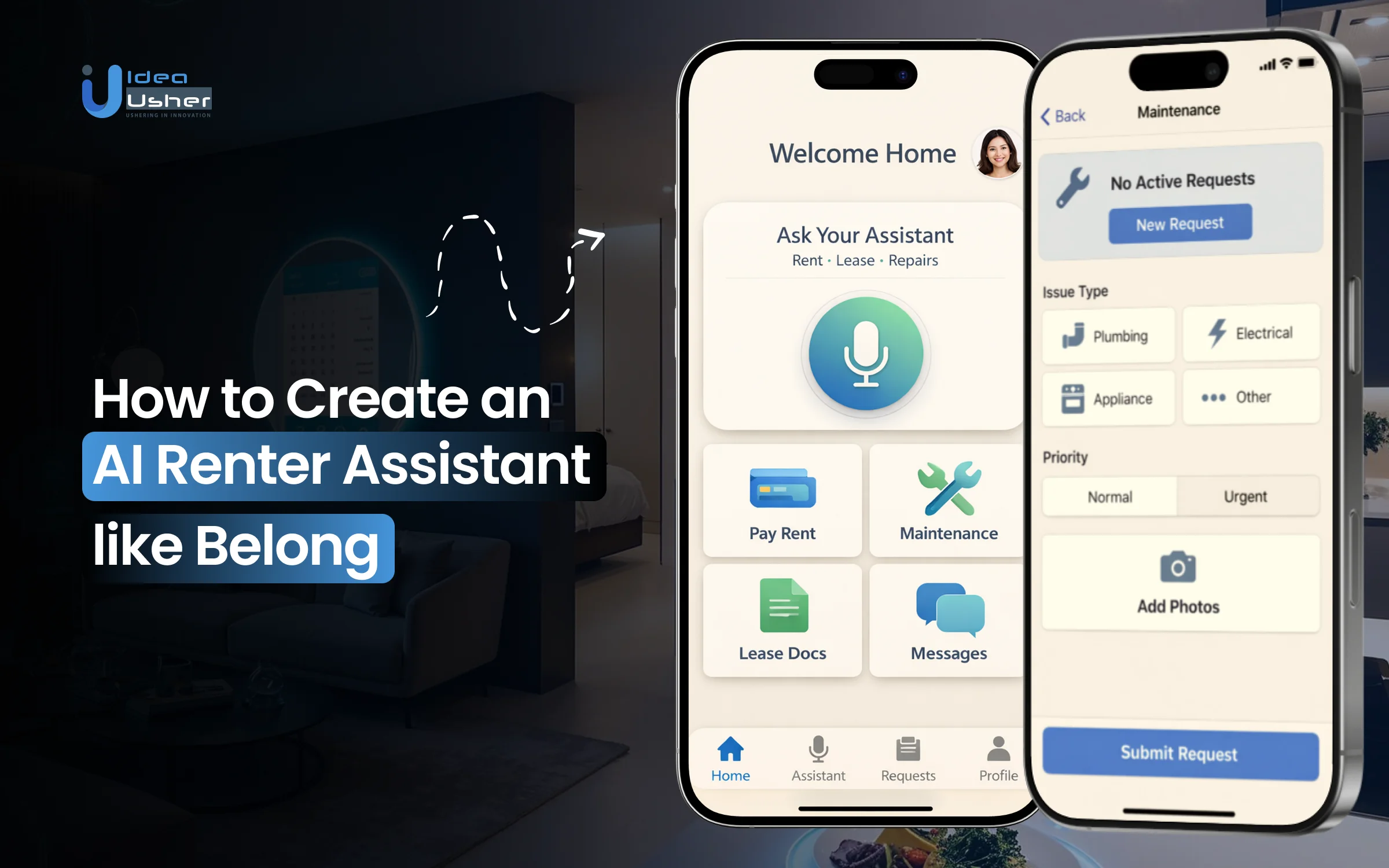
Renter interactions generate operational work long before and after a conversation ends. Scheduling viewings, processing applications, logging maintenance requests, enforcing response timelines, and routing issues across teams all require structured workflows. A Belong-like AI Renter Assistant sits at the center of this activity, acting as an orchestration layer that connects renter intent with operational systems rather than functioning as a standalone chatbot.
To perform this role effectively, the assistant must integrate with property management software, ticketing systems, payment workflows, and communication channels. It needs clear rules for escalation, automation logic for routine actions, and guardrails that ensure consistency across renter touchpoints. The quality of these integrations and workflows determines whether the assistant reduces operational load or adds complexity.
In this blog, we explain how to create an AI renter assistant like Belong by examining the workflow architecture, system integrations, and execution considerations involved in deploying a reliable renter-facing automation platform.
What is an AI Renter Assistant, Belong?
Belong is an AI-powered renter and property management platform that simplifies long-term residential rentals through technology and data intelligence. It manages the full rental lifecycle including pricing, marketing, onboarding, rent collection, and maintenance through a digital-first experience, delivering predictable income for homeowners, reduced vacancy risk, and clear visibility into property performance.
As a next-generation PropTech marketplace, the platform combines asset efficiency and renter experience, with an AI assistant boosting responsiveness and a service-led model reducing friction for owners, increasing recurring revenue for investors.
- AI-driven pricing using machine learning to optimize rent estimates and market positioning, boosting occupancy and revenue while reducing vacancy risk for property owners.
- Guaranteed rent plus flexible payment options that ensure predictable monthly income for homeowners, even when residents choose alternative payment schedules.
- Advanced pricing algorithms and real-time market data to maximize rental value and reduce vacancy periods.
A. Business Model
Belong is an AI-powered, full-stack PropTech platform that manages long-term residential rentals end to end. Its business model simplifies rental ownership for homeowners while delivering a tech-enabled renter experience through a scalable two-sided marketplace.
Key business model pillars and differentiators:
- AI-driven rental lifecycle management covering pricing, marketing, resident placement, rent collection, maintenance, and support
- Guaranteed rent and service-led ownership model that reduces income volatility and operational burden for homeowners
- Digital-first, mobile-enabled platform with real-time dashboards for homeowners and renters
- Human-plus-AI operations combining automation with dedicated local teams for maintenance and resident support
- Two-sided marketplace strategy that increases lifetime value by serving both homeowners and renters within one ecosystem
- Asset-light, scalable PropTech infrastructure designed to grow units under management with improving unit economics
B. Revenue Model
Belong generates revenue through recurring, service-based fees tied directly to rental performance and value-added offerings. Its monetization strategy aligns platform revenue with homeowner outcomes and long-term rental stability.
- Property management fees: Homeowners pay a percentage of monthly rent for ongoing management services
- Placement and onboarding fees: One-time fees charged for resident sourcing, screening, and lease setup
- Rent share: A portion of collected rent contributes to platform revenue under service agreements
- Financing and service add-ons: Revenue from repair financing, maintenance coordination, and premium homeowner services
- Brokerage and wealth tools: Fee-based income from services linked to future home ownership and financial products
How AI Renter Assistant Belong Work?
Belong operates through two connected journeys for homeowners and residents, powered by AI, automation, and service-led execution. The platform manages the full rental lifecycle while aligning income predictability, asset performance, and resident experience at scale.
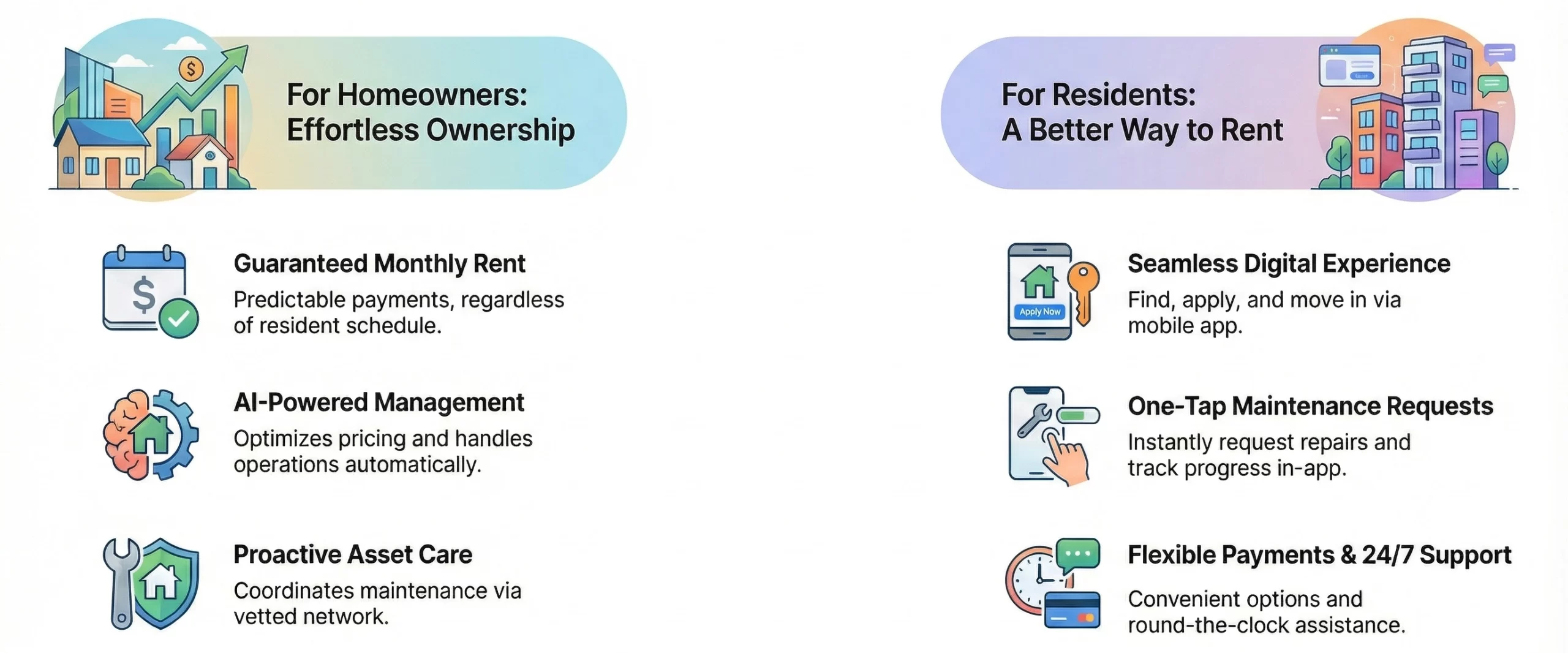
A. For Homeowners
Belong simplifies rental ownership for homeowners by combining AI-driven management, guaranteed income, and full-service operations into a single, digital-first platform.
- AI-Driven Rent Pricing & Market Positioning: Belong uses data intelligence and market signals to set optimal rent pricing, helping homeowners maximize returns while minimizing vacancy time and pricing volatility.
- Guaranteed Monthly Rent: Homeowners receive on-time, predictable rent payments every month, regardless of resident payment behavior, significantly reducing cash flow risk.
- End-to-End Rental Lifecycle Management: From professional listing and marketing to resident screening, leasing, renewals, and compliance, Belong handles every operational step without owner involvement.
- Real-Time Owner Dashboard & Financial Visibility: Homeowners access a digital dashboard that provides live insights into rent collection, expenses, maintenance activity, and overall property performance.
- Proactive Maintenance & Asset Care: Belong coordinates repairs and upkeep through a vetted service network, using workflows that prioritize speed, quality, and long-term asset protection.
B. For Residents
Belong enhances the rental experience for residents through a mobile-first platform that offers flexible payments, fast maintenance, and always-on support.
- Digital Home Discovery & Seamless Onboarding: Residents can search, apply, sign leases, and move in through a mobile-first experience designed for speed and transparency.
- Flexible Rent Payments with Full Transparency: The platform supports convenient payment options with clear tracking, reminders, and in-app support to reduce friction and late payments.
- One-Tap Maintenance Requests: Residents can request repairs instantly through the app, with issues routed to qualified professionals and tracked to resolution.
- 24/7 Support & Concierge-Style Assistance: A dedicated support team is available around the clock to handle questions, emergencies, and ongoing needs.
- Resident-First Experience Design: Belong focuses on long-term satisfaction through responsive service, clear communication, and a rental experience that feels supportive rather than transactional.
Together, these two experiences form an AI-enabled rental ecosystem that improves operational efficiency, strengthens retention, and creates sustainable value for homeowners, residents, and investors.
What Are the Core Modules of an AI Renter Assistant Platform?
The core modules of an AI renter assistant platform helps businesses build smarter, more efficient tenant support systems while streamlining daily property operations. This overview highlights the essential components that power reliable and scalable solutions.
| Core Module | Purpose | Business Value |
| AI Pricing & Market Intelligence | Uses market data, demand signals, and comparable listings to recommend optimal rental pricing. | Reduces vacancy, improves yield, and keeps properties competitively priced across market shifts. |
| Property Listing & Marketing | Manages listings, media assets, virtual tours, and multi-channel distribution from one system. | Accelerates tenant acquisition and increases conversion through consistent, high-quality property presentation. |
| AI-Driven Tenant Screening | Automates applicant evaluation using financial, behavioral, and eligibility criteria. | Lowers default risk, improves tenant quality, and ensures fair and repeatable screening decisions. |
| Lease & Contract Management | Automates lease generation, digital signing, renewals, and document storage. | Shortens leasing cycles, reduces legal friction, and ensures contract consistency at scale. |
| Rent Collection & Management | Handles rent scheduling, payment tracking, reminders, and exception handling. | Improves cash flow reliability and financial transparency for homeowners and renters. |
| Maintenance & Service Coordination | Receives requests, prioritizes issues, and coordinates service resolution workflows. | Protects asset condition, reduces downtime, and improves resident satisfaction. |
39% of Property Managers Spend Over 20 Hours a Month on Maintenance Requests
The global generative AI in real estate market was valued at USD 437.65 million in 2024 and is projected to reach USD 1,302.12 million by 2034, growing at a CAGR of 11.52% from 2024 to 2034. This growth reflects the accelerating adoption of AI to automate operational bottlenecks and improve decision-making across rental management.
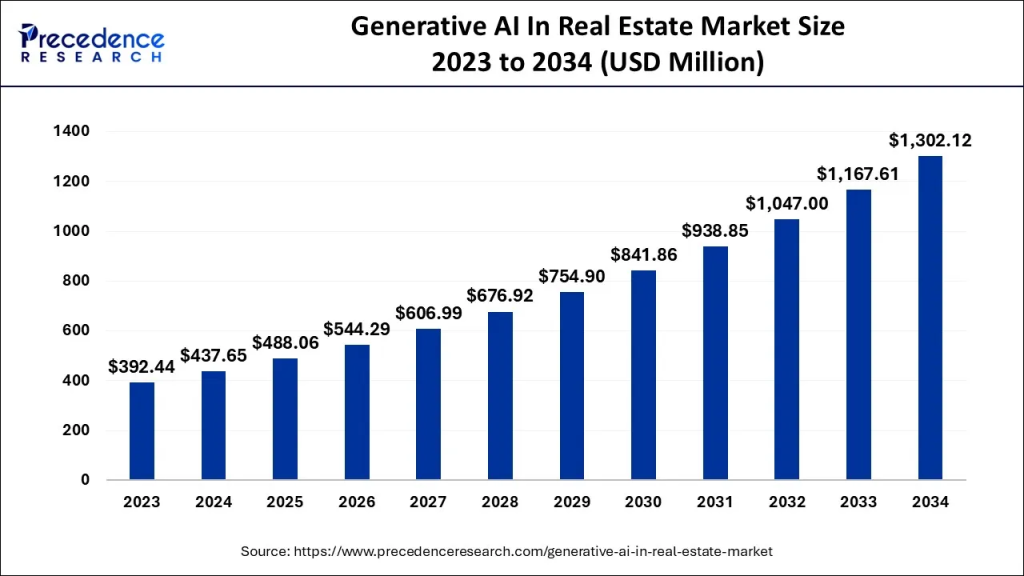
Despite strong market growth, rental operations remain largely manual. 39% of property managers spend over 20 hours per month on maintenance requests, while 41% identify late rent payments as their top challenge. These repetitive tasks drain time and resources that could be used for revenue growth and portfolio optimization.
A. How Operational Gaps Create Demand for AI Renter Assistants?
AI renter assistant platforms emerge as a response to structural inefficiencies that traditional property management struggles to solve at scale.
- Maintenance Workload Overload: High volumes of service requests require constant coordination, follow-ups, and vendor management, creating operational drag.
- Manual Rent Tracking and Delays: Payment monitoring and follow-ups increase administrative effort and disrupt predictable cash flow.
- Fragmented Communication Channels: Disconnected tools and conversations slow response times and increase error rates.
- Limited Time for Strategic Growth: Operational firefighting prevents property managers from focusing on acquisition, optimization, and tenant retention.
B. How AI Renter Assistants Solve These Challenges at Scale?
An AI renter assistant is designed to automate repetitive workflows while maintaining control and transparency.
- Intelligent Maintenance Request Handling: Automated triage, prioritization, and routing reduce manual intervention and response delays.
- Structured Rent Collection and Payment Oversight: Centralized rent workflows improve visibility, consistency, and on-time payments.
- Centralized Communication and Status Updates: Real-time notifications and unified messaging reduce back-and-forth and misalignment.
- Operational Efficiency Through Automation: By offloading routine tasks to AI-driven systems, property managers can reallocate time toward higher-value, revenue-generating activities.
Together, these challenges highlight why manual property management models struggle to scale efficiently. AI renter assistants offer a practical path to reduce operational load, improve rent reliability, and enable property teams to focus on growth rather than day-to-day firefighting.
Benefits of a Belong-like AI Renter Assistant Platform
An AI renter assistant delivers measurable value across the rental ecosystem by improving income stability, operational efficiency, and user experience. These benefits lay the foundation for the core capabilities that must be built into a competitive, market-ready platform.
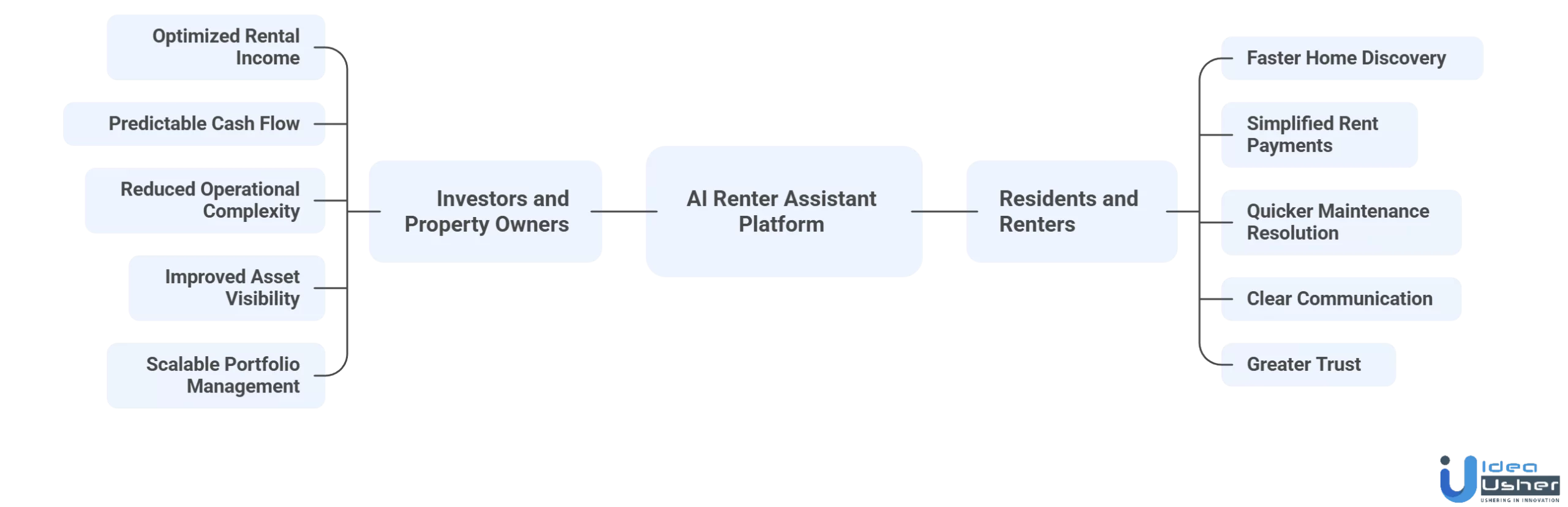
A. Benefits for Investors and Property Owners
For investors and landlords, an AI renter assistant transforms rental properties into data-driven, professionally managed assets that are easier to operate and scale.
- Optimized Rental Income and Pricing Accuracy: Intelligent pricing decisions based on market conditions help improve yield while minimizing vacancy and underpricing risks.
- Predictable Cash Flow and Income Stability: Structured rent management and income protection mechanisms reduce payment uncertainty and improve financial planning.
- Reduced Operational Complexity and Manual Effort: Centralized workflows simplify listing, leasing, maintenance, and renewals, lowering day-to-day management overhead.
- Improved Asset Visibility and Financial Control: Real-time insights into rent, expenses, and performance allow owners to make informed, timely decisions.
- Scalable Portfolio Management Across Locations: Standardized processes and centralized oversight make it easier to manage multiple properties across cities and regions.
B. Benefits for Residents and Renters
For residents, an AI renter assistant creates a more transparent, responsive, and convenient rental experience that reduces friction throughout the leasing journey.
- Faster Home Discovery and Decision-Making: Enhanced listings and immersive viewing experiences help renters evaluate homes more efficiently.
- Simplified Rent Payments and Financial Clarity: Clear payment tracking and flexible options reduce confusion and improve on-time rent behavior.
- Quicker Maintenance Resolution and Reliable Support: Structured service workflows ensure issues are addressed promptly with consistent quality.
- Clear Communication and Reduced Friction: Centralized messaging keeps renters informed and eliminates fragmented communication.
- Greater Trust and Long-Term Rental Stability: Professional management and consistent service foster confidence and encourage longer stays.
Key Features of an AI Renter Assistant like Belong
A Belong-like AI renter assistant simplifies renter support by handling common requests and organizing communication in one place. Below are the core features that help property managers operate more smoothly and consistently.

1. AI-Driven Dynamic Rent Pricing
The platform uses AI-based pricing models and real-time market data to determine optimal rent values. Analyzing demand trends, comparable listings, and occupancy signals, it helps reduce vacancy periods while improving rental yield and long-term revenue predictability.
2. Professional Property Marketing
Homes are marketed using high-quality digital listings, professional photography, and virtual tours, then distributed across leading rental channels. This ensures faster tenant acquisition, stronger first impressions, and consistent brand positioning across competitive rental marketplaces.
3. AI-Driven Tenant Screening and Placement
The system applies automated risk assessment and eligibility scoring using credit data, income validation, and behavioral indicators. This improves resident quality, lowers default risk, and increases lease longevity while maintaining fair and compliant screening standards.
4. End-to-End Rental Lifecycle Management
The platform centralizes complete rental operations from listing and leasing to renewals and move-outs. Automation reduces manual intervention while maintaining compliance, documentation accuracy, and operational continuity across multiple properties and markets.
5. Income Protection Layer
A built-in income assurance mechanism delivers predictable monthly payouts to homeowners, insulating them from late or missed renter payments. This feature increases owner trust, accelerates platform adoption, and stabilizes cash flow across economic cycles.
6. Automated Lease Creation and Management
The platform generates digitally executed, regulation-aware lease agreements with built-in workflows for renewals, amendments, and record keeping. This reduces legal friction, shortens leasing cycles, and ensures consistent contract governance at scale.
7. 24/7 Virtual Maintenance Concierge
Maintenance requests are handled through an always-on AI-assisted concierge that triages issues, schedules service professionals, and tracks resolution. This minimizes downtime, improves response speed, and protects long-term asset condition.
8. Owner and Financial Reporting Dashboards
Homeowners access real-time financial visibility covering rent collections, expenses, maintenance costs, and net performance. Data-driven dashboards support informed decision-making and position the platform as a trusted financial operating layer.
9. Real-Time Renter Communication Portal
A centralized in-app communication system enables instant updates, service tracking, and support interactions. This reduces friction, increases transparency, and strengthens resident engagement through consistent and documented communication flows.
10. AI Immersive Touring and Virtual Staging
The platform offers 360-degree virtual tours, 3D walkthroughs, and AI-powered staging to help renters visualize spaces remotely. This accelerates decision-making, expands reach beyond local markets, and improves listing conversion rates.
How to Create an AI Renter Assistant like Belong?
Build a sophisticated AI renter assistant like Belong by integrating smart automation with seamless property management. Our developers follow industry-best practices to deliver scalable, high-performance real estate technology solutions.
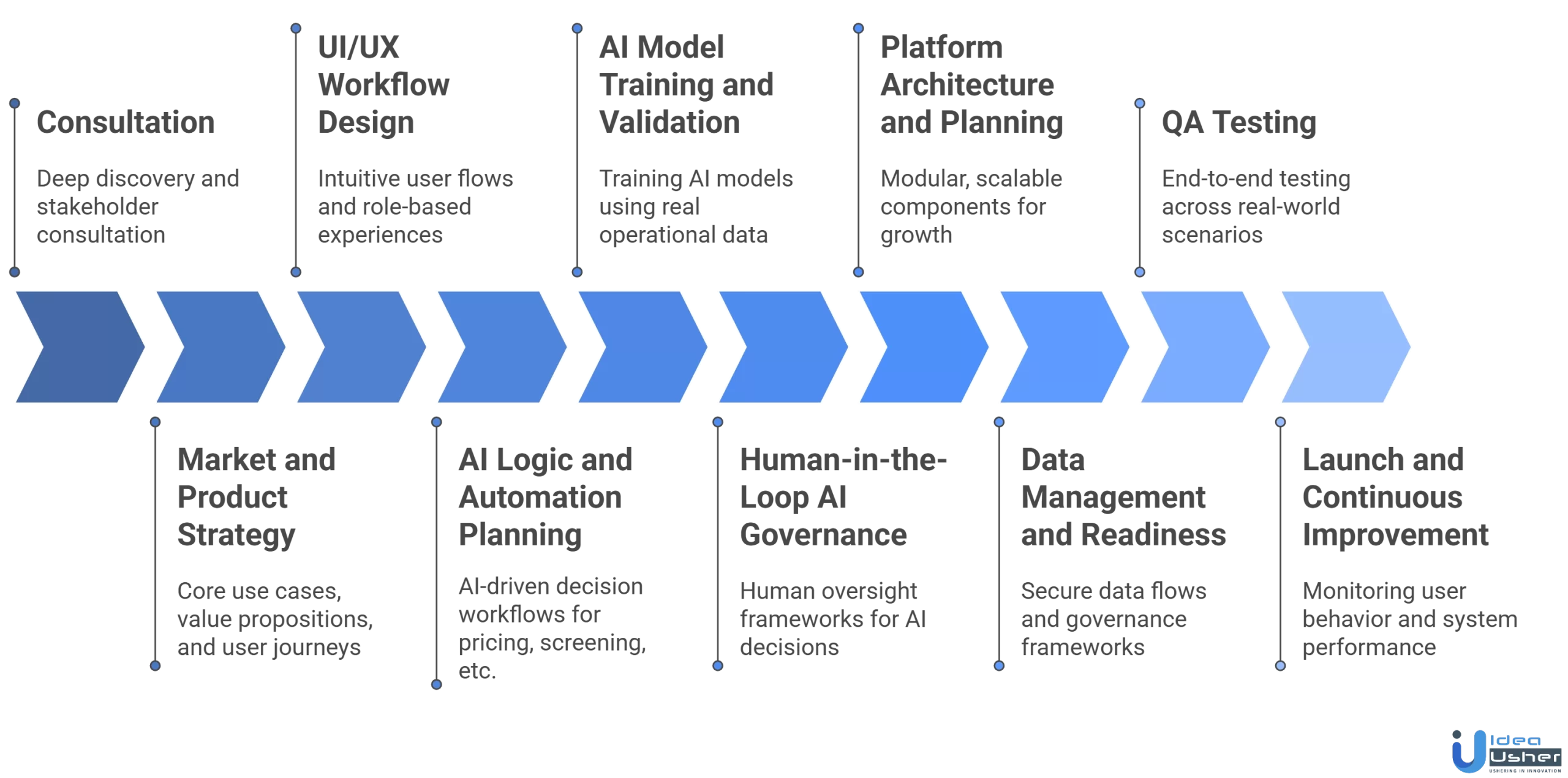
1. Consultation
We begin with deep discovery and stakeholder consultation to understand business goals, target users, market positioning, and competitive benchmarks. This phase helps us align the product vision with real operational needs and long-term scalability.
2. Market and Product Strategy Definition
Our team defines core use cases, value propositions, and user journeys for homeowners and renters. We translate market gaps into clear product requirements, feature priorities, and success metrics to ensure the platform is commercially viable.
3. User Experience and Workflow Design
We design intuitive user flows and role-based experiences that simplify complex rental operations. The focus is on reducing friction, improving clarity, and creating trust through transparent interactions for both property owners and residents.
4. AI Logic and Automation Planning
We map out AI-driven decision workflows for pricing, screening, communication, and maintenance routing. This step defines how intelligence, automation, and human oversight work together to deliver consistent and reliable outcomes.
5. AI Model Training and Validation
This step focuses on training AI models using real operational data, validating outputs against real-world scenarios, and establishing feedback loops for continuous improvement. It ensures accuracy, fairness, and adaptability as user behavior, market conditions, and regulations evolve over time.
6. Human-in-the-Loop AI Governance
We design human oversight frameworks that allow teams to review, intervene, and refine AI decisions when needed. This process builds trust, reduces risk, and ensures AI outputs remain aligned with business rules, ethical standards, and real-world rental operations.
7. Platform Architecture and Planning
Our developers structure the platform around modular, scalable components that support growth across properties, locations, and users. This ensures operational resilience, smooth integrations, and the ability to evolve features over time.
8. Data Management and Compliance Readiness
We design secure data flows and governance frameworks to handle financial, personal, and property data responsibly. Compliance considerations are embedded early to support regional regulations and long-term platform credibility.
9. QA Testing
Our team conducts end-to-end testing across real-world scenarios to ensure accuracy, reliability, and performance. This includes validating AI outputs, user workflows, and system responses under operational load.
10. Launch and Continuous Improvement
After launch, we monitor user behavior, system performance, and business metrics to guide ongoing improvements. Continuous iteration allows the platform to adapt to market feedback and scale with confidence.
Cost to Build a Belong-like AI Renter Assistant Platform
Building a Belong-like AI renter assistant requires balancing advanced automation costs with high-end user experience goals. This guide breaks down the essential investment factors for modern property management technology.
| Development Phase | Description | Estimated Cost |
| Consultation & Discovery | Product vision alignment, market research, stakeholder interviews, and requirement validation | $8,000 – $15,000 |
| Market & Product Strategy | Use case definition, feature prioritization, roadmap planning, and success metrics | $10,000 – $20,000 |
| UX & Workflow Design | User journey mapping, interface design, and interaction flow optimization | $14,000 – $25,000 |
| AI Logic & Automation Planning | AI decision workflows, automation rules, and intelligence mapping | $18,000 – $35,000 |
| AI Model Training & Validation | Model training pipelines, validation cycles, and performance tuning | $25,000 – $50,000 |
| Human-in-the-Loop AI Governance | AI oversight frameworks, escalation flows, and control mechanisms | $12,000 – $25,000 |
| Platform Architecture Planning | Scalable system design, modular architecture, and integration planning | $15,000 – $30,000 |
| Data Management & Compliance | Secure data handling, regulatory readiness, and governance setup | $10,000 – $20,000 |
| Quality Assurance & Testing | End-to-end testing, scenario validation, and reliability assurance | $12,000 – $22,000 |
| Launch & Post-Launch Optimization | Performance monitoring, feedback analysis, and iterative improvements | $8,000 – $18,000 |
Total Estimated Cost: $62,000 – $115,000
Note: Development costs depend on product scope, AI complexity, data, compliance, and customization. Optimization, scaling, and advanced features can increase investment.
Consult with IdeaUsher for a tailored cost estimate and development roadmap to build a scalable, market-ready AI Renter Assistant platform aligned with your goals.
Key Challenges in Building an AI Renter Assistant Platform
Developing an AI renter assistant requires navigating technical hurdles, from data privacy to legacy system integration. Our developers follow a rigorous engineering framework to overcome these obstacles and ensure secure, seamless performance.
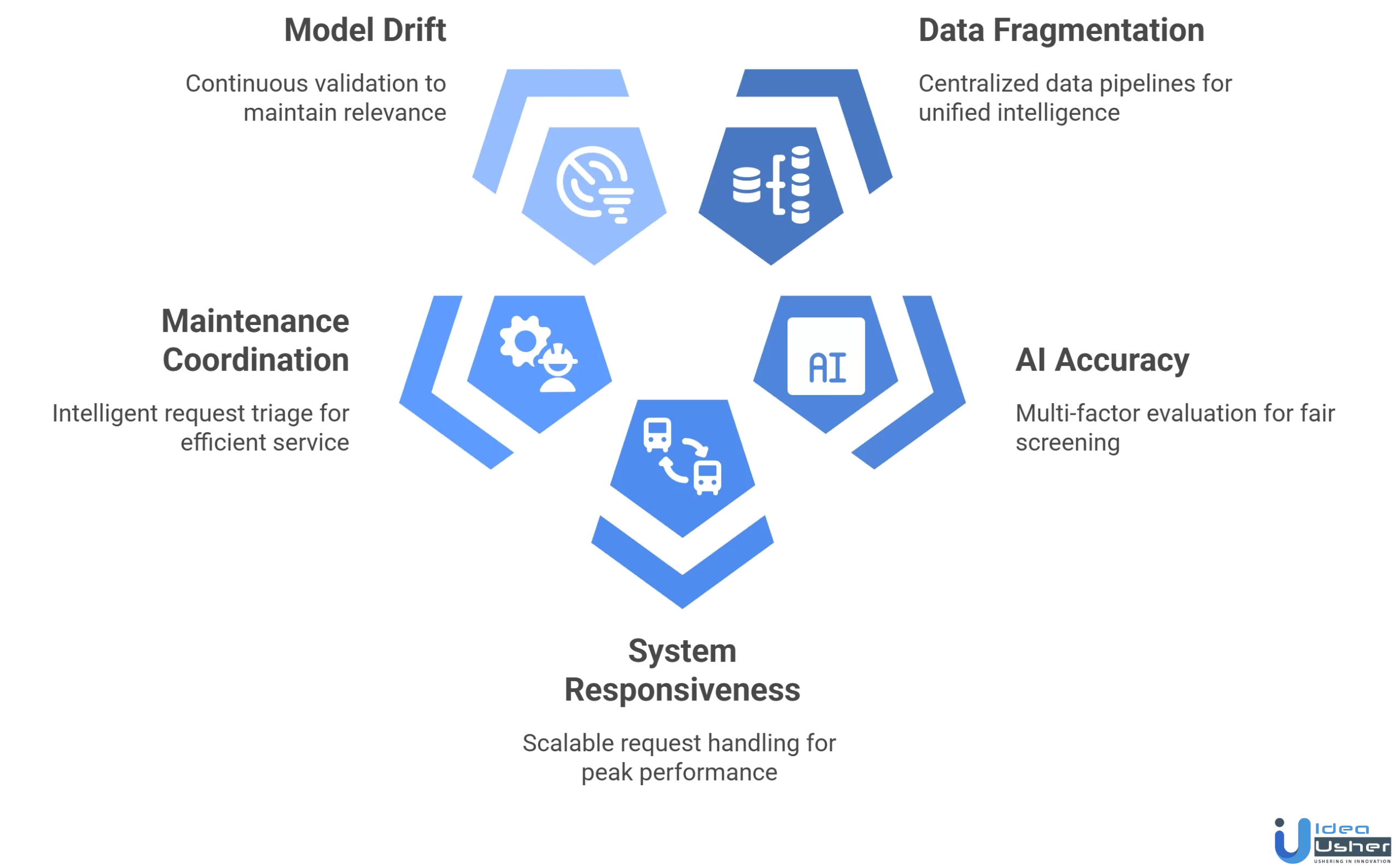
1. Data Fragmentation Across Rental Operations
Challenge: Rental data is often scattered across listings, payments, maintenance, and communication systems, making unified intelligence difficult.
Solution: Our developers design centralized data pipelines that normalize inputs across workflows, enabling consistent AI decision-making and reliable cross-module insights.
2. AI Accuracy in Tenant Screening and Risk Scoring
Challenge: Inaccurate or biased screening models can increase default risk and regulatory exposure.
Solution: We implement multi-factor evaluation logic with continuous validation, feedback loops, and human review checkpoints to ensure fair, explainable, and compliant screening outcomes.
3. Real-Time System Responsiveness at Scale
Challenge: Supporting thousands of concurrent users can strain performance during rent payments or maintenance spikes.
Solution: Our developers architect scalable request handling and workload orchestration, ensuring low latency and consistent performance during peak operational periods.
4. Maintenance Coordination and Service Reliability
Challenge: Automating maintenance without service delays or quality issues is operationally complex.
Solution: We develop intelligent request triage systems that prioritize urgency, route tasks efficiently, and track resolution through transparent service workflows.
5. AI Model Drift Over Time
Challenge: Market conditions and user behavior change, reducing AI effectiveness. Continuous data updates and adaptive learning help maintain accuracy as user needs and market dynamics evolve.
Solution: Our developers implement continuous monitoring and retraining mechanisms to keep models accurate, relevant, and aligned with real-world rental dynamics. This ensures consistent performance, faster issue resolution, and improved user experience across all renter interactions.
How Do AI Renter Assistant Platforms Scale Across Cities and Regions?
AI renter assistant platforms scale across cities by adapting to local regulations, languages, and tenant behavior while maintaining consistent service quality. This shows how regional expansion can be managed effectively.
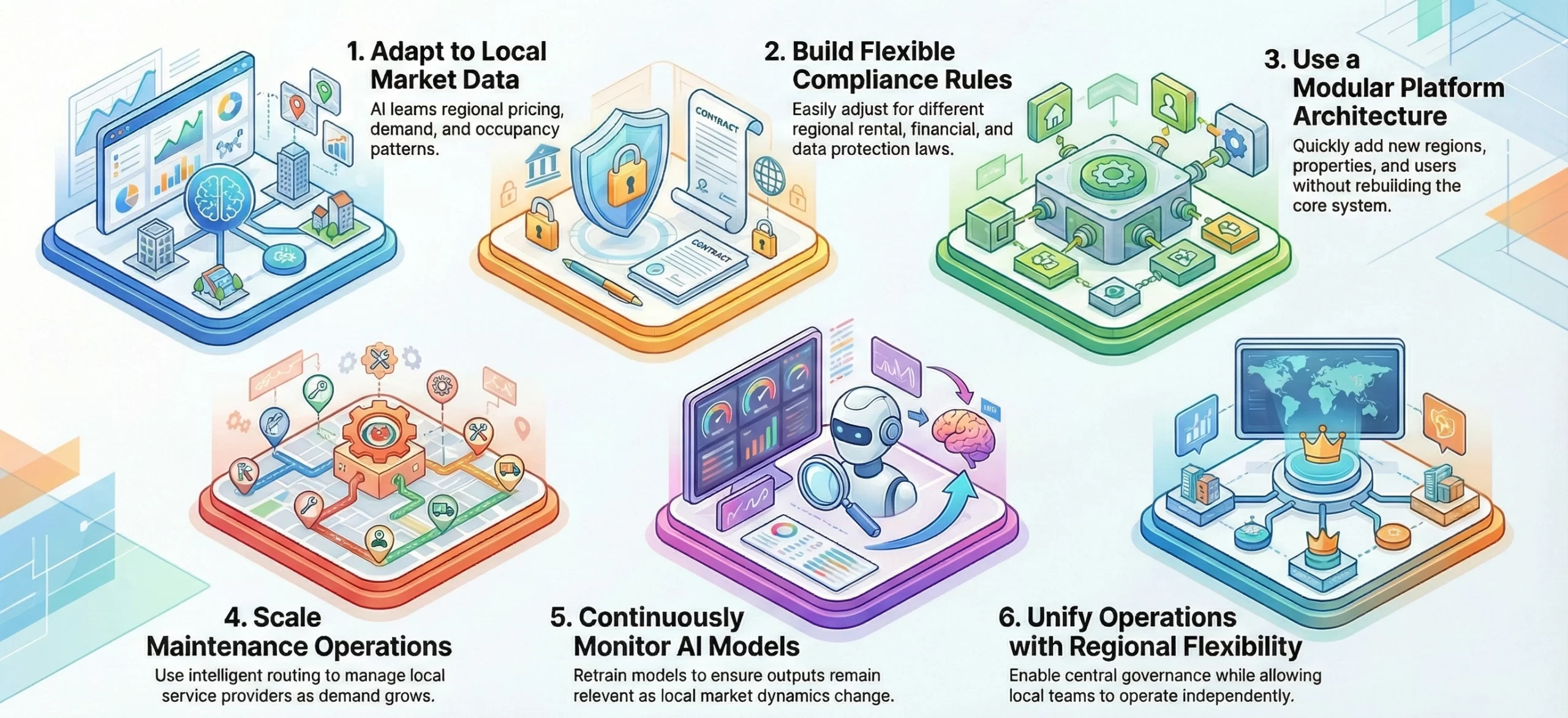
1. Localized Market Intelligence and Pricing Adaptation
Scaling begins with adapting AI models to local rental demand, pricing norms, and occupancy patterns. We design systems that learn from region-specific data, allowing rent recommendations and insights to stay accurate as the platform expands into new cities.
2. Configurable Compliance and Regulatory Workflows
Each region follows different rental, financial, and data protection regulations. Our developers build configurable compliance frameworks that adjust documentation, approval flows, and data handling rules without rebuilding the core platform for every market.
3. Modular Platform Architecture for Regional Expansion
To support growth, we structure the platform using modular and reusable components. This approach allows new regions, properties, and user groups to be added quickly while maintaining performance, stability, and operational consistency.
4. Scalable Maintenance and Service Operations
Regional growth increases service complexity. We implement intelligent routing and prioritization logic that connects local service providers, manages response times, and maintains quality standards as maintenance demand scales.
5. AI Model Monitoring Across Regions
Market behavior changes across locations and over time. Our developers deploy continuous monitoring and retraining mechanisms to ensure AI outputs remain accurate, relevant, and aligned with regional rental dynamics.
6. Unified Operations with Regional Flexibility
The platform maintains a centralized operational view while each city operates differently. This enables consistent reporting, performance tracking, and governance while allowing regional teams to operate independently within defined rules.
Conclusion
Creating an AI renter assistant like Belong is about making renting simpler for both tenants and property managers. A well-designed Belong-like AI Renter Assistant can answer common questions, track maintenance requests, and guide renters through important processes without creating friction. The real value comes from offering clear, helpful responses that feel personal rather than automated. When you focus on user experience, data accuracy, and system integration, your assistant becomes a trusted support tool. With a thoughtful approach, you can improve communication, reduce response times, and build stronger relationships across your rental ecosystem.
Why Partner with Us for Your AI Renter Assistant Development?
We specialize in building intelligent renter assistant platforms that automate tenant communication, reduce operational workload, and improve service efficiency. From strategy to deployment, we help you create scalable solutions tailored to modern property management needs.
What Sets Us Apart?
- Industry-Focused Expertise: Our ex-FAANG/MAANG developers understand real estate operations, tenant communication, and property management workflows, enabling us to create solutions that tackle real business challenges and enhance daily operations.
- Custom-Built Platforms: We develop AI renter assistants tailored to your goals, needs, and expectations, providing valuable solutions.
- End-to-End Development: We handle all aspects from user experience design, backend development, to AI model integration and testing for a smooth, reliable launch.
- Future-Ready Architecture: Our scalable platforms let you expand features, accommodate more users, and support a growing property portfolio without performance issues.
Explore our portfolio to see how we’ve helped businesses launch AI solutions successfully.
Get in touch today for a free consultation and take the first step toward launching your AI renter assistant platform.


FAQs
A.1. An AI renter assistant should handle rent queries, maintenance requests, lease information, and payment reminders. It should also support multi-channel communication, integrate with property systems, and use natural language processing to deliver fast, accurate tenant responses.
A.2. The cost depends on features, integrations, AI complexity, and development region. A basic version may cost less, while advanced automation, analytics, and CRM integration can increase the budget. Planning a scalable architecture helps control long-term expenses.
A.3. Start with competitor analysis, user surveys, and pilot testing with property managers. Validate pain points such as response delays and support overload. Early feedback helps refine features and ensures your solution solves real rental management challenges.
A.4. You need tenant queries, support tickets, lease documents, and property policies. Clean and well-structured data improves chatbot accuracy. Regular updates help the assistant adapt to new renter needs and changing property management workflows.