


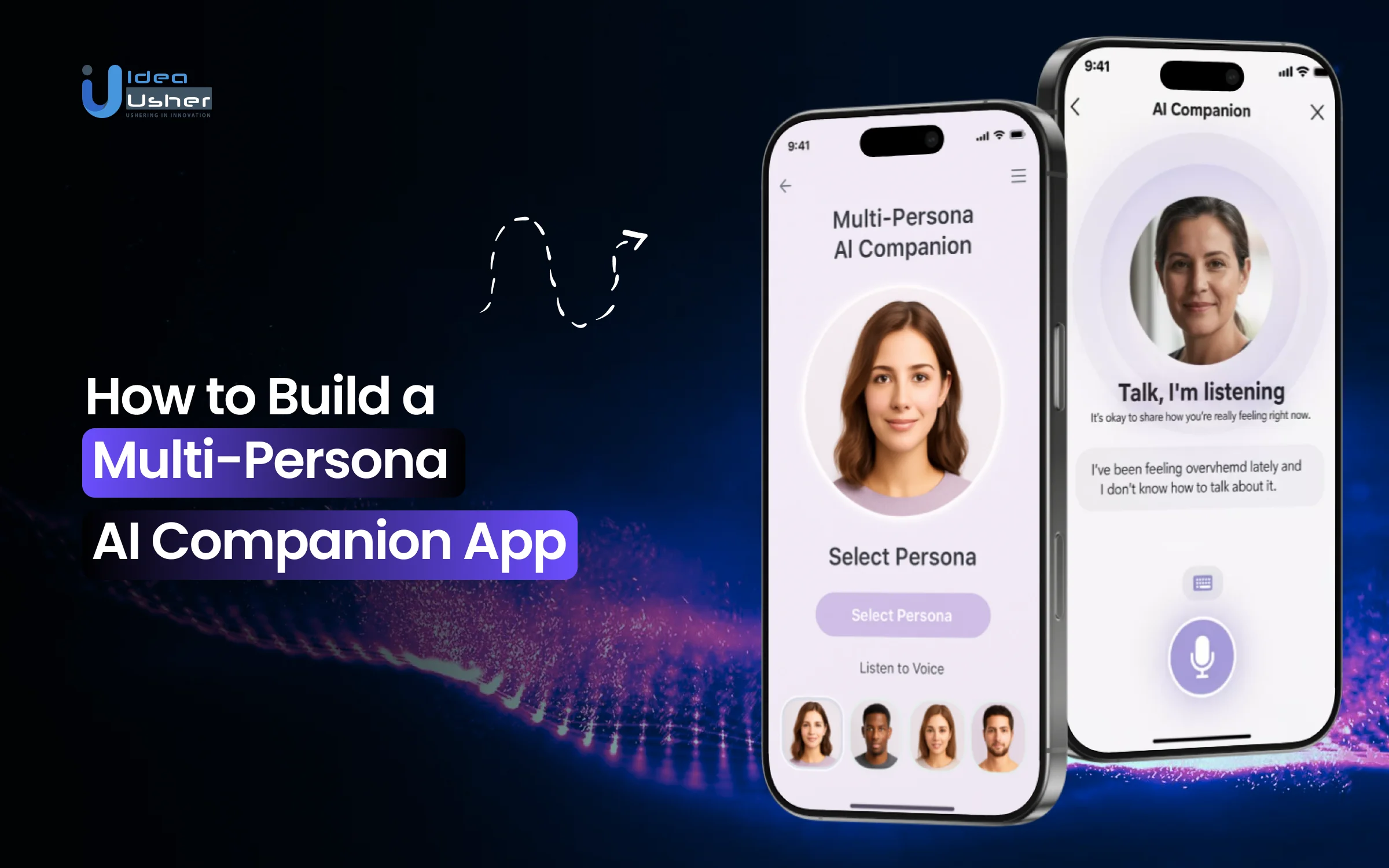
As people spend more time interacting with AI, expectations are shifting beyond a single, generic personality. Users want different kinds of conversations depending on their mood, purpose, or moment. This growing demand is driving the adoption of an AI multi-persona companion app, where guidance, creativity, and companionship can coexist without forcing a one-size-fits-all experience.
Building a multi-persona experience requires more than changing tone or prompts. Each persona needs its own behavioral rules, memory boundaries, response style, and interaction logic, while still sharing a common intelligence layer. Behind the scenes, this involves orchestrating language models, persona frameworks, context handling, and memory management to keep personalities consistent without blending unnaturally.
In this blog, we’ll explore how to build an AI multi-persona companion app, covering the core design principles, technical architecture, and key challenges involved. This guide will help you understand how to structure personas that feel intentional, coherent, and genuinely engaging.

What is an AI Multi-Persona Companion App?
An AI companion app is a digital application designed to interact with users in a natural, human-like conversational manner, offering companionship, assistance, emotional support, guidance or task-based help while adapting to the user’s preferences, communication style, and emotional context.
With a multi-persona approach in an AI companion app, this adaptability comes to life through multiple distinct AI personas, each shaped with its own personality, tone, and role, allowing the experience to shift naturally based on what the user needs in the moment. This creates interactions that feel more personal, flexible, and genuinely supportive within a single application.
- Personas are guided by structured behavioral frameworks that define tone, response style, and boundaries for consistent personality expression.
- Context and memory handling can be persona-aware, allowing each persona to retain relevant cues while staying separate from others when needed.
- Persona switching may occur through explicit user selection or implicit signals like intent, emotional cues, or interaction patterns.
- A shared underlying language model can support multiple personas through layered prompt configurations rather than separate models.
- Safety, alignment, and moderation rules can be applied globally while still allowing persona-specific flexibility.
- Persona definitions are extensible, enabling new personalities or the evolution of existing ones without disrupting the core system.
The Role of Personas in Shaping Human-Like AI Interactions
Personas shape how users perceive AI, enabling adaptive, consistent communication. In multi-persona apps, they provide structured behavior that supports diverse needs while preserving coherence and natural, human-aligned interactions across contexts.

1. Personas as Behavioral Frameworks, Not Characters
Personas aren’t just characters but behavioral frameworks defining tone, detail, emotional expressiveness, and boundaries in AI companion apps, ensuring consistent thinking, responses, and communication across interactions and contexts.
By treating personas as behavior models rather than surface traits helps teams control AI responses, reducing unpredictability while keeping a human-like feel.
2. Adapting to User Context and Emotional States
Personas let AI adapt tone to user context and emotions, delivering motivation, reassurance, or guidance as needed, without altering the core system or breaking conversational continuity over time.
This adaptability makes AI seem more attentive and responsive, enabling interactions to better match how humans adjust their communication in various situations.
3. Maintaining Consistency While Allowing Flexibility
Human-like interactions need a balance of consistency and variation. Personas define stable behavior patterns but allow natural flow. Without this, AI responses may seem rigid or erratic, undermining trust.
Well-designed personas clarify interaction expectations and maintain engaging, authentic conversations over time.
4. Reducing Cognitive Load for Users
Clear persona design lowers cognitive load by making AI responses predictable, so users interpret it easily and focus more on engagement. Personas act as familiar modes, helping users adapt to the AI’s style without instructions.
This clarity contributes to smoother, more comfortable conversations and supports long-term engagement, particularly in applications where users interact with the AI regularly.
5. Multiple Use Cases Within a Single AI System
Personas allow one AI companion to serve diverse user needs such as productivity, emotional support, learning, and guidance, without fragmenting the experience or requiring separate applications or isolated systems.
By structuring interactions around clear personas, teams can create one cohesive platform that scales across use cases, maintaining clarity, consistency, and flexibility.
Why Over 50% of AI Companion Users Interact Daily?
The global AI companion market was valued at USD 28.19 billion in 2024 and is projected to reach USD 140.75 billion by 2030, with a CAGR of 30.8% from 2025 to 2030. This growth is driven by increasing adoption, expanding use cases, and rising demand for emotionally intelligent, always-available AI experiences.

Daily usage patterns further highlight how deeply AI companion apps are integrated into users’ routines. Research indicates that over 50% of AI companion users interact with their AI on a daily basis, reflecting consistent engagement and long-term reliance rather than occasional or novelty-driven use.
A. Multiple Interaction Styles Support Daily Engagement
AI multi-persona companion apps promote daily use by adapting to users’ current mindset or situation. Instead of a fixed style, the app adjusts its engagement, making interactions feel relevant rather than repetitive.
Key ways multiple interaction styles drive daily engagement include:
- Context-appropriate responses throughout the day: Users may seek motivation, reflection, or casual conversation at different moments, and varied interaction styles help meet these shifting needs naturally.
- Reduced conversational fatigue: Switching interaction styles prevents the experience from feeling monotonous, encouraging users to return even after frequent daily use.
- Better alignment with emotional and cognitive states: Multi-persona design allows the AI to respond differently based on user intent, improving perceived understanding and responsiveness.
- Stronger habit formation: When users know the AI can adjust how it interacts, they are more likely to incorporate it into daily routines.
B. Persona Flexibility Keeps Long-Term Users Invested
As users engage with AI companions over longer periods, their expectations and usage patterns evolve. Persona flexibility ensures the app continues to feel useful and engaging, even as user needs change over time.
Key ways persona flexibility supports long-term retention include:
- Support for evolving user goals: Users may initially seek companionship and later rely on guidance, structure, or reflection, all within the same platform.
- Preservation of relevance across life stages: Flexible personas allow the AI to remain aligned with users as their priorities, challenges, and interaction preferences shift.
- Clear separation between interaction modes: Distinct personas help users understand what kind of interaction they are entering, improving clarity and trust.
- Sustained emotional and functional engagement: By adapting interaction styles without losing consistency, the AI remains engaging without feeling unpredictable.
Consistent daily use of AI apps reflects a shift toward more personalized digital interactions. Multi-persona design sustains engagement by enabling relevant interactions across moments and needs. Thoughtfully implemented, multi-persona AI companions balance flexibility and consistency, supporting trust, retention, and meaningful relationships in a competitive market.
The AI Intelligence Layer Powering Multi-Persona Companion Apps
Multi-persona AI apps use layered intelligence to manage interaction, consistency, and adaptation. Instead of one model, this layer coordinates capabilities, shaping the user experience.
| AI Intelligence Component | What It Does Behind the Scenes | Why It Matters |
| Conversational Reasoning Engine | Interprets user intent, context, and conversational direction | Enables meaningful, goal-aware responses instead of generic replies |
| Persona Orchestration Logic | Determines which persona behavior should guide each response | Ensures the AI responds in the most appropriate interaction style |
| Behavior and Tone Control Layer | Regulates tone, emotional range, and response patterns | Maintains personality consistency across repeated interactions |
| Context Awareness System | Manages short-term and long-term memory conversational context | Prevents confusion and unintended persona blending |
| Adaptive Response Management | Adjusts responses based on user signals within defined limits | Balances personalization with behavioral stability |
| Safety and Alignment Intelligence | Applies boundaries, content controls, and ethical constraints | Keeps all personas aligned with trust and usage expectations |
| Continuous Evaluation Mechanism | Monitors interaction quality and behavioral drift | Helps maintain consistency as the system evolves |
Key Features of an AI Multi-Persona Companion App
AI multi-persona companion apps enable adaptive, context-aware interactions through distinct behavioral frameworks. These features support varied user needs while maintaining consistency, safety, and conversational quality across experiences and use cases.

1. Behavioral Definition & Interaction Control
A multi-persona AI companion relies on clearly defined personas that govern tone, response structure, and behavioral boundaries. These definitions act as control layers that ensure consistent interaction patterns while allowing each persona to feel distinct and intentional.
2. Context-Aware Interaction Switching
Effective systems support dynamic persona switching based on user intent, conversation flow, or explicit selection. This requires contextual analysis and orchestration logic to ensure transitions feel natural without disrupting continuity or confusing the user experience.
3. Role-Aware Memory & Context Handling
Memory systems in multi-persona apps are often persona-aware, allowing relevant context to persist while preventing unintended overlap between personas. This approach improves personalization while maintaining clarity, privacy boundaries, and long-term conversational coherence.
4. User Preference & Interaction Customization
Multi-persona companions incorporate user preference signals such as communication style, engagement patterns, and usage history. These inputs help fine-tune persona behavior over time, resulting in interactions that feel more aligned with individual expectations.
5. Safety, Boundaries & System Alignment
A shared safety framework governs all personas, ensuring consistent moderation, ethical alignment, and response limits. Persona-specific expression operates within these constraints, balancing flexibility with responsible system behavior across diverse interaction scenarios.
6. Interaction Mode Selection & Discovery
Users need a clear and intuitive way to explore and select personas based on role, tone, or purpose. A well-designed interface sets expectations early and helps users choose interactions that match their immediate needs.
7. Distinct Identity & Communication Cues
Each persona should communicate with a distinct and recognizable style, supported by consistent language patterns, visual indicators, or naming. This clarity helps users understand who they are interacting with at any moment.
8. Seamless Switching Within Conversations
Users should be able to switch personas without restarting conversations, allowing interactions to continue smoothly. This capability reinforces flexibility and supports real-world use cases where needs change within a single session.
9. Guided Onboarding for Interaction Modes
Effective onboarding introduces personas with clear explanations of their roles and strengths, helping users understand how and when to use each one. This reduces confusion and improves early engagement and retention.
10. User Control Over Interaction Style & Limits
Users benefit from basic control settings that influence persona behavior, such as response depth or conversational tone. These controls create a sense of agency while keeping the experience aligned with personal comfort levels.
How to Build an AI Multi-Persona Companion App?
Building an AI multi-persona companion app requires carefully designed persona frameworks, context management, and safety controls. Our developers apply structured methodologies to deliver scalable, consistent experiences across diverse user interaction scenarios.

1. Consultation
We begin by understanding the product vision, target users, and intended use cases. During consultation, we focus on interaction goals, emotional expectations, and long-term scalability, ensuring the multi-persona approach aligns with real user needs from the start.
2. Persona & Interaction Strategy
Our team defines personas as structured interaction roles rather than surface personalities. We map behavioral intent, communication style, and boundaries for each persona, creating a clear foundation that supports consistency, flexibility, and meaningful differentiation.
3. User Experience & Interaction Design
We design user flows that make persona selection, switching, and discovery intuitive. Our focus remains on clarity, ease of use, and cognitive simplicity, ensuring users always understand how the AI will respond and why.
4. System Architecture Planning
Before development begins, we plan how personas, context, and memory interact within the system. This step ensures clean separation of concerns, smooth orchestration, and the ability to expand personas without reworking the core application.
5. Behavior Modeling & Response Control
We implement structured behavior controls that guide how each persona responds across scenarios. This allows us to balance predictable interaction patterns with natural conversational variation, reducing inconsistency while maintaining a human-like feel.
6. Persona Validation & Behavioral Alignment
We validate each persona through structured testing to ensure responses align with defined behavior, tone, and boundaries. This step focuses on reducing persona drift, improving response reliability, and maintaining alignment as conversations evolve over time.
7. Context & Memory Management
Our developers design memory handling to support personalization without confusion. By making memory context-aware and interaction-specific, we ensure conversations remain relevant while preventing unintended overlap between different interaction modes.
8. Testing & Launch Readiness
Before launch, we rigorously test persona behavior, switching logic, and edge cases. Continuous refinement helps ensure reliable interactions, safe responses, and stable performance, resulting in a platform that feels polished from day one.
Cost to Build an AI Multi-Persona Companion App
The cost to build an AI multi-persona companion app depends on persona complexity, AI models, integrations, and scalability requirements. These factors help businesses plan realistic budgets and development timelines effectively.
| Development Phase | Description | Estimated Cost |
| Consultation and Product Discovery | Defining product scope, user needs, and multi-persona product direction | $5,000 – $10,000 |
| Persona and Interaction Strategy | Designing persona behaviors, communication styles, and interaction boundaries | $8,000 – $15,000 |
| UI/UX Design | Creating intuitive flows for persona selection and interactions | $10,000 – $20,000 |
| System Architecture Planning | Structuring systems for scalable persona orchestration and expansion | $12,000 – $25,000 |
| AI Behavior Modeling & Alignment | Implementing response control, testing, and persona behavior alignment | $20,000 – $40,000 |
| Context & Memory Management | Managing personalization through context-aware and persona-specific memory | $15,000 – $30,000 |
| Testing & Launch | Validating stability, safety, and launch-ready conversational performance | $10,000 – $20,000 |
Total Estimated Cost: $65,000 – $130,000
Note: Development costs depend on scope, persona count, personalization, compliance, AI complexity, and ongoing optimization and updates that impact the overall budget.
Consult with IdeaUsher for a customized cost estimate and detailed plan to develop a high-performing AI-powered multi-persona companion app aligned with your business goals.
Challenges & How Our Developers Will Solve Those?
Building an AI multi-persona companion app comes with challenges like persona consistency, context management, and scalability. Our developers address these issues using structured frameworks and advanced AI strategies for reliable performance.

1. Maintaining Consistent Persona Behavior Over Time
Challenge: Maintaining consistent persona behavior across long conversations becomes difficult as responses gradually drift from defined tone and intent over time.
Solution: We establish persona validation loops, structured behavior guidelines, and regular testing to recalibrate responses, ensuring tone, intent, and boundaries remain stable throughout evolving conversations for all active personas consistently deployed.
2. Managing Context Across Interaction Switching
Challenge: Switching interaction modes mid-conversation complicates deciding which contextual information should persist without confusing users or blending persona behaviors unintentionally.
Solution: We design context handoff rules that selectively transfer relevant information while isolating persona-specific data, preserving continuity without contaminating responses or interaction intent across sessions, user flows, and supported personas.
3. Preventing Memory Overlap and Information Leakage
Challenge: Shared memory systems risk leaking information between personas, causing inaccurate responses, privacy concerns, and loss of user trust over time.
Solution: Our developers implement persona-aware memory separation, defining clear storage boundaries and retrieval rules so personalization remains relevant while sensitive context stays isolated across sessions, personas, users, and long term.
4. Balancing Personalization Without Losing Control
Challenge: Increasing personalization often introduces unpredictable behavior, making it harder to maintain consistent responses, safety limits, and expected interaction outcomes reliably.
Solution: We apply controlled personalization layers that adapt tone and depth using bounded signals, ensuring flexibility improves engagement without overriding behavioral constraints or safety alignment across personas, contexts, sessions, and users consistently.
5. Ensuring User Clarity and Trust
Challenge: Users lose confidence when AI behavior feels inconsistent or unclear, even if responses are technically correct or well-intentioned consistently.
Solution: We prioritize clear interaction cues, predictable response patterns, and explicit persona roles so users understand what to expect during conversations across features, flows, personas, sessions, updates, and long-term usage.
How Multi-Persona AI Impacts User Engagement and Retention?
AI multi-persona companion app enhances user engagement by delivering personalized, context-aware interactions that feel natural and responsive. This approach also supports long-term retention through consistent, adaptable conversational experiences.

1. Improving Relevance Through Adaptive Interactions
Multi-persona AI allows interactions to feel more relevant by adjusting tone and behavior based on user intent. This reduces frustration caused by mismatched responses and helps users feel understood, increasing overall engagement quality.
2. Encouraging Longer and More Meaningful Sessions
When users can switch interaction styles within the same app, conversations feel less repetitive. This flexibility naturally leads to longer sessions, as users remain engaged instead of abandoning interactions that no longer match their immediate needs.
3. Building Familiarity and Trust Over Time
Distinct personas help users form clear expectations around how the AI will respond. This predictability builds trust, making users more comfortable returning regularly and integrating the AI companion into their daily routines.
4. Supporting User Needs and Long-Term Retention
User expectations change over time, from exploration to habitual use. Multi-persona design supports this evolution by offering varied interaction styles, preventing stagnation and sustaining long-term retention as needs and usage patterns shift.
5. Reducing Churn Through Interaction Variety
Single-style interactions often lead to user fatigue over time. Multi-persona AI reduces churn by offering interaction variety, allowing users to adjust how the AI responds without abandoning the product or seeking alternatives.
Conclusion
Building an AI Multi-Persona Companion App requires thoughtful planning across persona design, context handling, safety controls, and scalable architecture. Each decision influences how users experience consistency, empathy, and trust over time. When personas are treated as behavioral frameworks rather than surface traits, the product becomes more adaptable and reliable. A well-structured approach also supports future expansion without disrupting existing interactions. By aligning technical choices with real user expectations, teams can create companion experiences that feel purposeful, coherent, and capable of supporting diverse needs across meaningful use cases and contexts broadly.
Partner with IdeaUsher for AI Multi-Persona Companion App Development!
At IdeaUsher, we specialize in designing and developing AI companion apps built on structured persona frameworks, adaptive context handling, and scalable architectures. Our team focuses on creating systems that support multiple personas without compromising consistency, safety, or performance.
Why Work with Us?
- AI Persona Architecture Expertise: We design extensible persona frameworks that support long-term scalability and evolution.
- End-to-End Development: From concept validation to deployment, we deliver complete, production-ready AI solutions.
- Context-Aware Systems: Our developers implement advanced memory and intent-handling strategies for seamless interactions.
- Proven Delivery Approach: We build reliable, high-performing AI products aligned with real user expectations.
Explore our portfolio of projects where we partner with organizations to deliver scalable, tailored solutions for diverse business goals.
Reach out today to discuss your AI multi-persona companion app idea and get a tailored development roadmap aligned with your product vision.


FAQs
The cost is around $65,000 – $130,000 and depends on the number of personas, AI complexity, integrations, and personalization features. Understanding these factors helps plan a realistic budget and development timeline for launching the app.
Essential features include persona switching, context-aware memory, adaptive tone, safety controls, and analytics. These ensure the app delivers consistent, engaging interactions while meeting user expectations from day one.
By designing personas with defined emotional range, conversational tone, and context awareness. Testing with real users helps refine responses so interactions feel natural without breaking personality consistency.
Yes, APIs and backend integration frameworks allow the companion to connect with messaging apps, CRMs, or web platforms, expanding its reach and functionality while maintaining persona consistency.


