

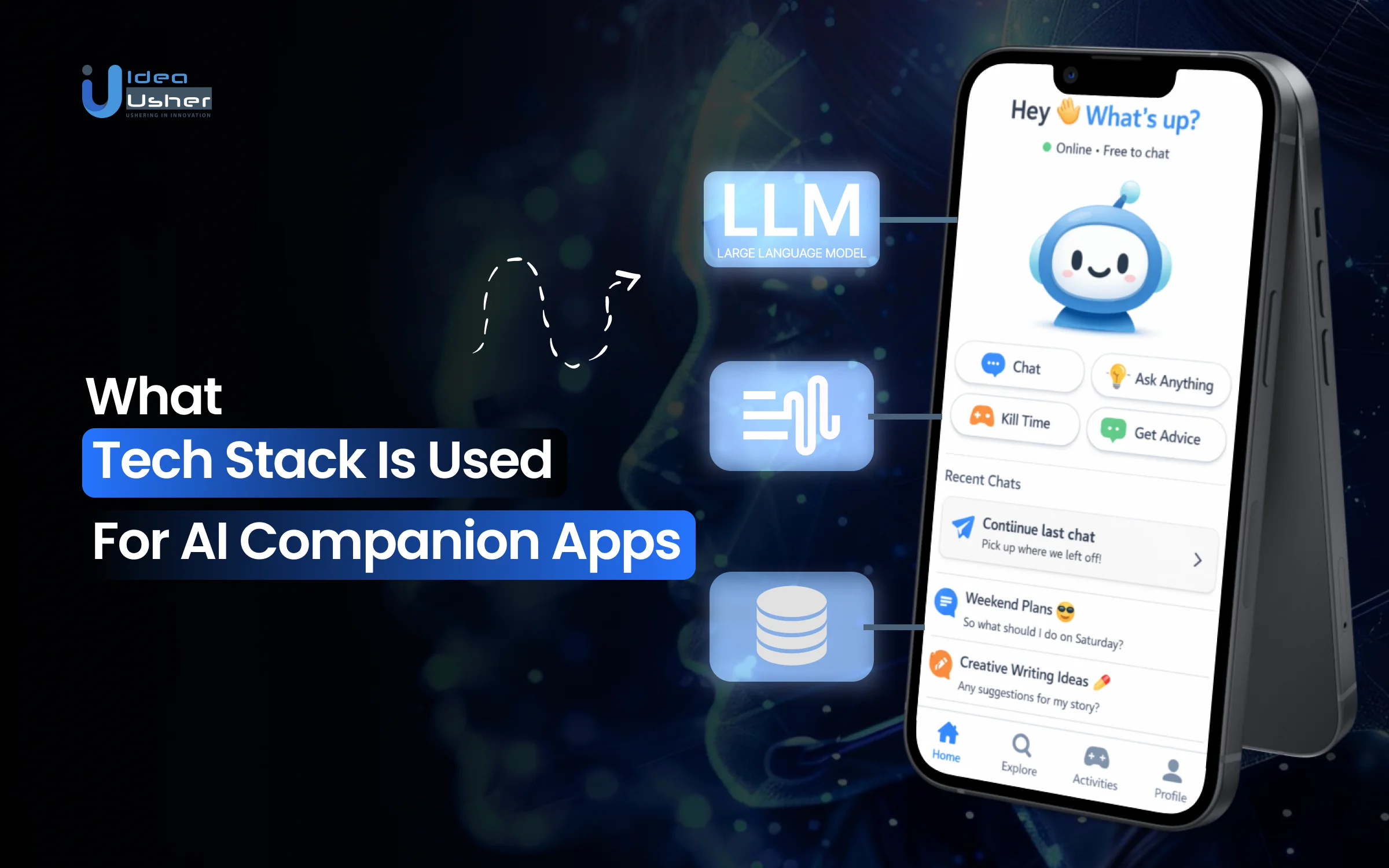
AI companion apps don’t run on a single model or a simple backend. Every response, memory recall, and personality shift is the result of multiple systems working together in milliseconds. As these apps grow more conversational and persistent, the AI companion app tech stack becomes the foundation that determines how fast the AI responds, how well it remembers, and how naturally it interacts over time.
Unlike standard chat products, AI companions require a layered architecture balancing intelligence, context, and scalability. Large language models handle dialogue, memory systems manage continuity, vector databases support recall, and orchestration layers decide responses. Each component plays a distinct role, and small design choices can dramatically change the user experience.
In this blog, we’ll take a closer look at the technology stack behind AI companion apps, breaking down the core layers, tools, and infrastructure choices involved. This guide will help you understand the architecture & technology behind how these systems are built.
Understanding the Technology Behind AI Companion Apps
AI companion apps are not built like traditional applications. They are designed to support continuous, real-time interaction, where every user message triggers a chain of coordinated technical processes that must feel instantaneous and consistent.
A. AI Companion Apps Are Multi-Layered Systems
At a high level, AI companion apps combine multiple technology layers that work together in real time. These typically include an intelligence layer for understanding and generating responses, backend services for orchestration, data layers for context and memory, and user-facing interfaces for interaction.
What matters is not just the presence of these layers, but how tightly they are integrated to support conversational flow and personalization.
B. Why AI Companion Apps Must Be Stateful by Design?
Unlike stateless applications that respond independently to each request, AI companion apps operate as stateful systems. Each interaction is influenced by previous conversations, preferences, and behavioral signals, requiring the system to manage and persist context across sessions.
This stateful nature directly impacts how backend frameworks, databases, and infrastructure are chosen and configured.
C. What Makes AI Companion App Technology Fundamentally Different?
AI companion apps are engineered to support ongoing, real-time, and personalized interaction, which introduces technical requirements far beyond those of standard applications.
- Continuous Interaction Flow: Systems must handle back-and-forth conversations without noticeable delays or resets
- Context Awareness: Each response depends on prior messages, stored memory, and user-specific signals
- Real-Time Processing: Requests are processed instantly, often involving multiple backend and AI components
- Scalability Under Repetition: The stack must remain stable even as users interact multiple times per day
- Stateful System Design: Conversations persist across sessions, requiring deliberate state and memory management
Responsiveness, personalization, and scalability depend on architecture. A bad tech stack causes latency and performance issues, while a well-structured one supports fluid conversations and engagement. Understanding this system-level view is essential before exploring the specific technologies used to build AI companion apps.
How AI Companion Apps Process Conversations?
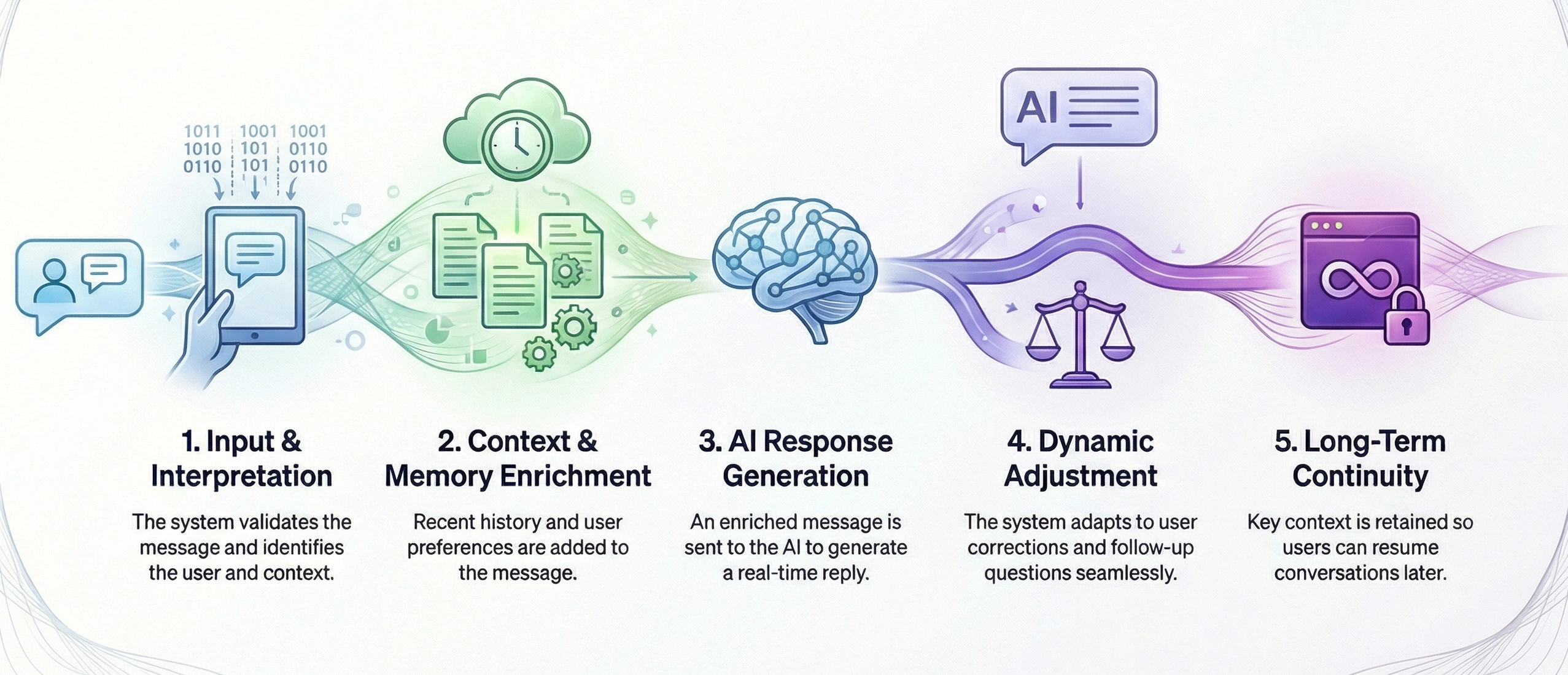
AI companion apps manage conversations through a sequence of coordinated actions rather than relying solely on Q&A. Each message initiates a flow balancing speed, context, and personalization to ensure a natural chat.
1. From User Input to System Interpretation
When a user sends a message, the app does more than forward text to an AI model. Backend services validate the request, identify the user, and determine conversational context, ensuring the system understands who is speaking and where the conversation stands.
2. Context & Memory Enrichment
Before generating a response, the system enriches the user’s message with short-term context and long-term memory, including recent conversation history, preferences, or intent signals. This step is crucial for producing coherent, personalized responses rather than generic ones.
3. Response Generation and Real-Time Delivery
Once the system prepares the enriched input, it passes it to the AI model for response generation. The system then processes the output and delivers it to the user in streaming or near real-time, ensuring conversations feel fluid and responsive.
4. Handling Errors & User Corrections
AI companion apps are designed to handle imperfect input. When users correct themselves, change direction, or ask follow-up questions, the system adjusts context dynamically rather than restarting, which is essential for maintaining natural conversation flow.
5. Maintaining Cross-Section Continuity
Conversations often span multiple sessions. AI companion apps retain relevant context so users can resume interactions without disruption, ensuring the experience feels continuous and coherent even when conversations occur over extended periods of time.
Why Do 52% of Teens Engage With AI Companion Apps on a Regular Basis?
The global AI companion market was valued at USD 28.19 billion in 2024 and is projected to reach USD 140.75 billion by 2030, growing at a CAGR of 30.8% from 2025 to 2030. This growth highlights rising demand for AI systems capable of supporting continuous, high-frequency user interaction at scale.
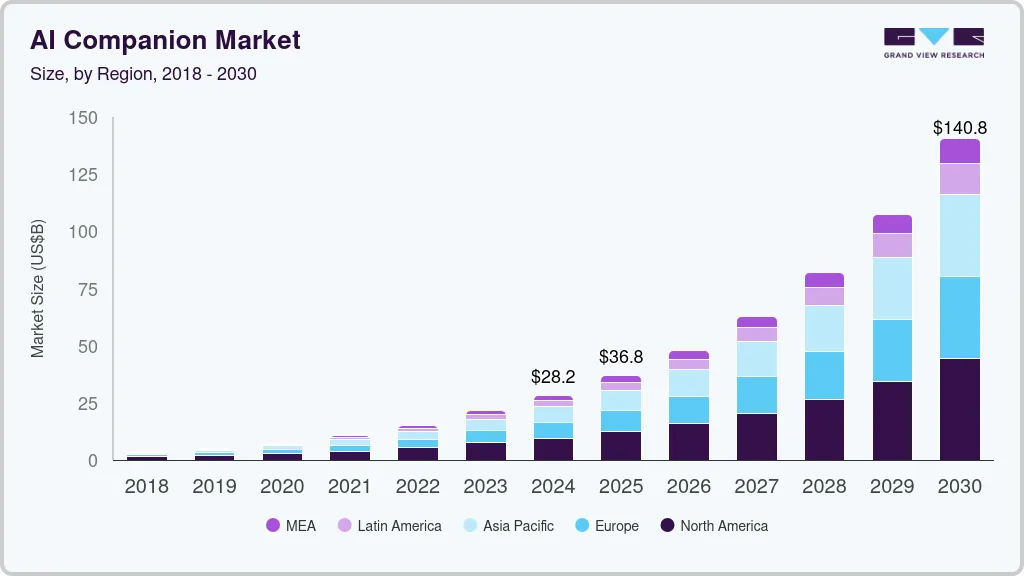
Supporting this growth, 52% of teens report regular usage of AI companion apps, with 13% interacting daily and 21% engaging a few times per week, indicating consistent and repeat usage rather than occasional experimentation.
A. Mainstream AI Usage Is Forcing More Robust Tech Stack Choices
With 78% of organizations globally using AI in at least one business function, AI companion apps are being built on increasingly mature and production-ready technology stacks.
- Enterprise-Grade Infrastructure: Widespread AI adoption pushes teams toward stable, scalable backend frameworks
- Standardization of Tooling: Proven cloud platforms, APIs, and AI services are preferred over experimental setups
- Reliability Expectations: Mature adoption raises expectations around uptime, latency, and fault tolerance
- Stack Implication: Tech choices must support production workloads, not prototype-level experimentation
B. Real-Time User Expectations Are Driving Technology Choices
Studies show that users expect AI-powered systems to respond within seconds during live interactions, making low-latency architecture a baseline requirement for AI companion apps.
- Real-Time Response Demands: Conversational experiences require streaming responses and fast inference
- Backend Technology Impact: Event-driven APIs and async frameworks become essential
- Frontend Implications: WebSockets and real-time messaging protocols are required for fluid conversations
- Stack Outcome: Tech stacks must be optimized for responsiveness, not batch processing
These engagement patterns show that users interact with AI companion apps frequently and for extended periods, especially younger users. As usage grows, teams must optimize the tech stack to ensure performance, scalability, and long-term product viability.
Core Technology Layers in an AI Companion App
AI companion apps rely on a structured AI companion app tech stack to deliver intelligent, consistent interactions. These technology layers support conversation processing, memory management, and system reliability while enabling scalable and adaptable application development.
| Technology Layer | Purpose in AI Companion Apps | Why This Layer Matters |
| Intelligence Layer | Handles language understanding, intent detection and response generation | Determines how accurately and naturally the AI interprets and responds to users |
| Backend and Orchestration Layer | Manages conversation flow, request handling, authentication and system coordination | Ensures reliability, scalability and smooth communication between system components |
| Data and Memory Layer | Stores short-term context and long-term user memory | Enables personalization, continuity, and context-aware interactions across sessions |
| Frontend and Interaction Layer | Manages user input, message display, and real-time updates | Directly impacts user experience, responsiveness and conversational flow |
| Infrastructure and Deployment Layer | Supports compute, networking, monitoring, and scalability | Maintains performance, uptime and flexibility as user demand grows |
What Tech Stack Is Used for AI Companion Apps?
AI companion apps rely on well-designed tech layers to handle real-time conversations, memory management, and scalability. These AI companion app tech stacks work together to ensure reliable performance, security, and long-term stability.
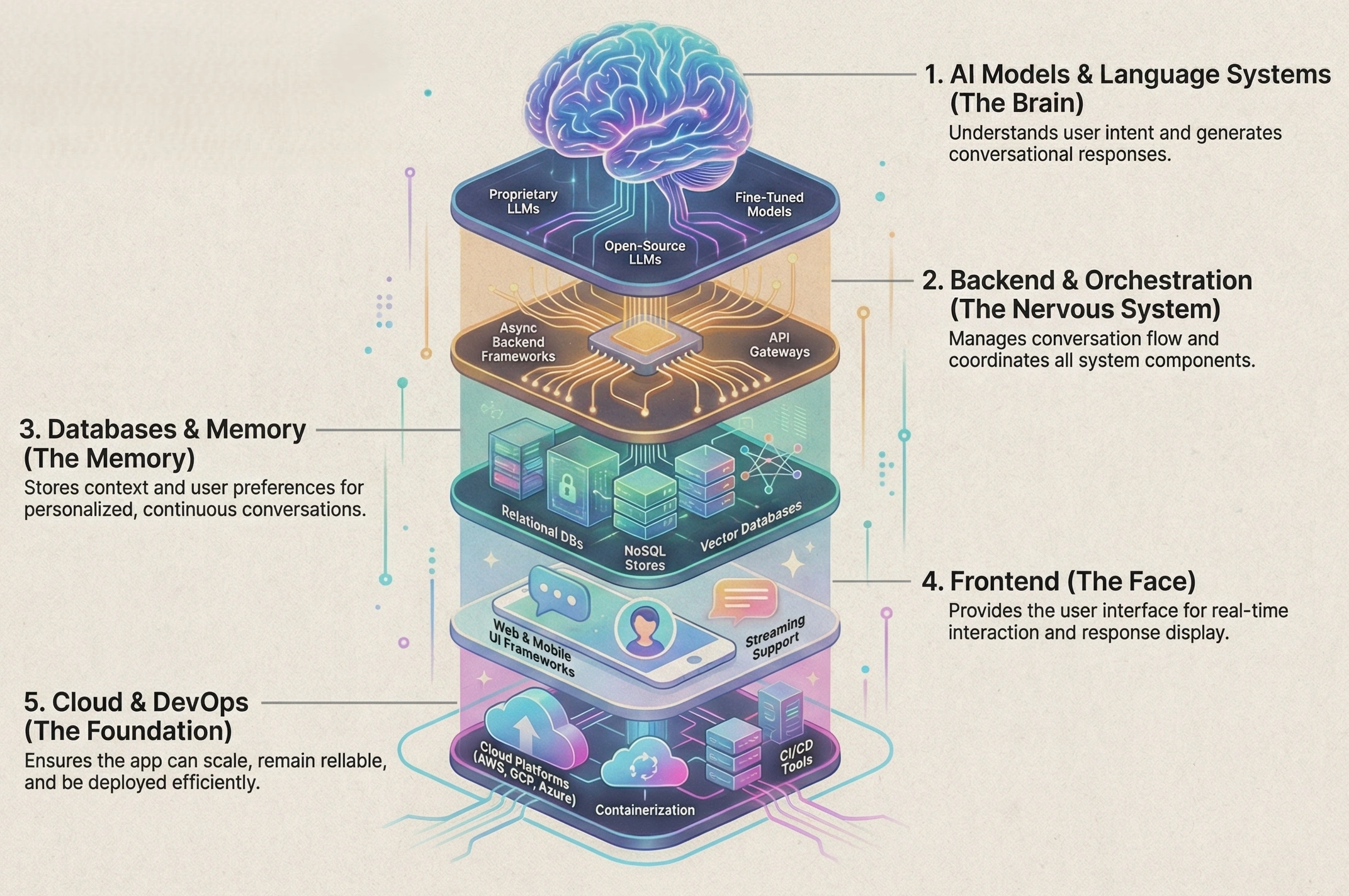
1. AI Models & Language Systems
AI models form the intelligence layer of AI companion apps, responsible for understanding user input and generating responses. These systems handle natural language comprehension, intent detection, and conversational reasoning.
For AI companion apps, model selection directly affects response quality, latency, and personalization depth. The tech stack must support efficient model inference, contextual prompting, and the ability to evolve as models improve over time.
2. Backend Technologies
The backend acts as the orchestration layer that coordinates all system components. It manages conversation flow, user sessions, authentication, API requests, and communication between the AI model and data layers.
In AI companion apps, backend technologies must handle high concurrency, asynchronous processing, and real-time interactions. Reliability and performance at this layer are critical to maintaining smooth conversational experiences.
3. Databases and Memory Infrastructure
Data infrastructure enables AI companion apps to store and retrieve both short-term conversational context and long-term user memory. This layer supports personalization, continuity across sessions, and adaptive behavior over time.
The tech stack typically includes systems optimized for structured data, unstructured information, and semantic retrieval. Efficient memory access is essential to ensure responses remain relevant without introducing latency.
4. Frontend Technologies
Frontend technologies define how users interact with the AI companion. This layer handles message input, response rendering, streaming updates, and overall user experience.
For AI companion apps, frontend frameworks must support real-time communication and responsive interfaces. Users perceive intelligence and engagement based on how quickly and smoothly the app delivers responses.
5. Cloud, DevOps & Scalability Stack
Cloud infrastructure and DevOps practices support deployment, scalability, monitoring, and reliability. This layer ensures the app can handle growing user demand while maintaining consistent performance.
AI companion apps often require elastic scaling, efficient resource management, and continuous deployment pipelines. Infrastructure decisions at this level directly affect uptime, cost efficiency, and long-term maintainability.
Common Technologies Used in AI Companion App Tech Stacks
AI companion app tech stacks commonly include language models, backend frameworks, databases, APIs, and cloud infrastructure that work together to support real-time conversations, memory management, and scalable application performance.
| Stack Layer | Use Cases | Why This Choice Matters | Common Technologies Used |
| AI Models & Language Systems | Understanding intent, generating conversational responses | Impacts response quality, latency, and personalization depth | Proprietary LLMs, open-source LLMs, fine-tuned models |
| Backend & Orchestration | Managing conversation flow and system coordination | Ensures reliability under high-frequency interactions | Async backend frameworks, API gateways |
| Databases & Memory | Storing context, preferences and long-term memory | Enables continuity without slowing real-time responses | Relational DBs, NoSQL stores, vector databases |
| Frontend | Real-time user interaction and response rendering | Shapes perceived intelligence and engagement | Web & mobile UI frameworks with streaming support |
| Cloud & DevOps | Scaling, deployment and system monitoring | Determines uptime, cost control, and long-term scalability | Cloud platforms, containerization, CI/CD tools |
How Tech Stacks Differ for MVP vs Scalable AI Companion App?
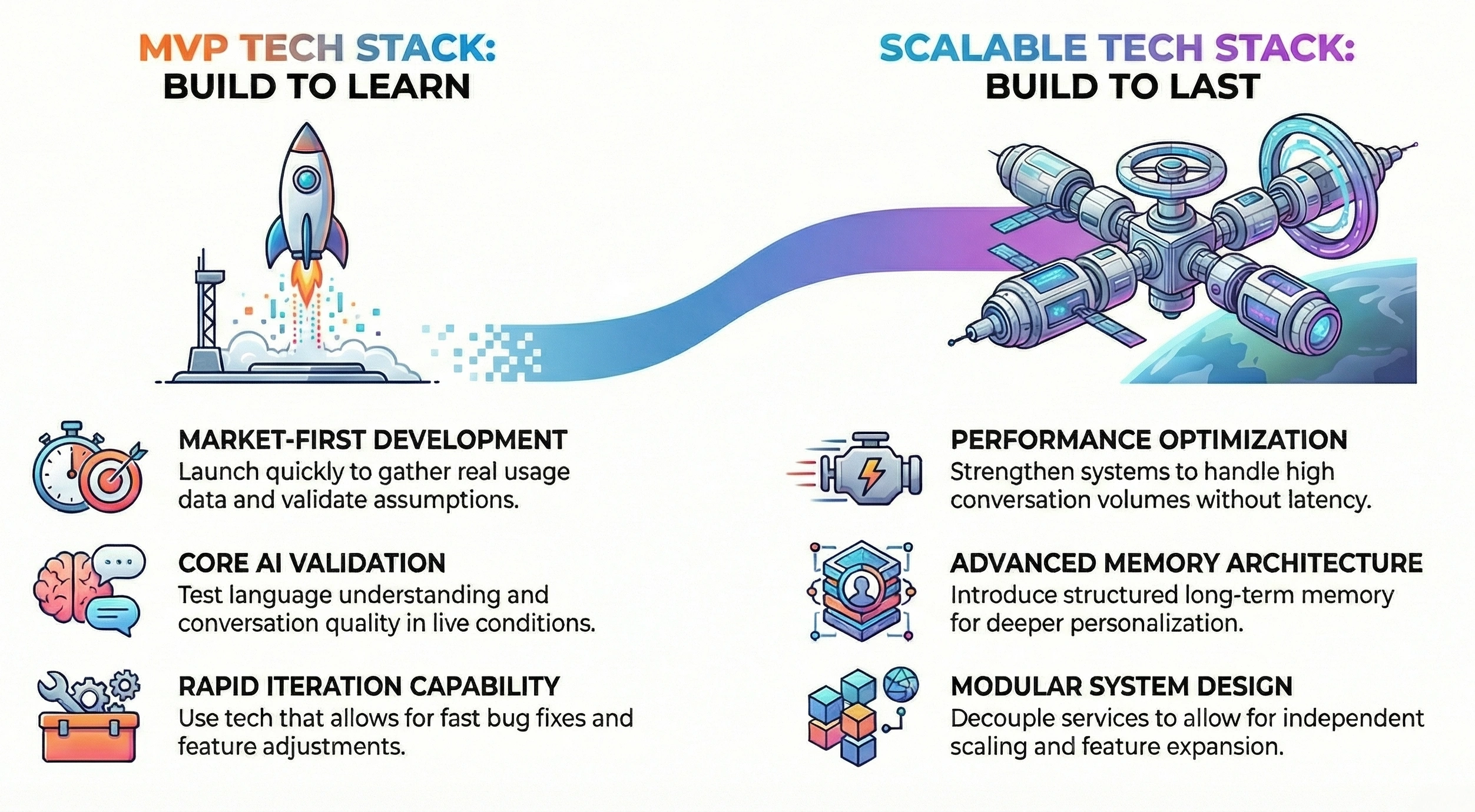
The team designs the tech stack for an MVP AI companion app differently from one for long-term growth. MVPs prioritize speed and validation, while scalable products require support for sustained usage, personalization, and operational complexity without constant rework.
A. MVP Tech Stack Priorities
Launching an AI companion app typically starts with an MVP designed to enter the market quickly and validate assumptions. The initial tech stack focuses on enabling real user interaction, testing AI behavior, and identifying technical gaps before scaling further.
- Market-first development: Prioritize launching a functional product to gather real usage data instead of relying on assumptions
- Core AI validation: Test language understanding, response quality, and conversational flow in live conditions
- Early memory experimentation: Implement basic context handling to observe how users expect the AI to remember information
- Rapid iteration capability: Choose technologies that allow fast bug fixes, model tuning, and feature adjustments
- Feedback-driven refinement: Use real user behavior to guide technical improvements and architectural decisions
B. Scalable Tech Stack Priorities
After validating the MVP, the team shifts focus to evolving the product into a reliable, growth-ready AI companion app. They enhance the tech stack to support higher usage, deeper personalization, and long-term operational stability.
- Performance optimization: Strengthen backend and AI pipelines to handle increased conversation volume without latency
- Advanced memory architecture: Introduce structured long-term memory and efficient retrieval mechanisms
- Modular system design: Decouple services to allow independent scaling and feature expansion
- Operational maturity: Add monitoring, logging, and automated deployment workflows
- Growth readiness: Prepare infrastructure and architecture to support user acquisition and competitive differentiation
Common Tech Stack Mistakes When Building AI Companion Apps
Building AI companion apps requires careful tech stack decisions, as common mistakes can impact performance, memory handling, and scalability. Understanding these pitfalls helps teams design more reliable, maintainable systems from the start.
1. Treating AI Companions as Stateless Applications
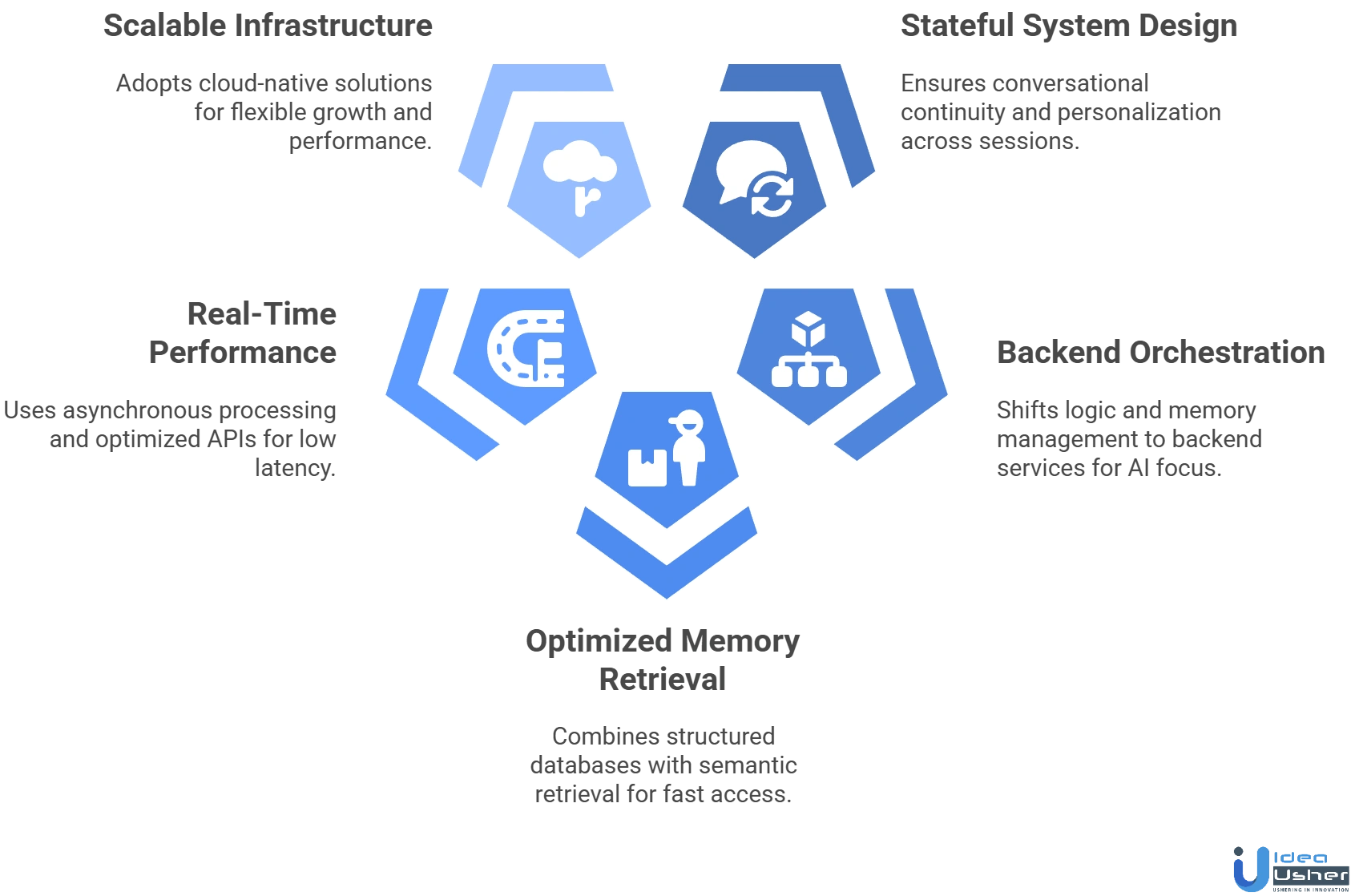
Challenge: Designing AI companion apps as stateless systems breaks conversational continuity and prevents meaningful personalization across sessions.
Solution: Architect the system as stateful by separating short-term context from long-term memory, ensuring conversations persist and evolve across repeated user interactions.
2. Overloading the AI Model With Responsibilities
Challenge: Relying on the AI model to manage logic, memory, and orchestration increases complexity and reduces system reliability.
Solution: Shift orchestration, memory handling, and business logic to backend services so AI models focus solely on language understanding and response generation.
3. Choosing Databases Without Memory Planning
Challenge: Using generic databases without considering retrieval patterns leads to slow responses and irrelevant memory recall.
Solution: Combine structured databases with semantic retrieval systems optimized for conversational access, enabling fast, context-aware memory lookup during active interactions.
4. Ignoring Real-Time Performance Requirements
Challenge: Failing to optimize for real-time interactions results in latency that disrupts conversational flow and user engagement.
Solution: Use asynchronous processing, streaming responses, and optimized APIs to maintain low-latency performance across high-frequency conversational workloads.
5. Scaling Infrastructure Too Late
Challenge: Delaying scalability planning causes performance bottlenecks and costly architectural changes as user demand increases.
Solution: Adopt cloud-native infrastructure, monitoring, and deployment strategies early to support smooth scaling and long-term operational stability.
How Tech Stack Decisions Impact Performance and Scalability?
Technology choices made during development have a lasting effect on how AI companion apps perform and scale. Early decisions often determine whether the system can handle real-time interactions and sustained user growth without degradation.
1. Impact on Real-Time Performance
Tech stack decisions influence latency, response consistency, and conversational fluidity. Backend architecture, AI model integration, and data retrieval methods all affect how quickly the system processes and delivers responses during active interactions.
2. Impact on Scalability and System Growth
Scalability depends on how well the tech stack supports increased usage, deeper memory, and higher concurrency. Infrastructure design, database architecture, and orchestration strategies determine whether the system can grow smoothly without costly reengineering.
3. Operational Cost and Resource Efficiency
Technology choices directly affect infrastructure costs and resource utilization. Efficient architectures reduce unnecessary compute usage and storage overhead, helping AI companion apps scale sustainably without compromising performance.
4. Balancing Performance With Long-Term Flexibility
Optimizing only for early performance can limit future scalability. A well-chosen tech stack balances immediate responsiveness with flexibility, allowing AI companion apps to evolve as user behavior, feature requirements, and usage volumes change.
Conclusion
Understanding what powers an AI companion app helps demystify how these products remain responsive, secure, and scalable. The AI companion app tech stack is not a single tool, but a layered combination of models, infrastructure, data pipelines, and interfaces working together. Each choice reflects tradeoffs between performance, cost, and user trust. When you look at the stack this way, it becomes easier to see why different apps behave differently and evolve at different speeds over time. That perspective supports clearer expectations about reliability, privacy decisions, and long-term product direction.
Why Choose IdeaUsher for AI Companion App Development?
IdeaUsher supports companies in designing and implementing robust AI companion app tech stacks that balance performance, flexibility, and long-term scalability. We align technology decisions with real product requirements, not trends.
Why Work with Us?
- End-to-End Tech Stack Planning: From AI models to backend infrastructure, we architect complete systems.
- Scalable and Secure Infrastructure: Our solutions support real-time conversations and future feature expansion.
- Custom Architecture: Teams tailor each tech stack to match product goals, budget, and growth plans.
- Delivery-Focused Execution: We build production-ready systems designed for reliability and maintainability.
Let’s look at our past work to understand how we’ve helped teams launch complex AI products.
Reach out to discuss how we can help you build a future-ready AI companion app from the ground up.


FAQs
An AI companion app tech stack usually includes language models, backend servers, databases, APIs, and frontend frameworks. These components work together to handle conversations, memory storage, performance scaling, and secure user interactions.
Backend systems often rely on cloud infrastructure, application servers, and databases such as relational or vector stores. These technologies manage user sessions, memory retrieval, and communication between the app interface and AI models.
AI models handle natural language understanding, response generation, and contextual reasoning. They are integrated through APIs and supported by orchestration layers that manage prompts, memory injection, and conversation flow efficiently.
The AI companion app tech stack directly impacts response speed, reliability, and scalability. Well-chosen infrastructure ensures low latency, stable memory access, and consistent behavior as the number of users and conversations increases.