

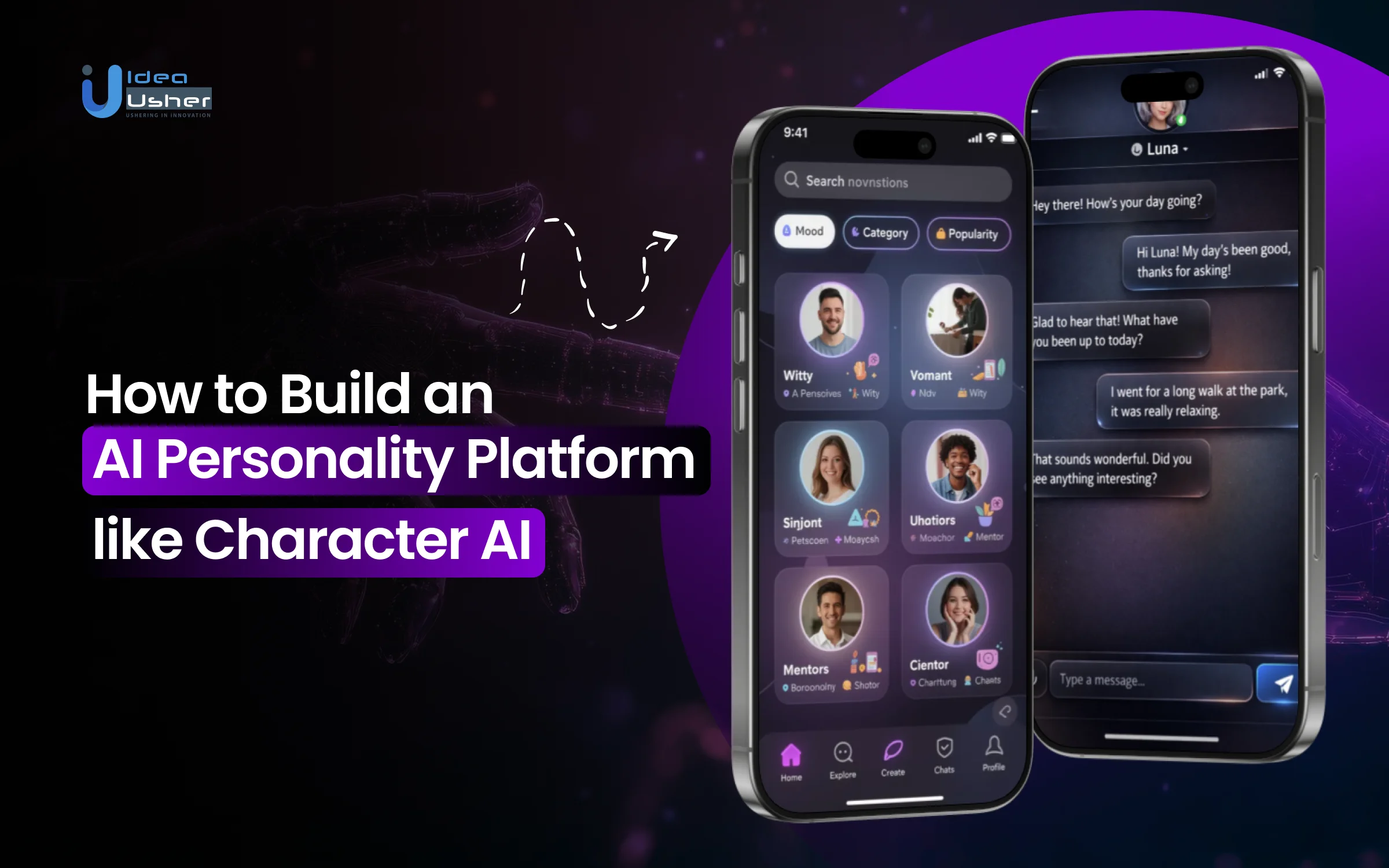
Conversations with AI are becoming part of daily life, but many interactions still feel flat and repetitive. Users expect more than generic replies and want AI that can express personality, remember context, and adapt to different moods or roles. This growing expectation is driving interest in a Character AI-like AI personality platform, where digital personas feel distinct, consistent, and engaging over time.
These platforms are built around more than just language generation. By combining large language models with memory systems, persona rules, and behavioral tuning, AI characters can maintain their tone and identity across conversations. This allows interactions to feel more natural and immersive, opening new possibilities for entertainment, learning, and digital companionship.
In this blog, we’ll explore how to build an AI personality platform similar to Character AI, breaking down the key components, architectural choices, and design principles that make personality-driven AI work at scale. This guide will help you understand what it takes to create AI experiences people genuinely connect with.
What is an AI Personality Platform, Character AI?
Character AI is an AI personality platform that lets users create, customize, and interact with intelligent virtual characters capable of human-like conversations using advanced generative AI. It enables anyone to design chatbots with distinct personalities, communication styles, and knowledge scopes, which can engage in context-aware dialogue, creative storytelling, or roleplay experiences across diverse use cases.
The platform enables creators and users to build and publish AI characters, fostering a vibrant ecosystem of personalized dialogues blending entertainment, creativity, and social interaction. Using large language models and machine learning, it supports user-generated characters, sharing, and immersive conversations with digital personas.
- User-generated character modeling that lets anyone create and publish custom AI personalities.
- Personality parameters and fine-tuning controls to shape tone, knowledge, and behavior of each character.
- Chat memories with pinned or auto-memory features allowing characters to retain key details across conversations.
- Group conversational dynamics where multiple characters and users interact in shared chats.
- Context-aware dialogue continuity that adapts responses based on ongoing interaction history.
- Interactive roleplay and scenario systems enabling storytelling and game-like engagement with AI personas.
- Cross-platform character persistence with cloud-synced chat logs and stateful interaction
Business Model: How It Operates
Character AI operates a consumer-focused AI personality platform built around user-generated characters, high engagement social interaction, and scalable creative participation.
- Freemium platform that allows users to interact with AI characters at no cost while encouraging upgrades for enhanced experiences
- Core growth driven by user-generated character creation, enabling creators to design, publish, and share AI personalities
- The platform emphasizes entertainment, roleplay, and social interaction rather than productivity-focused AI use cases
- Community dynamics and content discovery fuel organic engagement and repeat usage
- Large active user base creates leverage for future monetization through subscriptions, partnerships, and creator incentives
Revenue Model of Character AI
Character AI generates revenue through multiple channels designed to convert engaged users into paying customers and partners:
- Premium Subscription (c.ai+): A key revenue source offering faster responses, priority access, unlimited interactions, and exclusive features for about $9.99/month, ensuring predictable revenue and a better user experience.
- Creator Monetization & Revenue Share: The platform incentivizes creators by sharing revenue when their characters are used or featured in monetized contexts, encouraging high-quality character development and sustained ecosystem growth.
- Sponsored Content & Partnerships: Character AI can partner with brands and media firms to embed characters, licensed content, or campaigns that generate revenue beyond direct consumer spending.
- Advertising and Incentive Models: While subscriptions lead, optional reward ads support monetization in low subscription regions, diversifying revenue while maintaining a balanced user experience.
How AI Personality Platforms Are Evaluated?
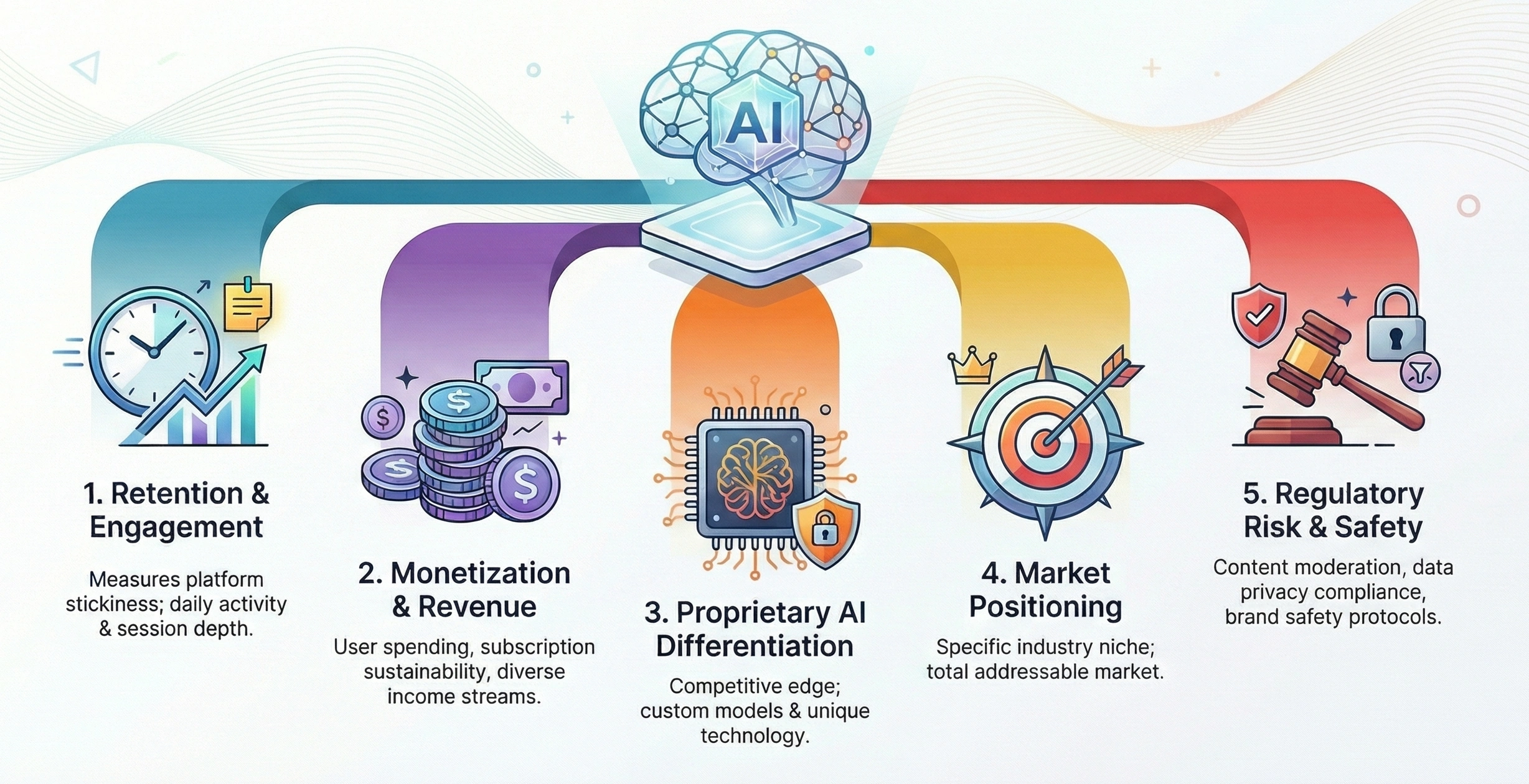
Enterprises evaluate AI personality platforms based on scalability, engagement metrics, and monetization potential. These factors determine market viability, growth prospects, and long-term investment value for a character AI-like AI personality platform.
1. Retention & Engagement Metrics
Investors focus on DAU/MAU ratios, session lengths, and conversation depth. Cohort retention (D7, D30, D90) shows platform stickiness. Founders monitor message frequency, interaction diversity, and re-engagement to validate product-market fit.
2. Monetization & Revenue Diversification
Evaluation centers on ARPU, conversion from freemium to premium, and LTV to CAC ratios. Investors look at subscription sustainability, in-app purchase speed, API licensing, and B2B growth. Multi-revenue resilience indicates robust business economics beyond single channels.
3. Proprietary AI Differentiation
Founders highlight competitive edges with custom language models, specialized datasets, and personality architectures. Investors evaluate technical debt, scalability, inference costs, and proprietary memory for ongoing character evolution. Defensibility depends on algorithmic sophistication, not just interface.
4. Market Positioning & Total Addressable Market Expansion
Strategic evaluation reviews vertical-specific positioning such as AI, creative tools, wellness, or entertainment. Investors analyze demographic, geographic, and market opportunities. Founders should define clear differentiation, avoiding direct competition with entertainment or therapy sectors through hybrid value propositions.
5. Regulatory Risk & Moderation Scalability
Due diligence reviews content safety, protection protocols, data privacy compliance (GDPR, CCPA), and brand safety. Investors assess moderation efficacy, human review, insurance coverage, and TOS enforceability. Platforms with proactive governance reduce regulatory shutdown and reputational risks.
55% of Users Prefer Emotionally Aware AI, with 33% Engaging Daily
The global AI companion market size was estimated at USD 28.19 billion in 2024 and is anticipated to reach USD 140,754.2 million by 2030, growing at a CAGR of 30.8% from 2025 to 2030. This rapid growth demonstrates rising user interest in personality-driven AI platforms across diverse global markets.
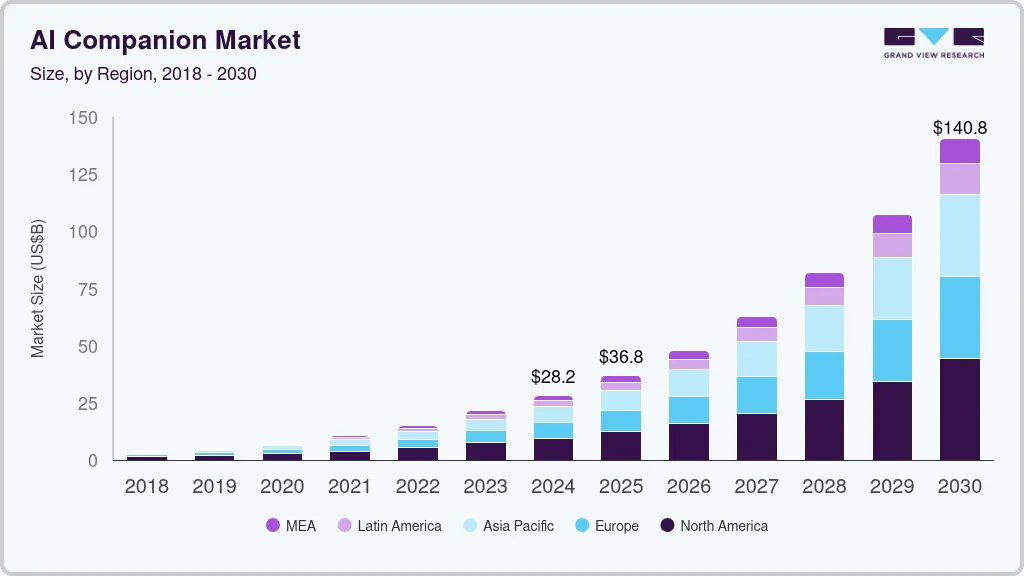
A key behavioral insight is that 55% of users prefer emotionally aware AI interactions, and 33% engage with companion AI daily, confirming strong demand for personality-driven experiences that are immersive, responsive, and emotionally intelligent.
Long-Term Engagement Through Personalized AI Interactions
A usage study shows that high daily engagement is a core driver of sustained adoption.
- 69% of free users and 82% of premium users interact with AI daily, reflecting habitual engagement across monetization tiers
- Over 100 million people globally interact with AI companions, demonstrating broad adoption and market receptivity
- Persistent memory allows AI to recall past interactions, making conversations feel attentive and human-like
- Personalization based on user preferences increases relevance and conversational comfort
- Remembering evolving dynamics and shared moments strengthens the perception of a developing relationship
Multi-Functional Use and Session Depth
AI personality platforms are adopted across various use cases, not just entertainment.
- 48% of AI companion users rely on the platform for mental health support, while 36% use them for learning assistance, highlighting functional versatility
- Average session durations reach up to 75 minutes per day, showing strong immersion and time investment
- Emotionally responsive dialogue reduces interaction fatigue and maintains user engagement
- Narrative-driven conversations sustain attention and encourage creative exploration
- Longer sessions and diverse use cases indicate stronger retention potential and higher lifetime value
The Psychology Behind AI Personality Adoption
User adoption of AI personality platforms is influenced by trust, emotional connection, and perceived utility. Understanding these psychological factors helps design an engaging Character AI-like AI personality platform that drives consistent, long-term user interaction.
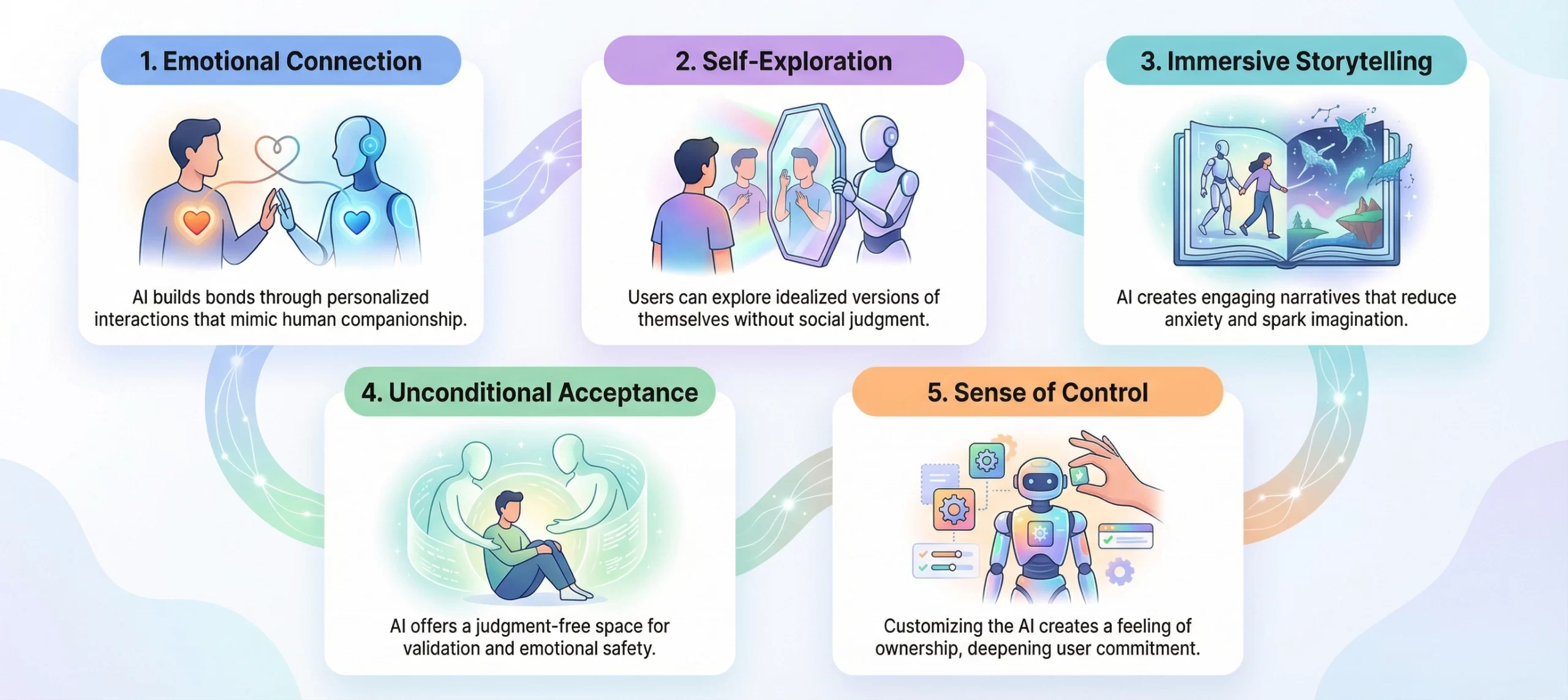
1. Emotional Attachment Via Parasocial Dynamics
AI personality platforms use parasocial theory, allowing users to bond emotionally with non-human entities through regular interactions. They trigger oxytocin release with personalized responses, creating dopamine loops similar to human companionship, which encourages habitual use via neurochemical reinforcement and perceived reciprocity.
2. Self-Concept Exploration in Digital Spaces
Users co-create identities by projecting idealized selves onto AI, enabling psychological experimentation without social judgment. This encourages self-discovery through mirroring, allowing exploration of suppressed traits, alternative views, and emotional expressions limited by social conformity.
3. Narrative Immersion & Cognitive Effects
AI personality platforms create immersive storylines where users become absorbed with AI co-creations. This activates the default mode network, reducing self-anxiety and boosting imagination. Serialized interactions build anticipation with cliffhangers and continuity, fulfilling human storytelling needs.
4. Validation & Illusion of Acceptance
These platforms offer judgment-free spaces that meet validation needs via algorithmic empathy, giving users psychological safety and unconditional acceptance. This lowers cortisol, making environments welcoming for vulnerable disclosures and fostering platform dependency as emotional sanctuaries.
5. Customization & Control-Autonomy Paradox
User-driven customization grants control, satisfying autonomy and increasing engagement via the IKEA effect. Personalization fosters sunk-cost fallacies, as users refine AI and develop proprietary bonds. This co-creation transforms passive use into active authorship, boosting commitment through ownership.
Key Features of Character AI-like AI Personality Platform
Character AI-like AI personality platform emphasize consistent personalities, contextual memory, and interactive dialogue for immersive user interactions. These features highlight how personality-driven AI systems enable scalable digital experiences.

1. Customisable AI Characters
The platform allows users to create customisable AI characters with defined personalities, communication styles, and behavioral traits. These settings influence how the character responds, interacts, and maintains consistency across conversations and roleplay scenarios.
2. Adaptive Personality Evolution Engine
This feature allows AI personalities to evolve gradually based on interaction patterns, emotional feedback, and user preferences rather than remaining static or roleplay-bound. Personality change is slow, traceable, and reversible, preserving identity stability while allowing growth.
3. Memory Enhancements
Memory enhancement systems enable characters to retain important conversation details, preferences, and pinned information. This selective recall supports continuity and improves interaction quality without overwhelming the system with irrelevant or outdated context.
4. Text & Voice Interaction
A Character AI-like platform supports text and voice interaction, allowing users to communicate naturally using their preferred format. Voice conversations enhance immersion while text-based chat ensures flexibility and continuous engagement across sessions.
5. Multi-Character Conversations
The platform enables multi-character conversations, allowing users to interact with multiple AI personalities simultaneously. Each character maintains its own conversational context, enabling dynamic dialogue, roleplay, and collaborative storytelling experiences.
6. Interactive Storytelling & Roleplay Tools
Built-in storytelling and roleplay tools allow users to create scenarios, narratives, and imaginative experiences. Characters adapt their responses based on evolving story context, supporting creative engagement beyond standard question-and-answer chat.
7. Personalisation Controls
Personalisation controls let users fine-tune character behavior, tone, and interaction boundaries. These controls ensure characters align with user expectations while preserving personality stability and predictable conversational patterns.
8. Broad Character Library
A Character AI-like platform offers a broad character library featuring diverse personalities, themes, and scenarios. This variety encourages exploration, repeated usage, and community-driven content creation.
9. Cross-Platform Accessibility
The platform provides cross-platform accessibility, enabling consistent conversational experiences across web and mobile interfaces. Conversation state and character behavior remain synchronized, supporting seamless interaction across devices.
10. Context-Aware Proactive Intelligence
The AI initiates conversations using situational and emotional context, not just time-based triggers. It considers past emotional states, interaction gaps, and shared history before engaging, making proactive messages feel intentional and relevant.
How to Build an AI Personality Platform like Character AI?
Building a character AI-like AI personality platform requires structured personality design, contextual memory, and safe interaction systems. Our developers follow these steps to deliver scalable, consistent, and responsibly designed personality-driven AI platforms.

1. Consultation
We begin with a strategic consultation to define platform goals, target audience, and character use cases. Our developers clarify personality scope, content boundaries, moderation needs, and scalability expectations to ensure the AI personality platform aligns with creative, social, and business objectives.
2. Character Framework Design
Our team designs the character framework, defining how personalities are created, structured, and maintained. We establish rules for traits, tone, knowledge limits, and behavioral consistency so each AI character feels distinct and stable across conversations.
3. Personality Authoring and Controls
We build personality authoring systems that allow creators to shape character behavior, communication style, and narrative direction. These controls ensure characters remain expressive while respecting predefined personality boundaries and platform guidelines.
4. Conversation Flow & Context Design
Our developers design context-aware conversation flows that maintain logical continuity and character consistency. We focus on dialogue pacing, intent recognition, and contextual referencing to support immersive, multi-turn interactions.
5. Memory & Continuity Planning
We plan selective memory mechanisms that retain important conversation details without overwhelming context. This approach ensures characters remember relevant information while preventing drift or contradictions over extended interactions.
6. Multi-Character Interaction Design
Our team enables multi-character interaction logic, allowing several AI personalities to participate in shared conversations. Each character maintains an independent context while responding coherently within group dialogue or collaborative roleplay scenarios.
7. Creative Storytelling & Roleplay Systems
We design storytelling and roleplay systems that allow characters to adapt dynamically to evolving narratives. These systems support imaginative scenarios while preserving character identity and narrative coherence.
8. Moderation & Content Safety Planning
Our developers integrate content moderation and safety guidelines to manage inappropriate behavior, misuse, or policy violations. This step ensures the platform remains safe, compliant, and suitable for a broad user base.
9. Testing Character Consistency
We rigorously test character consistency and response behavior across varied scenarios. Our team validates personality stability, narrative alignment, and conversational quality before public release.
10. Launch & Platform Optimization
After launch, we focus on continuous optimization using interaction insights. Our developers refine character behavior, conversation quality, and engagement patterns to improve retention, creativity, and platform scalability over time.
Cost to Build a Character AI-like AI Personality App
The cost to build a Character AI-like AI personality platform depends on feature depth, personality complexity, and infrastructure scale. Evaluating these factors helps define a practical budget and long-term development roadmap.
| Development Phase | Description | Estimated Cost |
| Consultation | Defining platform goals, character scope, and creator workflows to establish a clear product direction. | $5,000 – $8,000 |
| Character Framework Design | Designing personality structures and behavior rules for consistent and distinct AI characters. | $13,000 – $24,000 |
| Personality Authoring & Controls | Building creator tools to shape character tone, traits, and interaction boundaries. | $12,000 – $18,000 |
| Conversation Flow & Context Design | Creating context-aware dialogue flows that preserve character consistency. | $16,000 – $28,000 |
| Memory & Continuity Planning | Implementing selective memory logic to support relevant recall and continuity. | $11,500 – $22,000 |
| Multi-Character Interaction Design | Enabling group chats and collaborative roleplay across multiple characters. | $10,000 – $14,000 |
| Storytelling & Roleplay Systems | Designing adaptive narrative systems for creative interactions. | $13,500 – $19,000 |
| Moderation & Content Safety Planning | Defining content rules and safety controls for responsible platform usage. | $4,000 – $7,000 |
| Testing Character Consistency | Validating personality stability and response quality across scenarios. | $6,000 – $10,000 |
| Launch & Optimization | Refining engagement patterns and platform performance post-launch. | $6,000 – $10,000 |
Total Estimated Cost: $65,000 to $125,000
Note: Costs vary based on character complexity, creator tool depth, moderation needs, and scalability expectations. Additional customization or advanced features may impact the final budget.
Consult with IdeaUsher to get a personalized cost estimate and a detailed roadmap for building a scalable AI personality platform aligned with your business and growth goals.
Cost-Affecting Factors to Consider
Several technical, design, and operational factors directly influence the Character AI-like AI personality platform development costs, impacting performance, scalability, and long-term maintenance requirements.
1. Character Personality Complexity
More detailed character personalities and behavioral rules increase design, testing, and refinement efforts to ensure consistency across diverse conversations and long-term interactions.
2. Depth of Creator Controls
Advanced creator authoring tools for tone, traits, and boundaries require additional development to balance flexibility, usability, and personality stability.
3. Memory & Continuity Design
Implementing selective memory and recall logic raises costs due to careful planning around relevance, contradiction avoidance, and long-session consistency.
4. Multi-Character Interaction Scope
Supporting group conversations and shared roleplay adds complexity, as each character must maintain an independent context while responding coherently together.
5. Content Moderation Requirements
Stronger moderation and safety mechanisms increase cost due to rule design, edge-case handling, and ensuring platform compliance at scale.
6. Narrative & Roleplay Flexibility
Greater storytelling and scenario adaptability require more design effort to keep narratives engaging without breaking character identity.
Suggested Tech Stacks for AI Personality App Development
Choosing the right tech stack is essential for building a stable and scalable Character AI-like AI personality platform. Recommended technologies support consistent interactions, efficient processing, and long-term platform reliability.
| Core System Layer | Suggested Technologies | Purpose |
| Conversational Intelligence | Large language models, dialogue orchestration layers | Enable personality-driven conversations that stay coherent and expressive over long interactions. |
| Character Personality Engine | Behavioral modeling frameworks, rule-based systems | Maintain distinct character traits and tone across conversations. |
| Memory and Continuity Layer | Semantic memory systems, vector-based storage | Support context retention and relevant recall without personality drift. |
| Creator Authoring Tools | Configuration-driven character editors | Allow creators to design and control AI personalities easily. |
| Multi-Character Interaction Logic | Context coordination systems | Enable group conversations while preserving individual character context. |
| Narrative and Roleplay Systems | Scenario and state management frameworks | Support adaptive storytelling and roleplay experiences. |
| Moderation and Safety Layer | Content filtering and policy systems | Ensure safe and compliant interactions at scale. |
| Proactive Interaction Logic | Event-based engagement systems | Help characters maintain natural conversation flow. |
Challenges & How Our Developers Will Solve Those?
Developing a Character AI-like AI personality platform involves challenges around consistency, safety, and scalability. Our developers address these through structured design, robust moderation, and scalable architectures to support reliable personality-driven interactions.

1. Maintaining Character Personality Consistency
Challenge: AI characters may drift in tone, behavior, or values over time, breaking immersion and weakening user trust.
Solution: Our developers implement personality anchors and behavior constraints that lock core traits while allowing controlled variation based on conversation context.
2. Preventing Generic or Repetitive Responses
Challenge: AI personalities can start sounding repetitive or interchangeable, reducing engagement and perceived uniqueness.
Solution: We design context-aware variation logic and response diversity controls to ensure characters remain expressive, distinctive, and non-repetitive.
3. Balancing Creative Freedom with Control
Challenge: Too much creative flexibility can cause characters to behave unpredictably or violate intended boundaries.
Solution: Our team builds creator-defined limits and guardrails that balance expressive freedom with consistent, safe character behavior.
4. Managing Memory Without Character Drift
Challenge: Poor memory handling can lead to contradictions or personality erosion across long conversations.
Solution: We use selective memory retention and relevance filtering to preserve important context while protecting character identity.
5. Scaling Multi-Character Interactions
Challenge: Group conversations introduce complexity as multiple characters must respond coherently without overlapping context.
Solution: Our developers design isolated context management and coordination logic so each character maintains independent awareness in shared conversations.
How Emotional & Narrative Consistency Impacts Long-Term Retention?
Emotional and narrative consistency shape how users connect with AI over time. Maintaining coherent tone, memory, and story progression strengthens trust, engagement, and long-term retention across a character AI-like AI personality platform.
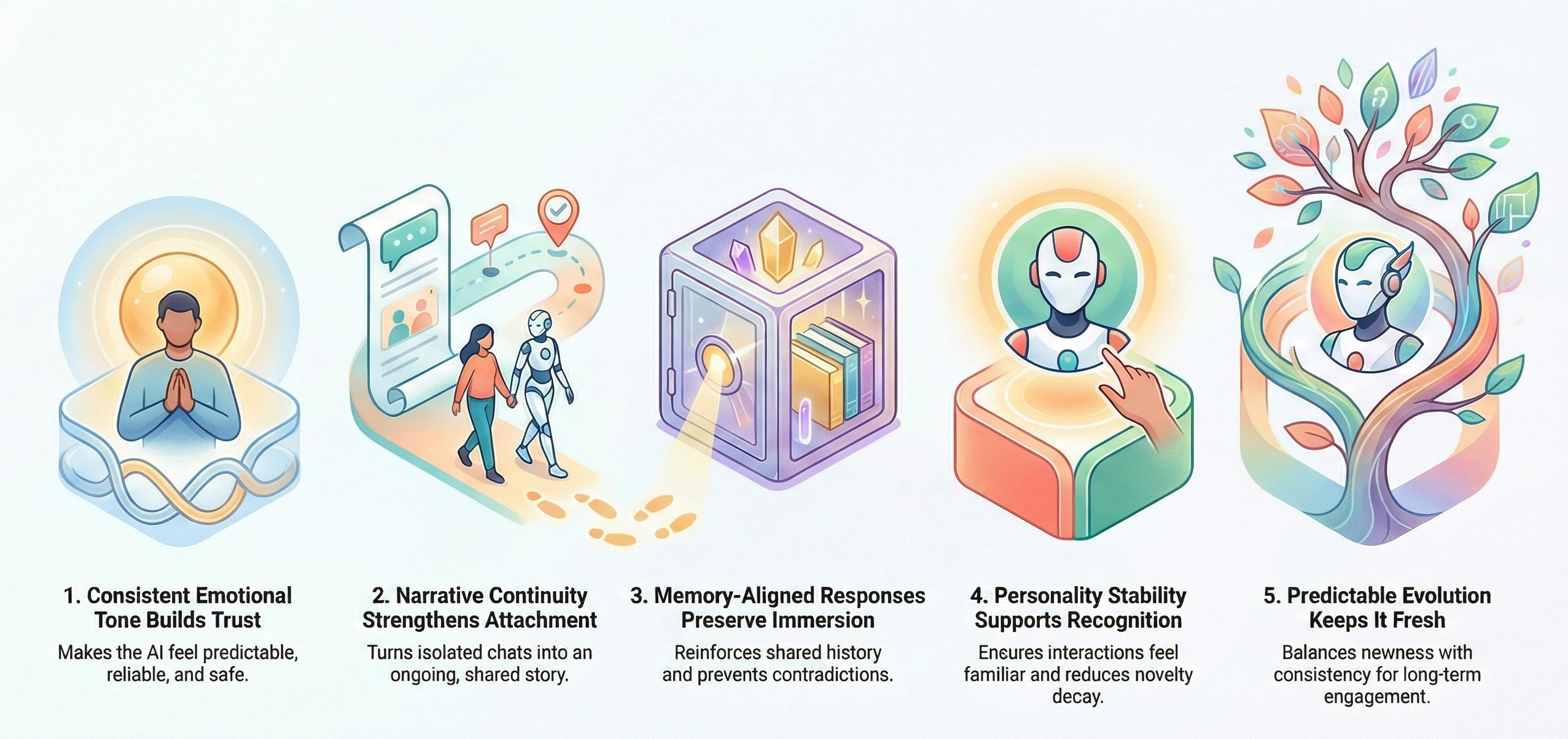
1. Consistent Emotional Tone Builds User Trust
Maintaining a stable emotional tone across conversations helps users form expectations and trust. Emotional consistency reduces cognitive friction, reinforces character reliability, and encourages repeated interaction by making the AI feel emotionally predictable and safe.
2. Narrative Continuity Strengthens Relationship Attachment
When AI characters maintain narrative continuity, users experience conversations as part of an ongoing story rather than isolated sessions. This continuity deepens emotional investment, strengthens attachment, and increases long-term engagement frequency.
3. Memory-Aligned Responses Prevent Immersion Breaks
Emotionally aligned memory systems ensure responses reflect past interactions accurately. Memory consistency prevents contradictions, reinforces shared history, and preserves immersion, which directly impacts user willingness to return and continue interactions.
4. Personality Stability Supports Identity Recognition
Stable personality traits allow users to recognize and emotionally bond with an AI character. Identity stability ensures interactions feel familiar, reducing novelty decay and supporting sustained user retention over extended periods.
5. Predictable Evolution For Long-Term Engagement
Controlled personality and narrative evolution keep interactions fresh without breaking character. Predictable adaptation balances novelty with consistency, motivating users to maintain long-term relationships with AI personalities rather than abandoning them.
Conclusion
Building an AI personality platform requires a balance between technical precision and human understanding. A Character AI-like AI Personality Platform succeeds when personality design, contextual memory, and conversational depth align with clear ethical boundaries. Every choice, from moderation systems to customization options, influences how users relate to digital characters over time. When personality consistency and user trust are prioritized, the platform evolves into more than interactive software. It becomes a structured environment where creative expression, safe engagement, and meaningful interaction can coexist and grow responsibly.
Why Work with Us to Build Your AI Personality Platform?
We help businesses create a Character AI-like AI personality platform that balances creativity, consistency, and user safety. Every system is built to support long-term interaction without sacrificing control or trust.
- Personality Modeling and Consistency: We define character traits, behavioral rules, and dialogue constraints to ensure each AI personality remains coherent across conversations.
- Controlled Creative Freedom: Our frameworks allow expressive character interactions while enforcing boundaries that prevent harmful, misleading, or inappropriate behavior.
- Conversation & Context Handling: We design dialogue systems that manage context switching, memory recall, and interaction pacing for immersive yet stable conversations.
- Platform-Ready Scalability: From concurrent users to character expansion, our infrastructure is designed to scale smoothly as engagement and content volume increase.
Explore our portfolio to see how we deliver a range of AI solutions for enterprises across industries.
Connect with our experts to discuss how we can help you bring your AI personality platform to market with confidence.


FAQs
AI personalities are created through prompt frameworks, behavioral rules, and contextual memory. Consistency is maintained by defining personality traits, conversation boundaries, and response patterns that guide how each character interacts across sessions.
Differentiation comes from unique character designs, customizable traits, interactive storytelling, and safety-focused features. Platforms that prioritize creativity and authentic interaction attract loyal users over generic AI chat systems.
Organic growth is driven by shareable characters, community creation tools, and consistent interaction quality. Platforms grow when users feel invested in character evolution and can easily discover new personalities.
Key risks include data privacy compliance, content moderation failures, and emotional dependency concerns. Clear terms, safeguards, and usage boundaries help mitigate regulatory and reputational risks during launch.