

Key Takeaways
- Dating is becoming more personalized as AI matchmaking apps learn from user preferences, behavior, and interactions.
- Leading platforms use AI recommendations, compatibility scoring, behavioral analysis, and curated introductions to reduce endless swiping.
- AI also supports profile coaching, conversation starters, date suggestions, identity verification, and safety moderation.
- Successful platforms monetize through subscriptions, premium AI services, priority matching, personalized coaching, and paid introductions.
Finding a compatible partner is not just about searching through profiles. It is about understanding what makes two people click. AI-based matchmaking apps are becoming better at this by learning from how users actually behave rather than relying only on what they say they want. Someone might describe their ideal partner in one way but consistently connect with a different type of person. These patterns can help matchmaking systems make more relevant suggestions over time. The real opportunity lies in building an experience that learns with the user and makes the search feel less random.
The way people find meaningful connections is changing as matchmaking platforms move beyond basic profiles and simple preference filters. We’ve worked on AI matchmaking apps that use machine learning recommendation models and behavioral data analysis to make match discovery more personalized. In this blog, we look at the top 10 AI matchmaking apps and the product strategies, technology choices, and user experiences that contribute to their success.
What Is Driving Demand for AI Matchmaking Platforms?
According to DataIntelo, the global matchmaking optimization AI market was valued at $3.8 billion in 2025 and is projected to reach $14.6 billion by 2034 at a 16.1% CAGR from 2026 to 2034. This growth reflects a clear shift in user expectations. People are becoming less interested in endless swiping and more interested in platforms that can understand compatibility and deliver relevant matches with less effort.
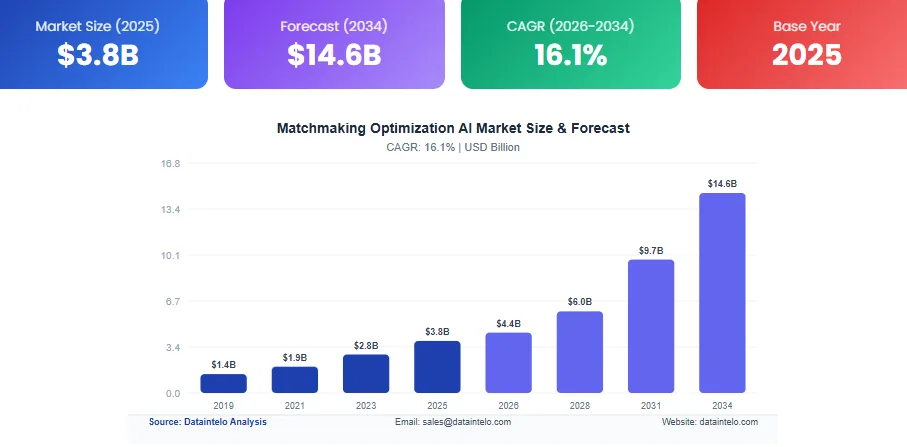
Source: DataIntelo
Building an AI matchmaking platform bridges the direct gap between this widespread consumer frustration and a highly lucrative business model. Investors who enter this space are not just building another consumer app. They are capitalizing on a fundamental pivot toward high-intent algorithmic pairing.
Dating Fatigue and Swipe Overload
Endless profile choices can quickly lead to decision fatigue. Users may spend hours reviewing profiles without finding meaningful connections. This creates burnout while frictionless swiping also attracts casual users and weakens the pool for people looking for serious relationships. Over time, low-quality interactions and conversation drop-offs can contribute to declining retention.
A shift toward more intentional matchmaking is already visible with platforms like Hinge. By focusing more on relationship outcomes than endless browsing, Hinge grew rapidly and generated over $600 million in annual revenue. AI-first matchmaking can take this approach further by reducing manual discovery and giving users fewer but more relevant introductions.
Demand for Better Personalization
Age and location filters are no longer enough for users who want meaningful connections. Modern matchmaking systems can look beyond profile details to understand behavior and communication patterns. They can learn from how users respond to matches and use those signals to make future recommendations more relevant. This creates a matchmaking experience that becomes more personalized with continued use.
Raya shows how curated matchmaking can support a focused business model. Its exclusive membership approach keeps the network selective and has helped the platform reach roughly $18 million in annual revenue with a lean operating structure.
Push for Meaningful Compatibility
The modern market values depth over volume. Users are increasingly willing to pay premium subscription prices for platforms that deliver curated, compatible connections rather than thousands of unvetted options. This willingness to pay creates strong unit economics for platform owners. Monetization moves away from low-tier ad placements toward high-margin premium models:
- High-tier monthly access for verified, high-intent profiles.
- In-app purchases for immediate deep-compatibility reports.
- Priority algorithmic placement in matching queues.
How Do AI Matchmaking Apps Work?
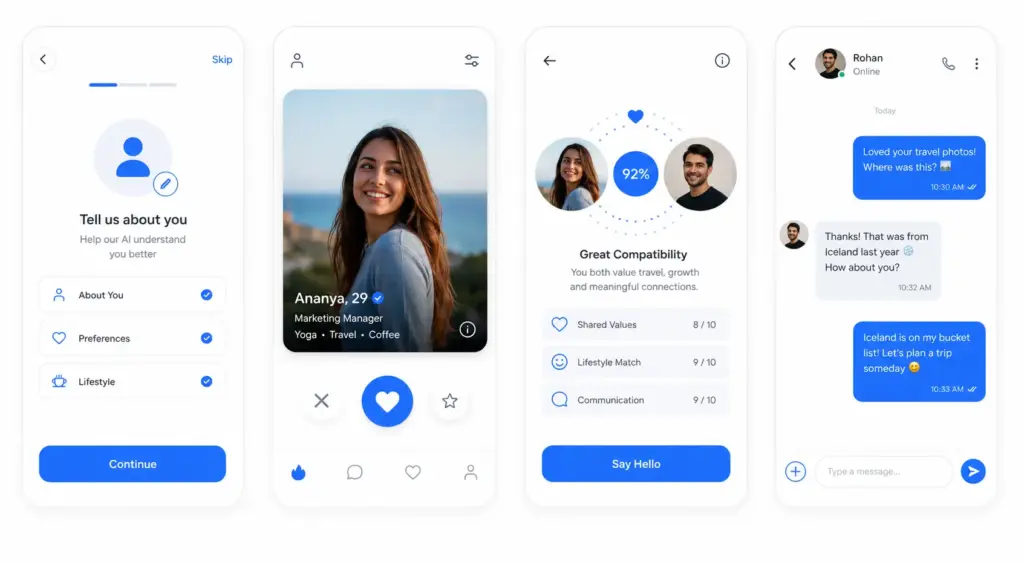
Modern matching engines move beyond static profile browsing by continuously learning from user activity. They combine what users say they want with how they actually behave to make better predictions. This helps the platform deliver more relevant matches over time instead of making users do all the searching themselves.
1. Profile and Preference Analysis
The matching engine begins by digesting structural inputs provided during onboarding. Traditional apps stop at basic demographic choices, but AI models convert subjective qualitative text into measurable data vectors.
- Contextual survey processing: Natural language processing parses open text prompts to map core values, personality traits, and lifestyle preferences.
- Deep visual analysis: Vision algorithms analyze user media uploads to catalog context tags like hobbies, social settings, and outdoor interests.
- Hard vs soft criteria: The algorithm distinguishes strict dealbreakers from flexible parameters to prevent artificial pool constriction.
Consider a specialized service like Tawkify, which combines algorithmic intake systems with high-touch human curation to optimize high-intent introductions. Tawkify operates on a premium tier model that generates over $60 million in estimated annual revenue, proving that users pay for advanced, structured profiling over superficial swiping.
2. Behavioral Tracking and Feedback Loops
What users say they want rarely aligns perfectly with how they act. AI platforms track real-time app telemetry to identify implicit preferences and continuously recalculate match queues.
- Dwell time metrics: Measuring the exact seconds spent evaluating specific profile elements reveals true visual or text interest.
- Interaction velocity: Tracking how fast a user sends a first message or responds reveals real engagement intensity.
- Reciprocal feedback: Rejections feed back into the learning loop immediately, tuning future recommendations to prevent repeated bad fits.
3. Compatibility Prediction Models
The core intellectual property of any AI matchmaking app lives in its predictive modeling. Machine learning architectures score two distinct profiles to measure long-term relational probability.
- Collaborative filtering: Identifies hidden patterns across thousands of similar user interaction paths.
- Sentiment analysis: Evaluates early chat mechanics to flag strong alignment or sudden interest drops.
- Churn prevention: Detects early signs of app fatigue and adjusts match frequency to maintain long-term user retention.
High-end platforms like The League apply targeted algorithmic filters to restrict membership and focus on high-achieving professionals. By leveraging strict access logic and algorithmic matching, The League achieved roughly $10 million in estimated annual revenue before its acquisition.
Top 10 AI Matchmaking Apps in the USA and What Makes Them Successful
We researched the category and found that the strongest AI matchmaking apps are taking very different approaches to dating. Some use AI to improve traditional discovery while newer platforms are removing swiping altogether. The interesting part is how each product turns personalization into a better dating experience.
1. Tinder

Tinder remains one of the biggest names in online dating and is now using AI to make its matching experience more personalized. Its Chemistry system uses AI to understand a user’s personality, interests and preferences and then provide more curated recommendations. Its Learning Mode also adapts recommendations based on user activity.
Standout features:
- Chemistry AI — Learns from user preferences and activity to personalize who appears in discovery.
- Personalized Recommendations — Uses behavioral signals to make match suggestions more relevant.
- Boost and Priority Likes — Gives paying users ways to increase profile visibility and move their Likes higher in the queue.
Revenue model: Tinder follows a freemium + subscription + in-app purchase model. Users can match and chat for free, while Tinder Plus, Gold and Platinum unlock additional features. It also sells products such as Boosts and Super Likes. Tinder does not publish one universal U.S. subscription price because pricing can vary by user, plan duration and platform.
Revenue/pricing stats: Match Group, Tinder’s parent company, reported $853 million in total revenue in Q2 2026 across its portfolio. Tinder’s daily active-user decline also narrowed to 4% year over year, its smallest decline in 10 quarters.
What makes it successful:
Tinder’s biggest advantage is its scale and network effect. It has millions of users generating enormous amounts of interaction data, giving its recommendation systems a large behavioral dataset to learn from. Its current AI strategy is also addressing one of the industry’s biggest problems: dating fatigue.
2. Bumble

Bumble is rebuilding its dating experience around AI and personalization. Its Bee AI assistant is designed to help users navigate dating while other AI tools can improve profiles and photos. The company says its new AI-enabled platform is intended to create a more personalized path from matching to an in-person date.
Standout features:
- Bee AI Assistant — Helps users navigate dating and make more confident decisions.
- AI Profile Guidance — Provides personalized suggestions for improving a dating profile.
- AI Photo Feedback — Helps users understand which profile photos may present them most effectively.
Revenue model: Bumble uses freemium subscriptions and paid add-ons. Its paid tiers include Boost, Premium and Premium+, while users can also purchase SuperSwipes, Spotlights and Notes separately.
Revenue/pricing stats: Bumble Inc. generated $212.4 million in total revenue in Q1 2026, including $172.7 million from the Bumble app. Its total paying-user base was 3.17 million, while Bumble’s average revenue per paying user was $27.65 for the quarter.
Bumble does not publish one fixed U.S. price for every subscription. It states that pricing varies according to subscription tier, duration and package size.
What makes it successful:
Bumble has a strong brand identity built around confidence, control and meaningful connections. Its AI strategy extends that positioning instead of simply adding an AI chatbot. This gives founders a useful lesson: AI features work better when they solve a clear user problem.
3. Hinge
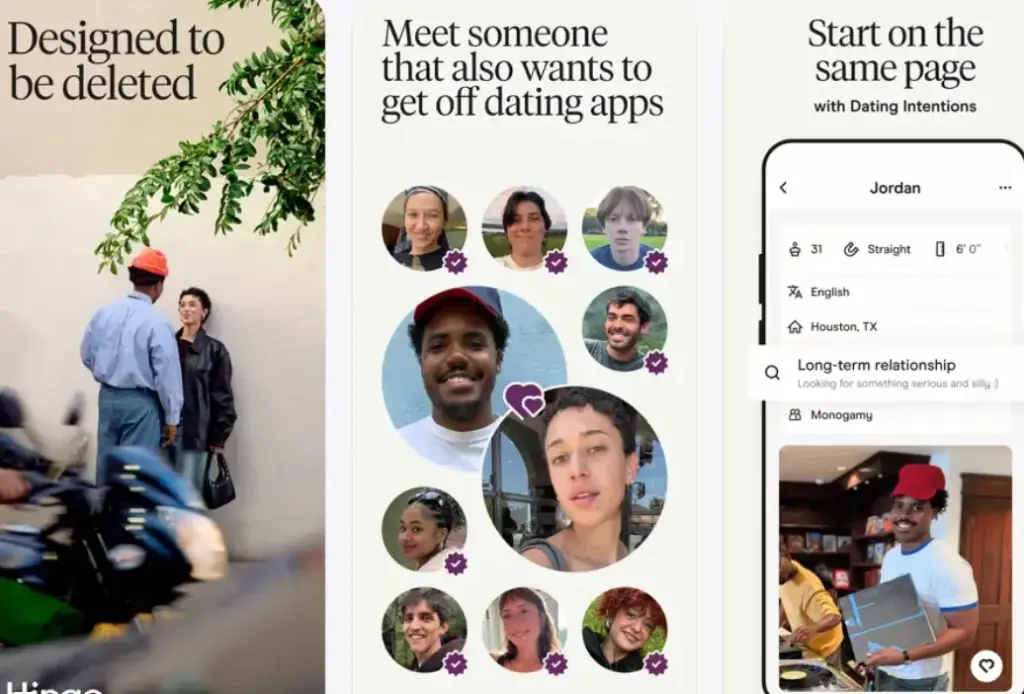
Hinge focuses on relationship-oriented dating and uses recommendation technology to help users discover people who may be more compatible with their preferences and behavior. Its HingeX plan includes Enhanced Recommendations, which uses common preferences and recent activity to move potentially relevant profiles higher in the Discover feed.
Standout features:
- Enhanced Recommendations — HingeX provides recommendations designed to better match a user’s preferences.
- Advanced Preferences — Users can narrow discovery using more detailed criteria.
- Priority Likes — Paid users can make their Likes more prominent to potential matches.
Revenue model: Hinge follows a freemium subscription model. Its paid offerings include Hinge+ and HingeX, with additional purchases such as Roses. HingeX includes enhanced recommendations, priority Likes and Skip the Line visibility.
Revenue/pricing stats: Hinge does not publish a single universal U.S. subscription price because pricing can vary by user and subscription duration. At the company level, Match Group reported that Hinge’s global monthly active users increased 13% in Q2 2026, driven by international expansion.
What makes it successful:
Hinge’s strength is its clear relationship-focused positioning. Instead of competing purely on the number of profiles users can browse, it focuses on making each recommendation more relevant. This is an important lesson for AI matchmaking founders: personalization can be the core product rather than just another feature.
4. Iris Dating
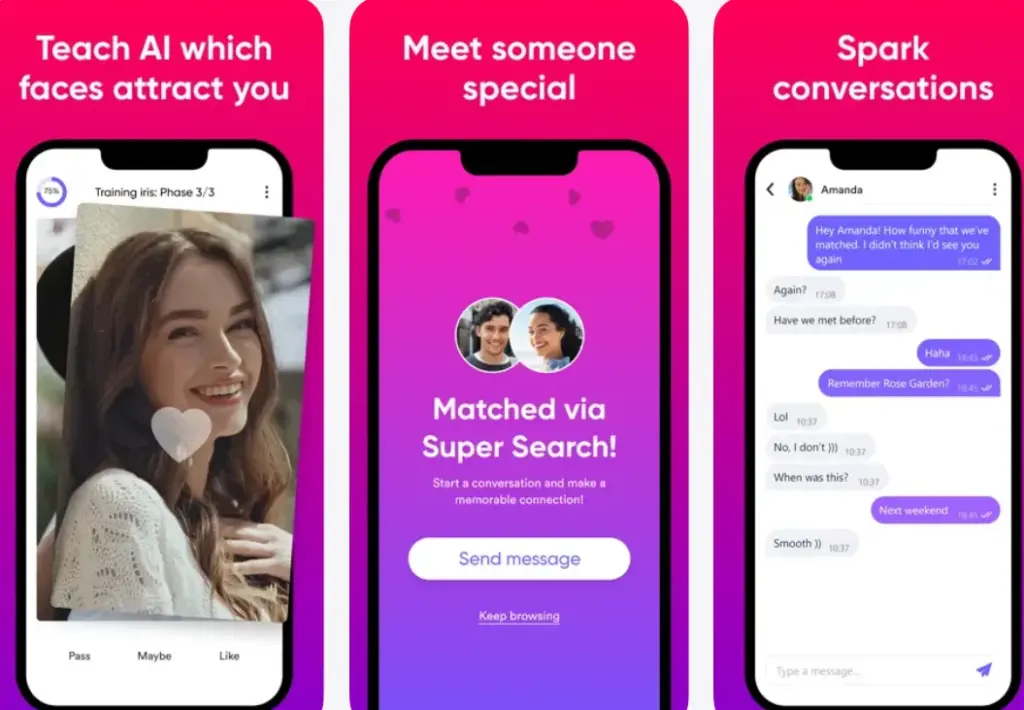
Iris Dating is more AI-centric than traditional dating apps because artificial intelligence sits at the center of its matchmaking proposition. The platform uses machine learning to understand attraction patterns and user behavior and then uses those signals to recommend potential matches.
Standout features:
- AI Attraction Prediction — Uses machine learning to identify patterns in the types of people a user finds attractive.
- Behavior-Based Matching — Learns from interactions rather than relying only on initial profile information.
- Personalized Recommendations — Continuously adapts suggestions as the platform learns more about the user.
Revenue model: Iris uses a freemium subscription model, with paid tiers including Gold and Platinum and additional premium functionality.
What makes it successful:
Iris has a strong AI-first positioning. Users understand immediately why AI matters to the product: it is not simply helping them write a profile; it is being used to improve the actual matchmaking process.
5. SciMatch
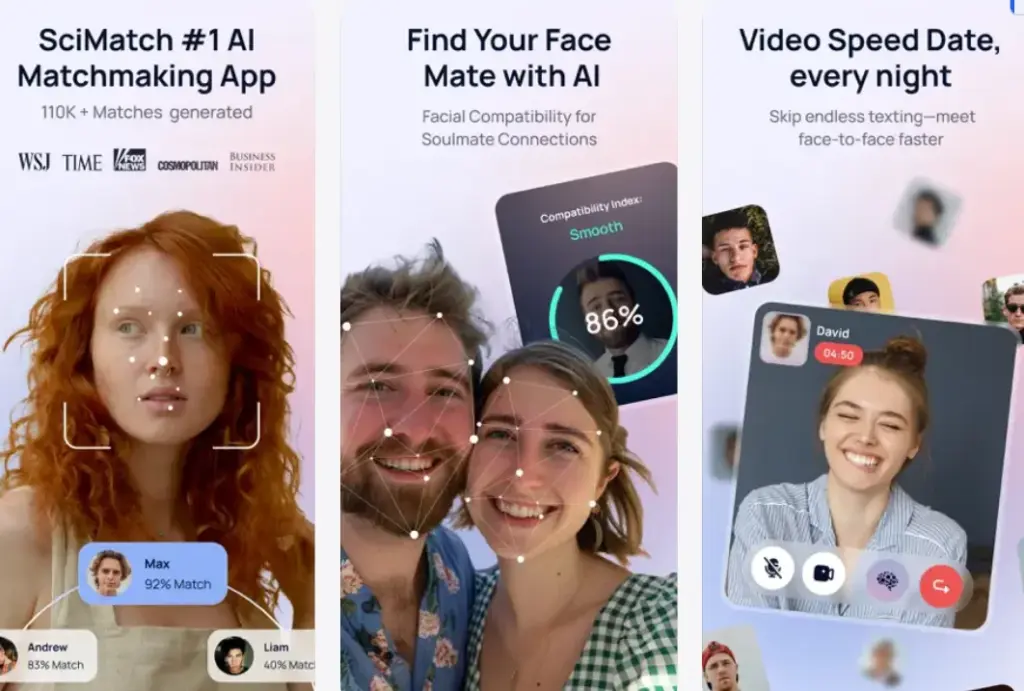
SciMatch takes a more personalized approach by combining AI matchmaking with personality and compatibility insights. Its AI matchmaker, Sci, helps users understand themselves, improve their dating approach and identify potentially compatible partners. SciMatch describes itself as an AI-focused dating platform and currently positions AI matchmaking as its main differentiator.
Standout features:
- Sci AI Matchmaker — Provides personalized matchmaking and dating guidance through AI.
- Compatibility Insights — Helps users understand personality and relationship compatibility.
- AI Dating Support — Offers guidance around profiles, conversations and dating decisions.
Revenue model: SciMatch uses a freemium model with premium AI services. Users can access core dating functionality while additional AI-powered tools and deeper insights can be monetized.
What makes it successful:
SciMatch demonstrates an interesting approach to monetizing AI: users can pay for personalized intelligence rather than simply paying for more swipes. That model could be particularly useful for a new AI matchmaking startup.
6. eHarmony

eHarmony is an important benchmark because compatibility has been at the heart of its product for years. Users complete a detailed Compatibility Quiz, which creates a personality profile and is then used to generate partner recommendations and compatibility scores.
Standout features:
- Compatibility Quiz — Collects detailed information about personality, preferences and relationship expectations.
- Personality Profiling — Turns questionnaire responses into a structured personality profile.
- Compatibility Matching — Compares profiles to generate recommended partners and compatibility scores.
Revenue model: eHarmony follows a free registration + paid membership model. Users can create a basic account without paying, while Premium memberships provide broader access to the service. Its terms list 6-, 12- and 24-month Premium membership options.
What makes it successful:
eHarmony shows that users will provide more personal information upfront when they believe it will lead to better matches. This is directly relevant to AI matchmaking because recommendation quality depends heavily on the quality and depth of user data.
7. Coffee Meets Bagel
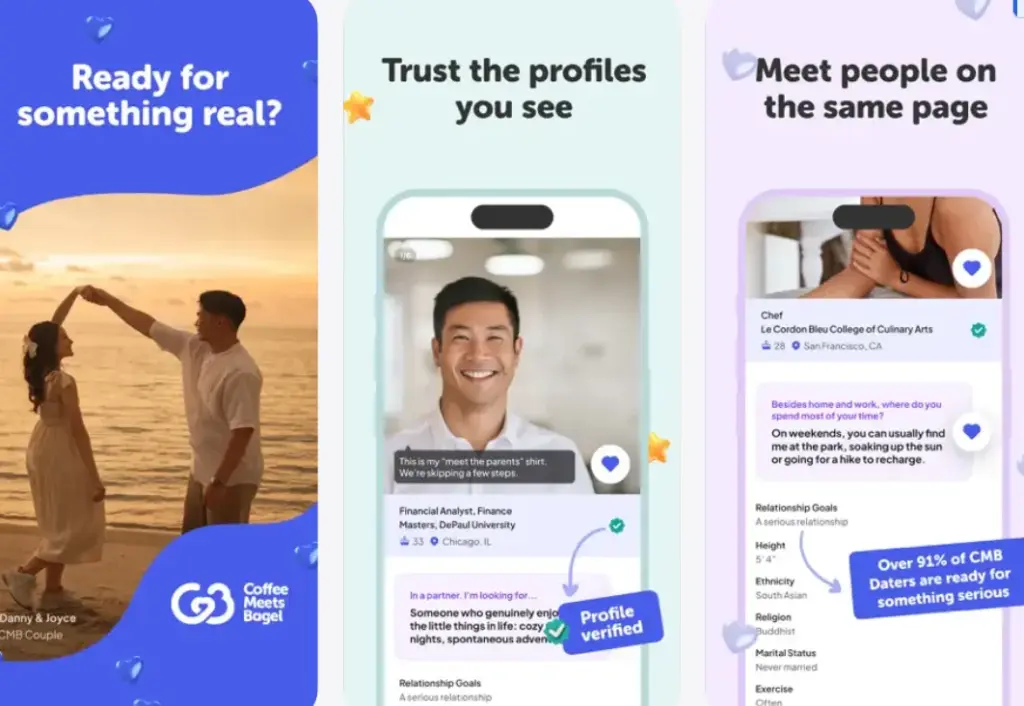
Coffee Meets Bagel is built around intentional dating rather than unlimited browsing. Its latest 2.0 platform uses a rebuilt machine-learning recommendation engine that continuously learns from user interactions and changing preferences while prioritizing mutual compatibility.
Standout features:
- Machine-Learning Recommendations — Learns from user behavior and changing preferences to improve daily matches.
- Curated Daily Matches — Gives users a focused selection instead of an endless stream of profiles.
- Selfie Verification — Checks users’ photos against a video selfie to reduce fake or misleading profiles.
Revenue model: CMB uses a freemium + premium subscription + in-app purchase model. Premium provides benefits such as unlimited suggested profiles, access to Likes You, profile boosts and additional preferences. Users can also purchase features such as Flowers and other credits.
Revenue/pricing stats: CMB does not publicly disclose a current fixed U.S. Premium price or annual revenue figure. However, the platform reports more than 250 million matches and says over 91% of its community is looking for a committed relationship.
Its latest redesign also produced an approximately 30% increase in messages sent with Likes and a 21% increase in average profile-viewing time during its initial rollout.
What makes it successful:
CMB succeeds by addressing a problem that many AI matchmaking platforms are now targeting: too much choice. Its product is built around curated discovery, meaningful conversations and moving relationships offline.
8. Amata
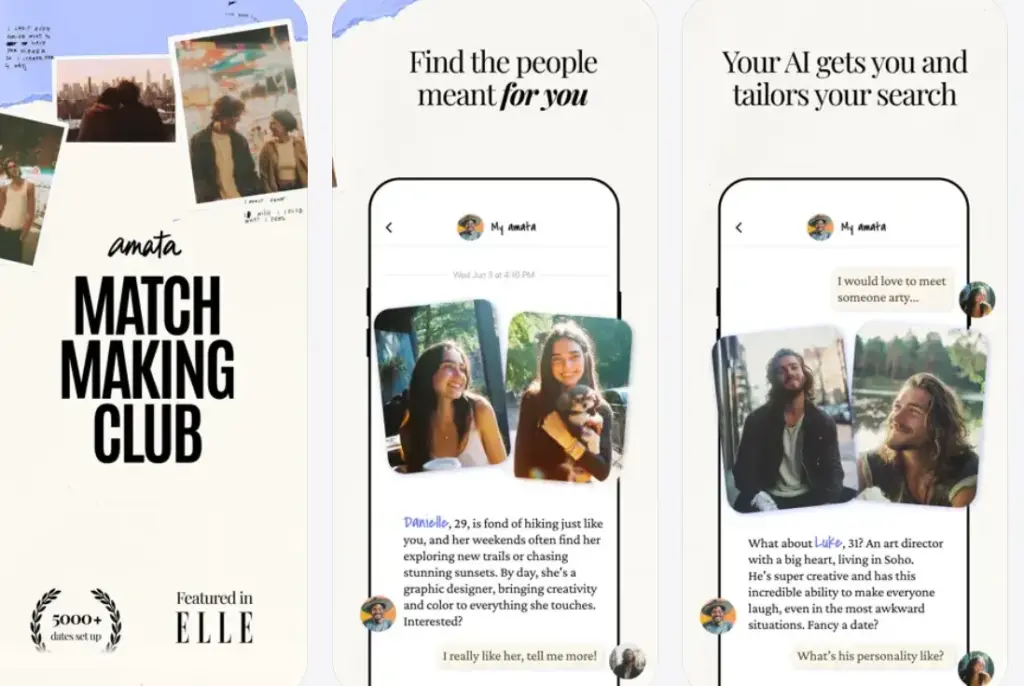
Amata is a strong example of the new generation of AI-native matchmaking platforms. Instead of asking users to swipe through profiles, its AI matchmaker learns about users through extended conversations covering their values, habits, background and relationship preferences. It then recommends people who appear compatible.
Standout features:
- AI Matchmaker Interviews — Uses extended conversations to understand what a user actually wants from a relationship.
- Deep Compatibility Profiling — Looks beyond basic profile fields to compare values, habits and relationship goals.
- Curated Introductions — Moves users toward an actual date rather than treating a Match as the final goal.
Revenue model: Amata uses a pay-per-date / curated introduction model instead of relying entirely on a monthly subscription.
What makes it successful:
Amata changes the value proposition from “find someone to match with” to “find someone worth meeting.” That gives the platform a much more outcome-oriented monetization opportunity.
9. Palaura

Palaura is an AI-first matchmaking platform focused on serious and values-based dating. Instead of making users browse a large pool of profiles, the platform uses AI to learn about a person’s personality, preferences, and relationship goals and then helps identify more suitable connections. This puts the emphasis on quality of matchmaking rather than the number of profiles users can browse.
Standout features:
- AI Matchmaking — Uses AI to understand a user’s preferences and identify potentially compatible partners.
- Values-Based Matching — Gives greater weight to relationship values and long-term compatibility.
- No-Swipe Discovery — Reduces profile browsing by letting the AI handle more of the discovery process.
Revenue model: Palaura follows an AI matchmaking/service-oriented model rather than relying solely on traditional swipe monetization.
What makes it successful:
Palaura’s biggest advantage is its clear positioning around serious dating. It doesn’t try to compete with mass-market dating apps on the number of profiles. Instead, it sells a more curated experience where AI does more of the searching.
10. Known
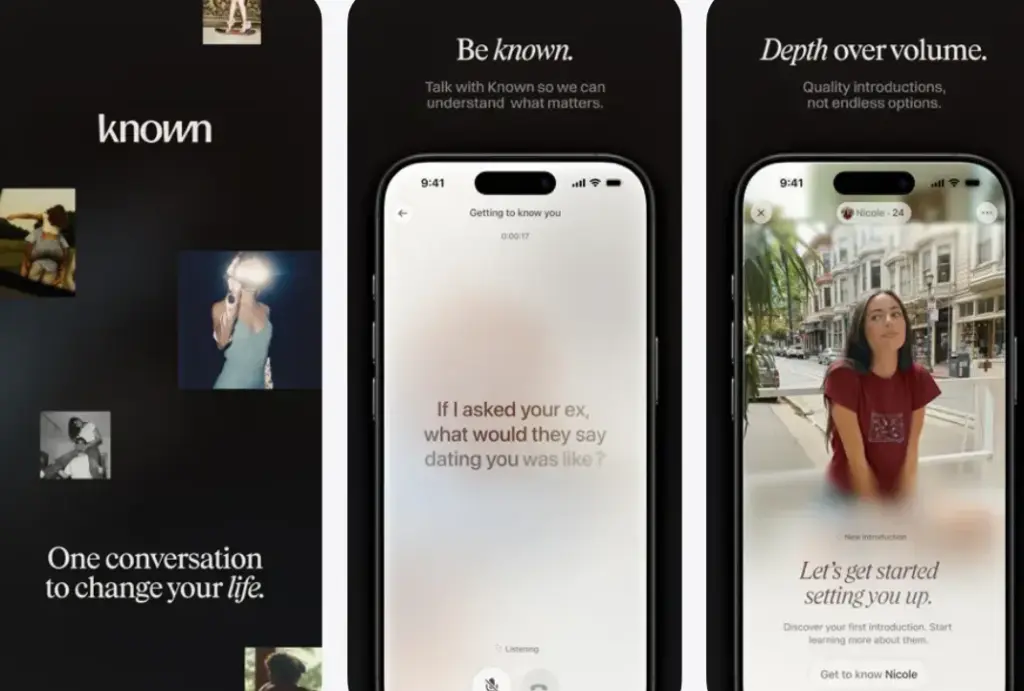
Known represents the emerging AI matchmaking concierge model. Instead of simply displaying profiles, AI can interview users about their personality, lifestyle, values, and relationship goals and then use those insights to identify compatible people. It is part of a broader wave of AI-first matchmaking businesses experimenting with curated introductions.
Standout features:
- AI User Interviews — Uses conversational AI to gather deeper information than a standard profile.
- Compatibility Profiling — Compares lifestyle, values and relationship goals to identify stronger matches.
- Curated Introductions — Turns AI recommendations into real-world introductions.
Revenue model: Known is associated with the emerging pay-per-date / pay-per-introduction model used by AI-first matchmaking services.
What makes it successful:
Known’s biggest differentiator is its concierge-style experience. Instead of making users responsible for searching through hundreds of profiles, the platform positions AI as the layer that does the filtering and matchmaking work for them.
How Successful Dating Apps Use AI Beyond Matching?
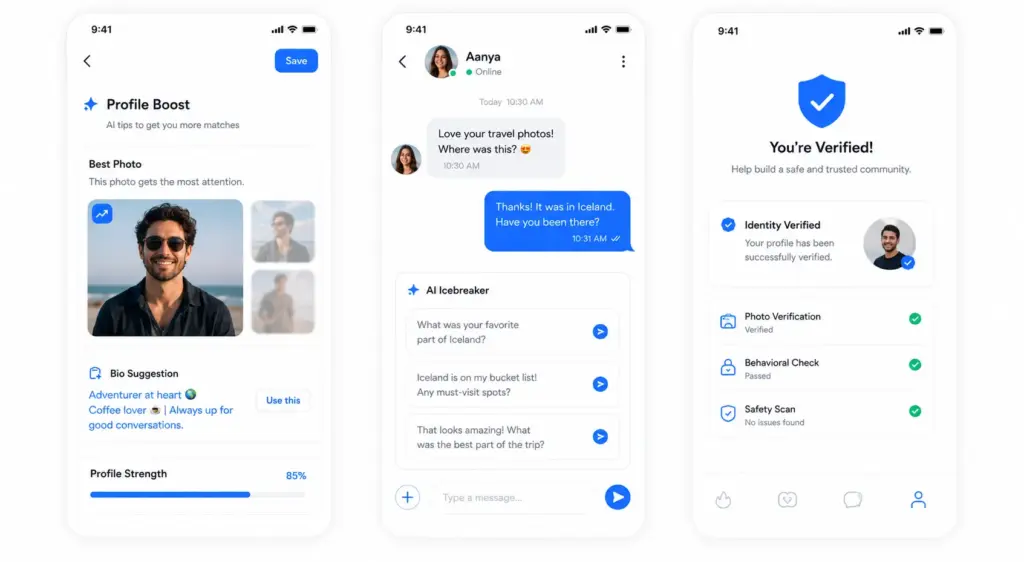
Modern dating apps do far more than line up profiles. Successful platforms deploy intelligent tools across the entire lifecycle to keep members engaged, comfortable, and active. Incorporating real-time AI capabilities transforms a passive app into an interactive experience while reducing operational overhead.
1. Profile Coaching and Personalization
A strong profile can make a major difference in how users perform on a matchmaking app. AI can help improve photos and bios by identifying stronger images and making profile text feel more natural. It can also learn which profile elements get more attention and use those insights to improve how profiles are presented.
Rizz AI shows how these tools can become a standalone revenue opportunity. The platform focuses on profile and communication coaching and generates over $2.2 million in annual revenue. A matchmaking app can use a similar approach by offering AI profile audits and personalized coaching as premium features.
2. Conversation Starters and Dating Assistance
Keeping a conversation going after a match can be difficult. AI can reduce this friction by suggesting relevant icebreakers and helping users respond when they are unsure what to say. It can also recommend date ideas based on shared interests and preferences. This makes the experience feel more useful without taking control away from the user.
Keeper shows how focused matchmaking can support a lean business model. The platform combines algorithmic matching with AI assistance to help users find more compatible connections. Its focus on serious relationships has helped it reach roughly $900,000 in ARR.
3. Moderation and Identity Verification
Platform safety directly impacts user trust and brand equity. Machine learning models act as a constant safety monitor, working quietly behind the scenes to protect members.
- Facial biometric verification: Matches live selfie captures against profile uploads to prevent catfishing instantly.
- Behavioral fraud tracking: System filters flag bot patterns, duplicate accounts, and spam interactions before they reach real users.
- Sentiment safety scans: Text classifiers catch toxic phrasing, unwanted solicitations, or harassment, issuing automated warnings in real time.
Build an AI Matchmaking App with IdeaUsher
Turning a matchmaking concept into a high-growth platform requires engineering precision and deep domain expertise. IdeaUsher delivers full-cycle development designed to help founders launch scalable, market-ready AI products. With over 500,000 hours of coding experience, our team of ex-MAANG/FAANG developers designs systems built to process complex algorithms and handle high user throughput.
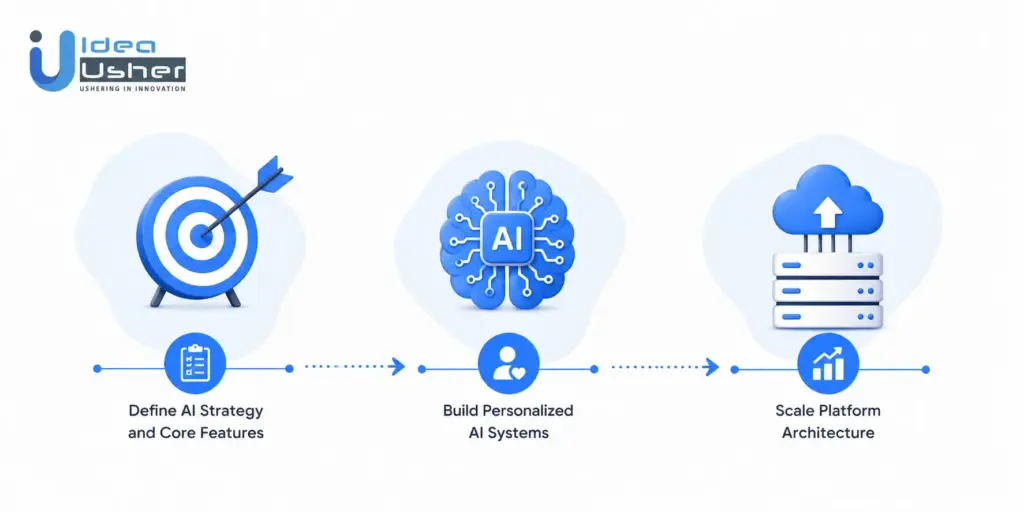
Define AI Strategy and Core Features
Every high-performing app starts with a clear architectural blueprint. We work alongside founders to establish clear technical specifications that match business objectives and monetization paths.
- Matching model design: We define how neural networks weigh hard preferences against subtle behavioral signals.
- Feature mapping: We prioritize key functionality like automated icebreakers, real-time safety scans, and smart profile polishers.
- Monetization integration: Premium subscription layers, microtransactions, and algorithmic boosts are designed directly into the core user journey.
Build Personalized AI Systems
Our engineering team builds custom recommendation engines tailored to your platform’s specific niche. We train models to analyze user preferences, message sentiment, and interaction velocity to continuously sharpen match accuracy. By leveraging natural language processing and dynamic feedback loops, the platform learns with every interaction. This ongoing optimization keeps recommendations fresh, driving higher user satisfaction and long-term retention.
Scale Platform Architecture
A matchmaking platform must remain fast and responsive during massive traffic surges. We construct robust serverless backends and cloud infrastructures capable of scaling effortlessly as your active database grows.
- High-speed data pipelines: Real-time data routing ensures instant match processing and low latency.
- Enterprise data protection: End-to-end encryption keeps sensitive user chats, biometrics, and preferences secure.
- Modular API design: Clean system frameworks allow seamless integrations with new AI tools and third-party services over time.
Conclusion
AI has changed what successful dating apps can offer. The strongest platforms are no longer focused only on helping users find more matches. They are using AI to make discovery more relevant and reduce the effort that comes with endless swiping. For founders, the bigger opportunity lies in building an experience that helps users find better connections with less work.
Things to Know About AI Matchmaking Apps
A1: AI matchmaking apps use artificial intelligence to help users find more relevant and compatible connections. Instead of relying only on basic filters such as age or location, these platforms can analyze preferences, interests, behavior, and relationship goals. The system can then use these insights to recommend matches that are more likely to align with what a user is actually looking for.
A2: AI can make matchmaking more personalized by looking at both what users say and how they behave on the platform. It can learn from likes, skips, conversations, match acceptance, and other interactions. As more data becomes available, the system can refine its recommendations and reduce the need for users to spend hours browsing profiles that may not be a good fit.
A3: An AI matchmaking platform can offer features such as intelligent match recommendations, compatibility scoring, AI profile optimization, conversation suggestions, behavioral analysis, and personalized dating insights. More advanced platforms can also include AI-generated icebreakers, date recommendations, profile audits, and systems that continuously improve match quality based on user feedback.
A4: AI matchmaking apps can use several revenue models depending on their target audience. Subscription plans can provide access to advanced matching and premium features. Platforms can also charge for AI profile audits, personalized coaching, priority introductions, premium memberships, and one-time in-app purchases. A focused platform can combine these models to create recurring revenue while keeping its core matchmaking experience accessible.