


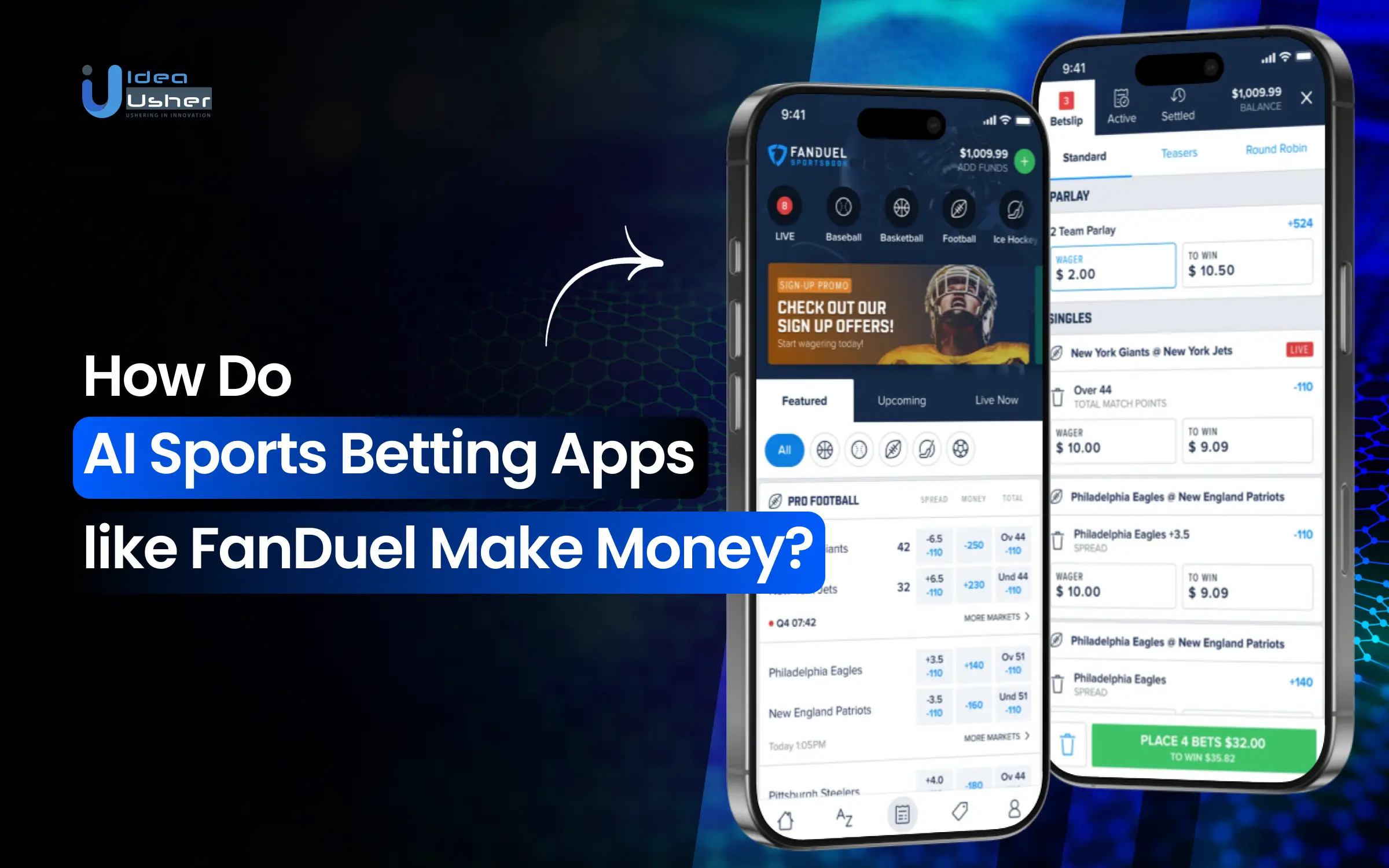
Key Takeaways
- AI sports betting apps like FanDuel generate revenue through sportsbook margins, parlays, live betting, casino, DFS, sponsorships, and affiliate partnerships.
- The core revenue engine is the vig or hold, while same-game parlays, live betting, and personalized markets can generate higher margins through dynamic pricing.
- AI improves profitability through dynamic odds pricing, liability management, sharp bettor detection, personalized recommendations, and real-time market adjustments.
- The platform also needs double-entry wallets, payment orchestration, fraud monitoring, KYC/AML, geolocation, responsible gaming controls, and multi-jurisdiction compliance.
- Development costs range from $60,000–$120,000 for an MVP to $500,000–$2M+ for enterprise platforms, depending on betting features, AI, integrations and regulatory scope.
Sports betting platforms are no longer competing only on odds, as rising acquisition costs, growing demand for live betting, and increasing regulatory complexity are driving operators toward broader ecosystems designed to monetize users across multiple gaming products. This makes understanding how AI sports betting apps like FanDuel makes money essential for businesses exploring differentiated sportsbook models.
FanDuel’s economics extend beyond sportsbook hold, with revenue across casino gaming, fantasy sports, horse racing, prediction markets and cross-product engagement. AI can support betting research, fraud detection and responsible gaming while KYC, geolocation, AML controls and secure payments enable compliant operations across regulated markets.
In this blog, we will talk about how AI sports betting apps like FanDuel make money, their revenue model, monetization strategies, AI capabilities, business economics and how IdeaUsher can help you build a scalable AI sports betting app that delivers personalized experiences, drives user engagement and creates sustainable revenue opportunities.
What Is an AI Sports Betting App like FanDuel?
An AI sports betting app (such as FanDuel, DraftKings, or BetMGM) is a data-driven digital sports entertainment and real-money gaming platform that uses machine learning algorithms, continuous data feeds and predictive modeling to facilitate real-time sports wagering, daily fantasy sports (DFS), and online casino gaming (iGaming).
Operating primarily via iOS, Android, and web interfaces, these platforms function as automated market makers that dynamically generate odds, evaluate risk, process transactions, and personalise user experiences at scale.
A. AI Sports Betting vs. Traditional Sports Betting Apps
AI is reshaping sportsbook operations by improving odds pricing, personalization, risk management, parlay optimization, and responsible gaming, creating more responsive experiences than traditional betting platforms.
| Feature / Dimension | Traditional Sports Betting Apps | AI Sports Betting Apps (e.g., FanDuel) |
| Odds Calculation | Static pre-game lines set manually by oddsmakers; delayed live odds. | Dynamic, millisecond-level live odds generated by predictive neural networks. |
| User Interface & Discovery | Rigid, identical grid menus showing all sports markets to every user. | Personalized feeds featuring custom bet suggestions, automated parlay builders, and conversational AI. |
| Same Game Parlays (SGPs) | Conservative odds cushions; high pricing margin. | Copula-based machine learning calculating true non-linear event correlation in real time. |
| Risk & Fraud Management | Manual review of suspicious accounts and large payouts. | Automated ML anomaly detection for fraud, account sharing, and bonus abuse. |
| Responsible Gaming | Passive self-exclusion lists and static deposit limits. | Proactive NLP models detecting signs of problem gambling or emotional distress in real-time. |
B. How AI Is Helping Sports Betting Apps in Revenue
The global sports betting market size was valued at $113.79 billion in 2025 and projected to grow from $126.51 billion in 2026 to $295.29 billion by 2034, exhibiting a CAGR of 11.18% during the forecast period. As betting shifts to complex live environments, legacy static algorithms and manual trading desks cannot match the speed or granularity required for modern sports data.

AI serves as crucial infrastructure for sportsbooks, enabling operators to handle live multi-feed data, balance complex multi-leg bets, and deliver personalized experiences without broad discounts.
- Conversational Bet Discovery: Generative AI assistants answer natural-language questions, surface statistics, explore markets, and help build bet slips. FanDuel’s AceAI processed 268,000+ queries since launch, demonstrating early engagement with AI-powered betting discovery.
- AI-Powered Parlay Optimization: Probability and pricing models evaluate correlations between selections and price complex bets more accurately. Parlays generated 60% of operator revenue in March 2026, up from roughly half historically, highlighting their commercial importance.
- Dynamic Pricing & Revenue Protection: AI models process game-state and player data to improve pricing, manage exposure, and reduce latency. DraftKings reported 10.9% sportsbook hold in Q2 2025, while live-betting handle grew 16% YoY.
Revenue Numbers of FanDuel
FanDuel is the primary US growth engine for its publicly traded parent company, Flutter Entertainment PLC.
- 2025 Full-Year US Revenue: Flutter’s US business dominated by FanDuel generated $6.97 Billion in revenue, representing a 20% year-over-year increase from $5.798 Billion in 2024.
- Breakdown by Segment:
- Sportsbook: ~$4.0+ Billion
- iGaming (Online Casino): ~$1.5+ Billion (achieved strong +44% YoY growth in 2025)
- Profitability: Flutter’s US unit delivered $922 Million in Adjusted EBITDA in 2025 (an 82% surge year-over-year).
- Market Share: FanDuel maintained a dominant position in the US, commanding approximately 41% Gross Gaming Revenue (GGR) market share in sports betting and 27% market share in iGaming in operating states.
- 2026 Outlook: Flutter forecasts US revenue to reach up to $8.2 Billion.
The Enterprise Takeaway: AI powers high-velocity, micro-market wagering. By integrating real-time risk correlation, automated data ingestion, and personalized discovery, operators maximize margins while ensuring a smooth user experience.

How Do AI Sports Betting Apps like FanDuel Make Money
AI sports betting apps like FanDuel do not rely on gambling luck to generate revenue. Instead, they combine the mathematical economics of traditional bookmaking with artificial intelligence, dynamic pricing algorithms, and multi-channel monetization.
Net Gaming Revenue (NGR) = (Total Handle Wagered × Hold Rate %) − Bonuses/Promotions − Taxes & Levies
By leveraging AI-driven dynamic pricing, high-margin parlay products, and personalized marketing, modern betting apps maximize their hold rate (often averaging 8%–12%+ across all bet types) while mitigating downside market exposure.
| Revenue Stream | How It Generates Income | Typical House Margin |
| Spread / Total Bets (Vig) | Built-in odds spread (e.g., -110 / -110 pricing). | ~4.5% – 5% |
| Same Game Parlays (SGPs) | Compounded multi-leg odds powered by AI correlation models. | 15% – 25%+ |
| Live / In-Game Betting | Real-time micro-odds adjusted continuously by data feeds. | 7% – 10% |
| iCasino (Slots / Tables) | Digital casino games governed by fixed mathematical house edges. | 2% – 8% per hand/spin |
| Daily Fantasy Sports (Rake) | Flat commission fees taken from player contest prize pools. | 5% – 15% of pool |
Below is an overview of how AI sports betting apps generate revenue through key streams such as betting margins, AI-based dynamic pricing, parlays, casino cross-selling, and data monetization in modern sportsbook ecosystems.
1. The Core Engine: The “Vig” (Vigorish or Hold Percentage)
Modern sports betting platforms operate as data-driven financial systems where pricing models, user behavior analytics, and automated risk controls determine profitability across every wager type.
The foundation of any sportsbook’s revenue is the vig, the built-in commission charged on every bet:
- On standard two-way bets (e.g., point spreads or over/unders), odds are typically priced at -110 / -110.
- A bettor must risk $110 to win $100.
- If two bettors place opposite sides of the bet, the app collects $220, pays out $210 to the winner, and keeps $10 risk-free (roughly a ~4.5% to 5% baseline house edge).
The “Hold”: This margin guarantees that over millions of bets, the app retains an average percentage of total money wagered (typically a 7% to 10%+ structural hold).
2. High-Margin Bets and Same-Game Parlays (SGPs)
Modern betting platforms function as algorithmic ecosystems where pricing intelligence, user engagement, and automated risk systems collectively drive consistent, scalable revenue generation.
While standard straight bets carry low hold rates (~4%–5%), complex bets significantly boost app profit margins:
- Parlays & Same-Game Parlays (SGPs): FanDuel pioneered SGPs, where bettors combine multiple legs into one slip. Because the house edge compounds with each leg added, parlays often have hold percentages of 15% to 30%+.
- Micro-Betting & Live In-Game Markets: Betting on dynamic in-play events (e.g., “Will the next play be a run or pass?”) carries wider margins and promotes rapid re-wagering.
AI models correlate complex dependent variables (e.g., If Quarterback X throws for 300+ yards, what is the exact likelihood Receiver Y scores a touchdown?).
The Profit Drivers: Because humans systematically overestimate their odds of hitting multi-leg parlays, these products are extremely profitable. Platforms like FanDuel use AI to dynamically recommend personalized parlay “builds” based on user history, maximizing high-margin action.
3. How AI Enhances Profitability & “Hold Rate”
AI betting platforms like FanDuel’s AI and machine learning-powered AceAI assistant helps customers research statistics, explore betting markets, and build bets through conversational interactions.
Artificial intelligence transforms traditional bookmaking margins into a high-efficiency algorithmic business:
| AI Function | How It Makes Money / Protects Margins |
| Dynamic Odds Pricing | Ingests thousands of live data points (weather, player tracking, live game state) to re-price micro-second odds and eliminate arbitrage vulnerabilities. |
| Automated Risk & Liability Balancing | Monitors liability exposure across markets. The algorithm shifts lines automatically to balance the book and ensure the platform profits regardless of the game outcome. |
| Sharp Bettor Detection | Machine learning identifies syndicate/professional (“sharp”) betting patterns. The app can instantly limit maximum wager sizes or adjust public lines based on sharp money signals. |
| Personalized Recommendation Engines | AI analyzes individual betting history, favorite teams, and risk tolerance to serve tailored parlays and prop bet suggestions directly on the home feed, driving higher wager frequency. |
4. Ecosystem & Cross-Selling Monetization
These platforms extend beyond wagering, building interconnected digital ecosystems that monetize engagement, entertainment, and user activity across multiple integrated verticals.
AI sports betting apps like FanDuel and similar operators operate as unified digital entertainment platforms:
- iGaming & Online Casino (Slots, Blackjack, Roulette): Sports betting acts as a customer acquisition funnel for digital casino games, which carry mathematically guaranteed house edges (often 2% to 15%) and continuous turn rates.
- Daily Fantasy Sports (DFS) Contest Rake: The platform takes an administrative cut (typically 10% to 15%) of the total prize pool entry fees before redistributing the remainder to winners.
- Online Horse Racing: Pari-mutuel wagering platform fees (e.g., FanDuel Racing).
5. Media, Sponsorships and Data Monetization
These platforms also generate significant revenue beyond wagering through media partnerships, advertising integrations, affiliate networks, and strategic data monetization, creating diversified income streams that complement core betting and gaming operations.
- In-App Advertising & Brand Integrations: Partnerships with sports leagues (NFL, NBA, MLB), media networks, and payment providers provide recurring sponsorship and media revenue.
- Affiliate & Referral Fees: Strategic outbound partnerships with live streaming services, data providers, and affiliate aggregators generate commission-based income.
What Makes an AI Sports Betting Platform Scalable?
Scaling an AI sports betting platform is one of the most demanding engineering challenges in fintech and real-time gaming. Unlike standard high-traffic e-commerce systems, sportsbooks experience 100x traffic spikes during major global tournaments (e.g., the Super Bowl or FIFA World Cup), requiring platforms to process hundreds of thousands of events per second while maintaining latency across odds distribution, risk recalculations, and bet settlements.
1. Real-Time Odds and Sports Data Infrastructure
A modern sportsbook ingests disparate, high-frequency data streams including official league tracking feeds (radar and computer vision), third-party odds compilations (Sportradar, Genius Sports), and real-time match events.
- Sub-50ms Data Ingestion Pipelines: Apache Flink or Kafka Streams normalize fast-moving match feeds into a unified schema within 10–15 milliseconds, minimizing latency gaps and front-running arbitrage opportunities.
- Edge Push Infrastructure: Distributed WebSocket/gRPC meshes and CDNs push live price changes and micro-market suspensions to millions of concurrent clients with minimal server load.
- Time-Series State Management: Redis Cluster or Dragonfly maintains live match states and tick-by-tick odds histories, enabling pricing engines to evaluate changes against instant rolling windows.
2. Automated Risk and Liability Management
Managing financial liability manually is impossible when operating thousands of continuous in-play betting markets. Scalable platforms embed automated AI risk management directly into the transaction path.
- Real-Time Correlation & SGP Modeling: Same Game Parlays (SGPs) require non-linear dependency modeling across correlated outcomes. Machine learning and Gaussian copula models dynamically price cross-market liabilities without slowing checkout latency.
- Predictive Bettor Profiling & Stake Factoring: Automated profiling engines evaluate bettor velocity, sharp-action signals, and Closing Line Value (CLV) to dynamically adjust acceptance thresholds and individual stake limits in milliseconds.
- Dynamic Micro-Suspensions: AI-driven micro-suspensions lock only impacted player props during live reviews while keeping unaffected moneylines, spreads, and totals open for continuous trading.
3. High-Performance Bet Processing
During high-concurrency moments (such as a blocked punt or last-second field goal), thousands of users attempt to place bets within the exact same two-second window. The core wagering engine must maintain strict transactional guarantees without crashing under peak throughput.
| Architecture Metric | Legacy Monolithic Sportsbook | Scalable Event-Driven AI Sportsbook |
| Peak Throughput | 500 – 1,500 Bets/Second (Bottlenecks) | 10,000 to 50,000+ Bets/Second |
| Bet Placement Latency | 2.5 – 5.0 seconds (High rejection rate) | < 100 milliseconds |
| Concurrency Model | Relational Row Locks (ACID contention) | Event-Sourced In-Memory State Machines |
| Database Structure | Monolithic RDBMS (PostgreSQL / MySQL) | Distributed Event Logs (Kafka) + NoSQL Key-Value |
4. Scalable Wallet and Payment Infrastructure
The wallet architecture of a sportsbook operates under the same regulatory and security rigor as an institutional banking system, balancing high transaction frequency with real-time fraud mitigation.
- Double-Entry Immutable Accounting: Every financial movement, including deposits, bet reservations, bonuses, payouts, and chargebacks, is recorded as immutable debit/credit entries across partitioned ledgers, preventing balance drift.
- Atomic Balance Isolation: Each wager triggers an atomic balance lock, preventing double-spending when users place rapid bets across multiple devices using the same uncommitted funds.
- Instant Payout Pipelines & Multi-Rail Routing: Treasury engines route payments across cards, ACH, Apple Pay, PayPal, Visa Direct, and Mastercard Send, while AI anomaly detection enables instant payouts for trusted users and flags suspicious withdrawals for AML review.
5. Multi-Jurisdiction Compliance Architecture
Operating across different states, countries, and regulatory territories (such as the UKGC, MGA, or US state boards) requires a modular compliance layer that adapts dynamically without requiring complete codebase refactoring.
- Edge Validation: The platform triangulates Wi-Fi MAC addresses, GPS telemetry, and cellular signals (via GeoComply or Radar) to ensure the user is physically located within the legal wagering boundary.
- Dynamic Jurisdiction Engine Evaluation: A localized rule-engine parses state/country restrictions such as enforcing bans on in-state college prop bets, applying jurisdictional tax withholdings, or checking mandatory cooldown intervals.
- Real-Time KYC & Self-Exclusion Auditing: The Player Account Management (PAM) system cross-references national exclusion registries (e.g., GAMSTOP) and checks user-defined deposit or time limits.
- Immutable Regulatory Vault Logging: Session metadata, timestamps, exact odds states, and wager payloads are written to encrypted, append-only compliance vaults to generate automated audit reports for gaming commissions.
How Do Sports Betting Apps Manage Risk With AI?
AI in sports betting is not limited to analyzing games or helping users discover betting markets. It can also operate behind the scenes to detect fraud, monitor betting behavior, manage sportsbook exposure and support responsible gaming. This makes AI an operational and risk-management layer as much as a customer-facing feature.
| AI Risk Function | How It Works | User & Business Value |
| Fraud & Account Monitoring | Machine learning analyzes logins, transactions, devices, and account patterns to detect account sharing, bonus abuse, suspicious activity, and fraud. | Users: Safer accounts and transactions. Businesses: Lower fraud losses and stronger platform security. |
| Abnormal Betting Detection | AI evaluates wager frequency, bet sizes, market selection, and behavior to identify unusual or coordinated betting activity. | Users: A more secure and fair betting environment. Businesses: Better detection of suspicious activity and betting patterns. |
| Market & Liability Management | Automated models monitor betting volume, market exposure, and payouts, dynamically adjusting pricing and risk parameters. | Users: More responsive and consistent betting markets. Businesses: Better control over market exposure and potential payout liabilities. |
| Responsible Gaming | Machine learning analyzes deposits and spending patterns to identify when player-protection tools or interventions may be appropriate. | Users: Greater visibility and control over betting activity. Businesses: Stronger responsible-gaming practices and regulatory compliance. |
Note: AI does not need to advise bets. FanDuel-style platforms can apply AI to backend operations while focusing user-facing tools on research, statistics, market discovery, and bet construction. This design separates AI-driven risk management, operational intelligence, and responsible gaming from automated betting advice.
How Much Does It Cost to Build an AI Sports Betting App?
The cost of building an AI sports betting app depends on how much of the sportsbook ecosystem you plan to build in-house versus integrate through third-party providers. A basic MVP with sportsbook functionality, payments and essential AI capabilities requires significantly less investment than a full-scale platform with live betting, advanced risk management, casino, fantasy sports, prediction markets and multi-jurisdiction compliance.
| Development Phase | Estimated Cost (MVP → Enterprise) | What It Covers |
| Discovery & Planning | $8,000–$30,000 | Business model, target market, regulatory requirements, feature scope and technical architecture |
| UI/UX Design | $12,000–$50,000 | User flows, sportsbook interface, bet slip, wallet, dashboards and responsive designs |
| Core Sportsbook Development | $40,000–$300,000 | User accounts, sports/market discovery, betting engine, bet slip, wager processing and betting history |
| AI & Data Integration | $30,000–$300,000 | AI assistant, sports data processing, analytics, personalization and machine learning capabilities |
| Payments & Compliance | $20,000–$150,000 | Wallet, payment gateway, KYC, AML, age verification and geolocation integrations |
| Admin, Risk & Analytics | $20,000–$200,000 | Risk monitoring, user management, odds/market management, reporting and operational dashboards |
| Testing & Security | $15,000–$150,000 | Functional testing, API testing, security testing, performance testing and compliance validation |
| Deployment & Launch | $10,000–$70,000 | Cloud deployment, production configuration, monitoring and launch support |
| Additional Integrations & Jurisdiction Expansion | $25,000–$750,000+ | Additional sportsbook feeds, payment providers, compliance services, geolocation systems and regulated-market requirements |
| Estimated Total | $60,000–$2M+ | Typical AI sports betting platform, from a focused MVP to a multi-jurisdiction, enterprise-scale solution |
Note: These are indicative software development ranges. Sports data feeds, odds providers, licensing, regulatory fees, payment processing, third-party AI services and market-access costs may be additional.
AI Sports Betting App Cost by Platform Level
The platform scope has a major influence on development cost. A sportsbook-only MVP requires a very different technology investment from a multi-product ecosystem that combines betting, casino, fantasy sports, racing and prediction markets.
| Platform Level | Estimated Cost | Typical Scope |
| Basic MVP | $60,000 – $120,000 | Core sportsbook, user accounts, pre-match betting, bet slip, wallet, payments and basic admin panel |
| Advanced Sportsbook | $120,000 – $250,000 | Live betting, player props, parlays, real-time odds, AI features, risk management and advanced analytics |
| AI-Powered Multi-Product Platform | $250,000 – $500,000+ | Sportsbook + casino/fantasy/racing, AI assistant, personalization, advanced risk systems and multiple integrations |
| Enterprise-Level Ecosystem | $500,000 – $2M | Multi-jurisdiction operations, high-scale infrastructure, multiple gaming verticals, sophisticated AI, compliance and enterprise analytics |
Note: The most cost-effective approach for a new operator is usually to validate the sportsbook model first and expand the ecosystem in stages. This allows the business to prioritize core betting infrastructure before investing heavily in additional gaming verticals.
Factors Affect Development Cost
Several technical and business decisions can significantly change the final development budget:
- Sportsbook Data & Odds Feed Contracts: Real-time odds, player statistics, event data, live betting feeds and historical datasets can cost $20,000–$100,000+ annually, depending on coverage and provider agreements.
- AI Model Development & Infrastructure: Odds optimization, bet correlation, fraud detection, personalization and conversational sports research models can require $50,000–$200,000+ for data pipelines, training, infrastructure, and maintenance.
- Sportsbook Trading & Risk Engine: Real-time pricing, liability monitoring, exposure management, bet validation, market suspension and automated risk controls can cost $60,000–$180,000+ due to low-latency architecture requirements.
- Regulated Market Compliance: KYC/AML, geolocation, responsible gaming, audit logging, licensing technology and compliance integrations can add $30,000–$150,000+ per jurisdiction, excluding license fees.
- Payment & Player Account Infrastructure: Deposits, withdrawals, digital wallets, payment integrations, transaction monitoring, chargebacks and player-fund reconciliation can add $25,000–$80,000+ to development costs.
- Live Betting Scalability & Reliability: High-volume wagering, low-latency processing, autoscaling, redundancy, monitoring and performance testing can require $40,000–$120,000+ for major-event reliability.
How IdeaUsher Can Build Your AI Sports Betting Platform
IdeaUsher is a top-tier product engineering partner with 11+ years of industry expertise spanning 50+ countries. Supported by 250+ specialists, 1,000+ completed projects, and a 4.9/5 Clutch rating, we build custom, scalable AI sports betting platforms tailored to your business needs.
We build custom apps and platforms instead of generic templates with cloud-native wagering architectures featuring sub-second odds processing, real-time risk balancing, predictive personalization, and automated compliance to ensure your platform dominates the digital gaming market.
A. Build the Sportsbook Around Your Revenue Model
We align your platform’s backend architecture and mathematical pricing models directly with your commercial monetization strategy.
- Custom Hold & Vig/Juice Engines: We build configurable risk and margin modules that dynamically optimize house edge across pre-match and in-play markets.
- Diversified Wagering Formats: Our developers support fixed-odds, P2P betting exchanges, parimutuel pools, and automated Same-Game Parlay (SGP) pricing.
- Tiered VIP & Bonus Infrastructure: We engineer promotional engines for free bets, deposit-match multipliers, odds boosts, and cashback rewards based on player lifetime value (LTV).
B. Integrate AI Without Overstepping Betting Rules
We deploy advanced machine learning systems with strict built-in governance to enhance user engagement and risk management while maintaining total regulatory compliance.
- Predictive User Personalization & Smart Bet-Slips: We build ML recommendation models analyzing wagering history, preferred leagues, and stake patterns to deliver personalized bet suggestions without promotional steering.
- Algorithmic Risk Management & Sharp Money Detection: Our engineers deploy real-time anomaly detection to identify syndicate betting, line-movement exploits, and arbitrage attempts while automatically balancing bookmaker exposure.
- Responsible Gaming & Early Intervention ML: We integrate predictive player-protection models that monitor behavioral telemetry, flag problem-gambling indicators, and trigger cooling-off periods or custom deposit limits where required.
C. Connect Data, Odds, Payments and Compliance
We engineer an interconnected, low-latency microservices ecosystem that harmonizes high-throughput external feeds, global payment rails, and regional compliance layers.
- Sub-Second Sports & Odds Feed Ingestion: We build resilient APIs integrating Sportradar, Betradar, and Genius Sports for live match tracking and millisecond-level odds synchronization.
- Multi-Rail Fiat & Crypto Cashier Systems: Our developers build PCI-DSS Level 1-compliant payment gateways supporting cards, ACH, open banking, Apple Pay, Google Pay, and crypto settlement.
- Automated KYC, AML & Precision Geolocation: We integrate Jumio, Sumsub, and GeoComply for automated identity verification, age checks, AML screening, and precise jurisdictional geofencing.
D. Design for Multi-Product Expansion
We architect modular, future-proof platforms designed to easily accommodate new betting verticals and interactive iGaming experiences as your user base expands.
- Esports & Micro-Betting Architecture: We build low-latency event pipelines for high-frequency esports streams like CS:GO and League of Legends, plus play-by-play markets such as next pitch, drive, or point.
- Cross-Vertical Casino & iGaming Integration: Our modular backend supports online casino, live-dealer games, crash games, and peer-to-peer poker, enabling seamless cross-selling across the iGaming ecosystem.
- Native Cross-Platform Frontends: We build high-performance iOS, Android, and responsive Web apps with smooth 60fps rendering and instant bet-slip execution during peak sporting events.
E. Launch an MVP Before Scaling the Ecosystem
We utilize an agile development framework that gets a compliance-ready Minimum Viable Product (MVP) to market rapidly, validating user traction before expanding infrastructure.
- Rapid MVP Feature Prioritization: We prioritize core wagering engines, primary sports feeds, essential payment gateways, and regulatory requirements to accelerate time-to-market.
- Auto-Scaling Cloud Infrastructure: We deploy Kubernetes-based microservices on AWS/GCP to handle traffic surges during marquee events like the Super Bowl, FIFA World Cup and March Madness.
- Zero Vendor Lock-In Asset Delivery: We deliver clean, well-documented, auditable source code, giving your organization 100% platform and IP ownership from day one.
Ready to build a high-performance, compliant AI sports betting platform that dominates the market? Partner with Idea Usher’s principal iGaming and AI software architects to map out your custom product build today.
Conclusion
The economics of AI sports betting apps extend far beyond sportsbook margins. Hold rates, parlays, live betting, cross-selling, AI-powered research, risk management and responsible gaming collectively shape the business model. FanDuel demonstrates how multiple revenue streams can operate within one connected ecosystem while technology supports scale and user engagement. For businesses entering this market, the right combination of product strategy, AI capabilities, regulatory infrastructure and monetization can create a differentiated platform with room for sustainable growth across evolving sports and gaming markets.
FAQs
A.1. AI sports betting app development typically costs $60,000 to $2M+, depending on platform scope, AI complexity, sportsbook features, integrations, compliance requirements, scalability and additional gaming products.
A.2. Core features include real-time odds, live betting, bet slips, player props, payments, digital wallets, AI research assistants, risk monitoring, KYC, geolocation and responsible gaming controls for regulated operations.
A.3. AI sports betting apps generate revenue through sportsbook hold, parlays, live betting, casino gaming, fantasy contests, racing, prediction markets, cross-selling and other complementary monetization channels.
A.4. AI sports betting platforms require jurisdiction-specific licensing, KYC, age verification, AML monitoring, geolocation, secure payments and responsible gaming controls to operate legally across regulated betting markets.


