 (+971) 8007 4267
 (+91) 946 340 7140
 (+1) 628 432 4305

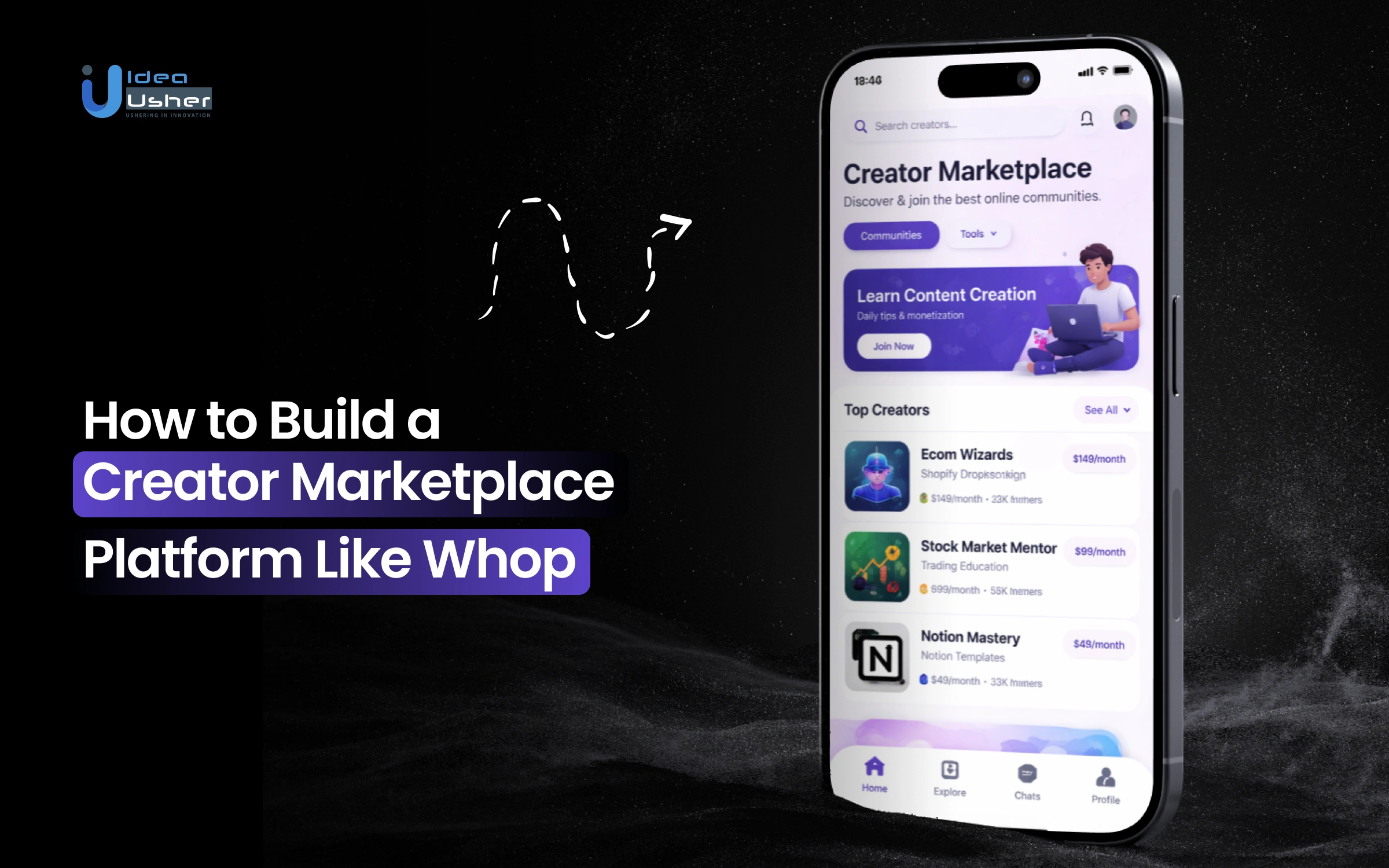
Creator marketplaces are becoming central to how digital products, communities, and services are distributed online. Instead of relying solely on social platforms or standalone websites, creators increasingly look for ecosystems where they can sell products, manage memberships, and engage directly with their audience. These trends are shaping creator marketplace platform development, where the platform must support both monetization and community interaction at scale.
Running this kind of marketplace requires more than just listing digital products; it demands seamless integration of creator onboarding, product hosting, subscription management, payment processing, analytics, and moderation. The platform’s strength comes from how well these components support creators and deliver a smooth experience for buyers and subscribers.
In this blog, we explain how to build a creator marketplace platform like Whop by examining core features, architectural considerations, and practical steps involved in launching and scaling a creator-driven digital marketplace.

What is a Creator Marketplace Platform, Whop?
Whop is a social commerce platform and creator marketplace designed for creators, entrepreneurs, and online businesses to create, market, and sell digital products, services, or memberships directly to consumers through a centralized marketplace and storefront system. It acts as an all-in-one “business layer” for the internet, allowing creators to monetize expertise without needing to manage separate tools for payments, content delivery, or community management.
Core Functionality
Creator marketplace platforms offer tools that help creators build, manage, and monetize digital products. These core functions simplify storefront creation, community access, and product management within one integrated platform.
- Digital Storefronts: Creators can build hosted storefronts (called a “whop”) to sell products like online courses, eBooks, software, and trading indicators.
- Gated Access: The platform excels at managing memberships for private communities on Discord, Telegram, or Whop’s native chat apps.
- Whop App Store: A unique feature where creators can “copy and paste” pre-built apps (like forums, quizzes, or booking tools) into their storefront to add functionality without coding.
- Unified Dashboard: Buyers use a single dashboard to manage all their various subscriptions and digital purchases in one place.
A. Product Categories
Whop caters to a broad range of digital offerings beyond traditional files:
- Knowledge-Based: Online courses, ebooks, webinars, and masterminds.
- Community-Based: Paid Discord/Telegram access and private community hubs.
- Software & Tech: SaaS tools, software licenses, trading bots, and AI prompt libraries.
- Creative Assets: Digital art, templates (e.g., Notion, Canva), and gaming skins.
B. Business Model: B2B2C Infrastructure
Whop operates on a freemium-infrastructure business model designed for the creator economy, generating revenue primarily through transaction-based commissions rather than fixed monthly fees.
- Infrastructure-as-a-Service: Whop provides a centralized “business operating system” for creators, handling storefront hosting, content delivery, and community management tools.
- Low Barrier to Entry: The platform is free to use with no setup or monthly subscription costs, shifting the financial risk from the creator to the platform.
- Marketplace Flywheel: Whop combines a seller tool with a discovery marketplace (“Discover”) that exposes creators to its 14.2 million users.
C. Revenue Model: How Whop Makes Money
Whop’s income is generated through a multi-tiered fee structure and service-based charges:
Standard Platform Fees:
- 3% Commission: Charged on sales involving automations like Discord, Telegram, or TradingView.
- Whop Payments: A processing fee of 2.7% + $0.30 for domestic card transactions.
- International Surcharge: An additional 1.5% for international cards and 1% for currency conversion.
Marketplace Referral Fees:
Previously, Whop charged up to 30% for sales driven by its native marketplace. In May 2025, they reduced this to 0% to prioritize growth in Gross Merchandise Volume (GMV) and creator acquisition.
Service & Infrastructure Fees:
- Payout Fees: Instant USD deposits cost 4% + $1, while crypto payouts incur a 5% + $1 fee.
- Merchant of Record (MoR): Whop earns through its automated tax compliance and global payout services for external partners (e.g., its partnership with micro1).
Key Financial Statistics (as of 2026)
| Metric | Value |
| Annualized Revenue | ~$142M (Oct 2025 estimate) |
| Annual GMV | Over $1B |
| Current Valuation | $1.6 Billion |
| Total Funding | $217M (Series B led by Tether) |
How does the Creator Marketplace Platform work?
Creator marketplace platforms operate through a structured system that manages digital products, payments, and user access. Each layer from product upload to analytics ensures seamless transactions, secure delivery, and continuous creator–consumer engagement.

1. Content and Product Management
The process starts when a creator uploads a digital asset, and Marketplace Infrastructure takes over like validating file type, compressing media for preview, generating secure URLs, and cataloging the product in the search index. This layer ensures digital products are stored, discoverable, deliverable, and ready for transactions.
2. Subscription Handling and Payment Routing
Once a consumer initiates a purchase or subscription, the Payment and Subscription Engine activates as the financial processing hub. It functions by:
- Authenticating the payment method.
- Routing the charge to the appropriate gateway (Stripe, PayPal, etc.).
- Applying platform logic (e.g., trial periods, discount codes).
- Recording the transaction against the specific creator’s ledger.
This engine ensures that money moves securely from the consumer to the platform (and eventually to the creator) without interrupting the user experience.
3. Access Control and Identity Verification
The Creator Identity and Access Management (IAM) layer verifies transactions and manages permissions, updating roles like “subscriber” or “premium member” upon purchasing a course or membership. It handles Single Sign-On (SSO) and prevents unauthorized access to another creator’s paid content across creator networks without proper credentials.
4. Community Synchronization and Social Routing
With access granted, the Community Integration Layer connects the consumer to the platform’s social fabric. Acting as a social router, it automatically adds the new member to the creator’s private Discord, subscribes them to a newsletter, or unlocks a forum. It makes the purchase the start of their participation, not the end.
5. Revenue Reconciliation and Analytics
Finally, the Analytics and Revenue Tracking Systems close the loop by capturing every interaction. As the working process concludes, this layer performs two functions:
- Reconciliation: It splits the transaction revenue, deducts the platform fee, and updates the creator’s payable balance in real-time.
- Feedback: It tracks the consumer’s journey (click-through rates, video watch time, churn) and feeds this data back to the Content Ingestion layer, informing the creator on what type of product to build next.
Why Creator Marketplace Platforms Are Growing Fast?
The Global Creator Marketing Platform Market size is forecasted to reach USD 272.2 Billion by 2034, up from USD 31.42 Billion in 2024, with a CAGR of 24.10% from 2025 to 2034. This growth highlights a major opportunity for creator marketplace platform development like Whop that helps creators sell digital products, memberships, and communities directly to their audience.

Platforms that reward performance rather than follower count are playing a key role in this shift. For example, Whop’s Content Rewards and clipping initiatives allow creators to earn based on actual engagement, typically ranging from $0.50 to $3 per 1,000 views.
Studies show that short-form videos generate 2.5x more engagement than long-form content and are shared 1,200% more than text and images combined, making video-centric creator marketplaces even more attractive for both creators and startups entering this space.
This growing emphasis on creator-driven platforms is also driven by the strong trust audiences place in creators. Research shows that 92% of consumers trust influencer recommendations more than traditional advertisements, making creator content feel more authentic and relatable than brand-led campaigns.
This trust also leads to real results, with 80% of consumers reporting they take action such as visiting a website, following a creator, or making a purchase after engaging with creator content. As a result, platforms that help creators build communities and monetize their influence are becoming an effective channel for brands and startups to drive engagement and conversions.
How Can a Creator Marketplace Prevent Piracy of Digital Products?
To safeguard high-value intellectual property, modern marketplaces employ a multi-layered security stack. This strategy shifts the focus from simple password protection to persistent, traceable, and automated defense mechanisms that deter unauthorized redistribution in real-time.

1. DRM Integration
Digital Rights Management (DRM) acts as a high-security gatekeeper, utilizing advanced encryption to restrict how files are accessed. It ensures that only authenticated users can open content, effectively preventing unauthorized copying, editing, or cross-device sharing.
2. Forensic and Invisible Watermarking
Invisible watermarking embeds unique, machine-readable identifiers into digital assets without affecting the user experience. If a file is leaked, these forensic marks allow the platform to trace the exact source back to the original buyer.
3. Dynamic and Expiring Download Links
Marketplaces generate unique, time-sensitive download links for every purchase. By setting strict expiration windows or limiting the number of total downloads per link, the platform prevents users from publicly sharing a single functional URL.
4. AI-Powered Real-Time Monitoring
Advanced AI agents continuously scan the internet, including social media and torrent sites, for unauthorized copies. These automated “crawlers” identify pirated listings instantly, triggering immediate DMCA takedown requests to remove infringing content from search results.
5. Gated Community and Access Controls
Piracy is often deterred by moving value from static files to interactive environments. By gating content within exclusive Discord servers or private dashboards, creators ensure that the primary value lies in ongoing, authenticated community participation.
Key Features Behind Creator Marketplace Platform Like Whop
The creator marketplace platform development requires a shift from simple storefronts to integrated digital economies. This architecture prioritizes seamless creator onboarding, friction-free global payments, and robust community engagement to drive long-term retention.

1. Creator Onboarding and Storefront Creation
The initial touchpoint for any creator is the ease with which they can transition from a concept to a live, branded digital storefront. High-conversion platforms eliminate technical debt by offering modular “drag-and-drop” interfaces that don’t sacrifice professional aesthetics.
- White-Label Customization: Creators can align the storefront with their existing brand identity through custom domains, CSS overrides, and personalized themes.
- Intuitive Dashboards: A centralized command center allows creators to manage inventory, pricing tiers, and visual assets without requiring backend development knowledge.
- Rapid Deployment: The “Time-to-Live” metric is critical; top-tier platforms allow users to list their first product and begin accepting payments in under ten minutes.
2. Digital Product Hosting and Access Control
Security is the cornerstone of digital asset management. A professional marketplace must provide high-availability hosting while implementing granular permission levels to prevent unauthorized distribution and “group-buy” leaks.
- Dynamic Gating: Systems that grant or revoke access instantly based on real-time subscription status or one-time payment verification.
- Encrypted Delivery: Utilizing secure CDN links that expire after a single use or a set timeframe to prevent direct-link sharing and piracy.
- API Webhooks: Real-time triggers that sync access across external ecosystems like Discord, Telegram, or private web portals, ensuring a unified user experience.
- Version Control: Allowing creators to push updates to digital files or software builds, ensuring all active members always have the latest version.
3. Social Community Integrations
Modern digital products rarely exist in a vacuum; they thrive within ecosystems where users can interact. Integrating directly with social hubs transforms a static purchase into an ongoing, high-value membership experience.
- Discord/Telegram Bot Automation: Automated role assignment based on the user’s purchase tier, ensuring premium members get instant access to private channels.
- Live Stream Compatibility: Tools that allow creators to gate live video content or private webinars behind their marketplace paywall.
- Feedback Loops: Integrated commenting and community forums that allow for peer-to-peer support, reducing the creator’s customer service overhead.
4. Whop Payments & Global Checkout
To scale globally, a platform must navigate the complexities of international currency, regional payment methods, and high-frequency transaction processing without increasing the churn rate at the checkout page.
- Multi-Currency Support: Automatically displays prices in the user’s local currency to increase trust and conversion rates.
- Diverse Payment Rails: Supporting everything from standard Credit/Debit cards to Apple Pay, Google Pay, and even cryptocurrency for niche markets.
- One-Click Checkout: Reducing friction by storing user credentials securely, allowing returning marketplace customers to buy new products instantly.
5. Modular App Ecosystem
The strength of a Whop-like platform lies in its “plug-and-play” nature. Instead of a rigid feature set, a modular approach allows creators to build a custom tech stack tailored to their specific niche.
- Feature Modules: Creators can add specific “apps” for courses, software licenses, trading signals, or physical merchandise as their business evolves.
- Developer SDKs: Open APIs allow third-party developers to build new tools for the marketplace, ensuring the platform stays at the cutting edge of tech trends.
- Interoperability: Data flows seamlessly between different apps within the store, ensuring a unified user experience.
6. Merchant of Record & Tax Compliance
Global digital sales introduce a nightmare of VAT, Sales Tax, and Nexus regulations. By acting as the Merchant of Record (MoR), the platform assumes the legal liability for tax collection and remittance.
- Automated Tax Calculation: The system identifies the buyer’s jurisdiction in real-time, applying correct VAT, GST, or Sales Tax rates at the point of checkout.
- Liability Shielding: As the MoR, the platform handles all tax filings and audits, protecting individual creators from complex international financial regulations.
- Fraud & Chargeback Mitigation: Sophisticated risk-scoring algorithms flag suspicious transactions before they process, reducing the creator’s exposure to costly disputes.
7. Creator Analytics & CRM
Data-driven decision-making is what separates hobbyists from professional enterprises. A robust CRM (Customer Relationship Management) system tracks the entire lifecycle of a user from discovery to churn.
- LTV Tracking: Monitoring the Lifetime Value of customers to help creators determine their most profitable marketing channels.
- Retention Metrics: Visualizing churn rates and subscription health through cohort analysis and automated “win-back” email triggers.
- Detailed Attribution: Identifying exactly where sales are coming from, whether it’s organic search, social media, or a specific affiliate.
8. Marketplace Discovery & SEO
While creators often bring their own audience, a central marketplace provides a secondary “discovery” engine. Strategic SEO and internal ranking algorithms help high-quality products reach new, untapped demographics.
- Optimized Metadata: Each storefront and product listing is automatically structured for Google’s crawlers, using schema markup for reviews and pricing.
- Internal Search Ranking: Products with high engagement and low refund rates are prioritized in the marketplace’s “Top Picks” or category rankings.
- Category Tagging: Granular classification (e.g., E-commerce, Sports Betting, SaaS) ensures users find exactly what they are looking for within the ecosystem.
9. Affiliate & Referral Engine
Growth is maximized when customers become advocates. An integrated affiliate system automates the process of recruiting, tracking, and paying partners who promote the creator’s products.
- Automated Payouts: Ensuring affiliates are paid their commission instantly or on a set schedule without manual intervention from the creator.
- Tiered Commissions: Setting different percentage splits for top-performing influencers to incentivize higher-volume sales.
- Transparency Dashboards: Providing affiliates with their own portal to track clicks, conversions, and upcoming earnings in real-time.
Advanced Features That Increase Marketplace Engagement
A high-performance creator marketplace platform development thrives on superior discovery and retention mechanisms, utilizing AI-driven personalization and robust community tools to transform passive browsers into dedicated, long-term brand advocates.

1. AI-Based Product Recommendations
The platform uses machine learning to analyze user behavior, matching buyers with creators based on niche interests. This hyper-personalized discovery engine increases conversion rates by surfacing high-value digital assets dynamically.
2. Real-Time Interactive Engagement Hubs
Live interaction tools, such as embedded chat and streaming, allow creators to connect with their audience instantly. These hubs foster a sense of exclusivity and urgency, driving higher retention and community-led sales.
3. Enhanced Community and Lifecycle Tools
Creators manage their entire funnel through integrated CRM and automated onboarding tools. By tracking the member journey from discovery to advocacy, these features ensure sustained growth and high long-term subscriber value.
4. Anti-Piracy Protection for Digital Products
Advanced security layers, including dynamic watermarking and device-locking, safeguard intellectual property. By preventing unauthorized sharing and “leaks,” the platform preserves the market value of every creator’s digital product.
5. Gamified Rewards and Achievement Systems
Incorporating leaderboards, badges, and loyalty points incentivizes consistent user participation. Gamification transforms the buying experience into an engaging journey, encouraging members to hit milestones and increase their platform spend.
How to Build a Creator Marketplace Platform Like Whop?
The creator marketplace platform development requires a shift from simple e-commerce to a community-first ecosystem, ensuring every architectural layer supports seamless digital distribution and recurring revenue models for modern creators.

1. Consult & Identify the Creator Niche
Consult with an experienced development company like IdeaUsher and finalizing high-growth subcultures like sports betting, trading, or specialized SaaS communities allows you to dominate an underserved market. This strategic focus ensures your platform solves specific monetization hurdles that generic marketplaces often overlook.
2. Validate Demand With Creators and Early Communities
Direct engagement with influential creators uncovers the exact pain points and technical barriers they face in their current workflows. Building a validated waitlist ensures a built-in user base that is ready to migrate.
3. Define Marketplace Model and Monetization
Structuring your revenue through transaction fees or tiered SaaS subscriptions creates a scalable financial foundation for the ecosystem. A transparent model balances long-term platform sustainability with maximum profitability for the creators you host.
4. Design Platform UX for Creators and Buyers
Frictionless navigation and a “one-click” checkout process are essential for converting passive visitors into active members. The interface must prioritize a powerful creator dashboard alongside an intuitive, high-speed storefront for global buyers.
5. Build the Core Creator Marketplace Features
Launching with essential functionalities like automated digital delivery and secure user authentication allows for rapid market entry. This lean approach ensures the core value proposition is battle-tested before adding complex secondary features.
6. Integrate Payments and Community Tools
Seamlessly connecting Stripe or similar gateways enables automated recurring billing and instant global payouts for creators. Integrating community hubs like Discord transforms a simple purchase into a high-value, interactive membership experience.
7. Launch With Early Creators and Collect Feedback
Rolling out to a select group of “founding creators” provides the raw data needed to refine the user journey. Their real-world feedback is critical for squashing bugs and optimizing the platform for a full-scale public launch.
Technology Stack Used to Build a Marketplace Like Whop
The creator marketplace platform development requires a modular architecture that separates the creator-facing dashboard from the heavy-lifting backend and secure payment layers. The following stack ensures a high-performance experience for both global buyers and digital entrepreneurs.
| Layer | Recommended Technologies | Primary Purpose & Utility |
| Frontend Technologies | Next.js, Tailwind CSS, React Query, Zustand | Delivers a lightning-fast, SEO-optimized storefront with seamless state management for complex creator dashboards and real-time sales analytics. |
| Backend Infrastructure | Node.js (NestJS), Go, PostgreSQL, Redis | Manages high-frequency API requests, handles relational data for subscriptions, and utilizes caching to ensure sub-second page loads during peak traffic. |
| Cloud & Storage | AWS (S3/CloudFront), Google Cloud, Vercel | Provides secure, encrypted storage for digital assets (PDFs, software, videos) with a global Content Delivery Network (CDN) for instant worldwide downloads. |
| Community & Access Control | Discord/Telegram APIs, OAuth 2.0, Webhooks | Automatically assigns roles in Discord or grants access to private Telegram groups the moment a subscription is confirmed. |
| Real-Time Engagement | WebSockets (Socket.io), Ably, PubNub | Powers live “Sales Walls,” real-time stock alerts for limited digital drops, and instant notifications when a creator goes live. |
| AI Content Security | Mistral/OpenAI APIs, FingerprintJS, Sift | Detects “group-buy” fraud or account sharing by analyzing login patterns and prevents AI-powered scraping of protected creator content. |
Essential “Creator-First” Technical Features
Modern creator marketplace platform development relies on creator-first technical infrastructure to operate smoothly. These features automate workflows, secure digital products, and streamline payments while ensuring scalable and efficient platform performance.
- Bot-Led Automation: The backend should include a Bot Management Layer. When a user cancels a subscription, the system not only stops payment but triggers an API call to the Discord Bot to instantly revoke the user’s “Premium” role.
- Programmable Digital Contracts: Using Smart Contracts on Layer 2 blockchains (like Polygon) allows for “Affiliate-Split-at-Source.” This means the affiliate marketer and the creator are paid simultaneously at the moment of sale, eliminating manual payouts.
- Serverless Edge Logic: Cloudflare Workers verify subscription status at the “Edge” (the server closest to the user). This setup makes digital file downloads instant while ensuring no one can bypass the paywall through URL manipulation.
Challenges in Building Creator Marketplace Platforms
The creator marketplace platform development requires navigating complex hurdles like real-time access automation, payment security, and multi-platform synchronization. Our developers solve these challenges by implementing robust microservices and scalable cloud architectures.

1. Solving the Creator and Buyer Liquidity Problem
Challenge: Launching a marketplace often fails when there are too few creators to attract buyers, or too few buyers to retain creators.
Solution: Our developers implement “vampire attack” migration tools and SEO-optimized storefronts. We build automated onboarding pipelines that allow creators to sync existing product catalogs, rapidly populating the marketplace with high-value content.
2. Preventing Fraud and Content Piracy
Challenge: Digital products are highly susceptible to “group-buy” leaks, unauthorized redistribution, and malicious actors using stolen credentials to drain creator revenue.
Solution: We integrate AI-driven behavioral analysis and dynamic watermarking. During development, our team implements device-locking and “Edge” authentication, ensuring that access tokens are revoked instantly if suspicious sharing patterns are detected.
3. Managing Payments and Refund Disputes
Challenge: High-risk digital goods often trigger excessive chargebacks and disputes, which can jeopardize the platform’s standing with major payment processors.
Solution: We deploy automated dispute-resolution workflows and “Stripe Radar” integrations. Our developers build a custom escrow-like system that holds funds during high-risk windows, protecting the platform from catastrophic financial liability and churn.
4. Scaling Community and Creator Support
Challenge: As the user base grows, the volume of technical queries and community management tasks can overwhelm a small platform team.
Solution: Our developers build AI-powered “Knowledge Agents” and automated ticketing systems. By integrating Large Language Models (LLMs) with your platform’s documentation, we provide creators with instant, 24/7 technical support and self-service troubleshooting.
Conclusion
Successfully executing a creator marketplace platform development strategy requires balancing high-performance infrastructure with a frictionless user experience. By prioritizing automated licensing, secure payment gateways, and a scalable creator dashboard, you provide the essential tools for digital entrepreneurs to thrive. While the technical architecture is complex, focusing on a modular, feature-rich MVP allows for rapid market entry and iterative growth. Ultimately, building a platform like Whop is about fostering an ecosystem where value exchange is seamless, secure, and ready for global scale.
Why Choose IdeaUsher for Creator Marketplace Development?
Building a creator marketplace like Whop requires orchestrating complex multi-vendor dynamics, instant digital delivery, and granular access control, all while maintaining seamless user experiences.
We build AI-driven products across industries, specializing in performance systems, model integration, and scalable infrastructure. Our expertise helps us create creator marketplaces that balance vendor empowerment, buyer trust, and platform sustainability.
Our ex-FAANG and MAANG engineers bring over 500,000+ hours of hands-on AI development experience, allowing us to architect marketplace platforms aligned with creator workflows, community engagement metrics, and diversified monetization strategies.
Why Hire Us:
- Marketplace & Fintech Expertise: We engineer high-traffic multi-vendor ecosystems, deploy robust digital rights management and access control, and ensure instant product delivery during flash sales and viral spikes.
- Custom Vendor Solutions: We build proprietary commission structures, automate payouts, and create vendor analytics dashboards to give your platform a competitive edge over generic templates.
- Full-Cycle Ownership: We manage infrastructure selection, payment gateway integration, fraud detection, and scalable architectures to ensure your creator marketplace is advanced and ready for launch.


FAQs
A.1. A successful marketplace needs automated product delivery, a subscription management system, and integrated community tools like Discord or Telegram bots. Additionally, providing creators with advanced analytics, affiliate marketing modules, and customizable storefronts is crucial for driving high platform engagement.
A.2. Security is paramount when managing digital assets and financial data. You should implement PCI-compliant payment processing via Stripe or PayPal, utilize SSL encryption, and integrate automated fraud detection systems to protect both creators and buyers from unauthorized transactions.
A.3. Attracting top talent requires offering competitive transaction fees and superior discovery tools. You can incentivize early adopters through zero-interest launch periods, robust SEO optimization for their products, and a user-friendly interface that simplifies the transition from other platforms.
A.4. Discovery is the engine that drives organic growth for creators and the platform. Robust search, trending categories, and AI-driven recommendations help buyers find relevant products, boosting transaction volume and loyalty.


