 (+971) 8007 4267
 (+91) 946 340 7140
 (+1) 628 432 4305

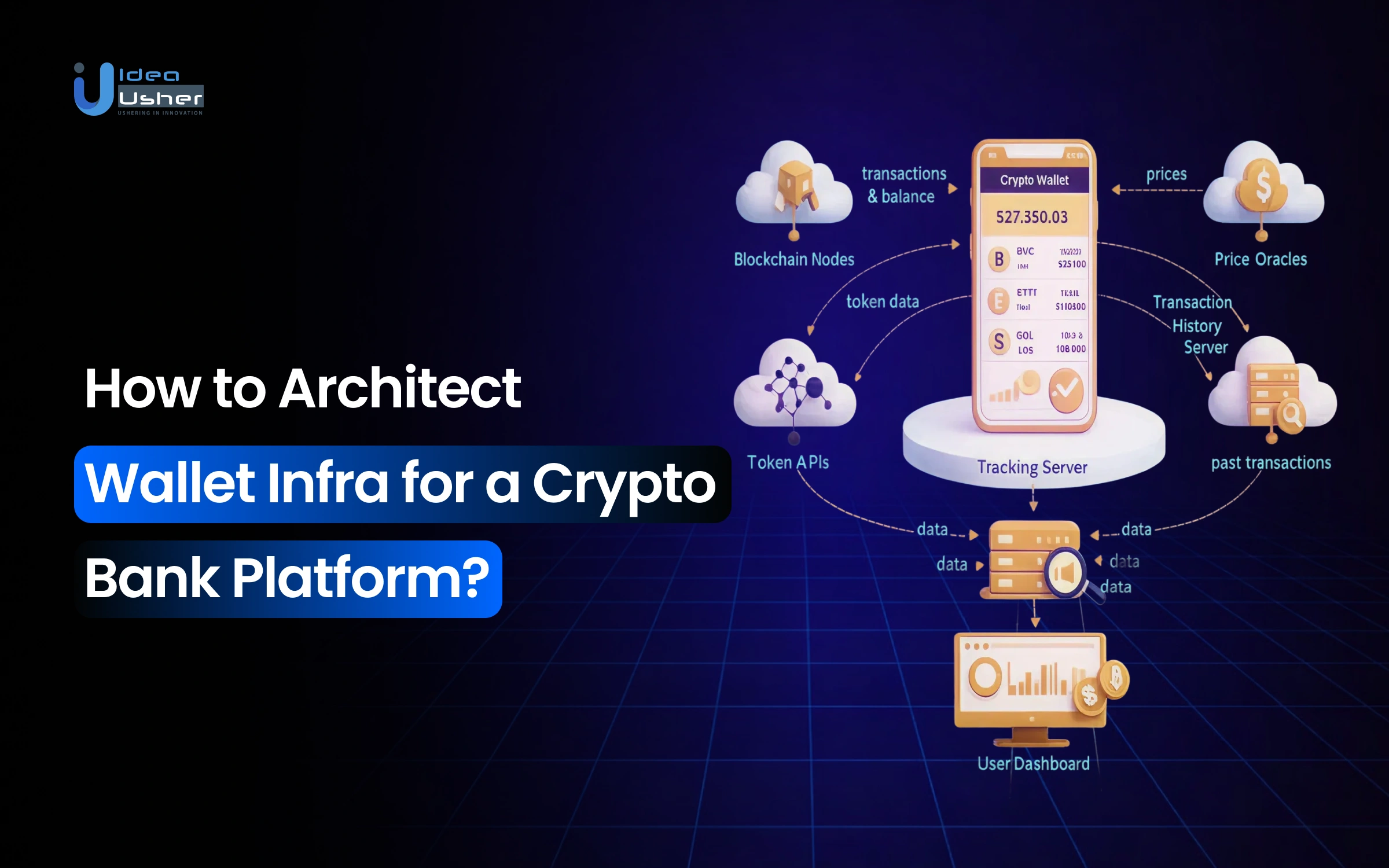
Most crypto products begin with speed in mind, serving a few thousand users with manageable volume and predictable activity. Over time, behavior shifts and capital scales quickly, placing far greater pressure on the underlying infrastructure. Regulators begin to examine transaction controls and custody logic more closely.
That is why wallet infrastructure must be architected correctly from the beginning, because it should enforce segregation of funds, policy-driven approvals, and audit-ready reconciliation before scale introduces systemic risk. Early crypto apps focused on access, but once institutions and serious retail capital entered the space, the platform had to operate more like structured financial infrastructure than an experiment.
We’ve developed numerous crypto banking platforms, powered by blockchain custody architecture and cryptographic key orchestration frameworks. With these years of expertise, we’re sharing this blog to discuss the steps to architect a wallet infrastructure for a crypto bank platform.
Key Market Takeaways for Crypto Bank Platforms

Source: Fortune Business Insights
As regulatory scrutiny increases under frameworks such as MiCA in Europe and FinCEN guidance in the United States, demand for risk and compliance software continues to rise, with the crypto compliance segment expected to reach USD 3.07 billion by 2025.
Two prominent compliance intelligence providers in this space are Elliptic and TRM Labs. TRM Labs delivers transaction monitoring, wallet screening, and forensic investigation tools across multiple blockchains and has achieved FedRAMP High authorization, enabling secure deployments within government environments.
A strong example of ecosystem collaboration is the partnership between Finoa and Crypto Risk Metrics. By combining regulated custody with structured compliance tooling, the partnership helps early-stage projects meet listing standards, strengthen consumer protection, and access regulated market channels with greater confidence.

What is a Crypto Bank Platform?
A crypto bank platform is a regulated digital banking infrastructure that combines blockchain-based asset custody, staking, payments, and compliance controls within a unified financial system. It allows users to store, transfer, stake, and manage cryptocurrencies, alongside fiat, while operating under structured risk management and regulatory oversight.
Unlike traditional exchanges, it is designed with banking-grade governance, capital safeguards, and transparent reporting mechanisms to support both retail and institutional clients.
How Does a Wallet Infra Work in a Crypto Bank Platform?
A wallet infrastructure within a crypto bank platform uses MPC to securely manage private keys and prevent single points of failure. Each transaction is checked against compliance and risk rules before it can be signed. Once approved it is signed across distributed shards and recorded on-chain while the banking ledger is updated.

1. The Vault Key Management
This is the foundation. In a bank, you cannot have a single point of failure.
How it works: Instead of a single private key, the infrastructure uses Multi-Party Computation MPC. The key is shattered into multiple shards, for example, 3 shards.
The Mechanism: These shards are distributed across geographically separate Hardware Security Module HSM protected environments. To sign a transaction, the infrastructure mathematically computes the signature by combining the shards in memory, ensuring the full private key never exists in a single location.
Banking Twist: The signing policy requires multiple jurisdictions to prevent a single government seizure order from accessing the funds.
2. The Policy Engine
Before a transaction reaches the blockchain, it passes through the policy engine, which applies programmable compliance and risk rules. The system can evaluate limit exposure and authorization in real time. If a rule fails, it will instantly block the signing process.
The Mechanism: When a user initiates a transfer, the infrastructure intercepts the request and runs it through a series of checks:
- KYT Know Your Transaction: Is the destination address sanctioned or linked to high-risk activity via Chainalysis or Elliptic APIs?
- Velocity Checks: Is this user withdrawing more than their daily limit?
- Threshold Logic: Does this transaction require 2 of 3 signers, or 3 of 5?
If any check fails, the infrastructure prevents the MPC shards from starting the signing process. The transaction is blocked preemptively.
3. The Node Network
The bank needs to talk to the blockchain. This requires a resilient node infrastructure.
How it works: The bank cannot rely solely on public nodes like Infura, as that would create a single point of failure. The architecture utilizes a Multi-Node Failover Cluster.
The Mechanism: The infrastructure runs its own full nodes, for example, Geth for Ethereum and Bitcoin Core across different cloud providers, AWS, GCP, and bare metal. If one provider goes down, the Load Balancer instantly routes traffic to the active node, ensuring 100 percent uptime for broadcast and monitoring.
4. The Smart Contract
For a bank to offer features such as recovery or batch payments, it needs Smart Contract Wallets Account Abstraction or ERC-4337.
How it works: The user account is actually a smart contract on the blockchain, controlled by the bank MPC signers and the user session keys.
The Mechanism:
- Social Recovery: If a user loses their phone, the contract allows pre-approved Guardians, for example, the bank compliance department and a family member, to rotate the user’s signing key.
- Gas Stations: The bank can pay gas fees on the user’s behalf, eliminating the need to pay in ETH or MATIC.
5. The Core Banking Integration
This is what separates a wallet from a bank.
How it works: Every on-chain event triggers a corresponding entry in the bank’s Core Banking System, for example, Temenos, Mambu, or a custom ledger.
The Mechanism: The infrastructure uses an Event Sourcing pattern. When a crypto deposit is confirmed, a webhook triggers the creation of a fiat equivalent credit in the user’s banking profile. This ensures that the user’s Total Net Worth, Crypto and Fiat, is always in sync for lending, interest calculations, and reporting.
Visualizing the Flow: A Standard Transaction
To bring this to life, let us trace a simple USDC withdrawal from a user account to an external wallet.
Initiation: User enters address 0x123… and amount 100 USDC in the mobile app.
Policy Check: The request hits the backend. The Policy Engine checks:
- Does the user have 100 USDC checked against the Hot Ledger?
- Is 0x123… on a sanctions list API Call to a compliance vendor.
- Does this user have a 24-hour withdrawal limit?
Transaction Construction: Assuming all checks pass, the Node Interface constructs the raw Ethereum transaction.
Signing MPC: The raw transaction hash is sent to the MPC service.
- Shard 1 AWS US East signs
- Shard 2 GCP Singapore signs.
- The MPC algorithm combines the signatures.
Broadcast: The fully signed transaction is broadcast to the bank redundant node cluster and out to the public mempool.
Settlement and Ledger Update:
- The Hot Ledger immediately deducts the 100 USDC from the user’s available balance, showing “Pending”.
- 30 seconds later, a node confirms the transaction succeeded.
- The Reconciliation Engine moves the entry in the user history from “Pending” to “Completed” and updates the Core Banking System.
How to Architect Wallet Infra for a Crypto Bank Platform?
Architecting wallet infrastructure for a crypto bank platform starts with designing a synchronized dual ledger that tightly links on chain state with the core banking system. The custody layer should use a multi-jurisdictional MPC with enforced policy controls to ensure that keys are never concentrated in a single legal jurisdiction.
We have architected multiple wallet infrastructures for crypto bank platforms, and this is how we approach it.

1. Dual-Core Ledger Layer
We build a Micro-Ledger Orchestrator that keeps blockchain states synchronized with the Core Banking System in real time. It maintains pending-on-chain markers, supports risk-weighted instant crediting, and absorbs chain reorganizations without balance inconsistencies. This eliminates atomic settlement conflicts and ensures accounting precision at banking standards.
2. Jurisdictional MPC Design
We distribute MPC shards across legally distinct regions and enforce multi-jurisdiction signature policies at the protocol level. This structure strengthens bankruptcy remoteness and reduces exposure to a single sovereign seizure. The result is a custody architecture that is legally resilient and technically secure.
3. Omnibus and Segregation Model
We architect a Virtual Private Ledger that uses omnibus vaults for gas efficiency while maintaining strict per-user sub-ledger accounting. Zero-Knowledge Proof systems enable verifiable balances and Proof of Reserves without revealing user data. This allows cost optimization without compromising regulatory transparency.
4. Account Abstraction Controls
We deploy ERC-4337 smart contract wallets with programmable controls such as timelocks, guardian recovery, and fraud-triggered intervention before finality. This bridges irreversible blockchain settlement with the operational safeguards expected in regulated banking systems.
5. Post-Quantum Readiness
We implement a signature abstraction layer that separates cryptographic logic from wallet execution. With a modular Signature Provider API, cryptographic standards can be upgraded to lattice-based algorithms when required. This ensures long-term institutional resilience against emerging quantum risks.
6. Embedded Compliance Layer
We integrate real-time KYT scanning, Travel Rule protocols, sanction screening, and transaction simulation engines directly into the pre-execution layer. Compliance becomes part of the infrastructure itself, ensuring every transaction is validated before broadcast, and audit readiness is continuous.
How Does Wallet Infrastructure Impact Capital Efficiency for a Crypto Bank?
Here is what most crypto bank platforms will not openly tell you. Nearly all client capital often sits idle because fragmented wallet architecture makes liquidity coordination operationally complex. Each wallet must pay gas and secure its own funds, so assets remain locked rather than being efficiently deployed.

This is the Liquidity Fragmentation Problem.
When every customer has their own on-chain wallet, moving those funds costs money. Lots of money. During network congestion, moving a single batch of customer funds might cost thousands in gas fees. So banks do not move them. They just sit there.
Meanwhile, the bank pays interest to customers on those idle assets but earns nothing from them. The math never works.
The Omnibus Revolution
The first leap in capital efficiency comes from infrastructure that enables omnibus wallet architecture.
Instead of 100,000 individual wallets, the bank maintains a small number of master wallets, sometimes just one per asset, while tracking individual ownership in an internal ledger.
The impact is immediate and dramatic:
Before Omnibus:
To move $10 from each of 10,000 customers into a yield-generating protocol, the bank must execute 10,000 separate on-chain transactions. At $5 per transaction during peak times, that is $50,000 in gas fees. The move becomes economically impossible.
After Omnibus:
The bank moves the entire $100,000 pool in a single transaction. Gas fee: $5. The move is not only possible but profitable.
This single architectural decision transforms capital efficiency. Assets that were previously frozen in retail wallets become deployable. Idle cash becomes yield-generating inventory.
The Settlement Layer
But omnibus architecture is just the beginning. The real revolution happens when wallet infrastructure includes a settlement layer that sits between the blockchain and the bank’s core systems.
Consider how a traditional bank handles money movement. When you transfer money to another customer at the same bank, the money never leaves the bank’s balance sheet. It is just a database entry, from Alice’s ledger to Bob’s ledger.
Crypto banks have historically been unable to do this. Every transfer, even between two customers of the same bank, had to be recorded on the blockchain. Every internal transfer costs gas. Every internal transfer took minutes or hours. Every internal transfer created an on-chain footprint that complicated privacy and compliance.
Modern wallet infrastructure changes this with internal netting engines.
When Customer A sends 1 ETH to Customer B at the same bank, the infrastructure recognizes this as an internal transfer. No blockchain transaction occurs. The bank’s internal ledger simply debits A and credits B. The on-chain wallet balance never changes.
The capital efficiency implications are staggering:
- Zero gas costs for internal transfers
- Instant settlement in milliseconds instead of minutes
- No blockchain congestion delays
- Complete privacy because no third parties see your customers’ transaction patterns
The bank effectively becomes its own settlement network, using the blockchain only as a final settlement layer with the outside world.
The Rehypothecation Engine
Here is where capital efficiency gets truly interesting.
In traditional banking, rehypothecation, which means using customer assets as collateral for other activities, is carefully regulated but widely practiced. In crypto banking, it has been nearly impossible due to limitations in wallet infrastructure.
However, advanced wallet architectures enable programmable collateral segregation. The infrastructure maintains cryptographic proof that customer assets exist while allowing the bank to deploy a portion of those assets into approved strategies.
The magic happens in the proof-of-reserves layer.
Using zero-knowledge proofs, the bank can demonstrate to regulators and customers that total assets exceed total liabilities, even while a portion of those assets are deployed in yield-generating protocols. The proof verifies the sum without revealing the specific deployment.
This unlocks capital efficiency that traditional banks can only dream of:
- Overnight lending of stablecoin holdings to institutional borrowers
- Automated yield farming across multiple DeFi protocols
- Collateralized lending to margin traders
- Liquidity provision to decentralized exchanges
Each of these activities generates revenue from assets that would otherwise sit idle. Because the infrastructure maintains real-time proof of solvency, the bank can do this while maintaining regulatory compliance and customer trust.
The Gas Optimization Layer
Every crypto bank has experienced the shock of the gas fee surprise. A routine treasury operation that should cost $100 suddenly costs $5,000 because of network congestion. A batch settlement that normally runs at midnight executes at 2 PM during an NFT minting frenzy.
Sophisticated wallet infrastructure includes a gas-optimization engine that treats blockchain fees as a variable cost to be minimized rather than a fixed expense to be borne.
This engine does several things:
Intelligent Batching:
It aggregates hundreds of withdrawals into optimal batches based on destination addresses, asset types, and current gas prices. Instead of 200 separate transactions, it might execute 5 optimized batches.
Temporal Routing:
It analyzes historical gas price patterns to execute non-urgent transactions during low-fee periods. Settlements that are not time-sensitive automatically queue for overnight execution when fees drop 60% or more.
Multi-Chain Arbitrage:
It evaluates whether a transaction could be executed more cheaply on a Layer-2 network or an alternative chain. Moving USDC on the Ethereum mainnet might cost $15. Moving it on Arbitrum might cost $0.03. The infrastructure automatically chooses the most efficient route.
Fee Currency Optimization:
It selects the optimal currency for paying gas fees, sometimes using the transferred asset, sometimes using a separate gas token, based on real-time exchange rates and available balances.
These optimizations do not just save money. They create profit margins that competitors without this infrastructure simply cannot achieve.
The Liquidity Aggregator
Perhaps the most visible impact of wallet infrastructure on capital efficiency is in execution quality.
When a customer wants to swap 100 ETH for USDC, where does that trade execute?
Basic infrastructure:
The bank has a relationship with a single exchange or liquidity provider. The trade executes there. The customer gets the price that the provider offers.
Advanced infrastructure:
The wallet connects to a liquidity aggregator that simultaneously queries dozens of exchanges, decentralized exchanges, and market makers. It splits the trade across the deepest liquidity sources, minimizing slippage and maximizing execution price.
But it goes further. The infrastructure maintains intelligent inventory management. It knows that the bank holds significant ETH balances across customer wallets. Instead of going to an external exchange for every trade, it can match buyers and sellers internally.
Customer A wants to sell ETH. Customer B wants to buy ETH. The infrastructure matches them internally at the mid-market price, capturing the spread for the bank while giving both customers better execution than they would get on external markets.
This internal matching engine turns the bank’s customer base into a liquidity pool. Every new customer increases liquidity. Every transaction improves efficiency.
The Capital Efficiency Scorecard
When all these infrastructure components work together, the impact on capital efficiency is measurable and dramatic:
| Metric | Basic Infrastructure | Advanced Infrastructure |
| Asset Utilization | 5–15% deployed | 60–80% deployed |
| Internal Transfer Cost | $5–50 per transfer | $0 via internal netting |
| External Transfer Cost | Market rate unoptimized | 40–70% lower through batching |
| Settlement Time | Minutes to hours | Milliseconds for internal settlement |
| Treasury Yield | 0–1% | 3–8% from actively deployed assets |
| Trading Revenue | Spread on external trades | Spread plus internal order matching revenue |
The cumulative effect is a bank that generates 3x to 5x more revenue from the same asset base, with lower costs and better customer outcomes.
Handling Blockchain Reorgs in Crypto Bank Platforms
Crypto banks do not mark funds as final when they first appear on-chain, and they deliberately wait for deep confirmations before unlocking them. If a reorg happens, the system can automatically reverse provisional credits and adjust the ledger in real time. This ensures internal balances remain accurate and customers only see truly finalized funds.

1. The Two-State Ledger System
Bank-grade infrastructure never treats a blockchain transaction as settled the moment it appears on the chain. Instead, every transaction exists in one of three states.
The Mempool State
When a transaction is broadcast but not yet in a block, it appears in the customer’s interface with clear language. “Pending network confirmation.” The funds are not spendable.
The Probationary State
Once the transaction enters a block, it moves to a special holding status. The customer might see the funds, but the bank’s risk engine applies strict withdrawal limits based on the confirmation count.
For large deposits, this might mean 30, 60, or even 100 confirmations before the funds achieve spendable status internally.
The Final State
Only after the bank’s probabilistic threshold is crossed, typically far exceeding the network minimum, do funds become fully liquid and withdrawable.
This tiered approach means that even if a ten-block reorg occurs, the affected transactions were never fully spendable in the bank’s internal accounting. The risk window is closed before the customer ever touches the money.
2. The Reorg Detection Engine
Behind the scenes, every crypto bank runs a seismic sensor network for the blockchain.
The infrastructure does not just passively accept new blocks. It actively monitors for chain divergence. When a new block arrives, the system checks:
- Does this block build on the previous tip we recognized?
- If not, how deep is the reorganization?
- Which transactions from our internal ledger exist in the now-abandoned chain?
This detection happens in milliseconds. The system immediately flags any transaction affected by the reorg and places a temporary hold on those funds while the funds are reconciled.
3. The Automatic Reversal Mechanism
Here is where bank-grade architecture diverges sharply from consumer wallets. When a reorg is detected, the infrastructure does not panic. It executes a precise and automated reversal process:
- The internal ledger generates a reversing journal entry for the affected transaction. This is not a deletion. Banking systems never delete transactions. It is a contra entry that offsets the original credit.
- Simultaneously, the system checks whether those funds were moved internally. If the customer traded the reorged deposit for another asset, that trade is also reversed or flagged for manual review.
Crucially, this all happens before the customer logs in and sees an inconsistent balance. The system presents a unified, corrected view regardless of the chaos on-chain.
4. The Customer Experience Buffer
A bank cannot tell its customers that the blockchain reorganized and their money is gone. Equally, it cannot show a negative balance while it figures out the issue.
The architecture includes a presentation layer that decouples what the customer sees from the blockchain’s real-time operations.
If a reorg affects a customer transaction, the customer sees a status update. “Transaction under network review.” Their available balance reflects only funds that are confirmed and finalized.
The disputed amount appears as pending or in review.
This language mirrors how traditional banks handle check holds or fraud reviews. Customers understand it. Regulators accept it. And it buys the bank critical time to resolve the underlying chain issue.
5. The Finality Threshold Matrix
Different assets require different confirmation rules. A sophisticated crypto bank does not apply a one-size-fits-all approach.
The infrastructure maintains a dynamic matrix that adjusts finality requirements based on:
- Transaction value: $10 moves faster than $10 million
- Asset type: Bitcoin requires different confirmations than Ethereum, which requires different confirmations than a volatile altcoin.
- Network conditions: During periods of high congestion or known instability, thresholds automatically increase.
- Counterparty risk: Transactions from trusted, regulated partners may clear faster than those from unknown addresses.
This matrix lives in the bank’s core risk engine and updates in real time based on market conditions and internal policies.
Top 5 Crypto Bank Platforms in the USA
We conducted targeted research and found crypto bank platforms built on robust wallet architectures with integrated compliance controls. These systems can combine secure custody with automated rule engines and reporting logic to strengthen risk oversight.
1. Revolut

A global digital banking super-app that combines traditional banking services with integrated crypto trading and holding features. It allows users to manage fiat and digital assets from a single interface. Over time, it has evolved into a hybrid financial ecosystem in which crypto is embedded within a broader banking stack rather than a standalone product.
Wallet architectural strengths:
- Hybrid custodial wallet model integrated into core banking infrastructure.
- Deep fiat-crypto on-ramp and off-ramp connectivity.
- The majority of assets are stored in cold storage for enhanced security.
- Tight integration between banking ledger systems and crypto wallets ensures smooth settlement and reconciliation across asset types.
2. Nexo

A crypto banking platform offering savings, lending, and crypto-backed credit lines under a unified ecosystem. It positions itself as a full-service digital asset wealth platform. The platform’s wallet infrastructure acts as the operational backbone for yield generation, liquidity provisioning, and instant borrowing services.
Wallet architectural strengths:
- Unified custodial wallet supporting 100+ crypto assets and fiat.
- Modular backend enabling instant crypto-backed loans.
- In-app asset swaps and an internal settlement engine reduce transaction latency.
- Risk management and automated collateral monitoring are embedded directly into the wallet logic, strengthening real-time liquidity control.
3. Wirex

A payments-focused crypto banking platform that bridges crypto assets with everyday spending via debit cards and global payment rails. It focuses heavily on usability, turning crypto wallets into practical payment instruments rather than passive storage tools.
Wallet architectural strengths:
- Multi-asset custodial wallet linked directly to card networks.
- Real-time crypto-to-fiat conversion during transactions.
- Cross-chain asset support within a single wallet interface.
- Payment-layer optimization allows instant balance updates without disrupting underlying blockchain confirmation cycles.
4. AMINA Bank

A regulated Swiss crypto bank providing institutional-grade digital asset custody alongside traditional banking services. It blends compliance-first banking standards with blockchain-native asset management capabilities.
Wallet architectural strengths:
- Layered wallet architecture combining hot, warm, and cold storage.
- Institutional-grade custody with regulatory compliance integration.
- Support for staking and tokenized assets inside a regulated framework.
- Governance controls, segregation of duties, and multi-party authorization strengthen operational security at the wallet layer.
5. Anchorage Digital

A federally chartered crypto bank in the United States focused on institutional custody and secure digital asset infrastructure. It primarily serves funds, enterprises, and institutional clients that require bank-level compliance and custody protection.
Wallet architectural strengths:
- Advanced custody architecture with hardware security modules (HSMs).
- Policy-based transaction approval systems for institutions.
- Secure staking and governance participation from within custody wallets.
- Built-in compliance tooling at the wallet layer enables audit trails and transaction monitoring without external dependency.
Conclusion
Wallet infrastructure within a crypto bank platform must operate as a regulated financial core, not merely as a key storage system. It should synchronize blockchain state with internal ledgers, embed compliance logic at the transaction layer, and maintain jurisdictional controls across environments. We architect these systems with resilient custody models and future-ready cryptography, enabling enterprises to confidently unlock new revenue streams while preserving regulatory trust and institutional-grade security.
Looking to Architect Wallet Infra for a Crypto Bank Platform?
At IdeaUsher, we design wallet infrastructure that can securely support regulated crypto banking operations at scale. We will architect MPC-based hot, warm, and cold wallet layers and integrate them with compliant dual-ledger systems to ensure funds move intelligently and securely.
Our team of ex-MAANG and FAANG developers has spent more than 500,000 hours mastering the complexities of blockchain architecture. We have built systems that many are still planning on paper.
What We Deliver
- Tiered Security Architecture – Hot, warm, and cold MPC wallets with jurisdictional key sharding
- AI-Powered Guardian Layers – Real-time transaction simulation and KYT compliance middleware
- Dual Rail Ledger Systems – Synchronized on chain banking with traditional core integration
- Post Quantum Readiness – Future-ready cryptography designed to adapt to evolving threat models
- Account Abstraction ERC 4337 – Social recovery and gasless transactions built for retail friendly user experience
Explore our latest projects to understand the depth and resilience of the infrastructure we design and deploy.


FAQs
A1: A crypto bank wallet must operate within a regulated financial stack rather than as a standalone key manager. It usually synchronizes blockchain balances with internal core ledger while embedding compliance logic and jurisdictional controls directly into the transaction flow. Retail wallets mainly focus on private key custody, but bank-grade systems must additionally support recovery governance and audit visibility.
A2: A regulated platform may implement controlled reversibility prior to final on-chain settlement, using account abstraction and timelock validation layers. The system can hold transactions in a programmable intent state where compliance and risk engines review activity before broadcast. This architecture significantly reduces fraud exposure while still preserving blockchain integrity once finality is reached.
A3: Compliance is typically embedded inside the wallet transaction pipeline rather than treated as an external add-on. The platform can run real-time KYT analysis, sanction screening, and Travel Rule data exchange before authorizing settlement. By integrating protocol-level monitoring, the bank can maintain continuous oversight without disrupting transaction performance.
A4: Immediate migration is not mandatory, but infrastructure design should include cryptographic abstraction from the start. This allows key algorithms to be upgraded in the future without rebuilding the entire custody stack. Enterprises that plan long-term digital asset operations will likely benefit from preparing for quantum-resilient models early.


