


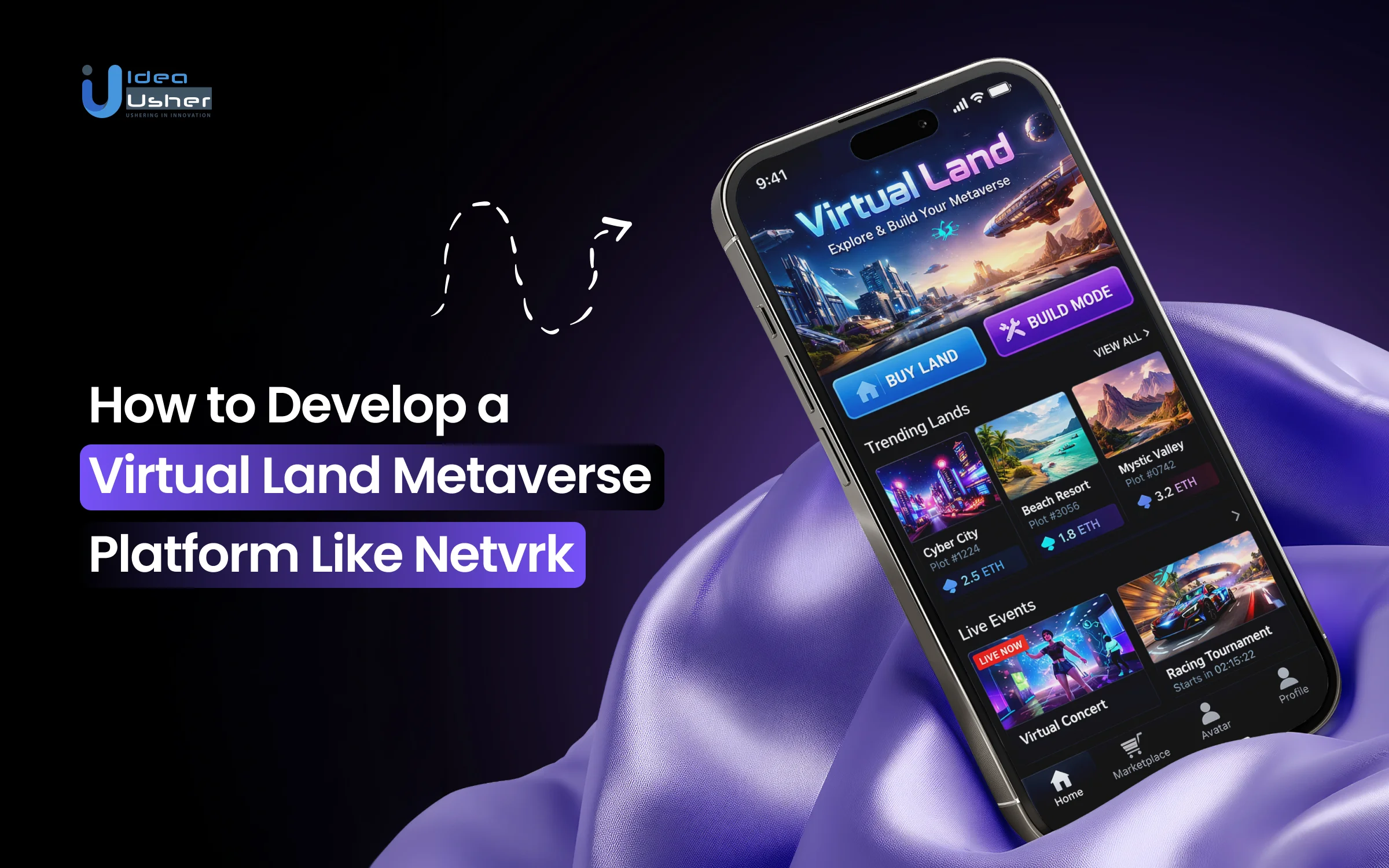
Virtual worlds are evolving from static environments into interactive economies where users can own, build and monetize digital assets. Beyond just exploring virtual spaces, users now expect to purchase land, create experiences and participate in economies that extend beyond gameplay, driving a shift in metaverse platform development where ownership, creation and monetization are integrated directly into the core experience.
The transition from concept to a working platform requires the seamless coordination of multiple systems including virtual land management, 3D world creation, asset ownership, marketplace functionality and social interaction within a persistent environment. Platforms like NetVRk demonstrate how users can explore, create and monetize virtual worlds while interacting socially and economically within a shared space.
In this blog, we explain how to develop a virtual land metaverse platform like Netvrk by examining core features, system architecture and practical considerations involved in building scalable and immersive digital ecosystems.
Why Virtual Land Metaverse Platforms Are Rising Fast?
The rapid acceleration of the metaverse projected to grow from USD 105.4 billion in 2024 to USD 936.57 billion by 2030 at a CAGR of 46.4% is fueled by a fundamental shift in how value is captured in digital environments where modern virtual land metaverse platform development focuses on creating digital scarcity so that virtual property functions as a productive asset rather than a simple backdrop for gameplay.

A. Shift From Gaming to Digital Ownership Economies
The transition from traditional gaming to decentralized ownership has redefined the user relationship with digital space. Unlike legacy platforms where assets are locked within a single game, blockchain integration allows for true sovereignty and interoperability.
| Feature | Legacy Gaming Platforms | Metaverse Ownership Economies |
| Asset Ownership | Licensed to user, owned by dev | True ownership via NFTs |
| Value Transfer | Trapped in walled gardens | Tradeable on open marketplaces |
| Land Utility | Static background | Programmable commercial real estate |
| Governance | Centralized decision making | Decentralized via DAO structures |
Building a platform with these features ensures that every participant is an active stakeholder. When users own their data and assets, they are more likely to invest time and capital into the ecosystem, driving long-term platform stability.
B. Rise of Play–Create–Earn Ecosystems
The evolution of the “earn” mechanic has moved beyond simple repetitive tasks toward a creator-centric model. By providing high-fidelity tools like Unreal Engine integration, a platform enables a sophisticated economy based on skill and innovation.
- User-Generated Content (UGC): Low-code or no-code tools allow users to build 3D assets and environments that can be monetized.
- Incentivized Participation: The $NETVR model demonstrates how native tokens facilitate transactions for land, services and exclusive content.
- Asset Monetization: Creators can design unique avatars, furniture or buildings and sell them as NFTs to other participants.
- Persistent Rewards: Unlike one-time purchases, creators can earn royalties on secondary sales of their digital works.
C. Enterprise and Creator Adoption Trends
Enterprises are moving into the metaverse to establish permanent digital headquarters. This trend is shifting the focus of virtual land metaverse platform development toward professional and commercial utility.
Key Adoption Drivers:
- Virtual Showrooms: Automotive and luxury brands use high-fidelity VR environments to showcase products to a global audience without physical constraints.
- Immersive Marketing: Companies are purchasing land to host interactive events, product launches and brand experiences that offer deeper engagement than 2D social media.
- Digital Offices: Remote-first companies are utilizing 3D spatial environments to foster collaboration and culture in a way that video calls cannot replicate.
- Influencer Hubs: High-profile creators are migrating to platforms where they can own the land their community gathers on, ensuring they keep a larger share of the revenue they generate.
What Is NetVRk and How It Works?
NetVRk is a sophisticated blockchain-integrated ecosystem designed to bridge the gap between high-fidelity gaming and decentralized finance. It operates as a multi-layered environment where the landscape itself is a tradeable commodity, providing the foundation for a scalable digital world. Unlike traditional VR applications that focus solely on social interaction, this platform is engineered as a full-stack economy where every element from the ground to the sky is programmable and monetizable.

A. Core Concept of a Virtual Land Economy
NetVRk divides its world into discrete land parcels that are represented as non-fungible tokens. These parcels are not just coordinates in a 3D space; they are revenue-generating assets in virtual land metaverse platform development that dictate the influence and earning potential of the owner within the ecosystem.
- Zoning and Districts: The world is organized into specific areas like business, gaming and creative zones which helps concentrate traffic and determine land value.
- Passive Income Generation: Owners can earn through the platform’s redistributive mechanics or by renting their space to other users or brands.
- Development Rights: Owning land grants the right to deploy custom code, 3D architecture or interactive games that attract the wider community.
B. How Users Create, Own and Monetize Assets
The platform empowers users to transition from passive consumers to active participants through a streamlined creation-to-market pipeline. This process ensures that the platform remains dynamic and self-sustaining without constant developer intervention.
| Process Stage | Action | Economic Outcome |
| Creation | Use no-code tools or Unreal Engine to design 3D objects | Intellectual property generation |
| Ownership | Minting the creation as an NFT on the blockchain | Provenance and permanent control |
| Monetization | Listing assets in the marketplace or charging for access | Real-world value accumulation |
| Trading | Buying and selling assets based on market demand | Secondary market royalty streams |
By integrating a user-friendly creation suite, the platform removes the technical friction often associated with 3D modeling. This allows a broader range of participants to contribute to the world’s growth, from professional architects building virtual skyscrapers to hobbyists designing unique digital apparel.
C. Role of AI, NFTs and GameFi in NetVRk
The convergence of these three technologies is what elevates a standard 3D world into a living metaverse. Each plays a specific role in ensuring the environment is interactive, secure and financially viable.
1. AI-Powered Interactivity
AI is used to populate the world with intelligent NPCs that possess memory and real-time interaction capabilities. Rather than following static scripts, these entities can assist users, manage virtual shops or act as quest-givers in gaming zones, making the world feel populated and responsive even when player density is low.
2. NFTs as the Standard of Proof
NFTs are the vehicle for all unique data in virtual land metaverse platform. They represent everything from land and vehicles to rare collectibles. This ensures that every transaction is recorded on a transparent ledger, preventing fraud and allowing users to verify the rarity of any item they purchase.
3. GameFi and Tokenomics
GameFi mechanics turn social and creative activities into economic opportunities. The native $NETVR token acts as the lifeblood of the system, used for:
- Staking: Locking tokens to earn rewards and participate in platform governance.
- Transactions: Buying land, upgrading assets and accessing premium experiences.
- Incentives: Rewarding players for achieving milestones or participating in community-led events.

Key Features That Define Platforms Like NetVRk
The virtual land metaverse platform development relies on integrating high-fidelity graphics with decentralized economics. These platforms provide a scalable infrastructure where users don’t just consume content but actively own and shape the world through advanced blockchain and AI technologies.

1. NFT-Based Virtual Land Ownership System
Virtual land metaverse platform development utilizes blockchain to transform digital coordinates into verifiable real estate. Each parcel is a unique NFT, ensuring permanent ownership and preventing unauthorized duplication or asset seizure.
Landowners can monetize their space through rentals, advertising or hosting exclusive events. This system creates digital scarcity, driving value appreciation as the platform gains users and commercial density within the ecosystem.
2. AI-Powered NPCs With Memory and Interaction
Unlike traditional static characters, these AI-driven entities use large language models to engage in dynamic conversations. They possess contextual memory, allowing them to recognize returning users and provide personalized assistance.
These NPCs act as autonomous shopkeepers, guides or quest-givers within the metaverse. This integration ensures the world feels alive and responsive, providing 24/7 engagement even during periods of lower player activity.
3. UGC Tools for Building 3D Environments
The inclusion of no-code creation suites allows participants to design complex structures without technical expertise. These tools facilitate the rapid deployment of interactive games, social hubs and unique architectural landmarks.
By lowering the barrier to entry, the platform fosters a thriving creator economy. High-quality user-generated content ensures the metaverse remains fresh and evolving which is critical for long-term user retention.
4. Cross-Chain Wallet and Token Integration
A robust cross-chain infrastructure enables seamless asset transfers between different blockchain networks. This interoperability ensures that the native token can interact with a wider liquidity pool and diverse ecosystems.
Secure multi-chain wallet integration allows users to manage their digital wealth effortlessly. This flexibility attracts a broader range of participants by removing the friction often associated with siloed blockchain environments.
5. Creator Marketplace for Digital Assets
The marketplace serves as the economic engine where users buy, sell or trade 3D models and wearables. It supports automated royalty distributions, ensuring creators earn a percentage of all secondary sales.
This transparent trading hub utilizes smart contracts to guarantee secure transactions. A well-populated marketplace encourages entrepreneurial activity, as designers can build entire businesses focused on supplying the metaverse with premium digital goods.
6. VR, AR and Multi-Device Compatibility
True immersion requires cross-platform accessibility across PC, mobile and VR headsets. High-fidelity rendering via engines like Unreal Engine 5 ensures a consistent, professional visual experience regardless of the hardware.
Integrating augmented reality features allows the metaverse to bleed into the physical world. This multi-device approach maximizes global reach, ensuring that the platform is accessible to users regardless of their technological preferences.
Must-Have Modules for Your Metaverse Platform
The virtual land metaverse platform development requires a modular architecture that balances performance with economic security. Each module must be engineered to handle high concurrency while maintaining the integrity of the decentralized ledger, ensuring the platform remains both immersive and commercially viable.
1. User Identity and Avatar System
The identity module is the gateway to the metaverse, serving as more than just a visual representation. In virtual land metaverse platform development, identity is tied to a user’s wallet, acting as a universal passport across the ecosystem.
- Interoperable Avatars: Utilizing standards like VRM allows users to move their 3D personas between different virtual worlds.
- Customization Engine: A robust system where users can equip NFT-based wearables, skins and accessories purchased from the marketplace.
- Reputation Layer: Tracking user behavior and contributions to determine access levels for premium zones or DAO voting power.
2. Virtual Land Buying and Leasing Engine
The virtual land buying and leasing engine manages smart contracts for selling, transferring and renting digital territory. This module ensures all transactions are recorded on-chain, providing a transparent and secure environment for high-stakes real estate within the metaverse ecosystem.
- Smart Listing and Auctions: Automated escrow systems allow for trustless peer-to-peer trading and time-sensitive auctions for premium parcels.
- Leasing Protocols: Specialized smart contracts enable time-locked rental agreements, allowing landowners to generate passive income from tenants without relinquishing ownership.
- Adjacency Mapping: The engine calculates land value based on proximity to high-traffic hubs, social centers or celebrity-owned estates, mirroring real-world urban planning.
- Estate Management: Tools that allow users to merge adjacent smaller parcels into larger estates for more ambitious commercial or residential builds.
3. Real-Time 3D World Rendering System
The rendering engine must deliver high-fidelity visuals without compromising performance to compete with platforms like NetVRk. This typically involves a hybrid approach using powerful engines like Unreal Engine 5 paired with cloud rendering or edge computing.
- Spatial Audio: Implementing 3D soundscapes where audio volume and direction change based on the user’s position relative to the source.
- Dynamic Lighting: Real-time day/night cycles and weather effects that increase immersion and provide a “living” atmosphere.
- Level of Detail (LOD) Optimization: Ensuring the platform runs smoothly on lower-end devices by adjusting texture quality based on distance.
4. In-Platform Economy and Token Engine
The token engine is the circulatory system of the metaverse. It handles the minting, burning and distribution of the native utility token which facilitates all internal commerce and incentive programs.
- Transactional Throughput: The engine must support near-instant payments for micro-transactions, such as buying a digital coffee or entering a game.
- Staking Rewards: Encouraging users to hold the native token by offering yield or early access to new land drops.
- Burn Mechanics: Implementing deflationary measures where a portion of transaction fees is removed from circulation to maintain token value.
5. Social Interaction and Event Hosting Tools
The long-term value of a virtual land metaverse platform is determined by its social density. This module provides the infrastructure for community gathering and massive-scale live events.
- Instance Management: Enabling thousands of users to attend the same concert or conference through sharding or instanced rooms.
- Live Streaming Integration: Allowing real-world content, such as DJs or keynote speakers, to be projected into the 3D environment in real time.
- Collaborative Tools: Shared whiteboards, 3D screens and voice-over-IP (VoIP) systems that facilitate virtual meetings and professional networking.
6. Governance Layer Using DAO Frameworks
A Decentralized Autonomous Organization (DAO) ensures that the platform evolves according to the wishes of its stakeholders. This layer moves the decision-making process away from a central authority and into the hands of land and token holders.
- Proposal Submission: Allowing the community to vote on platform updates, fee structures or the distribution of the treasury.
- Weighted Voting: Giving more influence to long-term participants or significant landowners to ensure the platform’s stability.
- Treasury Management: A multi-signature wallet controlled by the DAO to fund new development, marketing or community grants.
How to Design a Scalable Metaverse Architecture
The design of a scalable virtual land metaverse platform development strategy requires a multi-tiered architecture that balances high-fidelity visuals with low-latency synchronization. This ensures that as the user base grows, the performance and economic integrity of the world remains uncompromised.

1. Frontend with Immersive 3D Engines
The frontend serves as the primary interface for user immersion, necessitating the use of industry-leading engines to deliver professional-grade graphics. This layer translates complex code into a navigable, high-resolution 3D environment.
- Unreal Engine 5 Integration: Utilizing Nanite and Lumen technologies allows for cinematic-quality lighting and geometry that remains performant across different hardware profiles.
- Cross-Platform Wrappers: Implementing specialized builds for PC, mobile and VR headsets ensures that the visual experience is optimized for the specific constraints of each device.
- UI/UX Overlay: A lightweight 2D interface layer that sits atop the 3D world to handle inventory management, wallet connections and social notifications without obstructing the view.
2. Backend for Real-Time World Sync
The backend acts as the “brain” of the metaverse, ensuring that every movement or modification made by one user is reflected instantly for everyone else in the vicinity.
- Spatial Interest Management: To save bandwidth, the server only sends data about objects and players within a user’s immediate “interest radius” rather than the entire world.
- State Synchronization: A high-frequency clock system that reconciles player positions and asset states to prevent “rubber-banding” or visual glitches during high-traffic events.
- WebSockets and gRPC: Using advanced communication protocols to maintain a persistent, low-latency connection between the client and the server for real-time interaction.
3. Blockchain Layer for Asset Ownership
The blockchain layer is the source of truth for all economic activity. It provides a transparent, immutable record of who owns which parcel of land or digital item within the ecosystem.
| Component | Responsibility | Technical Execution |
| Smart Contracts | Governance of land and assets | Solidity or Rust-based logic |
| Metadata Storage | Holding 3D asset data | IPFS or Arweave for decentralization |
| Minting Engine | Converting creations into NFTs | Standardized ERC-721 or ERC-1155 protocols |
| Oracle Integration | Fetching real-world price data | Chainlink or similar decentralized oracles |
4. AI Layer for NPCs and Automation
The AI integration in virtual land metaverse platform development transforms a static world into a living, breathing environment. This layer manages the logic behind non-player characters and automated world events.
- Natural Language Processing (NLP): Allows NPCs to understand and respond to user voice or text input in a human-like manner.
- Behavior Trees: Sophisticated logic structures that dictate how NPCs move, interact with objects and react to environmental changes.
- Autonomous Economy Bots: AI agents that can manage virtual storefronts, facilitate trades or maintain the land when the owner is offline.
5. Cloud Infrastructure for Scalability
The platform must be hosted on a distributed cloud network to support a global audience that can dynamically scale resources based on demand.
- Edge Computing: Deploying servers closer to the user’s physical location to reduce “ping” and improve the responsiveness of the 3D environment.
- Auto-Scaling Clusters: Utilizing Kubernetes or similar container orchestration to spin up new server instances automatically during peak hours or massive virtual events.
- Global Content Delivery Network (CDN): Fast-tracking the download of heavy 3D assets and textures so new users can enter the world without long loading times.
Step-by-Step Process to Build a Platform Like NetVRk
The robust virtual land metaverse development requires a methodical approach that synchronizes high-end software engineering with decentralized economic theory. This structured lifecycle ensures the platform remains technically scalable while fostering a sustainable, owner-led ecosystem.

1. Define Product Vision and Monetization Scope
The initial phase involves establishing the specific niche and economic boundaries of the virtual world. This strategic blueprint identifies target demographics and outlines how the platform will generate revenue through land sales, transaction fees and premium subscription models for creators.
2. Design Virtual Economy and Tokenomics
A balanced supply-and-demand loop is essential for the long-term stability of the native token. This step establishes circulation patterns that incentivize holding, staking and active participation within the internal marketplace and the decentralized governance framework.
3. Build MVP With Core Land and Avatar Features
The minimum viable product centers on the primary interactions of land ownership and identity representation. This development cycle prioritizes a stable connection between the blockchain wallet and the 3D environment, allowing early users to claim territory and customize their digital presence.
4. Develop 3D World and Interaction Layers
Immersive landscapes and social hubs are crafted using powerful rendering engines to ensure professional-grade visuals. This phase involves implementing complex physics, spatial audio and environmental triggers that enable users to interact with the world and each other in real-time.
5. Integrate Blockchain and NFT Systems
Smart contract deployment provides the immutable ledger required for asset verification and secure trading. This technical layer ensures that every virtual item, from vast land parcels to small wearables, is recognized as a unique and tradeable non-fungible token.
6. Launch Beta and Scale With User Feedback
Stress testing the infrastructure under real-world conditions occurs during the transition into a live environment. The platform evolves through iterative updates based on community behavior, ensuring that scaling efforts align with the actual needs and growth of the user base.
Virtual Land Metaverse Platform Development Cost Sheet
The virtual land metaverse platform development requires distinguishing between a market-entry prototype and a full-scale commercial ecosystem. In 2026, costs are primarily driven by the complexity of 3D environmental fidelity and the depth of the integrated blockchain economy.
| Development Phase | MVP Level | Enterprise Level | Key Deliverables |
| Strategy & Economy Design | $15,000 – $25,000 | $50,000 – $80,000+ | Tokenomics whitepaper, DAO structure and land scarcity model. |
| 3D Design & Environment | $35,000 – $70,000 | $150,000 – $400,000+ | Unreal Engine 5 maps, custom 3D assets and lighting systems. |
| Blockchain & Smart Contracts | $25,000 – $45,000 | $90,000 – $180,000+ | Land NFT minting, marketplace contracts and wallet integration. |
| Backend & Multiplayer Sync | $30,000 – $55,000 | $120,000 – $250,000+ | Real-time server clusters, spatial audio and concurrency management. |
| AI & NPC Integration | $10,000 – $20,000 | $60,000 – $90,000+ | AI agents with NLP, autonomous shopkeepers and quest logic. |
| QA, Security & Audit | $10,000 – $20,000 | $35,000 – $75,000 | Smart contract audits, load testing and penetration testing. |
| Total Estimated Budget | $88,000 – $170,000 | $350,000 – $775,000 | A fully functional, scalable and secure metaverse ecosystem. |
Cost-Affecting Factors During the Development
The final cost for virtual land metaverse platform development is highly sensitive to specific technical choices and geographic variables. Small adjustments in the scope of AI or the choice of blockchain can result in a 20% to 40% fluctuation in total expenditure.
- Graphic Fidelity and Engine Choice: Utilizing Unreal Engine 5 with high-poly Nanite assets can increase design costs by 35% compared to stylized, low-poly environments like those found in Decentraland.
- AI Complexity and Interaction: Implementing basic NPCs is relatively affordable, but adding “Memory” and real-time NLP to 100+ agents can add $50,000 or more to the AI layer due to API costs and specialized logic development.
- Blockchain Interoperability: Building a cross-chain platform (e.g., Ethereum + Polygon + Solana) requires additional bridge security and multi-contract development, typically raising the blockchain budget by 25% to 30%.
- Geographic Talent Rates: Development teams in North America or Western Europe charge between $120 and $250 per hour whereas established teams in India or Eastern Europe offer similar expertise at $40 to $80 per hour, drastically altering the burn rate.
- Concurrency and Server Load: Supporting 10,000+ concurrent users in a single instance requires expensive edge computing and custom server sharding which can increase monthly infrastructure maintenance costs to over $5,000 – $15,000.
- Security Audits and Compliance: High-value virtual real estate platforms require rigorous smart contract audits from top-tier firms like CertiK or OpenZeppelin which usually command a flat fee between $15,000 and $45,000 per audit.
Development Timeline and Key Milestones
Successfully launching a high-fidelity metaverse involves a phased roadmap that balances speed-to-market with technical stability. Most platforms transition from a functional prototype to a full-scale economy over a period of 12 to 24 months, ensuring each layer is rigorously tested.
A. MVP Timeline Breakdown
Launching a Minimum Viable Product focuses on the essential loop of land ownership and social presence. This initial version establishes the foundational architecture required to validate the core business model before committing to massive environmental expansion.
| Phase | Duration | Primary Focus |
| Discovery & Planning | 2–4 Weeks | Defining land scarcity, token utility and technical stack. |
| UX/UI & World Design | 4–8 Weeks | Crafting map layouts, avatar templates and HUD interfaces. |
| Core Engine Build | 12–16 Weeks | Implementing multiplayer sync and land NFT integration. |
| Testing & QA | 3–5 Weeks | Auditing smart contracts and stress-testing server capacity. |
B. Scaling to Full Metaverse Ecosystem
Once the core mechanics are stable, the focus shifts toward expanding the economy and enhancing the visual experience. This transition transforms a simple social space into a complex, high-traffic commercial hub capable of hosting global events.
| Growth Phase | Duration | Strategic Milestones |
| Creator Tools Launch | Month 6 – 9 | Releasing no-code 3D builders and asset marketplaces. |
| Advanced AI Integration | Month 9 – 12 | Deploying NPCs with memory and real-time NLP capabilities. |
| Enterprise Onboarding | Month 12 – 15 | Building virtual showrooms and dedicated brand districts. |
| Global Scaling | Month 18+ | Implementing cross-chain bridges and multi-device support. |
C. Post-Launch Upgrades and Iterations
Maintaining momentum requires a continuous cycle of improvements driven by user data and emerging technologies. Modern virtual land metaverse platform development does not end at launch; it evolves into a perpetual service model.
- High-Fidelity Rendering Updates: Periodically upgrading the environment with the latest engine features, such as Unreal Engine 5’s Nanite or Ray-tracing, to stay visually competitive.
- Expanded Economy Mechanics: Introducing new DeFi features like land-backed loans, asset fractionalization and DAO-led treasury grants to keep the marketplace liquid.
- New Social Layers: Integrating live-streaming infrastructure and specialized event tools that allow for more complex interactions like virtual concerts or professional seminars.
- Hardware Interoperability: Expanding support for the latest VR/AR headsets and improving mobile optimization to capture the largest possible global audience.
D. Factors That Can Delay the Development Speed
Large-scale digital worlds are prone to specific bottlenecks that can push timelines back by 2 to 4 months if not managed properly. Identifying these risks early allows for more accurate planning and stakeholder expectation management.
- Scope Creep in World Design: Adding too many complex 3D assets or expanding the map size prematurely can overwhelm the rendering engine and double the design timeline.
- Smart Contract Vulnerabilities: Discovering security flaws during high-level audits often requires significant code rewrites and an additional 3-week re-audit cycle.
- Third-Party API Instability: Heavy reliance on external AI models or blockchain oracles can lead to delays if those services update their protocols or experience downtime.
- Server Sync Optimization: Managing real-time data for over 5,000 concurrent users is a significant engineering challenge that often requires unplanned optimization sprints.
- Regulatory Compliance Shifts: New legal frameworks regarding digital assets or data privacy may necessitate changes to the wallet integration or user registration flow.
Choosing the Right Tech Stack for Development
Selecting a high-performance technology stack is the most critical decision in virtual land metaverse platform development. The chosen architecture must support high-fidelity rendering, secure asset ownership and low-latency synchronization to deliver a world that is both visually stunning and economically reliable.
| Component | Recommended Stack | Strategic Advantage |
| Game Engines | Unreal Engine 5 or Unity | Unreal Engine 5 is preferred for high-fidelity realism using Nanite and Lumen, while Unity offers excellent cross-platform optimization for mobile users. |
| Blockchain Options | Ethereum and Polygon | Ethereum ensures unparalleled security, while Polygon enables fast transactions and near-zero gas fees for micro-transactions. |
| Smart Contracts & NFTs | ERC-721 and ERC-1155 | ERC-721 handles unique land parcels, while ERC-1155 supports semi-fungible items like building materials and consumables. |
| AI Tools | OpenAI GPT-4 or Inworld AI | These tools provide NPCs with “brain” modules for natural language conversations and persistent memory of player interactions. |
| APIs for VR/AR | OpenXR and WebXR | OpenXR ensures a unified standard for compatibility across Meta Quest, HTC Vive and Apple Vision Pro. |
Challenges in Building a Metaverse Platform
Engineering a persistent digital world involves overcoming complex technical and social hurdles. Balancing high-fidelity visuals with decentralized security requires strategic planning to ensure that performance bottlenecks or high transaction costs do not compromise the user experience or the platform’s economic viability.

1. Real-Time Rendering and Latency Issues
Challenge: Synchronizing high-resolution 3D environments for thousands of global users simultaneously often leads to significant lag and visual stuttering issues.
Solution: Our developers implement spatial interest management and edge computing to ensure data only syncs for nearby objects, maintaining a fluid 60 FPS experience regardless of the total platform population.
2. Blockchain Scalability and Gas Fees
Challenge: High network congestion on primary layers can lead to exorbitant transaction costs for simple actions like buying wearables or land.
Solution: We utilize Layer 2 scaling solutions like Polygon or zk-Rollups to facilitate near-instant transactions and minimal gas fees while maintaining the robust security of the underlying Ethereum mainnet.
3. User Adoption and Onboarding Friction
Challenge: Complexities involving seed phrases, wallet setups and cryptocurrency acquisition often deter non-technical users from entering and exploring the metaverse environment.
Solution: Our team integrates social login options and gasless transactions, allowing users to create accounts via email while abstracting the blockchain layer until they are ready to trade assets.
4. Security Risks in Digital Asset Ownership
Challenge: Vulnerabilities in smart contracts or phishing attempts can lead to the permanent loss of high-value virtual land and digital assets.
Solution: We employ rigorous multi-signature security protocols and conduct third-party audits with firms like CertiK, ensuring every contract is battle-tested against exploits before being deployed to the live environment.
Monetization Models Used in NetVRk-like Platforms
The economic viability of a metaverse depends on diverse, recurring revenue streams. Successful virtual land metaverse platform development integrates native commerce with decentralized finance to ensure the ecosystem generates value for both the developers and the participating stakeholders.

1. Virtual Land Sales and Leasing Fees
Initial land offerings provide significant upfront capital, while a secondary leasing engine creates ongoing revenue. The platform can collect a small percentage from every rental agreement, allowing landowners to monetize their property while the ecosystem benefits from increased transactional velocity.
2. NFT Asset Marketplace Commissions
Revenue is generated through a small transaction fee applied to every sale within the internal marketplace. By supporting a high volume of trades for avatars, vehicles and architectural assets, the platform secures a consistent stream of income from the creator economy.
3. Advertising and Branded Experiences
High-traffic zones within the 3D world serve as premium digital billboards for global brands. Developers can monetize these spaces through direct ad placements, sponsored events or by charging corporations to build permanent, immersive showrooms that attract a wider consumer demographic.
4. Play-to-Earn and Token Economy Models
The native token facilitates all internal commerce and acts as a reward mechanism for active participants. Revenue is captured through token withdrawal fees, staking commissions and the strategic management of the platform’s treasury, ensuring the token remains liquid and valuable.
5. Subscription and Premium Experiences
Users can pay recurring fees for “VIP” access to exclusive districts, early land drops or advanced creator tools. This model provides the platform with predictable monthly revenue while offering serious investors and creators enhanced features that accelerate their own digital growth.
How IdeaUsher Builds Scalable Metaverse Platforms?
IdeaUsher specializes in converting complex digital visions into high-performance realities through a fusion of blockchain engineering and cinematic 3D design. The development philosophy centers on building future-proof ecosystems that prioritize economic security, visual immersion and the technical capacity to scale alongside a growing global user base.
A. Expertise in Web3 and Immersive Tech
The core of our capability lies in a deep understanding of decentralized protocols and spatial computing. By leveraging advanced engines like Unreal Engine 5, we create environments that move beyond simple graphics into hyper-realistic worlds, while our Web3 mastery ensures that every asset remains secure, tradeable and fully owned by the user.
B. End-to-End Product Development Approach
We manage the entire lifecycle of a project, from the initial tokenomics whitepaper to the final deployment and post-launch maintenance. This holistic strategy ensures that the design, backend and blockchain layers are developed in perfect synchronization, preventing the integration bottlenecks that often plague fragmented development teams.
C. Custom Architecture for Scalability
Our engineering team designs bespoke backend infrastructures capable of handling high concurrency and massive-scale virtual events. We utilize sophisticated server sharding and edge computing to ensure that as your metaverse expands, the performance remains seamless, providing every user with a low-latency, high-fidelity experience regardless of their location.
D. Experience in AI and NFT Integrations
Building a living world requires the sophisticated integration of intelligent entities and verifiable assets. We have extensive experience deploying AI-driven NPCs with conversational memory and developing secure NFT frameworks for land, wearables and vehicles, ensuring your platform operates as a robust, self-sustaining digital economy from day one.
Case Study: Metaverse Platform Built By IdeaUsher
IdeaUsher successfully developed and launched Veelive, a high-fidelity metaverse environment designed for live entertainment and social interaction. This project demonstrates our ability to integrate complex VR infrastructure with secure economic layers to create a truly immersive and monetizable digital venue.
A. Client Problem and Business Goal
The client aimed to revolutionize live entertainment by overcoming the limitations of static 2D streaming platforms which fail to capture the energy and social connectivity of physical, real-world concert experiences.
- Need for a persistent 3D world where users could interact in real time rather than just watching a passive video feed.
- Requirement for a scalable architecture to host thousands of concurrent viewers without sacrificing visual fidelity or spatial audio quality.
- Objective to create new revenue streams through digital collectibles, NFT-based ticketing and virtual merchandise sales within the ecosystem.
- Desire to provide artists with a global stage that removes geographical barriers while maintaining professional production values.
B. Solution Architecture and Features Delivered
We engineered a multi-tiered VR ecosystem utilizing powerful 3D engines and cloud-based server synchronization to deliver a low-latency experience where users can attend events as customized, high-resolution digital identity avatars in digital ‘Minestar City’.
- Customizable Avatar System allowing participants to personalize their appearance and express themselves through interactive gestures or movements.
- Spatial Audio Integration that mimics real-world acoustics, ensuring sound volume and direction change based on the user’s proximity to the virtual stage.
- Integrated NFT Marketplace for secure trading of limited-edition digital wearables and event-specific memorabilia directly within the platform.
- Dynamic Virtual Venues designed with realistic lighting and physics to host diverse events ranging from intimate meetups to massive stadium concerts.
C. Key Outcomes and Growth Metrics
The deployment of Veelive resulted in a highly engaging digital environment that successfully attracted a global audience and established a sustainable business model centered on immersive social and commercial experiences.
| Metric | Achievement | Impact |
| User Engagement | 3.5x higher than 2D platforms | Increased retention and time spent in world |
| Concurrent Users | Supports 10,000+ per instance | Scalable infrastructure for global events |
| Monetization | Successful NFT and ticketing cycle | New revenue streams for artists and platform |
| Visual Performance | Consistent 60 FPS in VR | Professional-grade immersion on multiple devices |
How to Get Started with Your Metaverse Platform?
The journey toward a successful digital ecosystem begins with a clear strategic roadmap. Transitioning from a concept to a live platform requires meticulous planning, economic validation and technical precision.
A. Define Your Niche and Target Audience
Identify specific industries such as high-end real estate, gaming or corporate training to narrow your focus. Understanding the pain points of these users ensures the platform delivers genuine, long-term value.
B. Validate Your Virtual Economy Model
Stress-test your tokenomics and land scarcity logic to ensure a sustainable internal marketplace. A well-balanced economy prevents inflation and incentivizes users to invest in and hold their digital assets.
C. Choose the Right Development Partner
Collaborate with an engineering team that possesses deep expertise in Unreal Engine, blockchain protocols and AI. The right partner transforms complex technical requirements into a seamless and scalable user experience.
D. Launch MVP and Scale Strategically
Release a functional prototype focused on core land and avatar features to gather early user data. Iterative updates based on community feedback allow for controlled, high-quality growth without overextending resources.
E. Secure Initial Funding and Partnerships
Engage with venture capitalists or industry-specific brands to secure the capital needed for large-scale development. Strategic partnerships with established creators or enterprises can provide the necessary traffic for early adoption.
Why Businesses Choose IdeaUsher for Metaverse Dev?
IdeaUsher stands as a premier partner for digital transformation, combining technical rigor with creative vision. Our engineering standards and deep industry insights ensure your platform remains competitive.
A. Proven Experience in Web3 Ecosystems
Our team builds secure, decentralized infrastructures leveraging over 500,000+ hours of development experience. We specialize in complex smart contract logic and tokenomics that ensure the financial integrity of your metaverse.
B. Strong Portfolio in Immersive Platforms
The track record includes high-fidelity projects like Veelive, showcasing our ability to deliver cinematic visuals. This extensive portfolio reflects our expertise in merging spatial computing with engaging, user-centric digital environments.
C. Agile Development and Faster Time-to-Market
Our ex-FAANG/MAANG developers utilise optimized sprint methodologies to accelerate delivery. We prioritize efficiency without compromising quality, ensuring your platform launches ahead of the competition in this fast-moving sector.
D. Long-term Support and Scaling Strategy
We provide continuous maintenance and strategic upgrades to keep your ecosystem future-proof. Our focus on scalability allows your platform to evolve alongside emerging technologies, ensuring sustained growth and user retention.
Conclusion
The evolution of virtual land metaverse platform development represents a transformative leap in digital interaction, moving beyond simple gaming into a robust landscape of ownership and economic opportunity. By integrating advanced 3D rendering, secure blockchain systems and AI-driven engagement, platforms like NetVRk are redefining how we perceive digital value. As the market expands toward its trillion-dollar potential, now is the time for creators and enterprises to build immersive, scalable environments that empower users to truly own, create and thrive in the future internet.
FAQs
A.1. Artificial intelligence enhances the user experience by powering sophisticated NPCs with persistent memory and natural language capabilities. Additionally, AI tools streamline the creation of complex 3D assets and automate world-generation processes within the platform.
A.2. Ethereum remains the primary choice for secure and decentralized asset verification. To maintain efficiency, developers often utilize Polygon as a Layer 2 solution to facilitate faster transactions and reduce gas costs for participants.
A.3. Revenue is typically generated through initial land sales, marketplace transaction fees and secondary leasing activities. Additional streams include hosting branded events, implementing subscription models and selling unique digital assets or building materials.
A.4. Broad compatibility maximizes user acquisition by removing hardware barriers, allowing participants to access the environment via mobile, desktop or VR. This inclusivity ensures a larger, more active economy and higher digital asset liquidity.


