


Key Takeaways
- Users are shifting from fictional metaverse worlds to real-world mapped digital ownership, where assets are tied to geography, scarcity, and utility, not just imagination.
- Growth is driven by digital earth platforms ($13.4B → $28.7B market) using GIS data, blockchain ownership, and smart city applications.
- Platforms like EarthMeta enable 1:1 digital earth replicas, where users own cities and regions as NFT-based digital deeds with governance and tax rights.
- This model allows real-world mapping, brand-linked digital twins, and location-based commerce, making monetization more practical than fantasy worlds.
- Economies are built as circular systems using land sales, transaction taxes (e.g., 1%), staking, and secondary trading royalties.
- Core infrastructure combines GIS mapping, AI simulation, blockchain (Polygon), and real-time multiplayer systems to run large-scale digital worlds.
- Platforms use AI pricing, staking mechanisms, and activity incentives to prevent speculation and maintain economic stability and long-term value.
- Overall shift: from escapist virtual worlds → real-world digital ownership ecosystems with economic governance and utility.
Why are most metaverse platforms still building fictional worlds when users are starting to value ownership tied to reality?
The early wave of virtual platforms focused on escapism. Custom avatars, fantasy environments, and closed economies defined the experience. But user behavior is shifting. People no longer just want to explore digital spaces. They want assets that feel persistent, scarce, and economically meaningful. That shift is pushing platforms toward real-world mapping, where digital ownership mirrors physical geography.
Instead of creating new worlds, platforms now let users own cities, control regions, and participate in localized economies. The value here is not just immersion, it is geographically anchored digital ownership backed by real scarcity and utility.
For businesses, this changes the challenge. It is no longer just about 3D design. It is about combining geospatial data, tokenized assets, and scalable economic systems into a single platform.
Platforms like EarthMeta point to what comes next. The real opportunity lies in building systems that users can own, govern, and profit from at scale.
Why Digital Earth Platforms Are Gaining Momentum?
According to Verified Market Research, the Digital Earth Platform Market size was valued at USD 13.4 Billion in 2023 and is projected to reach USD 28.7 billion by 2031. This reflects a CAGR of 10% during the forecast period 2024 to 2031. For investors, this growth represents a new infrastructure layer merging physical geography with digital asset markets.
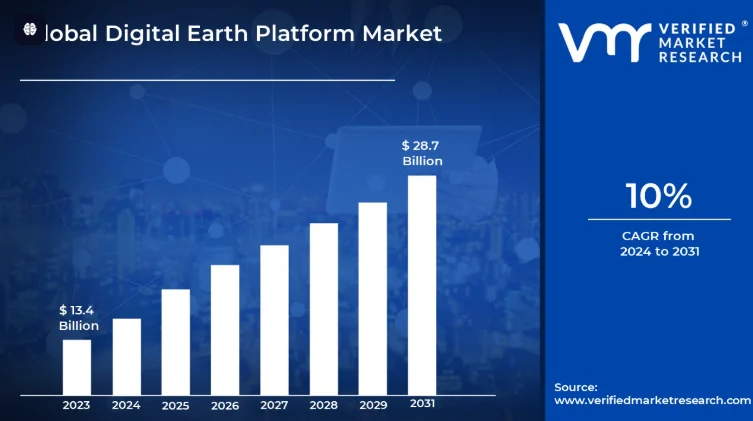
Source: Verified Market Research
Momentum is driven by the shift from speculative virtual worlds to high-utility Mirror Worlds. Unlike early gaming metaverses, these platforms provide functional replicas of the planet designed for commerce and urban management.
Platforms like Next Earth have already demonstrated this by allowing users to purchase virtual land based on real-world tiles, creating a tangible link between digital ownership and global geography.
Current market demand is fueled by three core factors:
- Affordable Geospatial Data: Cost-effective satellite and LiDAR technology allow developers to build 1:1 replicas of cities with high precision.
- Institutional Use: Governments use these twins for Smart City projects, creating stable revenue streams.
- Economic Decentralization: Blockchain enables fractional ownership of digital land, creating a liquid market for virtual real estate.
Virtual to Real Mapping
We are moving away from fictional environments toward geospatially accurate replicas. Early platforms lacked the real world context required for serious business applications. Today, precision mapping is the priority.
Platforms such as SuperWorld leverage this by allowing users to buy and sell virtual real estate mapped across the entire surface of the globe, using augmented reality to enhance the physical world.
Platforms anchored to real coordinates offer superior monetization. Brands can own the digital twin of their physical stores to bridge the gap between offline and online traffic. These platforms provide the essential data layer for Augmented Reality hardware.
By using the WGS84 coordinate standard, these platforms ensure compatibility with global telecommunications and real estate data.
NFT City Ownership
The financialization of space has evolved into utility-first NFT models. In this framework, an NFT acts as a digital deed to specific coordinates. Investors can bootstrap platform growth through Initial Land Offerings that offer long-term value.
Platform owners can implement governance models where NFT holders earn a percentage of transaction fees generated within their territory. Large assets can be fractionalized, allowing for broader market participation and deeper liquidity.
Because the Earth is finite, a 1:1 digital replica has inherent scarcity. This makes digital land a high conviction asset for institutional portfolios.
Simulation Driven Economies
Modern platforms are transitioning from static maps to dynamic simulations. These environments integrate IoT data and AI to create functioning economies. This transition offers the highest ROI for tech entrepreneurs.
Business applications include:
- Urban Analytics: Companies pay to simulate retail performance based on digital twin traffic patterns.
- Risk Modeling: Insurance sectors use these platforms to simulate environmental risks in specific locales.
- Labor Markets: Users can earn income by maintaining the data accuracy of their digital territories. This ensures a self-sustaining ecosystem.
Overview of EarthMeta Platform
EarthMeta represents a strategic evolution in the digital twin sector. It moves beyond basic decentralized plots to focus on administrative scalability through EarthMeta Core and the EarthMeta Marketplace. The platform functions as a macroeconomic environment where users manage urban ecosystems rather than static pixels.
Investor value is driven by:
- Administrative Authority. Owners act as stakeholders in geographic performance.
- Scalable Revenue. Income is tied to collective city activity.
- Real World Parity. Digital replicas stay relevant to physical global trends.
1:1 City Ownership
The architecture is built on a 1:1 scale of the planet. This ensures every physical city has a digital counterpart with finite boundaries. For an entrepreneur, this provides a familiar investment framework similar to real estate without physical maintenance.
| Asset Level | Ownership Type | Control Scope |
| City | Governor | Full tax rights over the urban area. |
| Sub-division | Landowner | Individual parcels for development. |
| Global | President | Oversight of a specific country. |
Acquiring a city allows an investor to subdivide territory and sell assets. This creates a primary and secondary market within each city. Scarcity is absolute as no new cities can be created once the globe is mapped.
Governor Model and Control
The Governor model is the cornerstone of the platform. When an individual acquires a city, they gain a functional title that dictates how the city interacts with the global economy. Using the Land Delimitation feature, Governors have the power to define and shape their digital territory.
Governors influence growth by attracting developers and brands. Success requires balancing tax rates with expansion. A Governor who optimizes for high activity sees a greater return through digital commerce volume. This mirrors municipal management where value increases through active infrastructure development.
AI Economy and Tax
EarthMeta AI manages global marketplace complexities. The AI layer provides real time analytics to help Governors identify profitable zones and shifting demand. This is supported by the 3D AI Builder for creating immersive assets that drive economic activity.
The tax mechanism is automated:
- Transaction Fees: A 1% royalty of every sale within city limits is distributed to the Governor.
- Passive Yield: Income is based on the economic health of the territory.
- Market Balancing: AI monitors asset pricing to ensure the economy remains stable.
Polygon and EMT Token
The technical backbone is the Polygon blockchain for speed and low costs. The EarthMeta Wallet and EarthMeta AR app provide the interface for users to interact with assets in real time.
The EMT Token functions as:
- Medium of Exchange: The primary currency for the EarthMeta Marketplace.
- Governance: Token holders participate in the United Nations Governors-Driven DAO Model.
- Staking: Investors use Staking Pools to earn rewards and align with long-term stability.
This integration allows for seamless use of decentralized finance tools, making EMT a flexible asset for professional portfolios.
Core Components of a Digital Earth Metaverse Platform
Building digital earth metaverse platforms requires more than just visual rendering. It necessitates a multi-layered stack that combines geographic precision with economic security. The value lies in the interplay between these technical layers, creating a moat that generic virtual worlds cannot replicate.
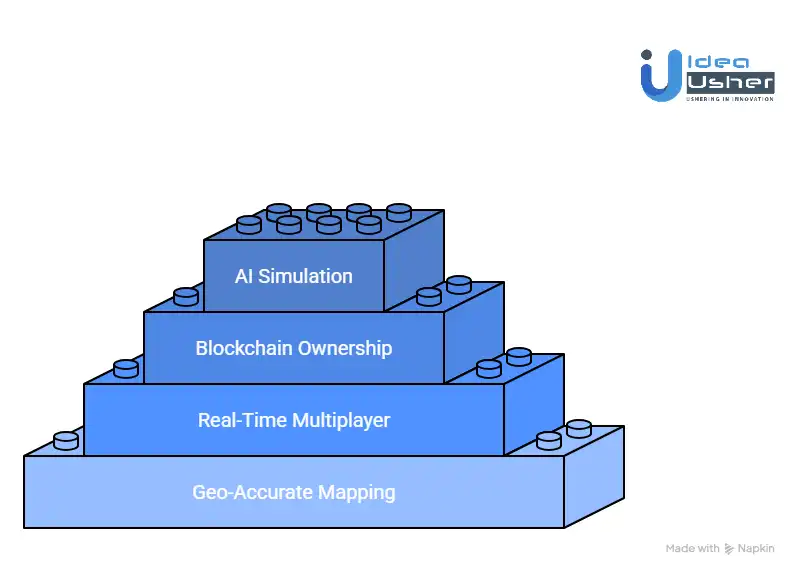
1. Geo-Accurate 3D Mapping
The base layer is a 3D mapping infrastructure. This is not a creative interpretation but a high-fidelity reconstruction using satellite imagery and GIS data. By utilizing the WGS84 coordinate system, the platform ensures that a digital storefront in London occupies the exact same relative space as its physical counterpart.
This infrastructure supports:
- Digital Twin Synchronization. Real-world changes reflect in the digital environment.
- AR Compatibility. Precise mapping allows mobile users to view digital layers over the physical world.
- Architectural Accuracy. High-resolution meshes allow developers to build structures respecting real-world topography.
2. Real-Time Multiplayer Layer
A Digital Earth is a ghost town without a robust interaction layer. This technical component handles the real-time presence of users, enabling social commerce and collaborative governance. It must scale to support thousands of concurrent connections within a single city-level territory.
Technical Insight: The interaction layer manages state synchronization. When a Governor updates a city tax rate or a brand launches a digital pop-up shop, the change must broadcast instantly to maintain a single source of truth for all participants.
3. Blockchain Ownership System
Blockchain is the trust layer. It replaces centralized databases with a decentralized ledger, ensuring city deeds and land parcels cannot be duplicated. Smart contracts automate legal and financial processes that usually require manual intervention.
| Feature | Function | Investor Benefit |
| Smart Deeds | Automated land transfers. | Instant liquidity and reduced friction. |
| Royalty Logic | Automated tax distribution. | Guaranteed passive income for Governors. |
| Immutable Ledger | Permanent proof of title. | Long-term asset security and defensibility. |
4. AI for Simulation and Automation
The AI layer transforms a static map into a living economy. Rather than relying solely on human input, AI-driven agents and automated systems manage city activity. This ensures the platform remains economically viable even during off-peak hours.
Strategic AI applications include:
- Predictive Analytics. AI analyzes market trends to suggest optimal land prices.
- Automated Content Generation. Tools like the 3D AI Builder allow users to generate structures using simple prompts, lowering development barriers.
- Economic Balancing. The AI monitors EMT Token circulation to prevent hyperinflation and ensure a stable environment for institutional participants.
Must-Have Features for EarthMeta-Like Platform
Developing competitive digital earth metaverse platforms requires a feature set that prioritizes economic utility and user governance. These tools transition a platform from a visual map into a functional financial ecosystem.
1. NFT City Ownership
The foundation relies on converting geographic coordinates into unique tokens. This ensures every city has an immutable digital deed. Platforms like Next Earth pioneered this by allowing users to purchase virtual land based on exact satellite map tiles, providing verifiable proof of title for long-term asset holding.
2. Territory Governance
Governance features allow top-tier owners to manage cities through administrative dashboards. These roles grant authority to approve developments and influence growth. This mirrors the approach in Earth2, where users claim large territories and manage properties to increase digital jurisdiction value through strategic resource control.
3. Land Marketplace
A high-liquidity marketplace is essential for a healthy secondary economy. This interface enables seamless listing, bidding, and transfer of land parcels. SuperWorld provides a prime example, offering a marketplace where any of the 64.8 billion plots on Earth can be traded with real-time pricing data.
4. Tax-Based Economy
Sustainable platforms include automated tax mechanisms that distribute wealth back to owners. In platforms like Upland, the economy is built around property ownership and collection. Owners earn a recurring monthly yield on holdings, demonstrating how royalty logic serves as a passive income stream for digital landlords.
5. AR/VR Immersive Support
Bridging the gap between digital data and physical reality ensures long-term relevance. Over the Reality utilizes AR to let users overlay digital assets onto the physical world via mobile devices. This increases utility for retail and social engagement by allowing interaction with digital assets in actual physical environments.
How the Digital Land Economy Works in EarthMeta?
The economy of digital earth platforms like EarthMeta is built on a sophisticated circular model that mimics real-world municipal finance. By combining blockchain transparency with AI-driven oversight, the platform creates a self-sustaining ecosystem where value is derived from both geographic scarcity and active trade.
1. Tokenizing Cities into NFTs
In EarthMeta, the fundamental unit of value is the city. Every major metropolitan area is minted as a high-tier NFT, providing the owner with the official status of Governor. This process converts physical borders into immutable digital deeds.
Ownership Concept: While platforms like Decentraland tokenize small, abstract plots, EarthMeta tokenizes entire urban jurisdictions. This allows a Governor to own the macro-layer of a city before subdividing it into smaller, more liquid assets like monuments or streets.
2. Pricing Models for Virtual Territories
Pricing is not arbitrary; it is governed by EarthMeta AI to ensure market stability. The valuation of a city during its initial phases depends on a multi-factor algorithm:
- GDP and Economic Power. Real-world economic data influences starting prices.
- Cultural Notoriety. Cities like Paris or Tokyo carry a premium due to their global recognition.
- Population Density. High-traffic urban areas are priced to reflect their potential for transaction volume.
3. Revenue From Transaction Taxes
The primary incentive for acquiring a city is the 1% Transaction Royalty. As the Governor, you receive a percentage of every trade that occurs within your city’s boundaries.
| Revenue Type | Mechanics | Recipient |
| Land Sale Tax | 1% fee on every parcel sold in the city. | Governor |
| Asset Royalties | Fees on trades of landmarks or buildings. | Governor |
| Presidency Bonus | National level tax share for top asset holders. | President |
This logic ensures that even if a Governor sells off the individual parcels within their city, they continue to earn passive yield from all future secondary market activity.
4. Secondary Marketplace Dynamics
The EarthMeta Marketplace is the engine of liquidity. Once a Governor subdivides their city, a vibrant secondary market emerges where independent landowners can buy, sell, or flip digital assets. This creates a layered economy:
- The Primary Mint. Initial acquisition of cities by Governors.
- The Sub-Market. Sale of specific landmarks and districts to smaller investors.
- The Speculative Market. Continuous trading of high-value assets based on platform growth and AR integration.
5. Managing Supply and Demand Balance
To prevent the hyperinflation that plagued earlier metaverses, EarthMeta employs a “Scarcity by Design” strategy. By excluding oceans and uninhabited terrain, the platform focuses exclusively on high-value land.
The Staking Pools further balance the economy by incentivizing users to lock their EMT Tokens in exchange for rewards.
This reduces circulating supply during periods of high growth, while the AI-driven valuation model adjusts city tiers based on real-time demand. This ensures the platform remains an attractive environment for serious participants looking for a structured, non-diluted marketplace.
How to Develop a Digital Earth Metaverse Platform Like EarthMeta?
Developing digital earth metaverse platforms like EarthMeta requires a sophisticated blend of geospatial engineering, blockchain architecture, and economic theory. The goal is to move beyond a simple visual map to create a decentralized, self-sustaining world layer that provides real-world utility and asset security.
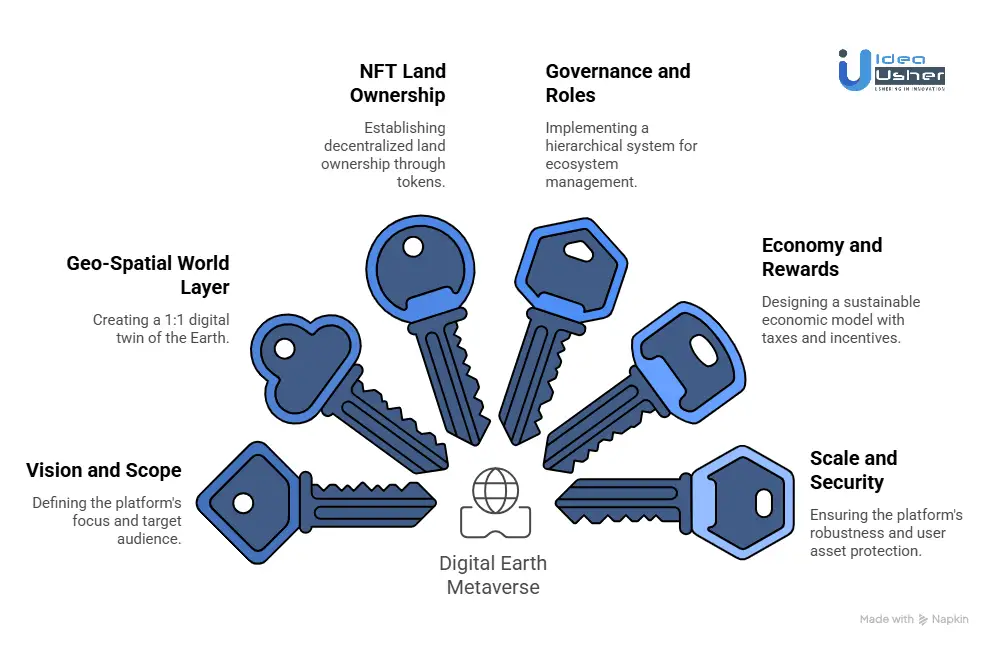
Our team has delivered several digital earth platforms similar to EarthMeta. Here’s our process.
1. Define Vision and Scope
Success begins with a clear definition of focus. We help you determine if the platform will serve as a high-fidelity industrial twin, a social commerce hub, or a pure financial layer.
- Niche Identification. We focus development on urban centers rather than uninhabited terrain to ensure high density and user engagement.
- Target Demographics. Our architecture is designed for institutional participants, brands, and digital landlords who prioritize governance and ROI.
- Feature Roadmap. We prioritize essential infrastructure such as mapping and ownership, before expanding into complex AR or social layers.
2. Build the 1:1 Geo-Spatial World Layer
The technological foundation must be a 1:1 digital twin of the Earth. This involves processing massive datasets to create a seamless, navigable world.
- Data Sourcing. We integrate satellite imagery and GIS (Geographic Information System) data to ensure global coverage.
- Coordinate Synchronization. We use the $WGS84$ standard so every digital pixel aligns with a real-world GPS coordinate.
- Rendering Strategy. We balance visual fidelity with performance, using tiled loading systems that allow for a global scale without compromising user hardware.
3. Develop NFT Land Ownership
Trust is established through a decentralized ownership system. We represent every city and land parcel as a unique token on a secure ledger.
Technical Pillar: Our smart contracts are the ultimate authority. When a user buys a city, the contract automatically mints an NFT that serves as the deed, granting exclusive administrative rights that cannot be altered by platform developers.
4. Design Governance and Roles
To foster a living ecosystem, we implement a hierarchical role system. This incentivizes participation and mimics real-world political structures.
| Role | Responsibility | Incentive |
| Governor | Manage city development and land sales. | Earn a percentage of city transaction taxes. |
| President | Oversee national-level territory and policy. | Receive a portion of the country-wide tax pool. |
| Landowner | Develop individual parcels and assets. | Value appreciation and utility within the city. |
5. Integrate Economy, Tax, and Rewards
A sustainable economy requires a circular flow of capital. We achieve this by embedding tax logic directly into the marketplace protocols.
Our economies function through:
- Automated Royalties. Every secondary market sale triggers a 1% tax distributed to the territory’s Governor.
- Native Currency Utility. We utilize tokens like EMT as the medium for all transactions and governance voting.
- Incentive Staking. We build Staking Pools where users lock tokens to provide liquidity and stability in exchange for rewards.
6. Optimize Scale, Security, and Performance
Scaling a global platform requires a robust backend capable of handling high transaction volumes.
- Layer 2 Integration. We utilize networks like Polygon to ensure transactions are fast and gas fees remain negligible.
- AI Oversight. We implement EarthMeta AI to monitor markets for anomalies and assist users with the 3D AI Builder.
- Security Audits. We conduct rigorous smart contract audits to protect user assets and maintain the platform’s reputation as a secure financial environment.
Designing a City-Level NFT Ownership Model
Successful digital earth metaverse platforms utilize the city as the primary unit for high-value asset management. Moving away from granular pixel sales, a city-level model provides a macro-economic layer that appeals to professional participants. This approach transforms a digital map into a structured hierarchy of administrative and financial control.
1. Dividing the World Into Units
World-partitioning prioritizes relevance over volume. By dividing the planet into distinct city-level NFTs, a market of premium assets with clear value is created.
- Macro-Assets: These are high-tier NFTs sold during initial offerings. They grant the owner Governor status.
- Micro-Assets: These are subdivisions of the city. A Governor can sell these to individual users while retaining an override interest.
- Infrastructure Assets: Landmarks and transit hubs are treated as unique strategic assets with higher traffic potential.
Strategic design avoids cutting the map into arbitrary squares. Using GIS data to follow real urban footprints ensures that owning a digital version of a specific economic powerhouse is defensible and valuable.
2. Ownership Rights and Control
A common pitfall is ambiguity regarding what an NFT actually owns. Establishing a clear protocol balances user autonomy with platform stability.
| Feature | Ownership Rights | Platform Control |
| Taxation | Set local royalty rates. | Maintain global protocol stability. |
| Subdivision | Decide how to partition land. | Ensure coordinate accuracy. |
| Branding | Approve local partnerships. | Moderate content for safety. |
This balance ensures the Governor has the freedom to monetize their territory while the underlying infrastructure remains functional. The EMT Token governance model further decentralizes this, allowing the community to vote on major platform-wide changes.
3. Preventing Key Location Monopoly
To maintain a healthy economy, platforms must prevent land squatting where a single entity leaves premium assets inactive. Several mechanisms ensure the world stays vibrant.
- Tiered Rollouts. Cities are released in phases based on demand. This prevents a single early-mover from capturing all global capitals at once.
- Activity Requirements. Smart contracts can integrate logic where inactive territories see reduced tax benefits. This incentivizes the owner to develop or sell the land.
- Progressive Taxation. Large-scale holdings can be subject to different fee structures to encourage a diverse ownership base. EarthMeta AI monitors market concentration to keep the entry barrier fair for new participants.
How to Build a Sustainable Governor Economy?
Creating digital earth metaverse platforms that last requires a shift from short-term speculation to long-term municipal management. A sustainable economy ensures that those holding the highest tier of assets remain active participants in the world’s growth. By structuring incentives around territory performance rather than just asset appreciation, a platform can maintain steady engagement.
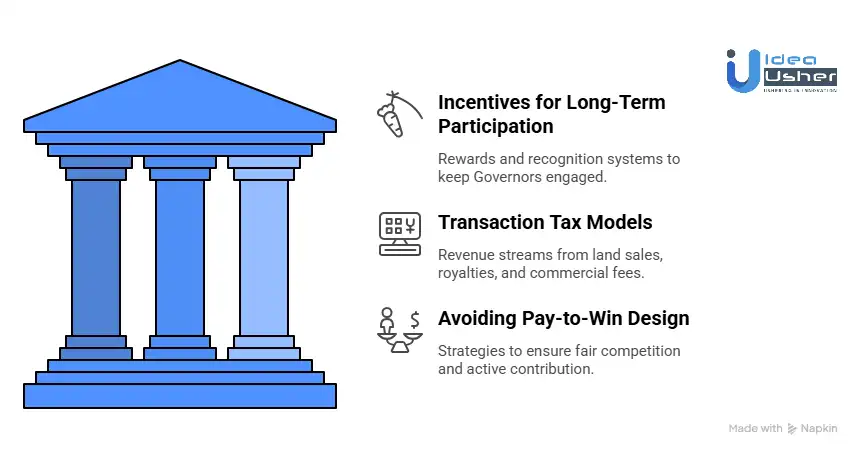
1. Incentives for Long-Term Participation
Longevity is built through Governor-as-a-Service models. When someone acquires a city, they are not just buying a digital image; they are entering a role that requires strategic oversight.
To keep Governors engaged over time, the platform can utilize:
- Tiered Rewards: Higher activity levels within a city unlock better staking multipliers or exclusive building tools.
- Recognition Systems: Displaying top-performing Governors on global leaderboards to foster healthy competition between urban centers.
- Exclusive Governance: Allowing city owners to vote on local protocol changes that affect their specific region.
2. Transaction Tax Models Explained
The tax system is the engine that drives revenue back to the Governors. In a well-designed digital earth, every economic action within a city boundaries provides a micro-yield to its administrator.
Primary Sales Revenue: Initial purchases of land parcels provide large upfront capital for city development. This allows Governors to fund infrastructure or marketing to attract more users.
Secondary Trade Royalties: A 1% royalty on all peer-to-peer sales ensures continuous passive income as the city grows. This rewards Governors who foster high-demand neighborhoods.
Commercial Transaction Fees: Taxes on virtual storefront transactions provide long-term revenue from digital commerce. As brands set up shop, the Governor benefits from the volume of trade.
Pro-Tip: Automated smart contracts handle these distributions instantly. This removes the need for manual bookkeeping and ensures that Governors receive their share of the EMT Token velocity immediately upon a transaction.
3. Avoiding Pay-to-Win Design
One of the greatest risks to digital earth platforms is a Pay-to-Win structure where the wealthiest users stifle the growth of the world. To prevent this, the economy must favor active contribution over deep pockets.
- Performance-Based Perks. Bonuses should be earned through city growth metrics like the number of active visitors or the quantity of developed parcels, rather than just the amount of tokens held.
- Market-Driven Balancing. Using EarthMeta AI to monitor land hoarding. If a city owner does not develop or sell their land for a long period, the platform can implement decay fees or reduce tax dividends to encourage liquidity.
- Accessible Entry Points. While Governors hold the macro-assets, the subdivision of land into affordable parcels ensures that the broader community can still participate and profit within the ecosystem.
Frameworks for Developing Platforms Like EarthMeta
Developing digital earth metaverse platforms like EarthMeta requires a stack capable of handling massive geospatial data and a decentralized economy. The goal is a seamless persistence that mirrors the physical world by balancing high-performance 3D rendering with blockchain security.
1. OpenSim for Simulation
OpenSimulator (OpenSim) is an open-source server platform for multi-user 3D environments. It allows for the creation of virtual spaces that scale via Hypergrid technology.
- Modular Architecture. Supports custom physics engines and scripting.
- Distributed Networks. Users can travel between different world installations.
- Live Creation. Enables users to build and modify land directly in-world.
2. Decentraland SDK for NFT Systems
The Decentraland SDK is the standard for blockchain-heavy economies. It is designed to tie interactive 3D scenes to Ethereum or Polygon NFTs.
- Ownership Protocols. Built specifically for LAND and Wearable assets.
- DAO Support. Includes structures for community-led platform governance.
- Monetization Tools. Standardized builders for deploying and selling digital real estate.
3. Custom Frameworks for Planet-Scale
Building a 1:1 replica of the planet often requires a custom framework using engines like Unreal Engine or Unity paired with geospatial plugins.
- GIS Streaming. Using tools like Cesium to stream satellite imagery and 3D terrain.
- Layer 2 Efficiency. Integrating Polygon to manage thousands of micro-transactions and city taxes with low fees.
- AI Automation. Implementing layers to handle procedural urban generation and automated economic balancing through EarthMeta AI.
Cost to Build a Digital Earth Metaverse Platform Like EarthMeta
Building digital earth metaverse platforms is a significant financial undertaking that scales with the complexity of the geospatial data and the sophistication of the economy. Founders must balance the high cost of 3D world rendering with the security requirements of a blockchain-based land registry.
1. MVP Development Cost Range
A Minimum Viable Product for a digital earth focuses on a specific region rather than the entire globe. This version typically includes a basic 3D map, wallet integration, and a primary land sale mechanism.
- Lean MVP ($25,000 – $60,000): This tier covers basic web-based 3D visualization, user authentication, and a simple smart contract for parcel ownership.
- Standard MVP ($60,000 – $150,000): This includes a more refined UI, multiple city locations, a basic secondary marketplace, and administrative dashboards for Governors.
- Advanced MVP ($150,000+): This tier integrates real-time data streaming and basic AI features to manage land valuation.
2. Full Platform Cost Breakdown
Scaling a platform to support thousands of concurrent users across a global map requires a multi-million dollar investment. The following table illustrates the typical allocation of capital for an enterprise-grade digital earth.
| Component | Estimated Cost | Percentage of Budget |
| 3D World & GIS Integration | $100,000 – $500,000 | 25% |
| Blockchain & Smart Contracts | $50,000 – $200,000 | 15% |
| AI & Economic Automation | $80,000 – $300,000 | 20% |
| Backend & Cloud Architecture | $60,000 – $250,000 | 15% |
| UI/UX & Frontend Mobile | $40,000 – $150,000 | 10% |
| Security, QA & Compliance | $30,000 – $150,000 | 15% |
3. Infrastructure and Maintenance Costs
The initial build is only part of the financial equation. Digital earth platforms incur heavy recurring expenses to keep the global map synchronized and the servers responsive.
- Cloud Hosting ($5,000 – $30,000/month). High-fidelity 3D assets and geospatial data require massive storage and bandwidth, especially as the user base grows.
- Ongoing Development (15% – 25% of build cost/year). Platforms need constant updates to patch security vulnerabilities and add new features like AR support.
- Node & Indexer Fees ($500 – $2,500/month). Maintaining a reliable connection to the blockchain for real-time ownership updates requires dedicated infrastructure.
4. Hidden Costs Founders Overlook
Beyond coding and servers, several “invisible” costs can drain a startup’s capital if not planned for during the discovery phase.
Legal and Regulatory Compliance ($15,000 – $100,000+)
Digital land often sits in a legal grey area. Founders must invest in legal opinions regarding tokenized real estate, KYC/AML (Know Your Customer) integration, and international business licensing to operate safely.
Smart Contract Audits ($5,000 – $25,000 per audit)
Security is non-negotiable. Before any city or parcel sale, third-party security firms must audit the smart contracts. This is not a one-time cost; every major protocol update requires a new audit to maintain user trust.
Data Sources for Digital Earth Platforms Like EarthMeta
Developing digital earth platforms requires a massive intake of geographic and spatial data. To create a high-fidelity mirror of the planet, businesses must source accurate information from satellite constellations and terrestrial databases. The quality of these sources directly impacts the immersion and commercial value of the virtual land.
1. Satellite Data and GIS Providers
The most realistic platforms rely on enterprise-grade satellite imagery. These providers offer the high-resolution base map needed for a 1:1 reconstruction.
Leading Providers
- Maxar and Airbus. These are the gold standards for sub-meter resolution. They provide the optical and radar imagery needed to identify individual buildings.
- Planet Labs. Known for high-frequency updates, their satellites capture daily changes. This allows a digital earth to reflect real-world developments quickly.
- Cesium and Google Earth Engine. These platforms provide the APIs and 3D tiling technology required to stream massive geospatial datasets into game engines without lag.
2. OpenStreetMap vs Proprietary Sources
Founders must choose between free community-driven data and paid commercial-grade databases. This decision affects both the accuracy of the world and the development budget.
OpenStreetMap: OSM is the Wikipedia of maps. It is free to use and offers deep community-contributed metadata for roads and building footprints. While cost-effective, it can suffer from inconsistent detail in rural areas.
Proprietary Data Commercial sources from providers like Google or TomTom offer high accuracy and professional validation. However, these come with high API costs and restrictive usage terms that can limit how you display or store the data.
3. Licensing Challenges to Consider
Data is rarely owned by the platform. It is licensed. Navigating these legal frameworks is a critical hurdle for any digital earth project.
- Redistribution Rights. Many satellite providers forbid the use of their imagery to create new derivative 3D models unless you pay a premium for a commercial redistribution license.
- Attribution Requirements. Open-source data like OSM requires clear and prominent credit to contributors. Failure to comply can result in legal issues.
- Data Sovereignty. Some countries have strict laws regarding the mapping of sensitive locations. Platforms must implement blurring or exclusion zones to remain compliant with international security regulations.
Economic Insight. While OpenStreetMap reduces initial costs the engineering time required to clean and standardize the data often closes the price gap with proprietary sources. Most sustainable platforms use a hybrid approach with proprietary imagery for visuals and OSM for functional street data.
Architecture for Planet-Scale Metaverse Systems Like EarthMeta
Building digital earth platforms like EarthMeta requires infrastructure that goes beyond traditional server models. Simulating a 1:1 planet for thousands of users requires massive spatial data streams and synchronized global ledgers.
1. Distributed Systems for Global Sync
Global synchronization is the heartbeat of a digital earth. If a user in Tokyo buys land, a user in New York must see that change instantly to prevent ownership conflicts.
State Relays: Distributed hash tables and gossip protocols broadcast updates. Network nodes communicate with neighbors to propagate the truth without waiting for a central server.
Blockchain Settlement: While visuals update in real-time, the final source of truth is recorded on Layer 2 blockchains like Polygon. This ensures immutability and instant conflict resolution through time-stamped ledgers.
2. Handling High Concurrent Loads
Managing thousands of users in one 3D space is a computational challenge. We solve this through Spatial Interest Management to prevent server crashes.
The Strategy:
- Horizon Principle. The system only sends data for what a user can actually see. Paris data is not sent to a user in London.
- Dynamic Sharding. When a city becomes crowded, the platform automatically splits it into invisible sub-servers. This distributes the CPU load across hundreds of processors without breaking immersion.
3. Edge Computing for Low Latency
Latency kills immersion. A 100-millisecond delay makes the world feel sluggish. We use Edge Computing to process data closer to the user.
- Local Physics. Movement and collision calculations happen at the nearest edge node for an instant feel.
- Asset Caching. Large 3D textures are stored at edge locations to ensure Governors can fly over cities without waiting for buildings to pop in.
- Data Filtering. By processing minor updates at the edge, we reduce network noise and keep the main blockchain ecosystem fast and cost-effective.
How to Prevent Economic Collapse in Your Platform?
Stability in digital earth platforms depends on structural economic design over hype. Active management prevents hyperinflation and speculative bubbles. A resilient world balances Governor needs with newcomer accessibility.
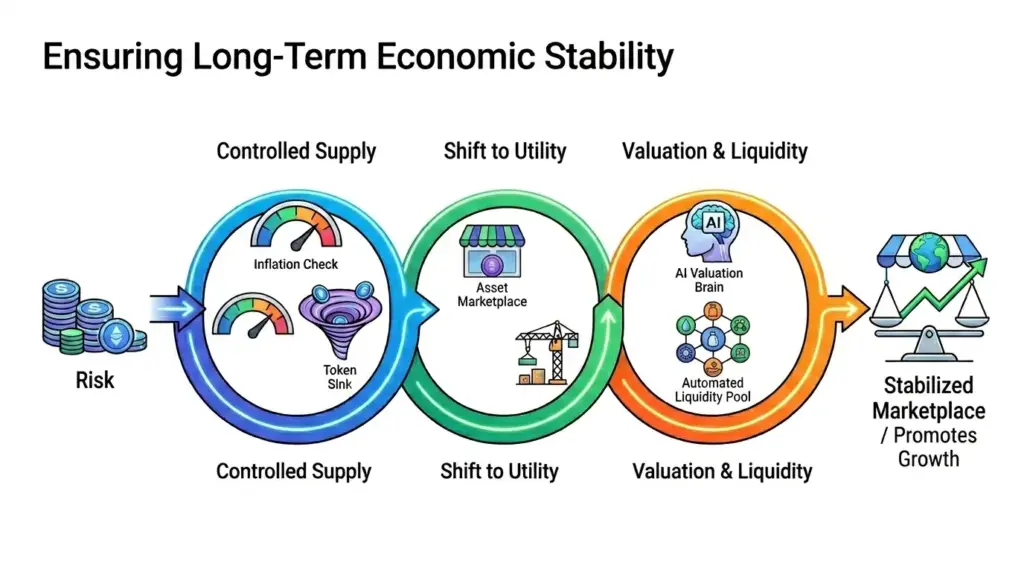
1. Inflation Control
Virtual currency supply must be regulated to prevent asset devaluation. If tokens like EMT mint too fast, purchasing power drops. This challenge is common among giants like The Sandbox, where ecosystem rewards must be balanced against the total supply of SAND to maintain value.
- Deflationary Sinks. Burning transaction fees or charging for premium city features removes tokens from circulation.
- Staking. Rewarding users for locking tokens reduces circulating supply and creates value pressure.
- Hard-Coded Emission. Smart contracts govern token releases to ensure transparency and predictable supply.
2. Speculation vs Utility
Speculation creates houses of cards. Success requires shifting focus from flipping assets to long-term usage. Much like Upland, which uses a property-to-markup model to encourage trading rather than just holding, platforms must provide reasons to use the land.
| Economic Driver | Speculative Focus | Utility Focus |
| Primary Goal | Short-term price flips | Long-term tax revenue |
| Asset Usage | Idle land banking | Active parcel development |
| Market Impact | High volatility | Stable recurring yield |
Platforms favor utility by rewarding active management. Governors who subdivide and brand cities earn higher tax percentages than inactive owners.
3. Stabilizing the Market
Volatility stems from low liquidity or whale movements. EarthMeta AI monitors trends to maintain health.
- AI Valuation. AI analyzes real-world data to set floor prices for city rollouts and prevent launch-day swings.
- Liquidity Seeding. Treasuries act as market makers to ensure users can exit positions without crashing prices.
- Vesting. Lock-up periods for founders and large holders prevent sudden asset floods from overwhelming demand.
Healthy platforms integrate speculators rather than banning them. Speculators provide the liquidity needed for others to exit positions. The goal is a marginal investor who values the world itself over the token price.
Monetization Strategies for Digital Earth Metaverse Platforms
Sustainable digital earth platforms move beyond one-time asset sales by creating recurring revenue streams. A multi-layered monetization strategy ensures the platform can fund massive infrastructure while providing Governors with tools to build local economies. By blending traditional real estate logic with blockchain-native features, businesses create a circular financial ecosystem.
1. NFT Land Sales and Auctions
Initial distribution of virtual real estate is the primary revenue driver for new platforms. By dividing the world into macro-assets like cities and micro-assets like parcels, businesses create a tiered entry system for different investor levels.
Public Auctions
High-value cities or landmarks are sold via competitive bidding. This establishes market value and generates upfront capital. For example, The Sandbox generated roughly $185,000 in its second land sale alone during its early growth phase.
Direct Minting
Individual land parcels are sold at fixed prices based on geographic desirability. Platforms use proximity to real-world hubs to drive demand. Even with market shifts, some major estates in these ecosystems have historically commanded millions in initial sales.
2. Transaction Fees and Tax Systems
Passive income for both the platform and its Governors comes from a robust tax system. Every economic action within virtual borders provides a micro-yield to stakeholders.
Trading Royalties
Standard percentage fees apply to secondary sales. These ensure long-term revenue as assets appreciate.
In EarthMeta, the ecosystem uses the EMT Token with a total supply of 2.1 billion to facilitate these rewards and govern city-level royalty distributions.
Governor Tax Overrides
When a user buys a parcel within a city, the City Governor can collect a local tax. This mimics real-world municipal finance and incentivizes Governors to attract active developers to their territory.
3. Premium Features and Subscriptions
To keep platforms functional for professional users, companies offer enhanced tools through recurring subscriptions or one-time feature unlocks.
- Analytical Dashboards. Advanced AI tools provide data on land value trends and traffic heatmaps for a monthly fee.
- Custom Branding. Governors pay to upload custom 3D models or skyboxes to make their cities unique.
- API Access. Developers pay for high-speed access to spatial data to build third-party applications or games on the map.
4. Brand Integrations and Virtual Ads
As the user base grows, a digital earth becomes a prime canvas for global brands. Advertising revenue monetizes the platform without charging users directly.
Virtual Billboards: Digital signage in high-traffic city centers allows brands to display targeted ads. Revenue is shared with the City Governor who owns the virtual air rights.
Branded Experiences
Companies create sponsored districts or mini-games. This is a massive revenue engine for platforms like Roblox which reported annual revenue of approximately $3.6 billion in 2024 and grew to over $4.8 billion by the following year. Top creators on such platforms now earn millions through these branded integrations.
Security Risks in NFT Land Platforms Like EarthMeta
When we partner with clients to develop digital earth platforms, we prioritize security as the foundation of the entire ecosystem. Because virtual land represents significant financial value, we implement a defense-in-depth strategy to protect your platform from permanent asset loss and economic manipulation.
1. Smart Contract Vulnerabilities
Smart contracts can be exploited to mint fake land, drain funds, or alter platform logic.
Preventing Reentrancy
We implement industry-standard reentrancy guards to prevent malicious contracts from calling back into your platform. This stops attackers from tricking the system into sending funds multiple times or duplicating city deeds before a transaction settles.
Securing Upgrade Paths
To ensure your platform can evolve we use secure proxy patterns. We help you manage these mutable parts of the code with strict administrative controls. This ensures no single compromised key can redirect the platform logic to a malicious source.
2. Protecting High-Value Assets
Large NFT land holdings can be stolen if a single wallet or key is compromised.
Multi-Signature Governance
We set up governance structures where critical actions like adjusting tax rates or releasing new territory require approval from multiple stakeholders. By using tools like Gnosis Safe, we ensure that a multi-signature rule prevents a single hacked account from damaging the ecosystem.
Cold Storage Integration
We guide our clients in implementing warm and cold wallet strategies. We help you design systems where high-value city NFTs remain in offline cold storage while lower-permission delegate wallets handle daily operational tasks to minimize the attack surface.
3. Preventing Economic Exploits
Attackers can manipulate trading activity, oracle data, or token supply to destabilize land prices and the platform economy.
We protect your platform’s economic stability from collapse caused by bad actors or artificial market trends.
- Anti-Wash Trading: We integrate AI monitoring to flag repetitive non-human trading patterns. This prevents manipulators from creating fake volume to trick real investors.
- Tamper-Proof Oracles: To set fair land prices we utilize decentralized oracles like Chainlink. This prevents attackers from using flash loans to manipulate data feeds and buy your land at an artificial discount.
- Vesting and Lock-ups: We build automated vesting schedules into your smart contracts. This ensures founders and early investors cannot suddenly flood the market, keeping the supply of land and tokens stable.
We believe no system is 100% unhackable. This is why we include formal code verification and bug bounty programs in our development lifecycle. By incentivizing ethical researchers to find flaws before they are exploited, we help our clients stay ahead of malicious threats.
Why Choose IdeaUsher for Digital Earth Metaverse Platforms?
Success in the digital earth space requires more than a map. At Idea Usher, we combine geospatial engineering and blockchain expertise to create 1:1 digital twins. With 500,000 hours of coding experience, our team of ex-MAANG developers builds high-performance and hyper-scalable ecosystems.
- Precision Engineering. Seamless 3D visuals and backend logic.
- Security-First. Every smart contract is hardened against exploits.
- Global Scalability. Infrastructure built for millions of users.
Geo-Based 3D Expertise
We build virtual worlds rooted in reality. We integrate high-resolution satellite imagery with procedural generation for maximum immersion.
- GIS Integration. Streaming real-world terrain data into your metaverse.
- Rendering. Optimized Unreal Engine 5 and Unity for web and mobile.
- Data Layering. Overlaying commercial and social data on coordinates.
Economy and Tokenomics
A digital earth survives on its currency. We design balanced economies that favor long-term stability over short-term speculation. Our deliverables include a custom token design with deflationary sinks to maintain value. We also implement secure NFT minting for land registries and automated tax overrides to provide recurring royalties for city owners. We ensure your native token remains a functional tool for trade and governance.
MVP to Global Scale
We take your vision from whitepaper to global rollout using a validated lifecycle.
- Agile MVP: We launch a Lean MVP with a land sale module and functional 3D map. This secures early capital and user data before we add complex features like AI.
- Scaling: Once validated we deploy edge computing and spatial sharding. This ensures your platform remains responsive as you add new territories. Our background ensures we apply the same rigor as tech giants to your project.
Conclusion
Developing a digital earth metaverse requires a strategic blend of geospatial precision and robust blockchain tokenomics. By integrating 1:1 satellite mapping with decentralized governance and AI-driven analytics creators transform a static world into a thriving financial ecosystem. Success lies in balancing high-performance rendering with a sustainable economy where users find value in owning and governing digital territories. Building such a platform effectively bridges the physical and digital divide for the next generation of global commerce.
FAQs
A1: Building a digital earth requires integrating GIS data with a game engine like Unreal Engine to create a 1:1 world model. You must develop smart contracts to handle land ownership as NFTs and establish a secure backend for real-time multiplayer interactions. Success depends on launching a lean MVP focused on core land trading before scaling with complex social features.
A2: Digital Earth is a virtual representation of our planet that mirrors real-world geography and coordinates. It functions as a digital twin where users can own, develop, and monetize virtual versions of actual physical locations. This concept bridges the gap between physical reality and the metaverse by providing a familiar spatial framework for social and economic activity.
A3: Key features include a 3D map interface for land exploration and a decentralized registry to secure property deeds as NFTs. Platforms also require governance dashboards for city management, AI-driven market analytics, and AR support to overlay digital assets onto the physical world. A robust tax-based economy is essential to distribute recurring rewards to landholders.
A4: These platforms generate revenue through primary NFT land sales and taking a percentage fee on every secondary market transaction. They also monetize via premium feature subscriptions, API access for third-party developers, and branded advertising within high-traffic virtual city centers. Strategic tokenomics and corporate partnerships provide long-term capital to sustain the ecosystem.