 (+971) 8007 4267
 (+91) 946 340 7140
 (+1) 628 432 4305

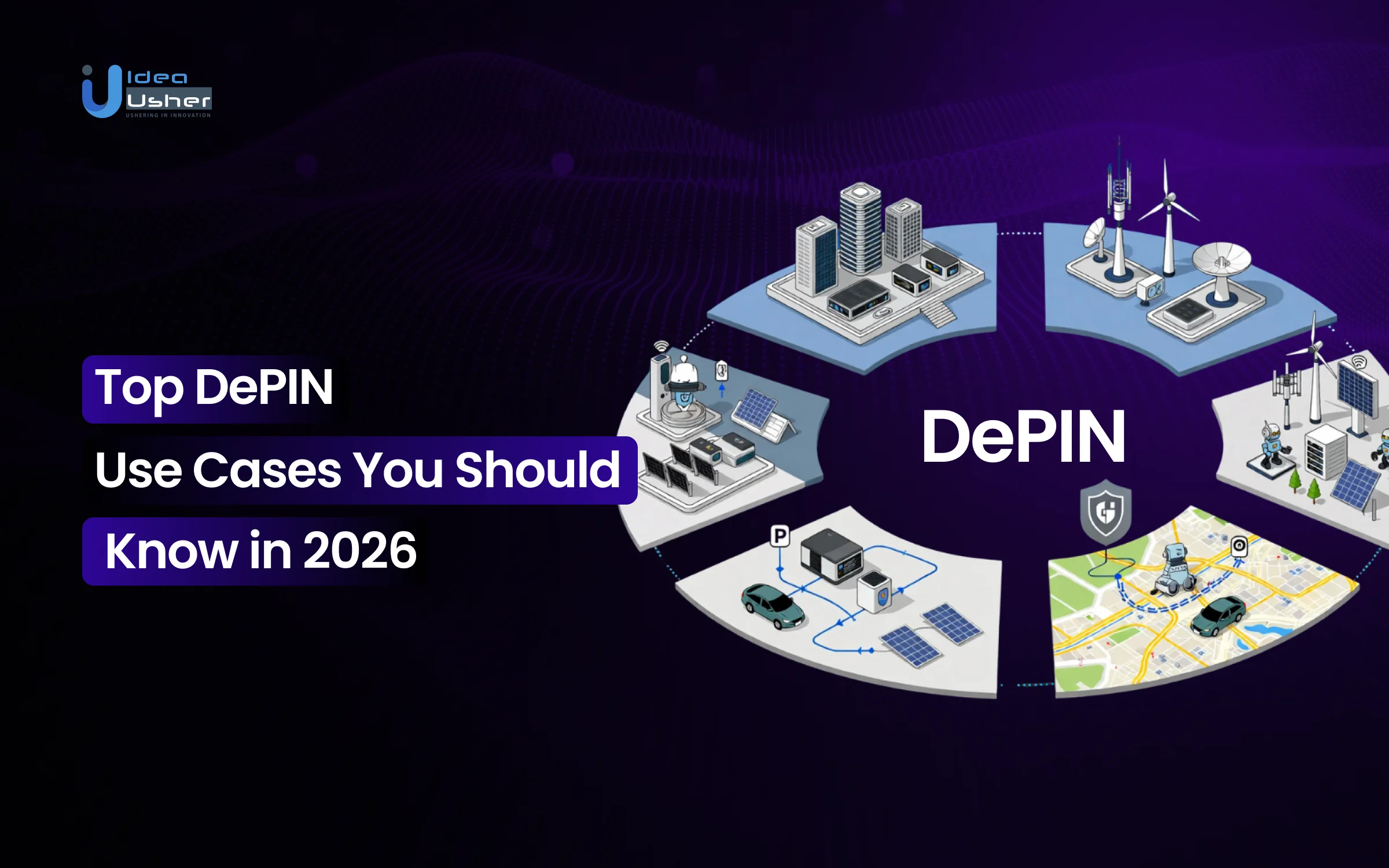
Many industries have lived with idle hardware and silent sensors for years, and these assets could perform better but often remain invisible within legacy systems. Traditional infrastructure tools lacked accountability and real-time verification, which limited action. DePIN networkschanged this by coordinating physical resources through verifiable systems.
Businesses started relying on DePIN systems because it made asset usage visible and predictable. This model now supports computer sharing, storage networks, wireless coverage, and energy coordination. Teams can gradually optimize costs, improve resilience, and unlock value from previously overlooked resources.
Over the years, we’ve developed a range of DeFin systems, powered by proof-of-physical-work mechanisms and distributed routing engines. As we have this expertise, we’re writing this blog to share practical insight into the top DePIN use cases you should know in 2026.
Key Market Takeaways for DePIN Technology
According to FortuneBusinessInsights, the blockchain market is steadily shifting from experimentation to infrastructure-scale deployment. Valued at USD 31.18 billion in 2025, the global blockchain technology market is projected to grow from USD 47.96 billion in 2026 to USD 577.36 billion by 2034, reflecting a strong CAGR of 36.50%. This growth is closely tied to practical blockchain use cases that extend beyond purely financial activity.

Source: FortuneBusinessInsights
DePIN, or Decentralized Physical Infrastructure Networks, is emerging as one of the most compelling outcomes of this shift. By rewarding users with tokens for contributing physical resources such as storage, wireless coverage, sensors, and computers, DePIN reduces dependence on centralized infrastructure providers.
Adoption continues to rise as these networks offer lower operating costs, transparent verification through cryptographic proofs, and greater resilience.
Real-world implementations are already operating at scale. Helium enables individuals to deploy hotspots that power decentralized IoT connectivity for agriculture, logistics, and smart cities, earning HNT tokens for participating in the network.
Partnerships like IoTeX and Eliza Labs further extend DePIN into AI-driven applications by feeding trusted weather and geospatial sensor data into intelligent systems, strengthening real-world awareness for robotics and urban infrastructure.

What is DePIN?
DePIN is a blockchain-powered model where physical infrastructure assets such as wireless hotspots, solar panels, sensors, servers, or storage drives are owned, operated, and maintained by a distributed network of participants instead of a single centralized entity.
At its heart, DePIN flips the script on how infrastructure gets built and used.
- Ownership is distributed – Anyone can contribute hardware and become a network provider.
- Operations are incentivized – Participants earn cryptocurrency rewards for providing real-world services like internet coverage, compute power, or data collection.
- Coordination is trustless – Blockchain and smart contracts automate verification, payments, and governance without middlemen.
The DePIN Model: How Distributed Ownership Works
DePIN networks are built on three core layers.
- The Physical Layer – The actual hardware in the real world, such as Helium hotspots, Render GPUs, or DIMO vehicle trackers.
- The Coordination Layer – Blockchain and smart contracts that track contributions, verify work, and distribute token rewards.
- The Access Layer – Marketplaces and apps where end-users can buy, sell, or rent these decentralized services.
This model creates a participatory economy. Providers earn tokens for their contributions, which they can hold, stake, or trade. Users receive services that are often cheaper, more resilient, and more locally responsive than traditional alternatives.
DePIN vs. Traditional Infrastructure
Traditional infrastructure relies on centralized ownership and long planning cycles, which can slow innovation and increase cost. DePIN shifts this model by enabling distributed hardware providers to coordinate via blockchain, enabling networks to scale faster and respond locally.
| Feature | Traditional Infrastructure (AT&T, AWS, Comcast) | DePIN (Decentralized Networks) |
| Ownership | Centralized corporation | Distributed individuals and organizations |
| Capital Model | Billions in upfront CapEx funded by debt or VC | Crowdsourced via token incentives |
| Deployment Speed | Slow with years of planning and rollout | Fast organic growth from months to global coverage |
| Pricing and Control | Set by corporate policy | Algorithmic market-driven and community-influenced |
| Failure Points | Single points of failure like data centers | Resilient and redundant across thousands of nodes |
| Innovation Pace | Roadmap-driven and slow to adapt | Single points of failure, like data centers |
Why Does This Difference Matter?
For Builders: Instead of raising billions to compete with telecom giants, a DePIN project can launch a token and incentivize a global community to build its network from the ground up.
For Participants: You are no longer just a consumer paying a bill. You can become an owner-operator, earn rewards, and have a voice in the network’s future.
For Society: Infrastructure becomes more adaptable, locally owned, and resistant to censorship or regional outages.
Important Benefits of DePIN Systems
The core advantages of DePIN systems arise from shifting infrastructure ownership away from single entities toward distributed participants. This model can improve reliability, transparency, and cost control through verifiable usage and incentive-based participation.
1. Network Resilience
DePIN systems distribute infrastructure across many independent nodes which reduces single points of failure. If one node goes offline, the network can still operate normally. This design usually improves uptime and long-term reliability under real-world conditions.
2. Incentive Alignment
Participants are rewarded based on verifiable contributions rather than assumptions. Token incentives may encourage honest behavior and consistent performance. This keeps operators and users aligned on the network’s health.
3. Open Participation
DePIN networks allow anyone with compatible hardware to join without central approval. This openness can accelerate network growth and geographic coverage. It also lowers barriers to entry for new contributors.
4. Resource Efficiency
Idle compute storage or bandwidth can be activated and monetized rather than left unused. The system measures real usage and allocates rewards accordingly. This often leads to better utilization and lower operational costs.
5. Sustainable Infrastructure
By reusing existing hardware, DePIN systems reduce the need for new centralized facilities. Energy usage is spread across the network and tied to actual demand. This can support more environmentally balanced infrastructure growth.
6. Scalable Network Growth
DePIN systems can expand organically as new nodes join the network. Capacity increases without heavy upfront capital investment. This makes scaling more flexible and demand-driven.
7. Reduced Centralized Dependency
Infrastructure ownership is shared among participants rather than centralized in a single provider. This reduces vendor lock-in and systemic risk. Networks may remain operational even if individual operators exit.
How Does the DePIN Network Actually Work?
A DePIN network works by enabling real hardware owners to share network connectivity or energy through a verified protocol. Proof systems can verify that the work was completed, and smart contracts can release payments automatically.

1. Network Participants and Resource Operators
This is where the magic begins. A global, permissionless ecosystem of contributors replaces centralized corporations.
The Two-Sided Marketplace:
| Participant | Role | Real World Example |
| Resource Operators | Individuals and businesses who deploy and maintain physical hardware such as GPUs, 5G nodes, solar inverters, and sensors | A gaming cafe in Seoul rents out its idle GPUs during off hours. A farmer in Iowa installs a Helium 5G hotspot covering his fields |
| Consumers or Enterprises | Companies paying for infrastructure services like compute, connectivity, data, and energy | An AI startup in Berlin trains its model. A logistics firm tracks containers in real time |
The Incentive Flywheel:
Operators earn crypto tokens for providing verifiable resources. Consumers pay for services with tokens or stablecoins. Early-stage networks use token emissions to bootstrap supply. Mature networks transition to fee-based sustainability.
2. Distributed Ledger Infrastructure
This is not just a blockchain. It is the automated audit and settlement layer that makes everything trustless.
Core Functions:
- Immutable Ledger: Records all resource proofs, transactions, and ownership
- Consensus Mechanism: Validates transactions without a central authority. Proof of Stake is common for scalability
- Token Standards: Facilitate incentives such as payments to operators and staking for security
Key Innovation: Hybrid Rollups
High-frequency proof submissions, such as sensor data, are batched on Layer 2 chains like Arbitrum and zkSync for near-zero cost. Periodic checkpoints are then secured to Ethereum or Solana for finality.
This creates a trustless SLA. The ledger automatically verifies service delivery before releasing payment. There are no billing disputes and no manual audits.
3. Physical Resource Layer
This is tangible hardware in the real world. It is the physical layer of DePIN.
Resource Categories & Verification:
| Resource Type | Hardware Examples | Verification Method (Proof of Physical Work) |
| Compute or Storage | GPUs, CPUs, Hard Drives | Proof of Compute using validated ML output and Proof of Replication for data storage |
| Wireless | 5G or Wi Fi hotspots, LoRaWAN gateways | Proof of Coverage using RF challenges from neighboring nodes |
| Sensor or Mapping | Dashcams, IoT sensors | Proof of Location using geospatial stamps and witness signatures |
| Energy | Smart inverters, battery packs | Proof of Delivery using metered energy flow to the grid |
The Critical Bridge:
Hardware does not speak blockchain. Secure middleware, often powered by Trusted Execution Environments such as Intel SGX, acts as a tamper-proof translator. It takes raw hardware data, cryptographically attests to its validity, and relays it to the ledger.
4. Automated Smart Contract Execution
This is the autonomous business logic that replaces traditional corporate operations.
The Smart Contract Stack:
- Registration and Onboarding Contracts: New hardware registers its specifications and location on chain
- Proof Verification Contracts: Automatically validate Proof of Coverage, Compute, and Location submitted by oracles
- Incentive Distribution Contracts: Calculate and disburse token rewards to operators based on verified work
- Marketplace Contracts: Match consumer demand with operator supply and handle billing and slashing for poor service
Top DePIN Use Cases You Should Know About
DePIN systems focus on turning idle physical resources into active infrastructure through verifiable coordination. These networks may support connectivity, compute storage, and data collection without relying on centralized operators. Over time, this approach should enable scalable systems that are more resilient, cost-aware, and locally responsive.

1. Energy Coordination Networks
Problem: Centralized power grids struggle to balance supply and demand at a local level.
Decentralized energy grids use individually owned solar panels, batteries, and meters to generate and share power. Blockchain coordination tracks production and consumption transparently. This model can improve grid resilience and reduce energy wastage.
Example: Powerledger enables peer-to-peer energy trading by recording electricity generation and usage on blockchain networks.
2. Distributed Storage Networks
Problem: Cloud storage relies heavily on centralized providers, creating lock-in and failure risks.
DePIN storage networks distribute encrypted data across independent nodes operated by users. Storage availability and performance are verified cryptographically. This approach may increase data durability while keeping costs market-driven.
Example: Filecoin allows storage providers to offer verifiable decentralized storage secured through proof-based validation.
3. Decentralized Network Access
Problem: Internet access expands slowly when controlled by a small number of service providers.
Peer-to-peer connectivity networks grow through user-deployed hardware that provides local coverage. Network usage is automatically measured and rewarded. This allows faster expansion into underserved areas.
Example: Helium rewards users for operating wireless hotspots that provide decentralized internet and IoT connectivity.
4. Urban Sensor Networks
Problem: City infrastructure lacks real-time visibility due to fragmented data systems.
DePIN smart city platforms aggregate data from distributed sensors that measure traffic pollution and utility usage. Data is verified and shared across public and private stakeholders. This supports more responsive urban planning.
Example: IoTeX connects real-world devices to blockchain networks to power decentralized smart city data systems.
5. Community Telecom Networks
Problem: Telecom infrastructure requires high capital investment and long deployment cycles.
Decentralized telecom networks rely on community-owned hardware to provide coverage and capacity. Blockchain coordination ensures fair rewards and transparent operations. Networks can scale faster with lower upfront costs.
Example: Pollen Mobile builds community-powered cellular networks where contributors earn for verified coverage.
6. Logistics Tracking Networks
Problem: Supply chains suffer from limited traceability and delayed data updates.
DePIN-based monitoring systems use distributed sensors and tracking devices to collect real-time logistics data. Records are stored immutably on-chain. This improves trust and operational visibility.
Example: DIMO enables real-time vehicle and logistics data sharing while preserving ownership and access control.
7. Healthcare Data Networks
Problem: Health data is fragmented across providers and difficult for patients to control.
DePIN health data networks allow individuals to securely share anonymized medical data through decentralized systems. Access permissions are managed transparently. This can improve research and interoperability.
Example: Solve Care uses blockchain infrastructure to coordinate healthcare data access and service workflows.
8. Autonomous Mobility Networks
Problem: Autonomous systems require large volumes of real-world data that are expensive to collect centrally.
DePIN transportation networks crowdsource driving data from distributed vehicles and sensors. Data quality is verified through multiple sources. This supports safer and more adaptive autonomous systems.
Example: Hivemapper collects real-world road data through driver-operated devices to support mapping and navigation systems.
9. Distributed Manufacturing Networks
Problem: Manufacturing capacity is underutilized and concentrated in a limited number of locations.
Distributed manufacturing networks coordinate idle 3D printers and fabrication equipment. Jobs are routed dynamically based on availability and location. This can shorten production cycles and reduce logistics costs.
Example: Fabchain connects decentralized manufacturing resources through blockchain-coordinated workflows.
10. Decentralized Financial Networks
Problem: Traditional financial systems rely on intermediaries that increase cost and friction.
DeFi platforms use smart contracts to automate lending, trading, and settlement. Infrastructure is operated by distributed validators rather than central institutions. This enables open and programmable financial services.
Example: Aave provides decentralized lending and borrowing through smart contracts without relying on traditional banks.
Key Challenges in Using DePIN Systems
While DePIN offers clear advantages, real adoption can be hindered by technical complexity, regulatory uncertainty, and operational coordination. We at IdeaUsher solve these challenges by designing systems that scale cleanly, remain compliant, and operate predictably in real environments.
With the right architecture, DePIN can be deployed steadily and support long-term business growth.

1. Scalability & Efficiency
As DePIN networks grow and add thousands of nodes, transaction throughput can become a bottleneck. Each sensor reading, compute proof, or coverage verification requires on-chain settlement. Without careful design, networks slow down just as they become most valuable, undermining the core efficiency promise of DePIN.
Our Solution:
We architect DePIN systems using a multi-layer scaling strategy.
- Hybrid Rollup Architecture: Layer 2 rollups batch micro transactions off-chain and settle final proofs on base layers like Ethereum or Solana to keep costs low and latency minimal.
- Proof Aggregation: Middleware groups proofs by region or logic and submits a single verified batch instead of thousands of individual transactions.
- Sharded Incentive Distribution: Rewards are distributed in scheduled epochs using Merkle trees, cutting the chain load by over 90 percent.
2. Interoperability Gaps
Most DePIN networks operate as walled gardens. A computer network cannot easily share resources with a wireless network, forcing businesses to manage multiple disconnected systems. This fragmentation reduces efficiency and increases integration complexity.
Our Solution:
We build with interoperability first design using emerging 2026 standards.
- Cross-Chain Messaging Protocols: Protocols like LayerZero, Wormhole, and CCIP enable secure asset and data flow across DePIN networks.
- Unified Resource Abstraction Layer: Middleware standardizes compute, storage, and bandwidth into common APIs for cloud-like consumption.
- Meta Orchestration Smart Contracts: Smart contracts coordinate resources across multiple DePINs within a single automated workflow..
3. Security Risks
Every additional node expands the attack surface. Weak hardware security, compromised middleware, or Sybil attacks can undermine the reliability of an entire network. In decentralized systems, the weakest link becomes a direct entry point for attackers.
Our Solution:
Our security approach follows defense-in-depth principles and is built by engineers experienced in securing systems at scale.
- Hardware Root of Trust Integration: Trusted Execution Environments like Intel SGX or AMD SEV secure proof generation at the firmware level.
- Decentralized Watchdog Networks: Secondary validators randomly challenge nodes to detect and penalize malicious behavior.
- Progressive Decentralization Roadmap: Networks begin with trusted nodes and decentralize gradually as security matures.
4. Privacy Transparency Paradox
DePIN systems require transparency for verification, yet businesses cannot expose sensitive operational data. Proving that a GPU completed a proprietary AI training job or verifying location without tracking individuals presents a fundamental tension between privacy and accountability.
Our Solution:
We apply advanced cryptographic techniques to enable selective transparency.
- Zero Knowledge Proofs: zk SNARKs and zk STARKs verify work without exposing underlying data or precise locations.
- Homomorphic Encryption Middleware: Nodes process encrypted data without decryption to maintain end-to-end confidentiality.
- Privacy-Preserving Audit Trails: Only cryptographic commitments are stored on the chain, while detailed data remains in controlled, decentralized storage.
Can DePIN Systems Meet Enterprise SLAs and Uptime Guarantees?
Yes, modern DePIN systems can realistically meet enterprise SLAs, but they do it through economics and verification rather than contracts. Uptime can be achieved by distributing workloads across multiple verified nodes and paying only for proven performance. For certain workloads, this approach may even deliver more resilience than centralized clouds.
Modern DePIN protocols do not attempt to replicate centralized cloud models. Instead, they redesign reliability from the ground up using four core technical pillars.

1. Redundancy at Scale
Centralized Risk: In traditional cloud infrastructure, a regional failure, such as in AWS us-east-1, can simultaneously disrupt thousands of dependent services.
DePIN Advantage:
A mature DePIN architecture has no single point of failure. Workloads are distributed across hundreds or thousands of independent nodes, often across continents.
Render Network illustrates this well. When an animation studio submits a render job, it is automatically split and distributed across a large pool of GPU nodes worldwide.
If an individual node fails, the task can be rerouted almost immediately to another available provider. Service availability can approach near-continuous levels because redundancy is intentionally designed to absorb localized failures without user impact.
2. Cryptographically Enforced SLAs
This represents a fundamental shift in how SLAs are enforced. In traditional systems, enterprises must trust dashboards and post-facto legal remedies.
In DePIN systems, SLAs can be encoded directly into smart contracts and verified autonomously.
Proof of uptime, proof of bandwidth, and proof of compute output are submitted on-chain. Payments are conditional and automated. If verifiable proofs are not submitted correctly or on time, providers may not receive compensation. This creates a trust-minimized SLA that can be more transparent and enforceable than legal contracts.
3. Intelligent Task Orchestration
Leading DePIN networks increasingly rely on advanced middleware rather than random task assignment.
Node Reputation Systems:
Nodes build verifiable on-chain reputation scores based on historical uptime, latency, and task success rates. Over time, consistently reliable nodes are more likely to receive higher-value workloads.
Enterprise QoS Pools:
Critical enterprise workloads can be routed exclusively to curated pools of high-reputation nodes, often operated by professional data centers or certified partners. Less critical tasks may still run on the open marketplace. This hybrid approach allows enterprises to combine decentralized resilience with predictable performance guarantees.
4. The Uptime Guarantee
In DePIN systems, the strongest guarantee is not contractual. It is economical.
A node operator’s revenue is directly tied to verifiable uptime and service quality. Persistent downtime or degraded performance can rapidly reduce reputation scores and future earning potential. As a result, operators are continuously incentivized to maintain optimal performance.
This creates a large, distributed operator base that is financially motivated to behave like a high-availability infrastructure provider, often without centralized enforcement.
The Trade-Off: A Shift in Responsibility
It is important to acknowledge the structural differences between DePIN networks and traditional cloud providers.
| Aspect | Traditional Cloud (AWS, Azure) | Mature DePIN Network |
| Uptime Guarantee | Contractual, such as a 99.95 percent SLO with service credits | Probabilistic and economic, achieved through redundancy and incentive alignment |
| Accountability | Single vendor and legal entity | Protocol governance and core development teams |
| Performance Profile | Homogeneous hardware in fixed regions | Heterogeneous, globally distributed nodes that may reduce edge latency |
| Failure Mode | Rare but large-scale regional outages | Frequent node-level failures that are typically invisible due to redundancy |
Conclusion
DePIN use cases represent a significant shift in how infrastructure can be designed, owned, and monetized at scale. For platform builders and enterprises, this model should be seen as a strategic layer rather than an experiment. Early adoption can quietly improve cost structures while increasing network resilience and operational control. It might also open new revenue paths through shared ownership and incentive-driven participation. With the right technical partner, these systems can be launched faster and scale more sustainably over time.
Looking to Develop a DePIN System?
IdeaUsher helps design and build DePIN systems by grounding the network in real-world evidence and reliable off-chain pipelines. Our team can carefully integrate hardware data token logic and verification layers so the system behaves predictably at scale.
Why Build with Idea Usher?
- 500,000+ hours of coding expertise – led by ex-MAANG/FAANG architects who understand both Web3 protocols and enterprise-grade systems.
- Full-stack DePIN development – from hardware/blockchain middleware and cryptographic proof systems to tokenomics design and dashboard analytics.
- Speed to market – Leverage our battle-tested modules for PoPW (Proof of Physical Work), oracle integration, and node management to launch in months, not years.
- Future-proof architecture – Designed for the 2026 standard: ZK-verified data, cross-chain interoperability, and adaptive tokenomics.


FAQs
A1: DePIN differs because ownership and control shift from a single company to a network that verifies work cryptographically. Instead of relying on a central operator, the system can verify that real infrastructure activity occurred. This shift may reduce single points of failure and can gradually build stronger trust at the protocol level.
A2: DePIN use cases can scale to enterprise levels when the network is designed with redundancy and clear service guarantees. Modern architectures may support predictable performance through stakeholder-based incentives and monitoring layers. For enterprises, this can feel familiar while still benefiting from decentralized coordination.
A3: Businesses can earn revenue on DePIN platforms by offering services that others depend on. Fees may be charged for access usage or performance guarantees. Token incentives can also be structured to ensure revenue grows steadily as network adoption increases.
A4: DePIN development is usually more complex because it spans both software and physical systems. Teams must work together on hardware signals, blockchain logic, and economic design. With the right expertise, this complexity can be handled securely and may unlock new infrastructure models.


