 (+971) 8007 4267
 (+91) 946 340 7140
 (+1) 628 432 4305

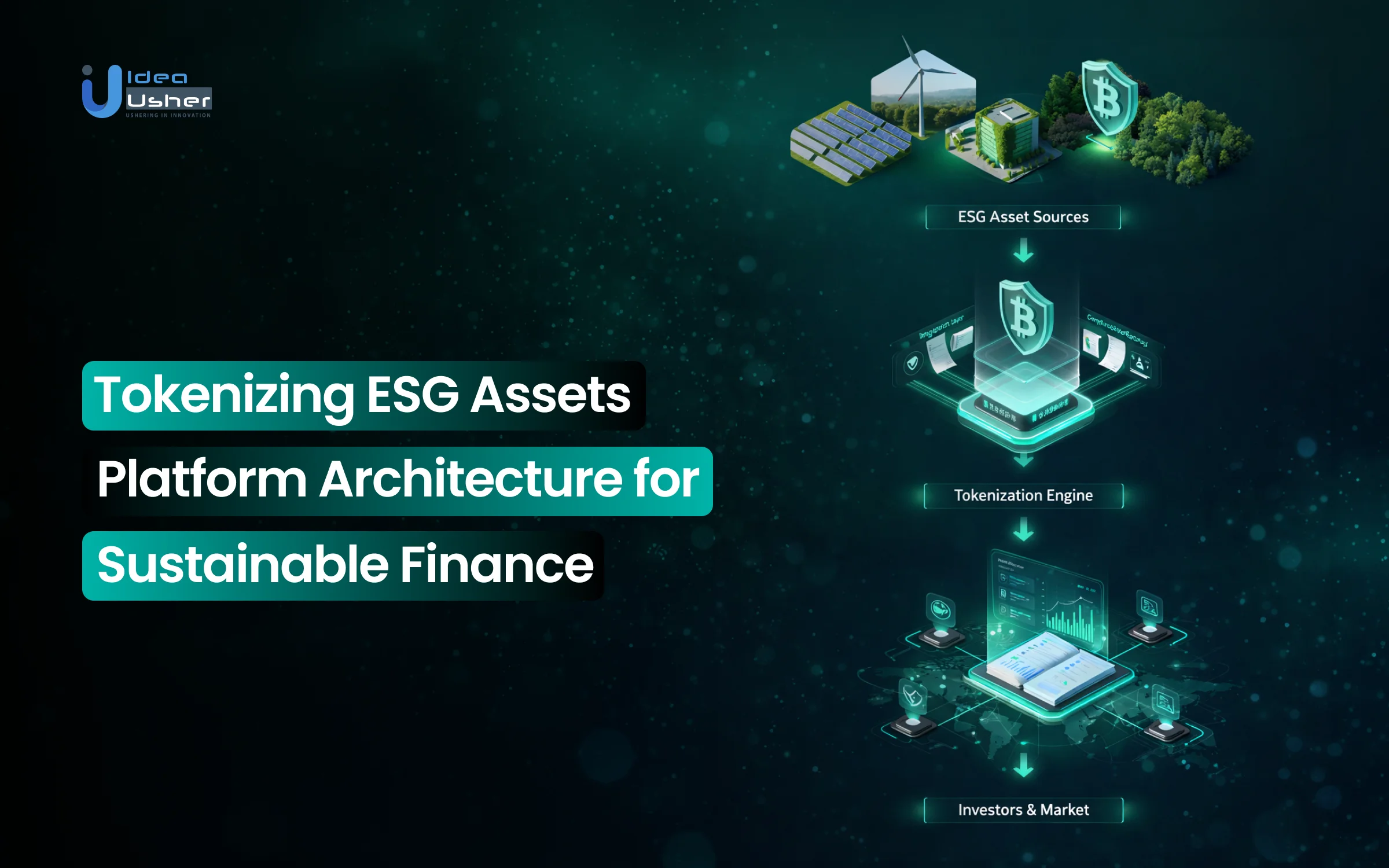
Sustainable finance sounds clean on paper, but behind the scenes, it often feels messy. Capital can move instantly, while ESG reporting may lag behind reality, leaving businesses caught between investor pressure and regulatory demands. That is why more and more businesses are using ESG asset tokenization platforms, because they can attach verifiable impact data, ownership history, and compliance rules directly to the asset itself.
As sustainability claims became harder to validate at scale, tokenization introduced traceability that traditional systems could not support. ESG performance can now be recorded and updated in near-real-time.
Over the years, we’ve built multiple ESG asset tokenization solutions, leveraging technologies such as blockchain-based asset tokenization frameworks and ESG data verification layers. Given our expertise, we’re sharing this blog to outline the steps to develop an ESG asset tokenization platform. Let’s start!
Key Market Takeaways for Tokenizing ESG Assets
According to Mordor Intelligence, the asset tokenization market was valued at USD 2.08 trillion in 2025 and is projected to grow from USD 3.01 trillion in 2026 to USD 18.74 trillion by 2031, at a 44.25% CAGR. Within this expansion, ESG asset tokenization is emerging as a key growth area as investors seek sustainable, transparent, and digitally native investment structures.

Source: Mordor Intelligence
Tokenizing ESG assets improves liquidity and transparency for assets such as renewable energy projects and carbon credits through fractional ownership and on-chain verification. This momentum aligns closely with the broader RWA tokenization wave, in which demand for compliant, auditable sustainability metrics is accelerating and pushing ESG-focused tokens into the mainstream.
A strong real-world example is FRACSIO’s SEA Solar Token Series 1, launched on IX Swap to finance solar infrastructure in Southeast Asia. By tracking energy production and carbon offsets in real time, the project lowers entry barriers and connects individual investors directly to high-impact clean energy assets.
In parallel, Veridium partnered with IBM to tokenize carbon credits on the Stellar blockchain, improving traceability and reducing fraud in offset markets. At the same time, Diginex and EVIDENT Group are embedding on-chain ESG data verification into tokenized assets, reinforcing enterprise trust and regulatory readiness.

What is an ESG Asset Tokenization Platform?
An ESG asset tokenization platform is a system that converts sustainability-linked assets into blockchain-based tokens while retaining environmental, social, and governance data associated with each unit.
It connects verified impact data to smart contracts, enabling ESG performance to be measured, enforced, and audited in real time. This allows investors and regulators to track value and impact together through a single transparent infrastructure.
Types of ESG Assets That Can Be Tokenized
ESG assets that can be tokenized include environmental outcomes, social impact instruments, and governance-linked financial structures. These assets can represent verified performance data and may be updated directly as real-world conditions change.
1. Environmental ESG Assets
Carbon Credits
Verified emission reductions can be tokenized to prevent double-counting and enable transparent trading. Tokenization also enables real-time tracking of issuance, transfers, and retirement in on-chain records.
Renewable Energy Assets
Solar, wind, and hydro projects can be fractionalized to align ownership with energy generation. Production data can feed directly into smart contracts to distribute returns based on actual output.
Water and Biodiversity Credits
Water conservation rights and ecosystem restoration outcomes can be represented as digital assets. Impact metrics such as water saved or habitat restored can be continuously verified and updated.
Reforestation and Nature-Based Assets
Forestry and land regeneration projects can be tokenized with measurable environmental value. Growth data and carbon absorption can be linked to tokens to reflect real biological progress.
2. Social ESG Assets
Affordable Housing Projects
Housing developments can be tokenized to link capital with social impact outcomes. Rental limits, occupancy thresholds, and compliance rules can be enforced programmatically.
Education and Healthcare Impact Bonds
Outcome-based bonds can be issued where returns depend on social performance. Verified education or health metrics can automatically trigger payouts when targets are met.
Microfinance and Financial Inclusion Assets
Microloans and inclusion programs can be digitized to create transparent digital instruments. Investors can track capital deployment and repayment performance in near-real-time.
3. Governance ESG Assets
Green and Sustainability Linked Bonds
Bond terms can be enforced through smart contracts rather than manual reporting. Yield adjustments can be triggered automatically when sustainability benchmarks are met.
Corporate ESG Performance Tokens
Governance commitments can be issued as auditable digital representations. Milestones such as policy adoption or compliance audits can be cryptographically verified.
Supply Chain Compliance Assets
Ethical sourcing and labor standards can be recorded as tokenized compliance proofs. Each supply chain event can create an immutable audit trail across vendors.
4. Hybrid and Emerging ESG Assets
Carbon Capture and Industrial Decarbonization
Industrial emission reduction systems can generate tokenized impact units. Sensor and operational data can validate reductions in real time.
Electric Vehicle Charging and Clean Mobility
Charging networks can tokenize usage and emissions savings. Tokens can reward performance based on uptime, demand, and verified environmental benefit.
Smart Infrastructure and Energy Grids
Infrastructure efficiency and sustainability performance can be digitally represented. Operational data can continuously update asset value and impact status.
How Does an ESG Asset Tokenization Platform Work?
An ESG asset tokenization platform turns a real-world sustainability asset into a digital token that can be tracked and verified on-chain. It can securely pull impact data from trusted sources and automatically adjust ownership rights, yields, or compliance logic based on performance.

1. The Onboarding Layer
The platform begins by creating a legally sound and digitally native representation known as a digital twin of a physical ESG asset, such as a green bond, carbon credit, or sustainable real estate share.
- Asset Structuring and Legal Wrapping: Legal teams and smart contract developers collaborate to encode ownership rights, cash flows, and governance rules into programmable logic.
- Due Diligence and Documentation: All regulatory disclosures, impact reports, and legal frameworks are digitized and hashed onto the blockchain, creating an immutable audit trail from day one.
- Token Blueprint Creation: The platform defines the token’s behavior. This includes whether it functions as a fixed-income instrument, a yield-bearing carbon credit, or a governance-enabled share in a sustainability fund.
2. The Data Integrity Layer
This is the core innovation. The platform establishes a trustless bridge between physical impact and digital value using oracles and verification protocols.
Multi-Source Oracle Integration:
The platform connects to
- IoT and sensor networks, such as solar panel output and grid carbon intensity
- Geospatial data, including satellite verification of reforestation
- Audited corporate ESG data feeds
Proof of Impact Consensus:
Data from multiple independent sources is aggregated and validated via decentralized oracle networks or trusted execution environments. Only consensus-verified data may trigger on-chain events.
AI Anomaly Detection:
Advanced platforms include machine learning modules that flag data irregularities before information is committed to the blockchain.
3. The Tokenization Engine
This is where verified data meets programmable finance and static assets become dynamic.
Smart Contract Minting: Code-based contracts mint tokens representing fractional ownership. These are not simple NFTs. They are ERC 3643 security tokens with embedded compliance logic.
Programmable Financial Logic: Yield calculations are encoded as mathematical functions tied directly to ESG performance.
Example Green Bond Coupon Formula,
Final Yield = Base Rate + (Carbon Reduction Bonus) – (Target Miss Penalty)
Oracles feed the variables, and the contract automatically calculates and distributes payments.
Automated Covenant Enforcement:
If a sustainability KPI is breached, the contract can automatically
- Escrow funds
- Trigger additional offset purchases
- Notify regulators through on-chain events
4. The Compliance Gateway
The platform embeds regulatory requirements directly into the transaction layer.
Identity Centric Architecture:
Every participant is verified through a KYC and AML onboarding module. Credentials are linked to digital wallets using non-transferable identity tokens or whitelist registries.
Programmable Transfer Restrictions:
Before any token transfer executes, the smart contract checks,
- Is the receiver whitelisted?
- Are both parties in permitted jurisdictions?
- Have the holding period requirements been met?
Real-Time Regulatory Reporting: Instead of quarterly PDF reports, regulators can be granted read-only access to on-chain audit nodes, enabling real-time compliance monitoring.
5. The Liquidity Hub
The platform transforms traditionally illiquid ESG assets into tradable instruments.
Fractionalization Engine: A $ 100 million renewable energy project can be divided into 10 million $ 10 tokens, expanding access while preserving an institutional-grade structure.
Hybrid Exchange Infrastructure:
The platform typically includes a primary issuance portal where ESG tokens can be created and offered to approved investors in a controlled way.
It may also include a secondary marketplace that enables compliant trading via an ATS or a regulated decentralized exchange, ensuring liquidity while respecting jurisdictional and investor-level rules.
Cross-Chain Portability: Through secure bridging protocols, assets can move between private permissioned chains used for sensitive data and public Layer 2 networks used for liquidity and DeFi integration.
6. The Lifecycle Manager
The platform manages the full asset lifecycle through automated governance and execution.
Dividend and Coupon Distributions: Smart contracts automatically calculate and distribute payments to token holders based on verified performance data.
Governance Modules: Token holders participate in on-chain voting for decisions such as reinvesting profits into sustainability upgrades.
Retirement and Proof of Use:
For carbon credits, the platform ensures finality
- The user initiates retirement
- Tokens are burned
- A non-transferable retirement certificate NFT is issued to the user’s wallet
- All registries are updated to prevent double-counting
How to Develop an ESG Asset Tokenization Platform?
An ESG asset tokenization platform is developed by grounding the system in verified impact data that can be reliably integrated into the blockchain. Smart contracts are then built to interpret ESG performance and should automatically enforce incentives or constraints as data updates.
We have worked on a range of ESG asset tokenization platforms and here is how we typically build them.

1. ESG Data Architecture
We start by identifying the most reliable ESG data sources for the asset, such as IoT devices, satellite feeds, or certified auditors. Our team then designs oracle and attestation layers that validate this data and anchor it on-chain. This ensures impact metrics remain tamper-resistant and trusted across the platform.
2. Impact Smart Contracts
We encode ESG performance logic directly into smart contracts. Clear thresholds are defined so contracts can react to verified impact data in real time. Based on outcomes, the system can apply premiums, penalties, or token burn logic, keeping incentives aligned with sustainability goals.
3. Compliance Tokens
Compliance is built into the token itself rather than added later. We integrate identity bound token frameworks and configure jurisdiction-specific transfer rules. This allows only approved participants to interact with the asset while regulatory conditions are enforced automatically.
4. Cross-Chain Logic
To support liquidity across ecosystems, we design secure cross-chain mechanisms, such as lock-and-mint and burn-and-mint flows. These controls ensure the ESG asset maintains a single impact state as it moves across networks. Retirement logic is included to prevent double-counting of impact.
5. Governance Controls
We implement governance and recovery layers to manage risk without centralizing authority. Multisig approvals and defined admin roles control upgrades and critical actions. Custody is kept separate from ESG records to improve resilience and auditability.
6. ESG Dashboards
The final layer is an institutional-grade dashboard built for transparency. Investors and regulators can view real-time ESG performance, token status, and compliance signals. On-chain audit visibility allows every claim to be traced back to verified data and contract logic.
How Do Platforms Handle ESG Data Disputes or Inconsistencies?
ESG tokenization platforms expect data disputes and handle them through built-in checks. When numbers conflict, the system may pause calculations and verify data using multiple sources and expert review. Once clarity is reached, smart contracts can automatically correct outcomes and continue operations.

1. Multi-Source Verification
How It Works: Proactively minimizing disputes before they occur
Triangulated Data Sourcing: Instead of relying on a single data provider, platforms ingest data from at least three independent sources.
- Primary Source: IoT sensors on-site
- Secondary Verification: Satellite imagery or remote sensing
- Tertiary Confirmation: Auditor-approved methodologies
Consensus Thresholds: Smart contracts are programmed to accept data only if it meets a predefined consensus threshold. For example, two out of three sources must agree within a five percent variance.
Example in Action:
A carbon credit project reports sequestering 10,000 tons of CO₂.
- Satellite A reports 10,200 tons
- Satellite B reports 9,800 tons
- Ground sensors report 10,100 tons
Platform Action: Consensus reached because all values fall within five percent variance. The data is accepted without dispute.
2. Anomaly Detection & Flagging
How It Works: Automated monitoring identifies potential issues before human review
AI-Driven Pattern Recognition
Machine learning models trained on historical ESG data watch for abnormal behavior in reported metrics. They can detect sudden spikes, seasonality breaks, or values that do not align with operational reality.
Automated Soft Lock Mechanism
When an anomaly appears, the platform may pause yield calculations without cancelling them. The data is flagged for review and routed to the next resolution layer so outcomes remain controlled and transparent.
Impact: This prevents disputed data from immediately affecting financial outcomes while maintaining full system transparency.
3. Decentralized Dispute Resolution
How It Works: A structured multi-stage resolution process encoded in smart contracts
Stage 1: Automated Challenge Period
After ESG data is submitted, the platform opens a short challenge window. Verified participants may stake a dispute bond to question the data, which discourages noise while allowing serious concerns to surface.
Stage 2: Expert Arbitration Panel
If challenged, the issue moves to a small group of vetted ESG experts. Validators are randomly selected and rewarded for accurate judgments, while penalties apply for poor or biased decisions.
Stage 3: On-Chain Voting for Major Disputes
For high-impact disputes, the decision-making authority may shift to token-holder governance. Votes are weighted carefully, and outcomes are executed automatically by smart contracts to ensure the resolution is final and transparent.
4. Post-Dispute Reconciliation
How It Works: Closing the feedback loop to improve future accuracy
Reputation System Updates
After a dispute is resolved, every participant receives an updated on-chain reputation score. This score can influence future validator selection bond requirements and the degree of trust placed in their data in consensus decisions.
Methodology Refinement
When disputes expose real flaws in measurement logic, the platform may trigger governance-led upgrades. Approved changes can adjust Oracle parameters or align methods with evolving regulatory standards.
Financial Reconciliation
Once the correct data is confirmed, the system automatically settles financial discrepancies. Underpaid yields may be corrected with true-up payments, while overpayments are balanced through future distribution adjustments.
Real-World Implementation: Carbon Credit Verification Dispute
Scenario: A reforestation project claims 50,000 new trees planted based on drone footage. A satellite imagery provider challenges the claim, showing only 40,000 visible mature trees.
Platform Resolution Timeline
| Time | Action | Technical Implementation |
| T+0 | Data submitted by project oracles | Smart contract receives 50,000 claim |
| T+1 hour | Competing satellite data submitted | Discrepancy greater than 15 percent triggers soft lock |
| T+2 hours | Environmental NGO stakes dispute bond | Five ETH bond locked in dispute contract |
| T+24 hours | Five expert validators selected | Chainlink VRF ensures randomness |
| T+72 hours | Validators review evidence | Drone metadata soil analysis seed purchase records and historical imagery hosted on IPFS with cryptographic signatures |
| T+96 hours | Validators vote four to one | Median value of 45,000 trees selected |
| T+97 hours | Smart contract executes outcomes | Bond release validator, reputation update credit adjustment and project accuracy score update |
All actions execute atomically in a single transaction.
Specialized Dispute Categories and Their Resolution
1. Methodological Disputes
Example: Different carbon calculation models, such as IPCC versus VERRA
Solution: The platform maintains an on-chain registry of approved methodologies. Disputes trigger governance votes to add or remove methodologies.
2. Jurisdictional Conflicts
Example: EU Taxonomy versus SEC Climate Disclosure rules
Solution: Asset-specific compliance modules apply the correct jurisdictional framework. Conflicts are resolved via legal oracle inputs from licensed jurisdictions.
3. Temporal Measurement Issues
Example: Determining whether carbon credits should be minted at planting or maturity
Solution: Programmable vesting schedules with milestone-based releases. Disputes are handled through time-locked escrows.
4. Additionality Debates
Example: Whether the project would have occurred without carbon financing
Solution: Counterfactual analysis using randomized control trial data. High-impact disputes may trigger manual circuit-breaker intervention by platform governors.
How ESG Impacts Are Prevented from Being Sold Twice?
Each ESG impact is represented by a single on-chain token with a fixed lifecycle that can be tracked at every step. When the impact is claimed, the token must be permanently burned and cannot be transferred again. This makes duplicate selling or reporting technically impossible.

1. The Immutable Ledger
Unlike traditional databases that can be copied or altered, blockchain creates a tamper-evident and append-only record of every impact unit’s lifecycle.
Key Safeguards
- Unique Digital Fingerprint: Each ton of carbon reduced, each MWh of renewable energy generated, or each sustainable hectare preserved is assigned a cryptographic hash at creation.
- Global Visibility: Every transaction involving this impact unit is recorded on a ledger visible to all permissioned participants, including issuers, buyers, verifiers, and regulators.
- Time Stamped Provenance: The exact moments of creation, transfer, and retirement are permanently recorded, creating an audit trail that cannot be retroactively forged.
For example, Toucan Protocol, a pioneering carbon credit tokenization platform, tokenizes verified carbon credits by assigning each credit a unique digital fingerprint on the Polygon blockchain.
This creates a public, auditable trail that shows when a credit was minted, who owned it, and when it was retired, making duplication impossible to detect.
2. The State Machine Model
ESG tokens are not static digital certificates. They are stateful assets with programmed behaviors that enforce proper accounting.
The Three Critical States
| State | Description | What’s Possible | What’s Blocked |
| ISSUED | Freshly minted and available | Transfer to whitelisted buyers | Retirement or reuse |
| ACTIVE | Owned but not yet applied | Trading, collateralization, transfer | Forced retirement |
| RETIRED | Permanently claimed for impact | Viewing historical proof | Any transfer or reuse |
State Transition Rules
- Issued to Active occurs upon the first purchase recorded on-chain
- Active to Retired occurs only by the current owner’s explicit command
- Retired to locked has no further transitions and is mathematically enforced
For example, KlimaDAO implements strict bonding curves and retirement mechanisms. When carbon credits are retired after backing KLIMA tokens, the smart contract permanently marks them as burned in the on-chain registry. The system ensures the same reduction cannot be backed by new tokens or be resold.
3. The Burn with Receipt Protocol
When impact is claimed, tokens are not merely transferred to a retirement account. They are destroyed with cryptographic proof.
The Retirement Process
Initiation: Company A decides to retire 100 carbon credits for emissions offsetting.
Burn Transaction: Tokens are sent to a burn address with no private key, making recovery impossible.
Receipt Generation: A non-fungible retirement certificate is minted and linked to:
- The specific tokens burned
- Company A’s verified identity
- The retirement purpose
- Timestamp and blockchain proof
Registry Update: All relevant registries and internal systems receive automated updates with cryptographic proof.
Why This Prevents Double Counting
The original tokens no longer exist. They cannot be retrieved, resold, or reused. Any attempt to claim the same impact would require tokens that are provably destroyed.
4. Cross Registry Synchronization
Double-counting often occurs because registries do not communicate. Tokenization platforms create real-time synchronization bridges.
The Synchronization Protocol
Primary Registry Anchoring: Each token is anchored to a primary registry such as Verra or the American Carbon Registry, using oracle connections.
Real Time State Mirroring: When a token’s state changes, updates propagate automatically to:
- Secondary ESG platforms
- Corporate sustainability software
- Regulatory reporting systems
- Voluntary market exchanges
Conflict Detection Algorithms: If conflicting states are detected, the system freezes related assets, triggers dispute resolution, and reconciles them to the on-chain truth.
For example, Moss Earth’s MCO2 tokens synchronize retirement across the Ethereum blockchain, Moss’s internal registry, and buyer certificates in real time. This eliminates registry lag that historically enabled double claiming.
5. The Identity Bound Ownership Model
Tokenization platforms require verified identity at every stage of ownership and retirement.
The Identity Stack
Every ESG project must be tied to a legally verified issuer, and each buyer must complete KYC and AML before holding any token. The final entity that claims the impact must also be verified so ownership and retirement stay fully accountable. This identity binding ensures that the same impact cannot be claimed by different parties.
The Prevention Mechanism
If Company B attempts to purchase already retired credits, the system verifies:
- Token state is retired
- No transfers occurred after retirement
- Retirement identity is provably Company A
The transaction fails at the smart contract level before the value is transferred.
Industry Specific Prevention Mechanisms
For Carbon Markets: Vintage and Buffer Pool System
In carbon markets, the system uses vintage locking and buffer pools to maintain clean accounting. Credits can only be claimed within their issued year, and a shared reserve quietly absorbs invalidations without minting new impact. This helps ensure the same reduction is not counted twice
For Renewable Energy Certificates: Temporal Spatial Tracking
For renewable energy certificates, the focus is on time and location accuracy. Each MWh is stamped with its exact hour and grid location and must be retired within a fixed reporting window. This prevents the same electricity from being claimed across regions or periods.
For Biodiversity Credits: Geospatial Proof Protocols
For biodiversity credits, proof is tied to the physical world. Satellites and sensors continuously verify that habitats still exist, and dynamic tokens reflect degradation if it occurs. This makes repeated or false impact claims difficult to substantiate.
Top 5 ESG Asset Tokenization Platforms in the USA
We reviewed how ESG assets are being tokenized in the U.S. market and which platforms are seeing real adoption. During this research, we identified a few ESG asset tokenization platforms that stand out for their architecture, depth of compliance, and data verification models.
1. Securitize

Securitize provides a regulated infrastructure for tokenizing real-world assets with strong adoption in the U.S. market. Its platform supports compliant issuance, on-chain lifecycle management, and secondary trading, making it suitable for ESG-linked funds, green bonds, and sustainability-focused investment vehicles that require institutional-grade governance.
2. Ondo Finance

Ondo Finance focuses on tokenizing high-quality financial instruments, including U.S. Treasuries and fixed-income products. These structures are increasingly used to support ESG mandates by offering transparent, yield-bearing assets that align with sustainable and risk-controlled capital allocation strategies.
3. Zoniqx

Zoniqx delivers end-to-end tokenization infrastructure with a strong emphasis on energy and ESG assets. The platform enables compliant structuring of carbon credits, renewable energy projects, and sustainability funds while supporting fractional ownership and real-time reporting through blockchain-based verification layers.
4. Toucan Protocol

Toucan Protocol specializes in bringing verified carbon credits on-chain through standardized token formats. By converting off-chain registries into transparent blockchain assets, this approach helps U.S.-based climate platforms and investors access auditable, tradable ESG instruments with a reduced risk of double-counting.
5. Powerledger

Powerledger focuses on tokenizing renewable energy and sustainability certificates such as RECs. Its blockchain-based energy markets support traceability and peer-to-peer settlement, making it relevant for ESG programs in the U.S. that require transparent measurement of clean energy generation and usage.
Conclusion
Tokenizing ESG assets turns sustainability from a static report into a programmable financial layer. For platform owners and businesses, it can unlock new revenue paths while improving compliance and widening investor access. With the right architecture and a capable integration partner, this model may scale efficiently and remain defensible over time. It could quietly become profitable as rules evolve and capital flows globalize.
Looking to Develop an ESG Asset Tokenization Platform?
IdeaUsher can help by designing ESG tokenization platforms where verified impact data and smart contracts operate as a single system. Our team may architect compliance-native tokens and impact-aware logic to enforce ESG performance directly on-chain.
With over 500,000 hours of coding experience and a team of ex-MAANG/FAANG developers, we build institutional-grade ESG tokenization platforms engineered for trust, scalability, and real-world impact.
- More Than Tokens – We design full-stack platforms with verifiable data oracles, smart covenants, and cross-chain liquidity layers.
- Compliance by Code – Automated KYC/AML, transfer restrictions, and real-time regulatory reporting built in.
- Future-Ready Architecture – Designed to evolve with regulations, asset types, and global markets.


FAQs
A1: Traditional ESG reporting describes impact after the fact, while ESG tokenization may enforce impact in real time through code. Data flows directly into smart contracts, and rules execute automatically based on verified inputs. This approach can shift ESG from narrative disclosure to measurable on-chain behavior.
A2: Tokenized ESG assets can be legally compliant when the platform is designed with regulation in mind. Compliance logic may be embedded into issuance transfer and disclosure workflows. This allows the system to operate predictably across jurisdictions while adapting gradually to local rules.
A3: ESG tokens can move across blockchains when cross-chain frameworks are used carefully. Bridges and messaging layers may preserve compliance states during transfer. This enables portability without losing regulatory context or audit integrity.
A4: Greenwashing can be reduced through cryptographic proofs and verified data feeds. Impact claims are tied to signed attestations and external oracles that update continuously. This structure may make false reporting harder to sustain over time.