 (+971) 8007 4267
 (+91) 946 340 7140
 (+1) 628 432 4305

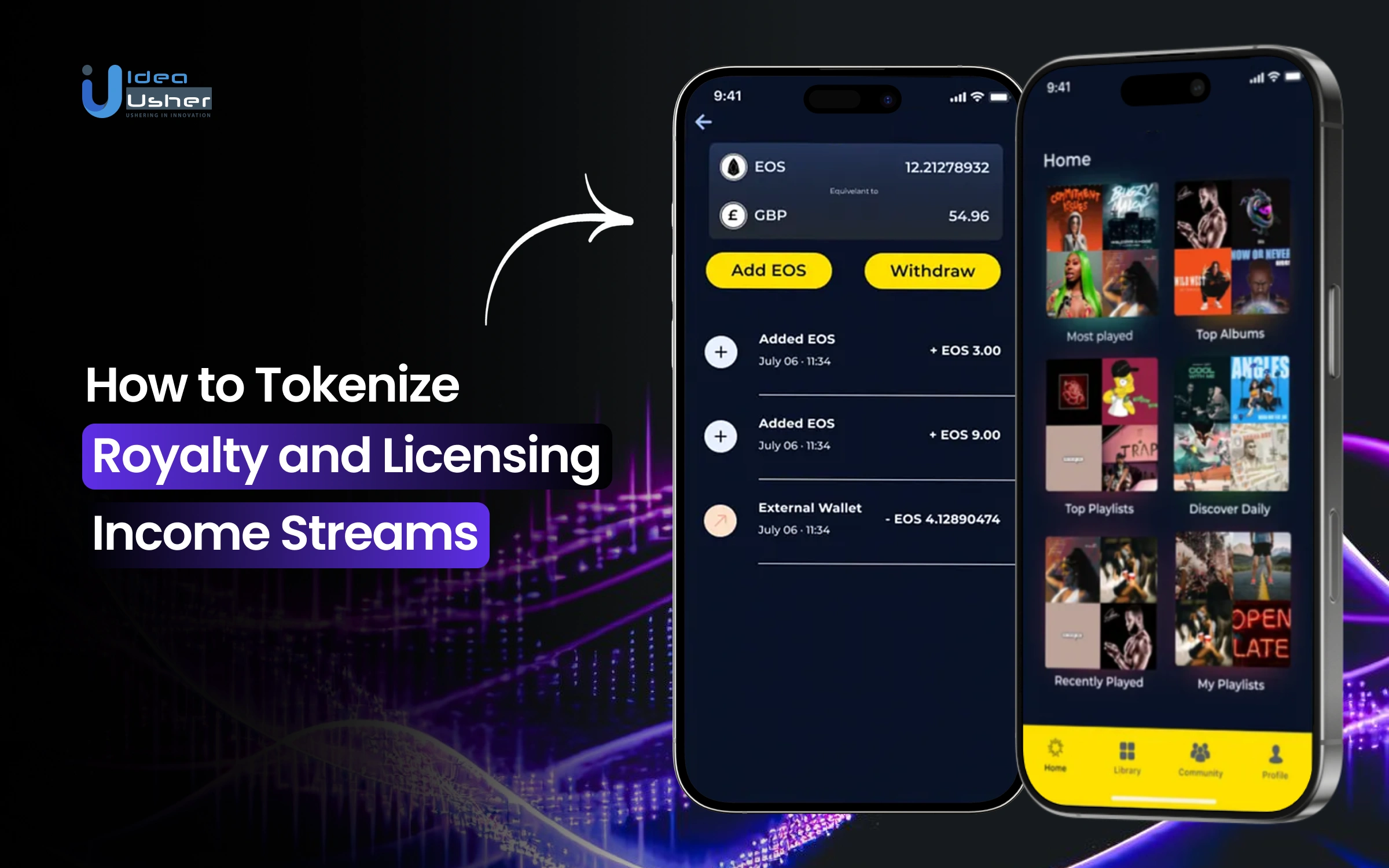
Artists, creators, and rights holders often face months-long payment delays, slow reporting cycles, complex contracts, and limited transparency in how royalties are generated or distributed. These issues reduce control and visibility, pushing stakeholders to seek faster payouts and clearer oversight. As a result, interest in adopting a tokenized royalties platform is accelerating across music, film, publishing, and licensing.
Tokenizing royalty and licensing income transforms earnings into digital assets that update, trade, and split in real time. With blockchain and smart contracts, platforms automate payouts, cut administrative work, and provide transparent income tracking. This modern approach streamlines royalty management and enables fractional ownership, creating new investment opportunities for creators and investors.
This guide explains how royalty tokenization works, the benefits of this platform for businesses, creators and investors. If someone wants to build and launch a tokenized royalties platform in the market, IdeaUsher has the expertise to build this blockchain solution with the proper architecture and strategy needed for tokenized royalty systems effectively.

What Are Royalty and Licensing Income Streams?
Royalty and licensing income streams are revenues generated when a company grants external parties the right to use its intellectual property, technology, brand assets, or proprietary innovations. These payments typically follow structured agreements that can be fixed-fee, usage-based, or tied to revenue performance, offering predictable and diversified cash inflows.
For investors, royalty and licensing models unlock highly scalable, low-operational-cost revenue opportunities because the underlying asset continues earning without additional production effort. As adoption expands, these streams compound in value, creating a powerful long-term growth engine.
- Non-dilutive revenue growth allows companies to scale earnings without raising additional capital.
- High-margin returns, since IP-based monetization avoids manufacturing or distribution costs.
- Built-in market validation, as third parties pay to use proven technologies or brands.
- Durability across cycles, offering resilience even when broader markets experience volatility.
Types of Royalty and Licensing Assets That Can Be Tokenized
A variety of royalty- and licensing-based assets can be converted into digital tokens, simplifying trading, fractionalizing, and monetizing. These tokenized rights enable creators, companies, and investors to unlock liquidity from usually illiquid intellectual property.

1. Music Royalties
Music royalties are earnings from streaming, downloads, broadcasts, or commercial use of songs, deriving from master recordings, publishing rights, or performance royalties.
How revenue is generated:
Revenue is generated each time a track is streamed, played live, used in media, or downloaded. Royalties come from PROs, publishers, and distributors, ensuring ongoing income.
Real-world platform example: AnotherBlock allows fans and investors to buy fractionalized music rights directly from artists. It uses blockchain to distribute royalty payouts automatically, giving users transparent access to music-generated income.
2. Movie and TV Distribution Rights
These rights cover ownership or participation in distributing films and TV shows, including streaming, theatrical releases, worldwide syndication, and licensing.
How revenue is generated:
Income is created through distribution deals with networks, streamers, and international markets. Revenue comes from licensing to platforms like Netflix or Amazon, box office splits, pay-per-view, syndication sales, and long-tail digital earnings.
Real-world platform example: Republic has hosted tokenized film offerings where investors participate in the revenue generated from theatrical releases and streaming deals. The platform ensures transparent reporting on distribution earnings and investor payouts.
3. Book & Publishing Royalties
Publishing royalties include income from book sales, e-books, audiobooks, translations, and sublicensing deals. Authors and publishers monetize intellectual property through both physical and digital formats.
How revenue is generated:
Every sale of a book, audiobook, or e-book generates a royalty payment. Additional revenue comes from international publishing rights, adaptation licensing, and special edition releases. These royalties accumulate over years, often with long-tail revenue potential.
Real-world platform example: Royalty Exchange has facilitated auctions for publishing rights, allowing investors to purchase revenue shares from successful books and audiobook catalogs with transparent royalty reporting.
4. Software & Tech Licensing
Software licensing gives companies the right to use proprietary software, APIs, algorithms, or digital tools. This type of IP often scales efficiently across industries.
How revenue is generated:
Revenue is created through SaaS subscriptions, per-user fees, enterprise licensing contracts, API usage charges, renewal fees, and long-term service agreements. This model offers consistent, predictable cash flows as long as clients maintain active usage.
Real-world platform example: Securitize has enabled tokenization of technology-related revenue streams, allowing companies to offer fractional access to future software licensing revenue through fully compliant digital securities.
5. Patents & Industrial IP
Patents protect unique inventions, formulations, industrial processes, mechanical designs, and scientific breakthroughs. These assets hold significant value because companies must license them to legally use the technology.
How revenue is generated:
Patent owners earn royalties when manufacturers, tech companies, or industrial firms license the patented technology. Revenue may come through licensing deals, per-unit fees, technology transfer agreements, or usage-based payments across different markets.
Real-world platform example: IPwe specializes in bringing patents onto blockchain networks. It lets innovators tokenize patent portfolios, enabling easier licensing, transparent ownership, and investor participation in patent-based revenue.
6. Brand Licensing & Franchising Contracts
Brand licensing allows businesses to use established trademarks, logos, or business systems. Franchising extends this model to full business operations under a unified brand identity.
How revenue is generated:
Brands earn income through recurring royalty fees, franchise payments, revenue-sharing arrangements, and marketing contributions. Each franchise or licensee contributes to the brand’s broader network, creating stable, contract-backed cash flows.
Real-world platform example: Rally has tokenized rights linked to brand assets and collectibles, demonstrating how brand IP can be fractionalized and shared among investors via compliant digital ownerships.
7. Video Game Royalties
Video game royalties stem from intellectual property linked to game distribution, in-app purchases, downloadable content, or marketplace transactions across various platforms.
How revenue is generated:
Games earn revenue through sales, subscriptions, cosmetic upgrades, live-ops purchases, licensing to consoles, and collaborations with marketplaces. This creates recurring and highly scalable digital revenue.
Real-world platform example: Bolero works with digital entertainment assets and has explored fractional IP ownership, giving fans and investors access to revenue from creative digital products including game-related rights.
8. NFT-Linked Licensing Models
NFT-linked licensing turns digital assets into programmable IP units. Rights can include commercial usage, distribution permissions, or access-based utility embedded directly within the NFT.
How revenue is generated:
Creators earn revenue from primary NFT sales, secondary market royalties set via smart contracts, and licensing usage fees when third parties use the NFT’s associated IP in products, media, or digital experiences.
Real-world platform example: Reveel offers creators tools to embed auto-distributing royalty logic into NFTs, enabling fair splits and transparent payouts whenever licensed IP is monetized across digital ecosystems.
How 80%+ Royalty-Ready NFTs Are Powering the Rise of Tokenized Royalty Platforms?
The global tokenized assets market is projected to reach approximately USD 2,832.3 billion by 2034, up from USD 25.8 billion in 2024, with a CAGR of 60% from 2025 to 2034. This momentum reinforces how instantly programmable digital ownership is becoming foundational to the future of licensing and royalty monetization.

In 2025, over 80% of new NFT smart contracts will automatically enforce royalty payouts, signaling a significant industry shift toward standardized, programmable licensing mechanisms. These developments create ideal conditions for tokenized royalty platforms to emerge.
Rise of Royalty-Ready NFTs Creates New Opportunities for Tokenized Royalties
The rise of royalty-ready NFTs changes how digital income is tracked, shared, and automated. For platform builders, this offers a chance to create tokenized royalty systems that improve transparency, distribution, and revenue reliability.
- Creators are already earning substantial income from tokenized royalty flows. Over US$1.8 billion has been paid to creators through Ethereum-based NFT royalties to date, highlighting strong real-world monetization (2025).
- Tokenized royalties often outperform initial sale revenue. 63% of NFT creators report earning more from secondary-sale royalties than from initial minting, proving long-term earning potential.
- Royalty fee structures are becoming economically standardized. The average royalty fee across major NFT platforms is 6.1%, with many collections consistently using 5–10%, an ideal range for predictable revenue models.
- Blockchains enhance global, frictionless royalty distribution. Instant, borderless payouts solve a major pain point in traditional royalty reporting, especially for international creators.
- Demand for transparent royalty trails grows. Tokenization lets anyone view on-chain payment flows, enhancing clarity and trust for rights holders.
How Tokenized Royalty Platforms Can Leverage Automated Digital Licensing?
As digital licensing models evolve, tokenized royalty platforms can now offer automated payouts, fractional ownership, and transparent licensing, driven by increasing acceptance of blockchain payments.
- Global digital adoption signals readiness for automated royalty systems. 78% of companies worldwide use AI in at least one business function, showing strong openness to digital automation in revenue-related workflows.
- Traditional royalty markets are growing, creating a base for tokenization. UK creative royalty payouts hit £944 million in 2023, up 12.8% YoY.
- Creator royalties worldwide reached €13.1 billion in 2023, growing 7.6%, indicating consistent demand for rights monetization models.
- Economic research confirms royalties increase liquidity and reduce risk. Studies show NFT royalties increase trade volume and mitigate information asymmetry, creating healthier markets for tokenized rights.
- The NFT ecosystem remains a significant global market and was valued at ~US$16 billion, providing liquidity infrastructure for tokenized royalty trading.
The convergence of programmable royalties, massive tokenization market growth, and rising creator demand for transparent income flows has created the perfect environment for tokenized royalty platforms to emerge. As NFT contracts increasingly automate payouts and traditional royalty markets expand, platforms that offer fractional, automated, and global royalty distribution will be positioned at the forefront of the next major shift in digital monetization.

How to Tokenize Royalty and Licensing Income Streams?
Tokenization platforms convert royalty and licensing income streams into digital tokens, enabling ownership, trading, and management on blockchain networks. This turns illiquid IP rights into accessible investments. Here’s the full user journey:
1. Asset Owner Onboarding & Documentation Upload
The rights holder registers, uploads ownership documentation, completes asset profiling, and undergoes automated plus manual verification to confirm eligibility for tokenization on RoyaltyChain.
Example:
Musician Sarah submits her catalog earning $180,000 annually to RoyaltyChain, uploading ASCAP registration, royalty statements, and master agreements. AI verifies she owns 100% master rights but 60% publishing (only master income tokenizable $126,000). She completes a 32-question asset profile, and compliance finalizes verification in 48 hours.
2. Asset Valuation & Token Structure Setup
The platform performs valuation, sets token supply, pricing, terms, and fees, then establishes an SPV and deploys smart contracts for compliant token issuance.
Example:
The catalog is valued at $1.8M using a 10× revenue multiple. Proposed 10,000 tokens at $180, 10-year term, quarterly payouts, 1.8% fee (negotiated). Legal creates a Delaware LLC SPV, files Reg D 506(c), and deploys an ERC-1400 security token. Sarah signs the transfer agreement and the setup completes in 12 business days.
3. Token Offering Launch & Investor Participation
Offering goes live with asset details; investors complete KYC/AML, review documentation, and purchase tokens. Smart contracts mint and transfer tokens upon payment.
Example:
The offering launches with audio samples, analytics, and projections. Investor James completes KYC in 18 minutes, reviews the 47-page memorandum, and buys 50 tokens ($9,000). Smart contracts mint tokens within 6 minutes. Over 45 days, 847 investors purchase 9,000 tokens, raising $1.62M. Sarah retains 10% (1,000 tokens).
4. Automated Royalty Collection & Distribution
Royalties flow into collection accounts, get reconciled, validated, and distributed automatically via smart contracts, which calculate proportional payouts and deduct platform fees.
Example:
Q1 royalties of $47,300 are deposited and reconciled. After the 1.8% fee ($851), $46,449 is distributed $4.64 per token. On April 15, smart contracts send payments. James receives $232 for 50 tokens in USDC, with yield metrics and the next distribution date (July 15) shown in-app.
5. Secondary Market Trading & Liquidity
After lock-up, investors trade tokens on secondary markets. Smart contracts enforce compliance, verify buyers, and update blockchain ownership instantly.
Example:
After a 6-month lock-up, James lists 25 tokens at $195 (8.3% premium). Maria buys based on strong performance (streams up 18% YoY). Smart contracts verify her credentials and execute in 90 seconds. James receives $4,875 (minus fee). Marketplace averages $12k–$18k daily volume, with 3–5% spreads.
6. Investor Dashboard, Reporting & Governance
Investors track performance, income, valuations, and reports. Major decisions use blockchain voting, with smart contracts executing outcomes automatically.
Example:
Maria’s dashboard shows $4,950 portfolio value, 13.2% yield, and streams up 23% (TikTok surge). A film studio offers $85,000 for licensing. Token holders vote 91% turnout, 73% approve. Smart contract executes, distributing $9.26 per token. Maria receives $231.50 as a one-time dividend within 3 days.
7. Compliance Management
The system enforces securities compliance, maintains KYC/AML, files regulatory reports, secures blockchain operations, and supports investors with ongoing updates.
Example:
New SEC rules trigger automatic disclosure updates and refreshed tax documents. James requests token transfer to his IRA and support completes it in 5 business days. The system performs annual accreditation checks, blocks non-verified transfers, and maintains 99.97% uptime. Maria requests tax basis data; the platform generates a detailed holdings report instantly.
Benefits for Businesses, Creators, and Investors
Tokenization benefits businesses, creators, and investors by converting royalty and licensing income into liquid digital assets. It opens new funding sources, broadens ownership, and allows transparent, data-driven revenue sharing.
A. For Businesses
Tokenized royalties give businesses a modern and flexible way to raise capital while maintaining operational control.
- More capital access by converting future royalty streams into investable digital assets that attract a wider pool of global investors.
- Faster financing because token issuance bypasses traditional bank processes, allowing businesses to secure funds quickly when cash flow is tight.
- Higher liquidity since companies can sell small portions of revenue rights instead of transferring entire assets or long-term ownership.
- Better cash-flow planning thanks to predictable, contract-backed royalty structures that support smarter budgeting and forecasting.
- Reduced dependency on loans as tokenized revenue financing offers an alternative to debt, lowering interest burdens and credit risks.
B. For Creators and IP Owners
Tokenization empowers creators to monetize their work without compromising artistic or commercial control.
- Upfront capital by selling fractional royalty rights that provide immediate funding for new projects or production costs.
- No need to surrender full rights, ensuring creators retain ownership, branding control, and long-term decision-making power.
- Ongoing royalties continue to flow to the original creator, even after tokenizing a share of future income.
- Expanded audience engagement because fans and supporters can directly invest in the creator’s work, strengthening community loyalty.
- Improved royalty transparency through blockchain records that prevent misreporting and ensure accurate distribution of earnings.
C. For Investors
Tokenized royalties open access to high-value IP assets that traditionally required significant capital or industry connections.
- Fractional income streams allow investors to participate in premium assets like music, films, or patents with minimal entry amounts.
- Diversified portfolio by spreading investments across multiple IP categories, reducing exposure to market volatility.
- Transparent payouts ensured by on-chain tracking, which removes ambiguity in royalty reporting and collection.
- Stable, non market correlated returns since royalties often perform independently of stock markets and economic cycles.
- Access to emerging asset classes such as gaming royalties, software licensing income, and digital IP markets typically unavailable to retail investors.

Emerging Future Trends in Royalty Tokenization
Royalty tokenization is rapidly evolving, bringing new possibilities for how intellectual property is financed, traded, and monetized. Advancements in AI, regulation, and blockchain infrastructure are shaping the next wave of innovation and investor opportunities.

1. AI-Powered Royalty Valuation Models
AI-driven valuation now key for pricing royalty assets, analyzing earnings, audience behavior, market sentiment, and future indicators for accurate projections, enabling smarter pricing and risk-adjusted investments for creators and investors.
Example: RWA.xyz and other digital-asset analytics platforms use on-chain revenue data to build predictive models for tokenized assets, demonstrating how AI-enhanced analysis boosts transparency and valuation in royalty investing.
2. Multi-Asset Royalty Portfolios
The future of royalty tokenization involves blended portfolios of music, film, patents, software, gaming, and brand IP, creating diversified, stable, ETF-like income streams. This reduces volatility.
Example: ANote Music has expanded beyond single-song listings to curated music catalogs, hinting at broader multi-asset royalty portfolios. As tokenization grows, platforms will increasingly bundle diverse IP classes into unified offerings.
3. Regulated Digital Securities for IP Income
More jurisdictions are adopting frameworks for royalty tokens as compliant digital securities, encouraging institutional involvement, boosting investor protection, and elevating royalty tokenization to a legitimate financial product class.
Example: Securitize issues fully compliant digital securities and has supported offerings tied to revenue and royalty streams. Their regulated infrastructure shows how tokenized royalties can evolve under formal securities treatment.
4. Fan & Community Ownership Models
Tokenization enhances creator-audience engagement by allowing fans to co-own content like songs, films, and books, turning supporters into stakeholders and boosting loyalty and finances.
Example: AnotherBlock invites fans to buy fractional music rights, giving them a share of streaming royalties and deeper participation in an artist’s career.
5. Cross-Border Licensing Automation
Tokenization streamlines international licensing by automating settlement, enforcing regional rules, and managing rights directly, speeding up global licensing and reducing compliance hurdles for creators and businesses.
Example: IPwe enables global patent licensing through blockchain-based Smart Pools, allowing companies worldwide to license technology with standardized digital agreements and transparent cross-border workflows.
6. AI Embedded Rights Management
AI enhances rights protection by detecting unauthorized content, monitoring digital channels, and identifying licensing opportunities. Tokenized IP creates a robust system for safeguarding and monetizing rights.
Example: Verisart uses AI-supported authentication and blockchain certificates to protect digital assets, track provenance, and manage licensing metadata, offering stronger rights control for creators.
Top Tokenized Royalties Platforms
The digital revolution transforms artist, creator, and investor interactions. Tokenized royalties platforms let artists monetize upfront and allow fans and investors to earn future royalties. Here are five leading platforms:
1. Opulous

Opulous empowers artists to tokenize their music royalties into Music Fungible Tokens (MFTs). Investors can purchase these tokens and receive a share of streaming and royalty income, while artists access upfront funding to grow their careers.
2. SongVest

SongVest operates an online marketplace where music rights holders sell shares of future royalty streams. Investors can buy a portion of these royalties and receive payouts as the songs generate income, offering a transparent way to invest in music.
3. ANote Music

ANote Music is a marketplace for music royalties. Artists and rights holders list future royalty streams, and investors can purchase a share of these streams. The platform bridges the gap between artists seeking funding and investors looking for new revenue streams.
4. JKBX (Jukebox)

JKBX offers fractional ownership of music royalties from popular songs. SEC-qualified offerings allow retail investors to buy shares in royalty income streams, combining music investment with regulatory oversight and transparency.
5. Aria Protocol

Aria Protocol tokenizes entire music catalogs into tradable digital tokens. Investors can acquire fractional shares of royalty income from a portfolio of songs, diversifying risk and gaining exposure to multiple revenue-generating tracks.
Conclusion
A Tokenized Royalties Platform gives creators, rights holders, and investors a practical way to turn predictable income streams into liquid, tradeable assets. As the model gains traction, it is reshaping how music, film, publishing, and IP-driven businesses raise capital and share value. The shift toward fractional ownership is creating more transparent, flexible participation for investors while helping creators unlock revenue without giving up control. Understanding the structure, compliance needs, and technology behind this model is the key step before moving from interest to implementation.
Why Choose IdeaUsher for Your Tokenized Royalties Platform Development?
IdeaUsher offers deep expertise in designing tokenization platforms that convert royalties, licensing income, and intellectual property revenue streams into tradeable digital assets. With our background delivering RWA marketplaces and collectible‑token systems, we are well‑equipped to build a Tokenized Royalties Platform suited to your creative or licensing business.
Why Work with Us?
- Tokenization Expertise: From smart contracts to payment flows, we build transparent systems that manage royalty distribution and fractional ownership effortlessly.
- Custom Platform Design: Whether you represent music, publishing, or licensing portfolios, we tailor the platform to your income model and revenue structure.
- Proven Implementation: Our prior platforms show successful integration of asset tokenization, secure transactions, and compliance with regulatory standards.
- Scalable & Secure Infrastructure: We ensure your platform can grow as your royalty base expands while safeguarding user funds and data integrity.
Check our portfolio to see how we have helped businesses tokenize real‑world assets and launch secure, user-friendly marketplaces.
Reach out to begin building your tokenized royalties system today.


FAQs
Tokenizing royalty and licensing income converts future earnings into digital tokens stored on a blockchain. This allows creators or businesses to sell fractional ownership, increase liquidity, and access faster funding while maintaining transparency.
A Tokenized Royalties Platform records royalty rights on blockchain and issues tokens representing income shares. Investors purchase these tokens and receive proportional payouts from verified earnings. The platform automates distribution and ensures transparent tracking.
Industries like music, film, publishing, artwork, patents, and software licensing benefit greatly. These sectors deal with recurring revenue streams that can be easily fractionalized, making tokenized royalties ideal for raising capital and improving liquidity.
A tokenization platform requires blockchain frameworks, smart contracts, secure wallets, identity verification tools, royalty tracking modules, and a scalable backend. These components ensure a seamless process for managing rights, issuing tokens, and distributing earnings.


