 (+971) 8007 4267
 (+91) 946 340 7140
 (+1) 628 432 4305

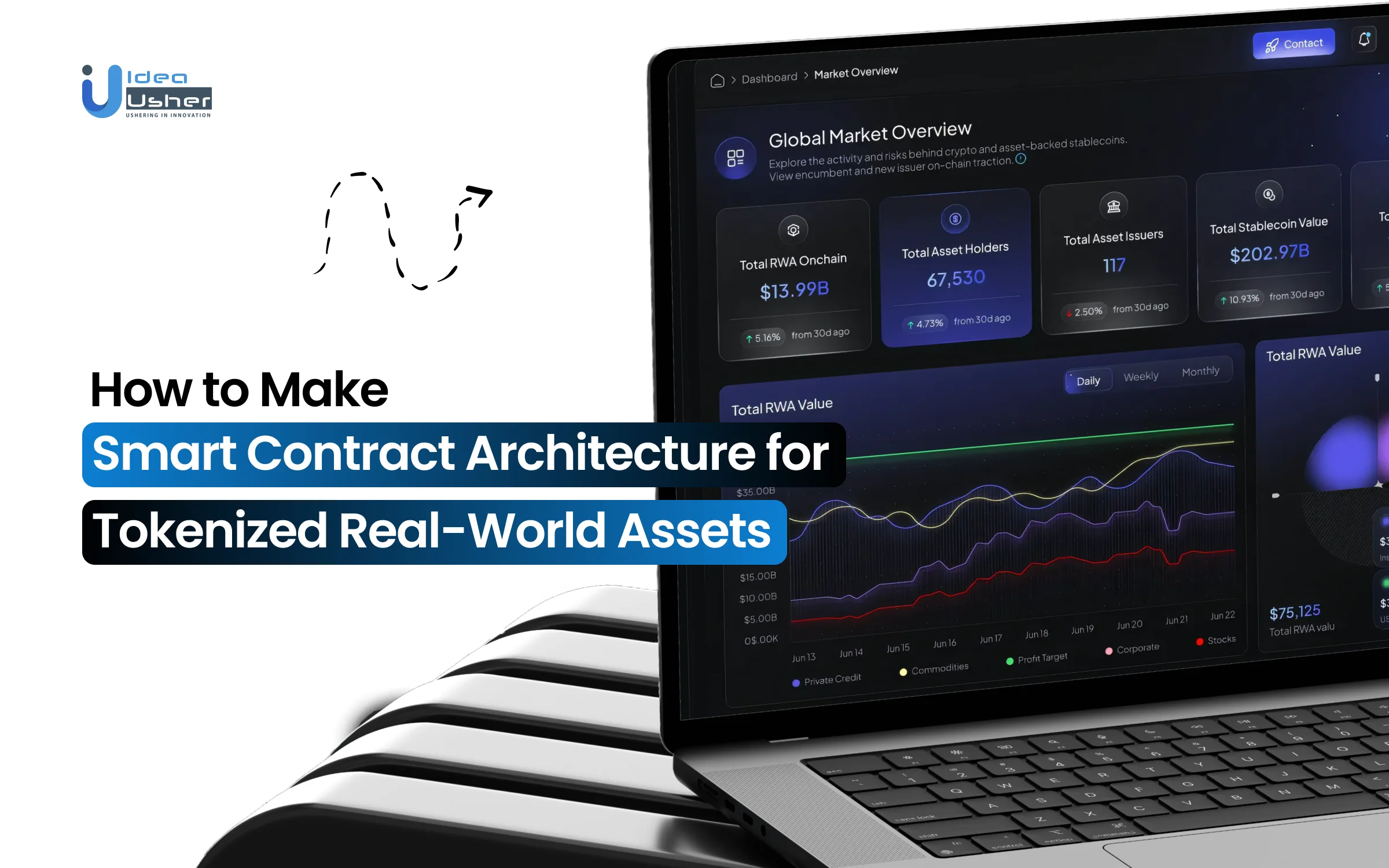
Smart contracts for tokenized real-world assets do more than move tokens between wallets. They must represent ownership rights, enforce restrictions, and reflect how the underlying asset behaves off-chain. This makes architecture decisions critical, as tokenized asset smart contracts need to balance precision, security, and flexibility while staying aligned with real-world agreements.
As asset complexity grows, contract design must handle issuance rules, transfer restrictions, permissions, and lifecycle events such as payouts or redemptions. These mechanisms often depend on legal structures, compliance requirements, and external data, making modular design and upgrade planning essential. Poor architectural choices can limit scalability or introduce risk once assets are live and actively managed on chain.
In this blog, we explain how to make tokenized asset smart contracts by breaking down key design patterns, contract components, and best practices for building secure, adaptable, and legally aligned on-chain asset systems.
Why Smart Contract Architecture Is Critical to RWA Tokenization?
Tokenizing real-world assets is not a matter of minting tokens against an asset and deploying a few standard contracts. Unlike native crypto assets, real-world assets exist outside the blockchain, are governed by legal systems, and rely on off-chain actors such as custodians, issuers, regulators, and auditors. This makes smart contract architecture the most critical layer in any RWA tokenization platform.
A. Smart Contracts Linking Legal Ownership and On-Chain Value
Smart contracts act as the enforcement layer that binds legal ownership and contractual rights to on-chain economic value in an RWA tokenization platform. They ensure that tokens represent enforceable claims rather than symbolic digital assets.
- Asset Registration and Legal Reference Anchoring: Smart contracts define how real-world assets are registered on-chain, anchoring legal documents, custodial records, and ownership proofs to immutable identifiers that establish asset legitimacy.
- Digital Representation of Ownership and Economic Rights: Contracts encode whether tokens represent direct ownership, beneficial interest, revenue entitlement, or collateral claims, ensuring on-chain balances accurately mirror off-chain legal structures.
- Rule-Based Transfer and Restriction Logic: Smart contracts enforce who can hold, transfer, or receive tokens based on compliance status, jurisdiction, and asset-specific constraints, preventing unauthorized or invalid ownership changes.
- Asset State and Lifecycle Enforcement: Contracts manage asset state changes such as impairment, maturity, default, or disposal, ensuring on-chain token behavior reflects real-world asset conditions at all times.
- Entitlement and Claim Validation Mechanisms Smart contracts determine when token holders are eligible for cash flows, redemptions, or distributions, enforcing entitlement rules without relying on off-chain manual processes.
B. Why RWA Smart Contract Design Cannot Follow Standard DeFi Patterns?
Real-world tokenized asset smart contracts operate under legal and compliance realities that prevent direct reuse of standard DeFi design patterns safely.
1. On-Chain Assumptions vs Real-World Assets
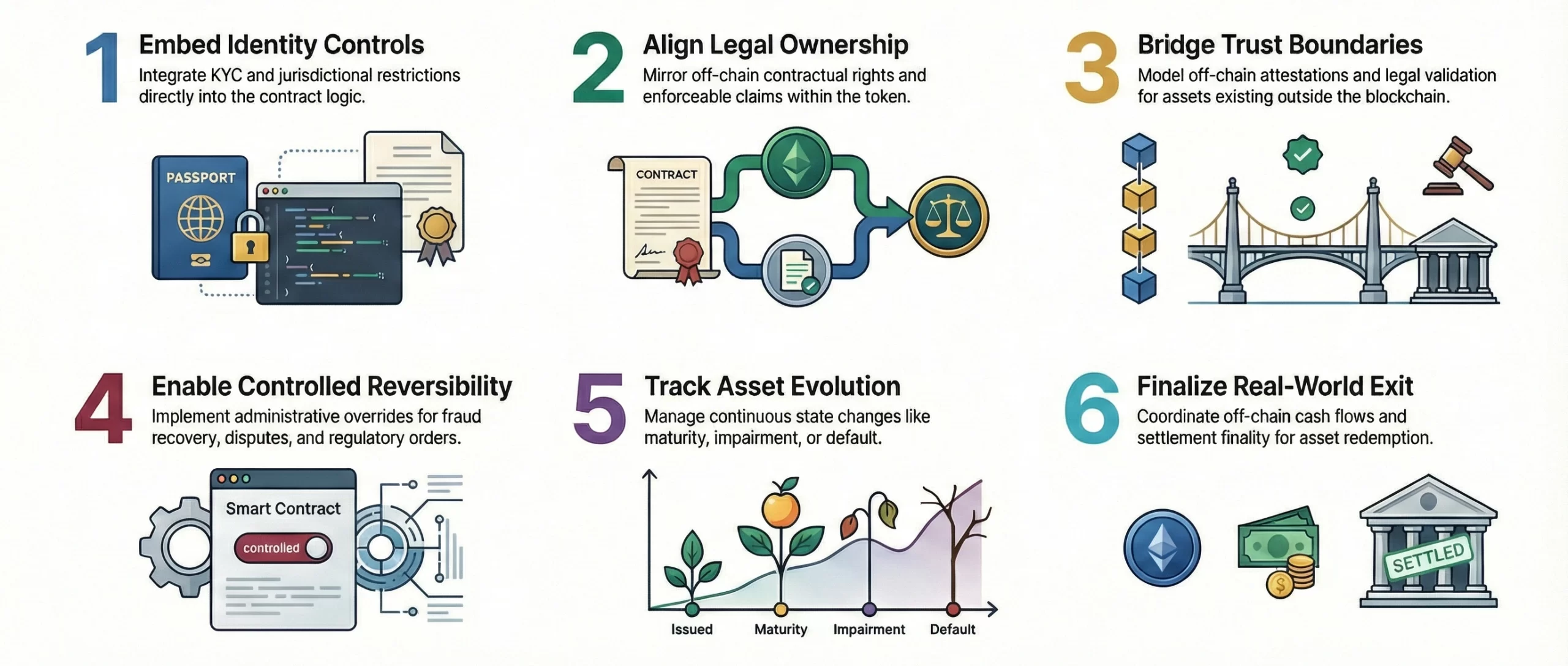
DeFi contracts assume asset existence, ownership, and state are provable on-chain. Real-world assets exist off-chain, requiring smart contracts to model trust boundaries, attestations, and legal validation explicitly.
2. Legal Ownership in RWA Tokens
DeFi tokens represent purely economic value. RWA tokens must align with legal ownership, contractual rights, and enforceable claims, forcing smart contracts to mirror off-chain legal structures and obligations.
3. Built-In Compliance and Identity Controls
Standard DeFi contracts are permissionless by design. RWA smart contracts must embed KYC, jurisdictional restrictions, and transfer controls directly into protocol logic to remain regulatorily compliant.
4. Controlled Reversibility in RWAs
DeFi treats immutability as a feature. RWA systems require controlled reversibility, freezes, and administrative actions to handle fraud, disputes, regulatory orders, and asset recovery scenarios.
5. RWA Asset Lifecycle Changes
On-chain assets are static in nature. Real-world assets change state over time through maturity, impairment, default, or disposal, requiring smart contracts to manage continuous asset lifecycle updates.
6. Redemption and Off-Chain Settlement
DeFi value stays on-chain. RWA tokenization demands redemption, settlement finality, and off-chain cash flows, making exit mechanisms and real-world coordination core smart contract responsibilities.
Real-World Asset Tokenization Global Market Growth
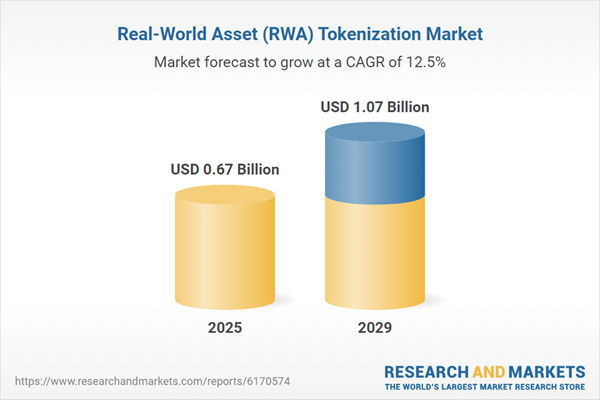
The RWA tokenization market is rapidly growing, expected to increase from $0.59 billion in 2024 to $0.67 billion in 2025 at a 12.9% CAGR. Growth is driven by institutional adoption, demand for on-chain liquidity, and clearer regulations supporting compliant asset tokenization.
This growth is translating into real scale across smart contract-based RWA platforms. By early 2026, on-chain real-world assets surpassed $20 billion, driven by smart contracts that automate compliance, settlement, and yield distribution while reducing operational costs by up to 30 percent.
Several platforms already demonstrate this institutional momentum. Ondo Finance crossed $2.5 billion in TVL by January 2026 through tokenized treasuries and equities. Securitize manages over $4 billion in RWAs, while Maple Finance has originated $18.2 billion in on-chain credit.
Asset class traction shows where smart contract architecture has the most impact. Private credit leads with about $18.7 billion in tokenized value, followed by U.S. Treasuries at roughly $8.7 billion. Real estate is projected at $3.73 billion, while tokenized gold ranges between $1.2 and $1.5 billion.
What Should Be On-Chain and Off-Chain in the RWA Smart Contract?
Tokenizing real-world assets presents a fundamental architectural paradox: How much of the messy, analog world should you force into the pristine, deterministic blockchain environment?
Get this boundary wrong, and you’ll either:
- Create “empty tokens” – digital claims with no enforceable connection to physical reality
- Build an impossibly complex system that tries to code every legal nuance into smart contracts
This layered separation is not theoretical. Production RWA protocols such as Centrifuge reinforce why asset registration, compliance enforcement, and value tokenization must remain distinct contract layers.
This guide defines the optimal boundary where on-chain efficiency meets off-chain enforceability.
The Spectrum of Tokenization Approaches
Tokenization exists on a spectrum, from fully on-chain automation to minimal digital ownership records. Understanding these extremes reveals why balanced approaches work best for real-world assets.
A. Full On-Chain Purism (The “Code is Law” Extremist)
This approach encodes asset ownership, governance, and compliance entirely on chain through tokenized asset smart contracts, prioritizing transparency and automation while reducing intermediaries, but introducing rigidity and challenges when adapting to evolving requirements.
Example: A real estate token that includes:
- Property title encoded as an NFT
- Rental income streams as automated payment channels
- Maintenance decisions via on-chain DAO votes
- Property taxes paid automatically via price oracle triggers
Why This Fails: Real-world legal systems don’t recognize smart contracts as ultimate authorities. A court order can transfer property regardless of your blockchain state. The gap between code execution and physical enforcement remains unbridgeable.
B. Minimal On-Chunk Tokenization (The “Digital IOU”)
This approach records only basic ownership on-chain, keeping governance, compliance, and operations off-chain, relying on traditional systems while limiting transparency and automation benefits.
Example: A single NFT representing “beneficial interest” in a property, with all legal, financial, and operational matters handled through traditional contracts and entities.
Why This Is Inadequate: This offers little beyond what paper certificates provide. It fails to leverage blockchain’s advantages in transparency, automation, and fractionalization.
The Optimal Boundary: The Three-Pillar Framework
The boundary should be drawn where blockchain’s unique advantages intersect with legal enforceability and practical feasibility.
Pillar 1: What MUST Be On-Chain
This pillar defines elements best placed on-chain to leverage immutability, transparency, and programmability for verifiable ownership, enforcement, and trustless execution.
| Element | Why On-Chain | Implementation Pattern |
| Ownership Registry | Single source of truth for who owns what fraction | ERC-1400 tokens or fractionalized NFTs |
| Transfer Restrictions | Enforce compliance at the protocol level | Modular rules engine with identity hooks |
| Dividend Entitlements | Transparent, auditable calculation of rights | Merkle tree distributions with on-chain roots |
| Voting Rights & Delegation | Tamper-proof governance mechanisms | Governor-style contracts with snapshot integration |
| Lifecycle State | Clear, transparent asset status | Explicit state machine with permissioned transitions |
Technical Imperative: These elements should be immutable or upgradeable only via strict governance. The on-chain state must be the definitive record for these specific functions.
Pillar 2: What SHOULD Bridge Both Worlds
This pillar covers elements that operate off-chain but need on-chain representation for verification, coordination, and consistent interaction between blockchain systems and real-world processes.
| Element | Off-Chain Reality | On-Chark Representation | Bridge Mechanism |
| Legal Title/Ownership | Physical deed at the county recorder | Cryptographic commitment (hash) | Notary-signed attestation stored in Asset Registry |
| Asset Valuation | Appraisal report from a licensed professional | Timestamped valuation hash + confidence score | Multi-oracle consensus with reputation weighting |
| Financial Performance | Bank statements, property management reports | Periodic Merkle roots of revenue data | Custodian/Oracle signed attestations |
| Insurance Status | Insurance policy documents | Active/expired status with provider details | Insurer API integration with fallback manual attestation |
| Regulatory Compliance | KYC/AML checks by licensed providers | Verifiable credentials linked to wallet addresses | Signed attestations from accredited providers |
Technical Imperative: These bridges must use cryptographic proof systems (Merkle proofs, zero-knowledge proofs, multi-signature attestations) to maintain trust while minimizing on-chain storage.
Pillar 3: What MUST Remain Off-Chain
This pillar defines elements that should remain off-chain because blockchain adds limited value or introduces legal, privacy, or technical challenges better handled by traditional systems.
| Element | Reason to Keep Off-Chain | Alternative Approach |
| Subjective Business Decisions | Requires human judgment, not suited for code | DAO/Governance votes to authorize, but execution remains off-chain |
| Physical Asset Control | Smart contracts can’t physically repossess assets | Legal wrapper (SPV) with clearly defined enforcement procedures |
| Negotiation & Dispute Resolution | Requires flexibility and human mediation | Arbitration clauses in legal agreements, not in code |
| Relationship Management | Customer service, investor relations | Traditional business operations with on-chain transparency |
Technical Imperative: Establish clear legal recourse pathways that reference on-chain states as evidence but don’t depend solely on code execution for enforcement.
How to Structure a Smart Contract Architecture for Tokenized RWAs?
The five layer RWA smart contract architecture provides a structured framework for designing compliant, secure, and scalable tokenized asset smart contracts. It balances on chain automation with legal, identity, and data verification requirements to support real world asset tokenization systems.
Platforms like RealT make it clear that redemption and off-chain settlement are not edge cases but core architectural requirements for any tokenized real-world asset platform.
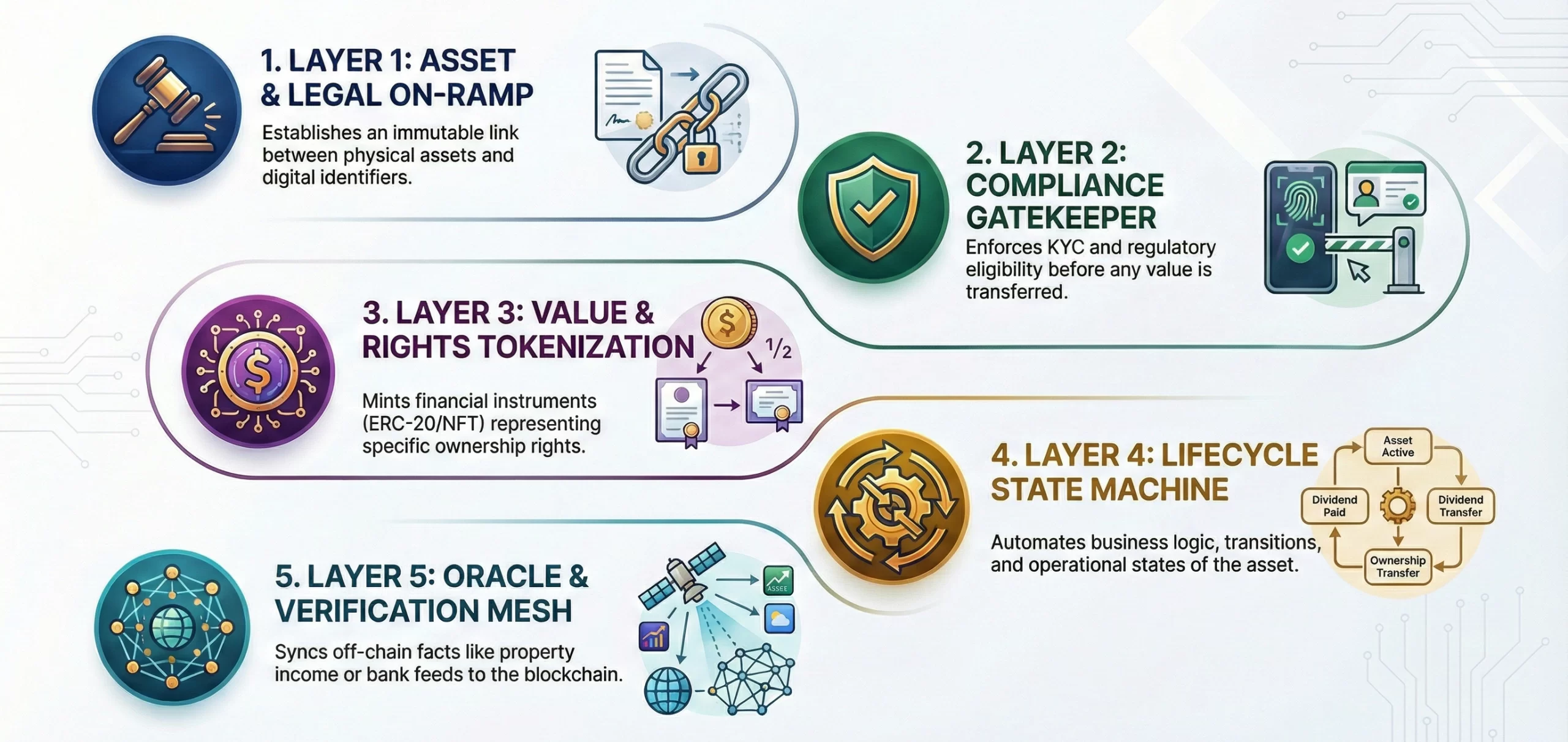
1. The Asset & Legal On-Ramp
The Asset & Legal On-Ramp is where real-world assets are verified before going on-chain. This (Source of Truth) layer ensures accurate legal and ownership representation.
Core Purpose: To establish an immutable, verifiable link between a specific real-world asset and its on-chain identifier.
Key Contract Patterns:
- Asset Registrar / Digital Twin Factory: A singleton contract that mints a non-transferable “Asset Anchor” NFT or records a unique asset ID. Think of it as the on-chain notary public.
- Document Hasher & Timestamper: A utility contract that stores cryptographic commitments (hashes) of legal documents like title deeds, appraisal reports, and SPV formation documents.
Critical Implementation Details:
- Immutable Asset Identifier: Each asset is bound to a globally unique, non-editable identifier that persists across all contract layers, ensuring traceability and preventing duplicate or conflicting registrations.
- Multi-Party Authorization at Registration: Asset anchors are created only after verifiable approval from multiple independent, authorized parties, reducing unilateral control and strengthening legal defensibility.
- Auditable Provenance Linking: Asset documentation is referenced through verifiable commitments, enabling transparent provenance audits without exposing sensitive legal or custodial data on-chain.
The Non-Negotiable: This layer must be practically immutable. Once an asset is registered, its foundational link cannot be altered without breaking the system’s trust model.
2. The Compliance & Identity Gatekeeper
The Compliance & Identity Gatekeeper defines who can interact with the asset on-chain. This (Who) layer enforces identity verification, permissions, and regulatory eligibility before any value is transferred.
Core Purpose: To enforce investor eligibility and transactional compliance at the protocol level, before a token transfer is even attempted.
Key Contract Patterns:
- Modular Identity Registry: A contract mapping wallet addresses to verified identities and compliance credentials (inspired by ERC-734/735), allowing protocol-level eligibility checks without embedding identity logic into token contracts.
- Policy and Rules Engine: A separate, upgradeable contract that defines and enforces transfer and holding rules based on regulatory status, jurisdiction, and asset-specific constraints.
Critical Implementation Details:
- Separation of Data and Logic: Identity data is kept separate from compliance rules. This allows you to update regulations (e.g., changing accreditation thresholds) without touching user data.
- Integration with External Verifiers: The registry doesn’t perform KYC itself. It receives and stores attestations from trusted, specialized providers (e.g., Chainanalysis, Onfido, Fractal) via signed messages or oracle calls.
- Pre-Transfer Compliance Enforcement: All token movements require protocol-level compliance checks, making non-compliant transfers technically impossible rather than just discouraged.
The Non-Negotiable: Compliance must be a prerequisite, not an afterthought. It’s baked into the transfer mechanism itself, making non-compliant transfers impossible, not just “against terms of service.”
3. The Value & Rights Tokenization Layer
The Value & Rights Tokenization Layer defines what is owned and the rights it provides. This (What) layer focuses on a clear, efficient on-chain representation.
Core Purpose: To create the actual financial instrument that investors hold, with embedded economic and governance rights.
Key Contract Patterns:
- Security Token Standards (ERC-1400, ERC-3643): Purpose-built for this. They have built-in hooks for Layer 2’s compliance checks and mechanisms for forced transfers (e.g., in a default).
- Fractionalized NFT (ERC-721/1155 + ERC-20 wrapper): Ideal for unique, high-value assets like fine art or landmark buildings. The NFT is held in a vault, and fungible tokens represent fractions.
- Hybrid Debt/Equity Tokens: Custom logic combining an ERC-20 with maturity dates, coupon payments, and conversion rights.
Critical Implementation Details:
- Rights Encoding: Dividend rights can be handled via a pull-based function that references an off-chain Merkle tree, reducing gas fees. Voting rights can be delegated on-chain (like Governor Bravo).
- Reference to Layer 1: Every token batch or series should reference the immutable from Layer 1, creating a clear lineage back to the source asset.
- Simplicity is Key: This token contract should be logic-light for security. Its main job is to ask Layer 2 if a transfer is okay, and check with Layer 4 if the asset is in a transferable state.
The Non-Negotiable: The token is a rights wrapper, not the source of truth. Its value and validity are derived from the layers below and around it.
4. The Lifecycle & State Machine
The Lifecycle & State Machine manages how a tokenized asset evolves over time. This (How) layer encodes operational states and transitions across the asset’s real-world lifecycle.
Core Purpose: To manage the business logic and lifecycle of the asset itself, governing what actions are permissible at any given time.
Key Contract Patterns:
- Explicit Asset State Controller: A dedicated contract that maintains the current operational state of the asset and strictly governs which actions are permitted at each stage of its lifecycle.
- Modular Operations Contracts: Independent contracts responsible for specific asset actions such as distributions, buybacks, and governance, activated only when permitted by the asset’s current state.
Critical Implementation Details:
- State-Dependent Permissions: All asset actions depend on the asset’s lifecycle state, ensuring operations occur only when legally and operationally valid.
- Triggering Transitions: State changes can be triggered by oracle inputs (e.g., “missed payment report”), multi-sig administrator actions, or decentralized governance votes from token holders.
- Emergency Freezes & Legal Overrides: Must include a clearly defined, auditable path for legal interventions (e.g., a court-ordered freeze), often via a multi-sig with a time-lock and public transparency.
The Non-Negotiable: Operational logic must be on-chain and transparent. Investors and regulators must be able to see the exact rules governing default, profit sharing, and dissolution.
5. The Oracle & Verification Mesh
The Oracle & Verification Mesh connects real-world facts to on-chain logic. This (Is It True?) layer delivers verified off-chain data to drive state changes and value distributions.
Core Purpose: To reliably and trust-minimally connect the deterministic blockchain to the messy, analog world.
Key Contract Patterns:
- Multi-Source Oracle Adapters: Contracts that aggregate and weight data from multiple sources (e.g., a property’s rental income from property management software and bank API feeds).
- Proof-of-Reserve / Attestation Verifiers: Contracts that verify signed messages from licensed custodians or auditors confirming the underlying asset is still held and insured.
- Keeper Network Triggers: Contracts that incentivize external actors to push data or execute time-based functions (e.g., initiating a monthly distribution).
Critical Implementation Details:
- Redundancy and Decentralization: For critical data (like payment defaults), use a consensus model (e.g., 3 out of 5 designated data providers must agree).
- Confidence-Based State Escalation: Oracle inputs are evaluated by confidence level, so low-certainty signals trigger reviews, while only high-confidence, corroborated events cause irreversible upgrades.
- Data Format Standardization: Use schemas like ARC-1 or custom schemas to ensure Oracle data is structured and easily consumable by your state machines.
The Non-Negotiable: Real-world asset data must be verified, not trusted. The oracle layer should expect faulty or corrupted sources and handle unreliable inputs gracefully.
How Smart Contracts Enforce Compliance in RWA Platforms?
Tokenized assets risk becoming unenforceable representations rather than legally defensible instruments without protocol level compliance enforcement. Tokenized asset smart contracts uphold regulatory obligations through code, reducing reliance on trust or manual intervention.
Institutional RWA platforms such as Ondo Finance demonstrate why compliance must be enforced directly at the smart contract level, ensuring eligibility rules persist across wallets, integrations, and secondary markets.

1. Compliance as a Core Protocol Layer
Compliance is enforced directly within smart contracts in RWA platforms rather than delegated to frontends or off-chain agreements. This ensures regulatory rules remain effective regardless of how tokens are accessed, transferred, or integrated.
2. Embedded Identity and Eligibility Checks
Every token transfer is conditioned on verified identity and eligibility checks executed at the protocol level. If a participant fails compliance requirements, the transaction is technically blocked rather than merely flagged or discouraged.
3. Separate Compliance Rules and Identity Data
Regulatory logic is designed independently from identity records, enabling compliance requirements to evolve without reprocessing user credentials or redeploying core contracts. This reduces operational risk while maintaining regulatory adaptability.
4. Persistent Compliance Across Transfers
Because compliance is enforced on-chain, restrictions apply consistently across wallets, marketplaces, and protocol integrations. This prevents non-compliant transfers even when tokens move outside the issuer’s original application layer.
5. Built-In Auditability and Transparency
All compliance decisions and enforcement outcomes are recorded on-chain, providing regulators, auditors, and platform operators with a verifiable trail of how and when rules were applied across the asset’s lifecycle.
How We Maintain Security and Governance in RWA Smart Contracts?
Maintaining security and governance in tokenized asset smart contracts requires combining robust technical controls with clear operational oversight. This approach preserves asset integrity, supports regulatory alignment, and enables safe contract evolution across real world scenarios.
This governance-first approach mirrors patterns seen in institutional RWA platforms such as Maple Finance, where long-term asset integrity depends on controlled upgrades and accountable authority.
1. Designing for Long-Lived Assets
RWA smart contracts are built with controlled upgrade paths that allow the protocol to adapt to regulatory changes, asset lifecycle events, and operational realities without breaking trust or invalidating existing investor positions.
2. Balancing Administrative Risk and Legal Control
We separate operational authority from unilateral control by distributing sensitive permissions across clearly defined roles, ensuring legal intervention and emergency actions are possible without introducing centralized failure points.
3. Practical Governance Design
Governance is applied selectively to areas that affect investor rights, asset operations, and protocol rules, while low-level contract logic remains shielded from frequent or discretionary changes.
4. Transparency for Privileged Actions
All administrative, governance, and emergency actions are executed through auditable, on-chain processes, allowing investors, auditors, and regulators to independently verify when and why critical decisions were made.
5. Failure Scenario Planning
Security design assumes that things will go wrong. Contracts include clearly defined mechanisms for freezes, recovery, and orderly resolution of adverse events without relying on off-chain intervention or ad hoc decision-making.
Conclusion
Designing smart contract architecture for real-world assets requires thinking beyond standard DeFi patterns. You must account for legal ownership, compliance, lifecycle events, and off-chain coordination from the start. When contracts clearly model these realities, trust becomes enforceable rather than assumed. Well-designed tokenized asset smart contracts align legal structures with on-chain execution, reduce operational risk, and support scalable adoption. If the architecture reflects how assets behave in the real economy, the platform can evolve confidently, handle complexity without fragility, and maintain integrity as institutional participation grows over time.
Why Partner with IdeaUsher for RWA Smart Contract Architecture?
At IdeaUsher, we specialize in designing smart contract architectures that align blockchain innovation with real-world regulatory, operational, and compliance requirements. From asset lifecycle management to permissioned access controls, we help businesses build secure and adaptable RWA tokenization systems.
What Sets Us Apart?
- Deep RWA & Blockchain Expertise: We design contracts that reflect real-world asset complexities, not just DeFi assumptions.
- Compliance-First Approach: Our architectures are built with auditability, governance, and jurisdictional compliance in mind.
- Custom, Scalable Designs: Every smart contract framework is tailored to your asset type, use case, and growth plans.
- End-to-End Support: From technical design to deployment and upgrades, we guide you at every stage.
Explore our portfolio to see how we’ve helped organizations design and deploy secure, compliant blockchain solutions across diverse industries.
Connect with us for a free consultation and start building a future-ready smart contract architecture for tokenized real-world assets.


FAQs
A.1. Smart contract architecture for RWAs must model legal ownership, compliance rules, asset lifecycle events, and off-chain data dependencies. Unlike DeFi, these contracts enforce real-world rights, support controlled actions, and maintain alignment with legal frameworks.
A.2. Smart contracts enforce legal ownership by mirroring off-chain structures such as SPVs or trusts. Tokens represent enforceable claims, while contracts restrict transfers and actions to ensure on-chain ownership always matches legal entitlement.
A.3. Oracles supply verified off-chain data such as valuations, performance metrics, and proof of reserves. Smart contracts use this data with validation logic to trigger distributions, adjust risk parameters, and maintain accurate on-chain asset representation.
A.4. RWA smart contracts manage lifecycle events like maturity, default, refinancing, or redemption through state-based logic. This ensures tokens remain functional, investor balances stay accurate, and assets transition smoothly without breaking protocol integrity.